

Plant and animal responses is one of the biggest spec points in Module 5. Spec point 5.1.5 starts with plants: tropisms and defences against herbivores, the roles of auxin, gibberellin, abscisic acid and ethene, the experiments behind them and their commercial uses. It then switches to animals: how the nervous system is organised, what each part of the brain does, reflexes, the fight or flight response, the control of heart rate and, finally, muscle structure and the sliding filament model.
Most of the marks lost here come from loose wording. Examiners' reports describe students naming a symptom without the part of the brain that causes it, writing carbon dioxide where carbonic acid was meant, saying ATP forms cross-bridges when it breaks them, and misreading the log scale on auxin graphs. The mark scheme won't accept "growth" on its own for a tropism: it has to be directional.
Work through the nineteen questions below in order. They start with recall, move on to applying what you know to new contexts, and finish with practical and evaluation questions on plant hormones. If you'd like to go through questions like these with me each week, my OCR A masterclasses run on Wednesdays at 5.15pm for Year 12 and on Tuesdays at 6.30pm or Thursdays at 5.15pm for Year 13.
Want help with this topic? It comes up in my weekly OCR A masterclasses. See the timetable →
What you need from GCSE
Each question on this page assumes you're secure on these GCSE ideas. If any of them feels shaky, look it up before you start.
- Plant shoots grow towards light (phototropism) and roots grow towards gravity (gravitropism or geotropism), controlled by auxin.
- Plant hormones are used in agriculture and horticulture as weed killers, rooting powders and to control fruit ripening (ethene).
- The nervous system is made of the central nervous system (brain and spinal cord) and nerves; a reflex arc runs from receptor to sensory, relay and motor neurones to an effector.
- Adrenaline is released by the adrenal glands in times of fear or stress and increases heart rate.
- Muscles contract using energy from respiration; during exercise heart rate and breathing rate increase.
Key terms
These words come up in the questions and mark schemes. Examiners expect you to use them exactly.
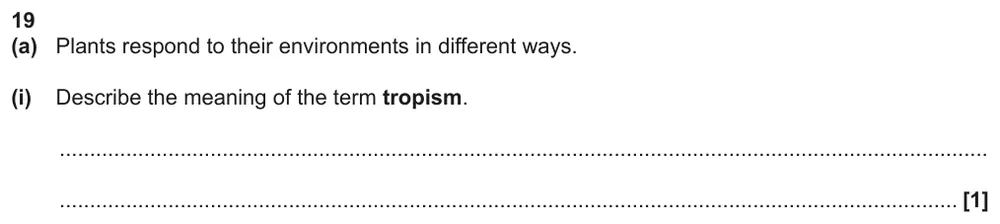
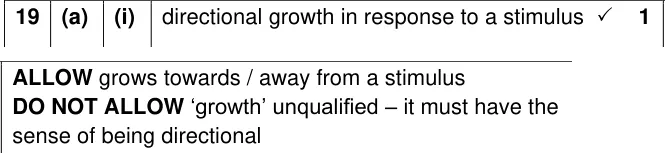
- Tropism: a directional growth response of a plant to a directional stimulus, e.g. phototropism (light) or geotropism (gravity).
- Apical dominance: auxin made by the apical bud (shoot tip) inhibits the growth of lateral (side) shoots.
- Gibberellin: a plant hormone that causes stem elongation and, in seeds, switches on the production of enzymes such as amylase during germination.
- Abscisic acid (ABA): a plant hormone that causes stomatal closure and maintains seed dormancy.
- Autonomic nervous system: the part of the peripheral nervous system that controls involuntary responses; divided into sympathetic and parasympathetic systems.
- Medulla oblongata: part of the brain stem that controls involuntary processes such as heart rate and breathing rate.
- Adenylyl cyclase and cAMP: adrenaline (first messenger) binding to its receptor activates adenylyl cyclase, which converts ATP to cyclic AMP (second messenger).
- Sarcomere: the repeating unit of a myofibril between two Z lines; it shortens when muscle contracts.
- Neuromuscular junction: the synapse between a motor neurone and a muscle fibre; acetylcholine causes depolarisation of the sarcolemma.
- Creatine phosphate: a store in muscle that regenerates ATP rapidly by giving its phosphate to ADP.
What these questions cover (OCR 5.1.5)
The questions test these learning outcomes from the OCR A Level Biology A specification (H420):
- (a)(i) the types of plant responses (including responses to abiotic stress and herbivory)
- (a)(ii) practical investigations into phototropism and geotropism
- (b) the roles of plant hormones (including leaf loss, seed germination and stomatal closure)
- (c) the experimental evidence for the role of auxins in the control of apical dominance
- (d) the experimental evidence for the role of gibberellin in the control of stem elongation and seed germination
- (e) practical investigations into the effect of plant hormones on growth
- (f) the commercial use of plant hormones
- (g) the organisation of the mammalian nervous system
- (h) the structure of the human brain and the functions of its parts
- (i) reflex actions
- (j) the coordination of responses by the nervous and endocrine systems (adrenaline, adenylyl cyclase and cyclic AMP in outline)
- (k) the effects of hormones and nervous mechanisms on heart rate
- (l)(i) the structure of mammalian muscle and the mechanism of muscular contraction (including the neuromuscular junction and the role of ATP)
- (l)(ii) the examination of stained sections or photomicrographs of skeletal muscle
How to use this page
Write your answer on paper before you open the mark scheme. Allow about 1.2 minutes per mark: the 19 questions are worth 51 marks, so about 61 minutes in total. Then mark your answer strictly against the mark scheme and read the examiners' tip underneath it. If you'd rather print the questions, download the PDF pack.
Recall
Question 1
A level Paper 3 · November 2021 · Q3(d) · 1 mark · Easy
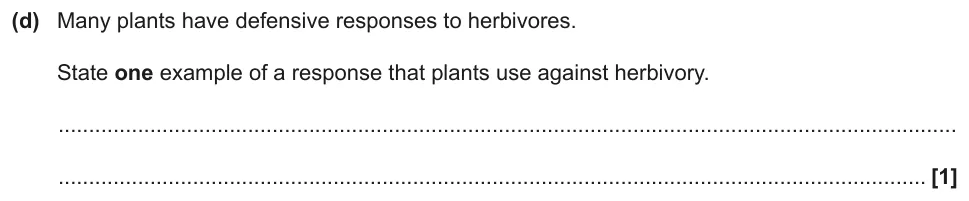
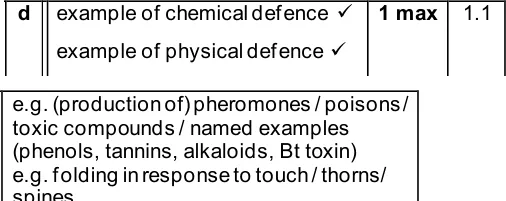
State one response that plants use against herbivory.
Show the mark scheme
Tap an image to open it full size.
From the examiners' report: Most students scored here. Name a specific response, such as producing toxic alkaloids or folding leaves when touched, rather than writing "defence chemicals".
Question 2
A level Paper 1 · June 2024 · Q19(a)(i) · 1 mark · Medium
Describe the meaning of the term tropism.
Show the mark scheme
Tap an image to open it full size.
Question 3
A level Paper 1 · June 2025 · Q18(a) · 4 marks · Medium
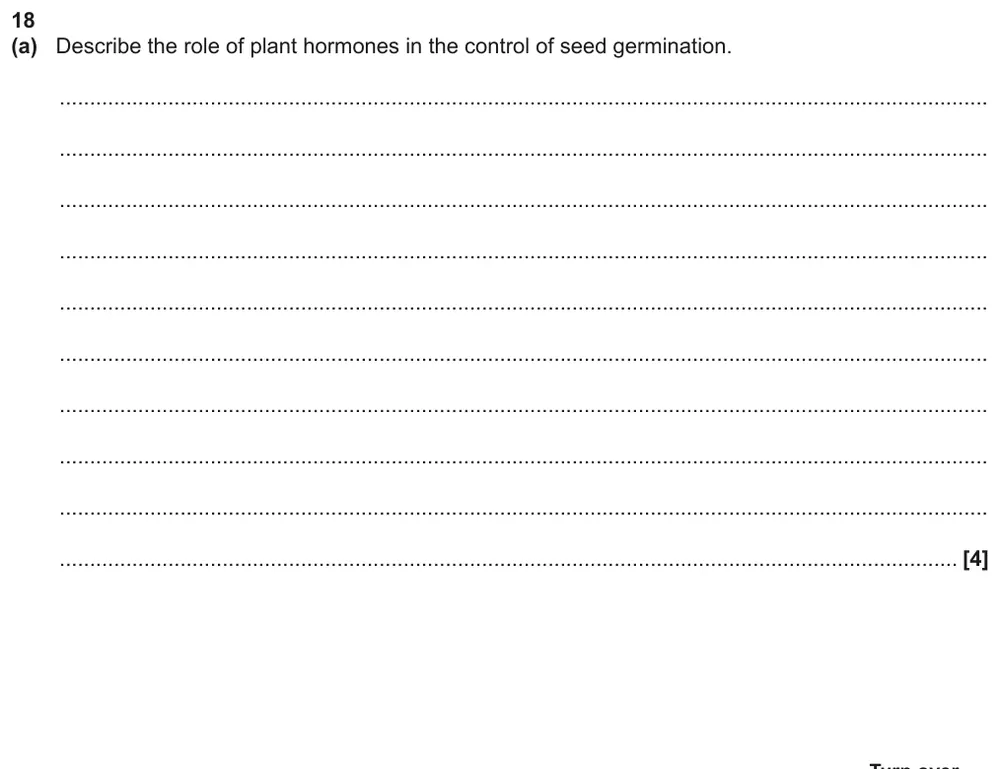
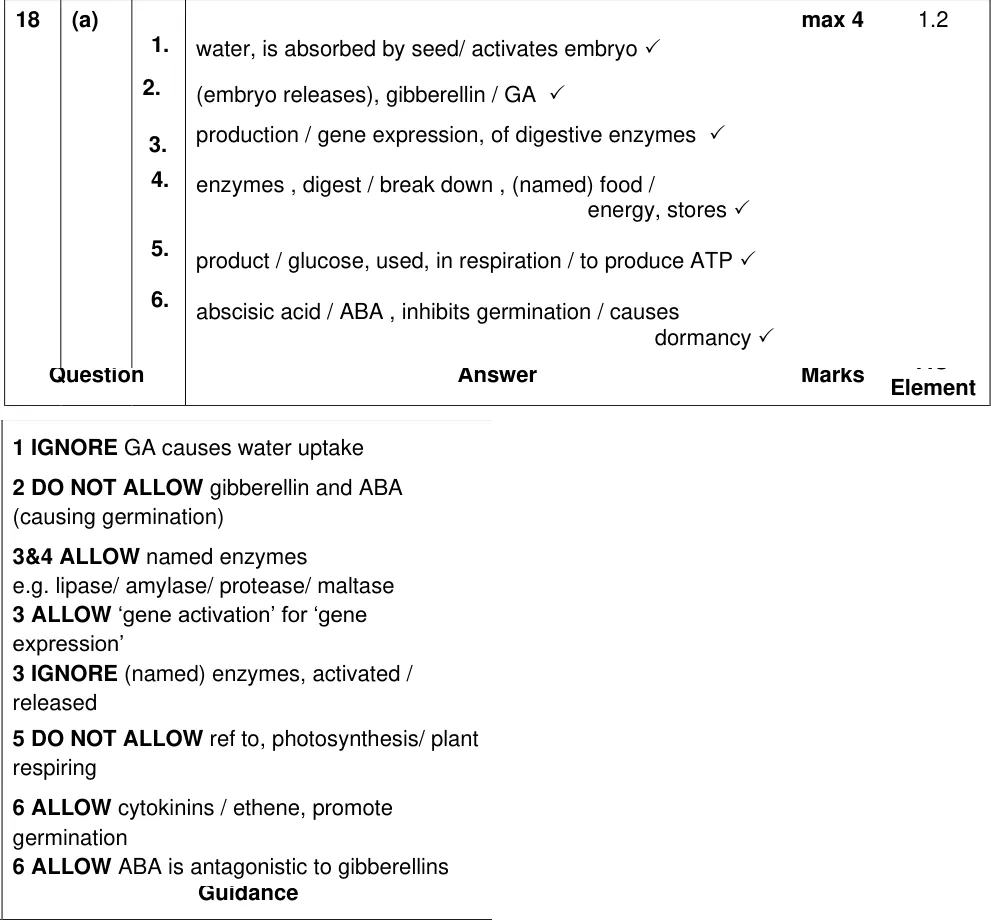
Describe the role of plant hormones in the control of seed germination.
Show the mark scheme
Tap an image to open it full size.
From the examiners' report: Apply gibberellin to the seed: water activates the embryo, gibberellin switches on enzymes such as amylase, and the products of digestion are respired. Don't drift into stem elongation or "the plant".
Question 4
A level Paper 1 · June 2022 · Q19(a) · 3 marks · Medium
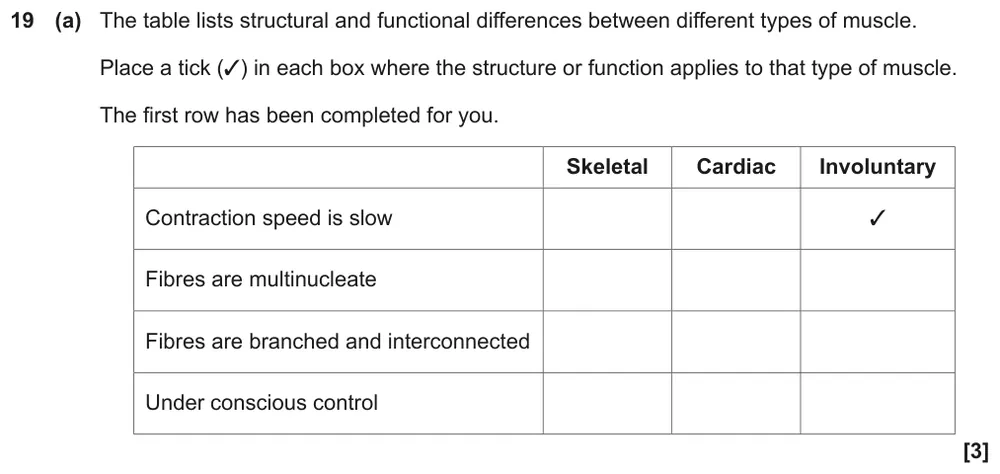
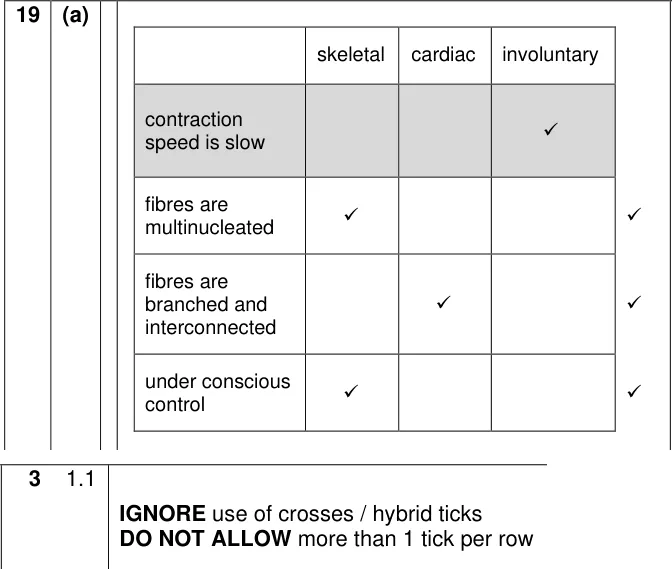
Complete a table of structural and functional differences between skeletal, cardiac and involuntary muscle.
Show the mark scheme
Tap an image to open it full size.
From the examiners' report: Put exactly one tick in each row. The usual slips were saying cardiac fibres are multinucleate and skeletal fibres are branched.
Question 5
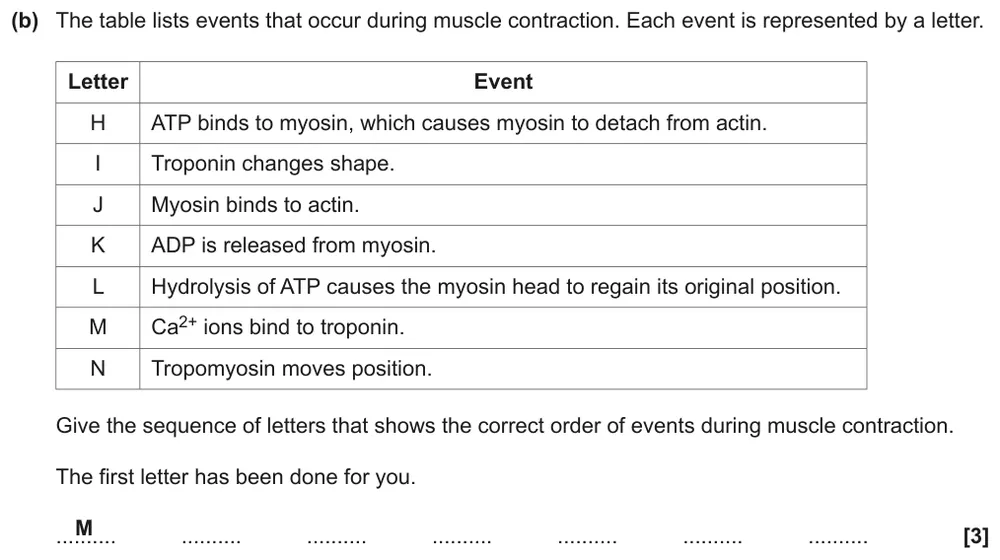
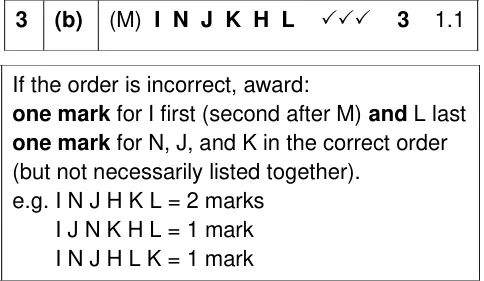
A level Paper 3 · June 2025 · Q3(b) · 3 marks · Easy
Put the events of muscle contraction in the correct order.
Show the mark scheme
Tap an image to open it full size.
From the examiners' report: Most students got at least 1 mark. The ATP and ADP steps go last: ADP is released in the power stroke, then ATP binds to detach myosin, then ATP hydrolysis resets the head.
Applying what you know
Question 6
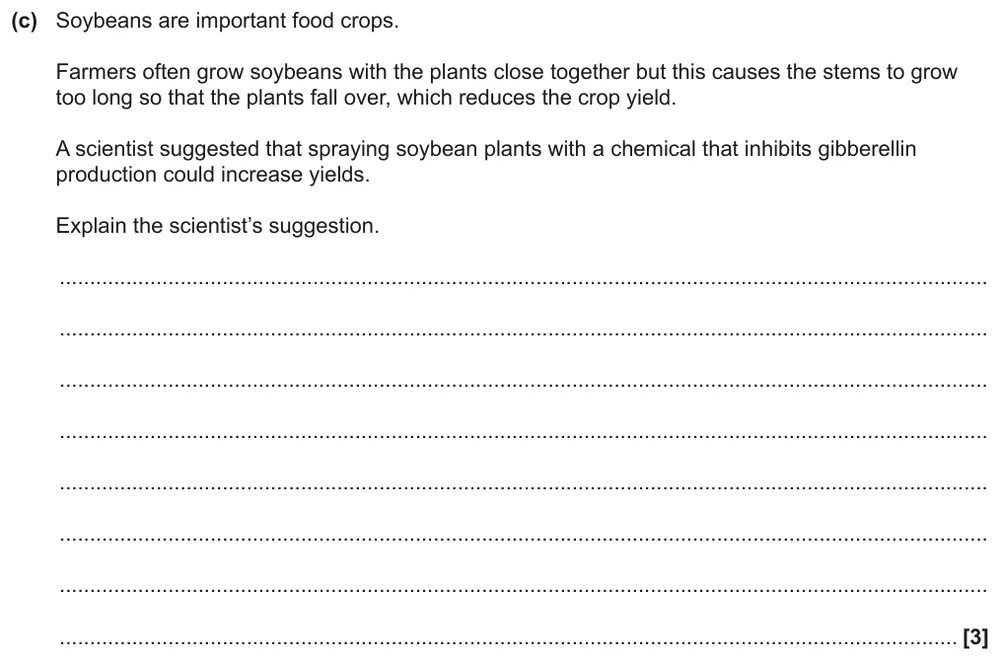
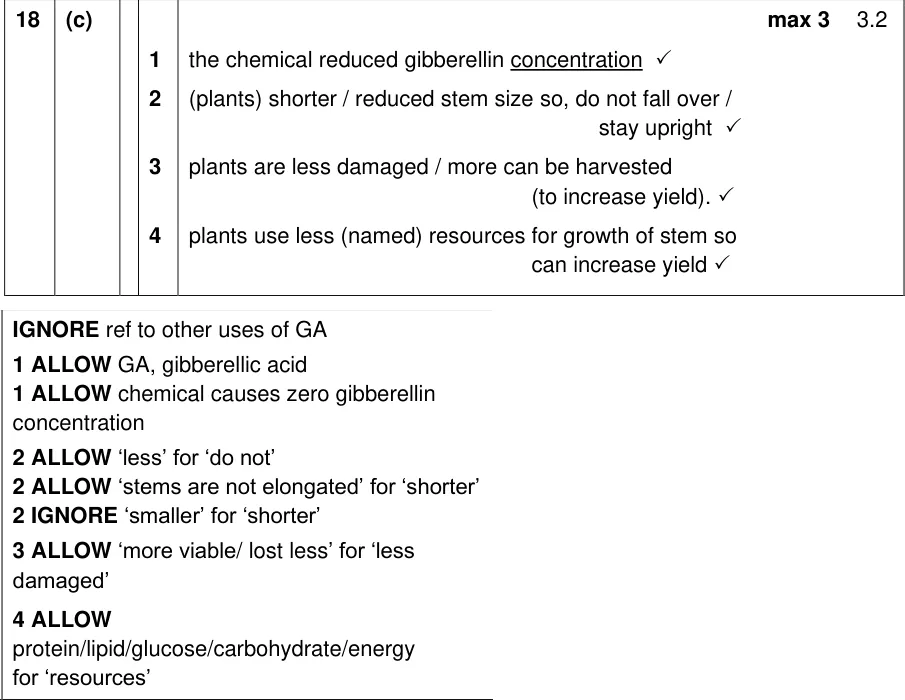
A level Paper 1 · June 2025 · Q18(c) · 3 marks · Hard
Explain why spraying soybeans with a gibberellin inhibitor could increase yield.
Show the mark scheme
Tap an image to open it full size.
From the examiners' report: Start from the inhibitor: it lowers the gibberellin concentration, so stems elongate less. Then say why plants that stay upright give a bigger yield, because the stem of the question already tells you yield goes up.
Question 7
A level Paper 3 · June 2022 · Q3(b)(iii) · 3 marks · Hard
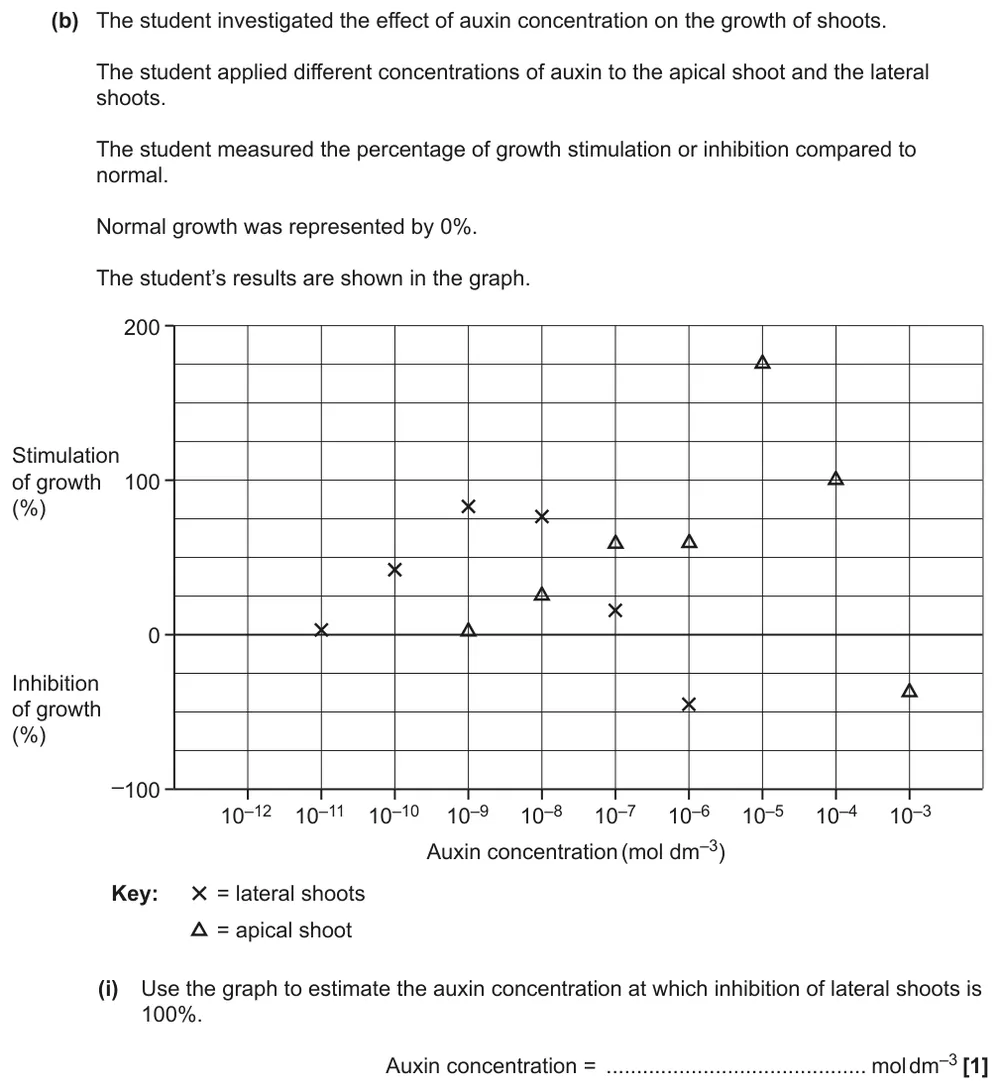
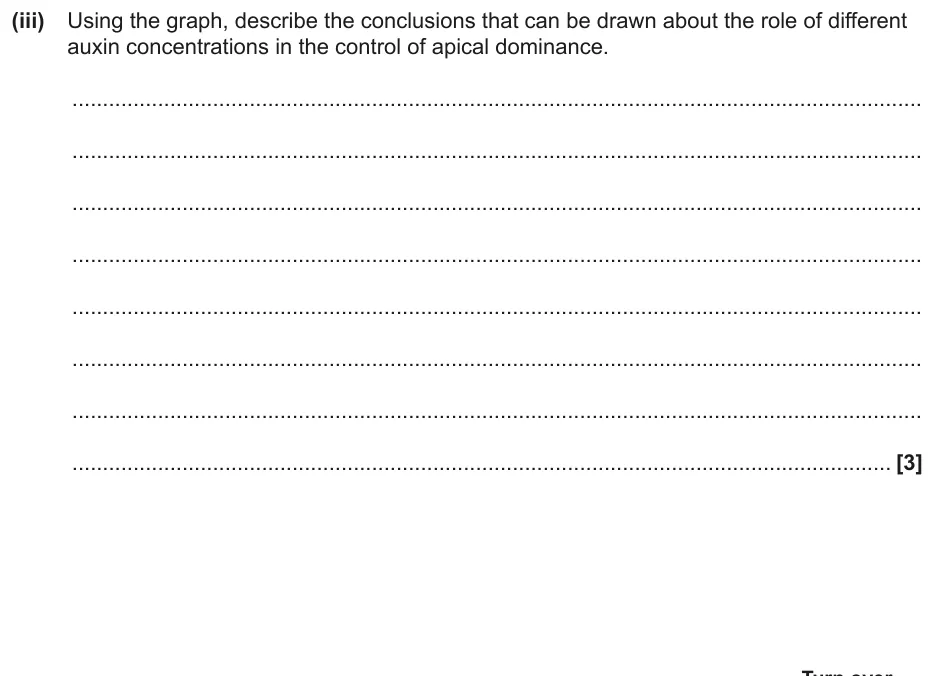
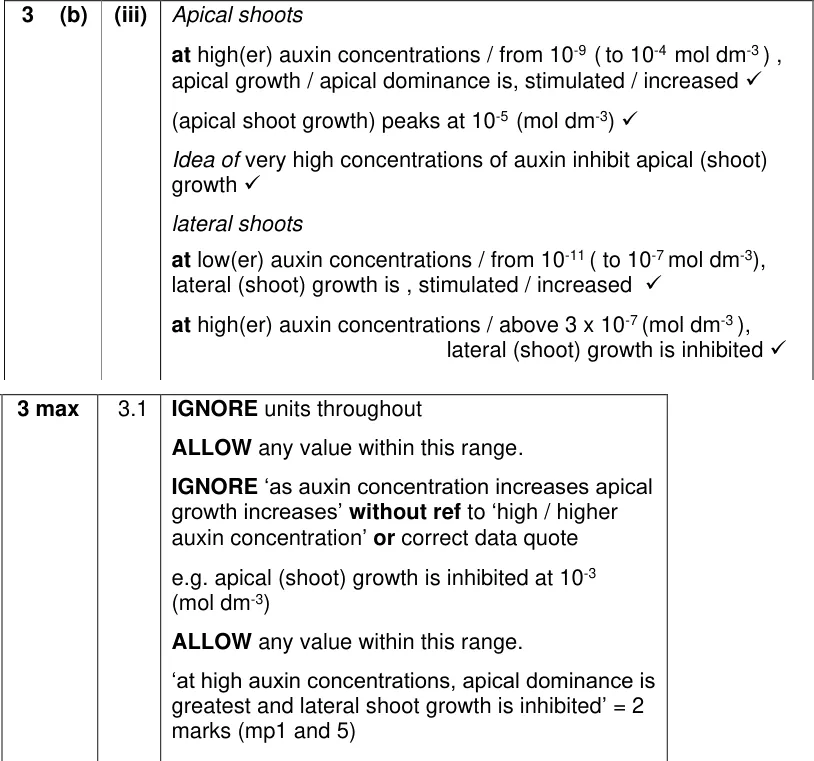
Use a graph to draw conclusions about auxin concentration and apical dominance.
Information from earlier in this question:
Show the mark scheme
Tap an image to open it full size.
From the examiners' report: Quote concentrations from the graph and cover both apical and lateral shoots. Remember 10⁻⁵ is a higher concentration than 10⁻⁹ on a log scale.
Question 8
A level Paper 3 · June 2017 · Q5(b)(i) · 2 marks · Medium
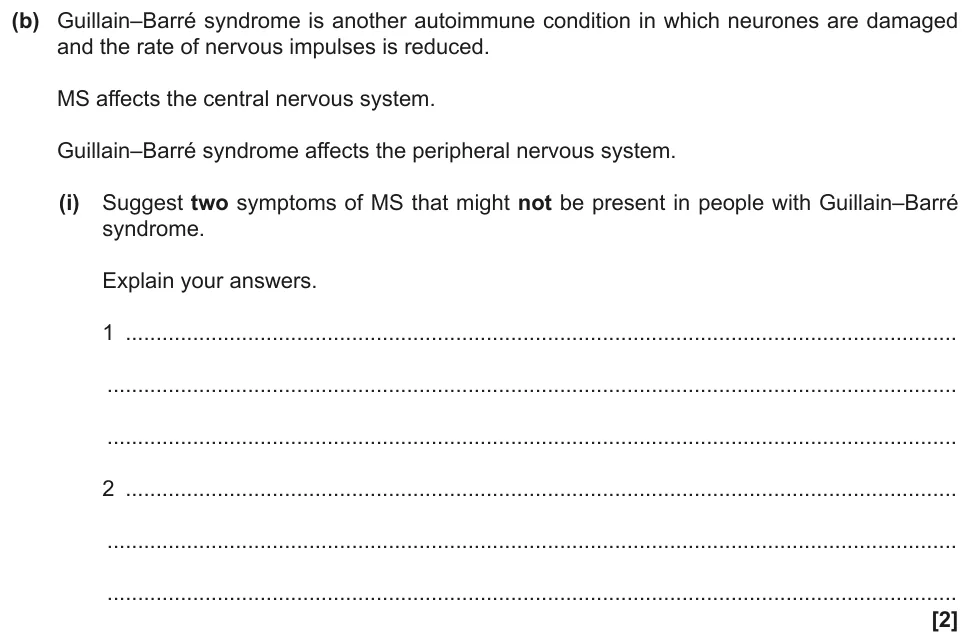
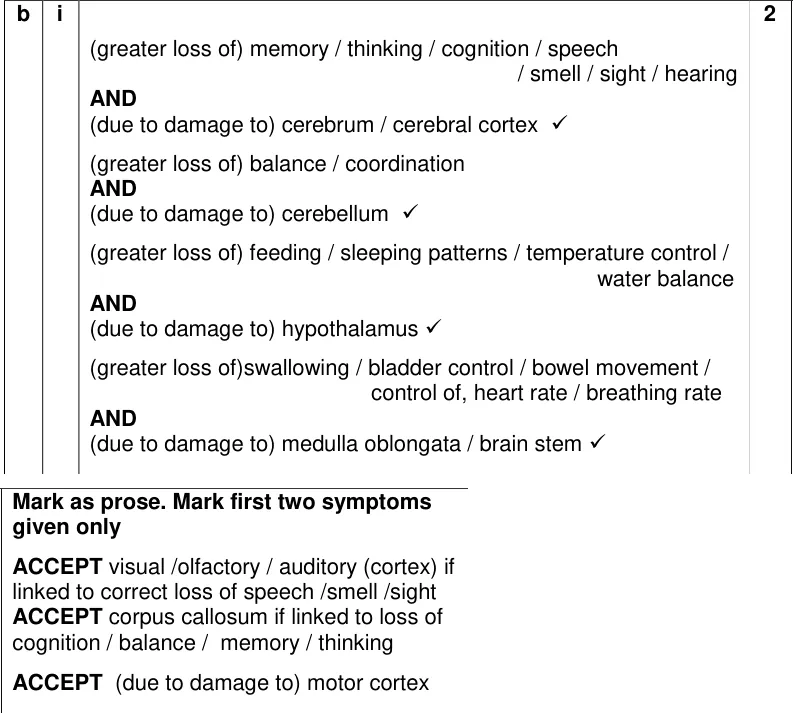
Suggest two symptoms of MS, a disease of the CNS, and explain them using parts of the brain.
Show the mark scheme
Tap an image to open it full size.
From the examiners' report: Each mark needs a symptom and the part of the brain whose damage causes it, such as loss of balance from damage to the cerebellum. Vague answers about "brain damage" or slower reflexes scored nothing.
Question 9
A level Paper 1 · June 2018 · Q23(b) · 4 marks · Medium
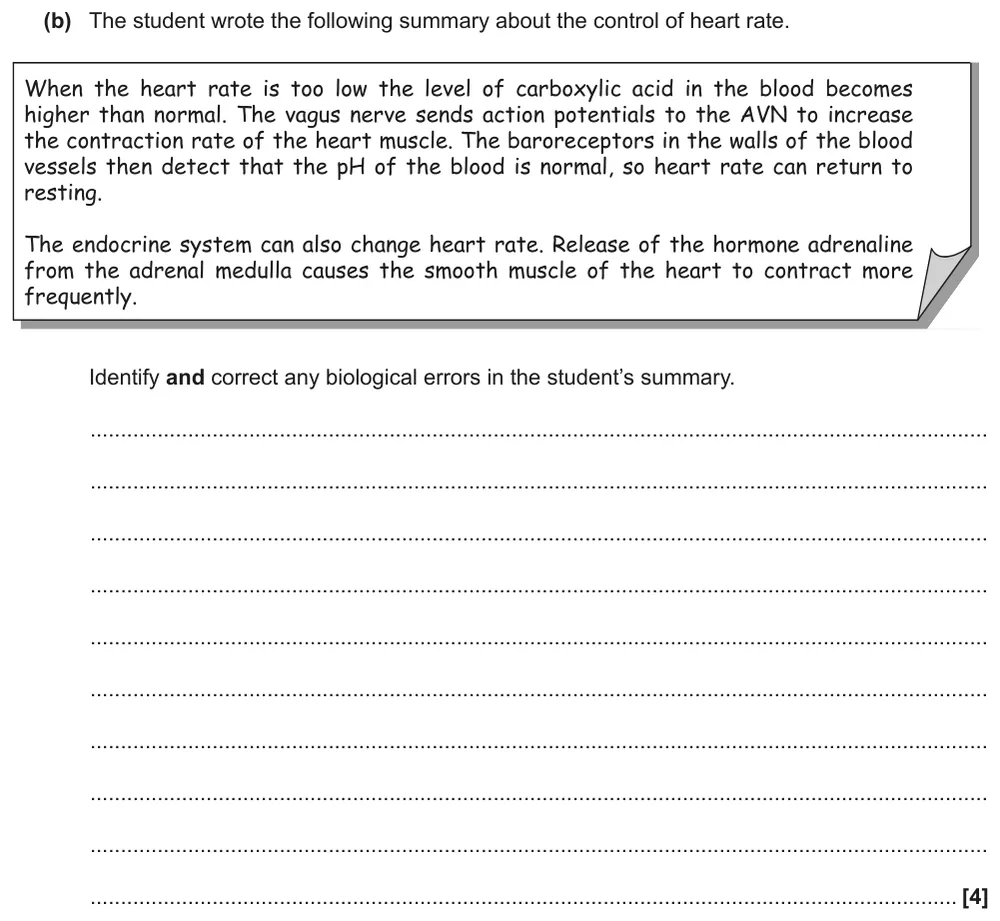
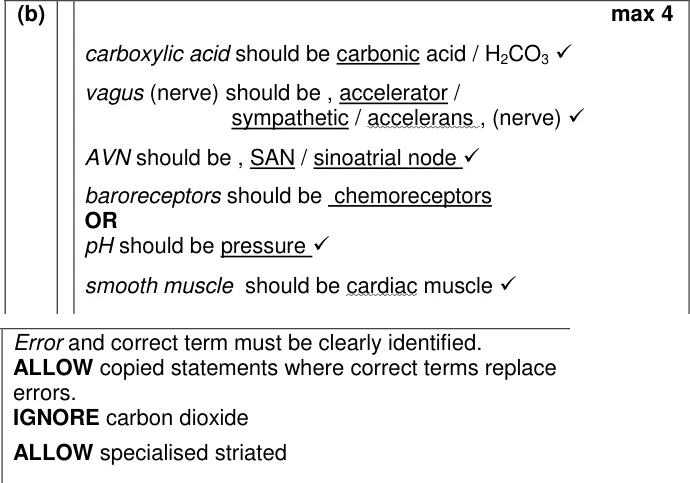
Identify and correct the errors in a student's summary of how heart rate is controlled.
Show the mark scheme
Tap an image to open it full size.
From the examiners' report: Write each error next to its correction. Carbonic acid, not carbon dioxide, is the error to fix, and the nerve goes to the SAN; don't "correct" terms that were already right, such as adrenal medulla.
Question 10
A level Paper 1 · June 2018 · Q23(c)(ii) · 3 marks · Medium
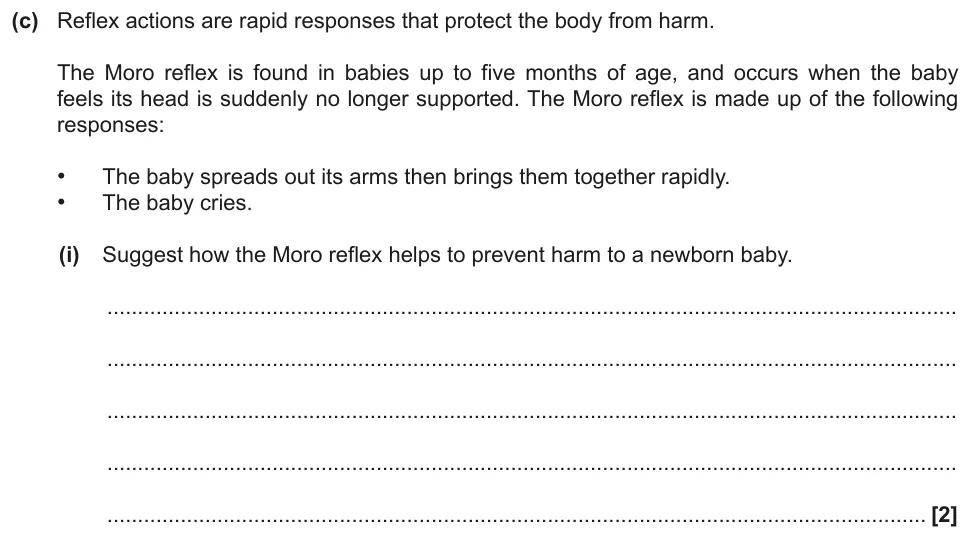
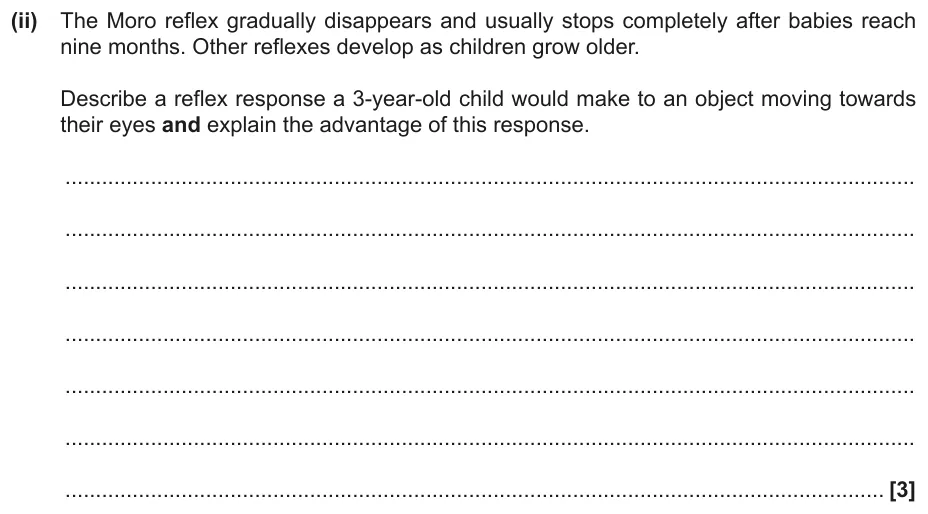
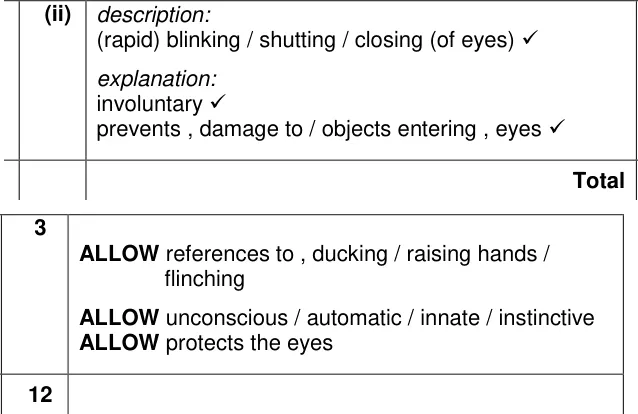
Describe a 3-year-old's reflex to an object moving towards their eyes and its advantage.
Information from earlier in this question:
Show the mark scheme
Tap an image to open it full size.
From the examiners' report: Most students gave blinking and protecting the eye. The third mark was for saying the response is involuntary (innate or automatic).
Question 11
A level Paper 3 · June 2023 · Q1(c) · 2 marks · Hard
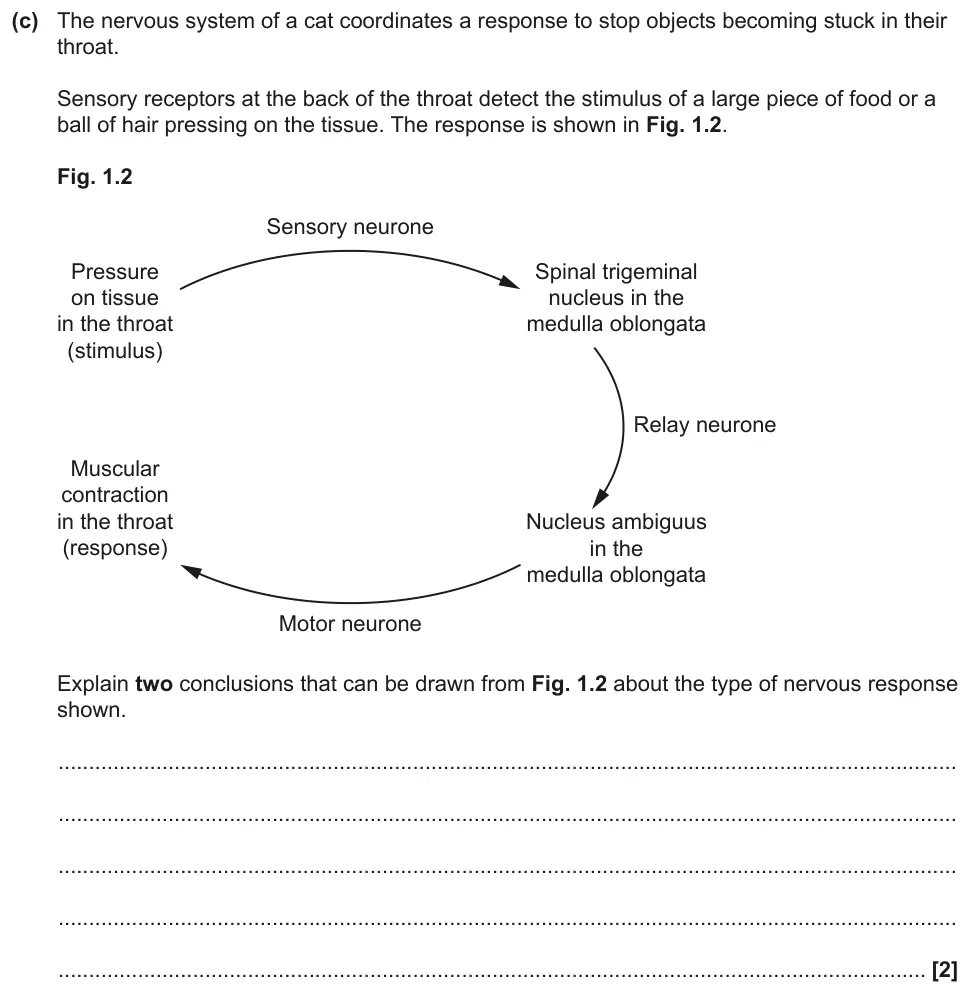
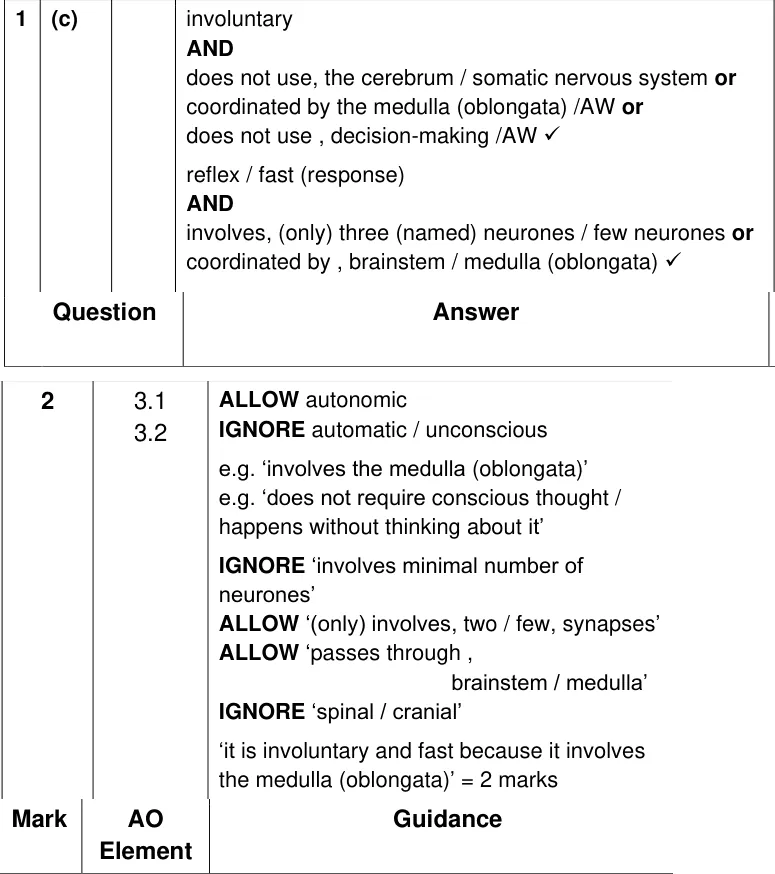
Explain two conclusions about a cat's throat reflex from a pathway diagram.
Show the mark scheme
Tap an image to open it full size.
From the examiners' report: A reflex can pass through the brain: say it is involuntary because it is coordinated by the medulla oblongata, not the cerebrum, and fast because it involves only three neurones. "Automatic" alone doesn't score.
Question 12
A level Paper 3 · June 2025 · Q2(a)(ii) · 2 marks · Medium
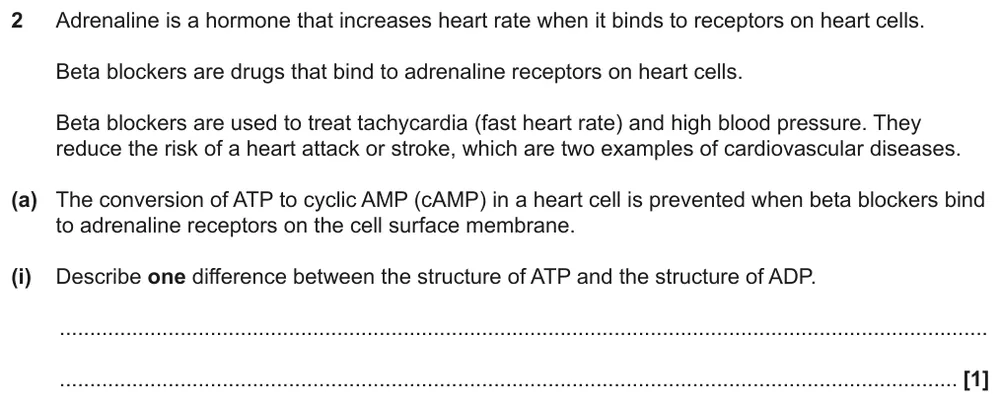
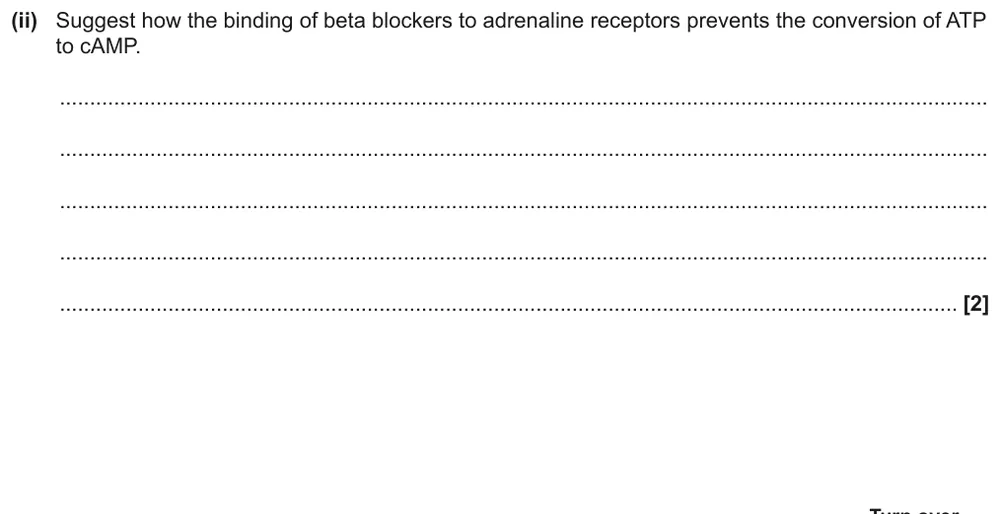
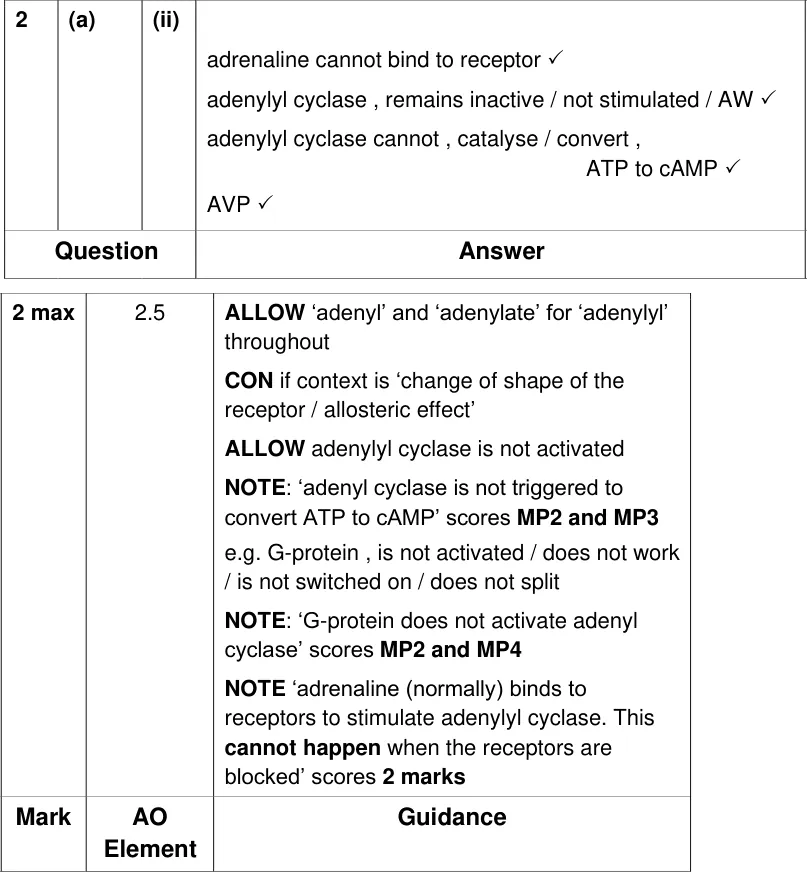
Suggest how beta blockers binding to adrenaline receptors prevent ATP being converted to cAMP.
Information from earlier in this question:
Show the mark scheme
Tap an image to open it full size.
From the examiners' report: Most students knew adrenaline can no longer bind. Go on to say that adenylyl cyclase is then not activated, so no cAMP is made; it is adrenaline, not ATP, that binds to the receptor.
Question 13
A level Paper 3 · June 2025 · Q2(c) · 2 marks · Medium
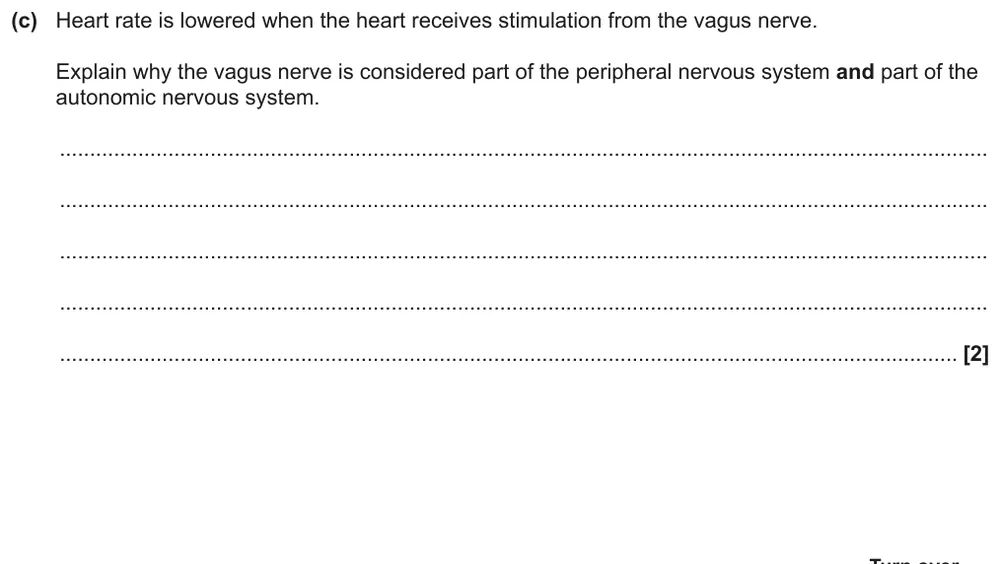
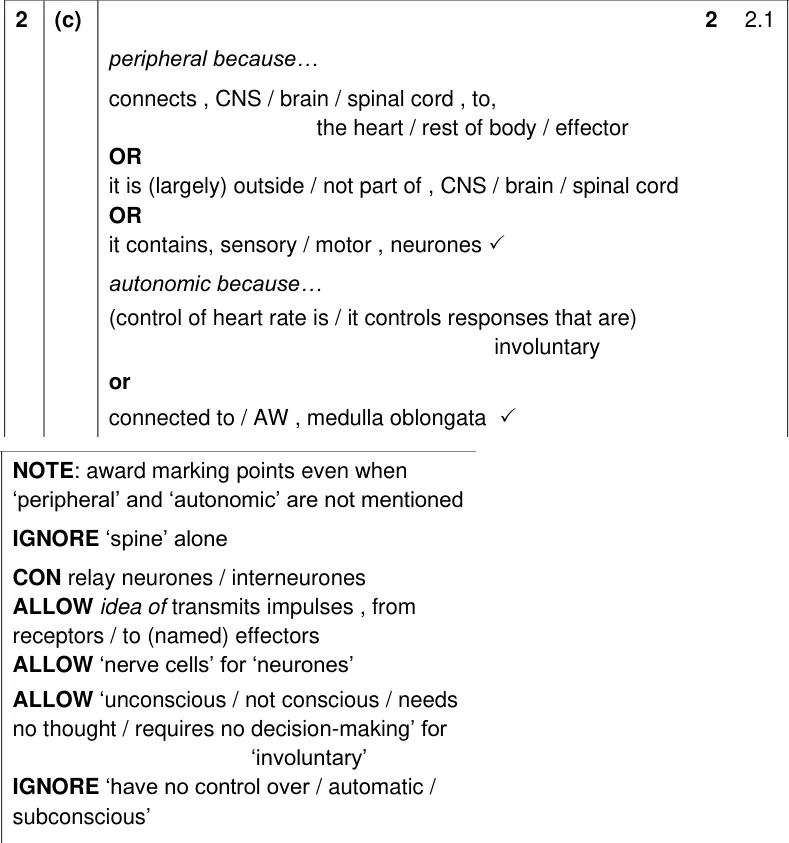
Explain why the vagus nerve is part of both the peripheral and the autonomic nervous systems.
Show the mark scheme
Tap an image to open it full size.
From the examiners' report: Give a separate reason for each: peripheral because it lies outside the CNS and links it to the heart; autonomic because the control is involuntary. Don't use "involuntary" for the peripheral reason too.
Question 14
A level Paper 1 · June 2022 · Q19(b)(iii) · 3 marks · Medium
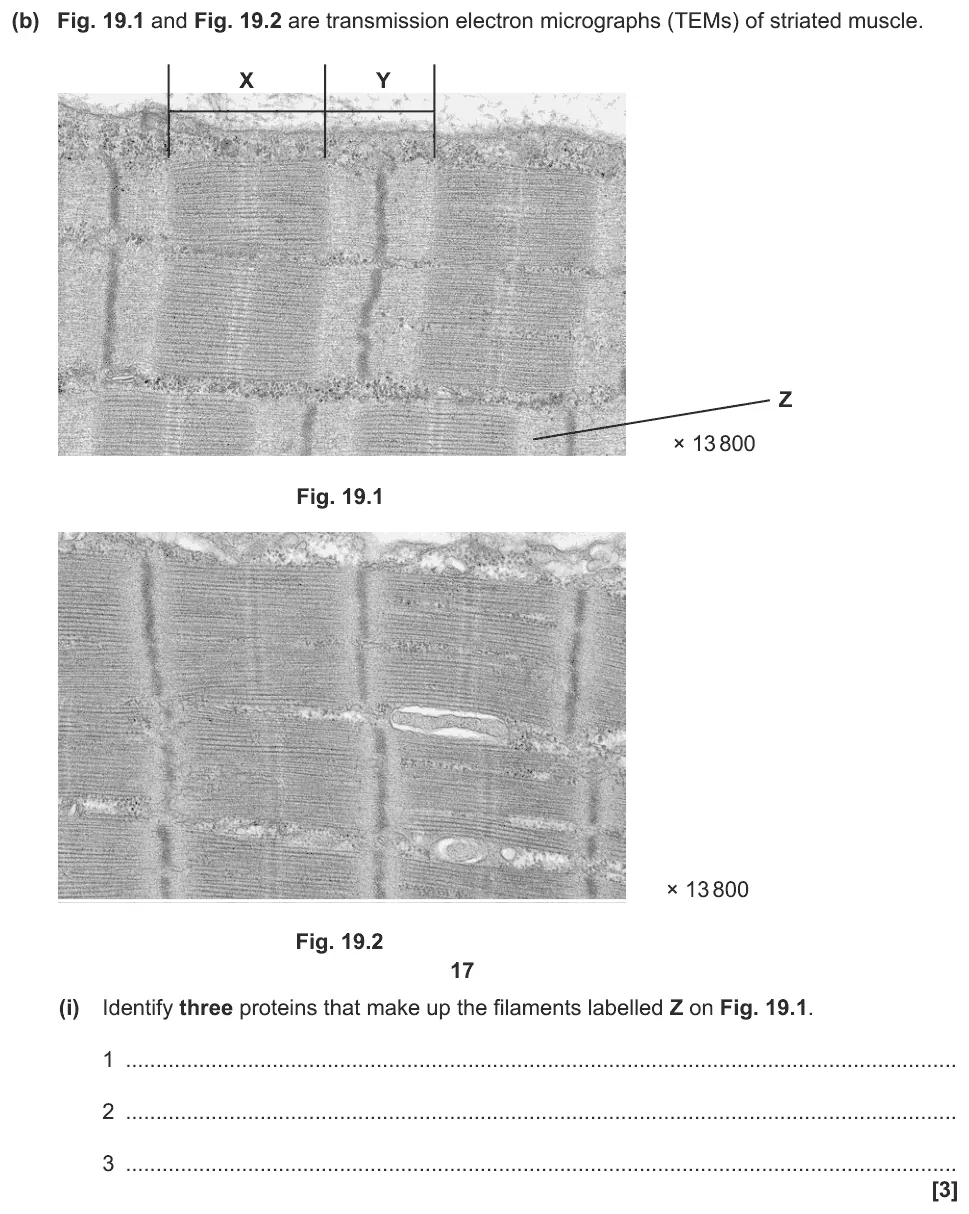
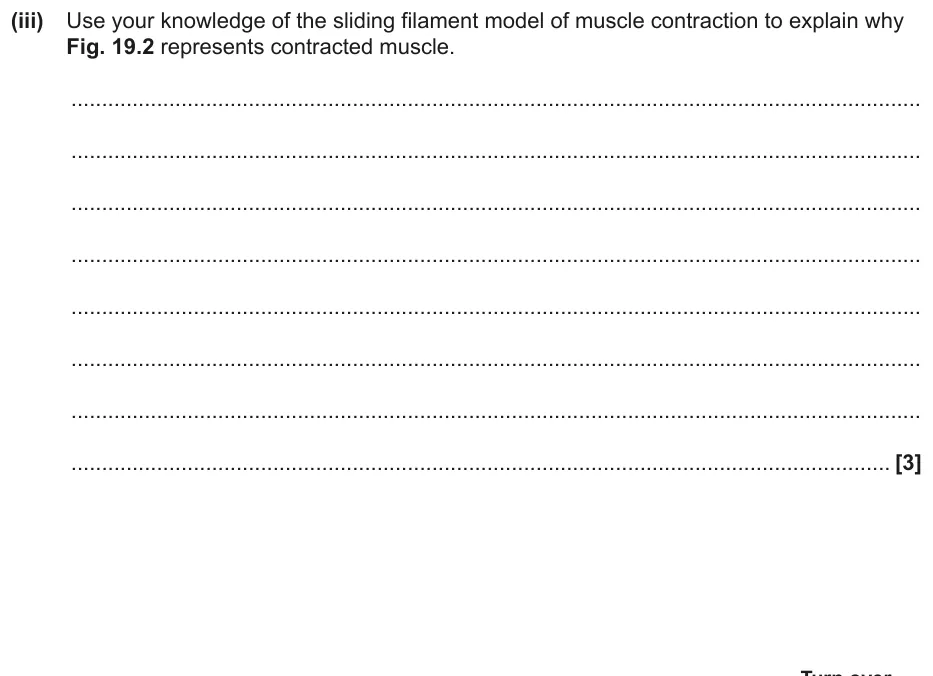
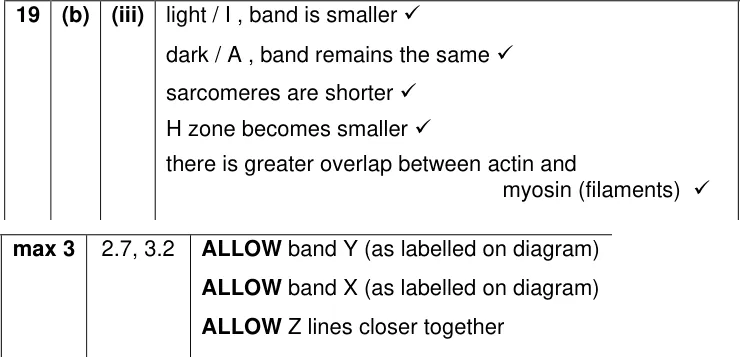
Use the sliding filament model to explain why one electron micrograph shows contracted muscle.
Information from earlier in this question:
Show the mark scheme
Tap an image to open it full size.
From the examiners' report: Point to what you can see in the micrographs, such as a shorter sarcomere, a narrower H zone and an A band that stays the same width, instead of describing the whole sliding filament model.
Question 15
A level Paper 1 · June 2022 · Q19(c) · 2 marks · Medium
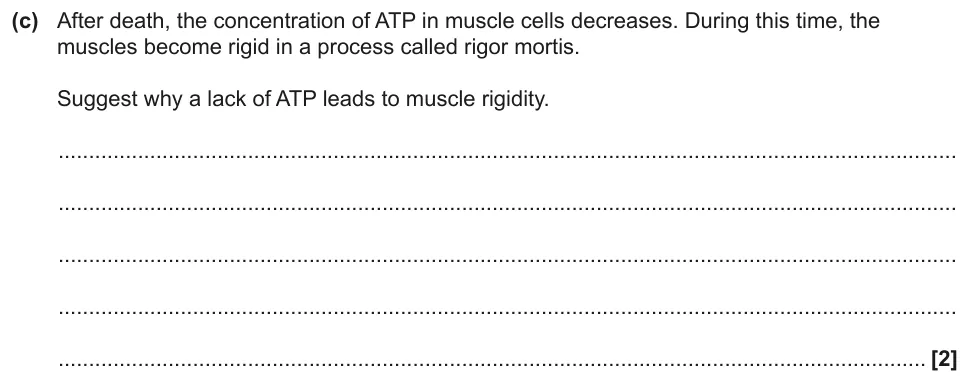
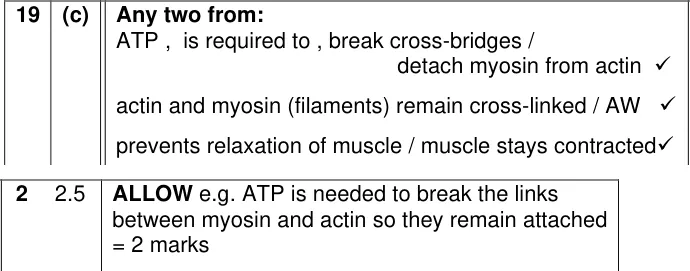
Suggest why a lack of ATP after death leads to rigor mortis.
Show the mark scheme
Tap an image to open it full size.
From the examiners' report: ATP is needed to break the cross-bridges, so without it myosin stays attached to actin and the muscle can't relax. Many students wrongly said ATP forms the cross-bridges or just called it the energy currency.
Question 16
A level Paper 3 · June 2025 · Q3(c)(ii) · 2 marks · Hard
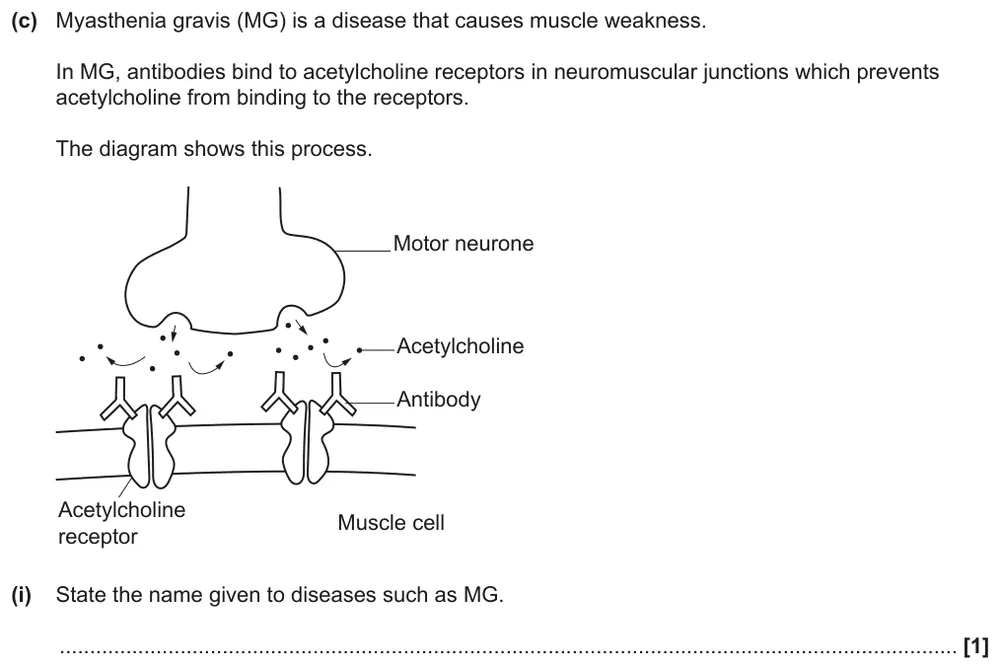
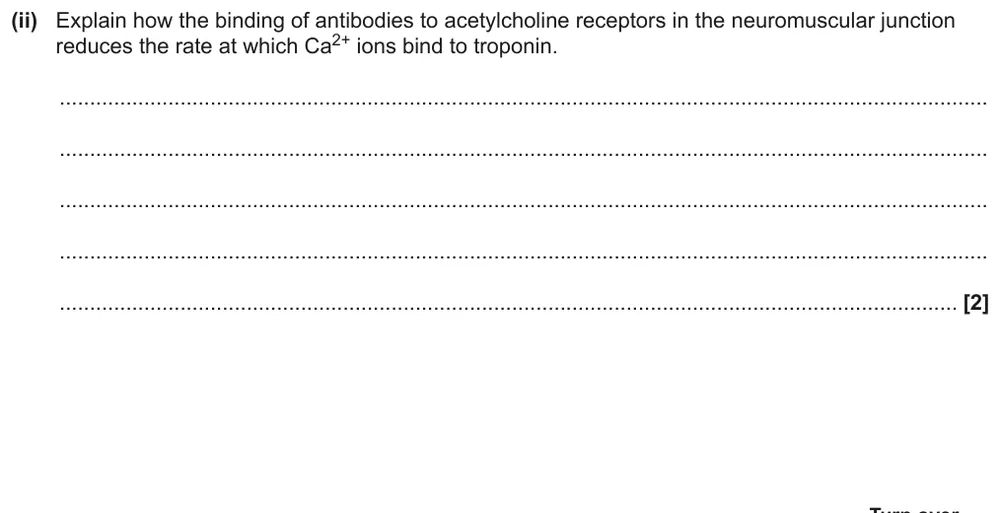
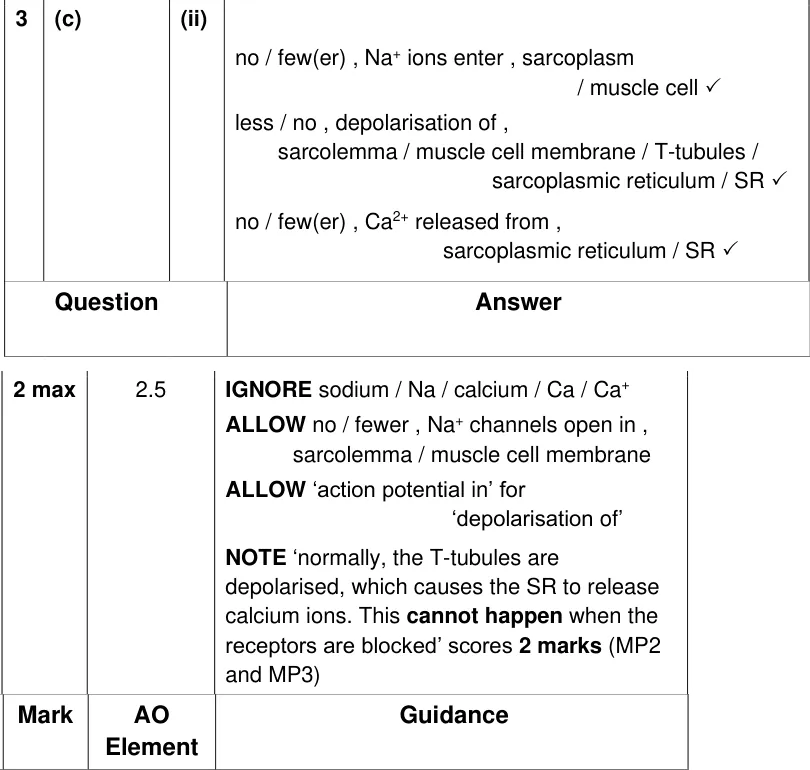
Explain how antibodies blocking acetylcholine receptors at the neuromuscular junction reduce Ca²⁺ binding to troponin.
Information from earlier in this question:
Show the mark scheme
Tap an image to open it full size.
From the examiners' report: Name the places: less depolarisation of the sarcolemma and T-tubules, so fewer calcium ions are released from the sarcoplasmic reticulum. Marks weren't given without the locations.
Practical and evaluation
Question 17
A level Paper 1 · June 2023 · Q17(a)(i) · 2 marks · Easy
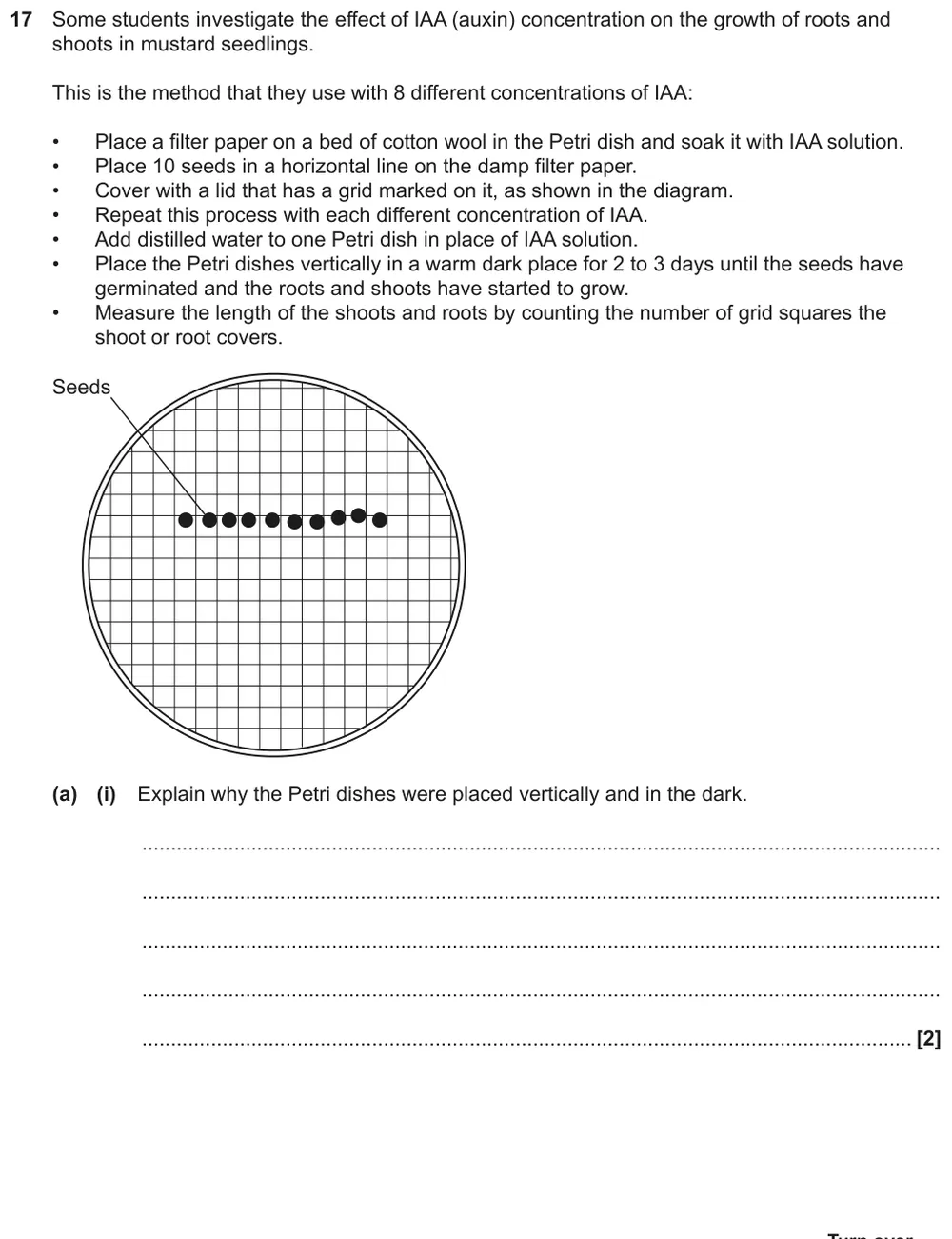
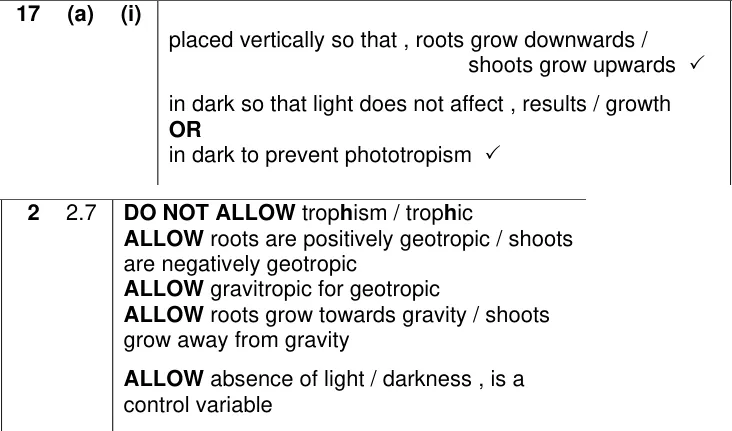
Explain why Petri dishes of germinating seeds were kept vertical and in the dark.
Show the mark scheme
Tap an image to open it full size.
From the examiners' report: Answer both conditions and label each. For the vertical dish, link geotropism to the roots growing down and shoots growing up; for the dark, say it prevents phototropism.
Question 18
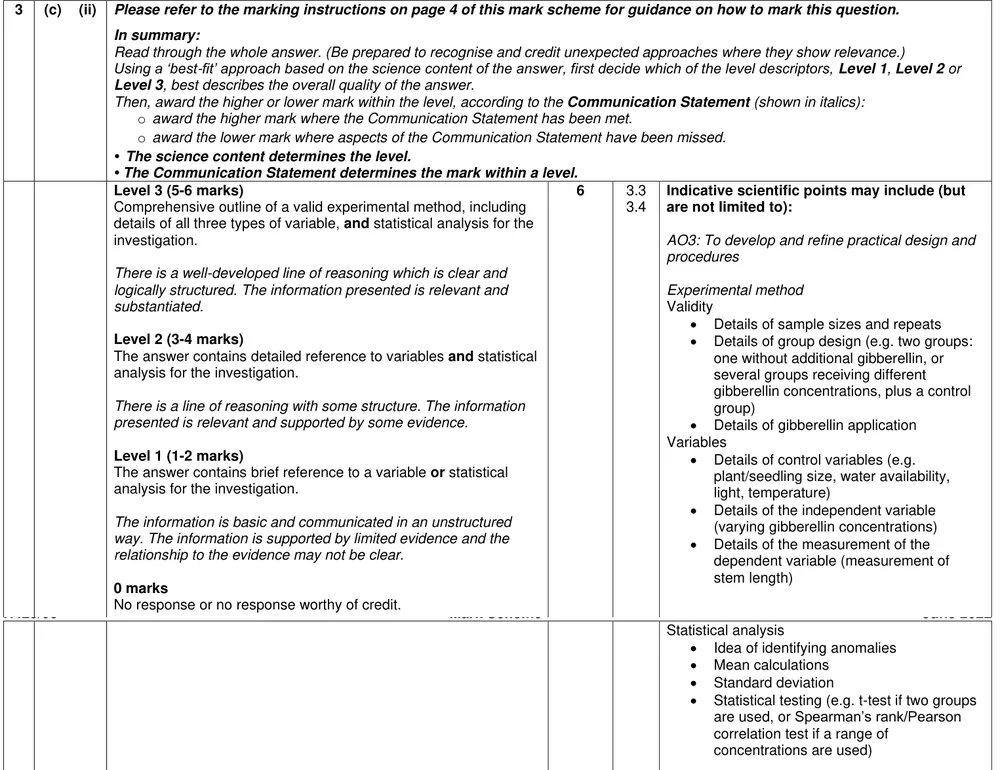
A level Paper 3 · June 2022 · Q3(c)(ii) · 6 marks · Easy
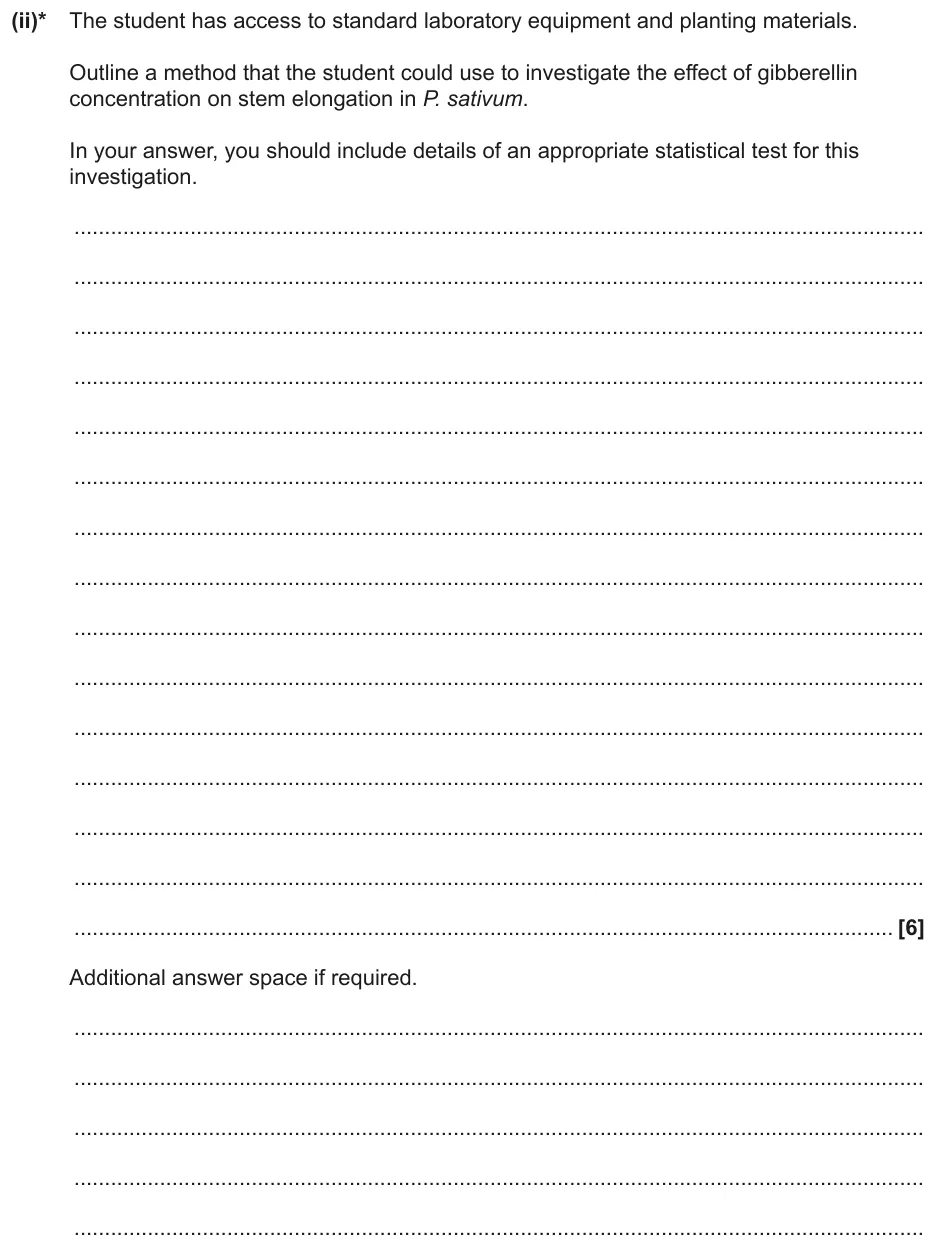
Outline a method to investigate the effect of gibberellin concentration on stem elongation, with a statistical test.
Information from earlier in this question:

Show the mark scheme
Tap an image to open it full size.
From the examiners' report: Measure stem length, not "growth", include a control group with no gibberellin, and choose a test that fits your design: correlation for a range of concentrations, a t-test only for two groups.
Question 19
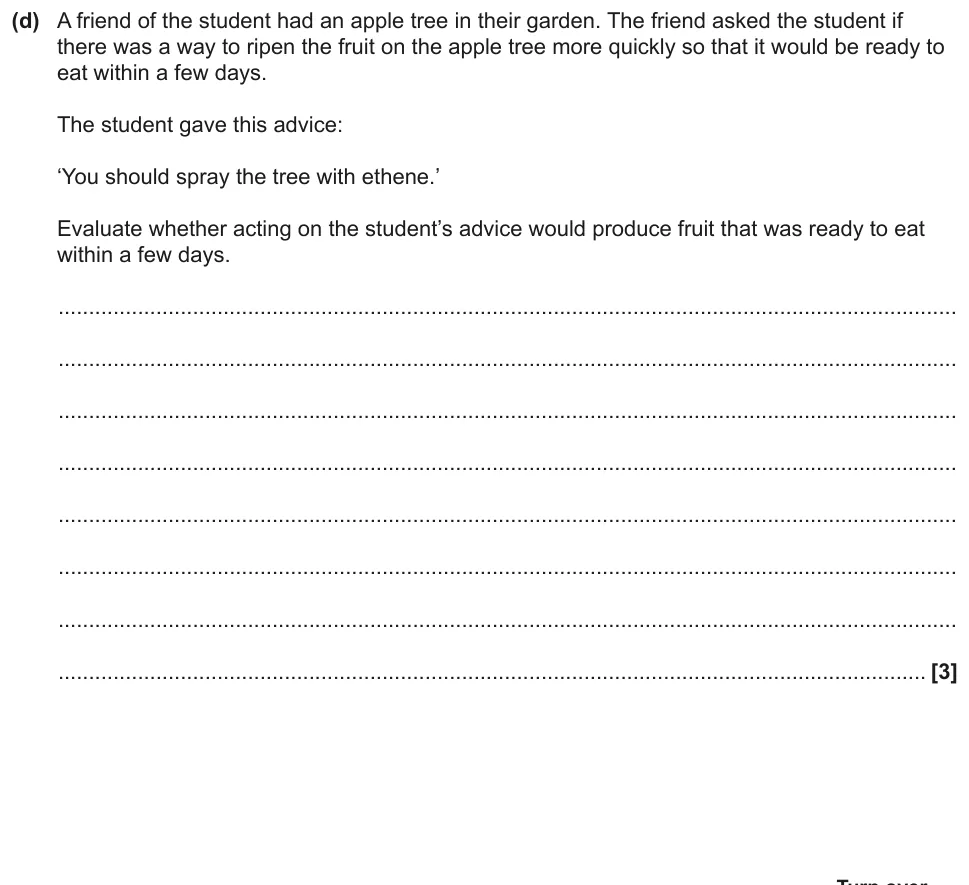
A level Paper 3 · June 2022 · Q3(d) · 3 marks · Hard
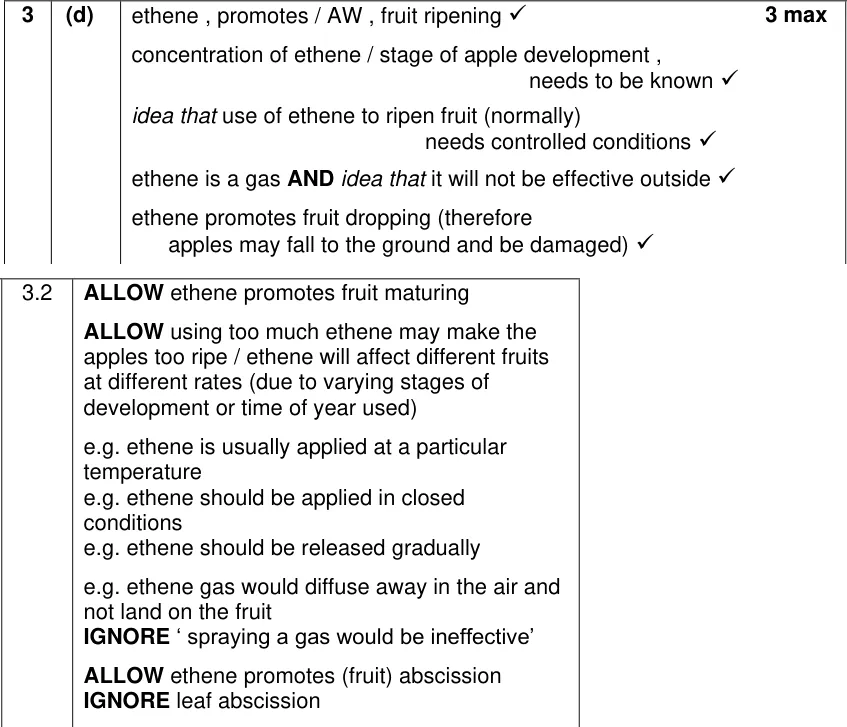
Evaluate the advice to spray an apple tree with ethene to ripen the fruit within a few days.
Show the mark scheme
Tap an image to open it full size.
From the examiners' report: Use all three marks: ethene does ripen fruit, but it is a gas that would disperse outdoors, it needs controlled conditions, and it can make apples drop.
Where students lose marks (from OCR examiners' reports and mark schemes)
Each point below is followed by wording that gained marks.
A tropism is growth with a direction: The mark scheme does not allow "growth" unqualified when defining a tropism.
✔ Gains credit: "Directional growth in response to a stimulus", or "grows towards or away from a stimulus".
Gibberellin switches on the seed's enzymes: Some students listed every function of gibberellin, or wrote about "the plant" and stem elongation, instead of applying it to a seed.
✔ Gains credit: "The embryo releases gibberellin", which switches on "production of digestive enzymes" that "break down food stores"; "abscisic acid inhibits germination".
On a log scale, 10⁻⁵ beats 10⁻⁹: Students who scored nothing often thought 10⁻⁹ mol dm⁻³ was a higher auxin concentration than 10⁻⁵, or gave no concentrations at all.
✔ Gains credit: "Apical shoot growth peaks at 10⁻⁵ mol dm⁻³" and "above 3 × 10⁻⁷ mol dm⁻³ lateral shoot growth is inhibited".
Ethene is a gas, so it drifts away outdoors: Most students knew ethene ripens fruit but few spotted that spraying a gas on a tree outside would not work.
✔ Gains credit: "Ethene is a gas and will not be effective outside"; "ripening with ethene needs controlled conditions"; "ethene promotes fruit drop".
Pair every symptom with a brain region: Many students who described a correct symptom of MS did not name the part of the brain whose damage caused it.
✔ Gains credit: "Loss of balance or coordination due to damage to the cerebellum"; "loss of memory or speech due to damage to the cerebrum".
Carbonic acid, and the nerve goes to the SAN: The errors most often missed were the acid (students wrote carbon dioxide) and the node ("SAN sends an impulse to the AVN").
✔ Gains credit: "Carboxylic acid should be carbonic acid" and "AVN should be SAN", with the vagus replaced by "the accelerator (sympathetic) nerve".
ATP breaks cross-bridges, it doesn't make them: Several students said ATP is needed to form the cross-bridges or to move the myosin head, so the muscle would not contract.
✔ Gains credit: "ATP is required to break cross-bridges", so "actin and myosin remain cross-linked" and the "muscle stays contracted".
A reflex can run through the medulla: Some students decided the cat's response was not a reflex because it involved the brain, or called it "automatic", which was ignored.
✔ Gains credit: "Involuntary and coordinated by the medulla oblongata" and "fast because it involves only three neurones".
Download the questions
Download the PDF pack (19 questions, mark schemes at the end)
Keep practising
- Plant and Animal Responses quiz
- Plant and animal responses: interactive written questions (20)
- PAG 11 Plant and Animal Responses: OCR A Level Biology exam questions by topic
- Neuronal and Hormonal Communication (5.1.3–5.1.4): OCR A Level Biology exam questions by topic
- OCR A Level Biology masterclasses
Questions, mark schemes and examiners' report extracts © OCR.