

These two spec points cover the body's two communication systems. Spec point 5.1.3 is about nerves: how sensory receptors act as transducers, the structure of sensory, relay and motor neurones, how resting and action potentials are set up and passed along a myelinated axon, and how synapses work. Spec point 5.1.4 moves on to hormones: endocrine glands, the adrenal glands, the histology of the pancreas, how insulin and glucagon control blood glucose, Type 1 and Type 2 diabetes and how diabetes is treated.
The marks are lost on detail. Students say no sodium ions enter when the answer is fewer, describe vesicles crossing the synaptic cleft, write that the impulse can't jump between nodes without saying the whole axon must depolarise, mix up the jobs of cortisol and aldosterone, or say ‘healthy diet’ when the mark needs less carbohydrate. In evaluation questions on diabetes treatment, many describe treatments but never weigh them up.
Work through the twenty questions below in order. They start with recall of synapses, glands and the pancreas, move on to applying what you know to toxins, unusual animals and patients, and finish with an experiment on calcium ions at a synapse and a six-mark evaluation of diabetes treatments. If you'd like to go through questions like these with me each week, my OCR A masterclasses run on Wednesdays at 5.15pm for Year 12 and on Tuesdays at 6.30pm or Thursdays at 5.15pm for Year 13.
Want help with this topic? It comes up in my weekly OCR A masterclasses. See the timetable →
What you need from GCSE
Each question on this page assumes you're secure on these GCSE ideas. If any of them feels shaky, look it up before you start.
- The nervous system uses electrical impulses carried by sensory, relay and motor neurones from receptors to effectors.
- A synapse is the gap between two neurones; a chemical diffuses across it to start an impulse in the next neurone.
- Hormones are chemicals secreted by endocrine glands into the blood, which carries them to target organs.
- Adrenaline from the adrenal glands prepares the body for ‘fight or flight’.
- Insulin from the pancreas lowers blood glucose and glucagon raises it; Type 1 diabetes is treated with insulin and Type 2 with diet, exercise and drugs.
Key terms
These words come up in the questions and mark schemes. Examiners expect you to use them exactly.
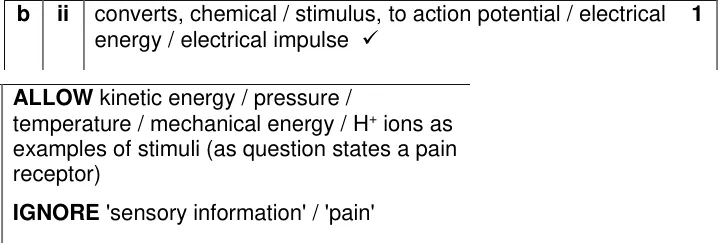
- Transducer: a sensory receptor that converts the energy of a stimulus into the electrical energy of a nerve impulse.
- Generator potential: a small depolarisation of a receptor membrane; if it reaches threshold, an action potential is produced.
- Resting potential: about −70 mV across the axon membrane, kept by sodium-potassium pumps and the membrane's greater permeability to potassium ions.
- Depolarisation: the inside of the neurone becoming more positive than the outside as voltage-gated sodium ion channels open and Na+ floods in; the opening of more channels is positive feedback.
- Saltatory conduction: in myelinated neurones, depolarisation happens only at the nodes of Ranvier, so the action potential travels faster.
- Synaptic cleft: the gap between the presynaptic and postsynaptic membranes, which the neurotransmitter diffuses across.
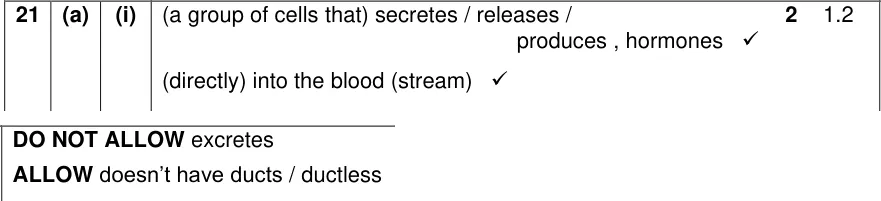
- Endocrine gland: a ductless gland that secretes hormones directly into the blood; an exocrine gland secretes into a duct.
- Adrenal cortex and medulla: the cortex secretes steroid hormones such as cortisol and aldosterone; the medulla secretes adrenaline and noradrenaline.
- Islets of Langerhans: the endocrine tissue of the pancreas: alpha cells secrete glucagon and beta cells secrete insulin.
- Type 1 and Type 2 diabetes: in Type 1 the beta cells don't produce insulin; in Type 2 insulin is produced but target cells respond less to it.
What these questions cover (OCR 5.1.3 and 5.1.4)
The questions test these learning outcomes from the OCR A Level Biology A specification (H420):
- 5.1.3(a) the roles of mammalian sensory receptors in converting different types of stimuli into nerve impulses (including the Pacinian corpuscle and receptors as transducers)
- 5.1.3(b) the structure and functions of sensory, relay and motor neurones (including myelinated and non-myelinated neurones)
- 5.1.3(c) the generation and transmission of nerve impulses in mammals (resting potential, action potential and saltatory conduction)
- 5.1.3(d) the structure and roles of synapses in neurotransmission (cholinergic synapses, summation, inhibitory and excitatory synapses)
- 5.1.4(a) endocrine communication by hormones
- 5.1.4(b) the structure and functions of the adrenal glands (hormones of the cortex and medulla and their functions)
- 5.1.4(c)(i) the histology of the pancreas
- 5.1.4(c)(ii) the examination and drawing of stained sections of the pancreas to show the histology of the endocrine tissues
- 5.1.4(d) how blood glucose concentration is regulated (insulin, glucagon, the liver, and the control of insulin secretion by beta cells)
- 5.1.4(e) the differences between Type 1 and Type 2 diabetes mellitus
- 5.1.4(f) the potential treatments for diabetes mellitus (insulin from GM bacteria and the potential use of stem cells)
How to use this page
Write your answer on paper before you open the mark scheme. Allow about 1.2 minutes per mark: the 20 questions are worth 43 marks, so about 52 minutes in total. Then mark your answer strictly against the mark scheme and read the examiners' tip underneath it. If you'd rather print the questions, download the PDF pack.
Recall
Question 1
A level Paper 1 · June 2023 · Q18(a)(i) · 1 mark · Easy
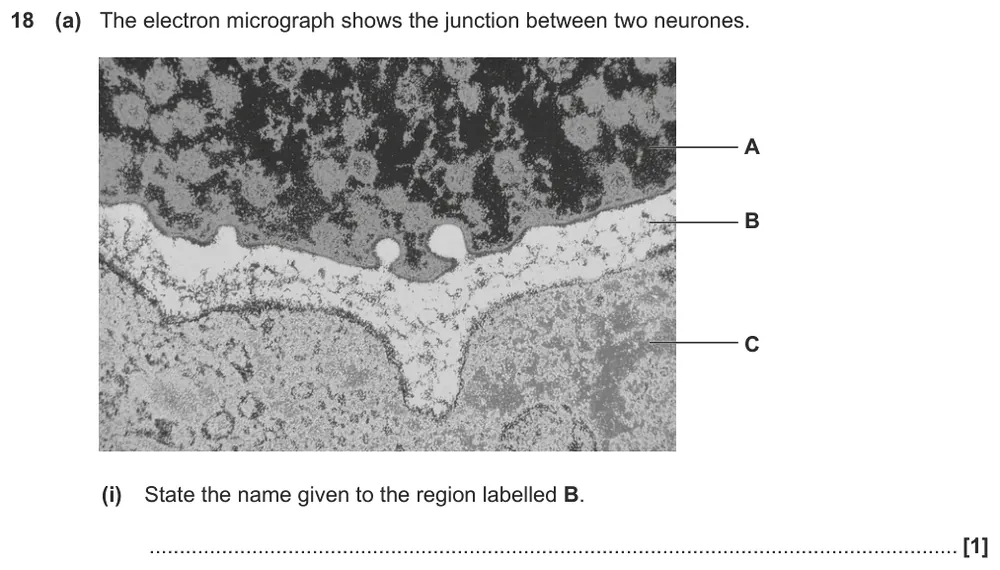
Name the region labelled B on an electron micrograph of a synapse.
Show the mark scheme

Tap an image to open it full size.
From the examiners' report: Be precise: B is the synaptic cleft. "Synapse" on its own is the whole junction, so it doesn't score.
Question 2
A level Paper 1 · June 2023 · Q18(a)(ii) · 1 mark · Medium
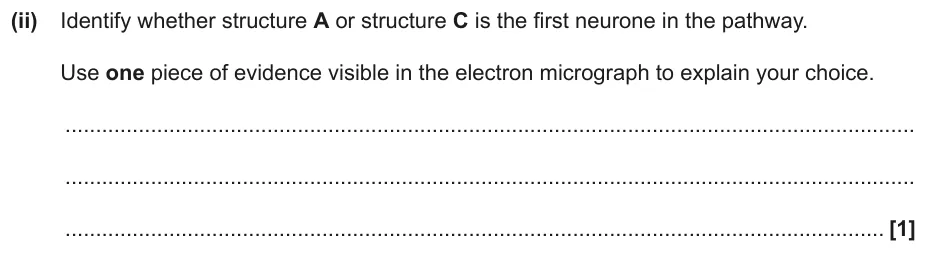
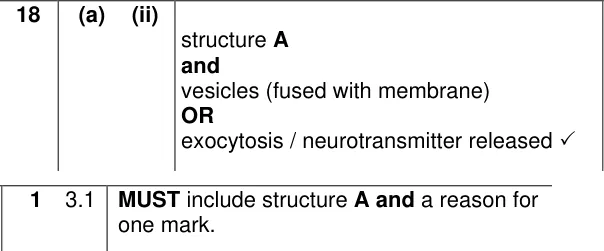
Decide whether A or C is the first neurone, using evidence from the micrograph.
Show the mark scheme
Tap an image to open it full size.
From the examiners' report: Say A, because you can see vesicles in it. Vesicles fuse with the presynaptic membrane and release neurotransmitter; they never move across the cleft.
Question 3
A level Paper 1 · June 2022 · Q21(a)(i) · 2 marks · Medium
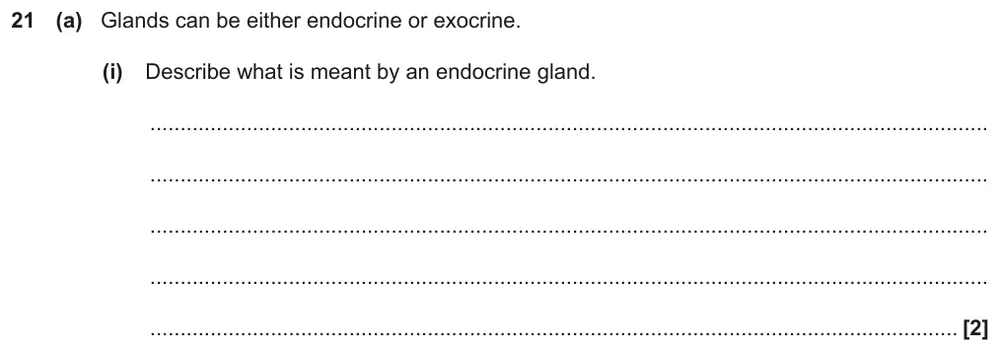
Describe what is meant by an endocrine gland.
Show the mark scheme
Tap an image to open it full size.
From the examiners' report: Give both points: it secretes hormones, and it releases them directly into the blood (it has no duct). Don't say excretes.
Question 4
A level Paper 1 · June 2022 · Q21(a)(ii) · 1 mark · Medium
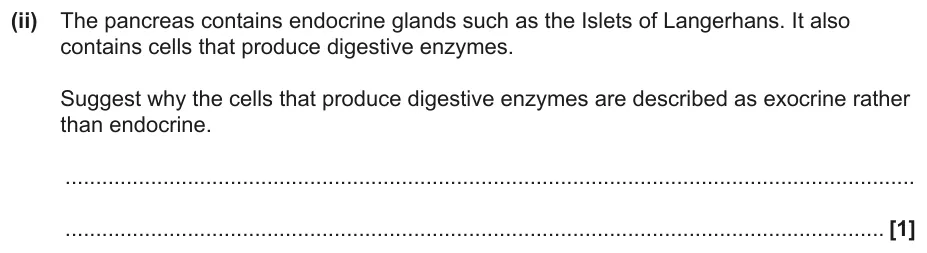
Suggest why pancreas cells that make digestive enzymes are called exocrine.
Show the mark scheme

Tap an image to open it full size.
From the examiners' report: Answer with where the enzymes go: into ducts, not into the blood. Saying they are secreted from the cells, or work outside them, doesn't explain exocrine.
Question 5
A level Paper 1 · June 2022 · Q21(b) · 2 marks · Easy
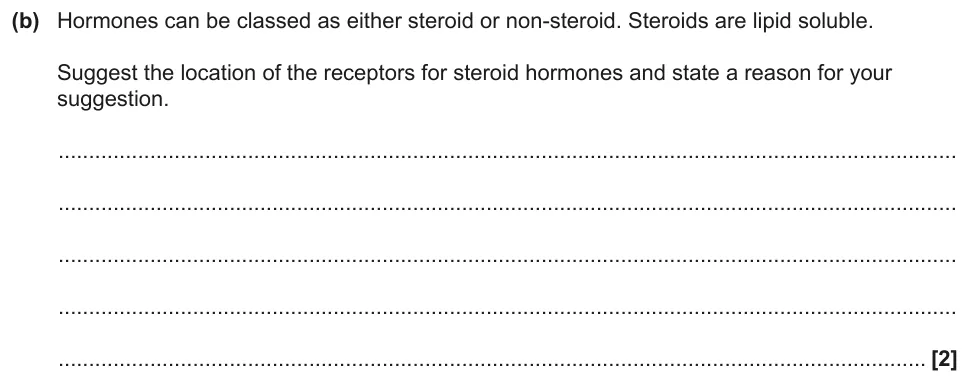
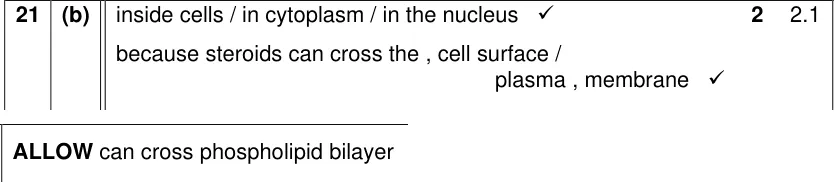
Suggest where the receptors for steroid hormones are, and why.
Show the mark scheme
Tap an image to open it full size.
From the examiners' report: Lipid-soluble steroids pass through the phospholipid bilayer, so their receptors are inside the cell. Use the term cell surface membrane or plasma membrane, not just "cell membrane".
Question 6
A level Paper 3 · June 2024 · Q5(b) · 3 marks · Easy
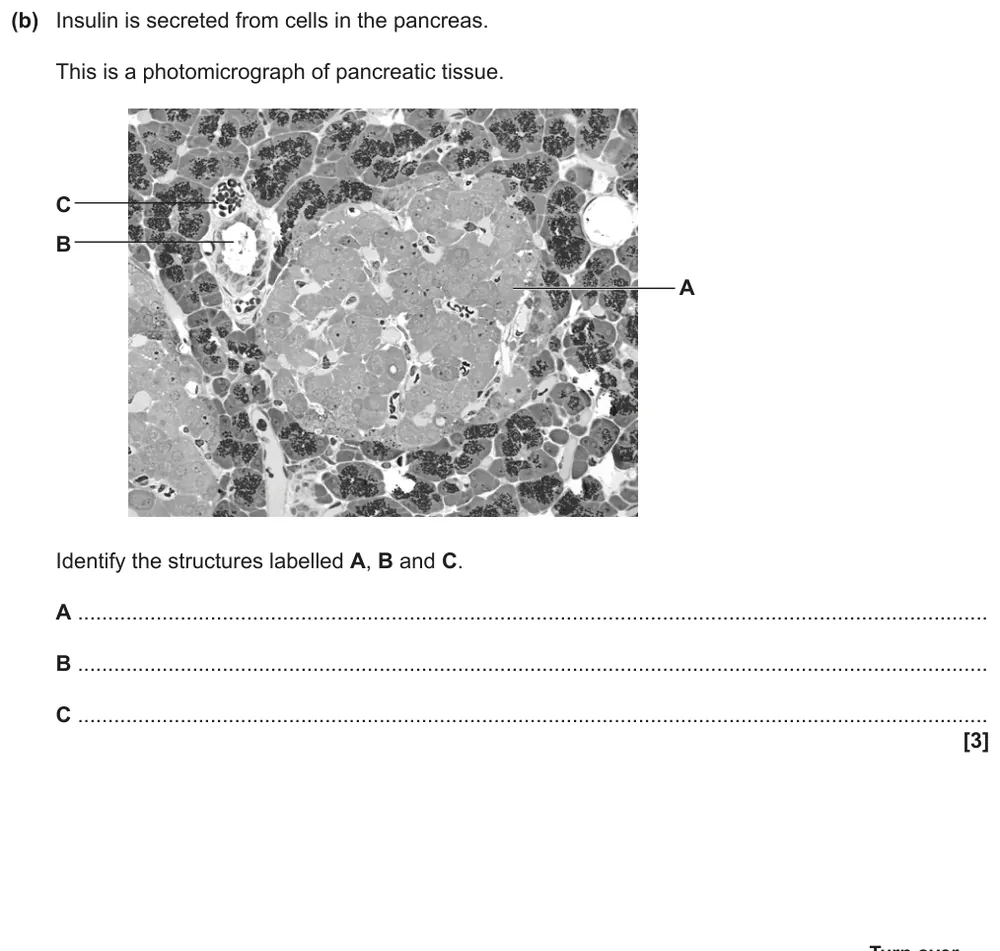
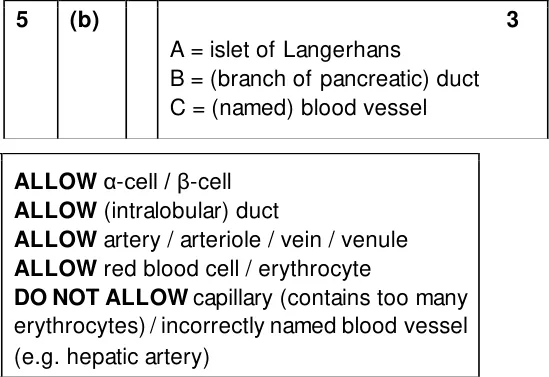
Identify an islet, a duct and a blood vessel on a photomicrograph of pancreatic tissue.
Show the mark scheme
Tap an image to open it full size.
From the examiners' report: C contains too many red blood cells to be a capillary, so call it a blood vessel, arteriole or venule. It's pancreatic tissue, so don't name hepatic vessels.
Question 7
A level Paper 1 · June 2018 · Q16(a)(i) · 2 marks · Medium
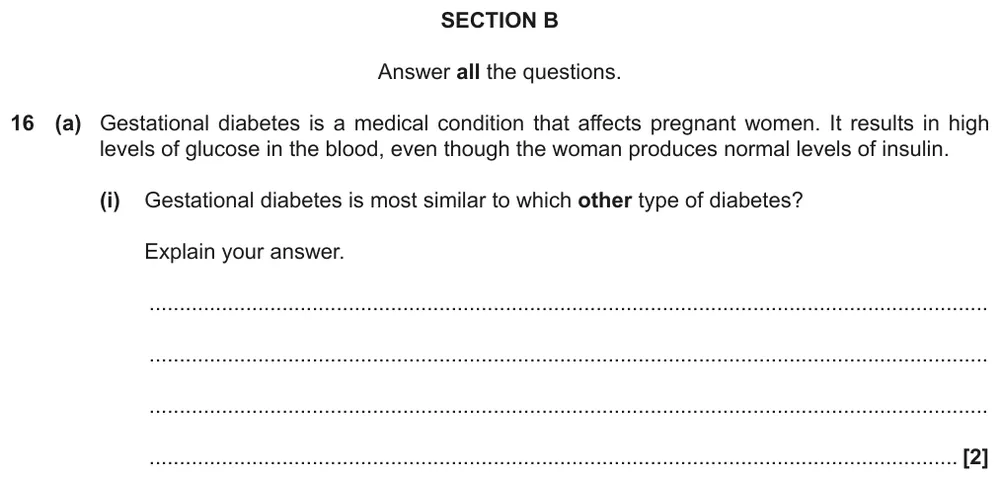
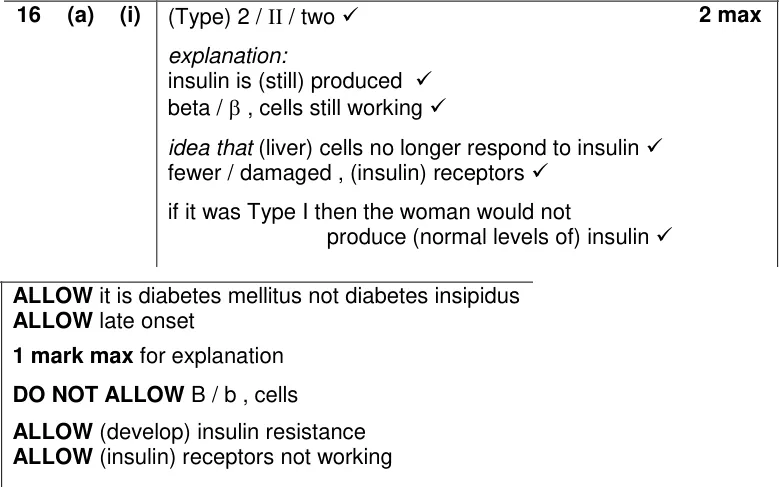
Say which type of diabetes gestational diabetes is most like, and explain.
Show the mark scheme
Tap an image to open it full size.
From the examiners' report: Say Type 2 and explain that insulin is still made but the target cells, not "the body", don't respond to it.
Question 8
A level Paper 1 · June 2018 · Q16(a)(ii) · 2 marks · Medium
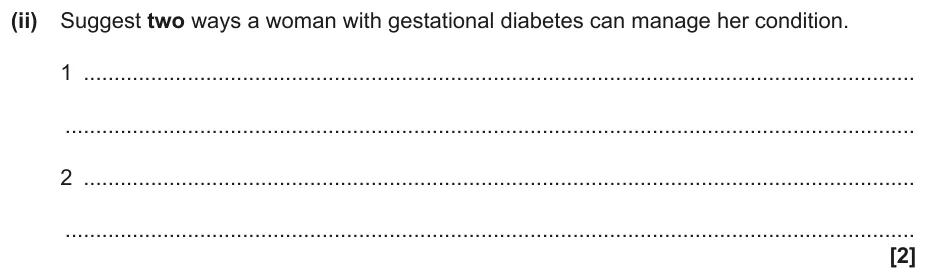
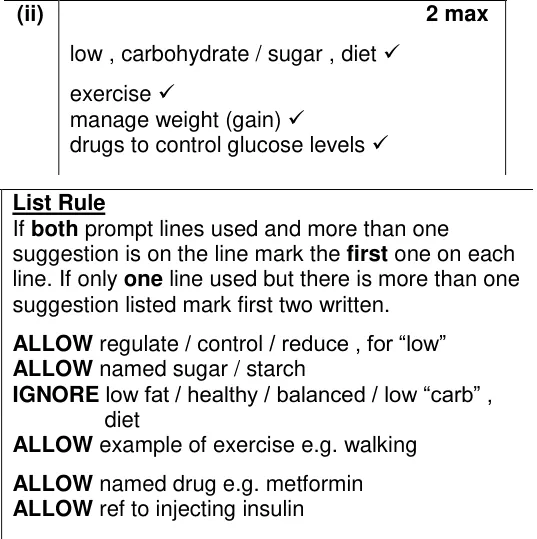
Suggest two ways a woman with gestational diabetes can manage her condition.
Show the mark scheme
Tap an image to open it full size.
From the examiners' report: Be specific about diet: a low-sugar or low-carbohydrate diet scores, but a "healthy diet" doesn't.
Question 9
A level Paper 1 · June 2018 · Q16(b)(i) · 1 mark · Medium
Name the other main tissue, besides skeletal muscle, that removes glucose from the blood in response to insulin.

Show the mark scheme

Tap an image to open it full size.
From the examiners' report: The answer is liver tissue. The question asks for a tissue, so naming cells such as hepatocytes, or another type of muscle, didn't score.
Applying what you know
Question 10
A level Paper 3 · June 2019 · Q2(b)(i) · 2 marks · Medium
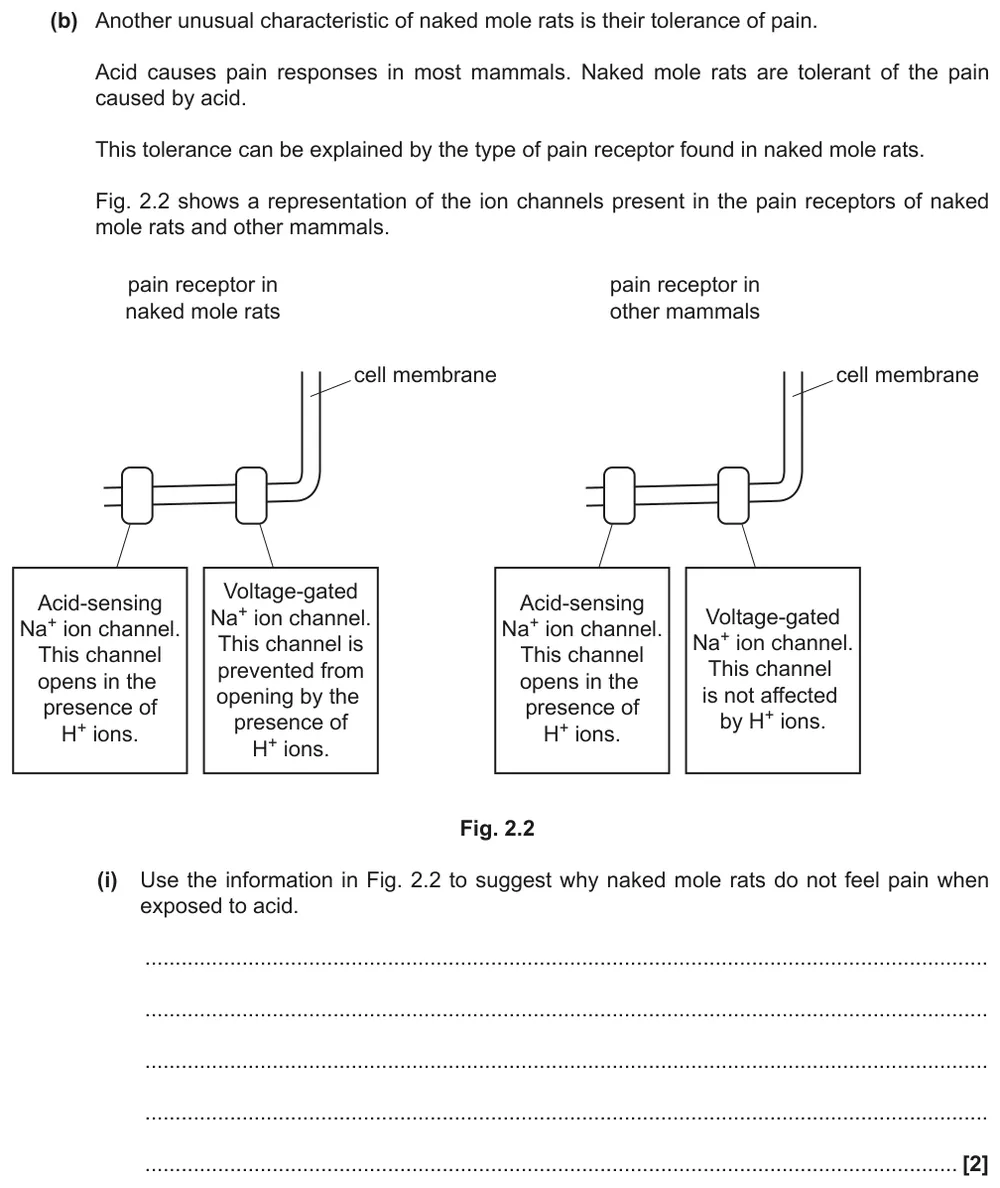
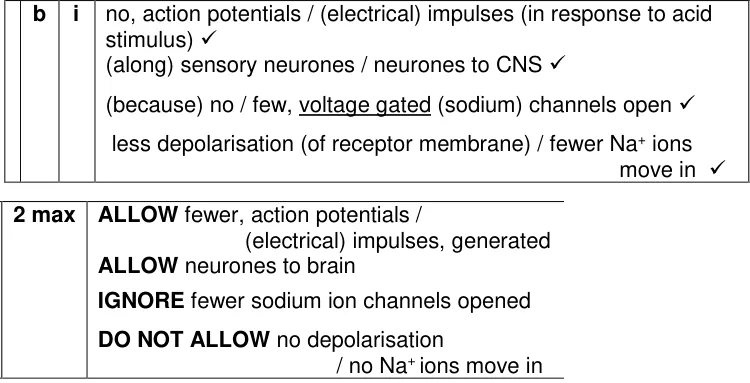
Use a diagram of ion channels to suggest why naked mole rats don't feel pain from acid.
Show the mark scheme
Tap an image to open it full size.
From the examiners' report: Separate the generator potential (acid-sensing channels) from the action potential (voltage-gated channels). Say fewer sodium ions enter and fewer action potentials are sent, not none, and use "action potential" rather than "message".
Question 11
A level Paper 3 · June 2019 · Q2(b)(ii) · 1 mark · Easy
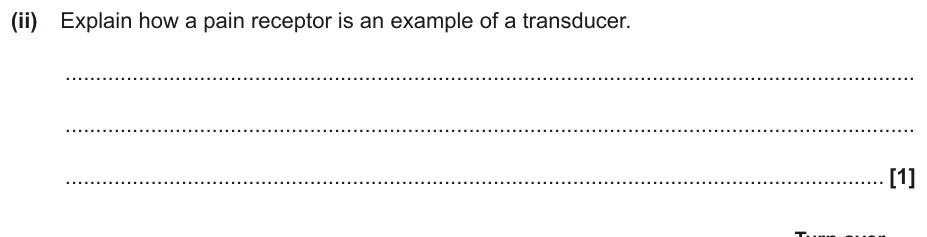
Explain how a pain receptor is an example of a transducer.
Show the mark scheme
Tap an image to open it full size.
From the examiners' report: Don't just define a transducer: apply it. Name the stimulus energy, such as chemical (H+ ions), and say the receptor converts it into electrical impulses.
Question 12
A level Paper 1 · June 2018 · Q21(a)(i) · 4 marks · Medium
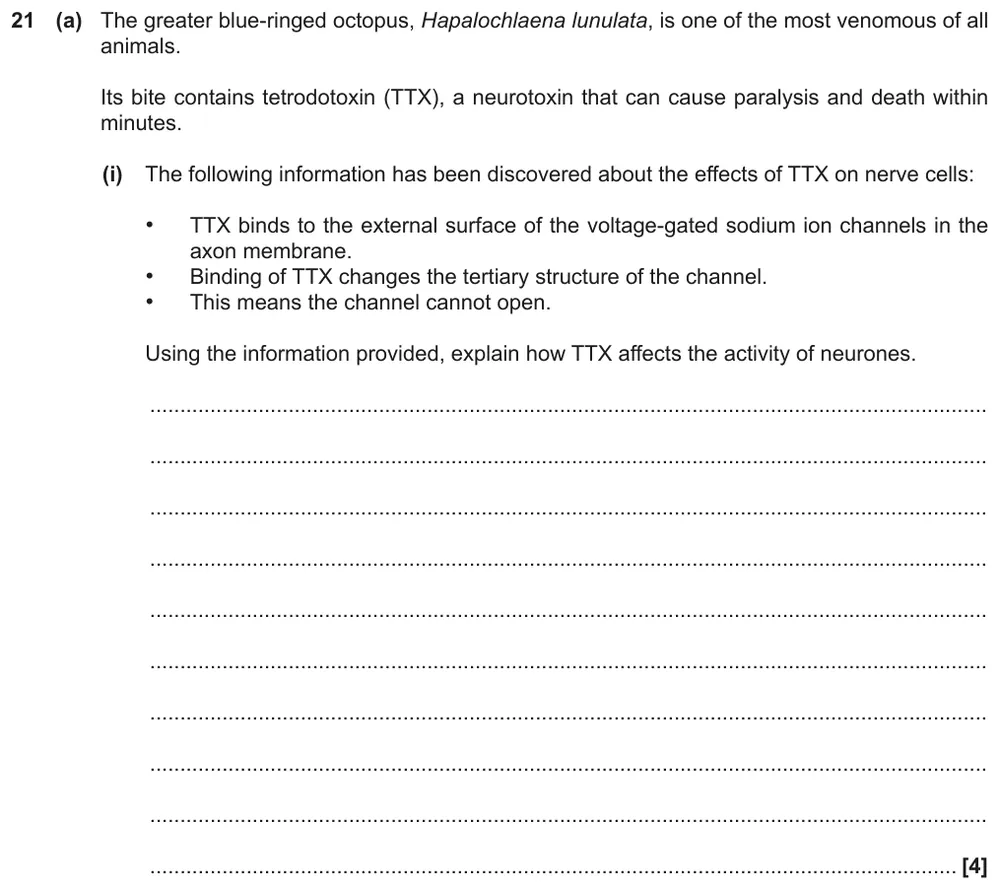
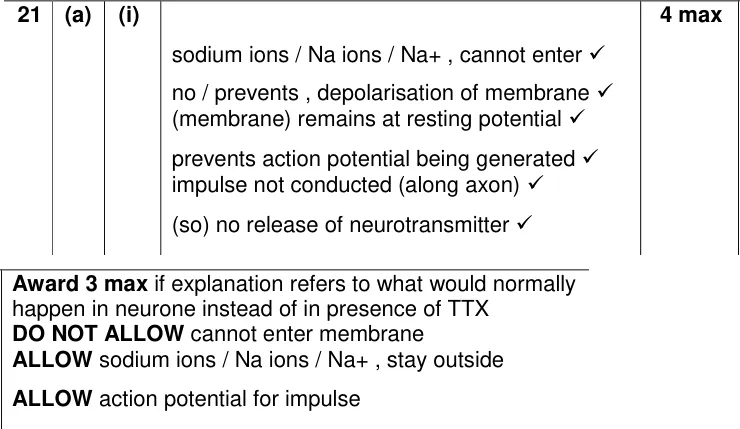
Explain how tetrodotoxin, which stops voltage-gated sodium channels opening, affects neurones.
Show the mark scheme
Tap an image to open it full size.
From the examiners' report: Describe what happens with TTX present, not how a normal neurone works, and say it is the axon membrane that isn't depolarised.
Question 13
A level Paper 1 · June 2018 · Q21(b) · 1 mark · Medium
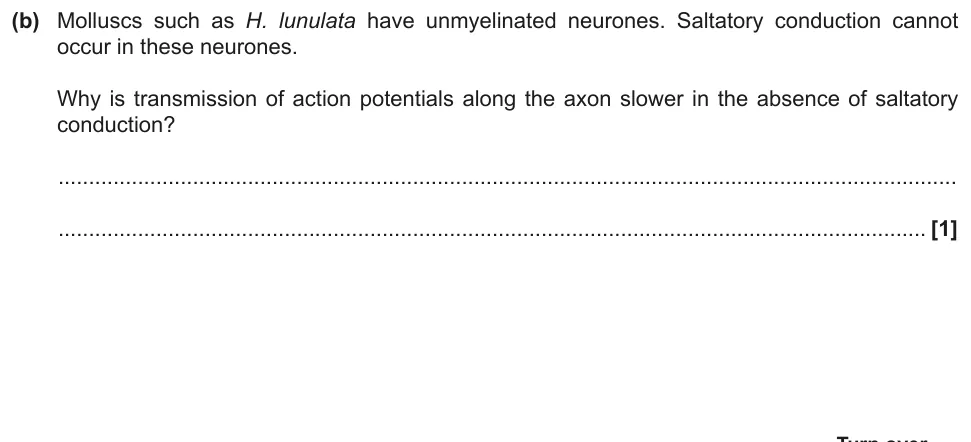
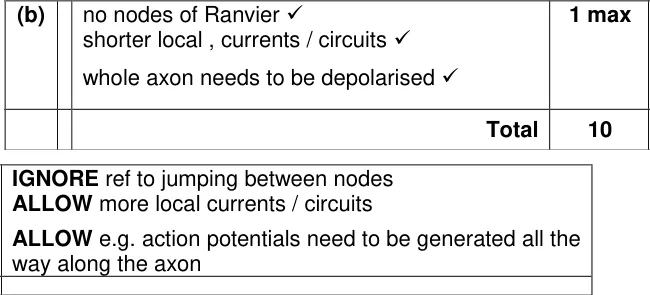
Explain why action potentials travel more slowly along unmyelinated neurones.
Show the mark scheme
Tap an image to open it full size.
From the examiners' report: Don't repeat the stem about not jumping from node to node. Say the whole length of the axon membrane has to be depolarised.
Question 14
A level Paper 1 · June 2022 · Q21(c)(i) · 2 marks · Hard
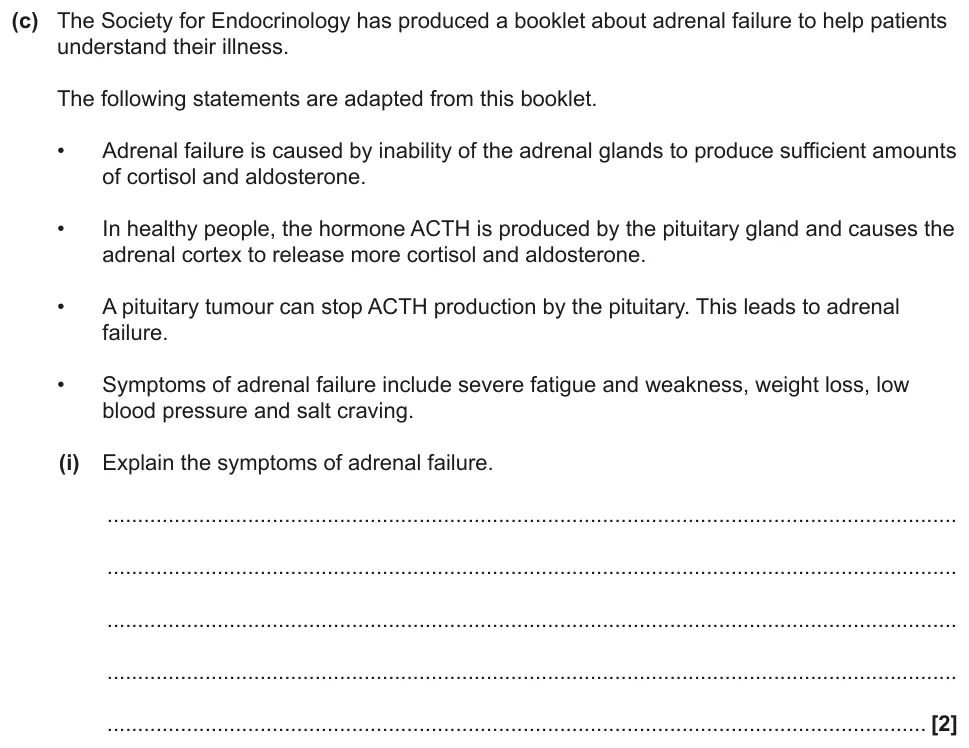
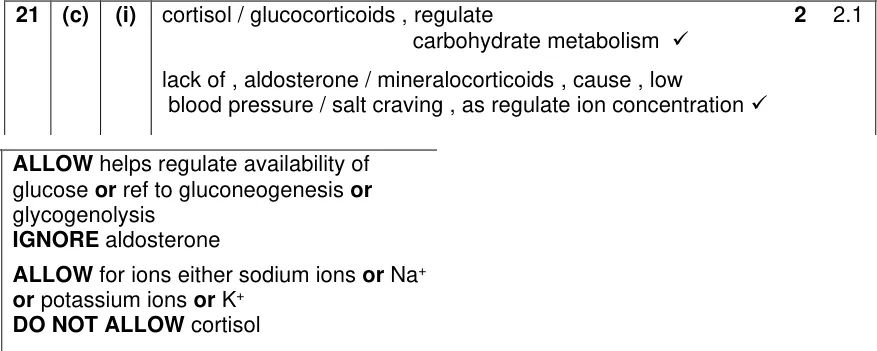
Explain the symptoms of adrenal failure.
Show the mark scheme
Tap an image to open it full size.
From the examiners' report: Match each hormone to its own symptoms: cortisol regulates carbohydrate metabolism, aldosterone regulates sodium and potassium ion concentrations. Say ions, not salts.
Question 15
A level Paper 1 · June 2022 · Q21(c)(ii) · 3 marks · Easy
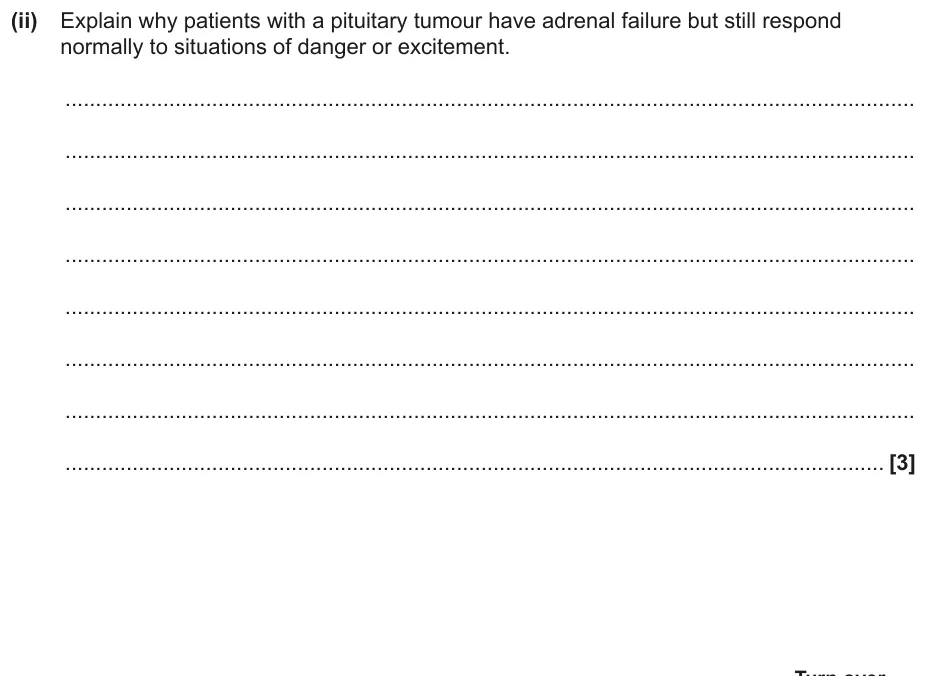
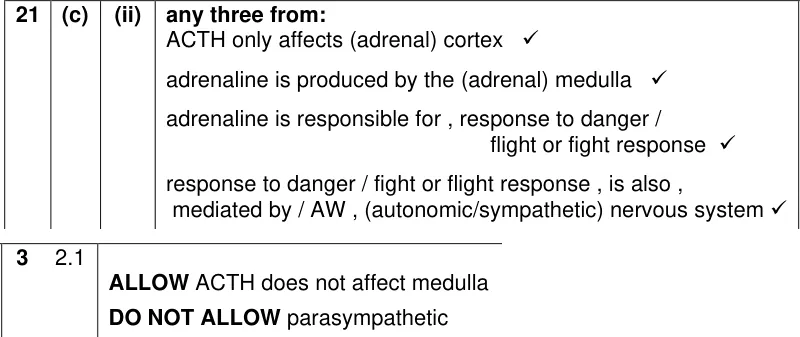
Explain why patients with a pituitary tumour still respond normally to danger.
Show the mark scheme
Tap an image to open it full size.
From the examiners' report: Link adrenaline to the adrenal medulla, which ACTH doesn't control. If you mention the sympathetic nervous system, say it also triggers the fight or flight response.
Question 16
A level Paper 1 · November 2021 · Q17(b)(i) · 1 mark · Hard
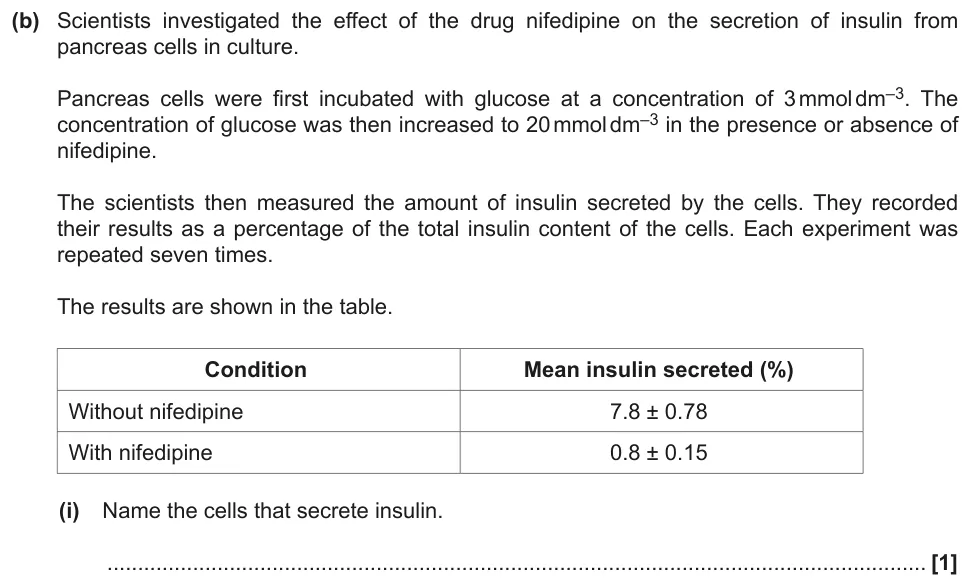
Name the cells that secrete insulin.
Show the mark scheme

Tap an image to open it full size.
Question 17
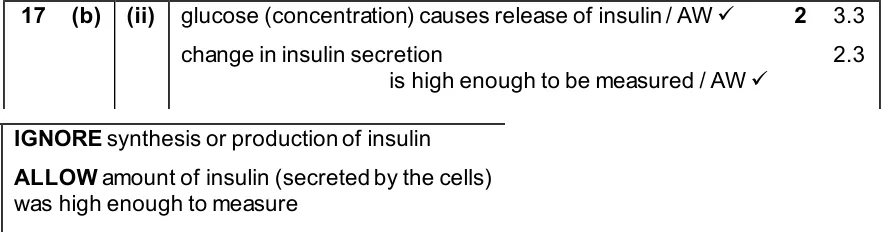
A level Paper 1 · November 2021 · Q17(b)(ii) · 2 marks · Hard
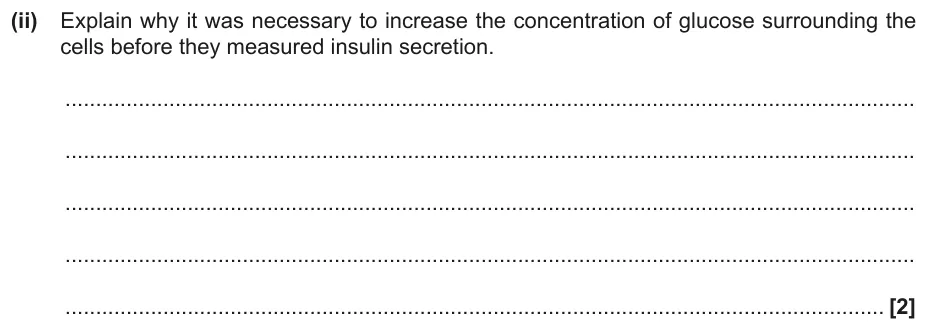
Explain why the glucose concentration was raised before insulin secretion was measured.
Show the mark scheme
Tap an image to open it full size.
Question 18
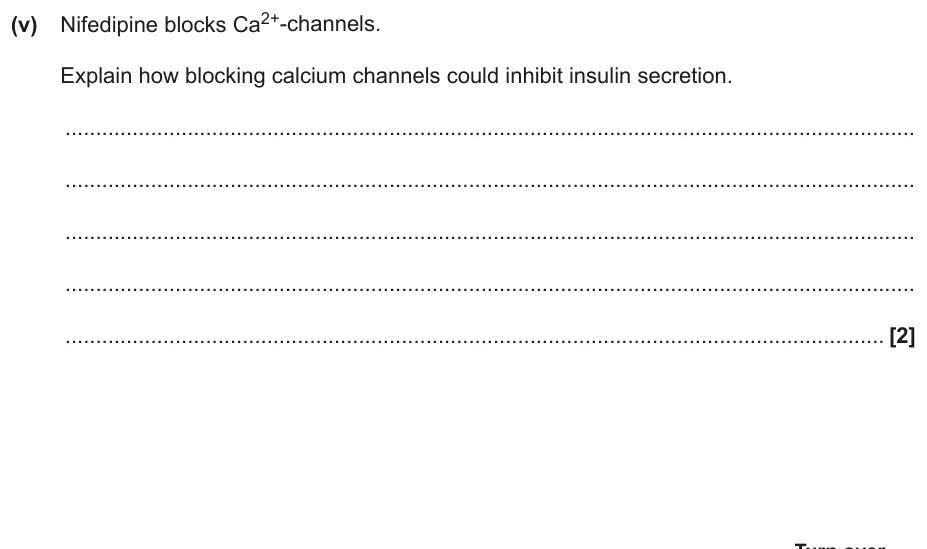
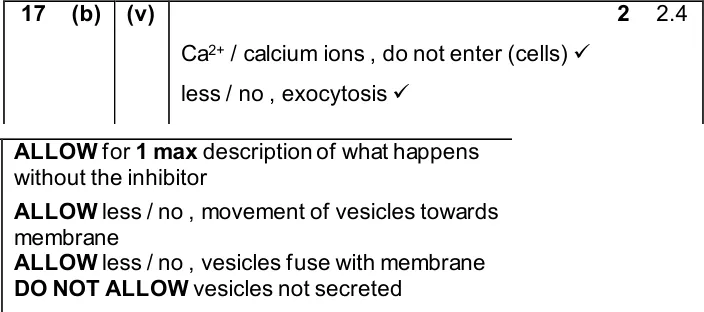
A level Paper 1 · November 2021 · Q17(b)(v) · 2 marks · Hard
Explain how blocking calcium channels could inhibit insulin secretion.
Show the mark scheme
Tap an image to open it full size.
Experiments and extended answers
Question 19
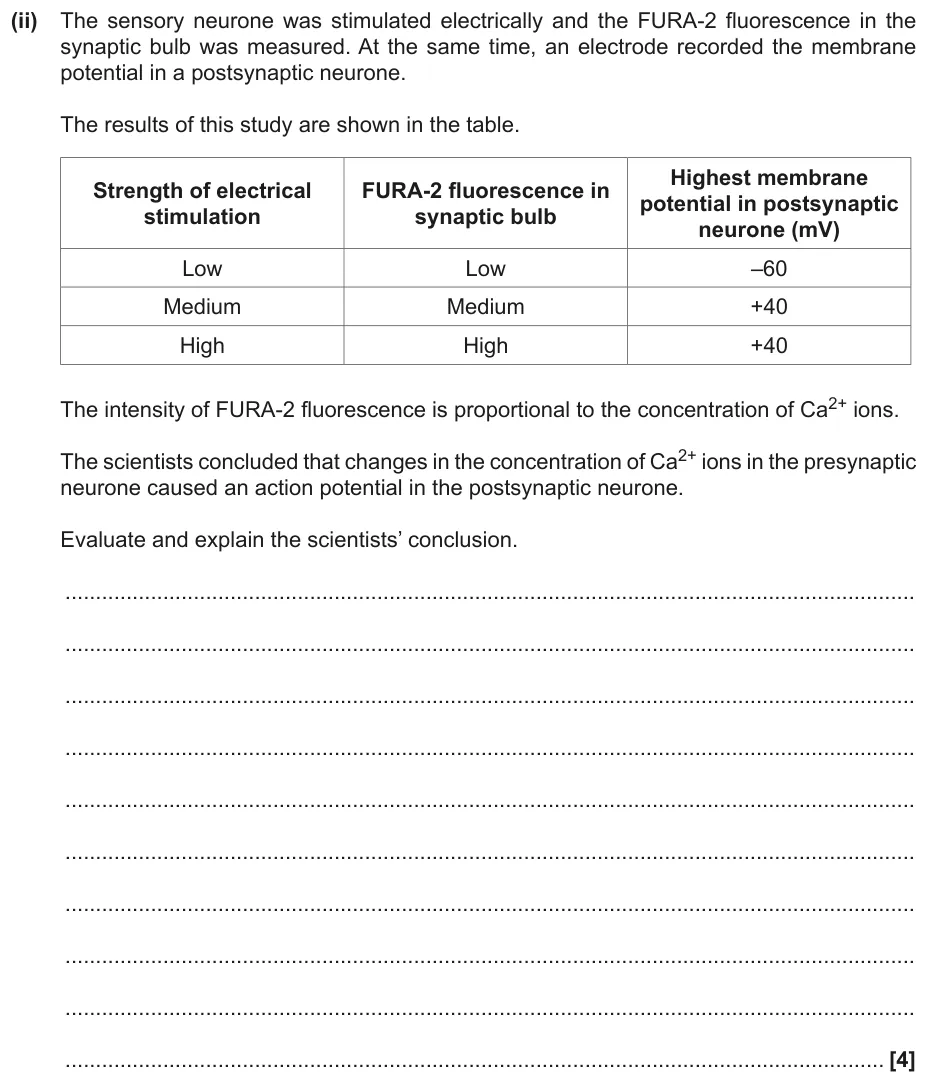
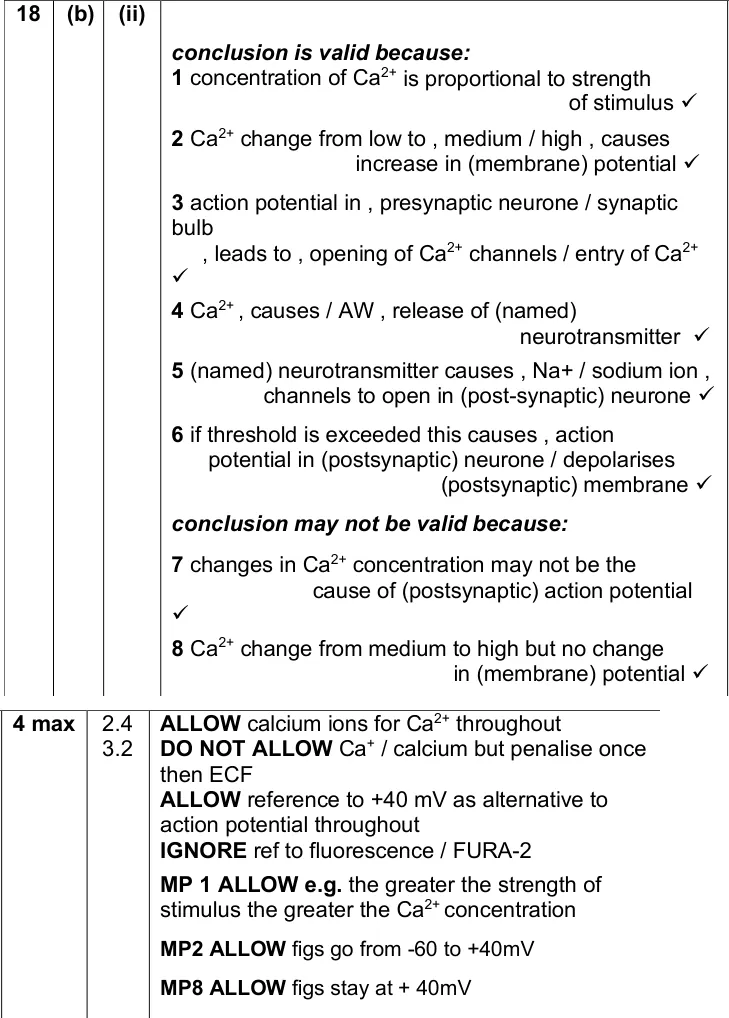
A level Paper 1 · November 2020 · Q18(b)(ii) · 4 marks · Medium
Evaluate the conclusion that a rise in presynaptic Ca²⁺ causes an action potential in the postsynaptic neurone.
Show the mark scheme
Tap an image to open it full size.
From the examiners' report: Analyse the table first: Ca²⁺ concentration rises with stimulus strength. Then explain the link (Ca²⁺ causes neurotransmitter release) and give a point against, such as no change in potential from medium to high.
Question 20
A level Paper 1 · November 2021 · Q17(c) · 6 marks · Hard
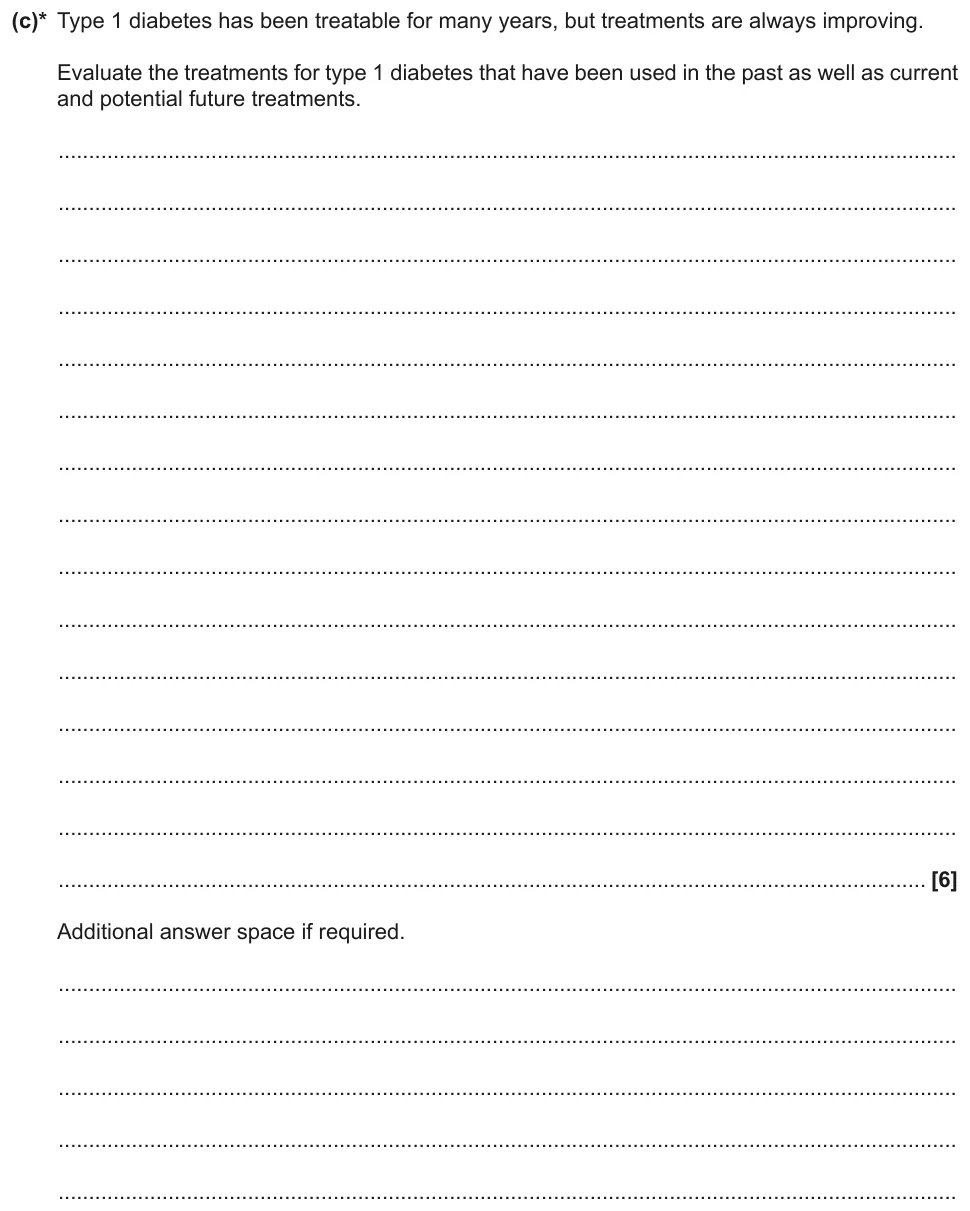
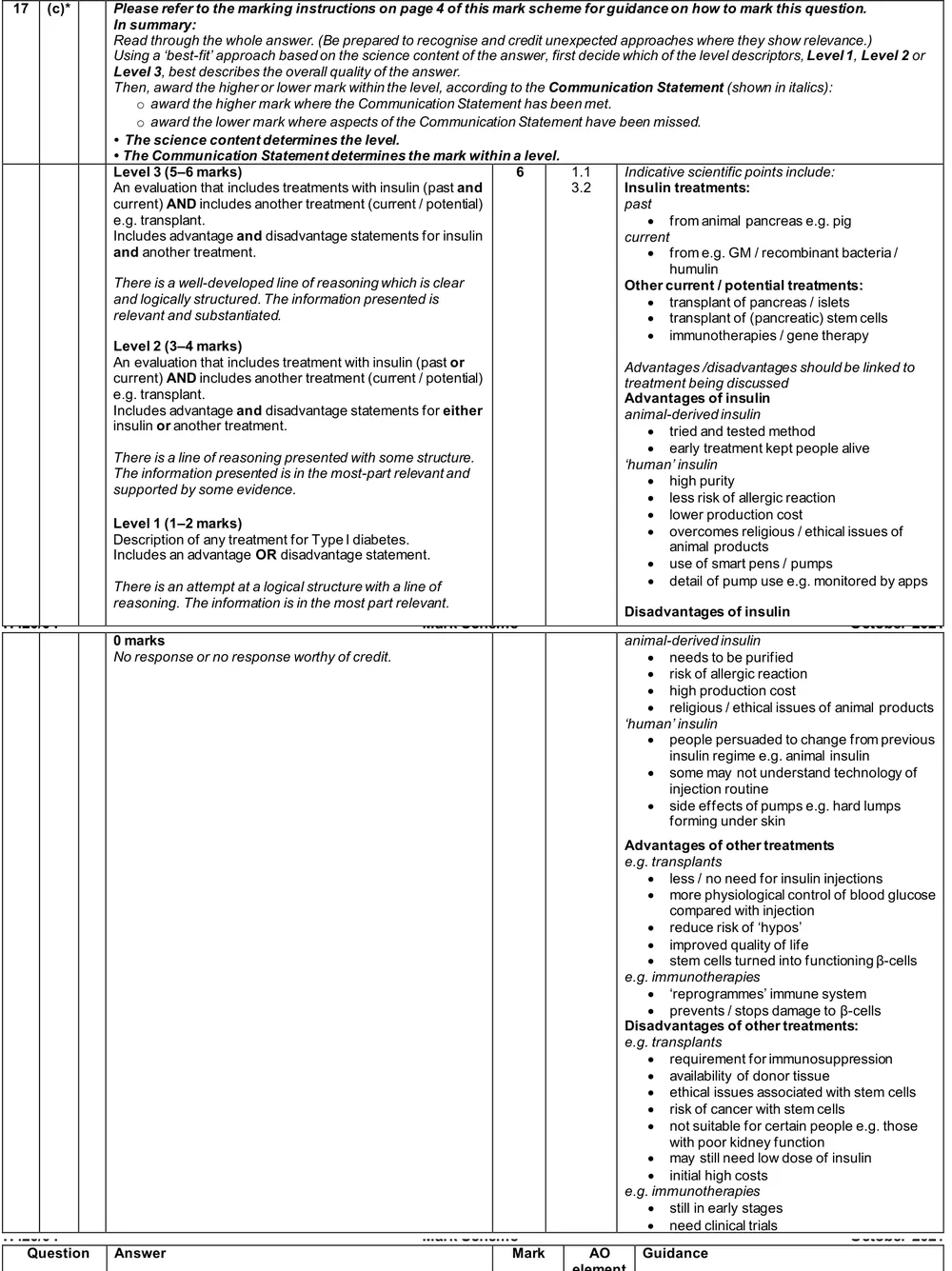
Evaluate past, current and potential treatments for Type 1 diabetes (6 marks).
Show the mark scheme
Tap an image to open it full size.
From the examiners' report: Evaluating means giving advantages and disadvantages, not just describing treatments. For Level 3, weigh up insulin (animal and GM) and at least one other treatment, such as transplants or stem cells.
Where students lose marks (from OCR examiners' reports and mark schemes)
Each point below is followed by wording that gained marks.
Fewer sodium ions, not none: Explaining why naked mole rats feel no pain from acid, many said no sodium ions enter or no depolarisation occurs, or wrote about a "signal" or "message".
✔ Gains credit: "Fewer voltage-gated sodium channels open, so less depolarisation and fewer action potentials along sensory neurones to the CNS"; "no depolarisation" is not allowed.
Vesicles fuse; they don't cross the cleft: Some students lost the mark by saying they could see vesicles moving across the synaptic cleft.
✔ Gains credit: "Structure A, because it contains vesicles fused with the membrane" (neurotransmitter is released by exocytosis).
Unmyelinated means the whole axon depolarises: Most answers repeated that the impulse can't jump from node to node, which was already in the question.
✔ Gains credit: "There are no nodes of Ranvier, so the whole axon membrane has to be depolarised".
Describe TTX at work, not a normal neurone: Weaker answers described normal nerve transmission instead of the effect of TTX, and didn't say it is the axon membrane that fails to depolarise.
✔ Gains credit: "Na+ cannot enter, so the axon membrane is not depolarised and stays at resting potential; no action potential is generated".
Cortisol for carbohydrates, aldosterone for ions: Many students didn't say cortisol regulates carbohydrate metabolism, wrote about salts instead of ions, or gave both hormones every symptom.
✔ Gains credit: "Cortisol regulates carbohydrate metabolism" and "lack of aldosterone causes low blood pressure because it regulates sodium ion concentration".
Steroid receptors sit inside the target cell: Some students said steroids can cross the membrane but still put the receptor on the membrane, or thought lipid solubility stops them getting in.
✔ Gains credit: "Inside the cell, in the cytoplasm or nucleus, because steroids can cross the cell surface membrane".
Low-carbohydrate diet, not a healthy diet: Suggesting how to manage gestational diabetes, answers that only said "maintain a healthy diet" weren't credited.
✔ Gains credit: "A low-carbohydrate or low-sugar diet" and "exercise".
Too many red cells for a capillary: Labelling pancreatic tissue, some students called structure C a capillary or named a hepatic blood vessel.
✔ Gains credit: "C = (named) blood vessel, e.g. arteriole or venule"; "capillary" is not allowed.
Download the questions
Download the PDF pack (20 questions, mark schemes at the end)
Keep practising
- Neuronal and Hormonal Communication quiz
- Neuronal communication: interactive written questions (12)
- Hormonal communication: interactive written questions (15)
- Sensory Receptors and Neurones: OCR A exam questions with worked answers
- Homeostasis and Excretion (5.1.1–5.1.2): OCR A Level Biology exam questions by topic
- Plant and Animal Responses (5.1.5): OCR A Level Biology exam questions by topic
- OCR A Level Biology masterclasses
Questions, mark schemes and examiners' report extracts © OCR.