

These two spec points sit together at the start of Module 5. Spec point 5.1.1 asks why multicellular organisms need communication systems, how cell signalling works, what negative and positive feedback are, and how endotherms and ectotherms control their body temperature. Spec point 5.1.2 uses excretion as the worked example of homeostasis: the liver, the structure and function of the kidney and nephron, how ADH controls the water potential of the blood, kidney failure and its treatment, and what urine tests can diagnose.
Most of the marks go on precision. Students define an endotherm without mentioning heat, write about the adrenal medulla when the kidney medulla is labelled, say ions instead of naming sodium and chloride ions, or blame high blood electrolytes on reabsorption when the filtration rate is the problem. In the long answers about ADH, the posterior pituitary is the step most often left out.
Work through the twenty questions below in order. They start with recall of definitions and kidney structure, move on to applying what you know to unfamiliar animals and patients, and finish with data on kidney function and a six-mark answer on ADH. If you'd like to go through questions like these with me each week, my OCR A masterclasses run on Wednesdays at 5.15pm for Year 12 and on Tuesdays at 6.30pm or Thursdays at 5.15pm for Year 13.
Want help with this topic? It comes up in my weekly OCR A masterclasses. See the timetable →
What you need from GCSE
Each question on this page assumes you're secure on these GCSE ideas. If any of them feels shaky, look it up before you start.
- Homeostasis is the regulation of internal conditions, such as body temperature, blood glucose and water content, so that cells work at their best.
- Control systems have receptors, coordination centres (the brain, spinal cord or pancreas) and effectors (muscles or glands).
- Body temperature is monitored by the thermoregulatory centre in the brain; sweating, vasodilation, vasoconstriction and shivering help keep it constant.
- The kidneys filter the blood, reabsorb useful substances and remove urea, excess ions and excess water in urine.
- ADH, released by the pituitary gland, makes the kidney tubules reabsorb more water. Kidney failure can be treated by dialysis or a transplant.
Key terms
These words come up in the questions and mark schemes. Examiners expect you to use them exactly.
- Homeostasis: keeping the internal environment within narrow limits despite changes inside or outside the body.
- Negative and positive feedback: in negative feedback a change triggers a response that reverses it; in positive feedback a change triggers a response that makes it bigger.
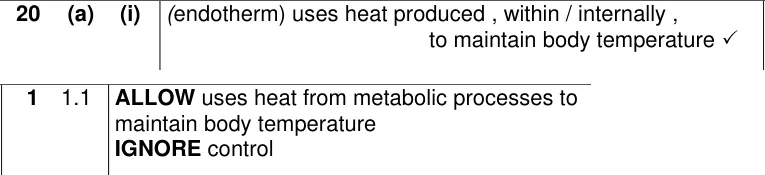
- Endotherm and ectotherm: an endotherm uses heat released inside its body by metabolism to keep its temperature up; an ectotherm relies on heat from its surroundings and controls its temperature mainly by behaviour.
- Excretion: removing the waste products of metabolism, such as carbon dioxide and urea, from the body.
- Deamination and the ornithine cycle: in the liver, the amino group is removed from excess amino acids as ammonia, which reacts with carbon dioxide to form urea.
- Ultrafiltration: filtration of small molecules out of the blood in the glomerulus, through the basement membrane and into the Bowman's capsule, under high hydrostatic pressure.
- Selective reabsorption: taking useful substances such as glucose, amino acids, ions and water back into the blood, mainly in the proximal convoluted tubule.
- Osmoreceptors and ADH: osmoreceptors in the hypothalamus detect the water potential of the blood; ADH released from the posterior pituitary makes the collecting duct walls more permeable to water.
- Glomerular filtration rate (GFR): the volume of blood filtered by the glomeruli each minute, used to judge how well the kidneys are working.
What these questions cover (OCR 5.1.1 and 5.1.2)
The questions test these learning outcomes from the OCR A Level Biology A specification (H420):
- 5.1.1(a) the need for communication systems in multicellular organisms
- 5.1.1(b) the communication between cells by cell signalling (signalling between adjacent cells and between distant cells)
- 5.1.1(c) the principles of homeostasis (including receptors and effectors, and negative and positive feedback)
- 5.1.1(d) the physiological and behavioural responses involved in temperature control in ectotherms and endotherms
- 5.1.2(a) the term excretion and its importance in maintaining metabolism and homeostasis
- 5.1.2(b)(i) the structure and functions of the mammalian liver (including glycogen storage, detoxification and the formation of urea)
- 5.1.2(b)(ii) the examination and drawing of stained sections to show the histology of liver tissue
- 5.1.2(c)(i) the structure, mechanisms of action and functions of the mammalian kidney
- 5.1.2(c)(ii) the dissection, examination and drawing of the external and internal structure of the kidney
- 5.1.2(c)(iii) the examination and drawing of stained sections to show the histology of nephrons
- 5.1.2(d) the control of the water potential of the blood (osmoreceptors, the posterior pituitary gland and ADH)
- 5.1.2(e) the effects of kidney failure and its potential treatments (including glomerular filtration rate, dialysis and transplants)
- 5.1.2(f) how excretory products can be used in medical diagnosis
How to use this page
Write your answer on paper before you open the mark scheme. Allow about 1.2 minutes per mark: the 20 questions are worth 49 marks, so about 59 minutes in total. Then mark your answer strictly against the mark scheme and read the examiners' tip underneath it. If you'd rather print the questions, download the PDF pack.
Recall
Question 1
A level Paper 1 · June 2023 · Q20(a)(i) · 1 mark · Medium
Define the term endotherm.

Show the mark scheme
Tap an image to open it full size.
From the examiners' report: Learn this definition in full: most answers missed out the word heat. Say an endotherm uses heat produced inside its body to maintain its body temperature.
Question 2
A level Paper 1 · June 2023 · Q20(a)(ii) · 2 marks · Medium
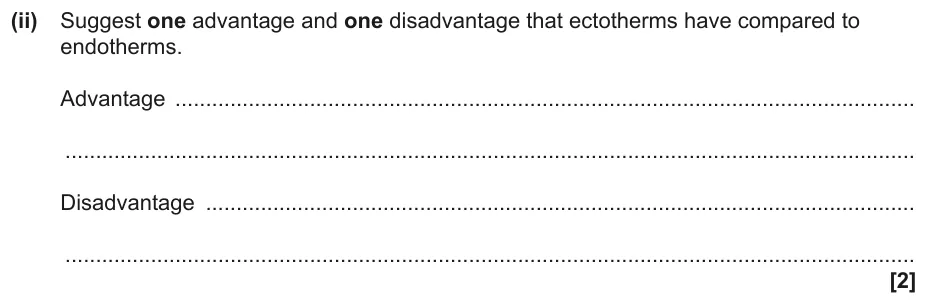
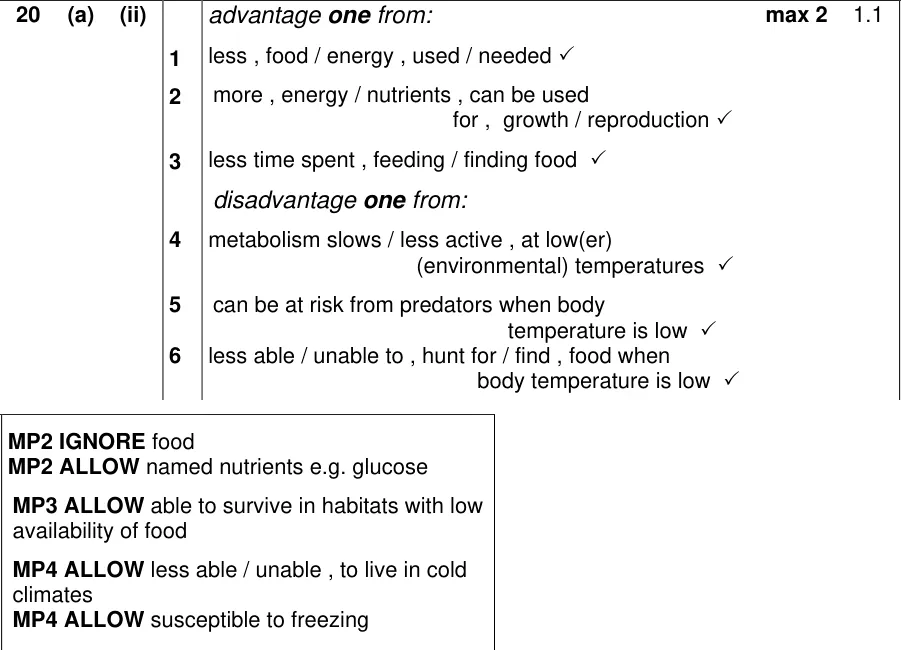
Suggest one advantage and one disadvantage that ectotherms have compared to endotherms.
Show the mark scheme
Tap an image to open it full size.
From the examiners' report: For the disadvantage, don't just say ectotherms can't control their temperature without outside heat. Say what that means for the animal, such as being slow and at risk from predators when it is cold.
Question 3
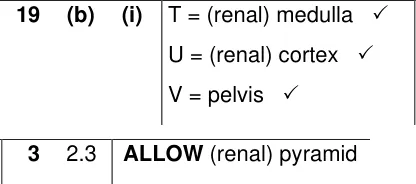
A level Paper 1 · June 2023 · Q19(b)(i) · 3 marks · Easy
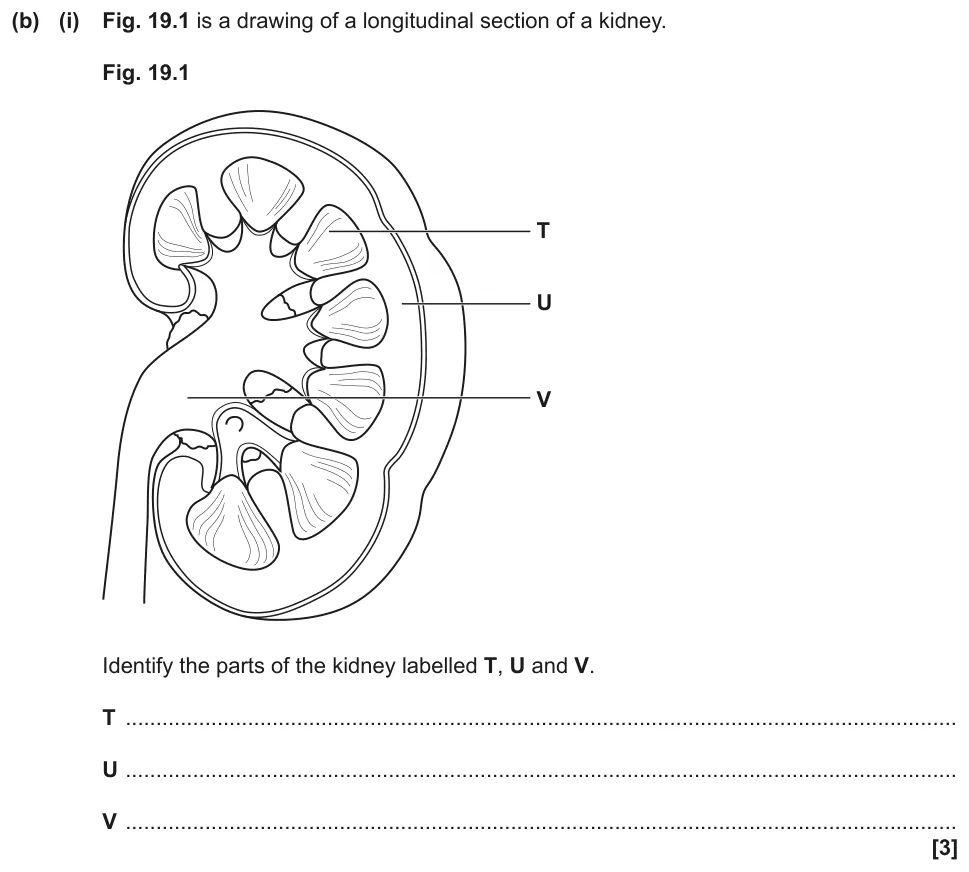
Identify the parts labelled T, U and V on a drawing of a kidney section.
Show the mark scheme
Tap an image to open it full size.
From the examiners' report: Don't swap cortex and medulla, and never write adrenal cortex or adrenal medulla for the kidney. V is the pelvis, not the ureter or the renal artery.
Question 4
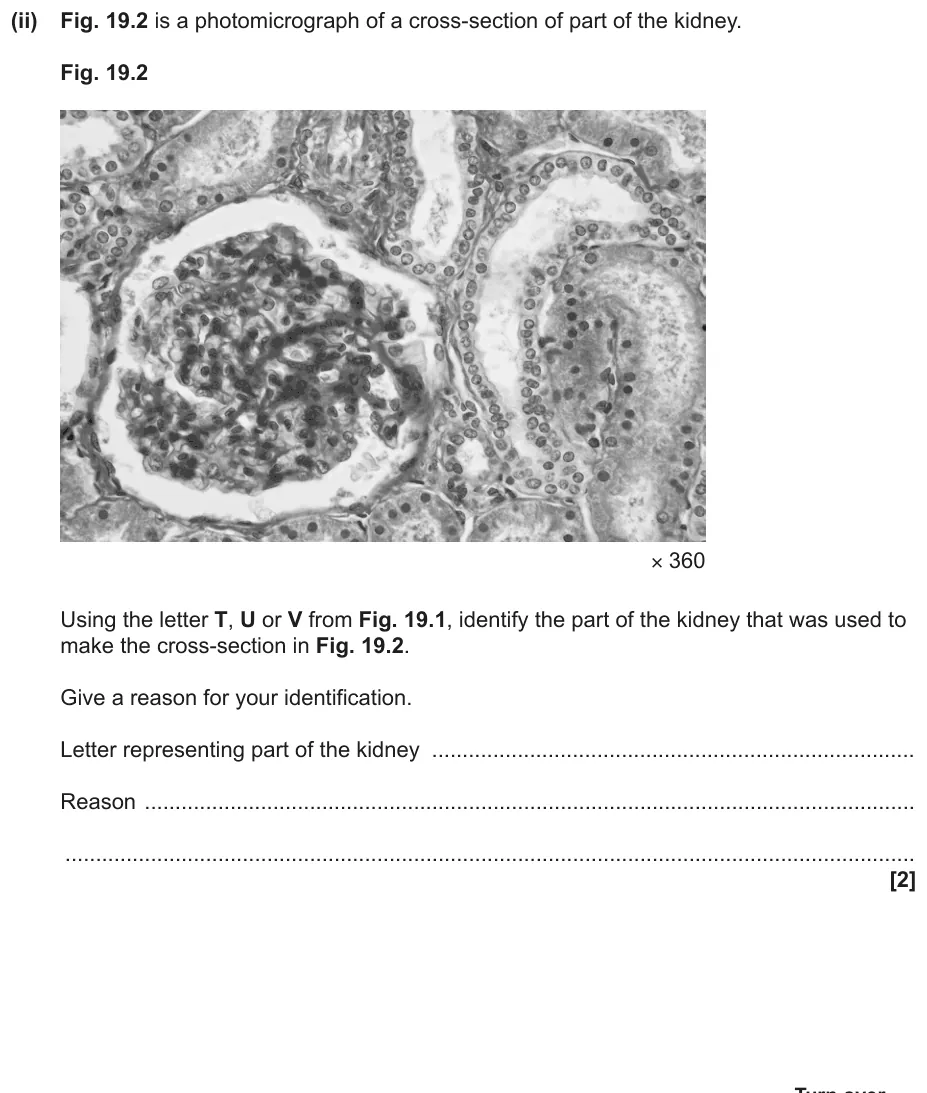
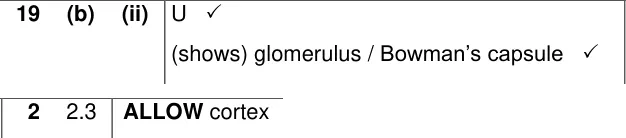
A level Paper 1 · June 2023 · Q19(b)(ii) · 2 marks · Easy
Identify which part of the kidney a photomicrograph comes from and give a reason.
Show the mark scheme
Tap an image to open it full size.
From the examiners' report: Most students got this. Give the feature you can actually see in the photomicrograph, a glomerulus or Bowman's capsule, as your reason for choosing the cortex.
Question 5
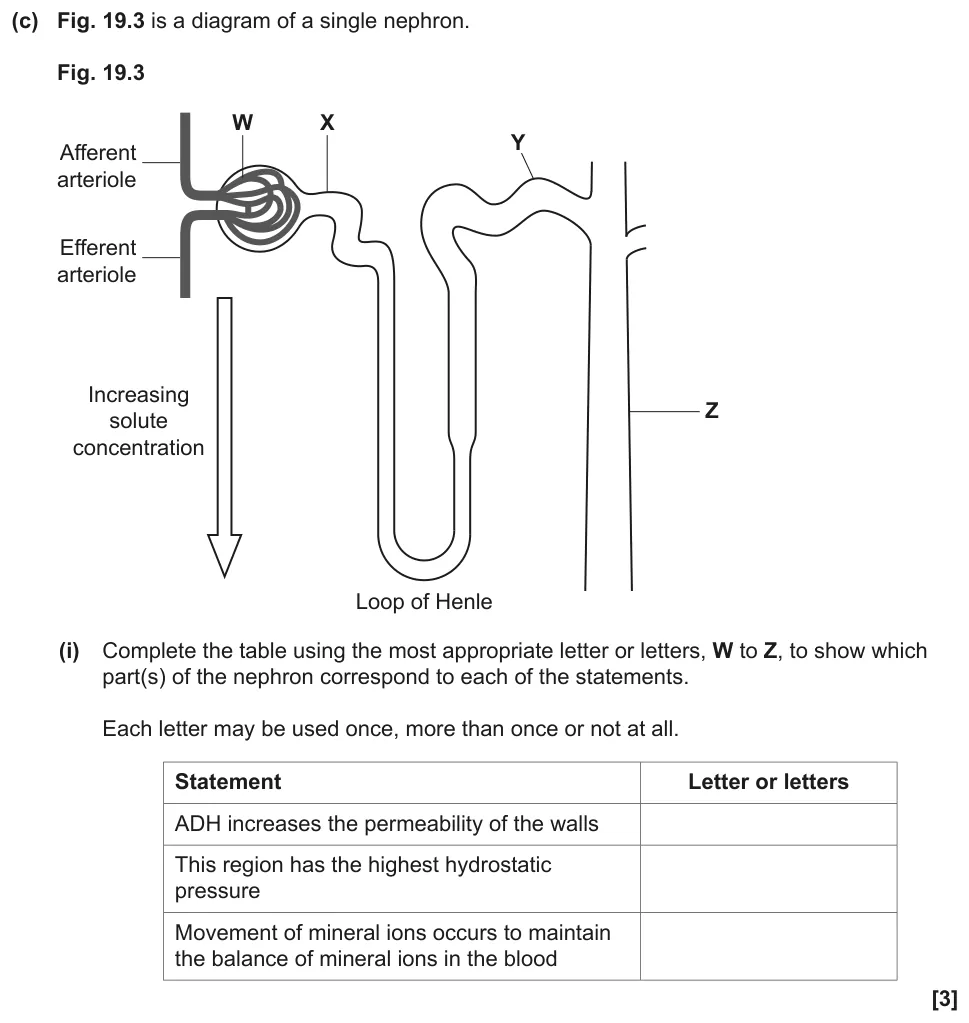
A level Paper 1 · June 2023 · Q19(c)(i) · 3 marks · Easy
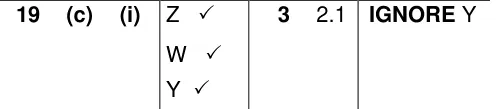
Match statements about ADH, hydrostatic pressure and ion balance to regions of a nephron.
Show the mark scheme
Tap an image to open it full size.
From the examiners' report: The third row caught most people out. Fine-tuning the balance of mineral ions happens in the distal convoluted tubule (Y), not the proximal tubule (X).
Question 6
A level Paper 1 · June 2023 · Q19(c)(ii) · 3 marks · Medium
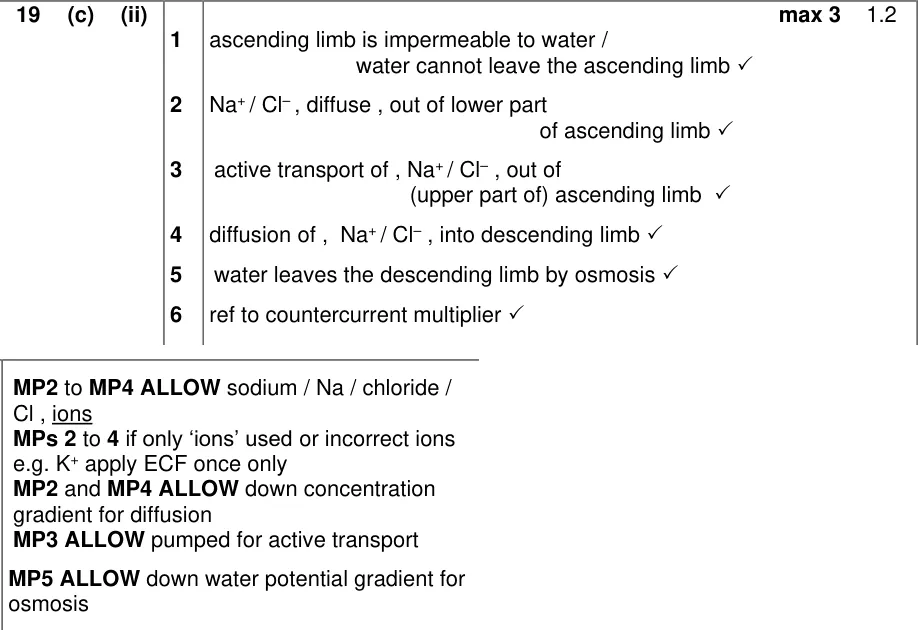
Outline the processes in the loop of Henle that make the solute concentration increase.
Show the mark scheme
Tap an image to open it full size.
From the examiners' report: Name the ions (sodium and chloride, not "salt", "solutes", K+ or Ca2+), say which limb you mean, and give the mechanism for each movement: active transport, diffusion or osmosis.
Question 7
A level Paper 3 · November 2020 · Q1(a) · 2 marks · Easy
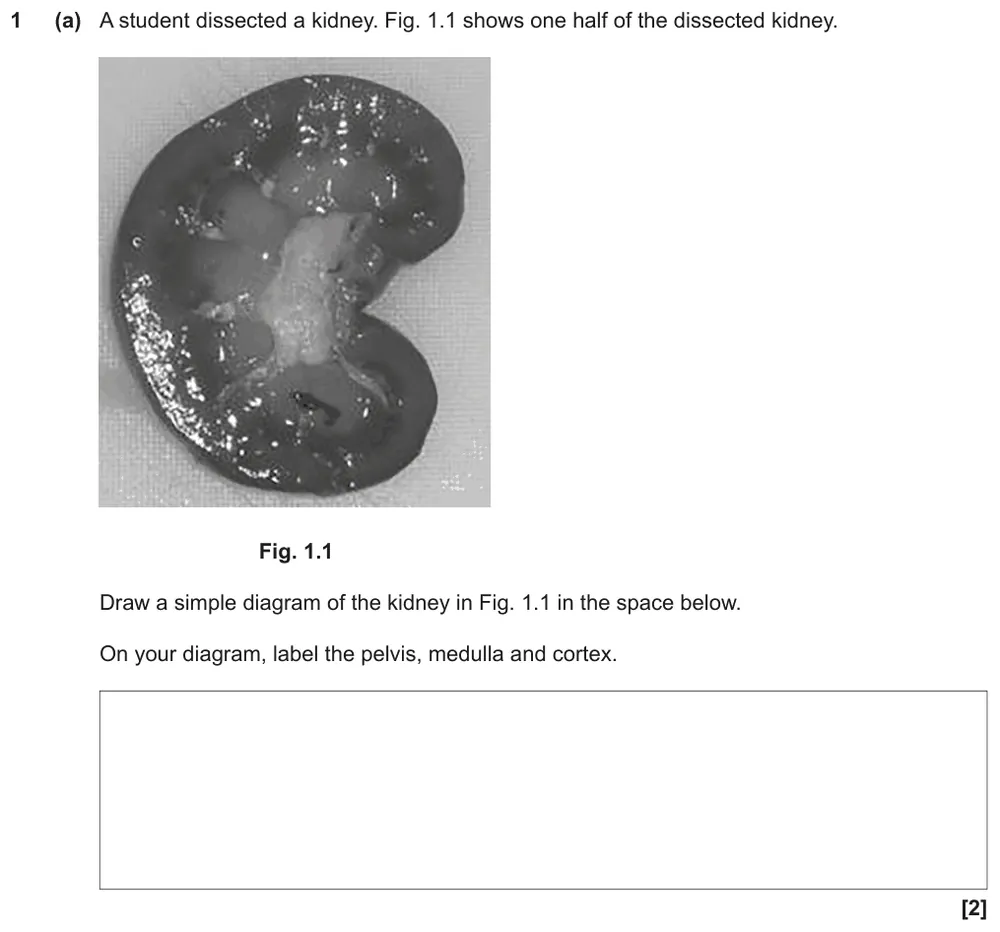
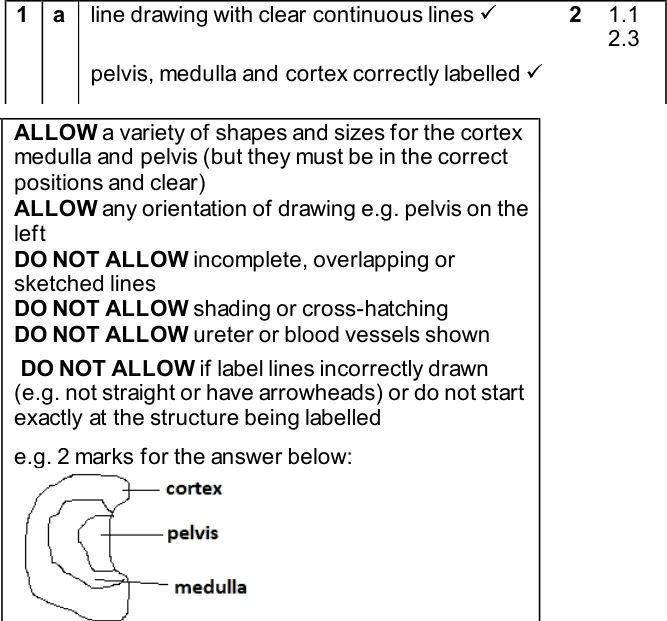
Draw a simple diagram of half a dissected kidney and label the pelvis, medulla and cortex.
Show the mark scheme
Tap an image to open it full size.
From the examiners' report: Use clear continuous lines with no shading, draw only what's visible in the photograph (no ureter or blood vessels), and use straight ruled label lines with no arrowheads that touch the tissue.
Question 8
A level Paper 3 · November 2020 · Q1(b)(ii) · 1 mark · Easy
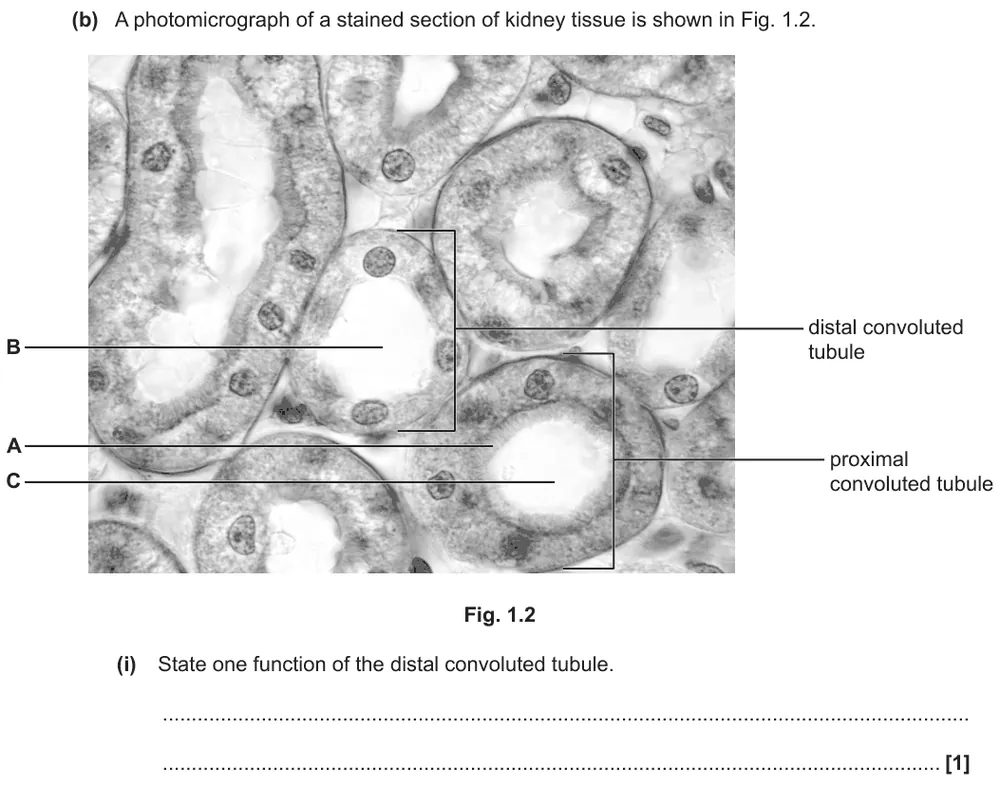
Describe the function of the structures labelled A on a photomicrograph of kidney tubules.
Information from earlier in this question:

Show the mark scheme

Tap an image to open it full size.
From the examiners' report: Many students couldn't interpret the photomicrograph. A labels microvilli on the proximal tubule cells: say they increase the surface area for reabsorption.
Applying what you know
Question 9
A level Paper 3 · June 2019 · Q2(a)(i) · 2 marks · Hard
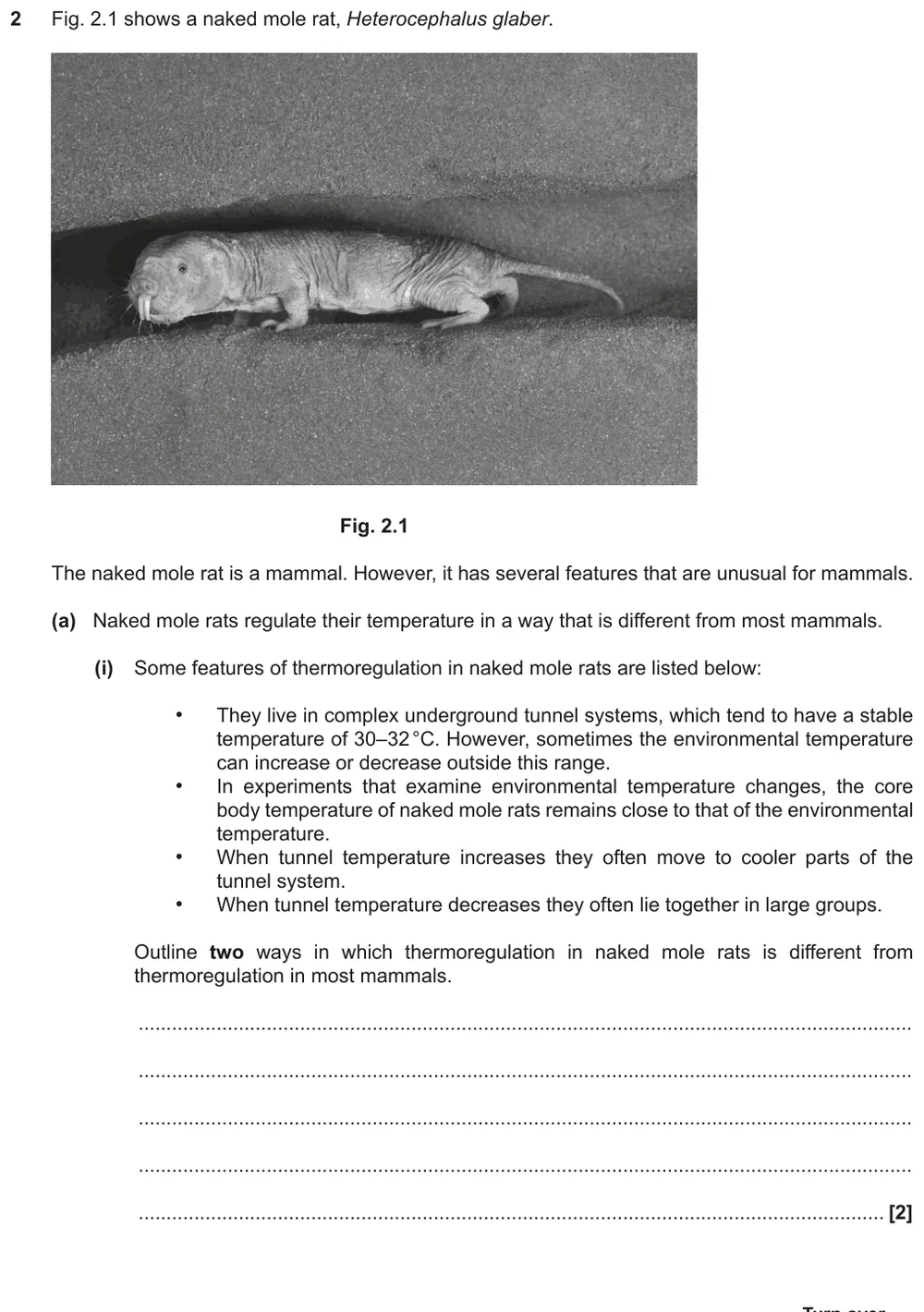
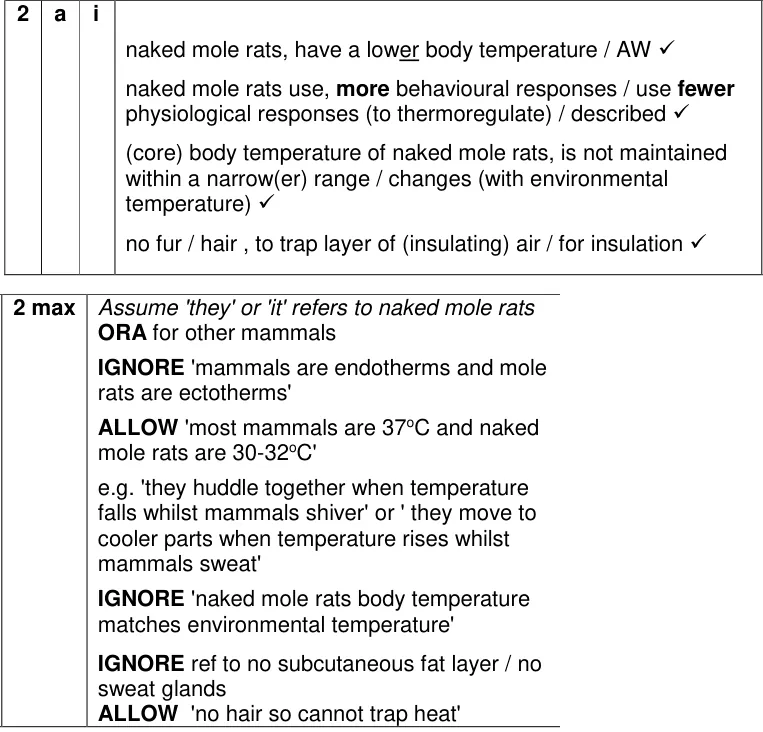
Outline two ways thermoregulation in naked mole rats differs from most mammals.
Show the mark scheme
Tap an image to open it full size.
From the examiners' report: Make each point a real comparison, using "more" or "less" and saying what most mammals do. Don't just copy the bullet points: interpret them, for example the mole rat's temperature changes with the environment.
Question 10
A level Paper 3 · June 2019 · Q2(a)(ii) · 4 marks · Medium
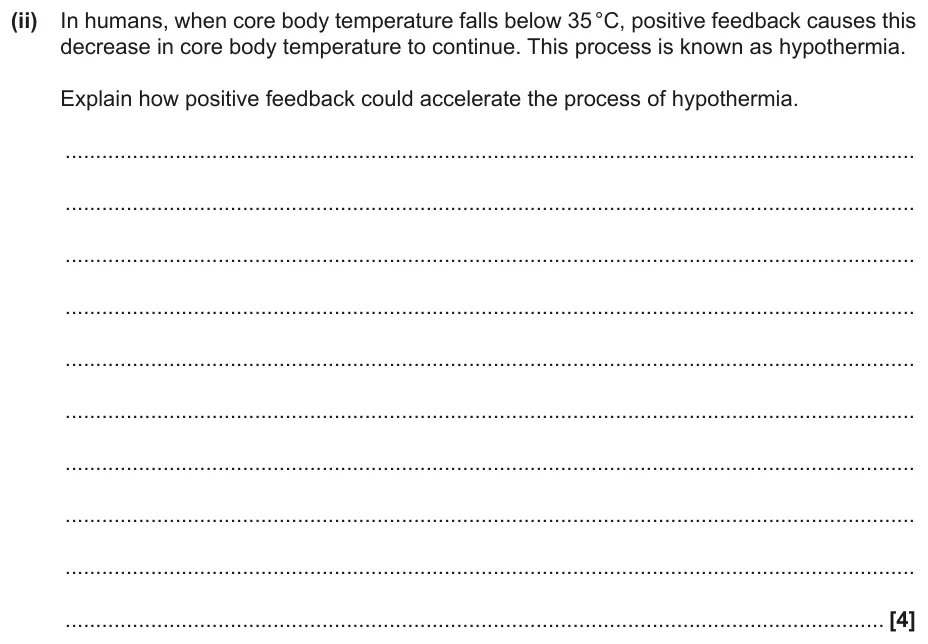
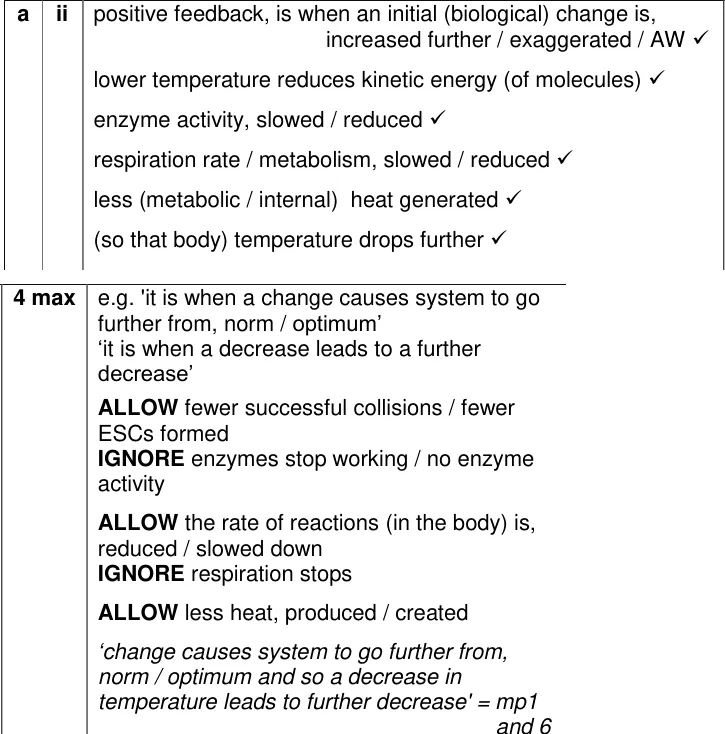
Explain how positive feedback could speed up hypothermia.
Show the mark scheme
Tap an image to open it full size.
From the examiners' report: Define positive feedback, then give the chain: lower temperature, less kinetic energy, slower enzyme activity and respiration, less heat released. Enzymes don't denature in the cold.
Question 11
A level Paper 3 · June 2019 · Q2(a)(iii) · 2 marks · Medium
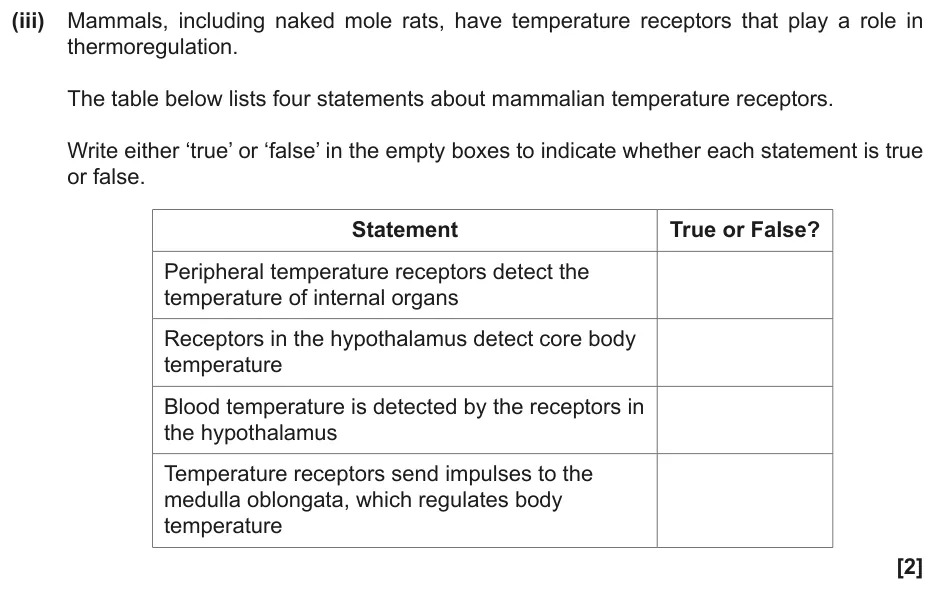
Decide whether four statements about mammalian temperature receptors are true or false.
Show the mark scheme

Tap an image to open it full size.
From the examiners' report: Know where each receptor is and what it does: the hypothalamus detects blood (core) temperature and controls body temperature, not the medulla oblongata. Write the words true and false in full when asked.
Question 12
A level Paper 1 · June 2023 · Q20(c)(i) · 2 marks · Hard
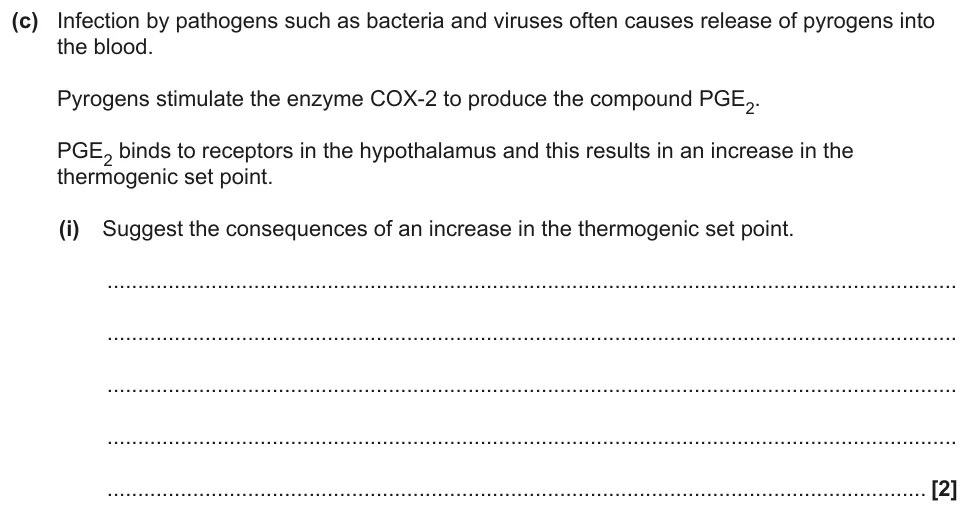
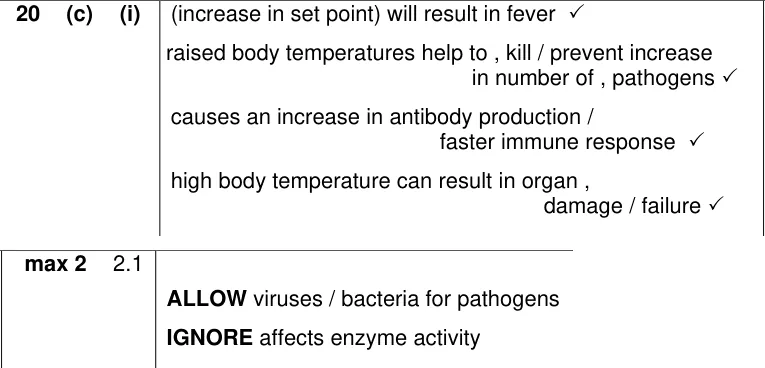
Suggest the consequences of a raised thermogenic set point during infection.
Show the mark scheme
Tap an image to open it full size.
From the examiners' report: Most students mentioned enzymes and stopped. Say the body temperature rises (a fever), then link it to fighting the infection, for example by slowing the growth of pathogens.
Question 13
A level Paper 3 · November 2020 · Q6(c) · 2 marks · Hard
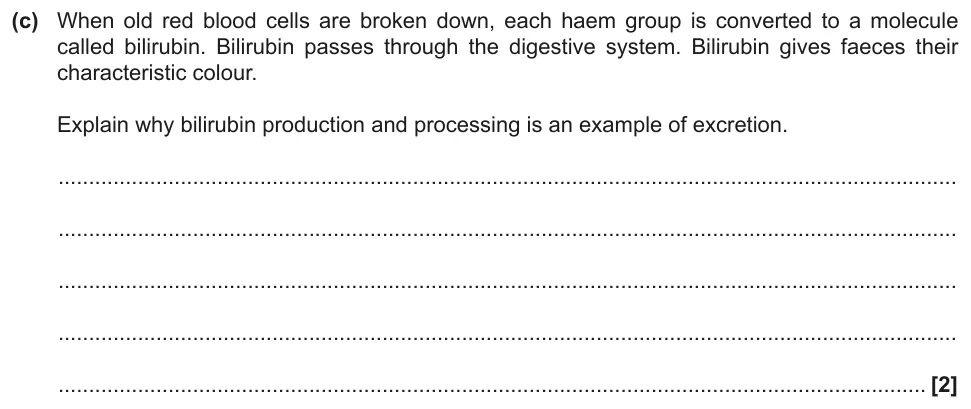
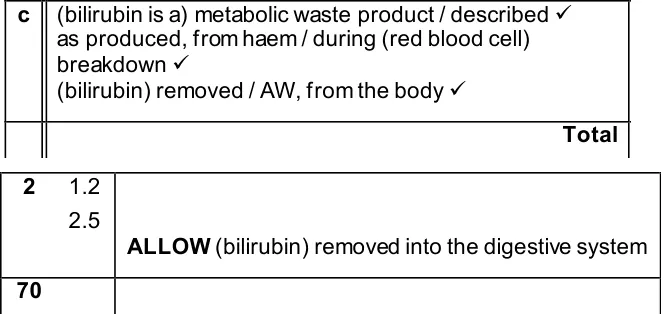
Explain why making and removing bilirubin is an example of excretion.
Show the mark scheme
Tap an image to open it full size.
From the examiners' report: Apply the definition to this example: bilirubin is a waste product of metabolism, made when haem is broken down, and it is removed from the body in the faeces.
Question 14
A level Paper 1 · June 2017 · Q17(a)(ii) · 2 marks · Medium
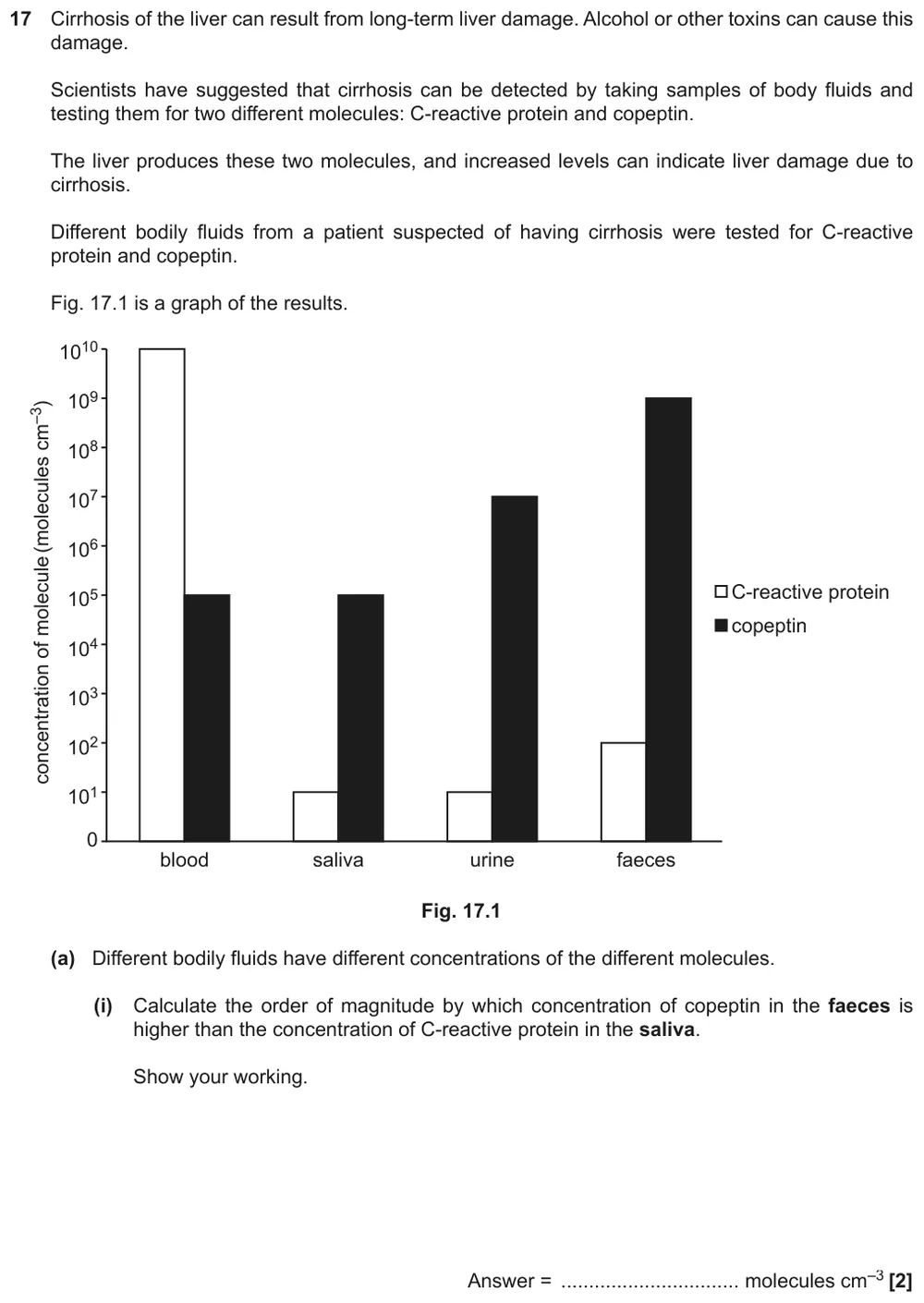
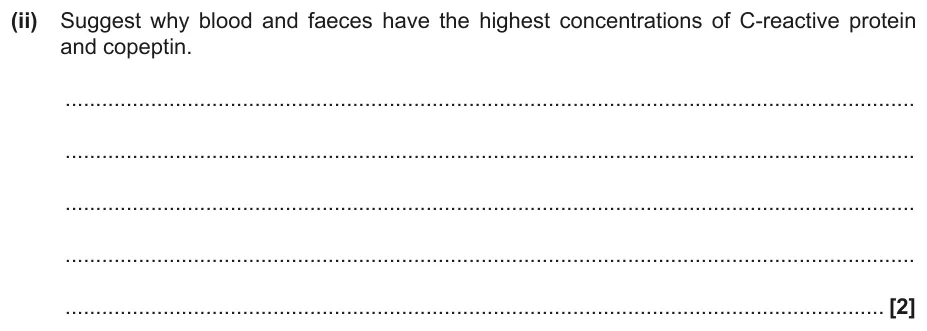
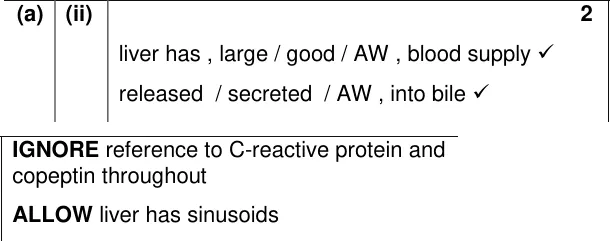
Suggest why blood and faeces have the highest concentrations of two molecules made by the liver.
Information from earlier in this question:
Show the mark scheme
Tap an image to open it full size.
Question 15
A level Paper 1 · June 2024 · Q18(a)(ii) · 2 marks · Medium
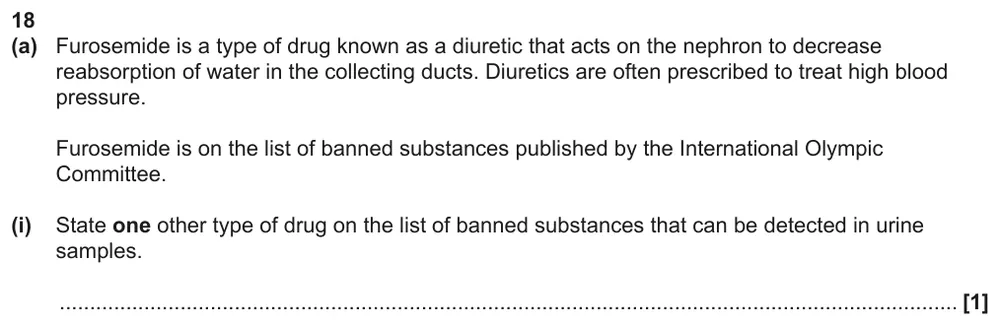
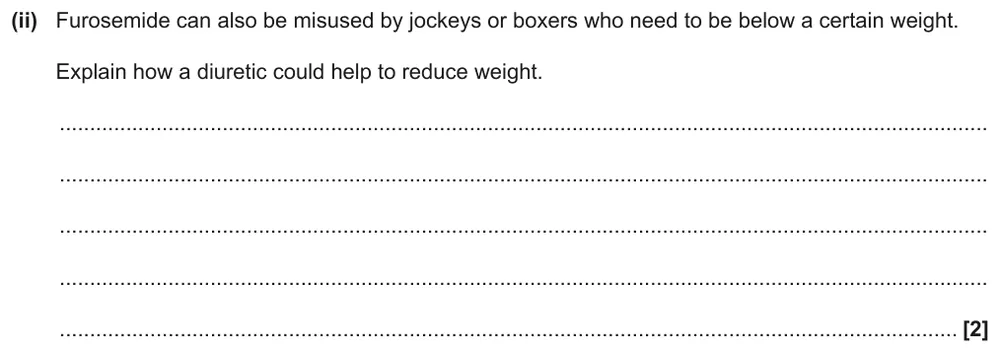
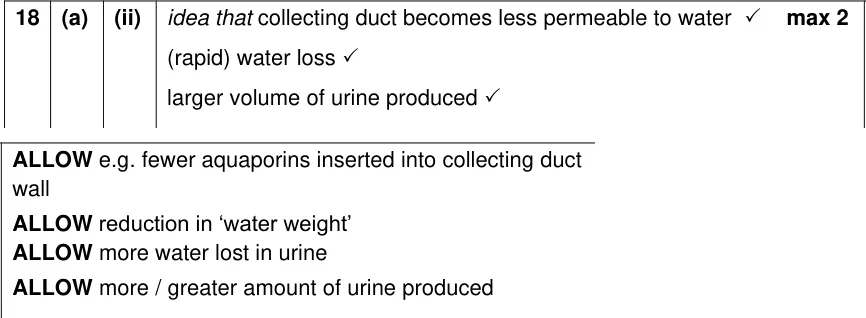
Explain how a diuretic such as furosemide could help a jockey or boxer lose weight.
Information from earlier in this question:
Show the mark scheme
Tap an image to open it full size.
From the examiners' report: Don't just repeat the stem. Explain the action: the collecting duct walls become less permeable to water, with fewer aquaporins, so more water is lost in a larger volume of urine.
Question 16
A level Paper 1 · June 2024 · Q18(b)(ii) · 1 mark · Medium
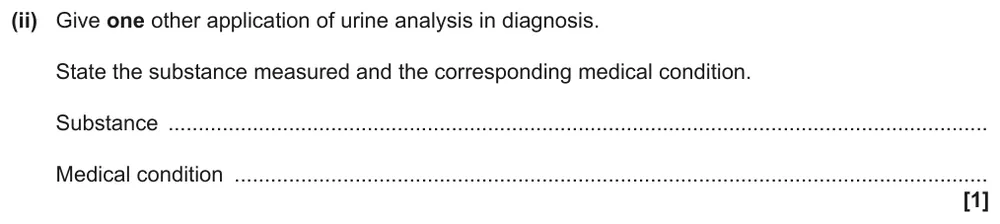
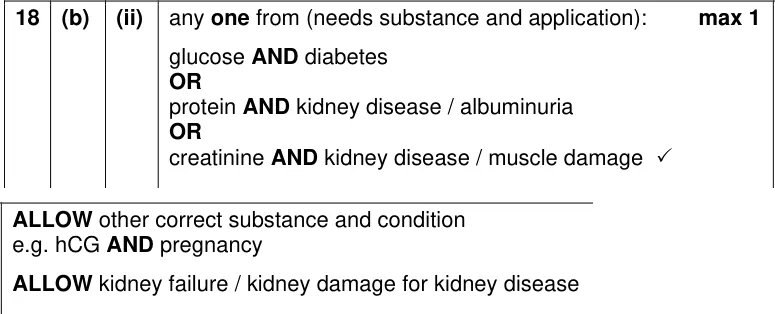
Give one other use of urine analysis in diagnosis, with the substance and the condition.
Show the mark scheme
Tap an image to open it full size.
From the examiners' report: Give both halves for the mark: the substance and the condition it shows, such as glucose and diabetes or hCG and pregnancy.
Data and extended answers
Question 17
A level Paper 3 · June 2018 · Q6(b)(i) · 4 marks · Medium
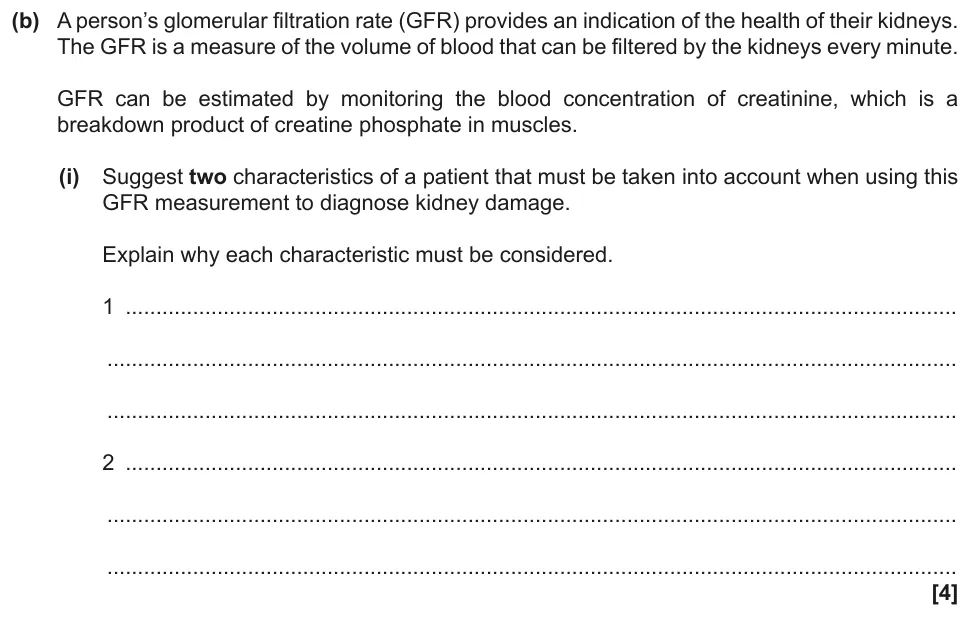
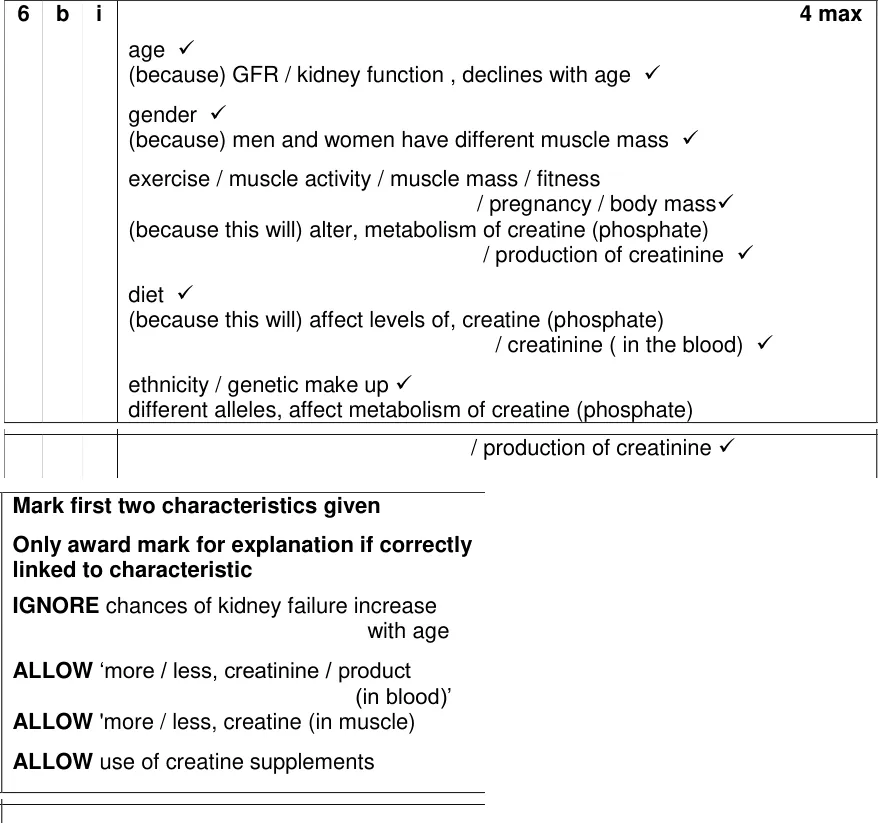
Suggest and explain two patient characteristics to consider when using creatinine to estimate GFR.
Show the mark scheme
Tap an image to open it full size.
From the examiners' report: Stay with how GFR is being measured here: pick factors that change creatinine production or GFR, such as age, muscle mass or diet. Listing other diseases such as diabetes or high blood pressure doesn't answer the question.
Question 18
A level Paper 3 · June 2018 · Q6(b)(ii) · 1 mark · Hard
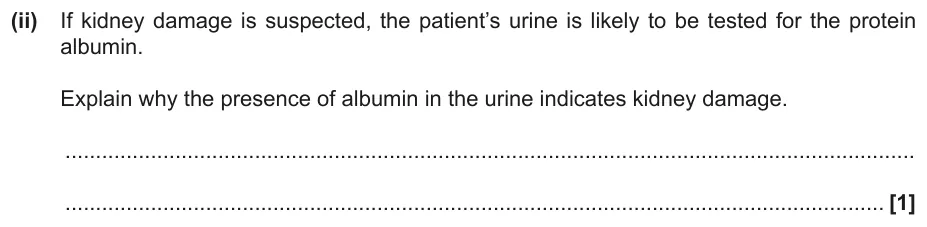
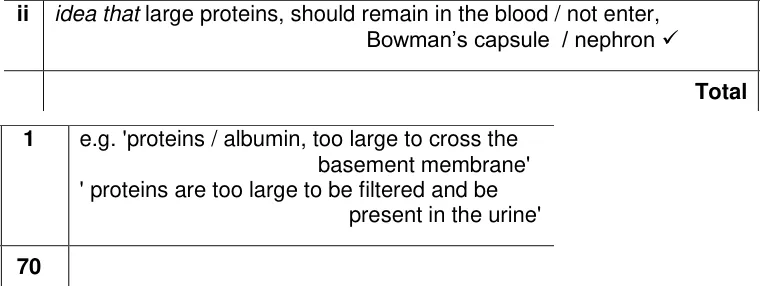
Explain why albumin in the urine indicates kidney damage.
Show the mark scheme
Tap an image to open it full size.
From the examiners' report: Avoid the phrase "filtered out", which examiners couldn't interpret. Say albumin is too large to pass through the basement membrane, so it shouldn't enter the Bowman's capsule at all; it isn't a reabsorption problem.
Question 19
A level Paper 1 · June 2023 · Q16(d) · 4 marks · Hard
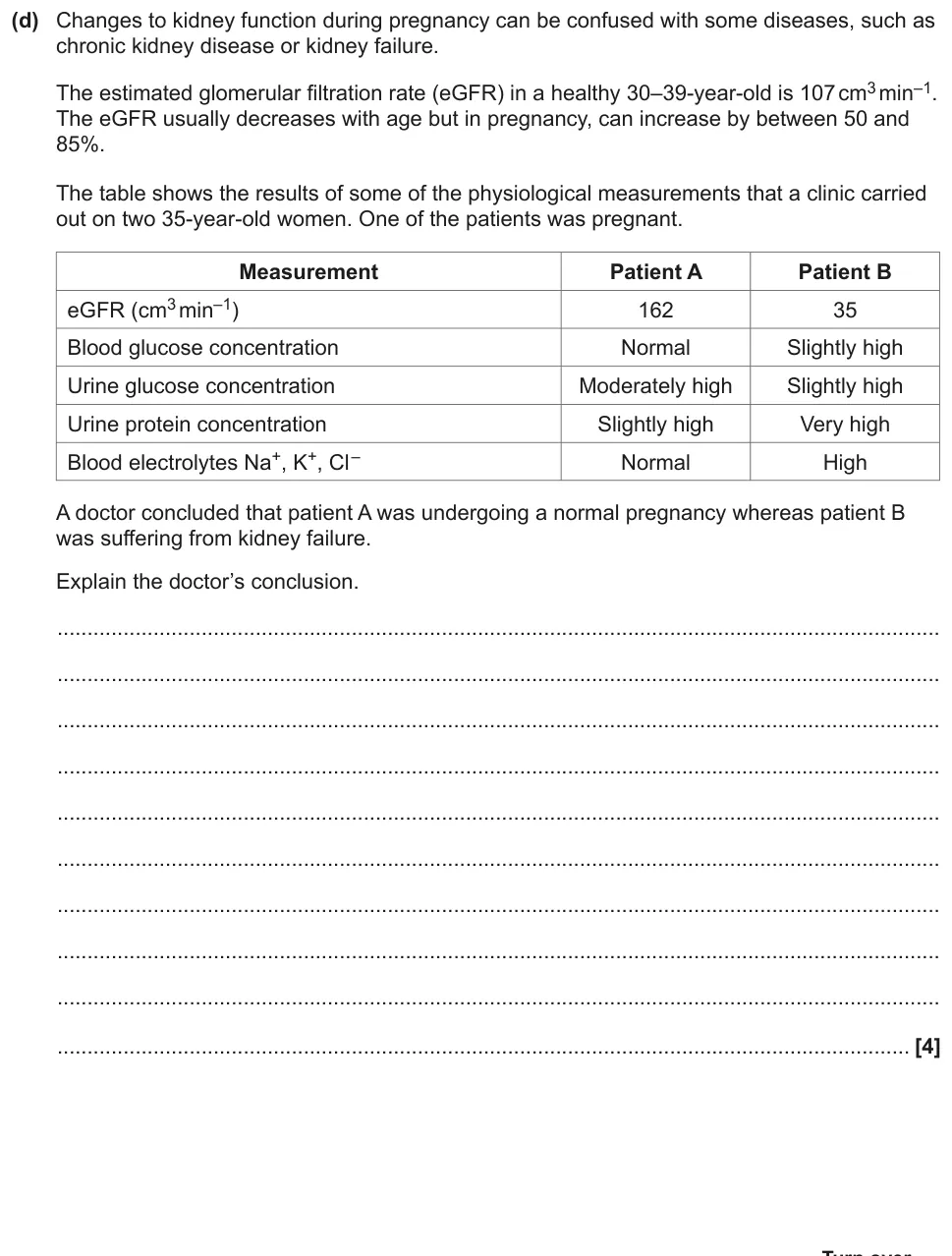
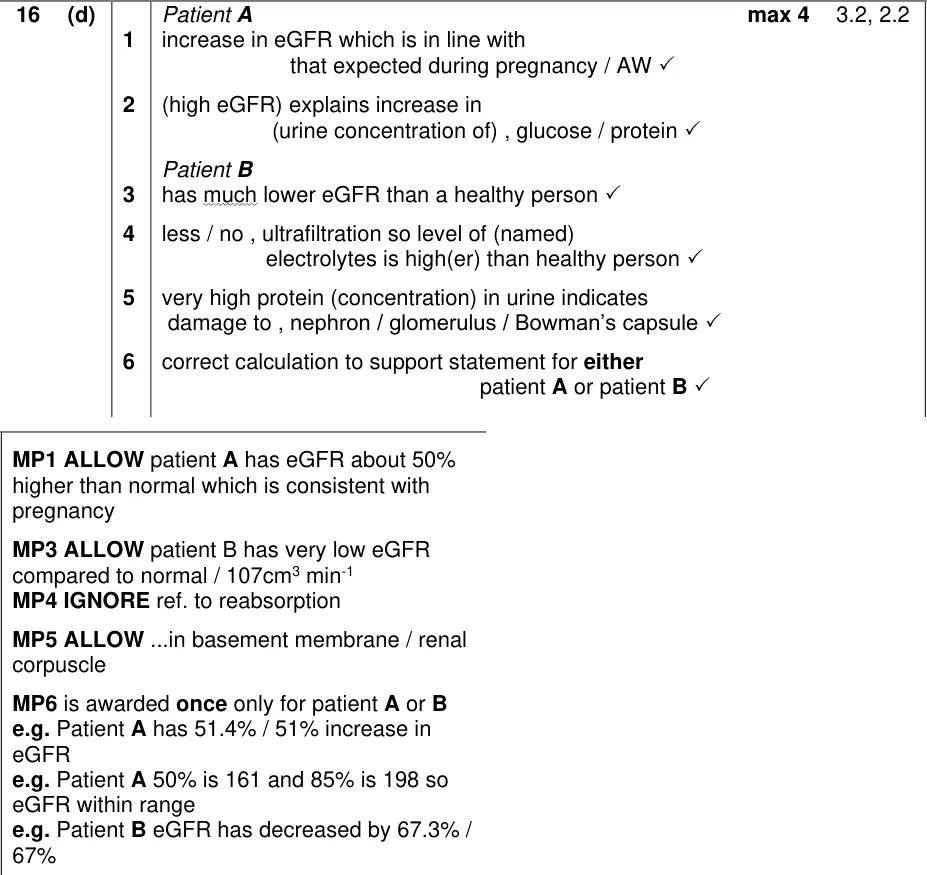
Use eGFR, glucose, protein and electrolyte data to explain why one patient is pregnant and the other has kidney failure.
Show the mark scheme
Tap an image to open it full size.
From the examiners' report: Compare patient B with the normal eGFR of 107, not with patient A, and back it up with a calculation. High electrolytes come from less ultrafiltration, not less reabsorption, and say exactly where the damage is: the glomerulus or Bowman's capsule.
Question 20
A level Paper 1 · June 2024 · Q18(d) · 6 marks · Medium
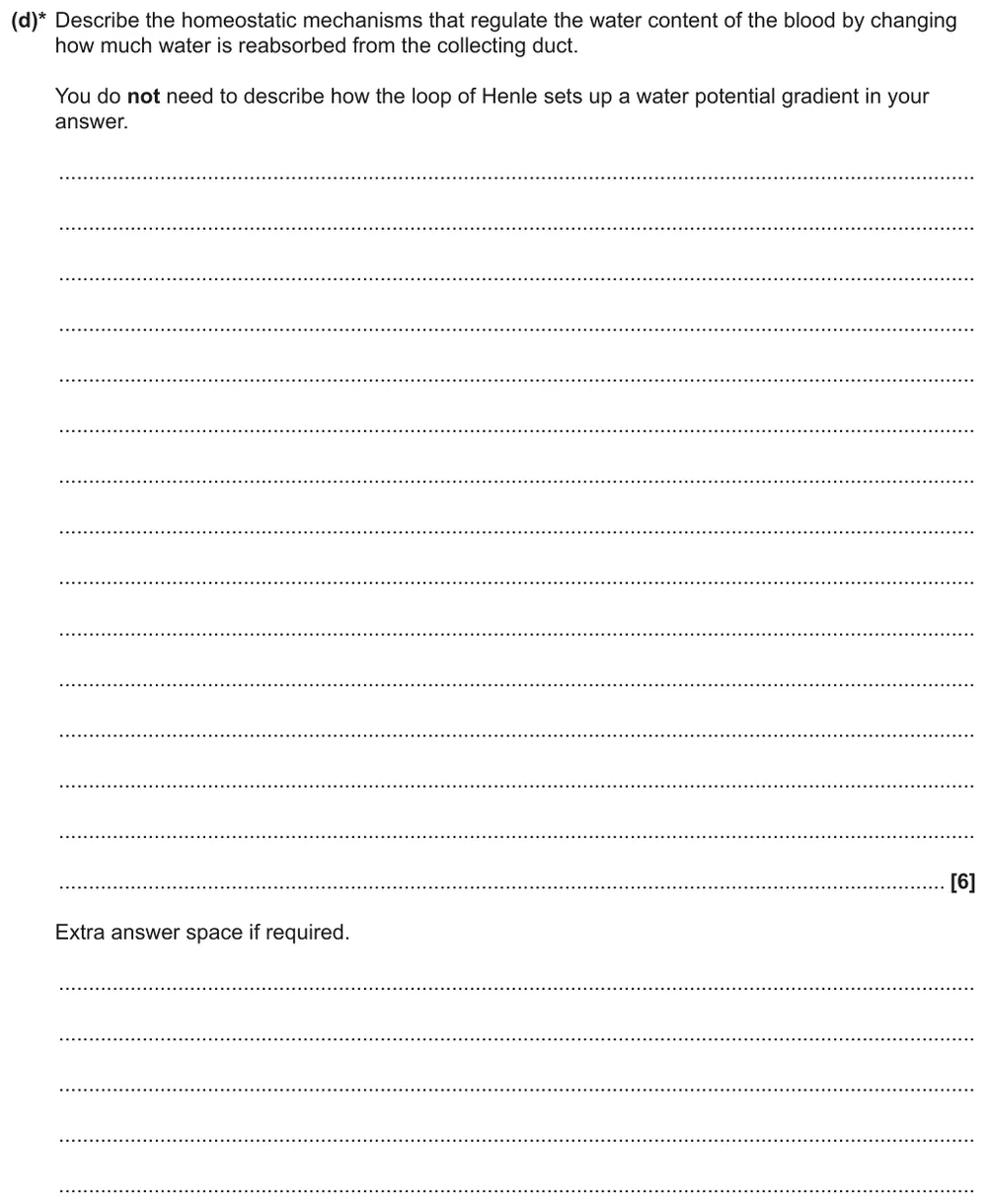
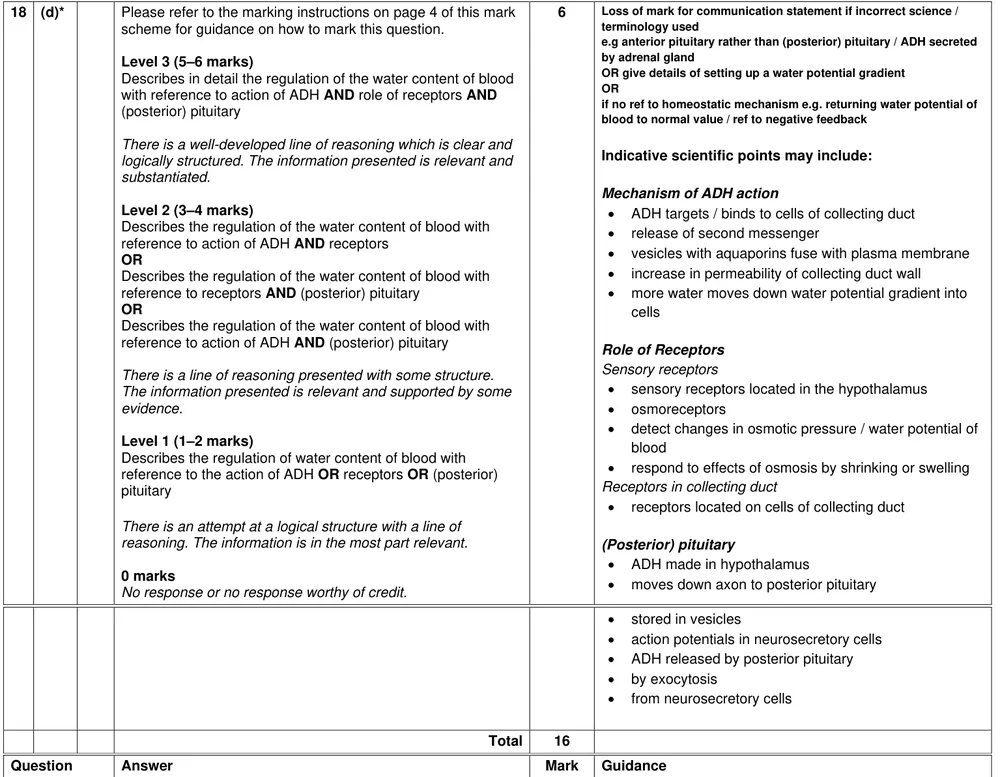
Describe how the water content of the blood is regulated by changing water reabsorption from the collecting duct (6 marks).
Show the mark scheme
Tap an image to open it full size.
From the examiners' report: Cover receptors, the posterior pituitary and the action of ADH. Level 2 answers usually missed the posterior pituitary or got ADH production wrong; the best described aquaporin vesicles and negative feedback.
Where students lose marks (from OCR examiners' reports and mark schemes)
Each point below is followed by wording that gained marks.
An endotherm's definition needs the word heat: Most definitions of an endotherm were incomplete, with few answers mentioning heat at all.
✔ Gains credit: "An endotherm uses heat produced internally to maintain its body temperature".
Compare the mole rat with other mammals in every point: Many answers didn't use comparative words, called naked mole rats ectotherms, or copied the bullet points without interpreting them.
✔ Gains credit: "Naked mole rats have a lower body temperature" and "use more behavioural responses and fewer physiological responses than most mammals".
Cold slows enzymes; it doesn't denature them: Explaining how positive feedback speeds up hypothermia, some students said falling temperature denatures enzymes, or suggested sweating in a cold mammal.
✔ Gains credit: "Lower temperature reduces kinetic energy, so enzyme activity and respiration slow, less heat is generated and body temperature drops further".
Kidney medulla, not adrenal medulla: Labelling a kidney section, some students wrote adrenal medulla or adrenal cortex, swapped cortex and medulla, or called the pelvis the ureter or renal artery.
✔ Gains credit: "T = (renal) medulla, U = (renal) cortex, V = pelvis".
Name sodium and chloride in the loop of Henle: Many answers referred to solutes or salt, named the wrong ions such as K+ or Ca2+, or didn't say which limb they meant.
✔ Gains credit: "Na+ and Cl− are actively transported out of the ascending limb, which is impermeable to water; water leaves the descending limb by osmosis".
Albumin is too big to be filtered: Many thought albumin in urine meant a reabsorption problem, or wrote "filtered out" in a way examiners couldn't follow.
✔ Gains credit: "Proteins are too large to cross the basement membrane, so they should not enter the Bowman's capsule".
Low eGFR means less ultrafiltration: Some students blamed patient B's high blood electrolytes on a lack of reabsorption, and compared B's eGFR with patient A instead of a healthy person.
✔ Gains credit: "Patient B has a much lower eGFR than a healthy person, so less ultrafiltration and higher electrolytes"; reference to reabsorption is ignored.
ADH leaves from the posterior pituitary: Level 2 answers on water balance most often left out the posterior pituitary gland or described ADH production and release wrongly.
✔ Gains credit: "Osmoreceptors in the hypothalamus detect the fall in water potential; ADH is released from the posterior pituitary and makes the collecting duct walls more permeable to water".
Download the questions
Download the PDF pack (20 questions, mark schemes at the end)
Keep practising
- Homeostasis and Excretion quiz
- Homeostasis and excretion: interactive written questions (21)
- Homeostasis and Thermoregulation: OCR A exam questions with worked answers
- Neuronal and Hormonal Communication (5.1.3–5.1.4): OCR A Level Biology exam questions by topic
- OCR A Level Biology masterclasses
Questions, mark schemes and examiners' report extracts © OCR.