

Biodiversity opens Module 4 and turns up on every paper, often with a Simpson's index calculation attached. Spec point 4.2.1 asks you to describe biodiversity at three levels (habitat, species and genetic), to sample a habitat fairly, to measure species richness and evenness, and to calculate and interpret Simpson's Index of Diversity and the proportion of polymorphic gene loci. It then moves on to why biodiversity is falling, why it is worth keeping, and how in situ, ex situ and international agreements such as CITES protect it.
The calculations are usually done well. The marks go on the definitions and on reading the question. Students describe richness as the "amount" of species, suggest Simpson's index to measure genetic diversity, forget that CITES is about trade, or explain why a population fell when the question asked what that did to its alleles.
Work through the seventeen questions below in order. They start with recall, move on to applying what you know to new data, and finish with Simpson's index and field sampling. If you'd like to go through questions like these with me each week, my OCR A masterclasses run on Wednesdays at 5.15pm for Year 12 and on Tuesdays at 6.30pm or Thursdays at 5.15pm for Year 13.
What you need from GCSE
Each question on this page assumes you're secure on these GCSE ideas. If any of them feels shaky, look it up before you start.
- Biodiversity is the variety of all the different species of organisms in an ecosystem. High biodiversity makes an ecosystem more stable.
- Quadrats and transects are used to sample plants; the sample should be random so it represents the whole area.
- Human activities such as deforestation, farming, pollution and climate change reduce biodiversity.
- Biodiversity can be protected by breeding programmes, protecting habitats, seed banks and laws.
Key terms
These words come up in the questions and mark schemes. Examiners expect you to use them exactly.
- Habitat biodiversity: the number of different habitats in an area.
- Species richness: the number of different species in an area or community.
- Species evenness: how close in numbers (relative abundance) the different species in a community are.
- Genetic biodiversity: the variety of alleles for the genes in a population or species.
- Polymorphic gene locus: a locus with two or more alleles in a population; genetic diversity = number of polymorphic loci ÷ total number of loci.
- Simpson's Index of Diversity (D): D = 1 − Σ(n/N)²; values near 1 mean high diversity and a stable community, values near 0 mean low diversity.
- Random and non-random sampling: random sampling uses random coordinates to avoid bias; non-random sampling is opportunistic, stratified or systematic (e.g. along a transect).
- Keystone species: a species that many others in the ecosystem depend on, so its loss has a large effect.
- In situ and ex situ conservation: protecting species in their natural habitat (e.g. wildlife reserves); protecting them away from it (e.g. zoos, seed banks).
- CITES: the Convention on International Trade in Endangered Species: an international agreement that controls trade in endangered species and their products.
What these questions cover (OCR 4.2.1)
The questions test these learning outcomes from the OCR A Level Biology A specification (H420):
- (a) how biodiversity may be considered at different levels
- (b)(i) how sampling is used in measuring the biodiversity of a habitat and the importance of sampling
- (b)(ii) practical investigations collecting random and non-random samples in the field
- (c) how to measure species richness and species evenness in a habitat
- (d) the use and interpretation of Simpson’s Index of Diversity (D) to calculate the biodiversity of a habitat (the formula is given in the exam)
- (e) how genetic biodiversity may be assessed, including calculations (including the proportion of polymorphic gene loci)
- (f) the factors affecting biodiversity
- (g) the ecological, economic and aesthetic reasons for maintaining biodiversity
- (h) in situ and ex situ methods of maintaining biodiversity
- (i) international and local conservation agreements made to protect species and habitats
How to use this page
Write your answer on paper before you open the mark scheme. Allow about 1.2 minutes per mark: the 17 questions are worth 32 marks, so about 38 minutes in total. Then mark your answer strictly against the mark scheme and read the examiners' tip underneath it. If you'd rather print the questions, download the PDF pack.
Recall
Question 1
A level Paper 3 · June 2023 · Q4(b)(iv) · 2 marks · Medium
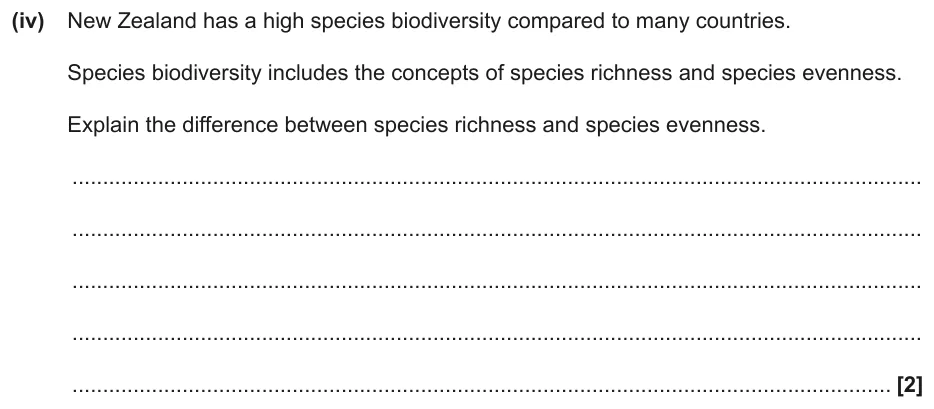
Explain the difference between species richness and species evenness.
Show the mark scheme

Tap an image to open it full size.
From the examiners' report: Use exact words: richness is the number of different species, not the "amount", and evenness is the relative abundance of each species, not their "spread" or "distribution".
Question 2
AS Paper 1 · June 2022 · Q22(a) · 2 marks · Hard
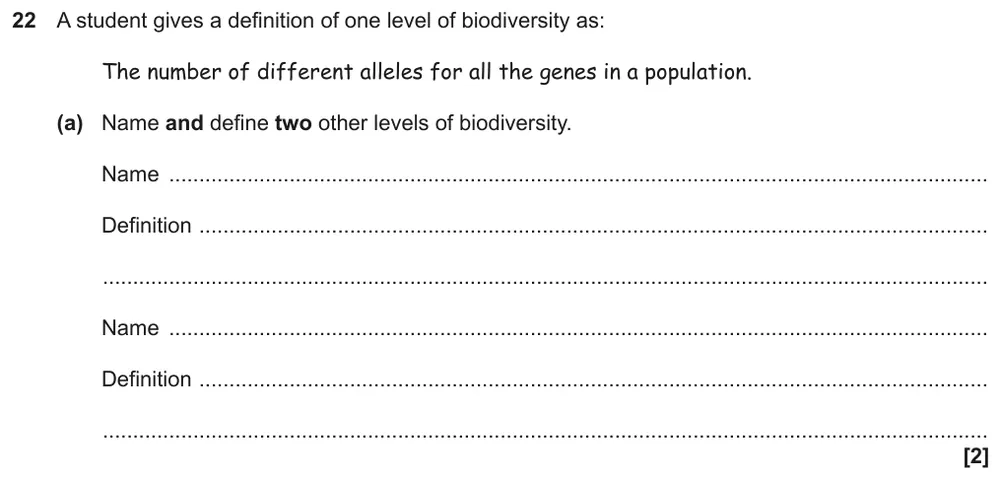
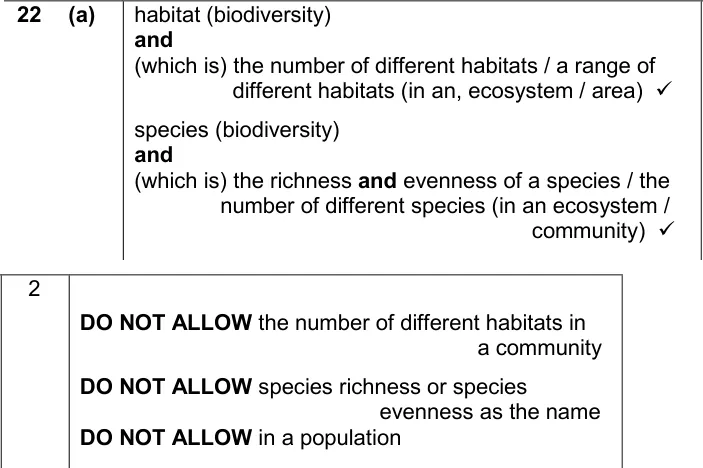
Name and define two levels of biodiversity other than genetic biodiversity.
Show the mark scheme
Tap an image to open it full size.
From the examiners' report: Name the levels as habitat biodiversity and species biodiversity, then define the biodiversity, not the words "species" or "habitat". Species richness and evenness are parts of species biodiversity, not levels in their own right.
Question 3
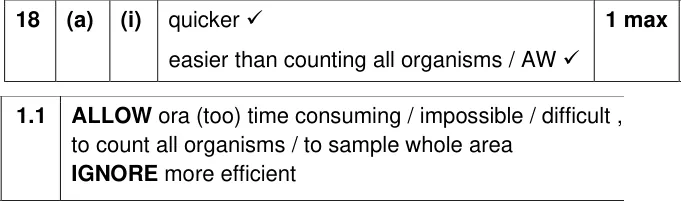
A level Paper 2 · June 2025 · Q18(a)(i) · 1 mark · Hard
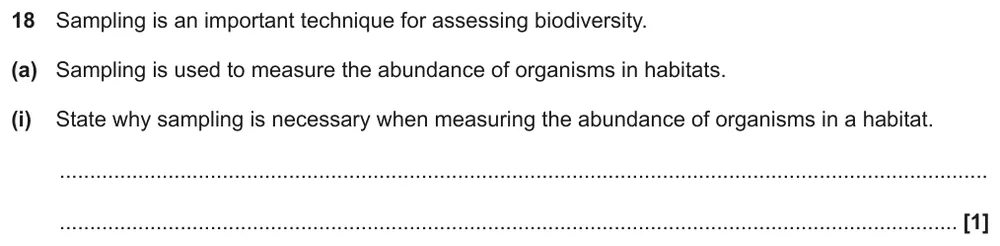
State why sampling is needed when measuring the abundance of organisms in a habitat.
Show the mark scheme
Tap an image to open it full size.
From the examiners' report: The question asks why sampling is necessary, not what its benefits are. Say it would be impossible or far too time-consuming to count every organism in the habitat.
Question 4
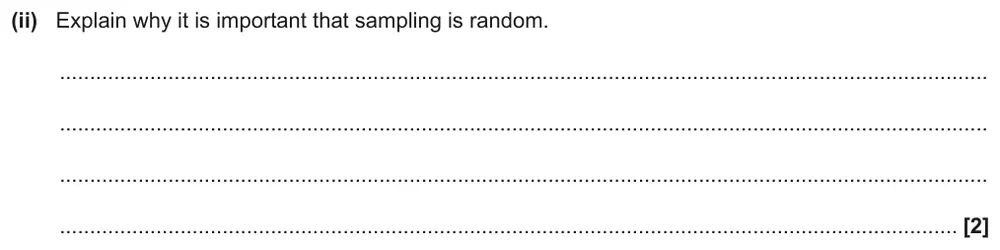
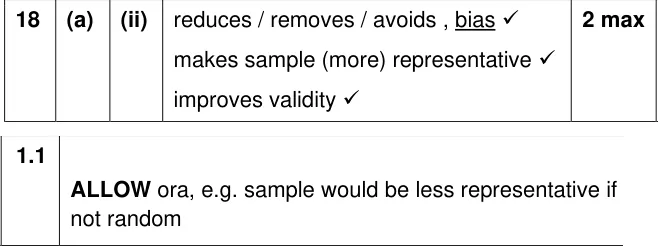
A level Paper 2 · June 2025 · Q18(a)(ii) · 2 marks · Medium
Explain why it is important that sampling is random.
Show the mark scheme
Tap an image to open it full size.
From the examiners' report: "Bias" and "representative" both score. Don't call random sampling more "reliable": that word isn't accepted in the language of measurement.
Question 5
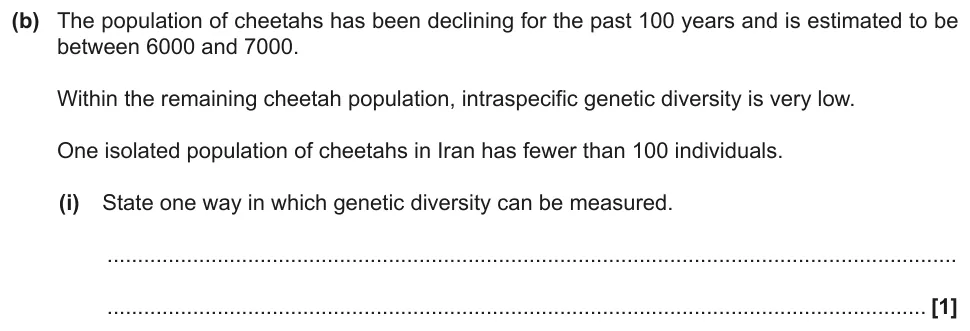
A level Paper 2 · June 2018 · Q20(b)(i) · 1 mark · Easy
State one way genetic diversity can be measured, in a declining cheetah population.
Show the mark scheme

Tap an image to open it full size.
From the examiners' report: Fewer than 1 in 4 students got this easy mark. Simpson's index measures species diversity, not genetic diversity; the answer is the proportion of polymorphic gene loci.
Question 6
AS Paper 1 · June 2024 · Q26(a) · 3 marks · Medium
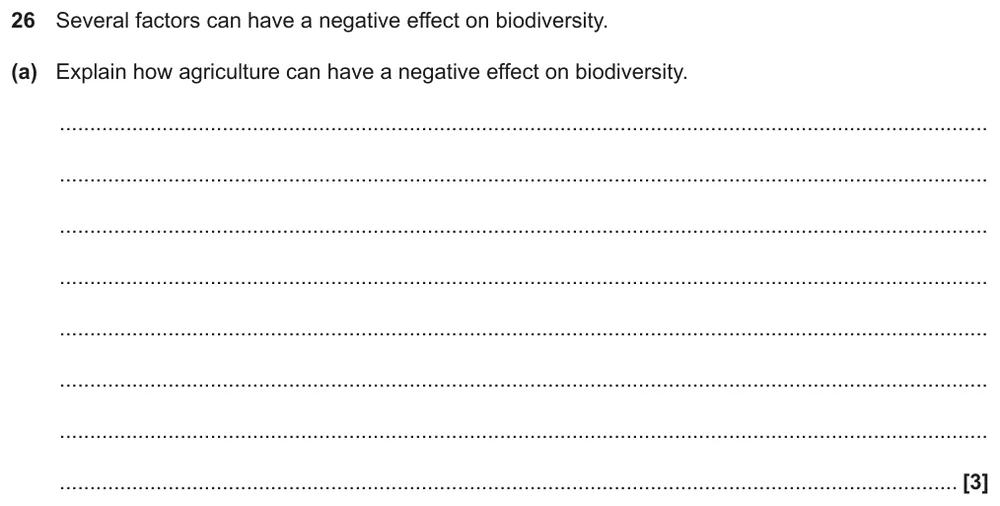
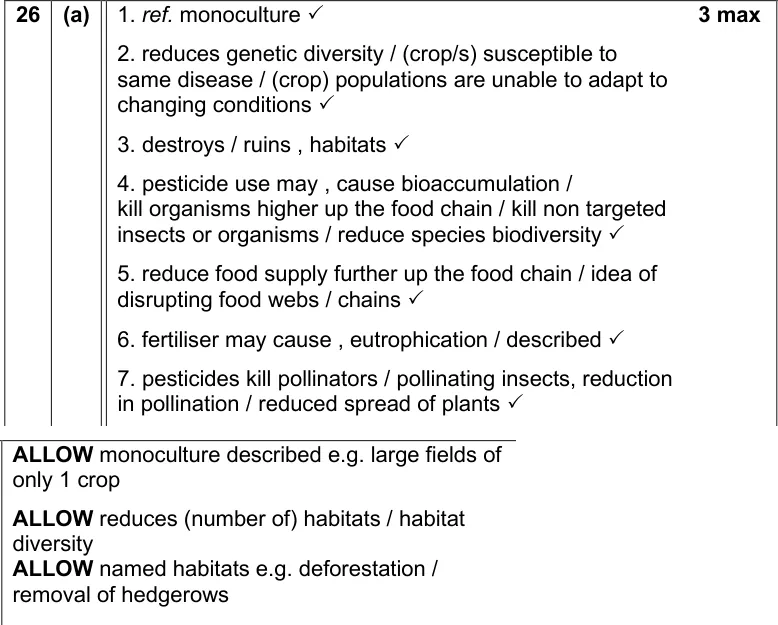
Explain how agriculture can have a negative effect on biodiversity.
Show the mark scheme
Tap an image to open it full size.
From the examiners' report: Link each farming practice to its effect, for example monoculture reduces genetic diversity and clearing land destroys habitats. Name eutrophication if you mention fertilisers, and say which level of biodiversity is lost.
Question 7
A level Paper 2 · June 2025 · Q19(a)(i) · 3 marks · Medium
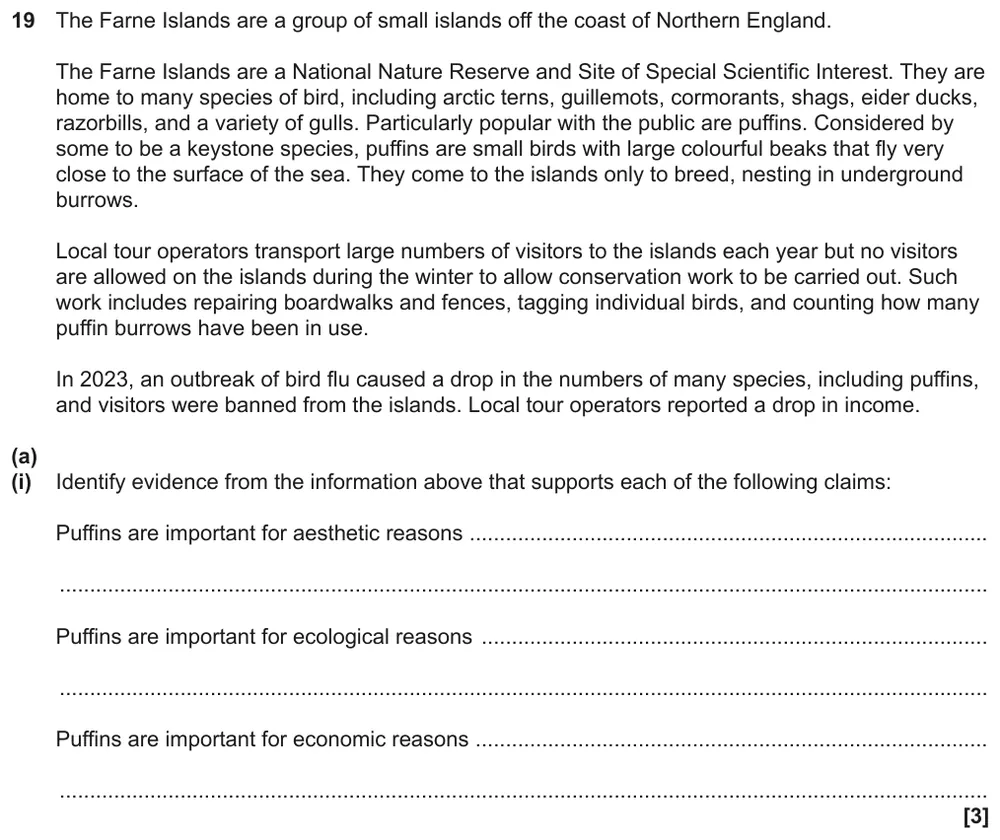
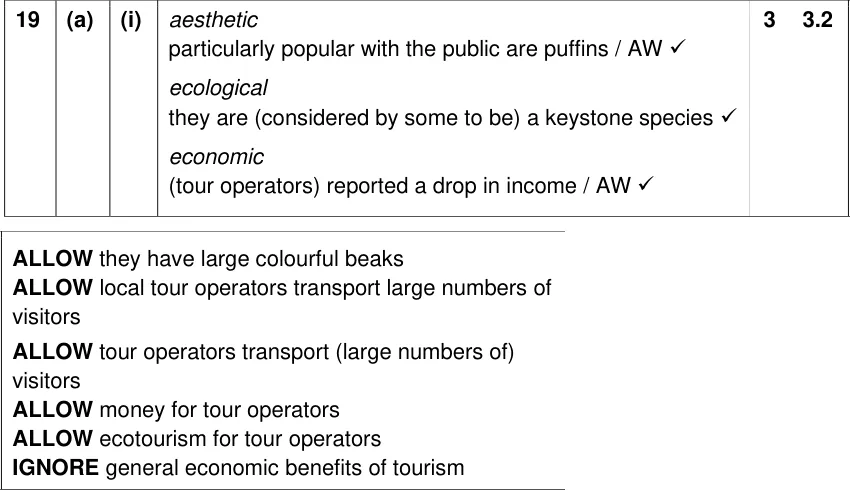
Use a passage about puffins on the Farne Islands to give an aesthetic, an ecological and an economic reason for protecting them.
Show the mark scheme
Tap an image to open it full size.
From the examiners' report: Use the evidence in the passage for each reason. For economic, link to the tour operators' income rather than writing about tourism in general.
Question 8
A level Paper 2 · June 2025 · Q19(a)(iv) · 1 mark · Medium
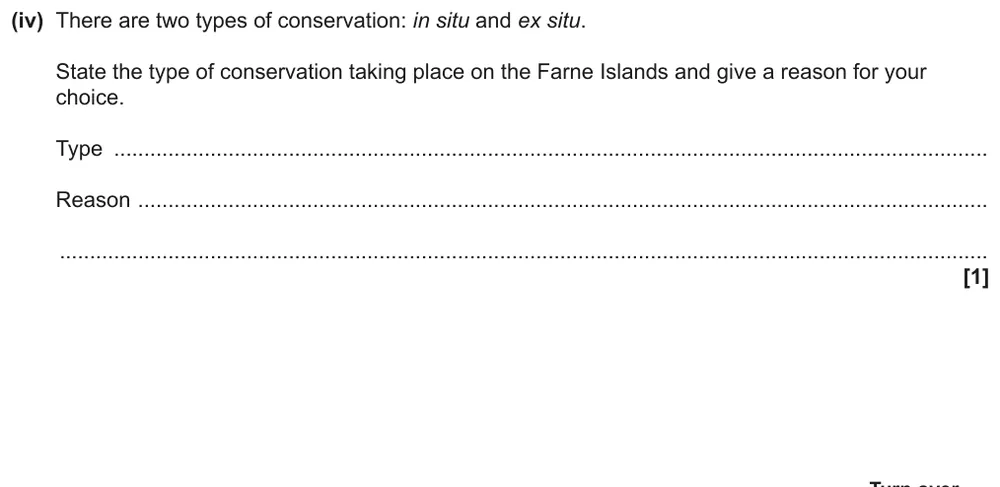
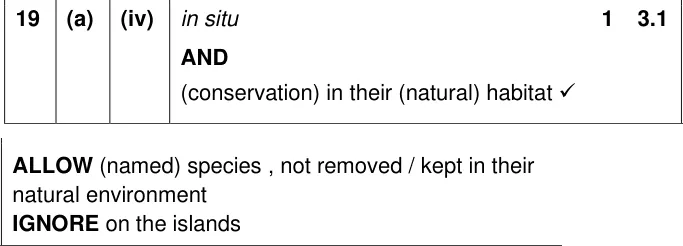
State whether conservation on the Farne Islands is in situ or ex situ, and why.
Show the mark scheme
Tap an image to open it full size.
From the examiners' report: In situ means the species are conserved in their natural habitat. "They stay on the island" was too vague: use the word habitat.
Question 9
AS Paper 2 · June 2018 · Q5(a)(i) · 1 mark · Medium
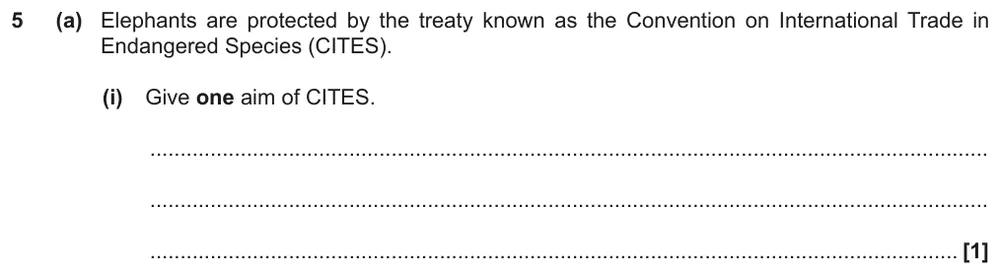
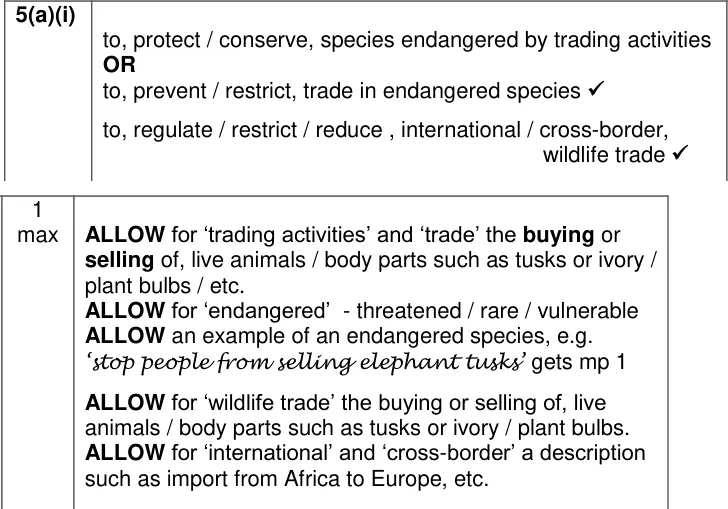
Give one aim of CITES.
Show the mark scheme
Tap an image to open it full size.
From the examiners' report: Many answers said CITES protects endangered species but didn't mention trade. CITES is about controlling international trade in endangered species and their parts.
Applying what you know
Question 10
AS Paper 2 · June 2023 · Q4(b) · 3 marks · Medium
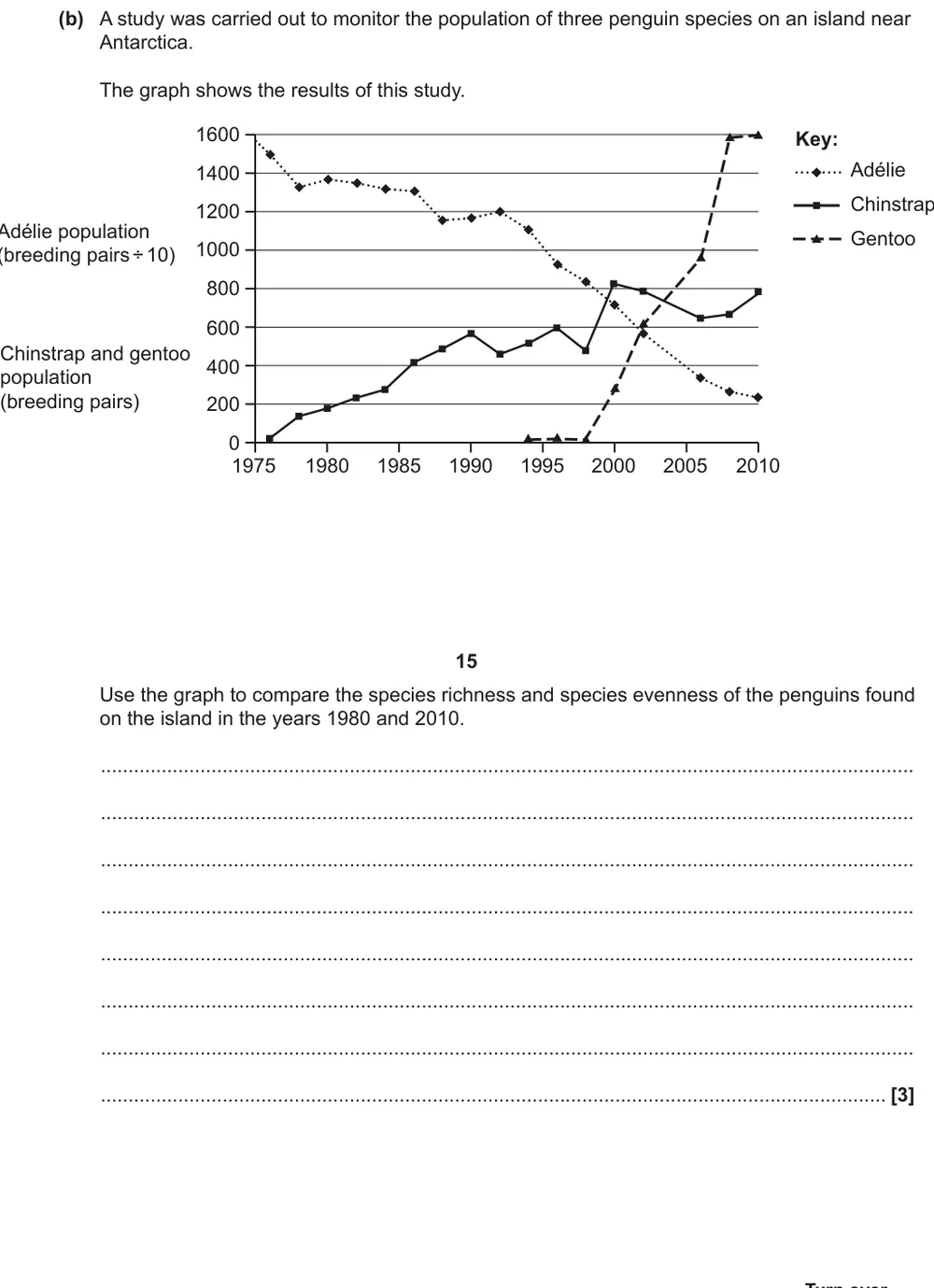
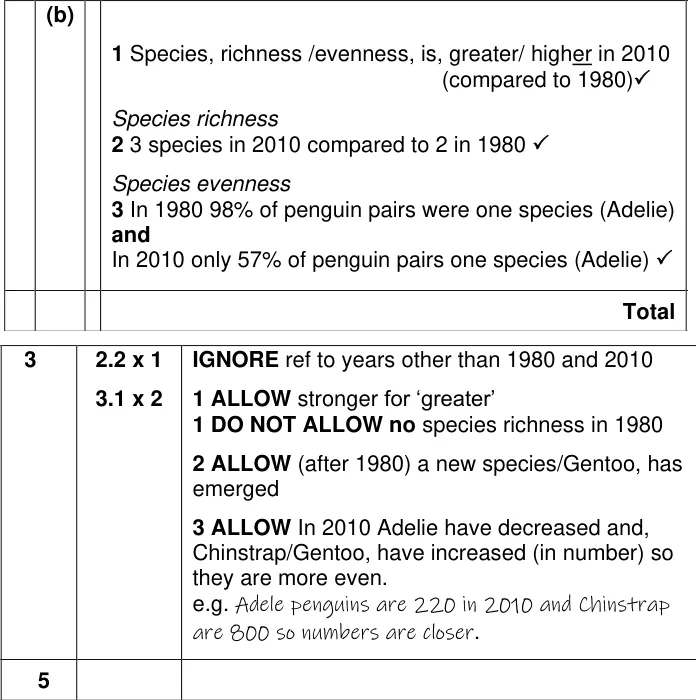
Use a graph of three penguin populations to compare species richness and evenness in 1980 and 2010.
Show the mark scheme
Tap an image to open it full size.
From the examiners' report: Most students didn't score well. Compare only the two years asked for, 1980 and 2010, and treat richness and evenness as properties of the whole community, not of each species.
Question 11
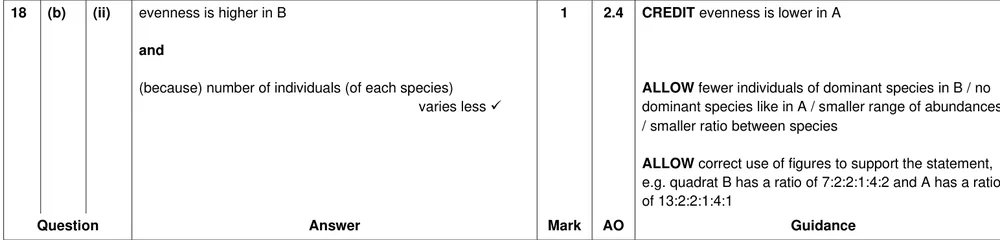
A level Paper 2 · June 2025 · Q18(b)(ii) · 1 mark · Hard
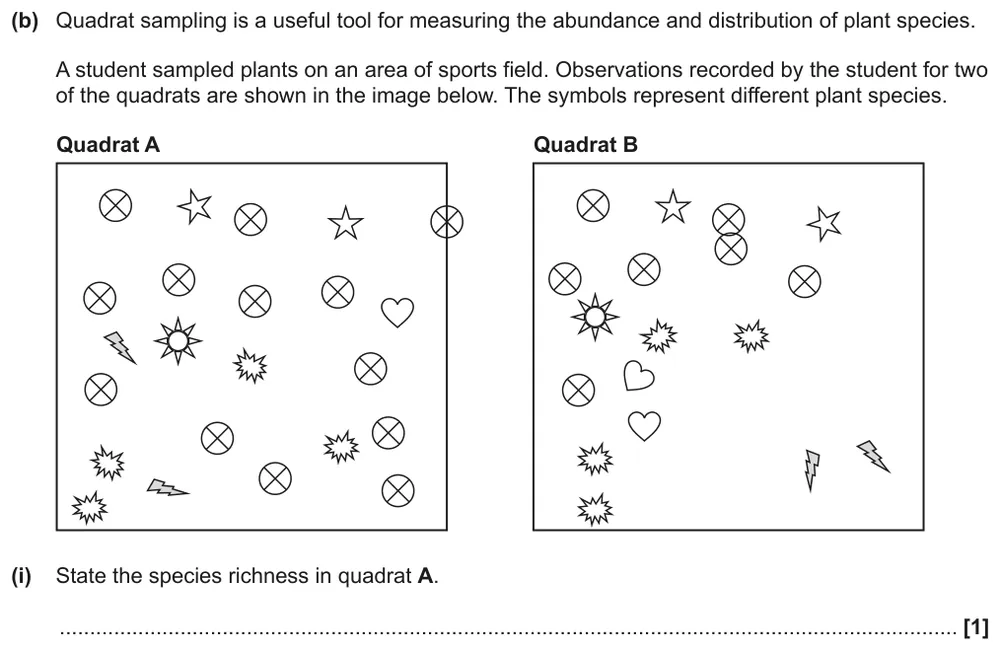
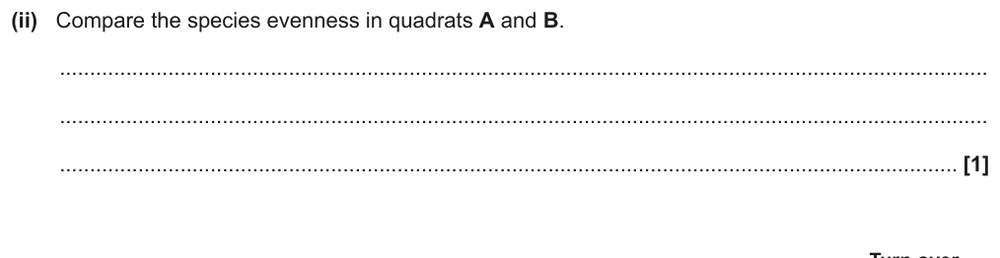
Compare the species evenness in two quadrats.
Information from earlier in this question:
Show the mark scheme
Tap an image to open it full size.
From the examiners' report: Saying "B is more even" on its own isn't a comparison: marks are never given for a binary choice. Add the reason, that the numbers of each species are more similar in B.
Question 12
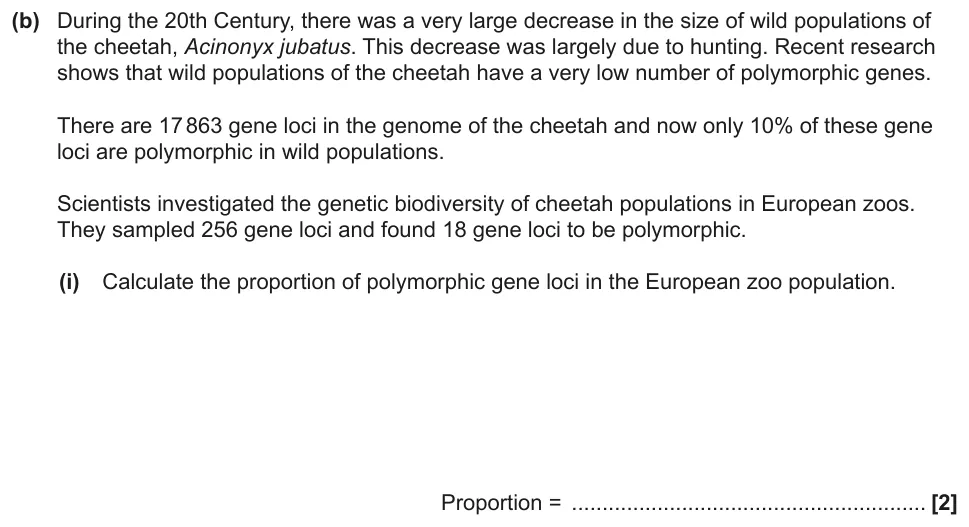
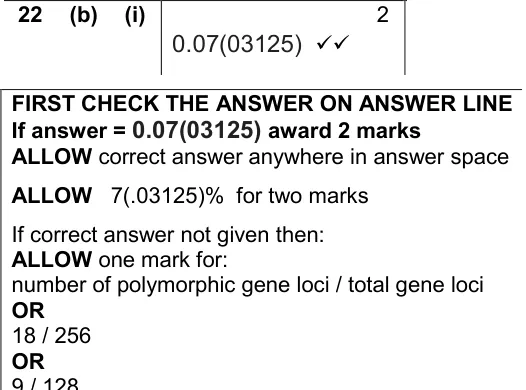
AS Paper 1 · June 2022 · Q22(b)(i) · 2 marks · Medium
Calculate the proportion of polymorphic gene loci in a zoo population of cheetahs.
Show the mark scheme
Tap an image to open it full size.
From the examiners' report: Most students got 0.07. Show the division, 18 ÷ 256, so you can still earn a mark if you slip.
Question 13
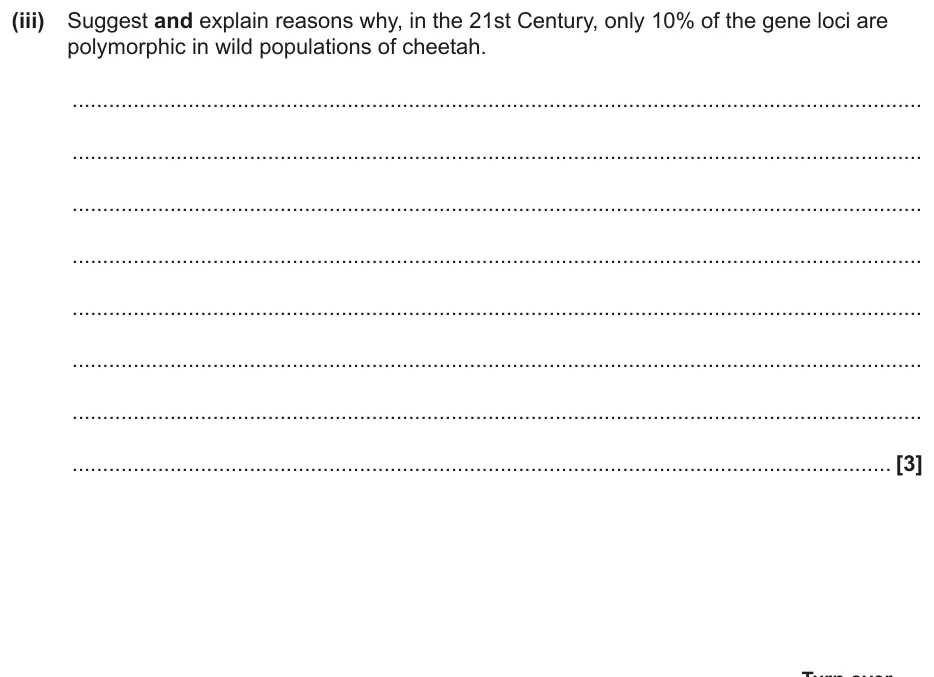
AS Paper 1 · June 2022 · Q22(b)(iii) · 3 marks · Medium
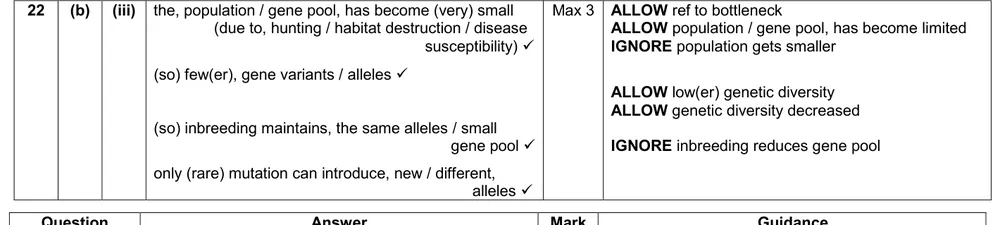
Suggest and explain why only 10% of gene loci are polymorphic in wild cheetahs.
Show the mark scheme
Tap an image to open it full size.
From the examiners' report: Most students explained why cheetah numbers fell instead of what that did to their genes. Go on to the genetics: a small population has a small gene pool, so alleles are lost and fewer loci are polymorphic.
Practical and maths
Question 14
A level Paper 2 · June 2022 · Q20(b)(ii) · 2 marks · Medium
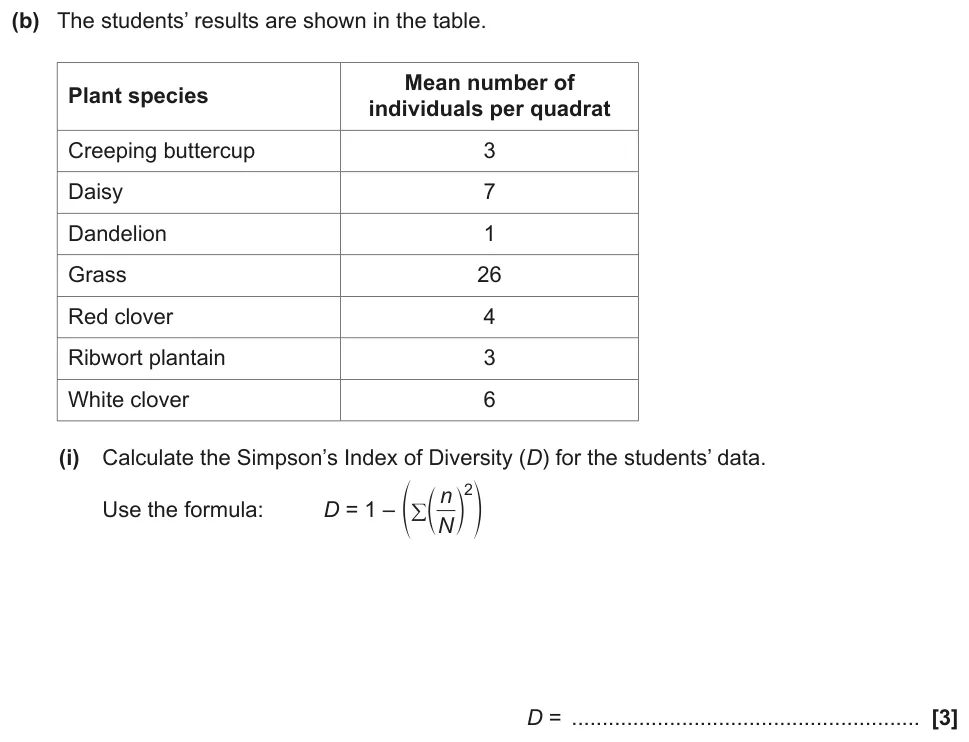
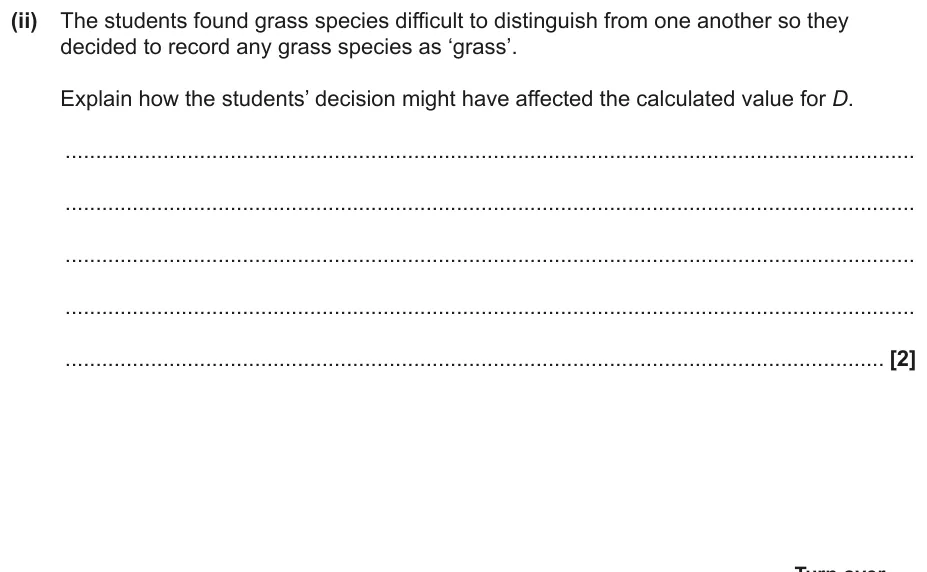
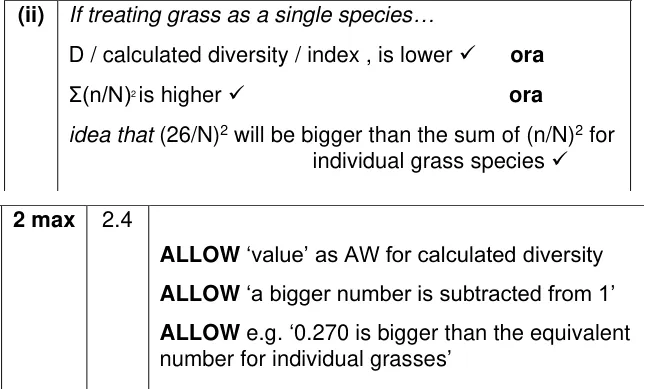
Explain how recording all grasses as one species affects the calculated Simpson's index.
Information from earlier in this question:
Show the mark scheme
Tap an image to open it full size.
From the examiners' report: Most students said D would be lower, but few explained it through the calculation. Say Σ(n/N)² gets bigger, so a bigger number is taken away from 1.
Question 15
AS Paper 2 · June 2024 · Q1(a)(ii) · 3 marks · Easy
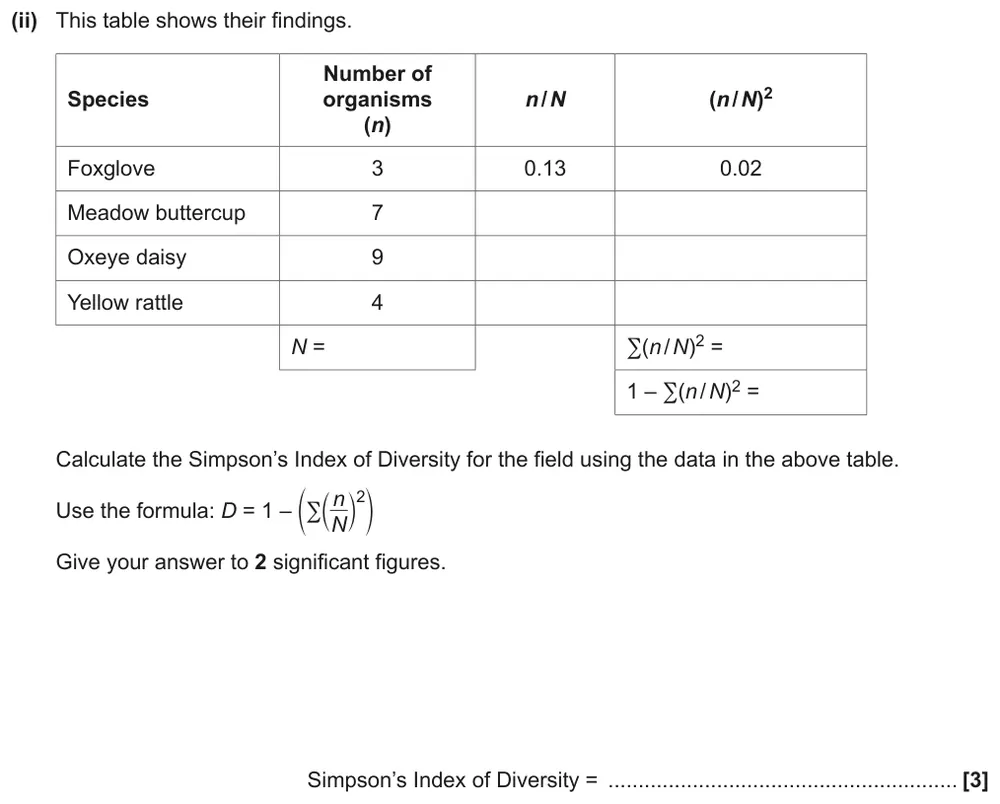
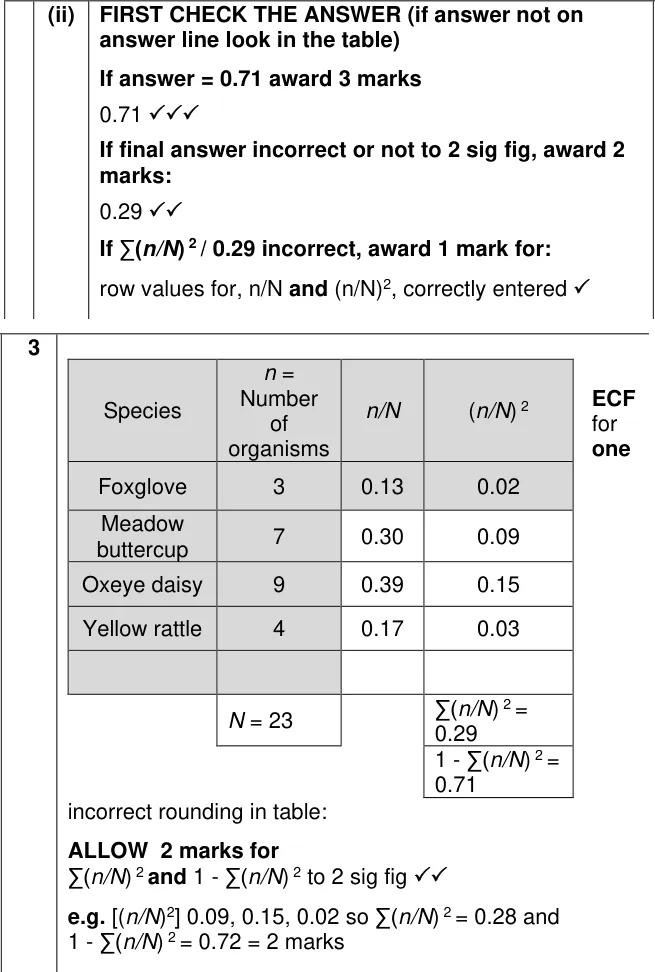
Complete a table and calculate Simpson's Index of Diversity for a field of wildflowers.
Information from earlier in this question:

Show the mark scheme
Tap an image to open it full size.
From the examiners' report: Most students did well. Don't round n/N too early before you square it, or Σ(n/N)² drifts and so does D.
Question 16
AS Paper 2 · June 2024 · Q1(a)(iii) · 1 mark · Easy
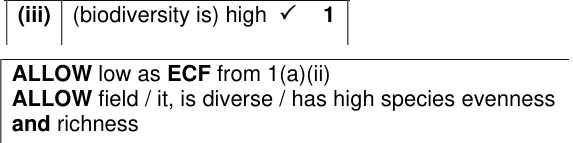
State what your value of D tells you about the diversity of the field.

Show the mark scheme
Tap an image to open it full size.
From the examiners' report: Say the biodiversity is high. A high D reflects richness and evenness together, so don't pick out just one of them.
Question 17
AS Paper 2 · June 2024 · Q1(b) · 1 mark · Medium
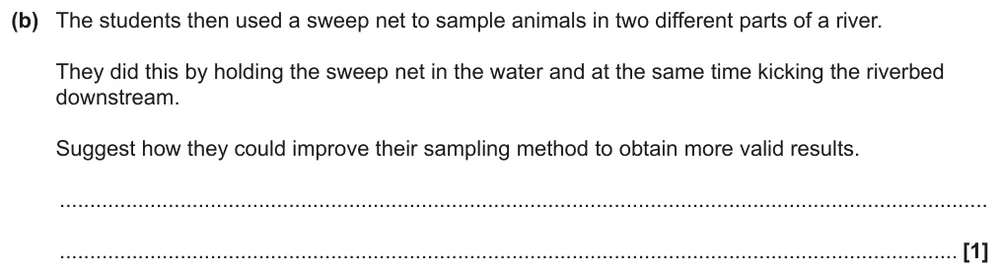
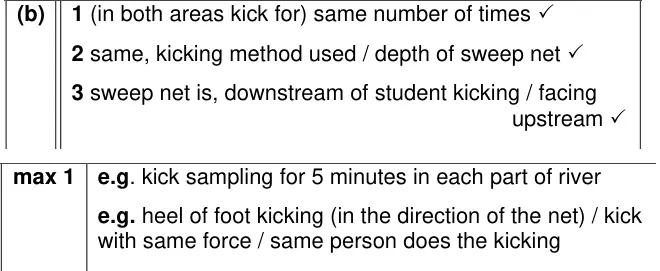
Suggest how to improve kick sampling with a sweep net to get more valid results.
Show the mark scheme
Tap an image to open it full size.
From the examiners' report: Validity here means controlling variables, such as kicking for the same time in both places. Repeating the method or moving to a new site doesn't improve the method.
Where students lose marks (from OCR examiners' reports and mark schemes)
Each point below is followed by wording that gained marks.
Richness counts species; evenness compares them: Less successful answers called richness the "amount" of species and described evenness as the "spread" or "distribution" of a species.
✔ Gains credit: "Species richness is the number of different species in an area" and "species evenness is the relative abundance of each species".
Habitat and species are levels; richness is not: Some students defined the words "species" and "habitat", or gave species richness and species evenness as the levels of biodiversity.
✔ Gains credit: "Habitat biodiversity is the number of different habitats in an area" and "species biodiversity is the number and evenness of different species in a community".
Simpson's index won't measure genes: Fewer than 1 in 4 students could state how genetic diversity is measured; many suggested sampling or Simpson's Index of Diversity.
✔ Gains credit: "The proportion of polymorphic gene loci" or "the proportion of heterozygotes".
Random means unbiased, not "reliable": Explaining why sampling must be random, some students used words like "reliable" that aren't accepted.
✔ Gains credit: "Random sampling avoids bias, so the sample is more representative".
CITES is a trade agreement: Many students said CITES protects endangered species but wrote vaguely about conservation without mentioning trade.
✔ Gains credit: "To prevent or regulate international trade in endangered species or their parts, such as ivory".
Two years named, two years compared: Comparing penguin richness and evenness "in 1980 and 2010", many described every year in between, or the evenness of each species separately.
✔ Gains credit: "There were three species in 2010 but two in 1980" and "in 1980 98% of pairs were Adélie, but in 2010 only 57%".
From fewer cheetahs to fewer alleles: Asked why few gene loci are polymorphic, most students explained why cheetah numbers fell and stopped there.
✔ Gains credit: "The population has become very small, so the gene pool is small with fewer alleles; inbreeding keeps the same alleles".
One lumped species pushes D down: Most students said D would fall when all grasses were recorded as one species, but few explained why using the calculation.
✔ Gains credit: "D is lower because Σ(n/N)² is higher: (26/N)² is bigger than the sum for the separate grass species".
Download the questions
Download the PDF pack (17 questions, mark schemes at the end)
Keep practising
- Biodiversity quiz
- Biodiversity and Simpson's Index: OCR A exam questions with worked answers
- PAG 3 Sampling Techniques: OCR A Level Biology exam questions by topic
- Communicable Diseases and the Immune System (4.1.1): OCR A Level Biology exam questions by topic
- Biodiversity: interactive written questions (21)
- OCR A Level Biology masterclasses
Questions, mark schemes and examiners' report extracts © OCR.