

Required practical 1 asks you to investigate the effect of a named variable on the rate of an enzyme-controlled reaction. In class that is usually catalase and hydrogen peroxide, amylase and starch, or a protease, with temperature, pH or concentration as the variable. On the AQA papers the enzyme is often one you've never met, such as polyphenol oxidase in apples, but the questions test the same practical skills every year.
Those skills are naming the independent and dependent variables, choosing the right control, keeping safe, drawing a results table, processing results into rates, plotting a graph, drawing a tangent, and explaining what you see in terms of enzyme–substrate complexes. The examiners' reports show where students lose marks: calling the enzyme the independent variable when it is time, saying "the same pH" instead of using a buffer, forgetting a denatured-enzyme control, and putting units in the body of a table.
Answer each question on paper before you open the mark scheme. If you'd like help with the required practicals, my AQA masterclasses run online on Tuesdays at 5.15pm for Year 12 and on Wednesdays or Thursdays at 6.30pm for Year 13.
What you need from GCSE and Year 12
Each question on this page assumes you're secure on these GCSE and Year 12 ideas. If any of them feels shaky, revise it before you start.
- GCSE: enzymes are biological catalysts with an active site that fits a specific substrate; high temperature and extreme pH denature them.
- GCSE: the required practical on the effect of pH on amylase, timing how long it takes for starch to disappear using iodine.
- GCSE: plotting a line graph and finding a mean; a shorter time means a faster rate (rate = 1 ÷ time).
- Year 12 (AQA 3.1.4.2): enzymes lower activation energy, the induced-fit model, enzyme-substrate complexes, and how temperature, pH, concentration and inhibitors affect the rate. See the Enzymes page for questions on these.
Key terms
These words come up in the questions and mark schemes. Examiners expect you to use them exactly.
- Independent variable: the variable you deliberately change, such as temperature or substrate concentration (or time, if you take readings at intervals).
- Dependent variable: the variable you measure, such as the volume of oxygen produced or the time for a colour to change.
- Control variable: a variable other than the independent variable that could affect the results, so it is kept the same, such as volume, concentration or temperature.
- Control (experiment): a test set up in exactly the same way but without the factor being tested, for example with boiled (denatured) enzyme, to show that any change is caused by the enzyme.
- Buffer: a solution that keeps the pH constant, used to set or control pH.
- Denatured: when the enzyme's tertiary structure, and so the shape of its active site, changes so it can no longer form enzyme-substrate complexes.
- Mean: the total of the repeat readings divided by the number of readings.
- Repeatable and reproducible: repeatable: similar results when the same person repeats the method with the same equipment; reproducible: similar results when someone else, or a different method or equipment, is used.
- Accurate and precise: accurate: close to the true value; precise: repeat readings are close together (little spread).
- Resolution and uncertainty: resolution: the smallest change an instrument can show; uncertainty: the range either side of a reading within which the true value probably lies, often ± half the smallest scale division.
- Initial rate: the rate at the start of the reaction, found from the gradient of a tangent drawn at time zero.
What these questions cover (AQA required practical 1)
The questions come from the first required practical in the AQA AS and A-level Biology specification (7401/7402), and test these statements and practical skills:
- Required practical 1: Investigation into the effect of a named variable on the rate of an enzyme-controlled reaction. (every question on this page)
- PS 2.4 Identify variables including those that must be controlled
- PS 4.1 Know and understand how to use a wide range of experimental and practical instruments, equipment and techniques appropriate to the knowledge and understanding included in the specification
- PS 2.2 Present data in appropriate ways
- PS 3.2 Process and analyse data using appropriate mathematical skills
- PS 3.1 Plot and interpret graphs
- 3.1.4.2 The effects of the following factors on the rate of enzyme-controlled reactions – enzyme concentration, substrate concentration, concentration of competitive and of non-competitive inhibitors, pH and temperature.
- MS 3.6 Draw and use the slope of a tangent to a curve as a measure of rate of change
How to use this page
Write your answer on paper before you open the mark scheme. Allow about 1.3 minutes per mark: the 17 questions are worth 36 marks, so about 47 minutes in total. Then mark your answer strictly against the mark scheme and read the examiners' tip underneath it. If you'd rather print the questions, download the PDF pack.
Variables, controls and safety
Question 1
AS Paper 1 · June 2024 · Q08.2 · 2 marks · Hard
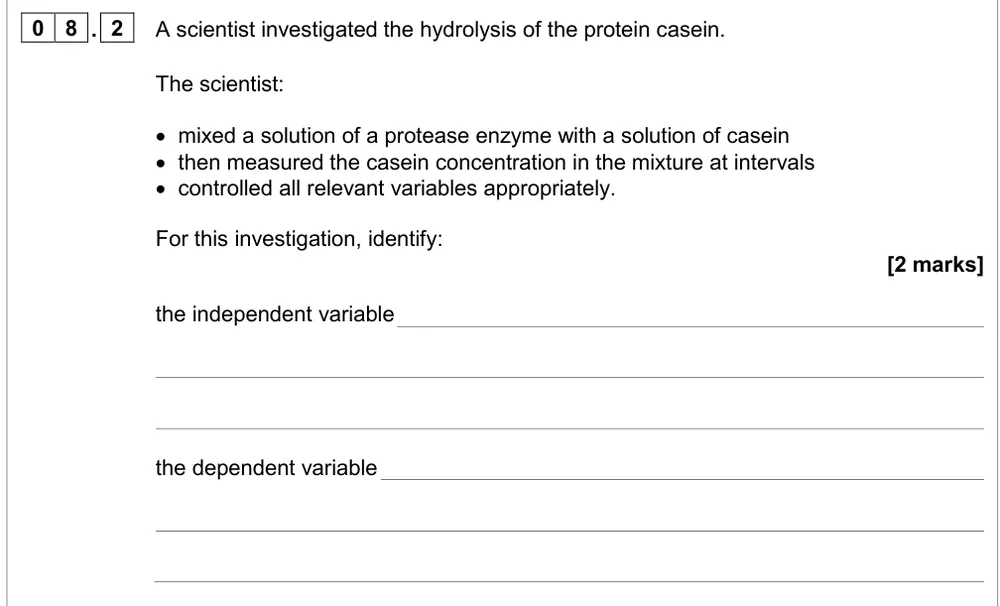
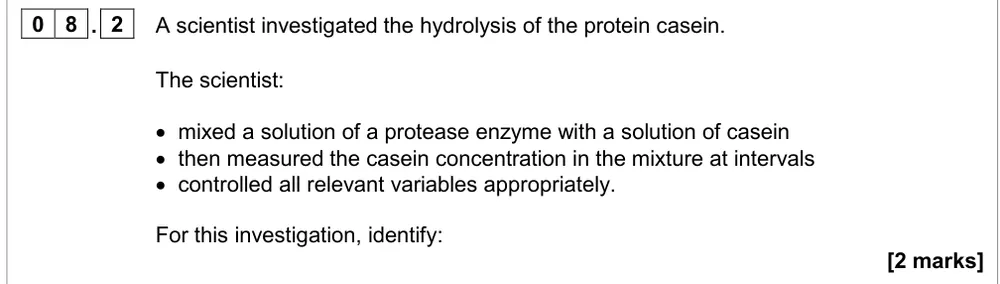
Identify the independent and dependent variables when casein is measured at intervals.
Show the mark scheme

Tap an image to open it full size.
From the examiners' report: Many students named the enzyme or its concentration as the independent variable. Ask what the scientist chose to change: here it is the time of each measurement.
Question 2
A level Paper 1 · June 2022 · Q05.3 · 3 marks · Hard
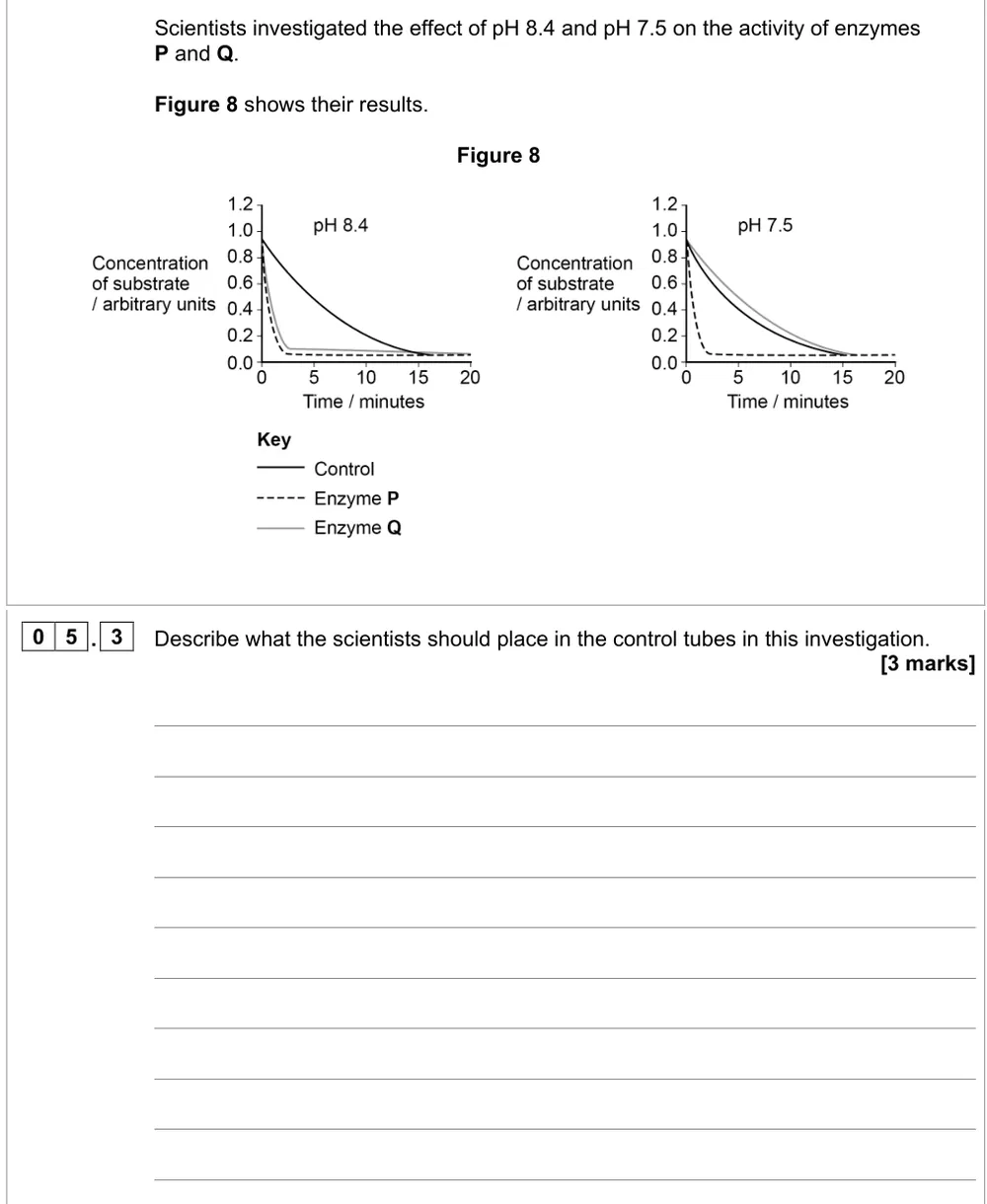
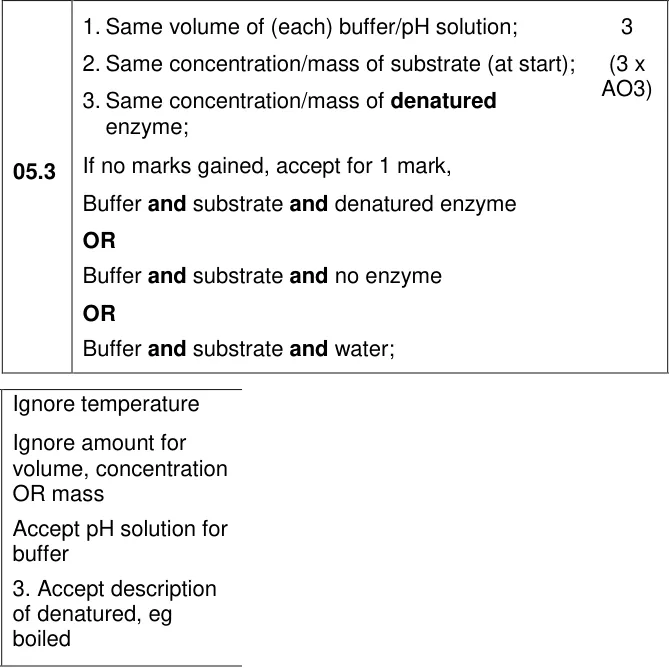
Describe what should go in the control tubes for an investigation of pH and two enzymes.
Show the mark scheme
Tap an image to open it full size.
From the examiners' report: Only 2% scored 2 or 3 marks. A control keeps everything the same except the active enzyme: same buffer, same substrate, denatured enzyme. Don't change the pH or the enzyme.
Question 3
AS Paper 2 · November 2021 · Q08.4 · 1 mark
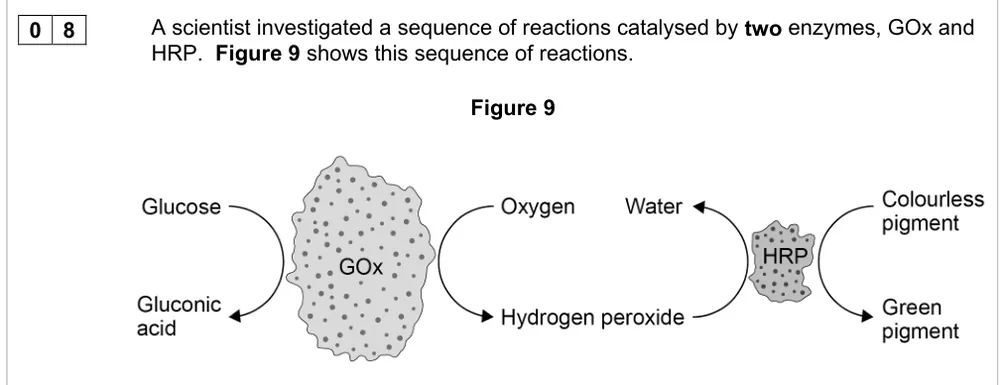
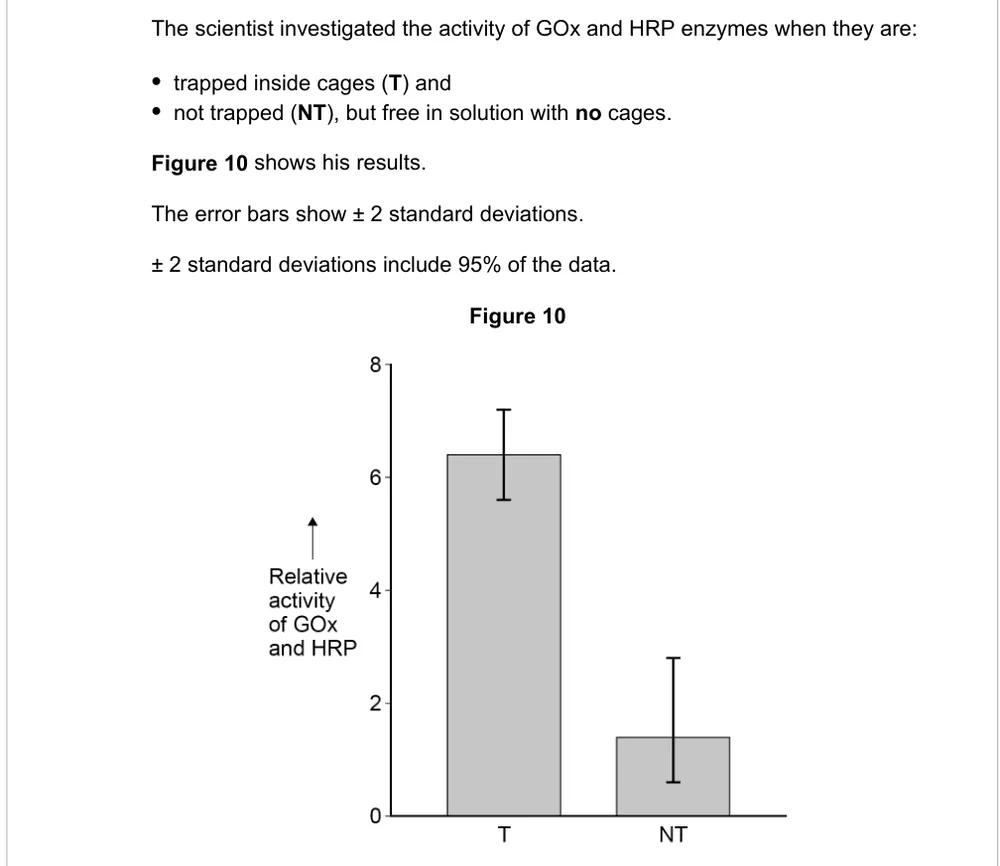
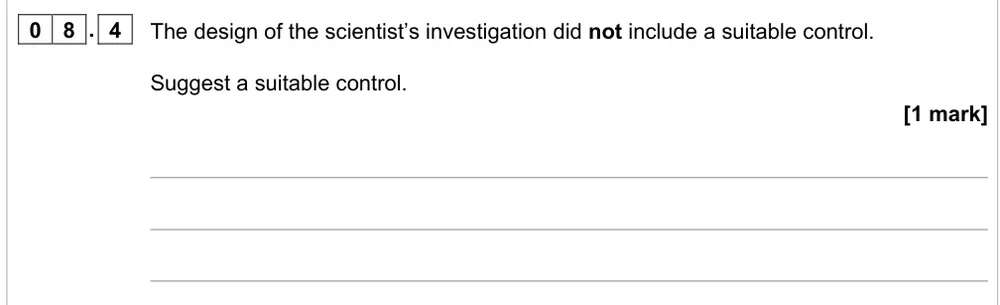
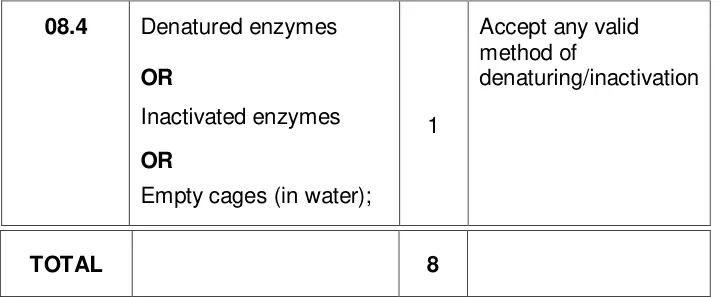
Suggest a suitable control for an investigation of enzymes trapped in DNA cages.
Information from earlier in this question:
Show the mark scheme
Tap an image to open it full size.
From the examiners' report: There's no examiners' report for this paper, so this tip comes from the mark scheme. A control in an enzyme investigation is usually the same set-up with denatured (boiled) enzyme.
Question 4
AS Paper 1 · June 2019 · Q07.2 · 1 mark
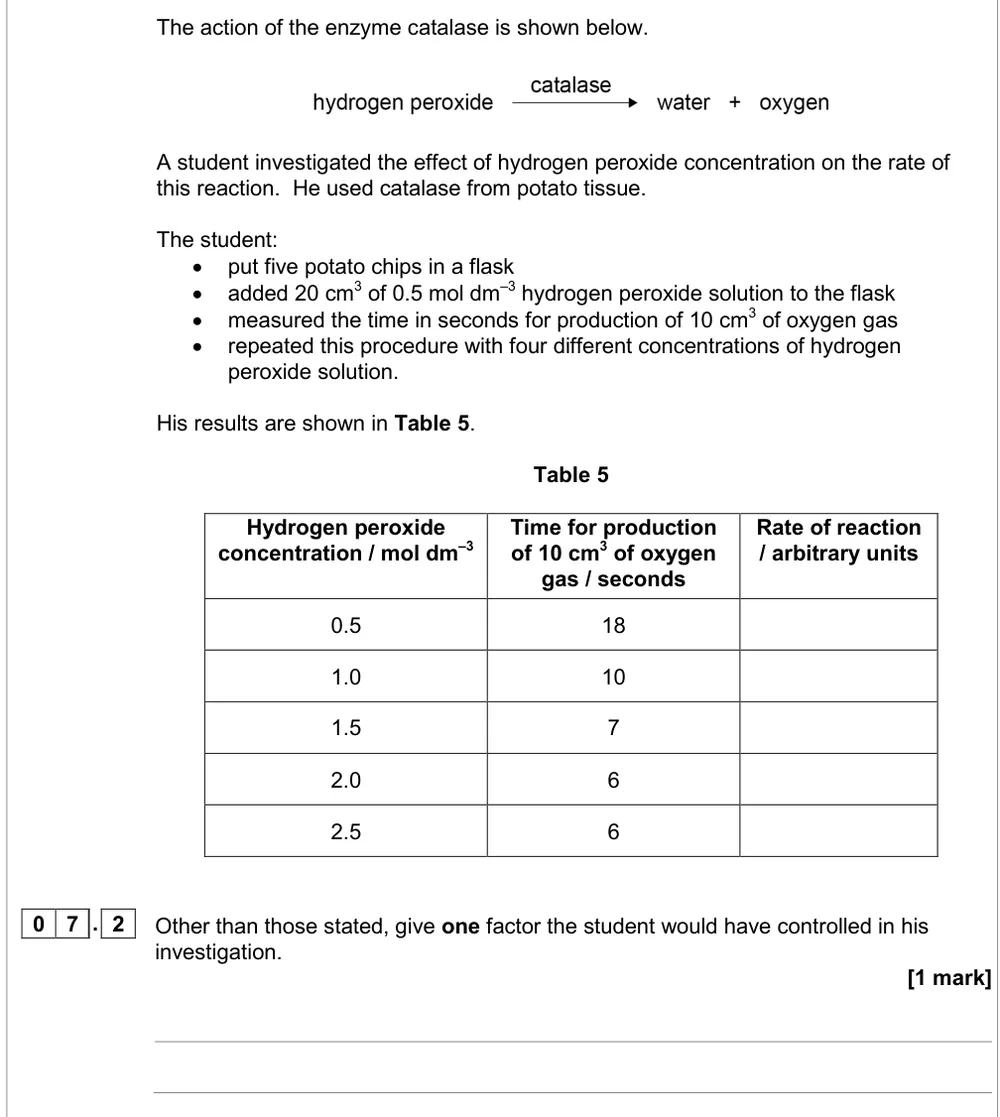
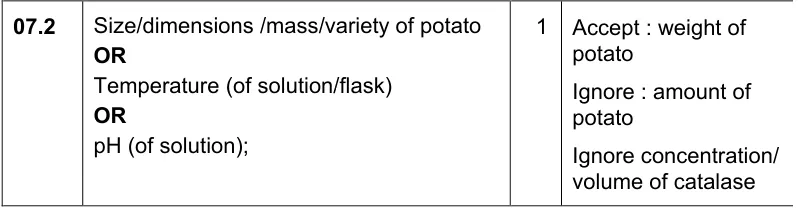
Give a factor the student should control when catalase from potato breaks down hydrogen peroxide.
Show the mark scheme
Tap an image to open it full size.
From the examiners' report: There's no examiners' report for this paper, so this tip comes from the mark scheme. "Amount" of potato is ignored: give the size, mass or variety, or the temperature or pH.
Question 5
AS Paper 2 · June 2025 · Q06.2 · 2 marks · Easy
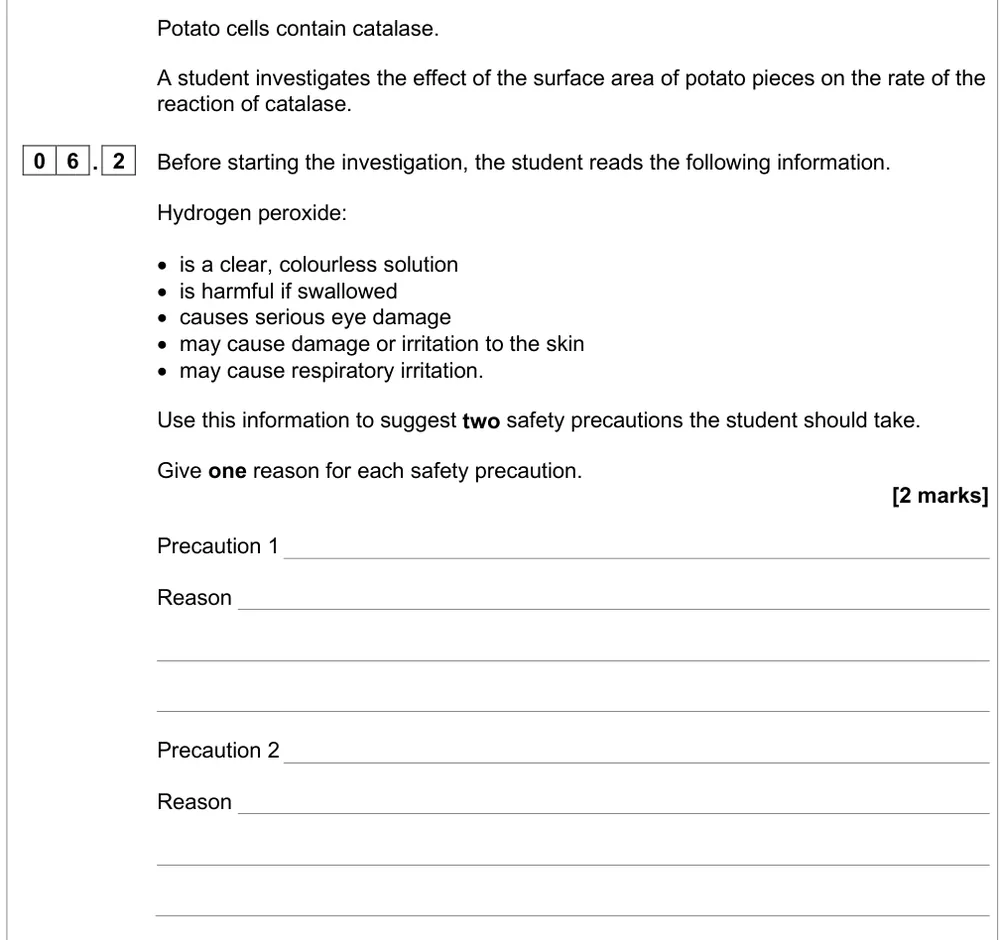
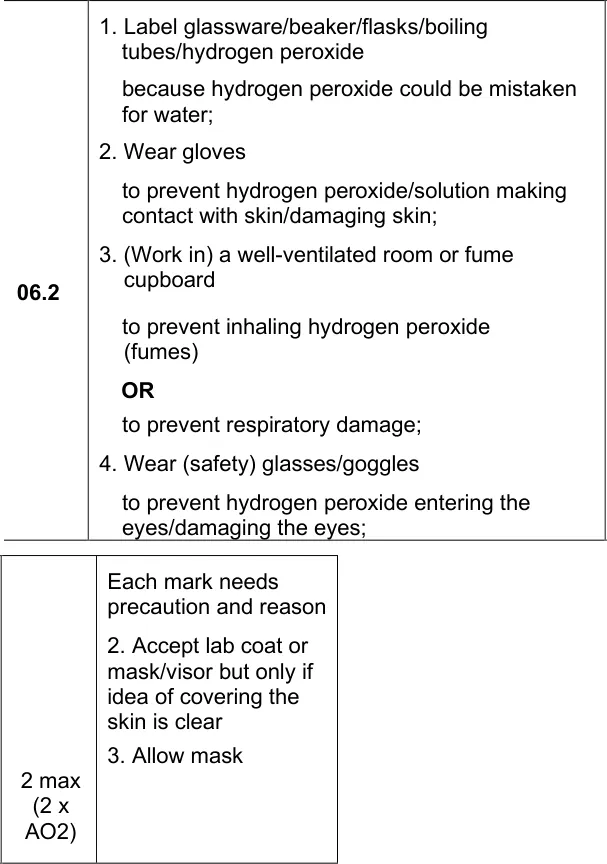
Suggest two safety precautions, with reasons, for using hydrogen peroxide.
Show the mark scheme
Tap an image to open it full size.
From the examiners' report: 82% got both marks. Each precaution needs its reason, linked to the hazards listed.
Question 6
AS Paper 2 · June 2025 · Q06.3 · 1 mark · Hard
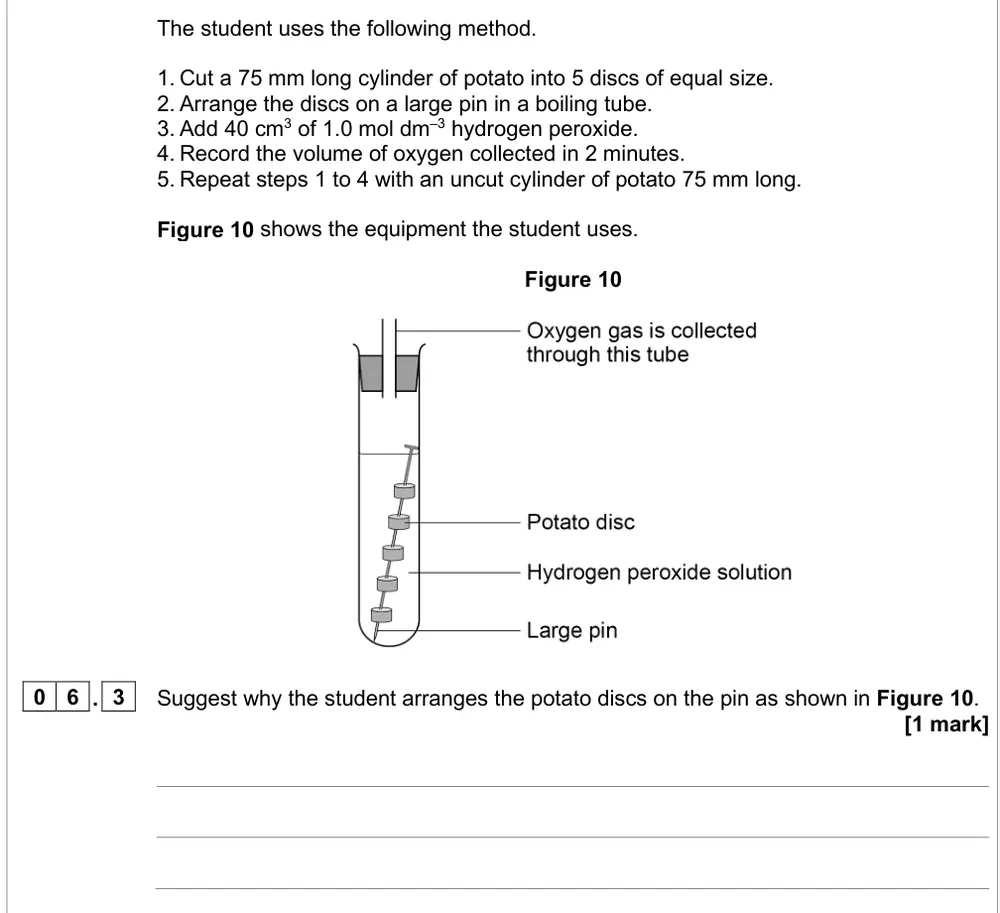
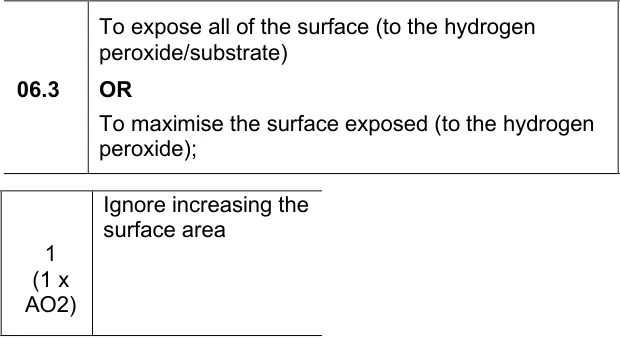
Suggest why potato discs are spaced out on a pin in the boiling tube.
Show the mark scheme
Tap an image to open it full size.
From the examiners' report: About a third got this. Spacing the discs doesn't increase their surface area; it keeps all of it in contact with the hydrogen peroxide.
Question 7
AS Paper 2 · June 2025 · Q06.4 · 3 marks · Easy
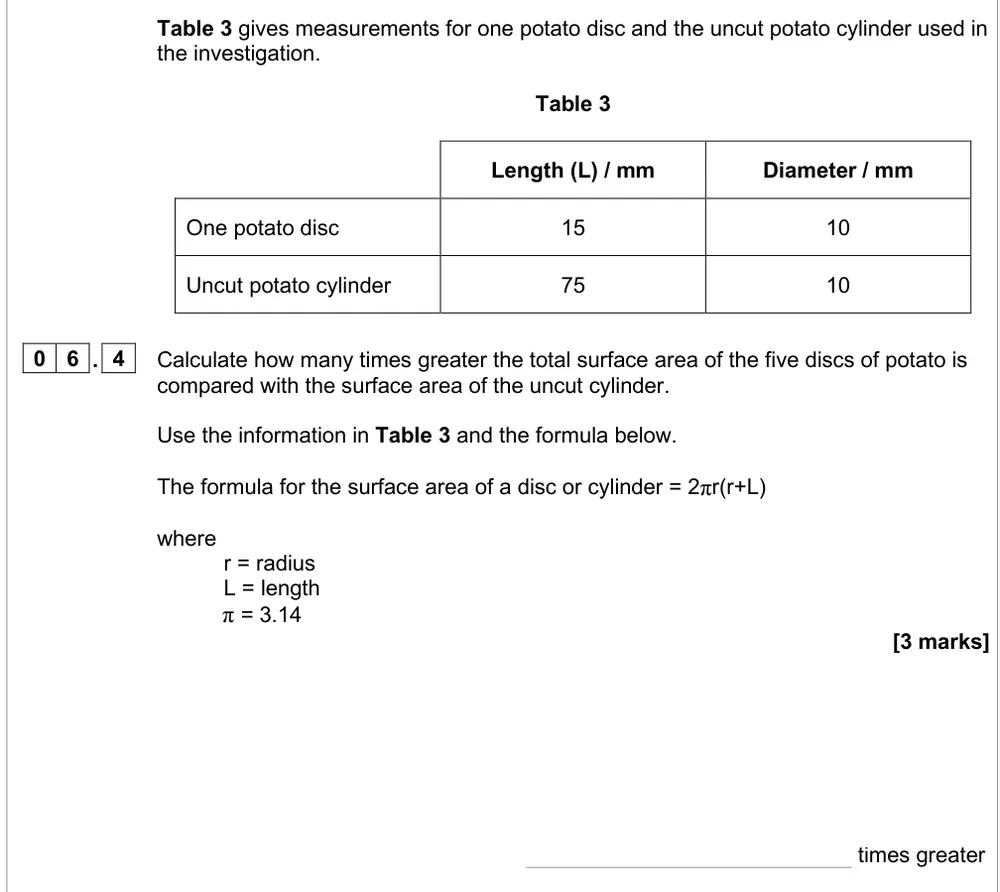
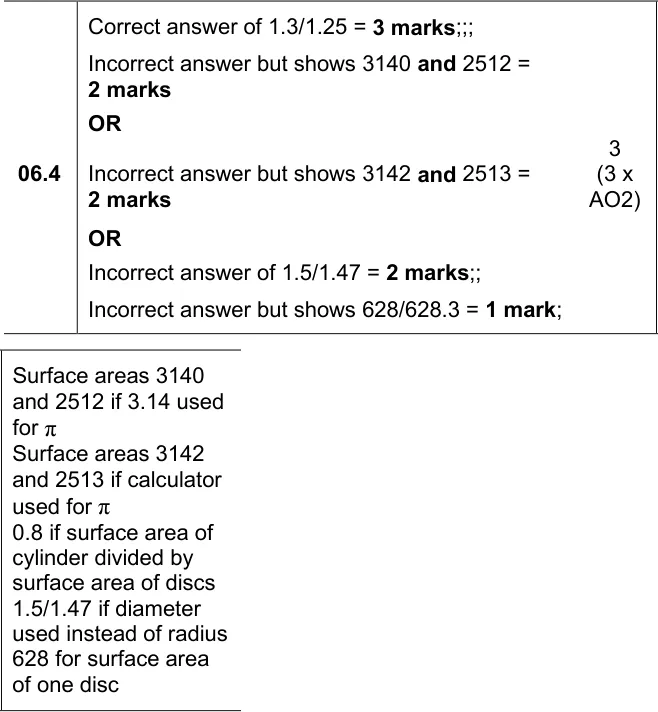
Calculate how many times greater the surface area of five discs is than an uncut cylinder.
Show the mark scheme
Tap an image to open it full size.
From the examiners' report: 66% got all three marks. Many found both areas and then subtracted; "how many times greater" means divide.
Recording and processing results
Question 8
AS Paper 2 · November 2020 · Q05.1 · 2 marks · Medium
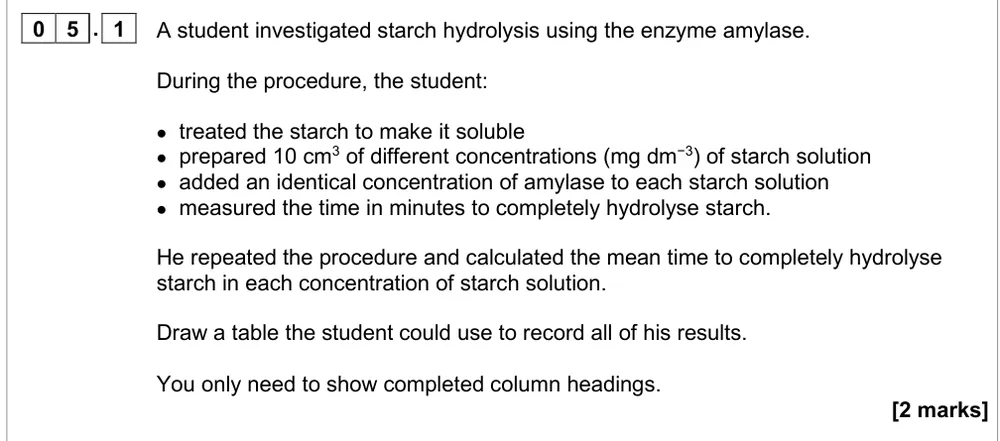
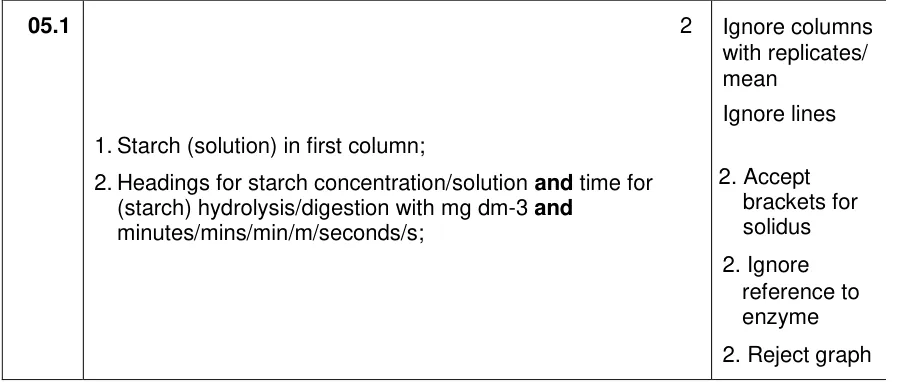
Draw the column headings for a table of starch concentration and time to hydrolyse starch.
Show the mark scheme
Tap an image to open it full size.
From the examiners' report: About a quarter scored nothing: they drew a graph, put the independent variable in the first row, or wrote just "Time" instead of time for hydrolysis.
Question 9
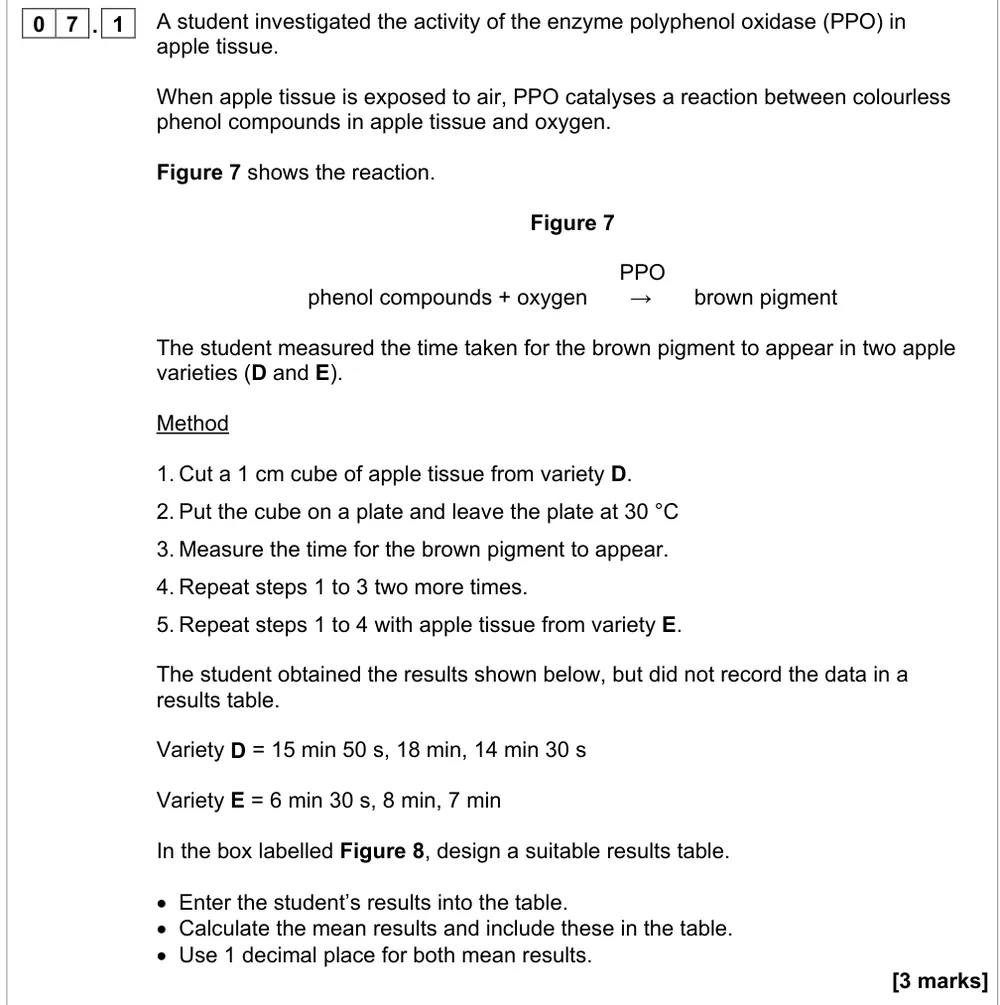
A level Paper 1 · June 2024 · Q07.1 · 3 marks
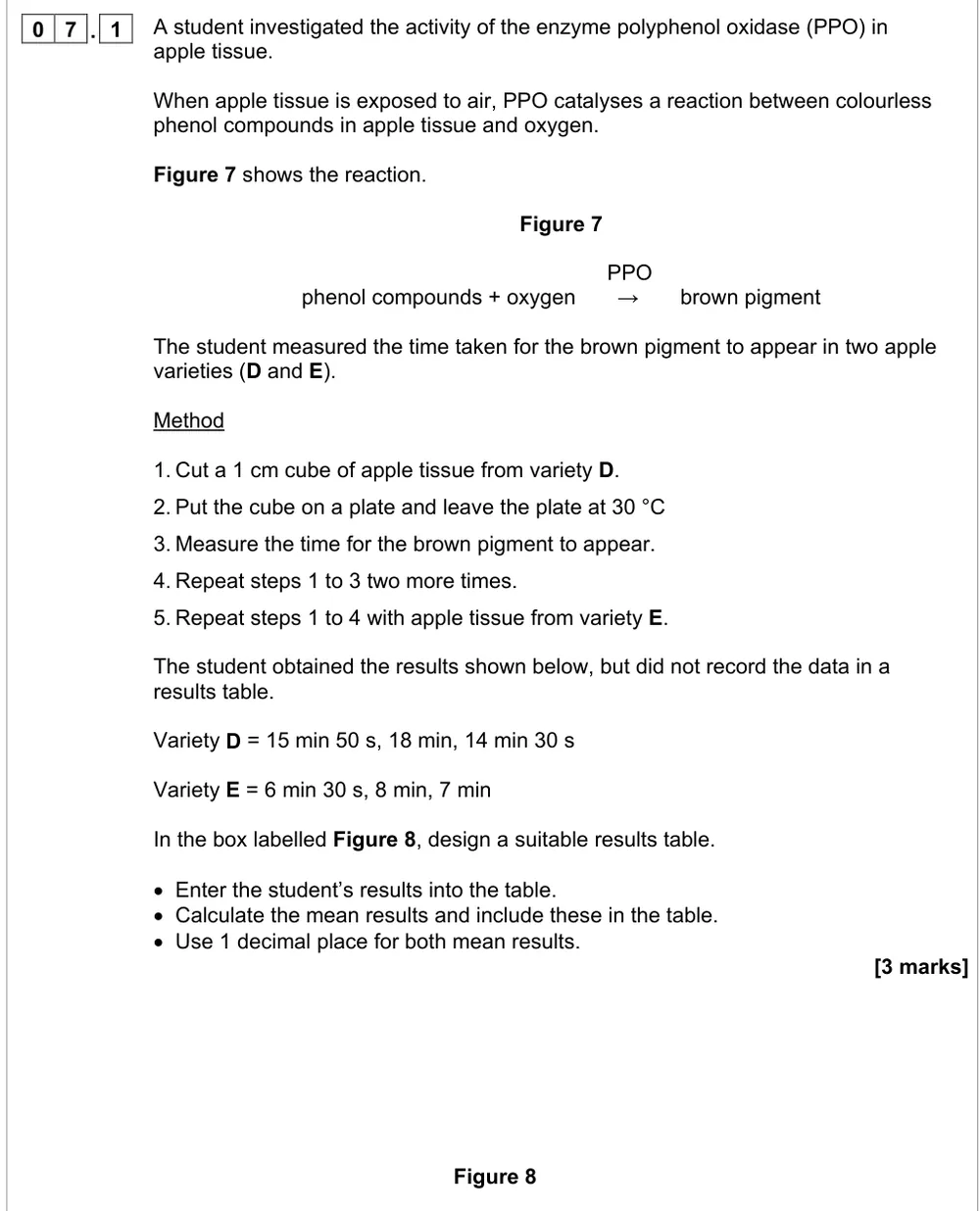
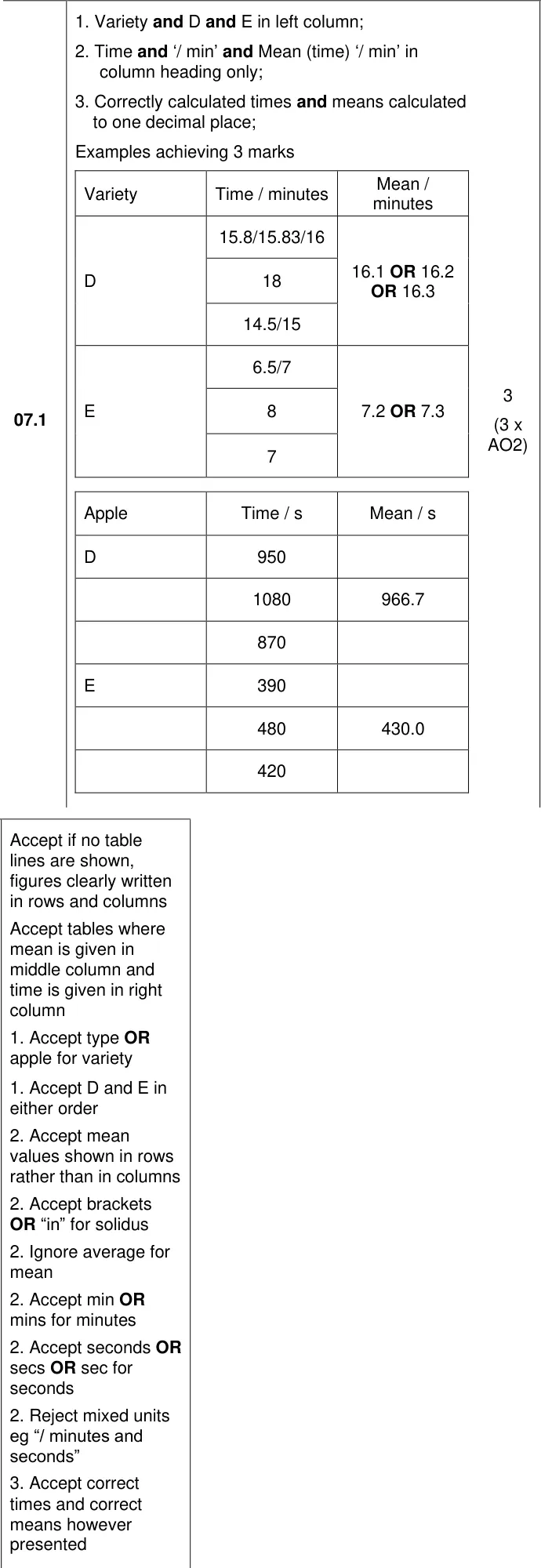
Design a results table for browning times of two apple varieties and add the means.
Show the mark scheme
Tap an image to open it full size.
From the examiners' report: Units belong in the column headings, not next to each number. Convert minutes and seconds into one unit and give the means to 1 decimal place.
Question 10
AS Paper 1 · June 2019 · Q07.3 · 2 marks
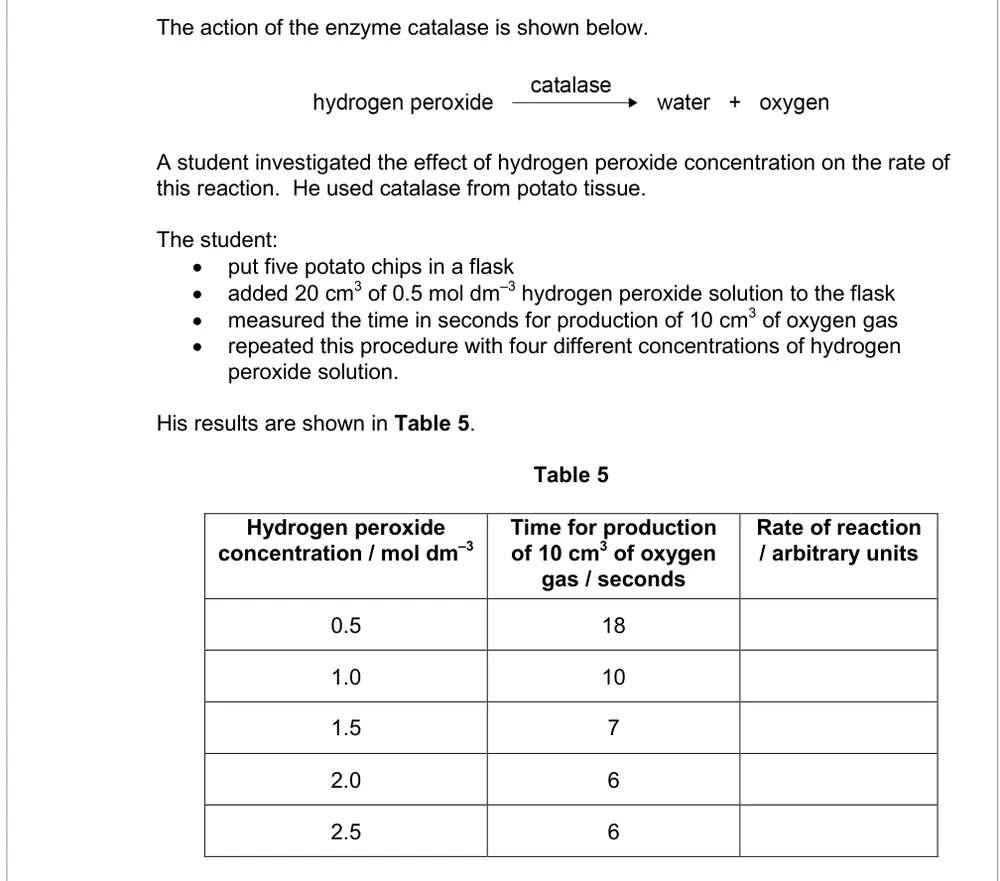
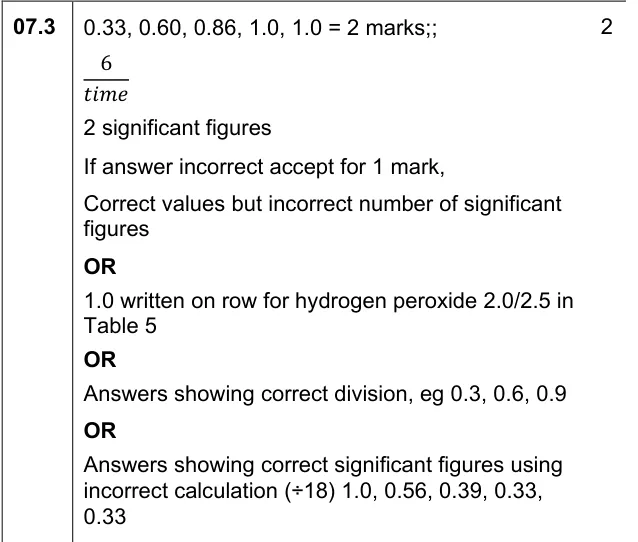
Calculate relative rates of reaction and record them to a sensible number of significant figures.
Information from earlier in this question:

Show the mark scheme
Tap an image to open it full size.
From the examiners' report: There's no examiners' report for this paper, so this tip comes from the mark scheme. Rate = 6 ÷ time, so the fastest time (6 s) gives 1.0; give every value to 2 significant figures.
Question 11
AS Paper 1 · June 2019 · Q07.4 · 3 marks
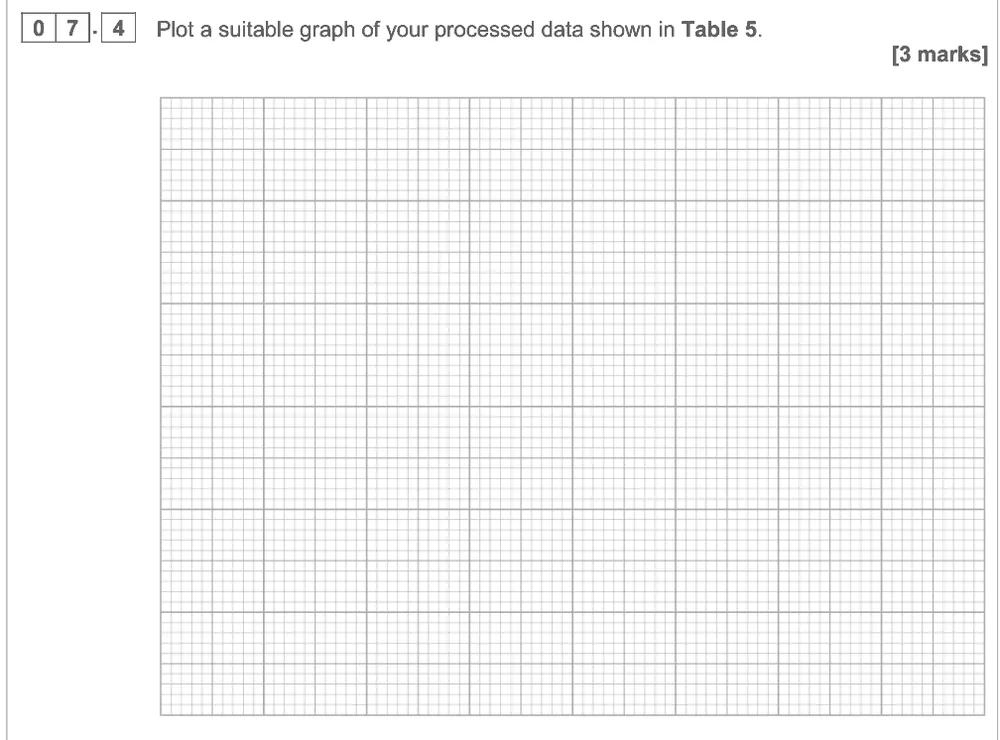
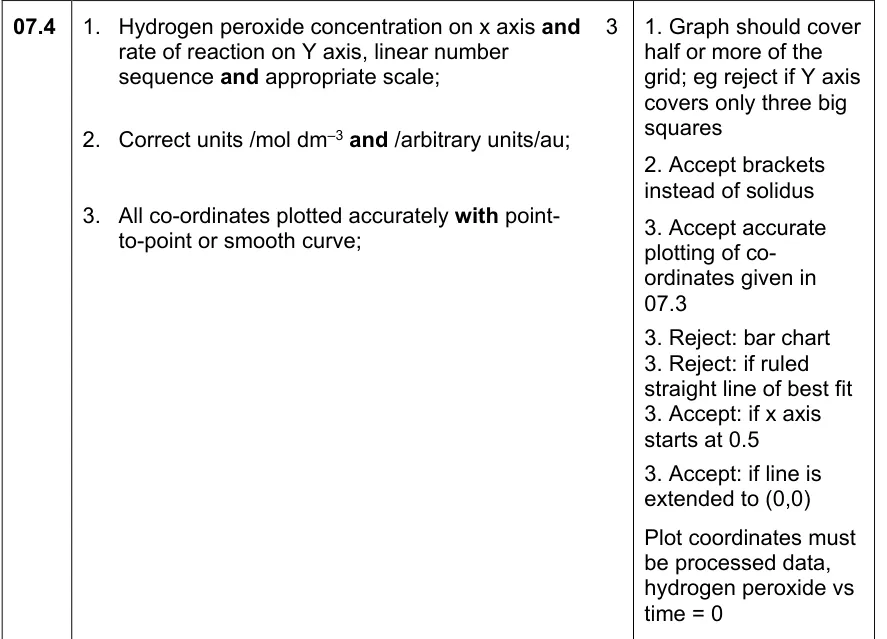
Plot a graph of rate of reaction against hydrogen peroxide concentration.
Show the mark scheme
Tap an image to open it full size.
From the examiners' report: There's no examiners' report for this paper, so this tip comes from the mark scheme. Plot the processed rates, not the times, and don't rule a straight line of best fit through curved data.
Question 12
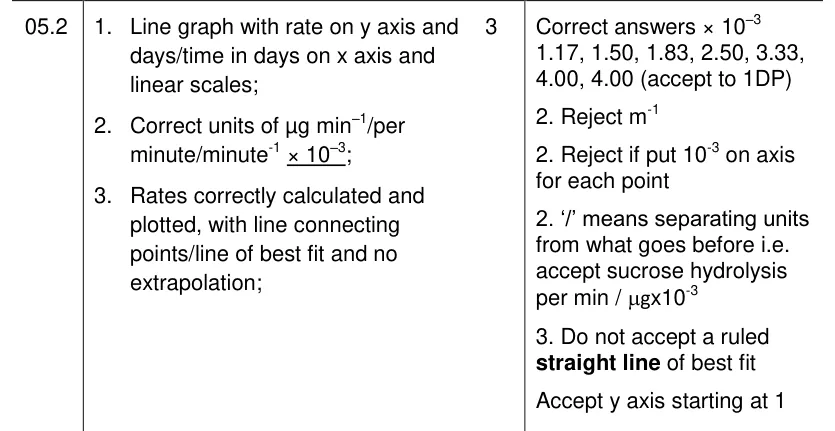
AS Paper 1 · June 2016 · Q05.2 · 3 marks
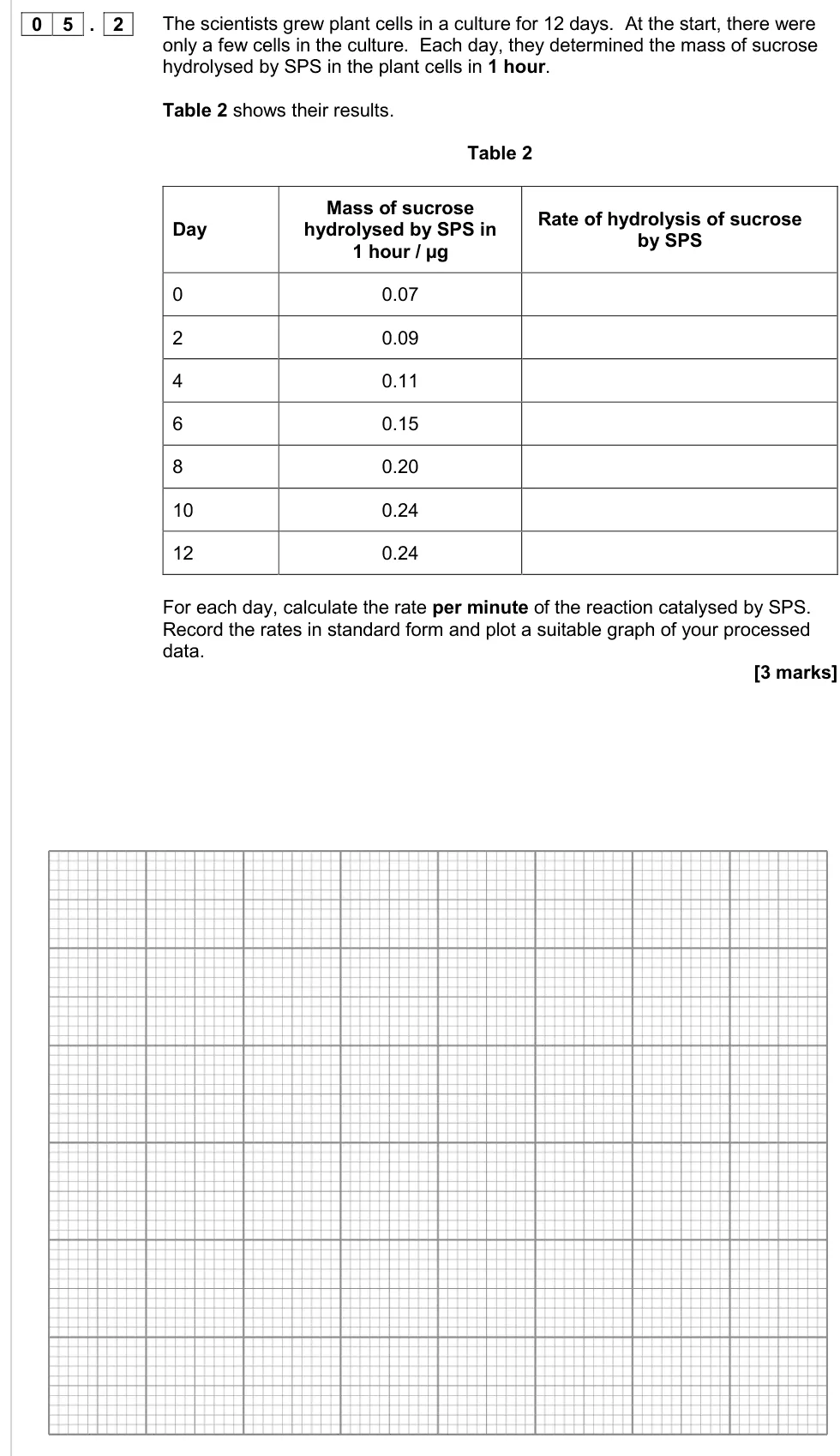
Convert sucrose hydrolysed per hour into rates per minute in standard form and plot them.
Show the mark scheme
Tap an image to open it full size.
From the examiners' report: There's no examiners' report for this paper, so this tip comes from the mark scheme. Divide each value by 60 for a rate per minute, put the × 10⁻³ in the axis label, and don't extrapolate.
Explaining results and finding rates
Question 13
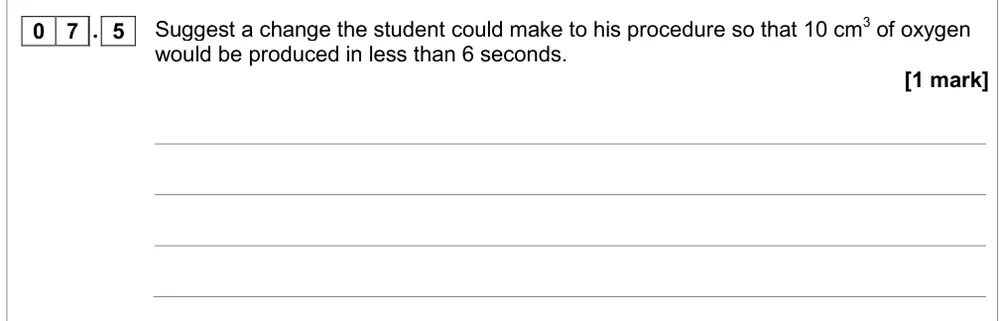
AS Paper 1 · June 2019 · Q07.5 · 1 mark
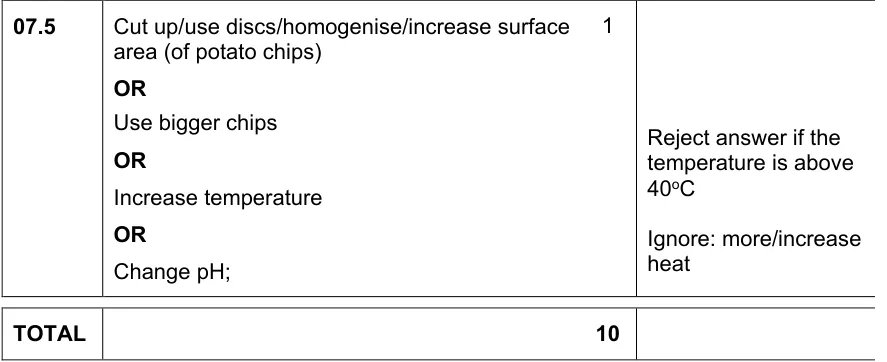
Suggest a change so that 10 cm³ of oxygen is made in under 6 seconds.
Information from earlier in this question:
Show the mark scheme
Tap an image to open it full size.
From the examiners' report: There's no examiners' report for this paper, so this tip comes from the mark scheme. Once the substrate is in excess, more enzyme is needed: more potato surface, or a temperature closer to the optimum.
Question 14
A level Paper 1 · June 2024 · Q07.2 · 2 marks · Hard
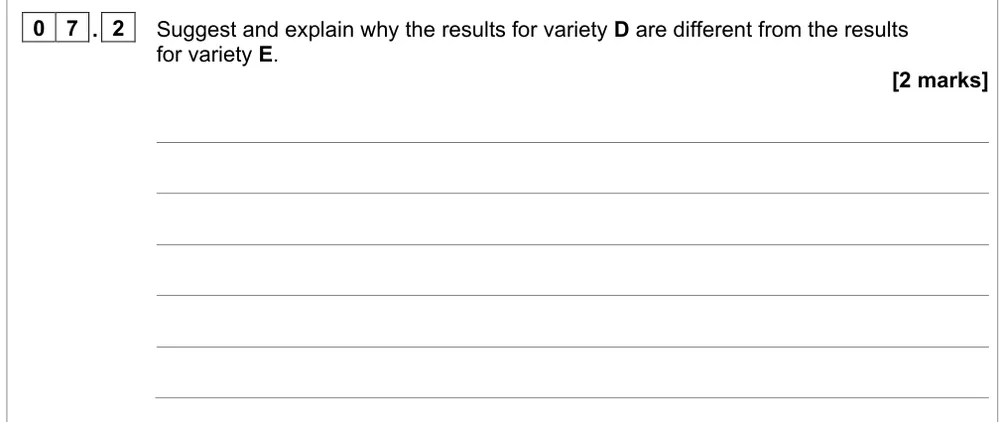
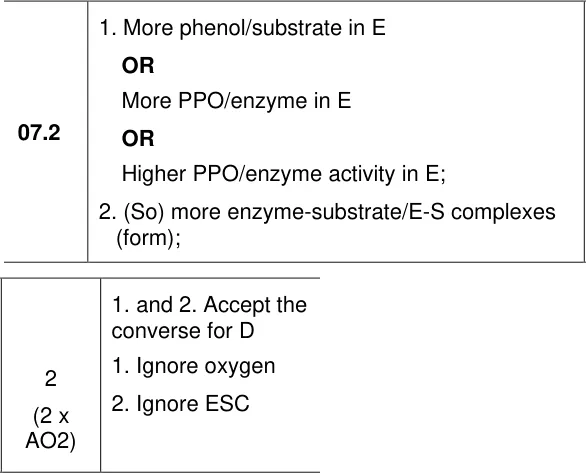
Suggest and explain why one apple variety goes brown faster than the other.
Information from earlier in this question:
Show the mark scheme
Tap an image to open it full size.
From the examiners' report: Some thought a longer time meant a faster reaction. Few went on to enzyme–substrate complexes, so got only one mark.
Question 15
A level Paper 1 · June 2024 · Q07.3 · 3 marks
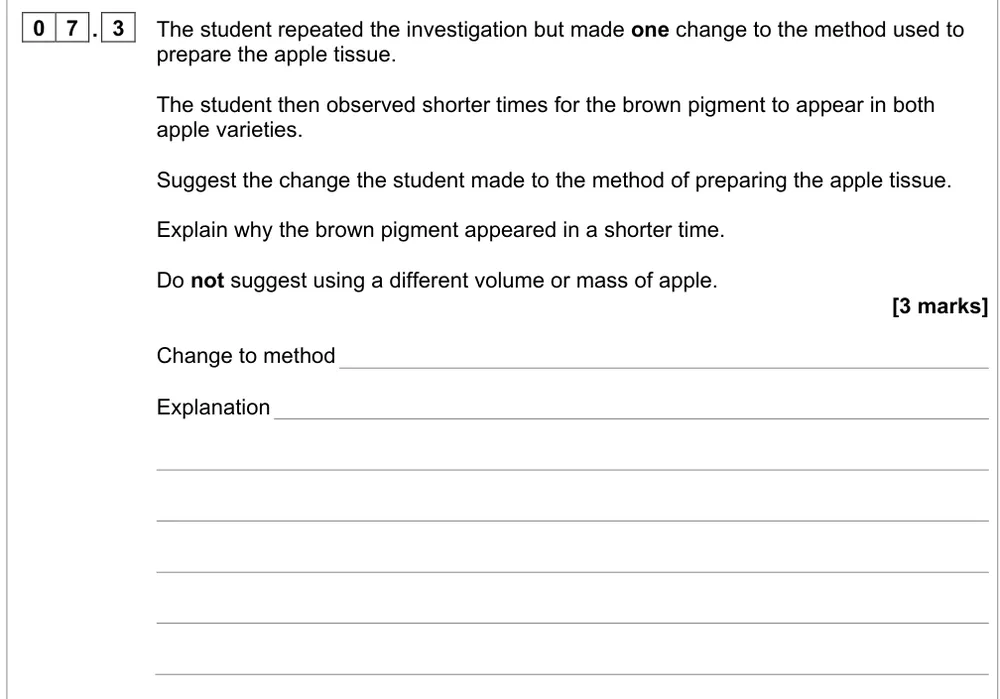
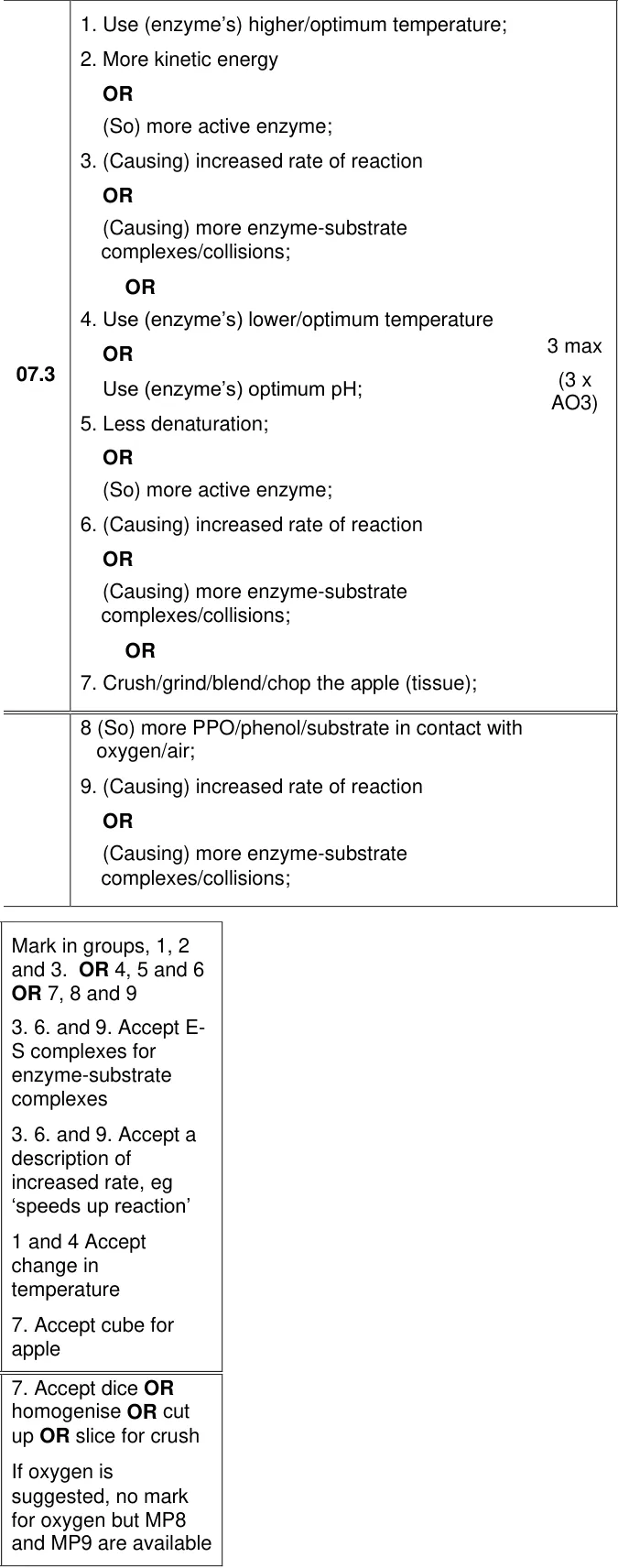
Suggest a change to how the apple is prepared that makes it brown faster, and explain it.
Show the mark scheme
Tap an image to open it full size.
From the examiners' report: The most common full answer was a higher temperature, more kinetic energy and a faster reaction. Say which way you change the temperature, and don't say it lowers the activation energy.
Question 16
AS Paper 1 · June 2024 · Q08.3 · 2 marks
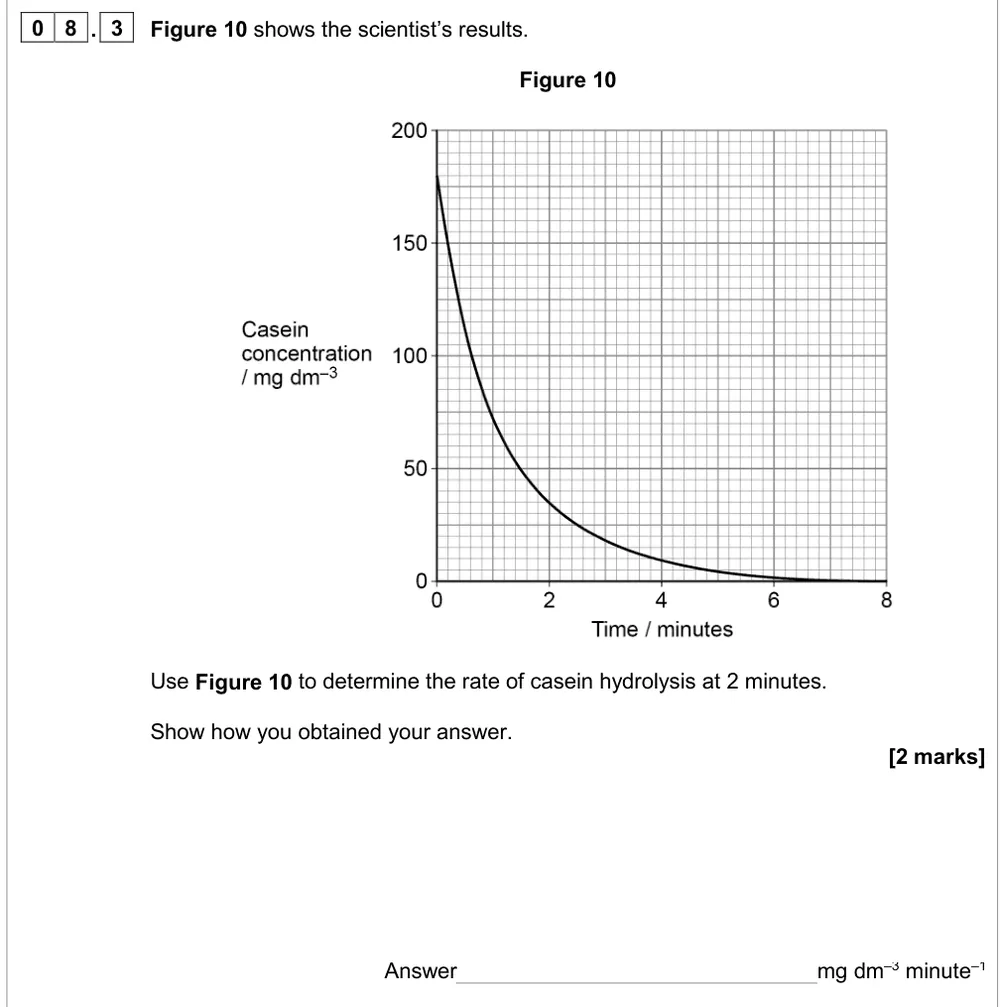
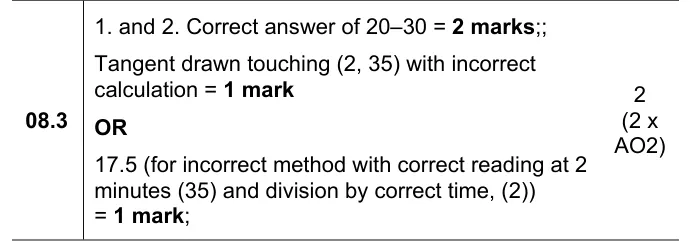
Draw a tangent to find the rate of casein hydrolysis at 2 minutes.
Information from earlier in this question:
Show the mark scheme
Tap an image to open it full size.
From the examiners' report: Students who drew a tangent usually got full marks. Dividing the reading of 35 by 2 minutes isn't a rate at 2 minutes.
Question 17
AS Paper 1 · June 2024 · Q08.4 · 2 marks · Hard
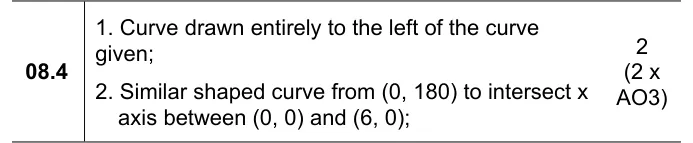
Sketch the curve you'd expect at the protease's optimum temperature.

Show the mark scheme
Tap an image to open it full size.
From the examiners' report: A higher temperature towards the optimum gives a faster rate, so the curve is steeper, to the left, and reaches zero sooner. Start it from the same point.
Where students lose marks (from AQA examiners' reports and mark schemes)
Each point below is followed by wording that gained marks.
Time can be the independent variable: Measuring casein concentration at intervals, many students named the protease or its concentration as the independent variable. The thing the scientist chose to vary was the time of each measurement.
✔ Gains credit: "Independent variable: time; dependent variable: casein concentration."
A control uses denatured enzyme: Only 2% scored 2 or 3 marks for the contents of the control tubes. Many changed the independent variable, used a different enzyme or an inhibitor; references to denatured enzyme were rare.
✔ Gains credit: "The same volume of each buffer, the same concentration of substrate and the same concentration of denatured (boiled) enzyme."
A buffer, not "the same pH": Students invariably wrote "use the same pH" rather than a buffer or a solution of known pH, which lacks the detail expected at A-level.
✔ Gains credit: "Same volume of the pH 8.4 (or pH 7.5) buffer solution."
Independent variable in the first column: About a quarter scored nothing for a results table because they drew a graph, put the independent variable in the first row, or wrote just "Time".
✔ Gains credit: Column headings "Starch concentration / mg dm⁻³" then "Time for hydrolysis / min".
Units in the headings only: Students lost the mark by putting units both in the headings and next to the numbers, by leaving times as minutes and seconds, or by not giving means to one decimal place.
✔ Gains credit: "Variety | Time / min | Mean time / min", with values such as 15.8, 18, 14.5 and a mean of 16.1.
A shorter time is a faster rate: Some students thought that a longer time for the apple to turn brown meant a faster reaction, so got the enzyme activity the wrong way round.
✔ Gains credit: "E turns brown faster, so there is more PPO (or more substrate) in E."
End with enzyme–substrate complexes: Many identified more enzyme or more substrate but never said what that does, so only got one mark.
✔ Gains credit: "...so more enzyme–substrate complexes form."
Say which way the temperature changes: Some gave "temperature" as the change without saying higher or lower, or said a higher temperature lowers the activation energy.
✔ Gains credit: "Use a higher temperature (up to the optimum), so more kinetic energy and more enzyme–substrate complexes form."
Download the questions
Download the PDF pack (17 questions, mark schemes at the end)
Keep practising
- Enzymes: AQA A Level Biology exam questions by topic
- Graph skills: AQA A Level Biology exam questions by topic
- Carbohydrates: AQA A Level Biology exam questions by topic
- Enzymes: test your understanding
- AQA A Level Biology masterclasses
Questions, mark schemes and examiners' report extracts © AQA.