

Lipids (AQA 3.1.3) is a short section of the specification, but it comes up on almost every AS and A-level Paper 1, and it underpins later topics such as cell membranes, digestion and absorption, and respiration. You need to know how one glycerol and three fatty acids join by condensation to form a triglyceride, what an ester bond is, how to spot a saturated or unsaturated fatty acid in a diagram, how a phospholipid differs from a triglyceride, why phospholipids form bilayers, and how to do the emulsion test.
The examiners' reports show the same slips every year: calling the bond glycosidic instead of ester, forgetting that three molecules of water are removed, circling the wrong H on a diagram, writing "glyceride" for glycerol, saying hydrogen "molecules" instead of atoms, and adding water before ethanol in the emulsion test. In compare-and-contrast questions, separate descriptions of each molecule score nothing.
Work through the questions in order: triglycerides first, then fatty acids, phospholipids and the emulsion test. Answer each on paper before you open the mark scheme. If you'd like help with this topic, my AQA masterclasses run online on Tuesdays at 5.15pm for Year 12 and on Wednesdays or Thursdays at 6.30pm for Year 13.
What you need from GCSE and Year 12
Each question on this page assumes you're secure on these GCSE and Year 12 ideas. If any of them feels shaky, revise it before you start.
- GCSE: lipids (fats and oils) are made of fatty acids and glycerol, and lipase breaks them down in digestion.
- GCSE: lipids are a store of energy, and cell membranes contain lipids.
- GCSE: the food test for lipids (Sudan III, or ethanol then water to give a white emulsion).
- Year 12 (AQA 3.1.2): condensation reactions join molecules and remove water; hydrolysis breaks them using water. See the Carbohydrates page.
Key terms
These words come up in the questions and mark schemes. Examiners expect you to use them exactly.
- Triglyceride: a lipid made of one glycerol molecule joined to three fatty acids.
- Glycerol: a small molecule with three OH groups; each one can join to a fatty acid.
- Fatty acid: a carboxylic acid (RCOOH) with a long hydrocarbon chain, the R group.
- Ester bond: the bond formed between glycerol and a fatty acid by a condensation reaction.
- Saturated and unsaturated: saturated: no C=C double bonds in the R group; unsaturated: at least one C=C double bond, which puts a kink in the chain.
- Phospholipid: a lipid like a triglyceride but with one fatty acid replaced by a phosphate-containing group.
- Hydrophilic and hydrophobic: hydrophilic: attracted to water (the phosphate 'head'); hydrophobic: repels water (the fatty acid 'tails').
- Bilayer: two layers of phospholipids, with the hydrophobic tails pointing inwards and the hydrophilic heads facing the water on each side.
- Emulsion: tiny droplets of one liquid spread through another; in the emulsion test, lipid makes a white, milky emulsion.
What these questions cover (AQA 3.1.3)
The questions test these statements from the AQA AS and A-level Biology specification (7401/7402):
- Two groups of lipid: Triglycerides and phospholipids are two groups of lipid.
- Triglycerides: Triglycerides are formed by the condensation of one molecule of glycerol and three molecules of fatty acid.
- Ester bonds: A condensation reaction between glycerol and a fatty acid (RCOOH) forms an ester bond.
- R-groups: The R-group of a fatty acid may be saturated or unsaturated.
- Phospholipids: In phospholipids, one of the fatty acids of a triglyceride is substituted by a phosphate-containing group.
- Properties: The different properties of triglycerides and phospholipids related to their different structures.
- Emulsion test: The emulsion test for lipids.
- Students should be able to recognise, from diagrams, saturated and unsaturated fatty acids
- Students should be able to explain the different properties of triglycerides and phospholipids.
How to use this page
Write your answer on paper before you open the mark scheme. Allow about 1.3 minutes per mark: the 16 questions are worth 36 marks, so about 47 minutes in total. Then mark your answer strictly against the mark scheme and read the examiners' tip underneath it. If you'd rather print the questions, download the PDF pack.
Triglycerides and ester bonds (3.1.3)
Question 1
AS Paper 1 · June 2018 · Q05.1 · 2 marks · Easy
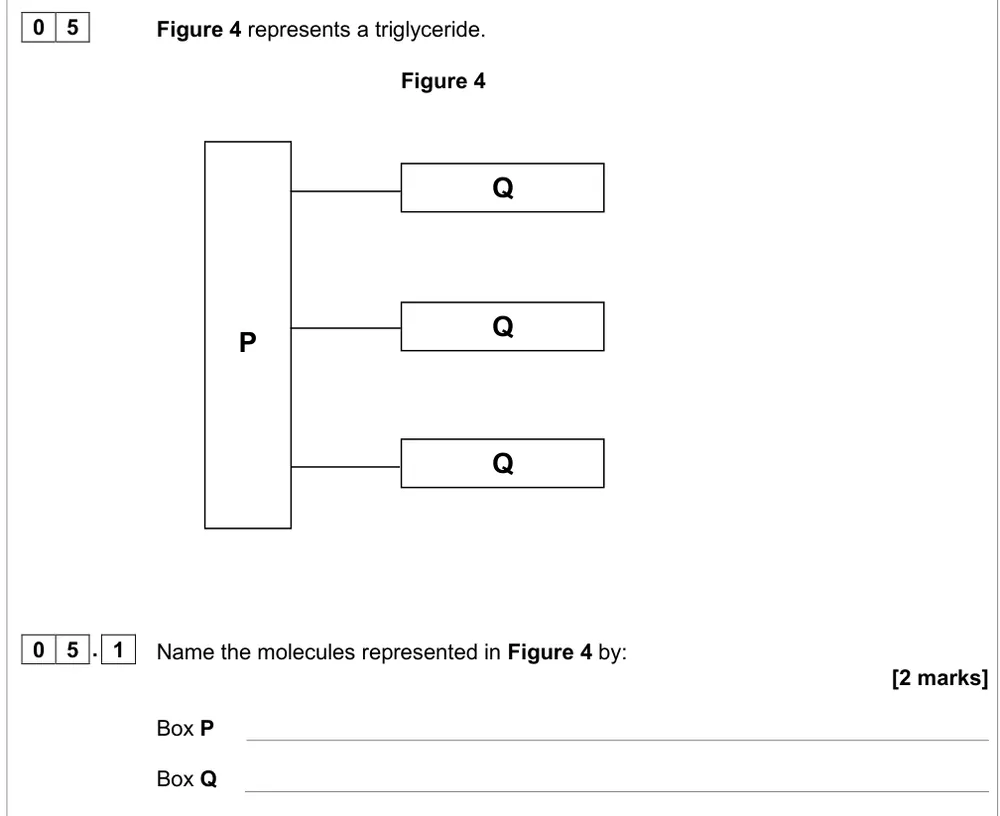
Name the two kinds of molecule that make up a triglyceride.
Show the mark scheme

Tap an image to open it full size.
From the examiners' report: Well answered, but some swapped the answers and many wrote 'glyceride' instead of glycerol.
Question 2
AS Paper 1 · June 2018 · Q05.2 · 1 mark · Easy
Name the bond between glycerol and a fatty acid.

Show the mark scheme

Tap an image to open it full size.
From the examiners' report: Well answered. It's an ester bond; glycosidic bonds are in carbohydrates.
Question 3
A level Paper 1 · November 2021 · Q08.1 · 3 marks
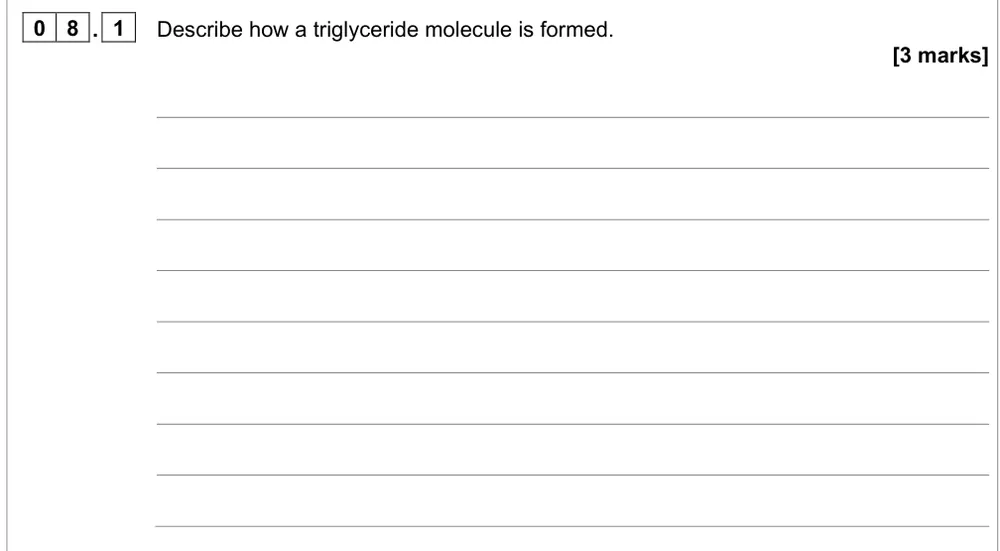
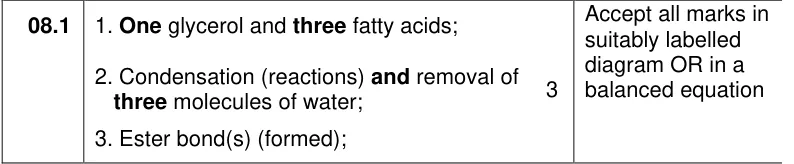
Describe how a triglyceride molecule is formed.
Show the mark scheme
Tap an image to open it full size.
From the examiners' report: Most described the structure well, but some missed a mark by not saying that three water molecules are removed.
Question 4
AS Paper 1 · November 2020 · Q02.2 · 2 marks · Easy
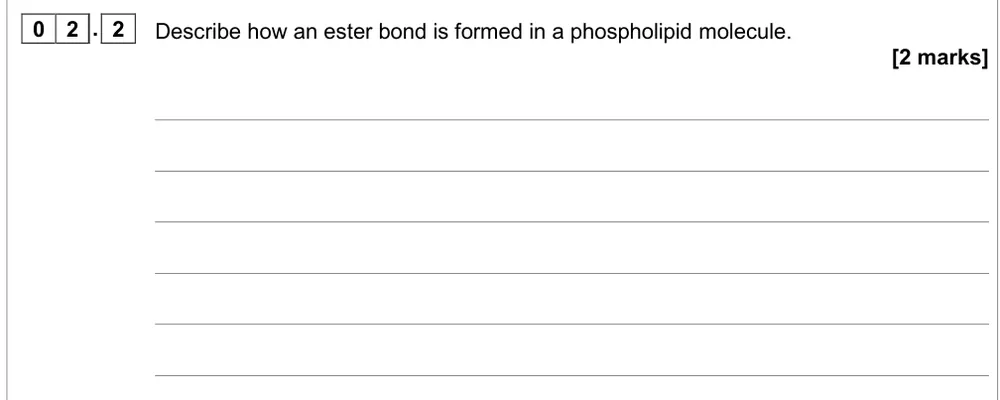
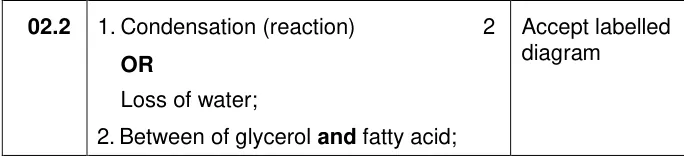
Describe how an ester bond forms in a phospholipid.
Show the mark scheme
Tap an image to open it full size.
From the examiners' report: Largely well answered. Name the reaction and the two molecules it joins.
Question 5
A level Paper 1 · June 2024 · Q01.1 · 3 marks · Easy
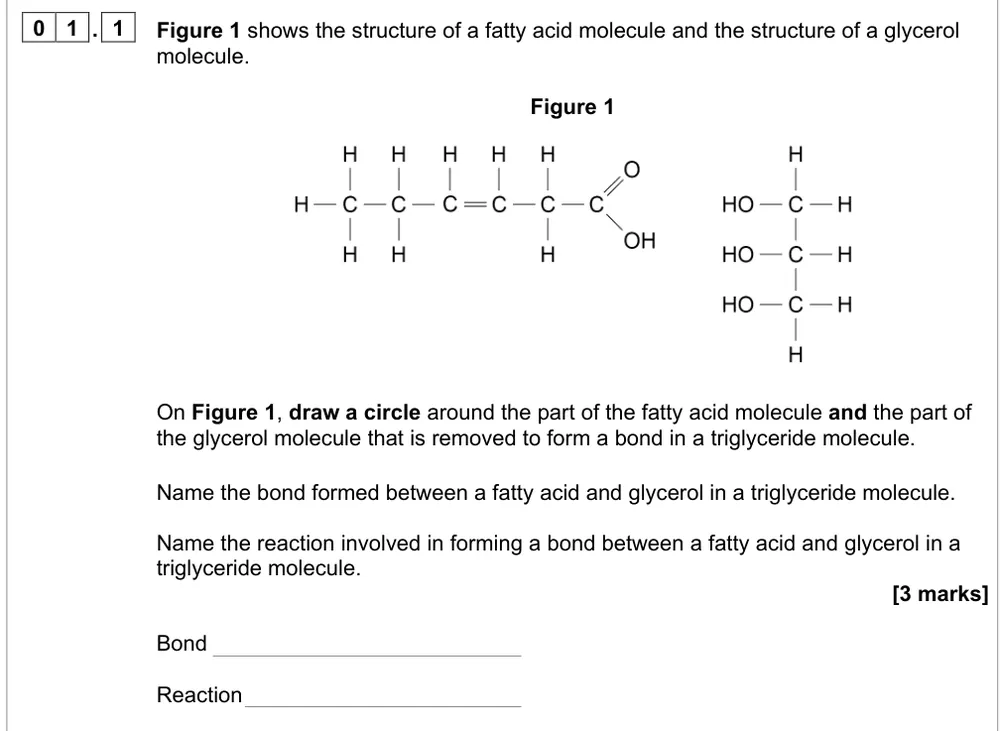
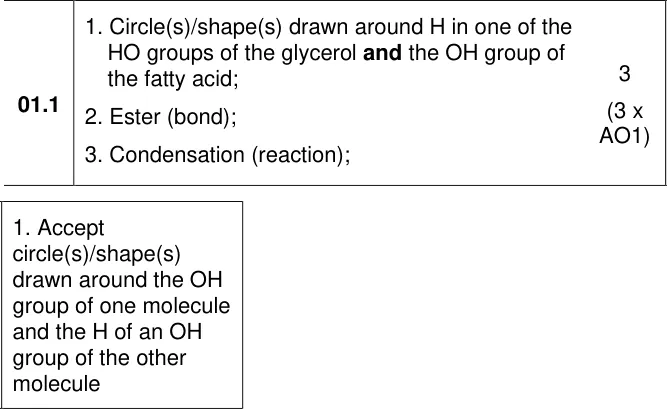
Circle the atoms removed when a fatty acid joins glycerol, and name the bond and reaction.
Show the mark scheme
Tap an image to open it full size.
From the examiners' report: Most named ester and condensation. The circling was the hard part: water comes from an OH and the H of another OH, not from a C–H.
Phospholipids and their properties (3.1.3)
Question 6
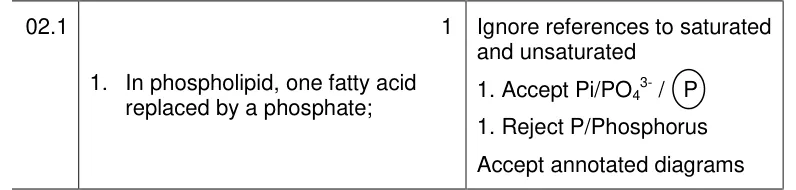
AS Paper 1 · June 2016 · Q02.1 · 1 mark
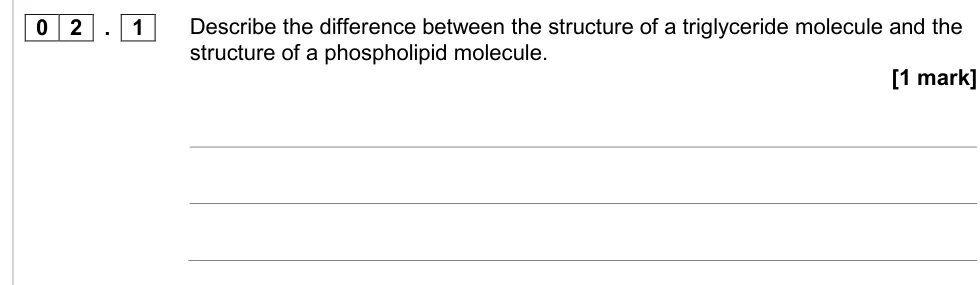
Describe the difference between the structure of a triglyceride and a phospholipid.
Show the mark scheme
Tap an image to open it full size.
From the examiners' report: There's no examiners' report for this paper, so this tip comes from the mark scheme. Say 'phosphate', not phosphorus.
Saturated and unsaturated fatty acids (3.1.3)
Question 7
A level Paper 1 · June 2024 · Q01.2 · 1 mark · Easy
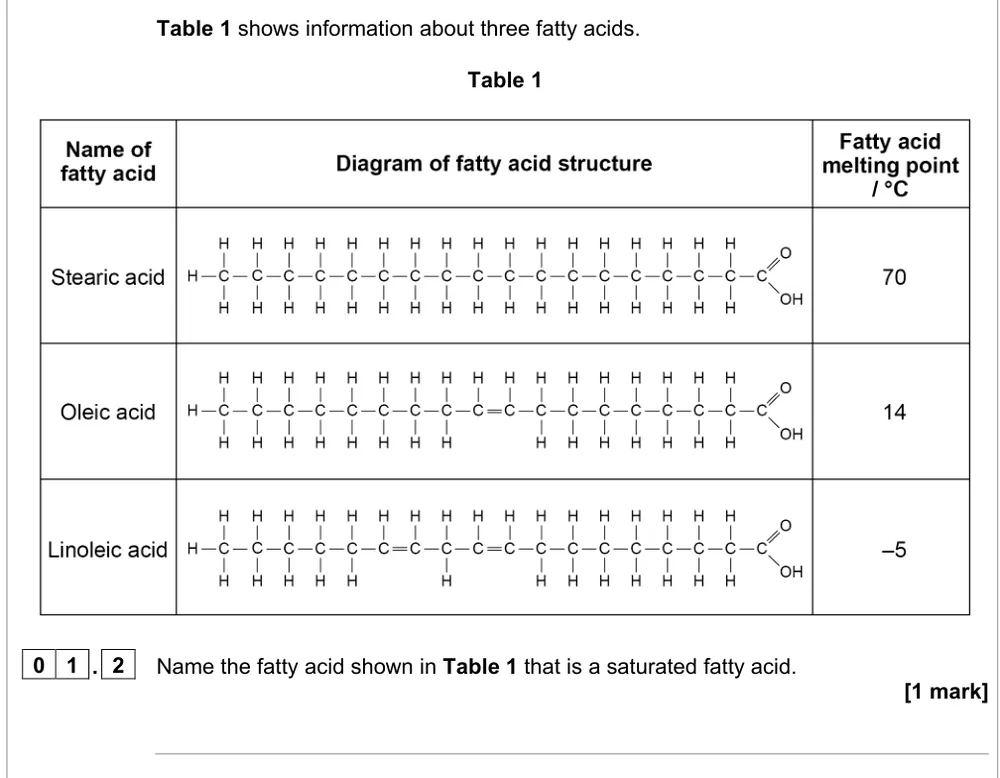
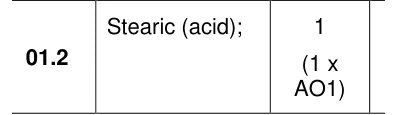
Pick out the saturated fatty acid from three structures.
Show the mark scheme
Tap an image to open it full size.
From the examiners' report: Nearly everyone identified stearic acid: no C=C double bonds in the chain.
Question 8
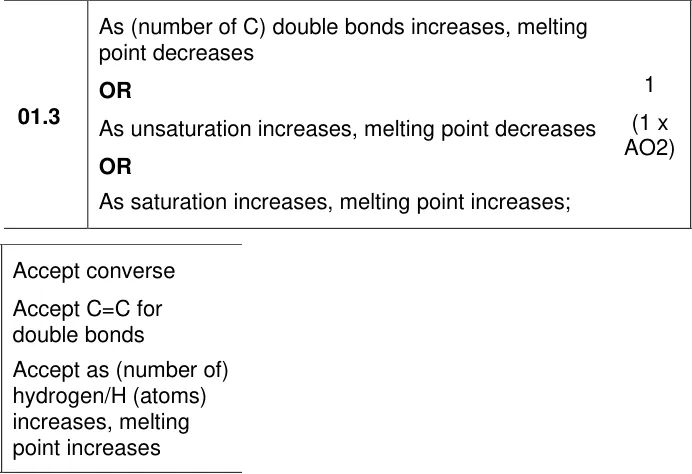
A level Paper 1 · June 2024 · Q01.3 · 1 mark
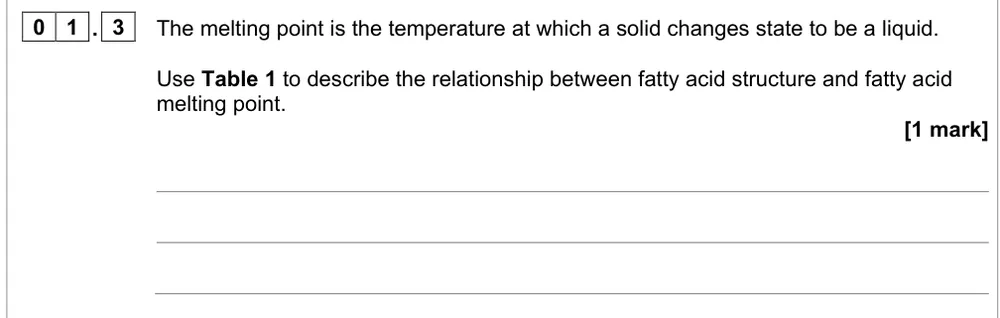
Describe the link between fatty acid structure and melting point.
Show the mark scheme
Tap an image to open it full size.
From the examiners' report: Many did well. Refer to carbon double bonds, and to hydrogen atoms rather than hydrogen molecules; and read melting, not boiling.
Question 9
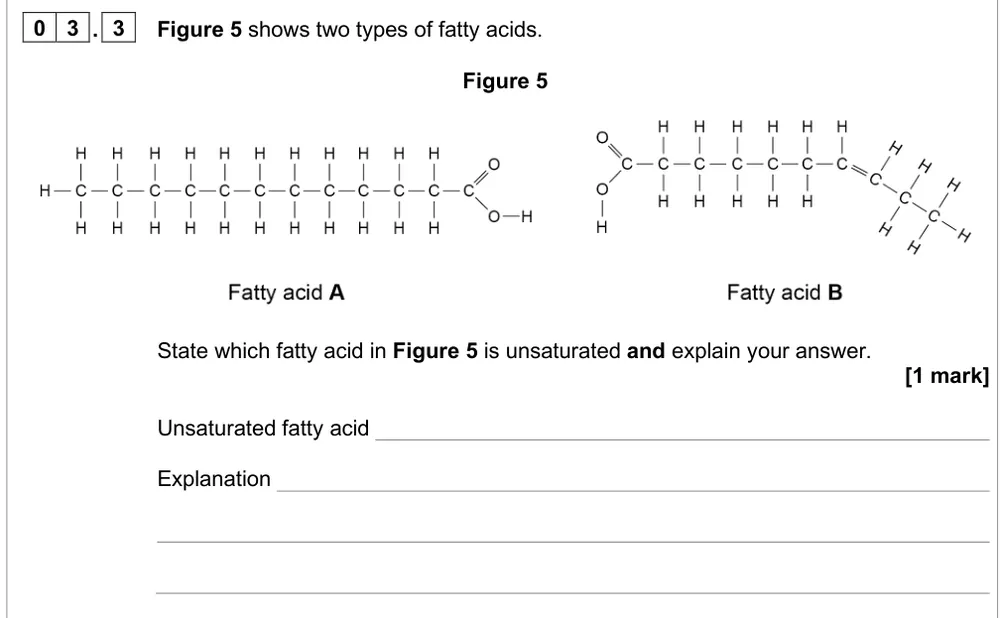
AS Paper 2 · June 2025 · Q03.3 · 1 mark · Easy
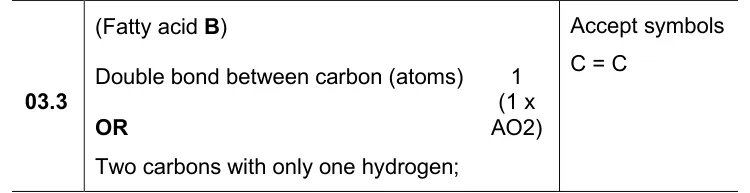
State which of two fatty acids is unsaturated and explain why.
Show the mark scheme
Tap an image to open it full size.
From the examiners' report: About 83% got this. Those who didn't usually forgot to say the double bond was between two carbon atoms.
Phospholipids and their properties (3.1.3)
Question 10
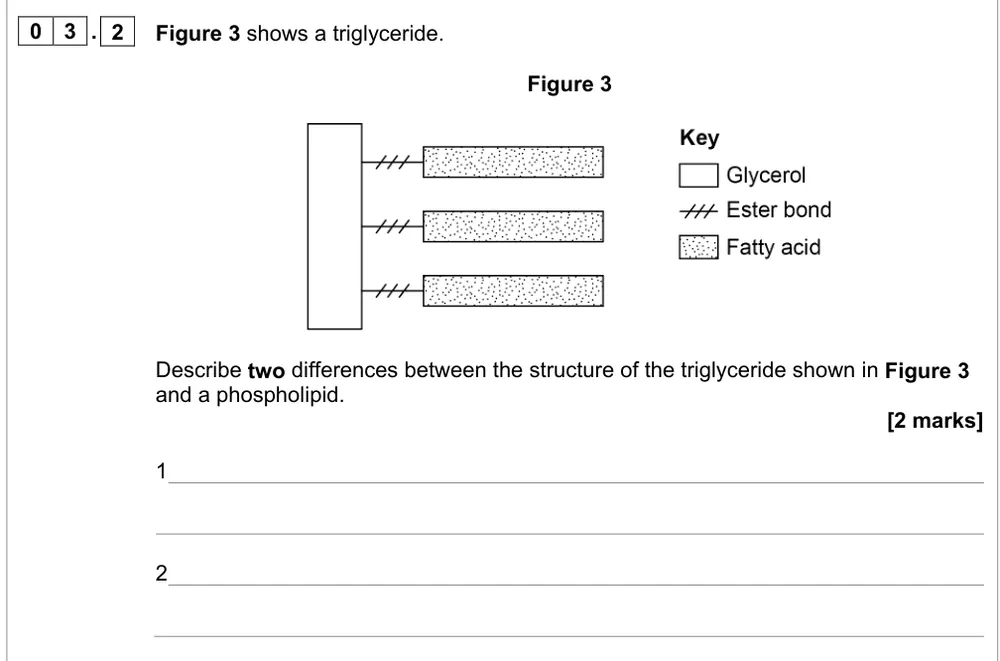
AS Paper 1 · June 2023 · Q03.2 · 2 marks · Easy
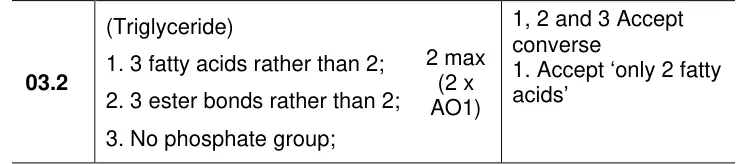
Give two differences between a triglyceride and a phospholipid.
Show the mark scheme
Tap an image to open it full size.
From the examiners' report: Well answered. Use comparative wording, and don't say phospholipids have phosphodiester bonds.
Question 11
AS Paper 1 · June 2023 · Q03.3 · 3 marks
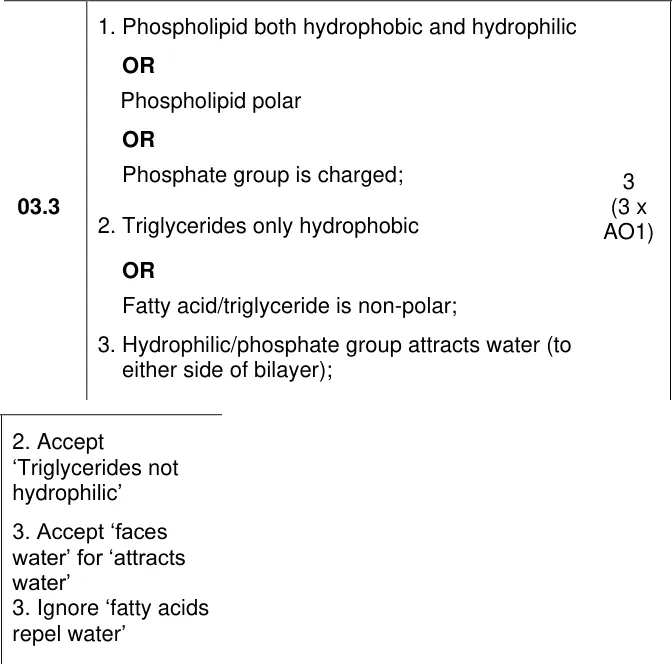
Explain why phospholipids can form a bilayer but triglycerides can't.
Show the mark scheme
Tap an image to open it full size.
From the examiners' report: Many knew phospholipids have both regions, but fewer said triglycerides are only hydrophobic, or linked the hydrophilic phosphate to attracting water.
Question 12
A level Paper 1 · June 2018 · Q10.2 · 5 marks · Hard
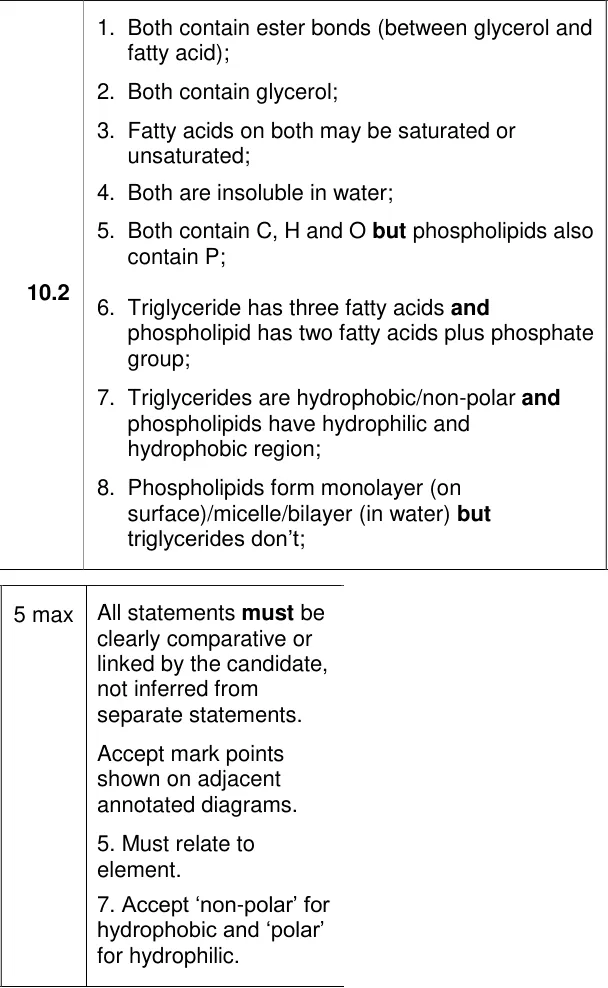
Compare and contrast the structure and properties of triglycerides and phospholipids (5 marks).
Show the mark scheme
Tap an image to open it full size.
From the examiners' report: Many knew each molecule but didn't compare them: separate descriptions score nothing. Many also left glycerol out of the phospholipid.
Question 13
AS Paper 1 · June 2023 · Q03.4 · 3 marks · Medium
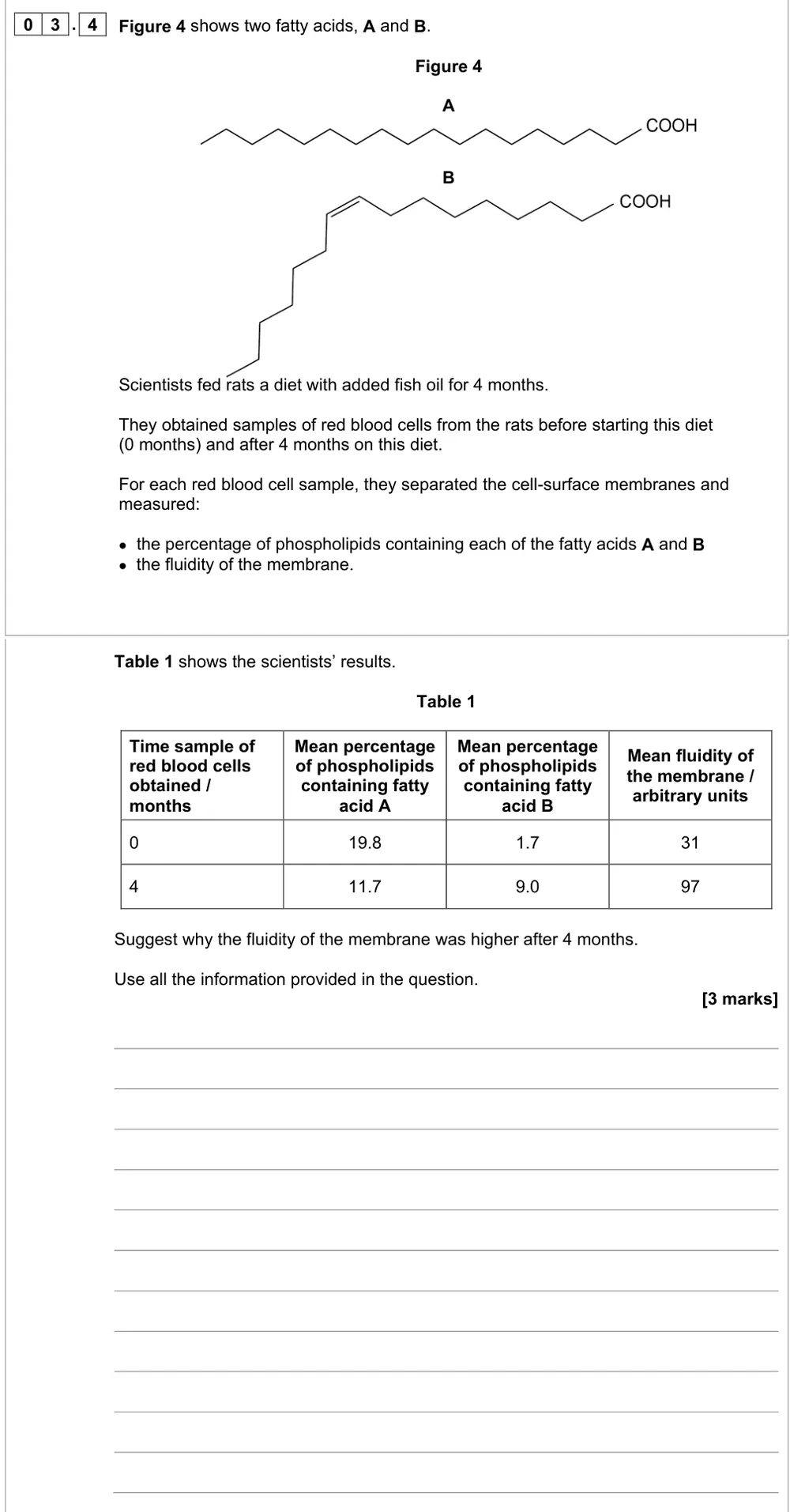
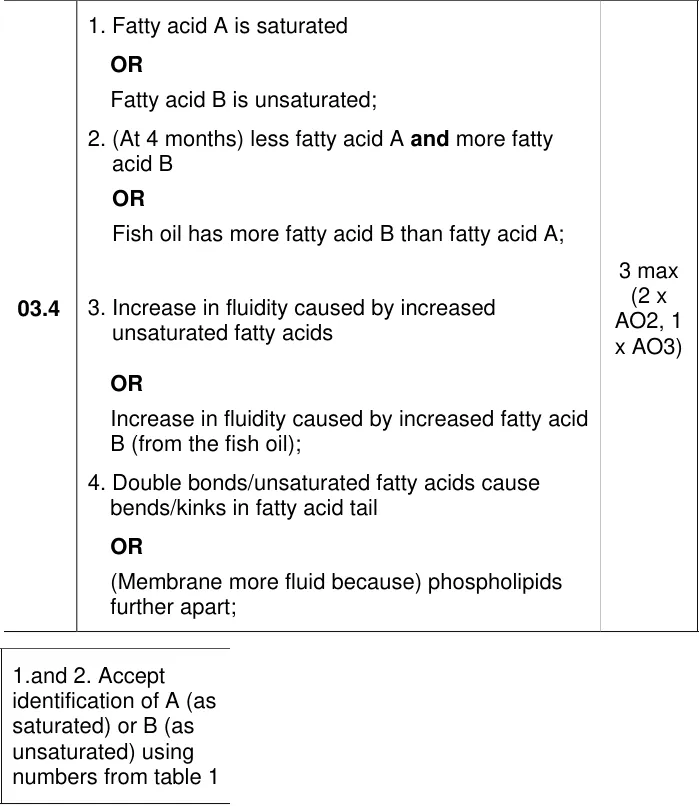
Use data on two fatty acids to explain why membranes became more fluid on a fish-oil diet.
Show the mark scheme
Tap an image to open it full size.
From the examiners' report: About 25% got full marks. Some mixed up which fatty acid was saturated, and some wrote about cholesterol instead of using the data.
Saturated and unsaturated fatty acids (3.1.3)
Question 14
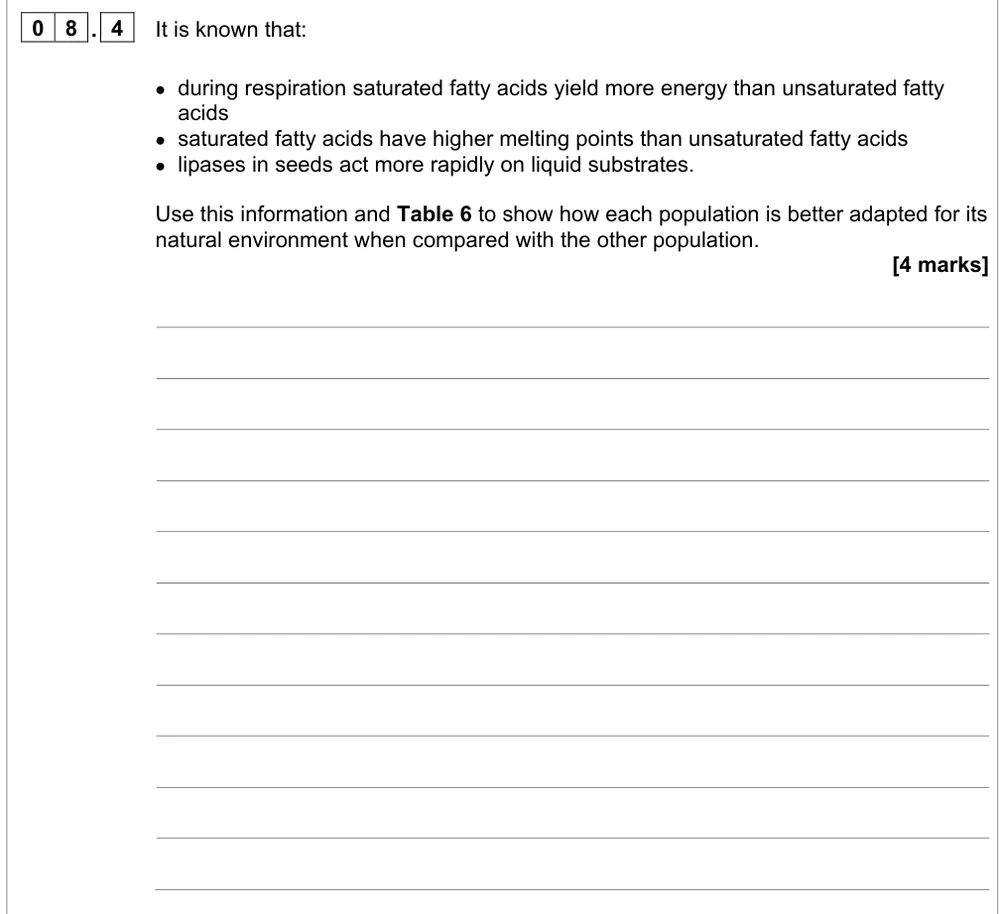
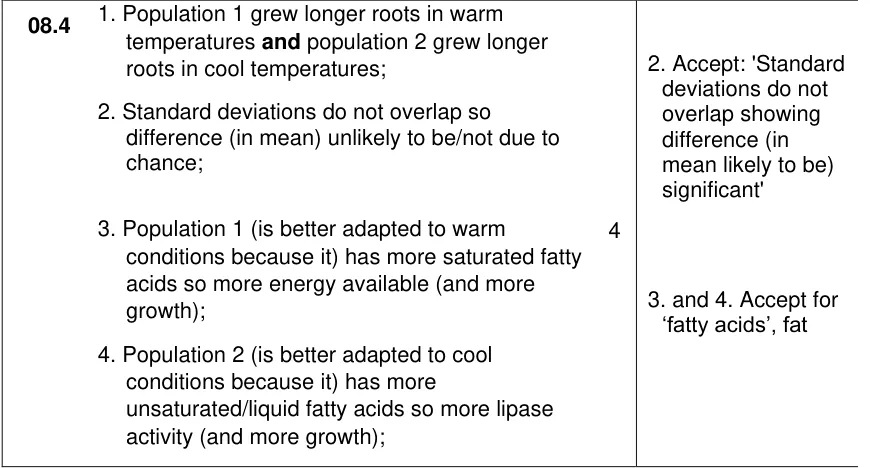
A level Paper 1 · November 2021 · Q08.4 · 4 marks · Hard
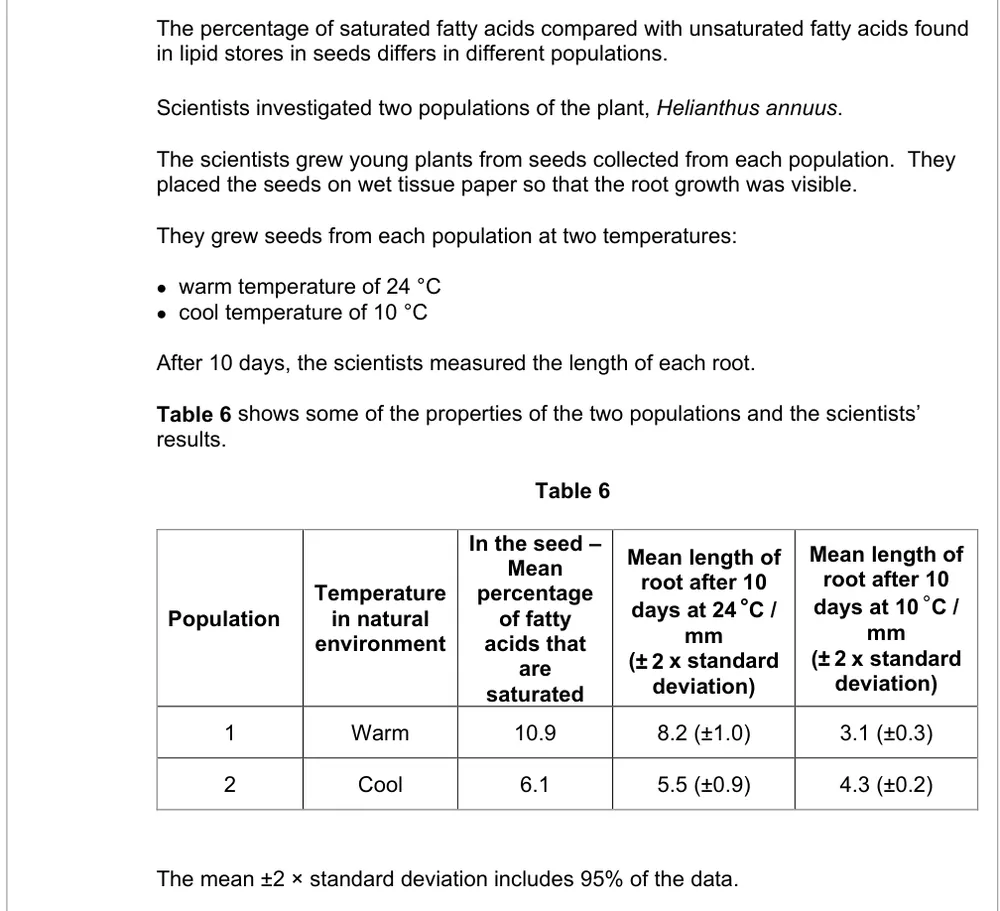
Use data on seed fatty acids to explain how two sunflower populations are adapted.
Information from earlier in this question:
Show the mark scheme
Tap an image to open it full size.
From the examiners' report: Only a few got full marks. Many compared within each population instead of between the two populations.
The emulsion test (3.1.3)
Question 15
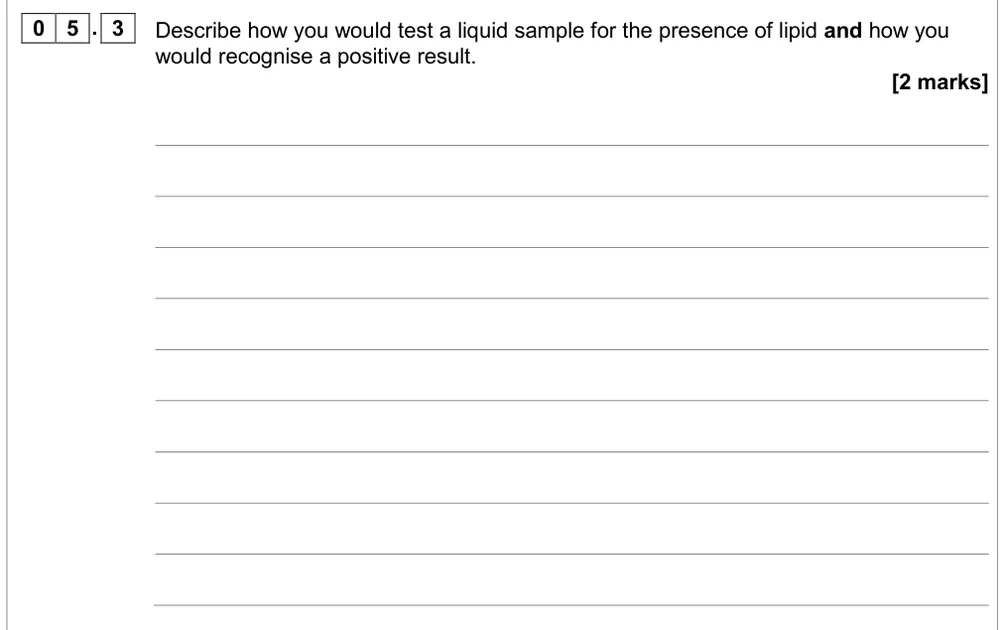
AS Paper 1 · June 2018 · Q05.3 · 2 marks
Describe the emulsion test for lipid and a positive result.
Show the mark scheme

Tap an image to open it full size.
From the examiners' report: 47% got both marks. Errors were leaving out water, adding water before ethanol, 'cloudy' with no colour, and 'precipitate'.
Question 16
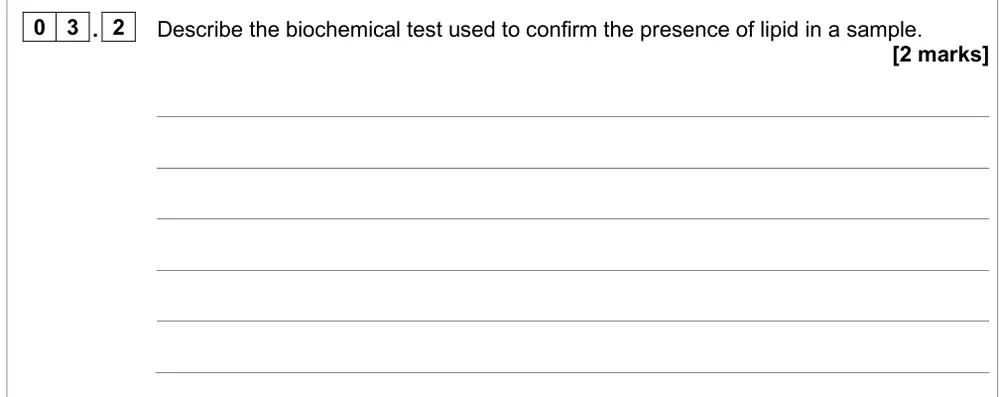
AS Paper 2 · June 2025 · Q03.2 · 2 marks · Easy
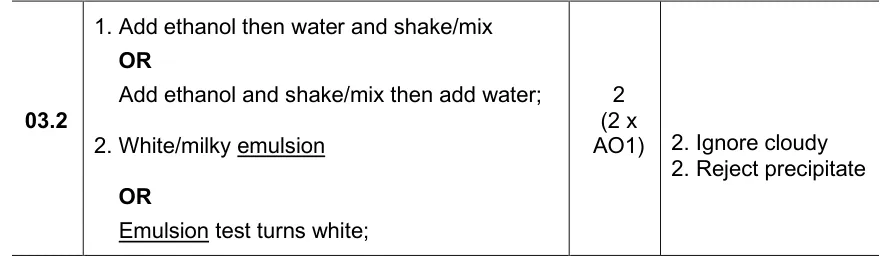
Describe the biochemical test that confirms lipid in a sample.
Show the mark scheme
Tap an image to open it full size.
From the examiners' report: Under 50% got both marks. Some described the wrong test and some forgot to add water.
Where students lose marks (from AQA examiners' reports and mark schemes)
Each point below is followed by wording that gained marks.
Ester, not glycosidic: 'Glycosidic' was a common wrong name for the bond between a fatty acid and glycerol. Some also wrote 'glyceride' instead of glycerol.
✔ Gains credit: "An ester bond, formed by a condensation reaction between glycerol and a fatty acid."
Three waters for three fatty acids: Describing how a triglyceride forms, some students lost a mark by not stating that three water molecules are removed.
✔ Gains credit: "One glycerol and three fatty acids; condensation, removing three molecules of water; ester bonds formed."
Circle OH and H, not C–H: Many circled an H from a C–H group of glycerol, or circled OH on both molecules, so didn't show which atoms leave as water.
✔ Gains credit: Circle the OH of the fatty acid's COOH and the H of one OH group on glycerol (or the reverse).
Hydrogen atoms, not molecules: Describing the link between fatty acid structure and melting point, some answers referred to hydrogen 'molecules' in a fatty acid, and some wrote about boiling point.
✔ Gains credit: "As the number of C=C double bonds increases, the melting point decreases."
Say the double bond is between carbons: Students who identified the unsaturated fatty acid often didn't say where the double bond was, and missed the mark.
✔ Gains credit: "Fatty acid B, because it has a double bond between carbon atoms (C=C)."
Both regions, then the water: Many knew a phospholipid has hydrophilic and hydrophobic parts, but fewer said a triglyceride is only hydrophobic, and some called the phosphate group hydrophobic.
✔ Gains credit: "Phospholipids have a hydrophilic phosphate group that attracts water and hydrophobic tails; triglycerides are only hydrophobic, so can't form a bilayer."
Phosphate, not phosphorus or phosphodiester: Common slips were saying phospholipids contain phosphodiester bonds, or calling the phosphate group a 'phosphorus group'. The mark scheme rejects 'P/phosphorus'.
✔ Gains credit: "In a phospholipid, one fatty acid is replaced by a phosphate group, so it has two fatty acids and two ester bonds."
Ethanol first, then water: In the emulsion test, students lost marks for adding water first, leaving water out, saying 'cloudy' with no colour, or calling the result a precipitate.
✔ Gains credit: "Add ethanol and shake, then add water; a white (milky) emulsion shows lipid."
Download the questions
Download the PDF pack (16 questions, mark schemes at the end)
Keep practising
- Carbohydrates: AQA A Level Biology exam questions by topic
- Proteins: AQA A Level Biology exam questions by topic
- Carbohydrates, lipids and food tests: test your understanding
- AQA A Level Biology masterclasses
Questions, mark schemes and examiners' report extracts © AQA.