

Carbohydrates is one of the first topics you meet in AQA A Level Biology (section 3.1.2), and it keeps coming back: on AS Paper 1, on A-level Paper 1, and as the background to questions on digestion, respiration and plant cells. You need the monosaccharides and the disaccharides they make, how condensation forms a glycosidic bond, the difference between α-glucose and β-glucose, how starch, glycogen and cellulose are built, why their structures suit their jobs, and the biochemical tests for sugars and starch.
Most marks here are lost on precise wording rather than on big ideas. Students write "broken down" when the mark scheme wants "hydrolysed", say that starch is compact without saying it is coiled, list the features of starch and cellulose without comparing them, or describe the Benedict's test without the word "heat". The examiners' reports for these questions say so again and again.
Work through the questions in order: recall first, then new molecules you haven't seen before, then the food tests. Answer each on paper before you open the mark scheme. If you'd like help with this topic, my AQA masterclasses run online on Tuesdays at 5.15pm for Year 12 and on Wednesdays or Thursdays at 6.30pm for Year 13.
What these questions cover (AQA 3.1.2)
The questions test these statements from the AQA AS and A-level Biology specification (7401/7402):
- Monomers: Monosaccharides are the monomers from which larger carbohydrates are made. Glucose, galactose and fructose are common monosaccharides.
- Glycosidic bonds: A condensation reaction between two monosaccharides forms a glycosidic bond.
- Disaccharides: Disaccharides are formed by the condensation of two monosaccharides.
- Maltose: maltose is a disaccharide formed by condensation of two glucose molecules
- Sucrose: sucrose is a disaccharide formed by condensation of a glucose molecule and a fructose molecule
- Lactose: lactose is a disaccharide formed by condensation of a glucose molecule and a galactose molecule.
- Isomers: Glucose has two isomers, α-glucose and β-glucose.
- Polysaccharides: Polysaccharides are formed by the condensation of many glucose units.
- Glycogen and starch: Glycogen and starch are formed by the condensation of α-glucose.
- Cellulose: Cellulose is formed by the condensation of β-glucose.
- Structure and functions: The basic structure and functions of glycogen, starch and cellulose.
- Structure related to function: The relationship of structure to function of these substances in animal cells and plant cells.
- Biochemical tests: Biochemical tests using Benedict's solution for reducing sugars and non-reducing sugars and iodine/potassium iodide for starch.
How to use this page
Write your answer on paper before you open the mark scheme. Allow about 1.3 minutes per mark: the 18 questions are worth 42 marks, so about 55 minutes in total. Then mark your answer strictly against the mark scheme and read the examiners' tip underneath it. If you'd rather print the questions, download the PDF pack.
Monosaccharides and disaccharides (3.1.2)
Question 1
A level Paper 1 · June 2024 · Q04.1 · 1 mark · Easy
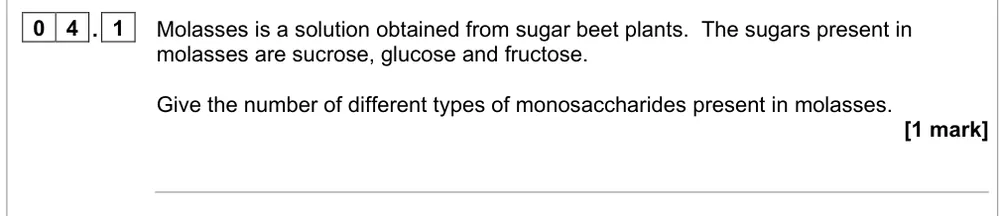
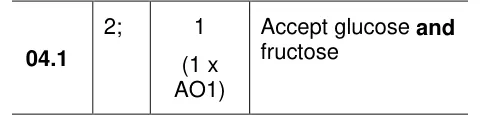
Count the different monosaccharides in a mixture of sucrose, glucose and fructose.
Show the mark scheme
Tap an image to open it full size.
From the examiners' report: Three-quarters of students got this. Sucrose is a disaccharide, so it doesn't count: only glucose and fructose are monosaccharides.
Question 2
A level Paper 1 · November 2020 · Q07.1 · 2 marks · Easy
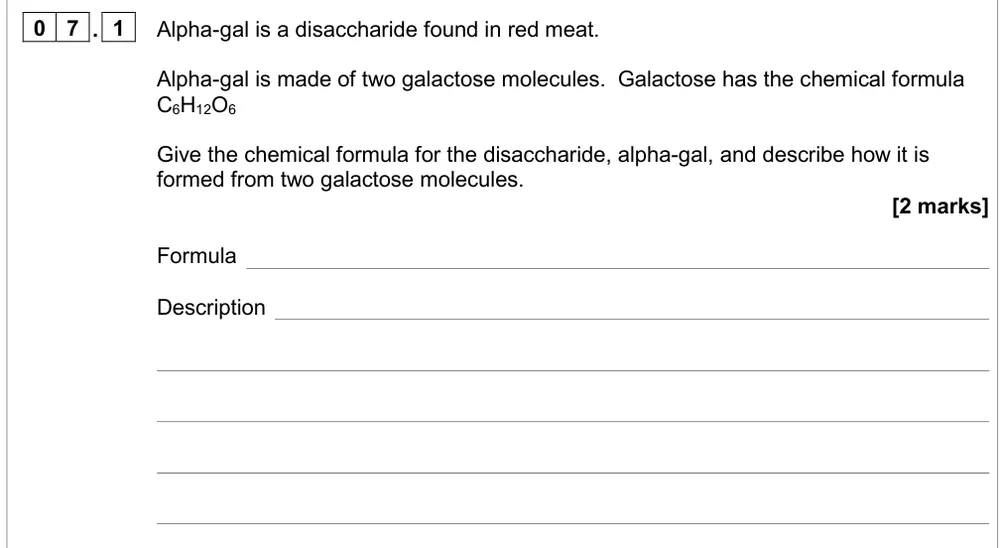
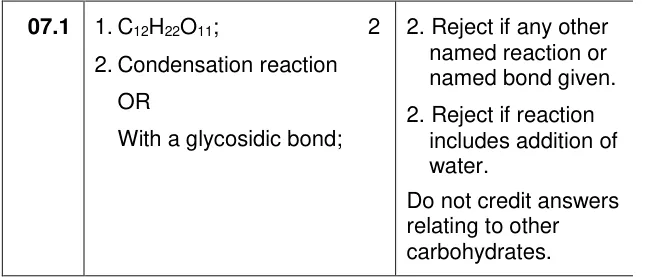
Give the formula of a disaccharide made from two galactose molecules and say how it forms.
Show the mark scheme
Tap an image to open it full size.
From the examiners' report: Nearly everyone knew condensation and the glycosidic bond, but only 49% got the formula. Add the two formulae, then take away one H2O.
Question 3
AS Paper 1 · November 2020 · Q01.2 · 1 mark · Hard
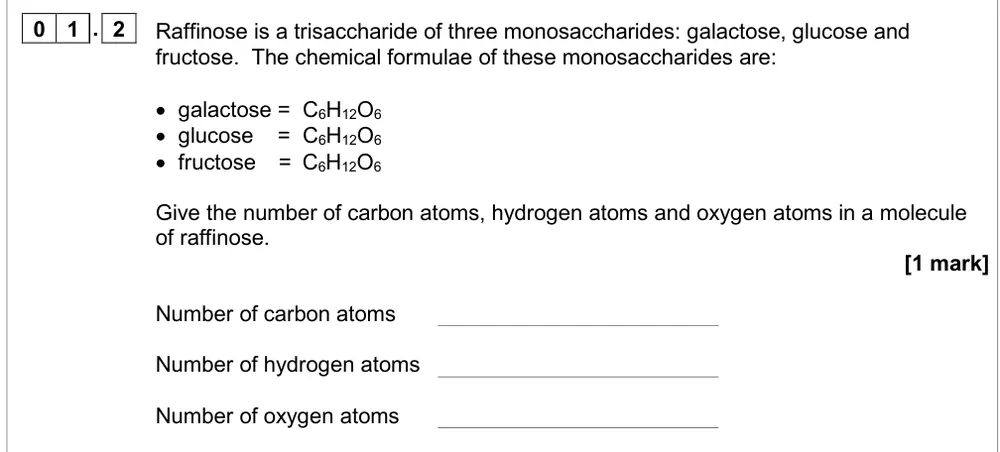
Work out the number of C, H and O atoms in a trisaccharide made of three hexoses.
Show the mark scheme

Tap an image to open it full size.
From the examiners' report: Surprisingly few students got this mark. Three monosaccharides are joined by two glycosidic bonds, so two molecules of water are removed.
Question 4
A level Paper 1 · June 2022 · Q02.2 · 1 mark
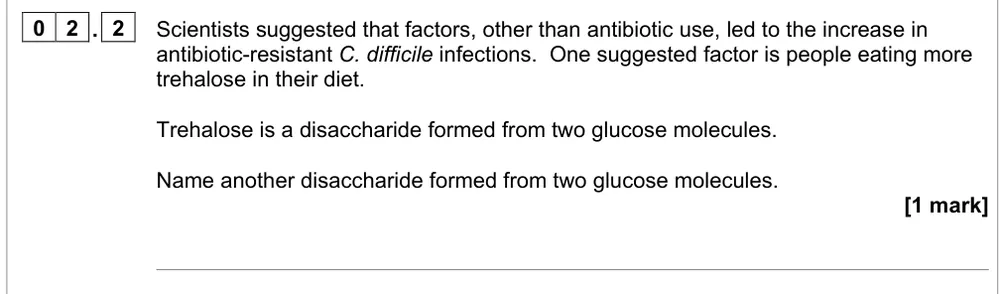
Name a second disaccharide made from two glucose molecules.
Show the mark scheme

Tap an image to open it full size.
From the examiners' report: 85% got this. Check the spelling: "maltase" is the enzyme and is rejected.
Question 5
A level Paper 1 · June 2025 · Q03.1 · 3 marks · Easy
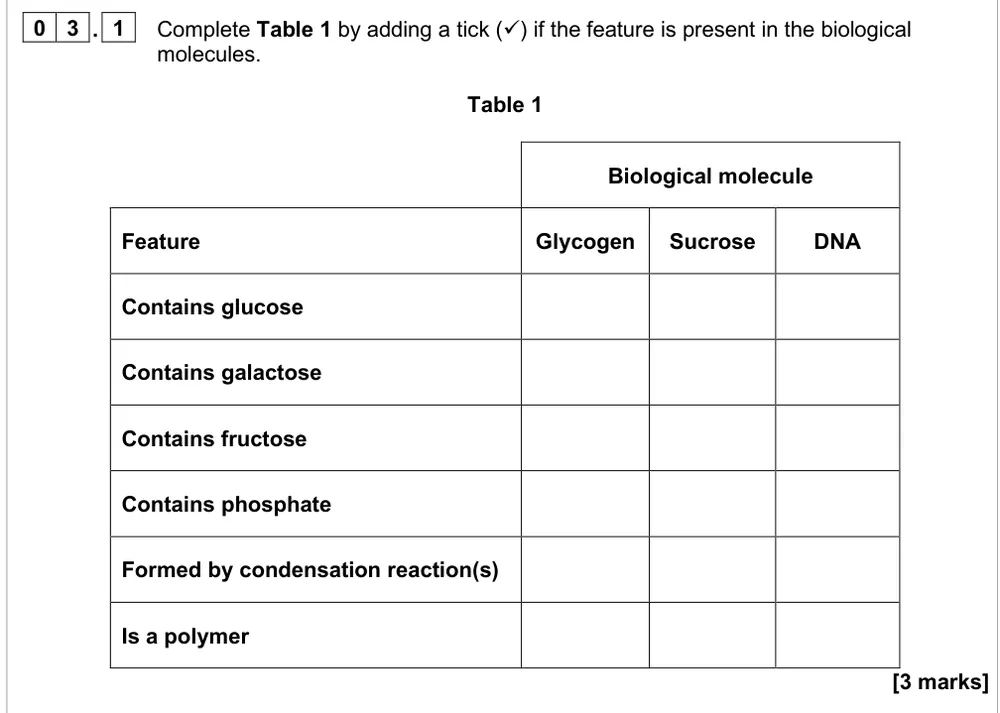
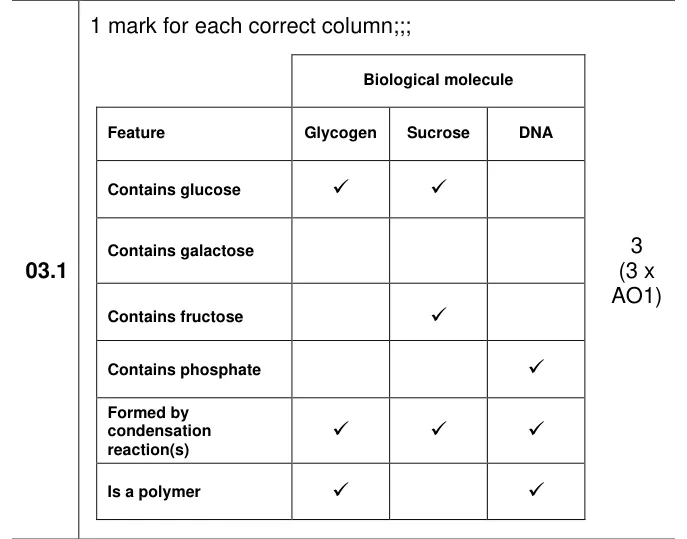
Tick which features are found in glycogen, sucrose and DNA.
Show the mark scheme
Tap an image to open it full size.
From the examiners' report: About 45% got all three columns right. Work down each column: sucrose is glucose plus fructose, and it is not a polymer.
Question 6
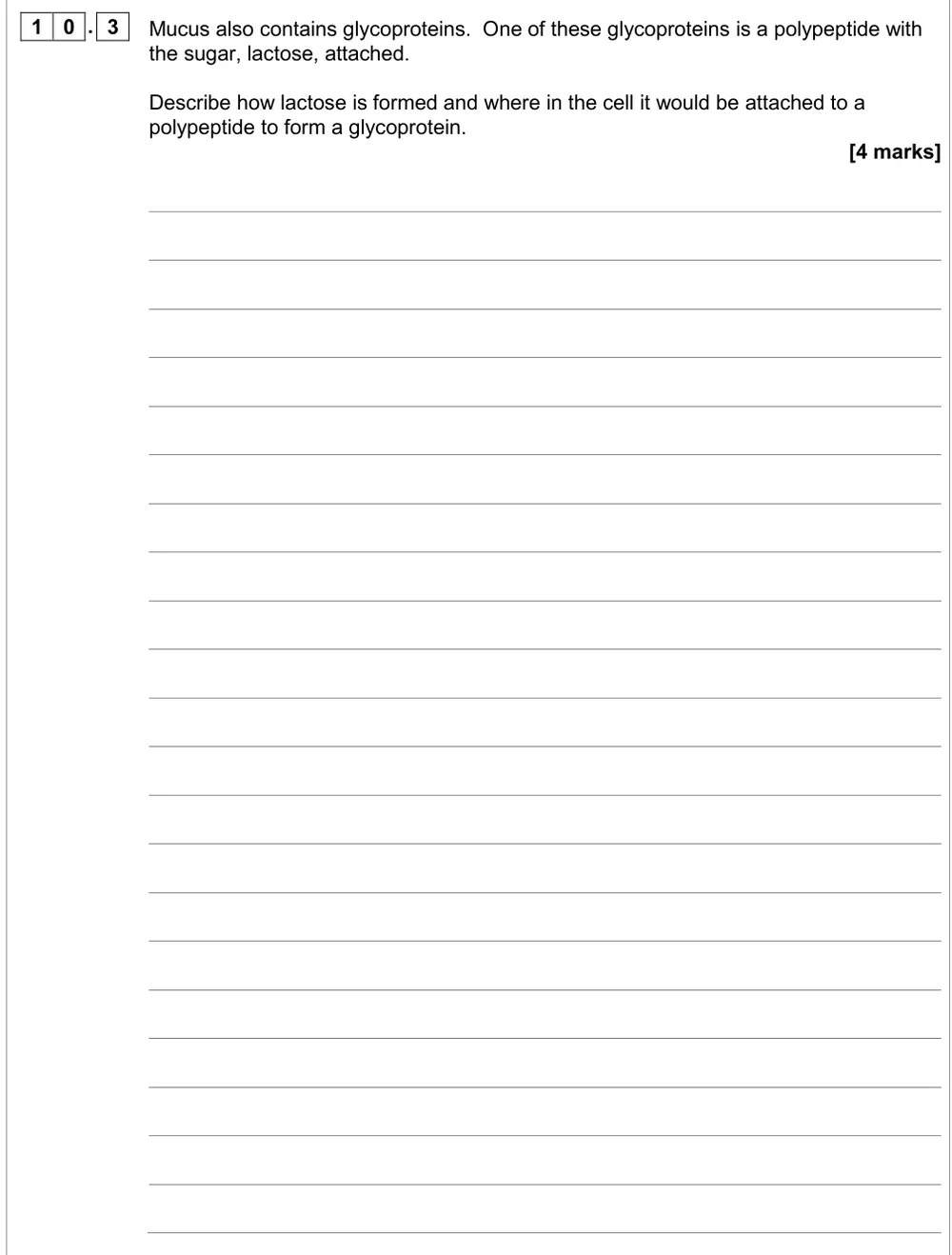
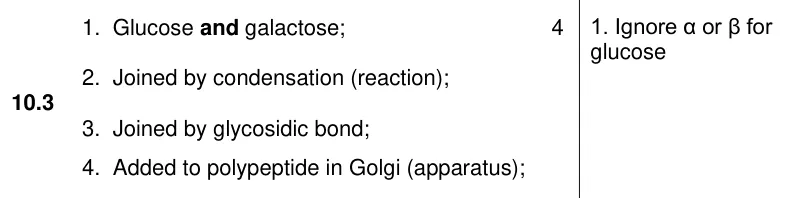
A level Paper 1 · June 2018 · Q10.3 · 4 marks · Medium
Describe how lactose is formed and where it is added to a polypeptide in the cell.
Show the mark scheme
Tap an image to open it full size.
From the examiners' report: Most knew glucose, galactose and condensation, but some left out the glycosidic bond. Fewer knew the Golgi apparatus; answer "where in the cell", not where on the polypeptide.
Question 7
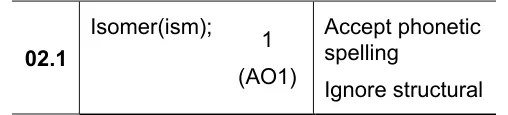
AS Paper 2 · June 2022 · Q02.1 · 1 mark · Medium
Give the term for the different structures of α-glucose and β-glucose.

Show the mark scheme
Tap an image to open it full size.
From the examiners' report: Only just over 40% scored, and 14% didn't try. α-glucose and β-glucose are isomers.
Polysaccharides: starch, glycogen and cellulose (3.1.2)
Question 8
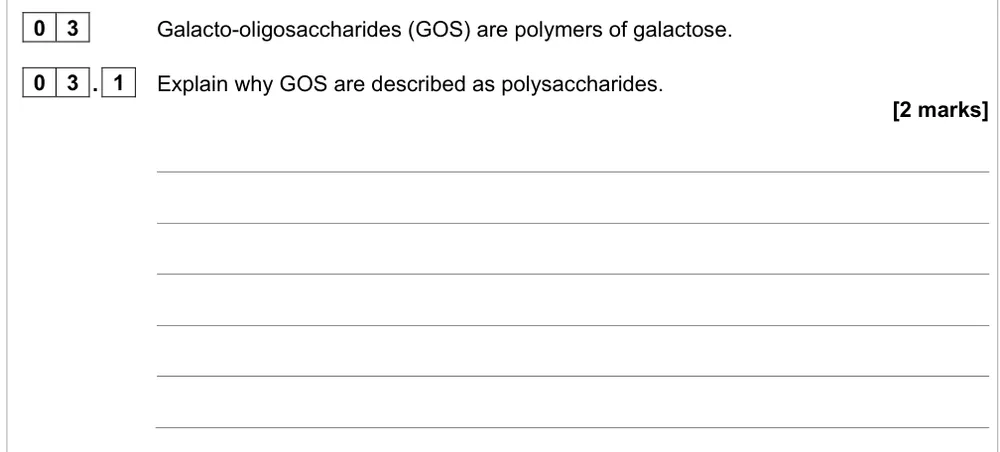
AS Paper 2 · June 2023 · Q03.1 · 2 marks · Medium
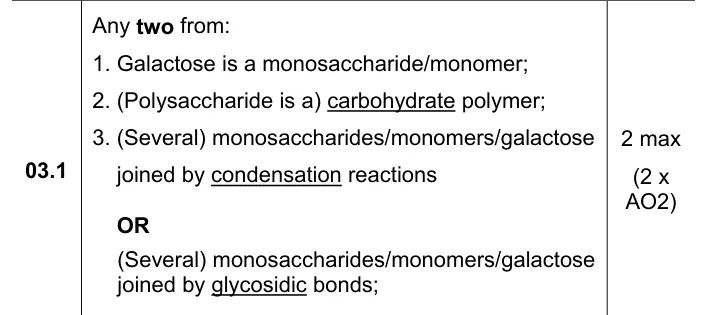
Explain why polymers of galactose are called polysaccharides.
Show the mark scheme
Tap an image to open it full size.
From the examiners' report: Over two-thirds scored at least 1 mark. Marks were lost for vague talk of polymers and monomers; name galactose and the glycosidic bonds.
Question 9
AS Paper 2 · June 2023 · Q03.2 · 2 marks
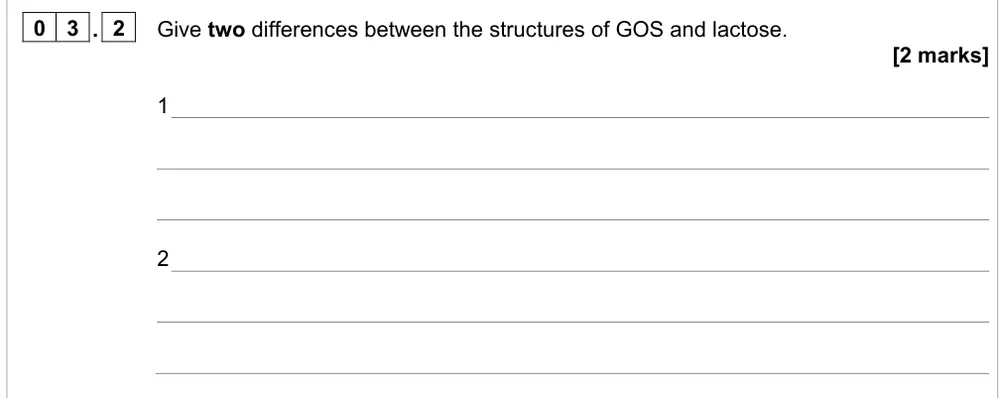
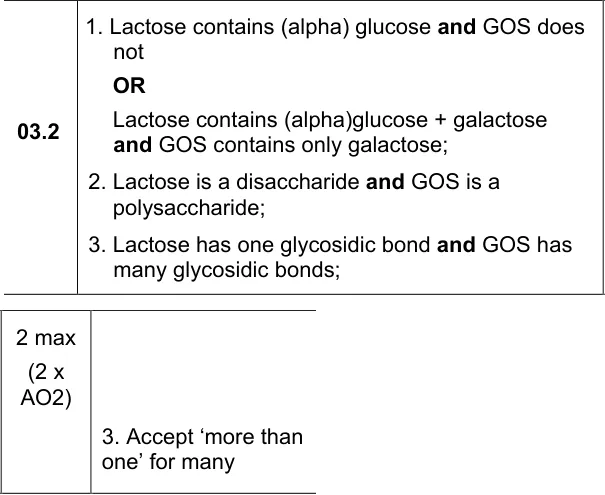
Give two differences between the structures of GOS and lactose.
Show the mark scheme
Tap an image to open it full size.
From the examiners' report: Many students were confused about lactose, even though they were told GOS is a polymer of galactose. Write each difference as a comparison of both molecules.
Question 10
A level Paper 1 · June 2017 · Q02.1 · 2 marks
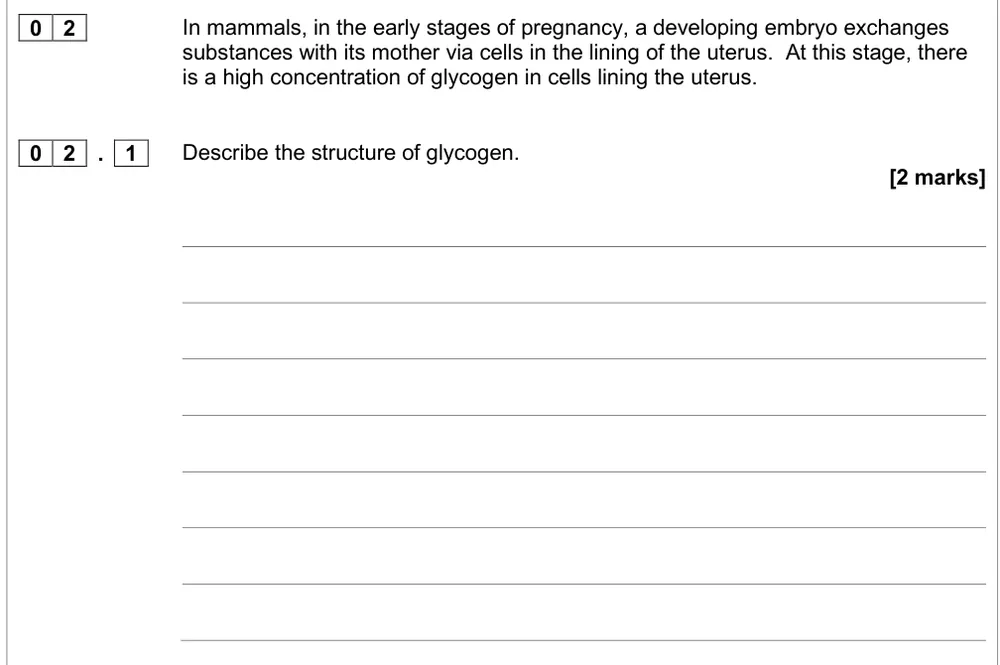
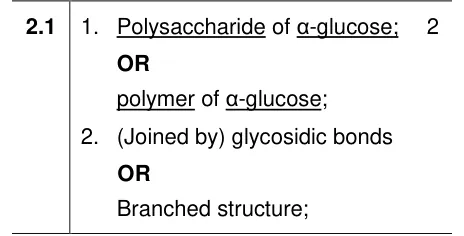
Describe the structure of glycogen.
Show the mark scheme
Tap an image to open it full size.
From the examiners' report: There's no examiners' report for this paper. The mark scheme wants α-glucose by name, then glycosidic bonds or branching.
Question 11
A level Paper 1 · June 2022 · Q09.2 · 6 marks · Medium
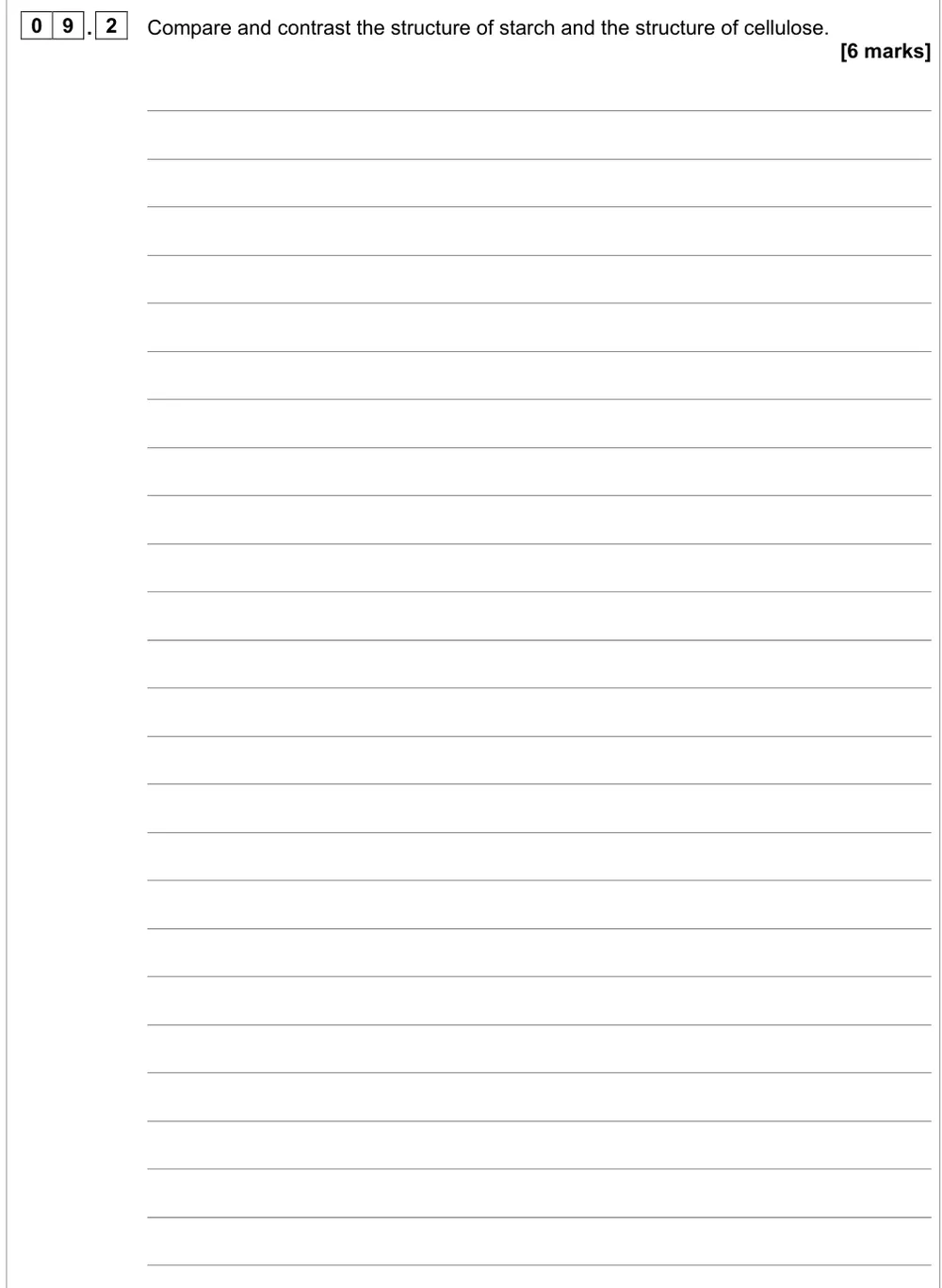
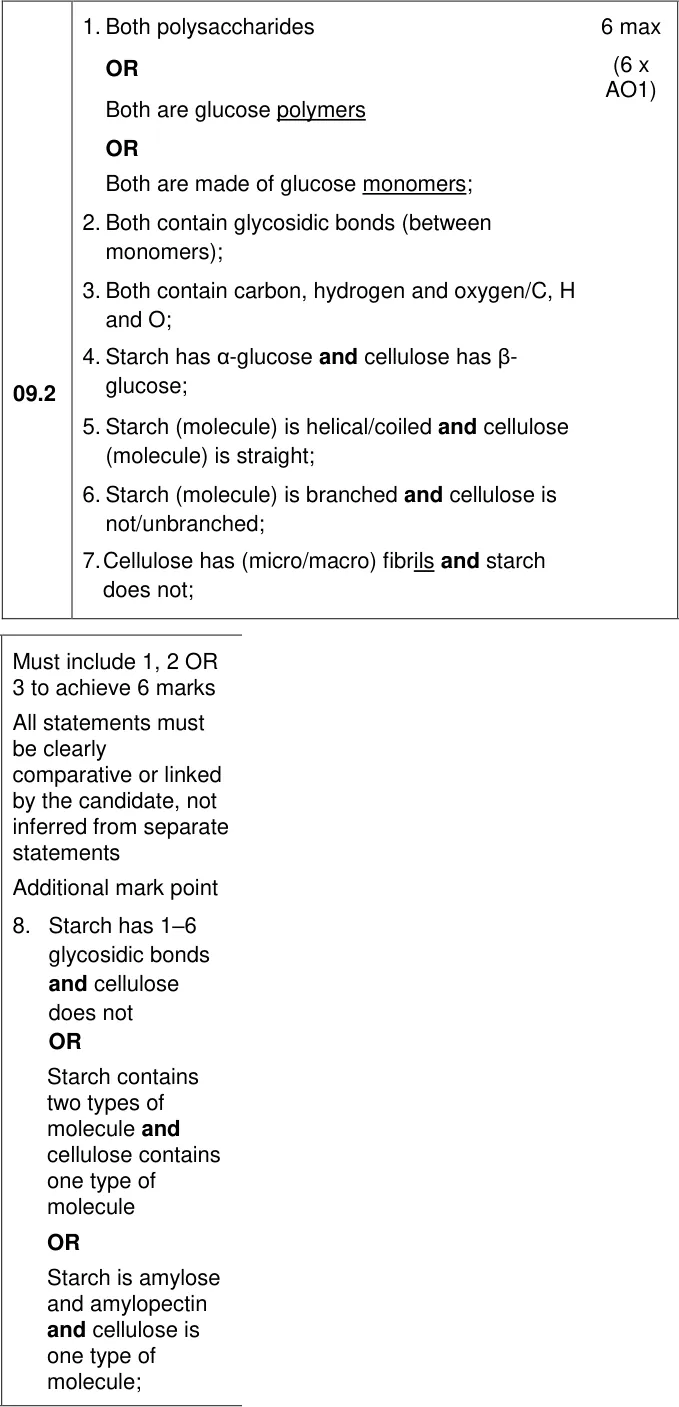
Compare and contrast the structures of starch and cellulose (6 marks).
Show the mark scheme
Tap an image to open it full size.
From the examiners' report: A quarter scored 5 or 6. Lists of features that weren't linked into comparisons scored nothing, and long answers about function didn't answer the question.
Question 12
AS Paper 1 · June 2025 · Q07.2 · 3 marks · Medium
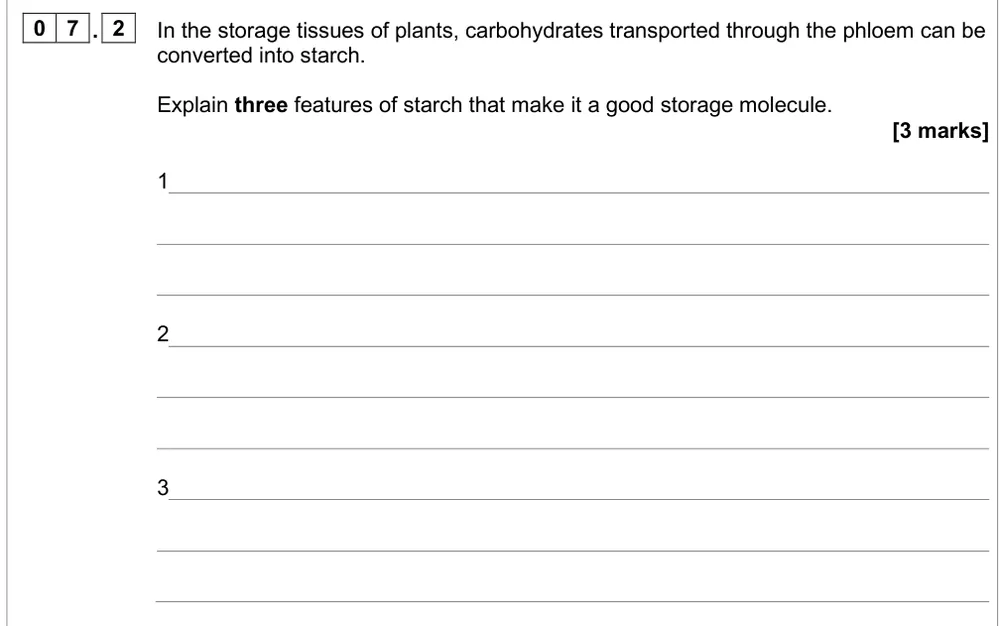
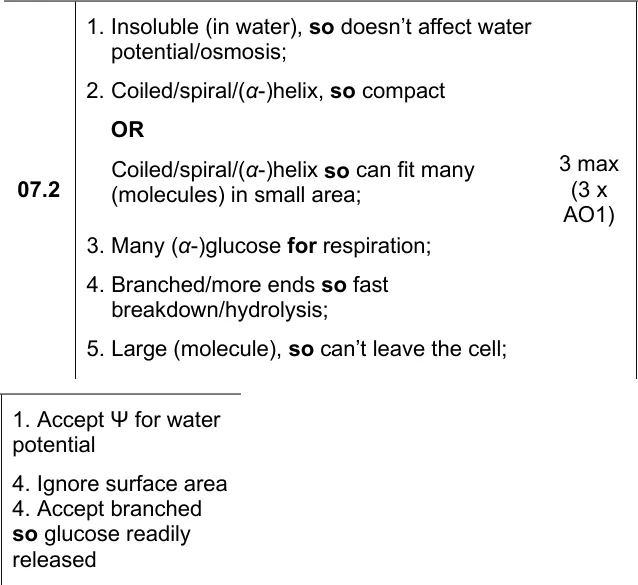
Explain three features of starch that make it a good storage molecule.
Show the mark scheme
Tap an image to open it full size.
From the examiners' report: About 25% got all three. Each mark needs a feature and its explanation; many said "compact" without linking it to the coiled or helical shape.
Applying it to new molecules (3.1.2)
Question 13
AS Paper 1 · June 2018 · Q02.2 · 2 marks
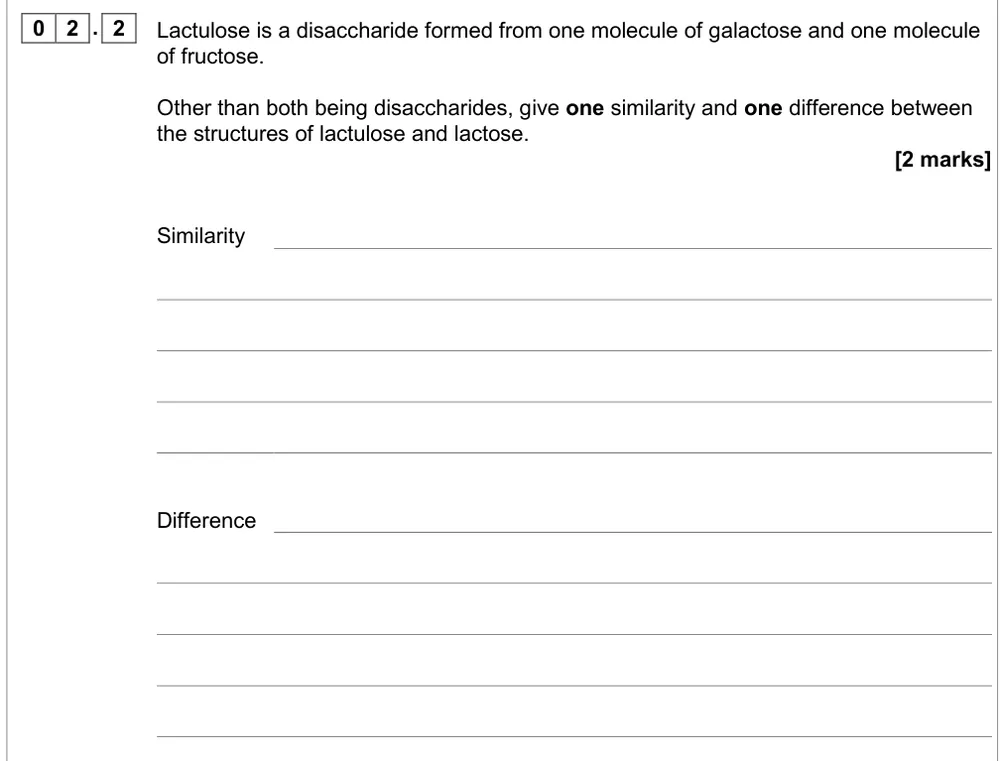
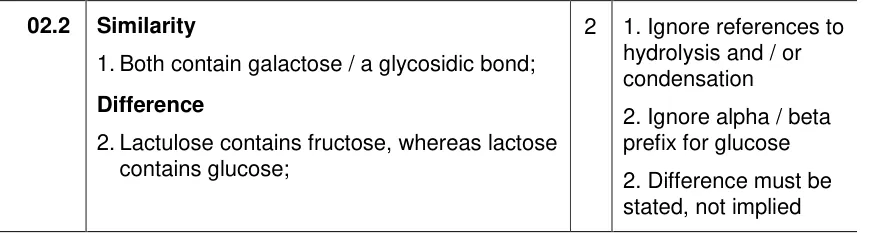
Give one similarity and one difference between lactulose and lactose.
Show the mark scheme
Tap an image to open it full size.
From the examiners' report: Students did well on the similarity but often lost the difference by writing only "lactulose contains fructose". State both sides of the difference.
Question 14
A level Paper 1 · June 2023 · Q02.1 · 3 marks · Easy
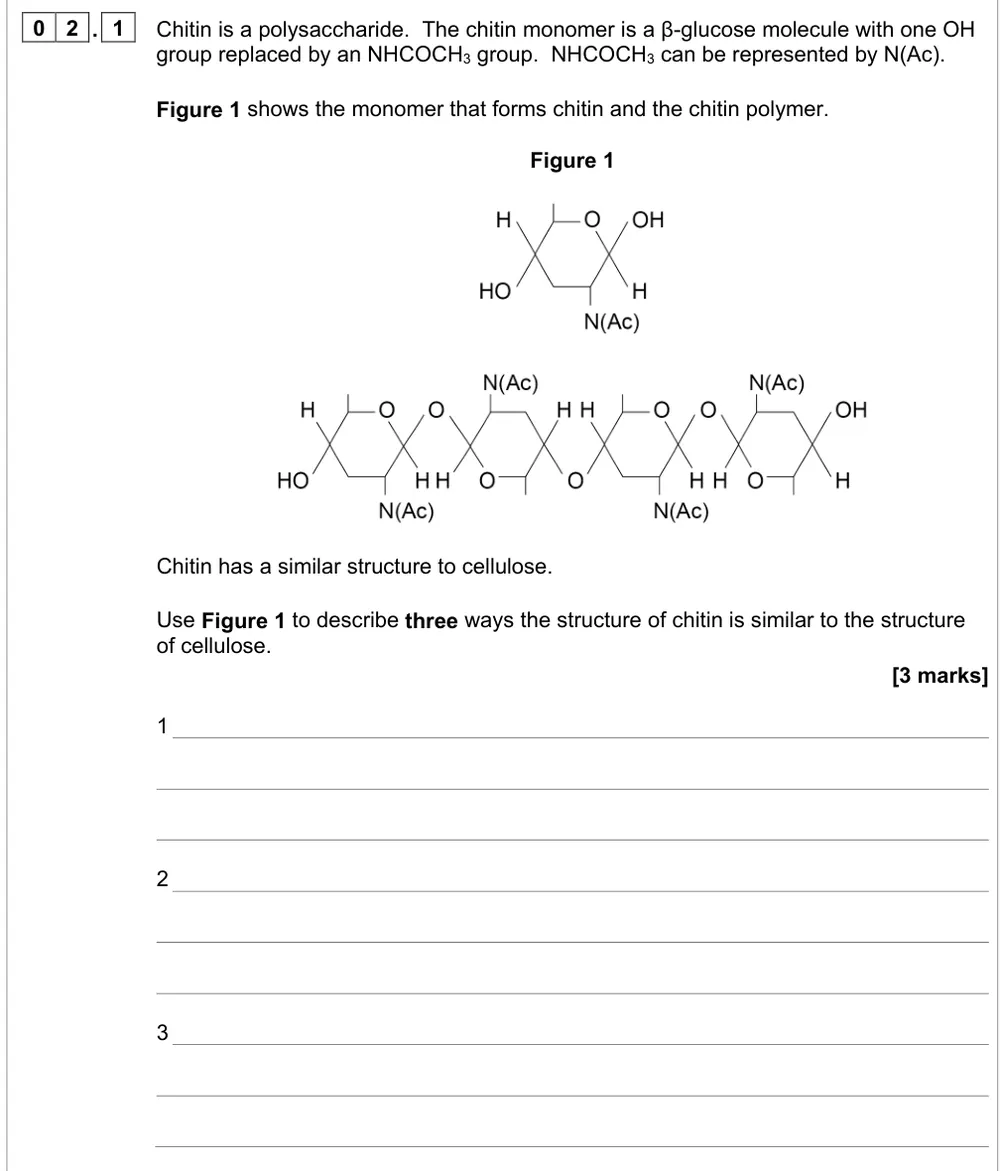
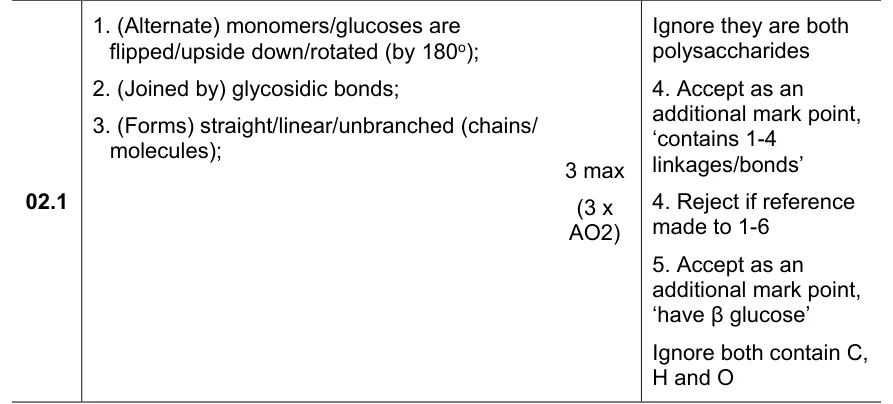
Use a diagram of chitin to describe three ways it is similar to cellulose.
Show the mark scheme
Tap an image to open it full size.
From the examiners' report: About 40% got full marks. Say "monomers", not "molecules", and don't add hydrogen bonds or 1-6 bonds, which aren't in the figure.
Biochemical tests for sugars and starch (3.1.2)
Question 15
A level Paper 1 · June 2024 · Q04.2 · 3 marks
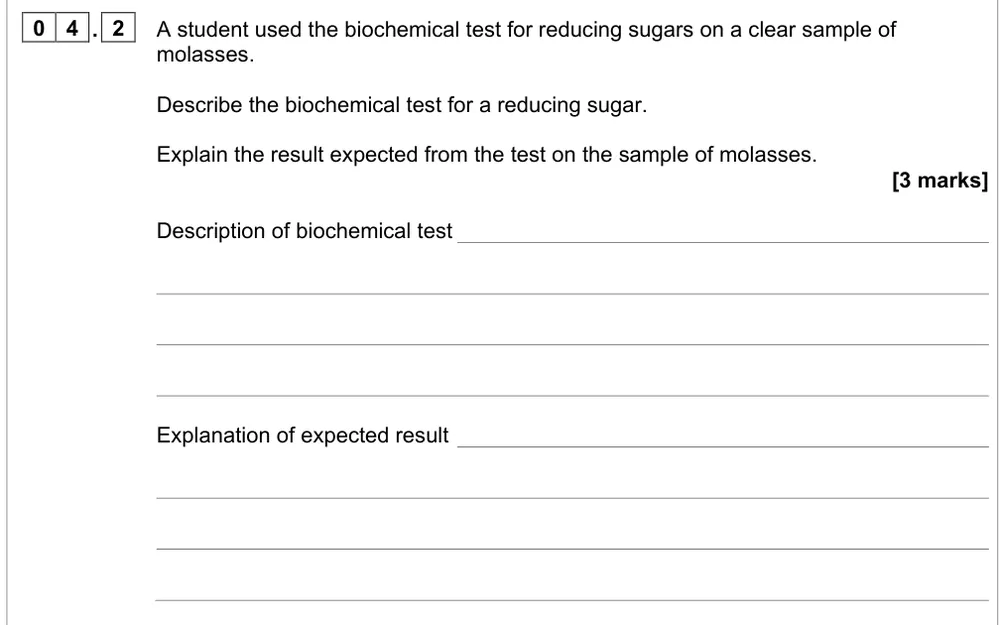
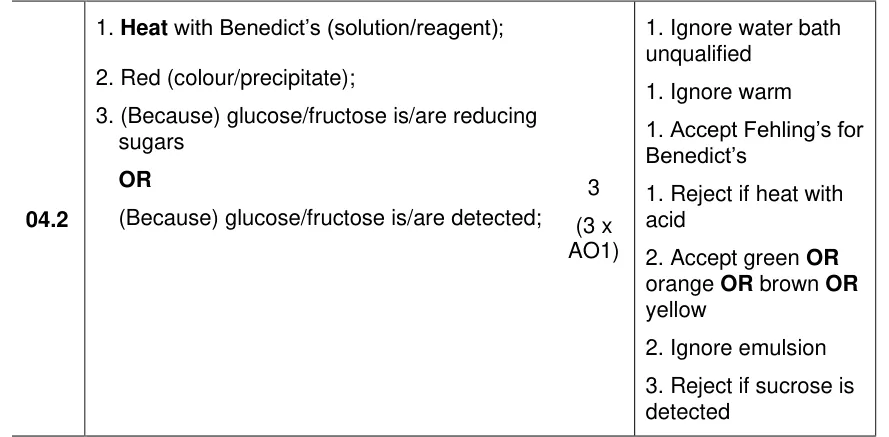
Describe the test for reducing sugars and explain the result for molasses.
Show the mark scheme
Tap an image to open it full size.
From the examiners' report: Most described the test well, but some missed "heat" or wrote only "water bath". Few explained the result: glucose and fructose give the positive result, not sucrose.
Question 16
AS Paper 1 · November 2020 · Q01.3 · 3 marks
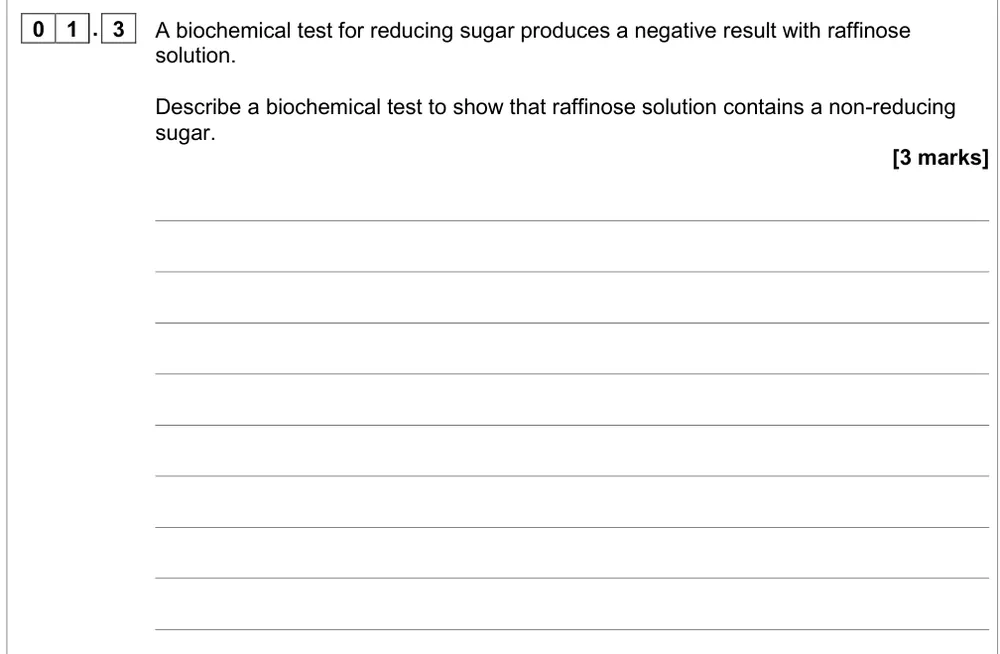
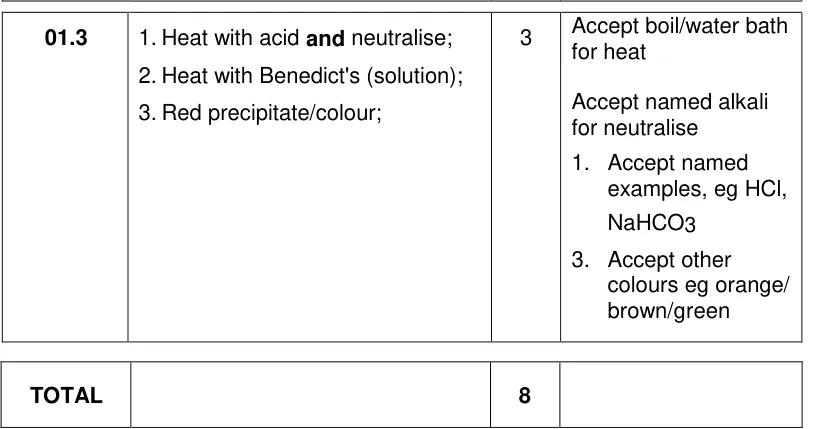
Describe a test to show that a solution contains a non-reducing sugar.
Show the mark scheme
Tap an image to open it full size.
From the examiners' report: Many scored one mark but few wrote the steps clearly and in order. Acid and heat, neutralise, then heat with Benedict's again.
Question 17
AS Paper 2 · June 2022 · Q02.2 · 1 mark · Hard
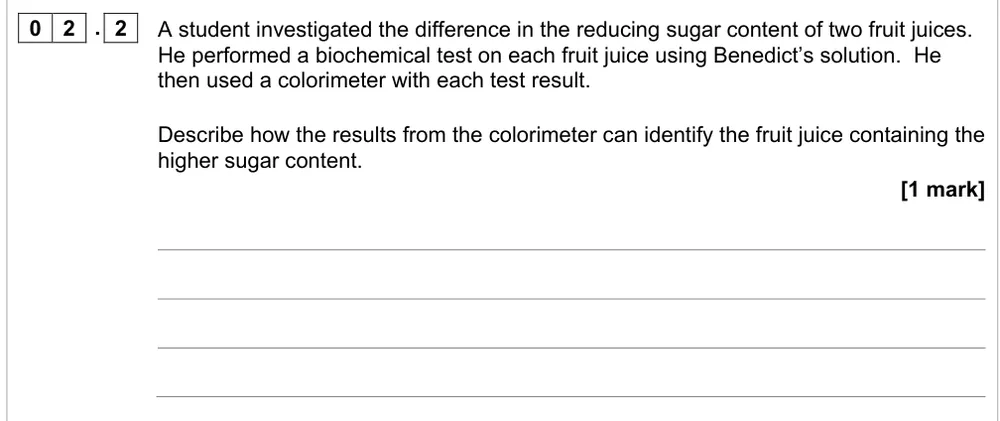
Say how colorimeter readings show which fruit juice has more sugar.
Show the mark scheme

Tap an image to open it full size.
From the examiners' report: Only 20% scored. Too many described the red colour of a positive test; the question is about what the colorimeter reads.
Question 18
AS Paper 2 · June 2022 · Q02.3 · 2 marks · Medium
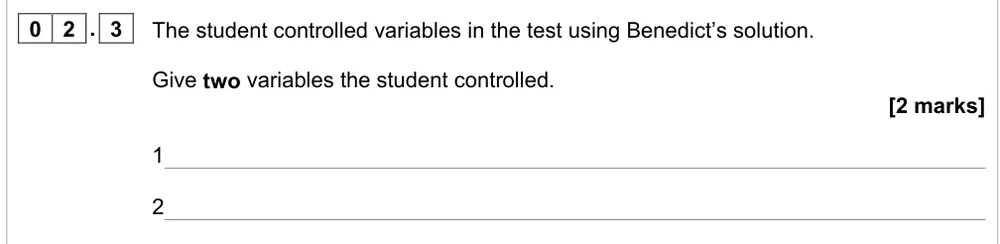
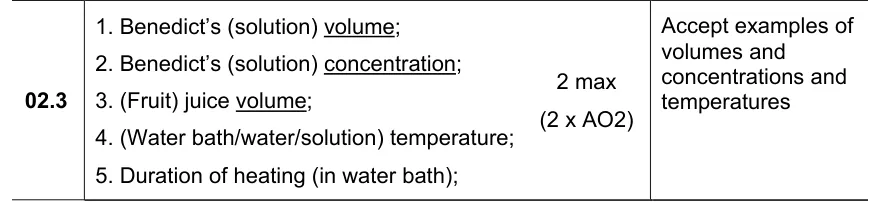
Give two variables to control in a Benedict's test.
Show the mark scheme
Tap an image to open it full size.
From the examiners' report: 43% got both marks. "Amount" isn't accepted at A level: say volume, concentration, temperature or time.
Where students lose marks (from AQA examiners' reports and mark schemes)
Each point below is followed by wording that gained marks.
Hydrolysed, not broken down: Explaining why yeast respires maltose more slowly than glucose, the most common reason for losing a mark was writing that maltose is "broken down" instead of hydrolysed.
✔ Gains credit: "Maltose is a disaccharide, so it has to be hydrolysed into glucose first" (or the glycosidic bond has to be broken).
Take the water out of the formula: Almost everyone knew that two galactose molecules join by condensation, but only 49% gave the right formula for the disaccharide. Many said water is lost and then didn't take it away.
✔ Gains credit: "C12H22O11, formed by a condensation reaction, with a glycosidic bond."
State the difference in full: Asked for a difference between lactulose and lactose, many wrote only "lactulose contains fructose". The mark scheme says a difference must be stated, not implied.
✔ Gains credit: "Lactulose contains fructose, whereas lactose contains glucose."
Helix, so compact: In starch questions many students said starch is compact but didn't link this to its shape. Each mark needs the feature and the reason.
✔ Gains credit: "Coiled/helical, so compact"; "insoluble, so doesn't affect water potential"; "branched, so more ends for fast hydrolysis".
Link each comparison: In "compare and contrast" questions on starch and cellulose, answers that listed the structures separately scored nothing, and some confused cellulose microfibrils with muscle myofibrils.
✔ Gains credit: "Starch has α-glucose and cellulose has β-glucose"; "starch is branched and cellulose is unbranched"; "both contain glycosidic bonds".
No "strong hydrogen bonds": Students often explained the strength of cellulose by "strong hydrogen bonds", which the mark scheme penalises. Each hydrogen bond is weak; it's the large number of them that matters.
✔ Gains credit: "Long, straight chains of β-glucose joined by hydrogen bonding to form microfibrils, which give strength."
Heat it with Benedict's: Some answers left out heating, or said only "use a water bath" with no sign that it was hot. Others described the non-reducing sugar test when asked about reducing sugars, or said sucrose would be detected.
✔ Gains credit: "Heat with Benedict's solution; red precipitate, because glucose and fructose are reducing sugars."
Read the absorbance: Only 20% scored when asked how a colorimeter shows which juice has more sugar. Most described the red colour of a positive Benedict's test instead of the colorimeter reading.
✔ Gains credit: "Higher absorbance (or lower transmission) means more reducing sugar."
Download the questions
Download the PDF pack (18 questions, mark schemes at the end)
Keep practising
- Graph skills: AQA A Level Biology exam questions by topic
- Required practical 1, enzyme rates: AQA A Level Biology exam questions
- AQA 3.1 biological molecules: 10 practice questions on carbohydrates
- Carbohydrates, lipids and food tests: test your understanding
- AQA A Level Biology masterclasses
Questions, mark schemes and examiners' report extracts © AQA.