

Green Planet asks a puzzling question: why did photosynthesis evolve to split water, a hard and risky job that releases toxic oxygen, when some bacteria split hydrogen sulphide far more easily? Adapted from a chapter of the book Oxygen, it explains how chlorophyll absorbs light, how electrons passed along a chain drive ATP synthesis, how small changes to chlorophyll shifted the light it absorbs, and why the oxygen-evolving complex may have evolved from catalase. This was the scientific article for the June 2023 A level Paper 3 (9BN0/03), and the article question was worth about 30 marks. Its parts test biology from across the specification, including productivity, the light-dependent and light-independent reactions, chloroplast structure, protein structure and evidence for evolution. Read the article (linked just below this introduction) before you try the questions.
The examiners' report found that many candidates described when they were asked to explain. On ATP, many listed its uses instead of explaining that hydrolysis releases energy quickly. On chloroplasts, many named features without linking them to their roles, such as pigments absorbing light. In the light-independent reactions, some mixed up GP and GALP or left out ATP and reduced NADP. Protons are pumped into the thylakoid space, not an intermembrane space, and chlorophyll is not a protein. When devising the Hill reaction investigation, use isolated chloroplasts rather than whole plants, and when sketching enzyme graphs draw a line for each enzyme with labelled axes and units.
Studying Edexcel SNAB and want more help? If you'd like to arrange one-to-one Edexcel tutoring, or to register your interest in an Edexcel group class, message Tom on WhatsApp using the link at the bottom of this page.
Read the article first: Green Planet: Radiation and the Evolution of Photosynthesis (June 2023). It is the June 2023 Paper 3 question paper (PDF); the article is printed at the back.
What you need first
Each question on this page assumes you're secure on these ideas. If any of them feels shaky, look it up before you start.
- Photosynthesis has light-dependent reactions in the thylakoid membranes and light-independent reactions in the stroma of the chloroplast.
- ATP is made from ADP and inorganic phosphate and releases energy when it is hydrolysed.
- A protein's primary structure (amino acid sequence) is coded for by the base sequence of a gene and decides its 3D shape.
- Enzymes are proteins whose rate of reaction depends on substrate concentration.
Key terms
These words come up in the article, the questions and the mark schemes. Examiners expect you to use them exactly.
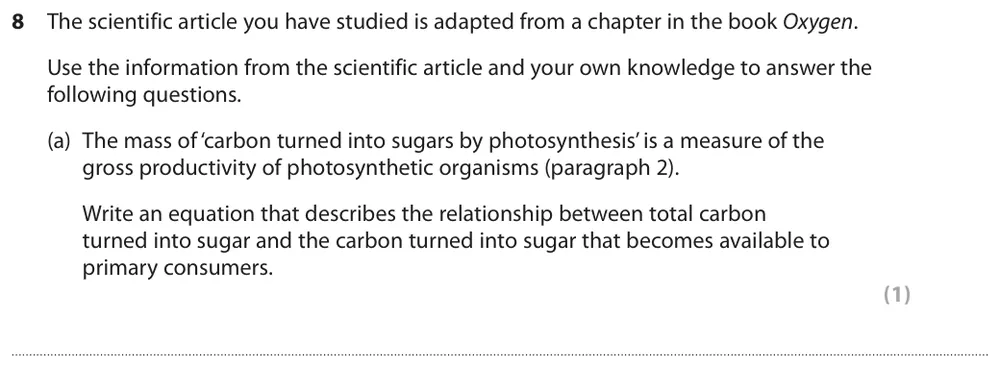
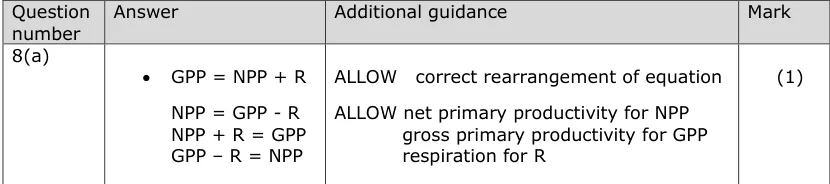
- Gross primary productivity (GPP): the rate at which plants convert light energy into chemical energy in organic molecules; GPP = NPP + R.
- Net primary productivity (NPP): the energy (or carbon) left after the plant's respiration, available to primary consumers.
- Photophosphorylation: making ATP from ADP and inorganic phosphate using energy from light, via the electron transport chain.
- Thylakoid: the flattened membrane sacs in the chloroplast that hold the photosynthetic pigments and electron carriers; stacks of them form grana.
- RUBISCO: the enzyme that combines carbon dioxide with RuBP in the light-independent reactions.
- Hill reaction: isolated chloroplasts in the light reduce an electron acceptor such as DCPIP or ferricyanide and release oxygen, without carbon dioxide.
- Oxygen-evolving complex: the protein structure that holds water while electrons are removed from it, releasing oxygen.
- Catalase: an enzyme that breaks down hydrogen peroxide into water and oxygen.
What these questions cover
The article questions draw on biology from across the specification. These are the statements of the Pearson Edexcel A level Biology A (Salters-Nuffield) specification (9BN0) that they test.
- 2.9iii Understand the significance of a protein’s primary structure in determining its three-dimensional structure and properties (globular and fibrous proteins and the types of
- 2.10i Understand the mechanism of action and the specificity of enzymes in terms of their three-dimensional structure.
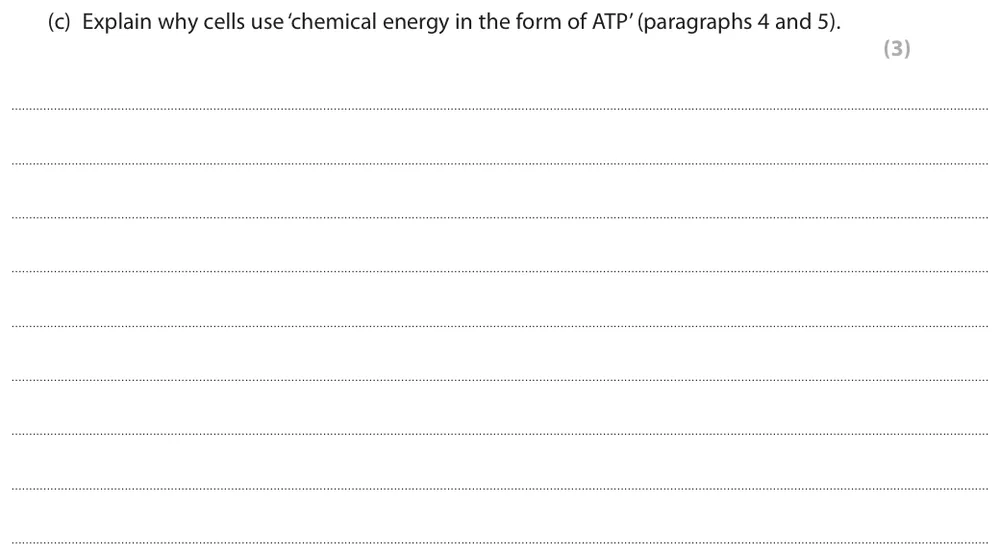
- 5.6 Understand how phosphorylation of ADP requires energy and that hydrolysis of ATP provides an immediate supply of energy for biological processes.
- 5.7 Understand the light-dependent reactions of photosynthesis including how light energy is trapped by exciting electrons in chlorophyll and the role of these electrons in g
- 5.8i Understand the light-independent reactions as reduction of carbon dioxide using the products of the light-dependent reactions (carbon fixation in the Calvin cycle, the ro
- 5.9 Understand the structure of chloroplasts in relation to their role in photosynthesis.
- 5.10ii Understand the relationship between gross primary productivity, net primary productivity and plant respiration.
- 5.18 Understand the role of the scientific community (scientific journals, the peer review process, scientific conferences) in validating new evidence, including proteomics an
How to use this page
Write your answer on paper before you open the mark scheme. Allow about 1.2 minutes per mark: the 10 questions are worth 30 marks, so about 36 minutes in total. Then mark your answer strictly against the mark scheme and read the examiners' tip underneath it. If you'd rather print the questions, download the PDF pack.
Productivity and the light-dependent reactions (paragraphs 2–4)
Question 1
A level Paper 3 · June 2023 · Q8(a) · 1 mark
Write an equation linking the carbon turned into sugar to the carbon available to primary consumers.
Show the mark scheme
Tap an image to open it full size.
From the examiners' report: Many gave a correct equation, GPP = NPP + R. Some had a sign wrong and a few wrote the equation for respiring glucose, which did not gain the mark.
Question 2
A level Paper 3 · June 2023 · Q8(b) · 1 mark
Name one product of the light-dependent reactions other than ATP and oxygen.

Show the mark scheme

Tap an image to open it full size.
From the examiners' report: The common error was reduced NAD instead of reduced NADP. Do not shorten 'reduced' to r or R: use only abbreviations found in the specification.
ATP and the light-independent reactions (paragraphs 4–5)
Question 3
A level Paper 3 · June 2023 · Q8(c) · 3 marks · Hard
Explain why cells use chemical energy in the form of ATP.
Show the mark scheme
Tap an image to open it full size.
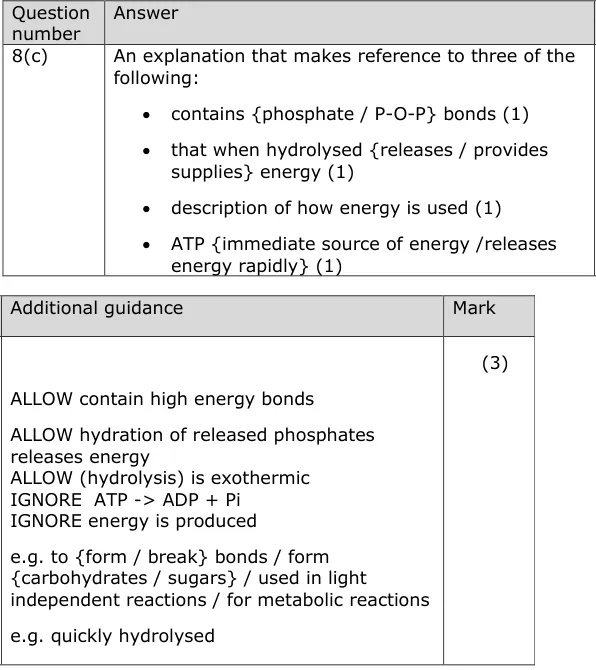
From the examiners' report: Many simply described uses of ATP and gained only one mark. Better answers said hydrolysis of ATP releases energy and that ATP is an immediate source of energy; few mentioned the phosphate bonds.
Question 4
A level Paper 3 · June 2023 · Q8(d) · 4 marks
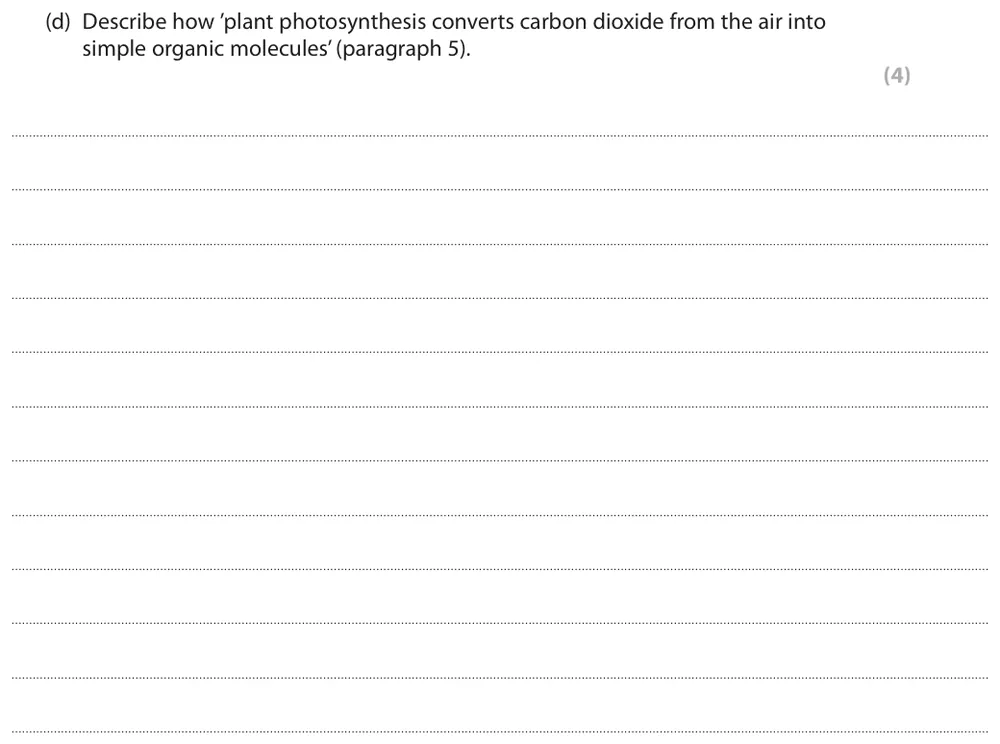
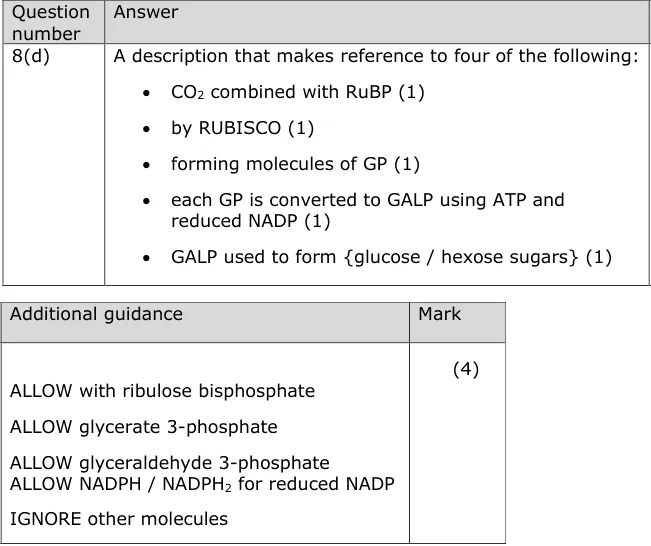
Describe how photosynthesis converts carbon dioxide into simple organic molecules.
Show the mark scheme
Tap an image to open it full size.
From the examiners' report: Many gave complete answers. Some mixed up GP and GALP, and some forgot that ATP and reduced NADP are used to convert GP to GALP.
Where the oxygen comes from (paragraphs 6–7)
Question 5
A level Paper 3 · June 2023 · Q8(e) · 4 marks
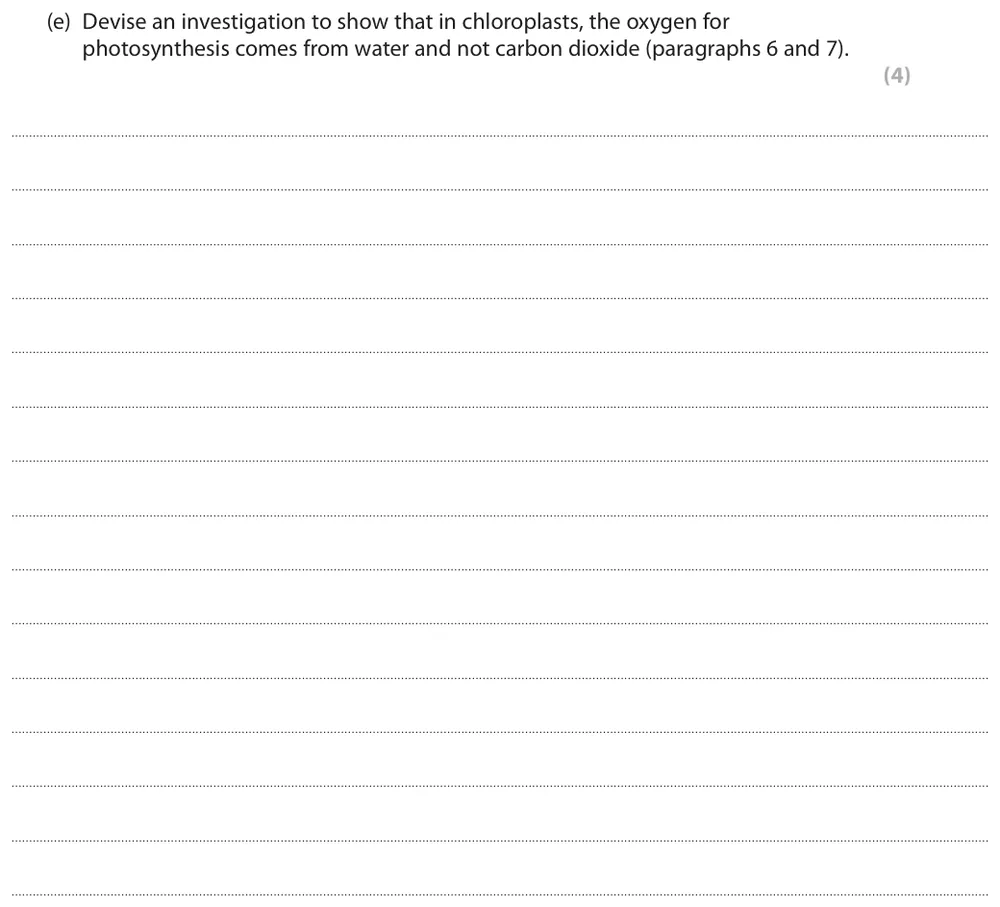
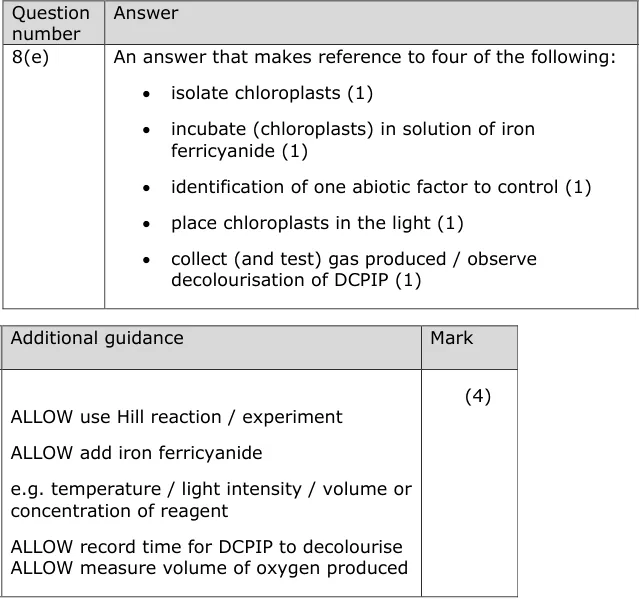
Devise an investigation to show that the oxygen in photosynthesis comes from water, not carbon dioxide.
Show the mark scheme
Tap an image to open it full size.
From the examiners' report: Use isolated chloroplasts: candidates who used whole plants usually gained only the mark for a controlled variable. Do not spend the answer space on how to isolate chloroplasts; add ferricyanide, keep them in the light and collect the gas or watch DCPIP decolourise.
Chloroplasts and making ATP (paragraphs 9–10)
Question 6
A level Paper 3 · June 2023 · Q8(f) · 4 marks · Hard
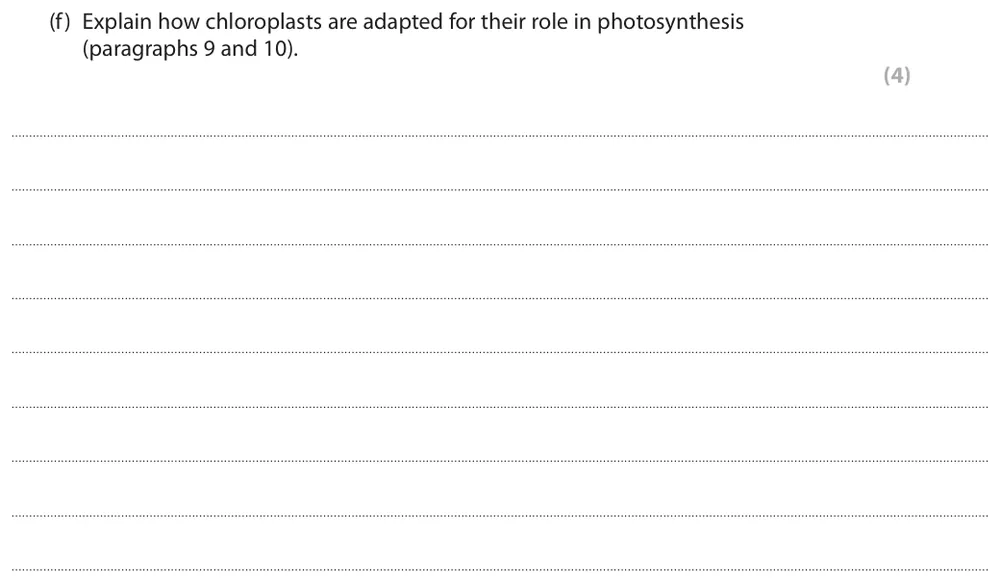
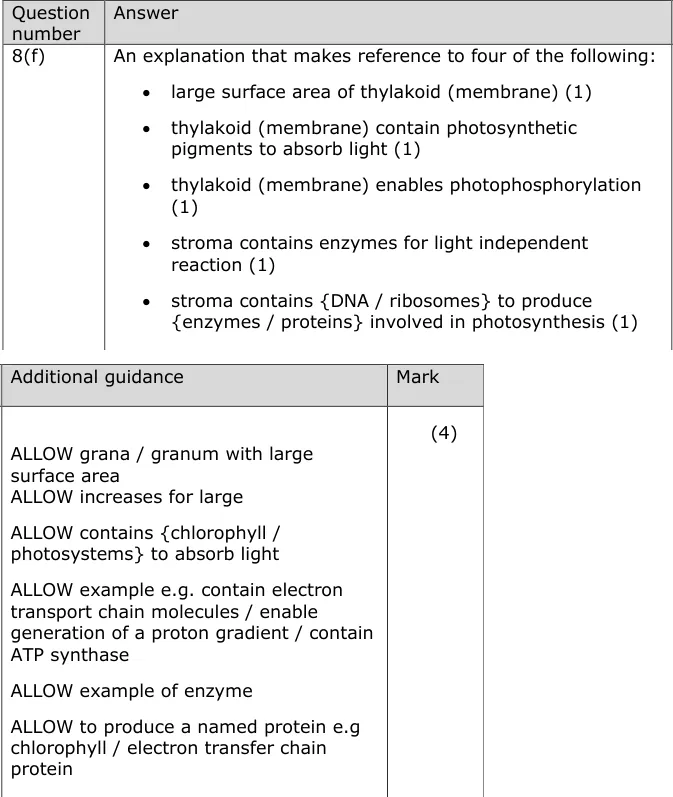
Explain how chloroplasts are adapted for their role in photosynthesis.
Show the mark scheme
Tap an image to open it full size.
From the examiners' report: Many simply described features of chloroplasts. Many lost a mark by not linking photosynthetic pigments to their role in absorbing light.
Question 7
A level Paper 3 · June 2023 · Q8(g) · 3 marks · Easy
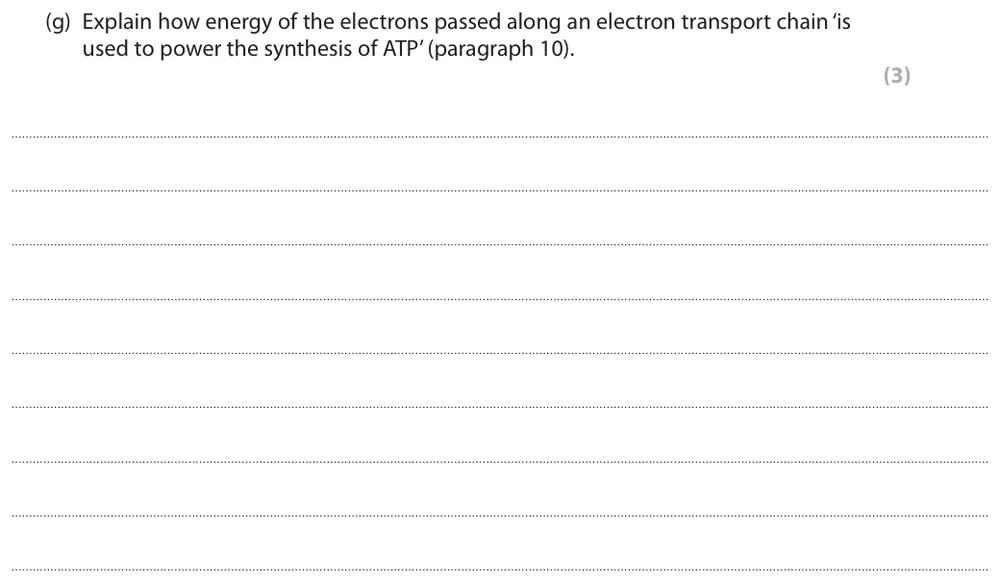
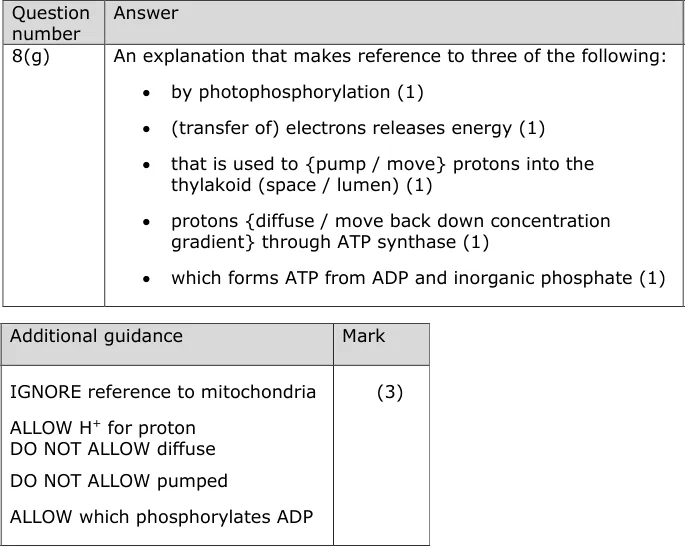
Explain how the energy of electrons passed along an electron transport chain powers ATP synthesis.
Show the mark scheme
Tap an image to open it full size.
From the examiners' report: Answered well by many. Protons are pumped into the thylakoid space, not the intermembrane space, and then diffuse back through ATP synthase: do not swap 'pump' and 'diffuse'.
Chlorophyll and the evolution of water splitting (paragraphs 12–17)
Question 8
A level Paper 3 · June 2023 · Q8(h) · 3 marks · Hard
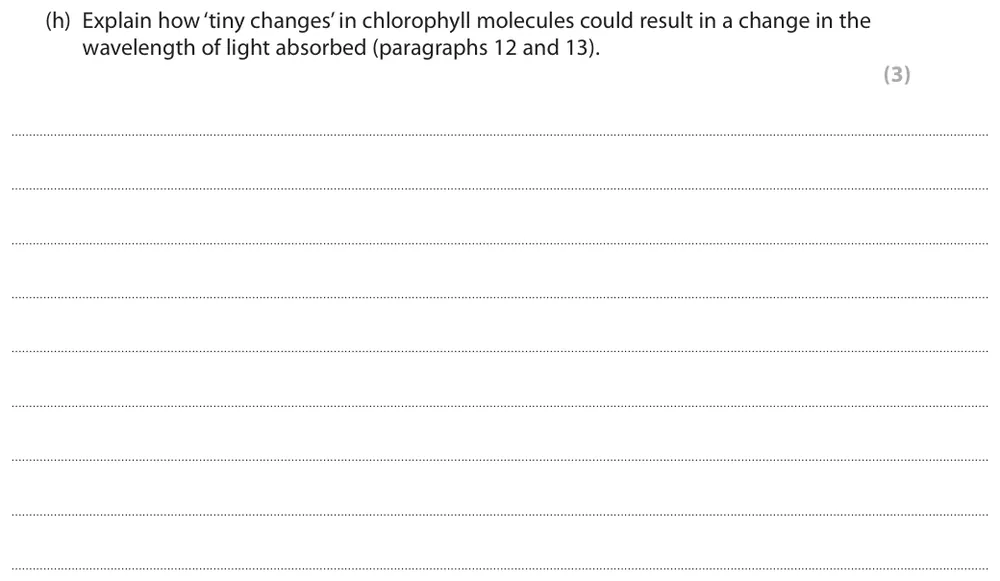
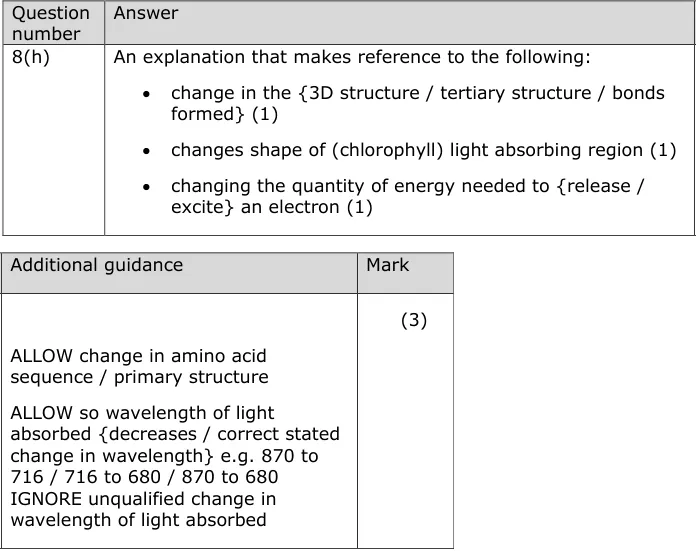
Explain how tiny changes in chlorophyll could change the wavelength of light it absorbs.
Show the mark scheme
Tap an image to open it full size.
From the examiners' report: Chlorophyll is not a protein, yet many wrote about mutations and active sites. Few went on to say the shape of the light-absorbing region changes, changing the energy needed to excite an electron.
Question 9
A level Paper 3 · June 2023 · Q8(i) · 4 marks
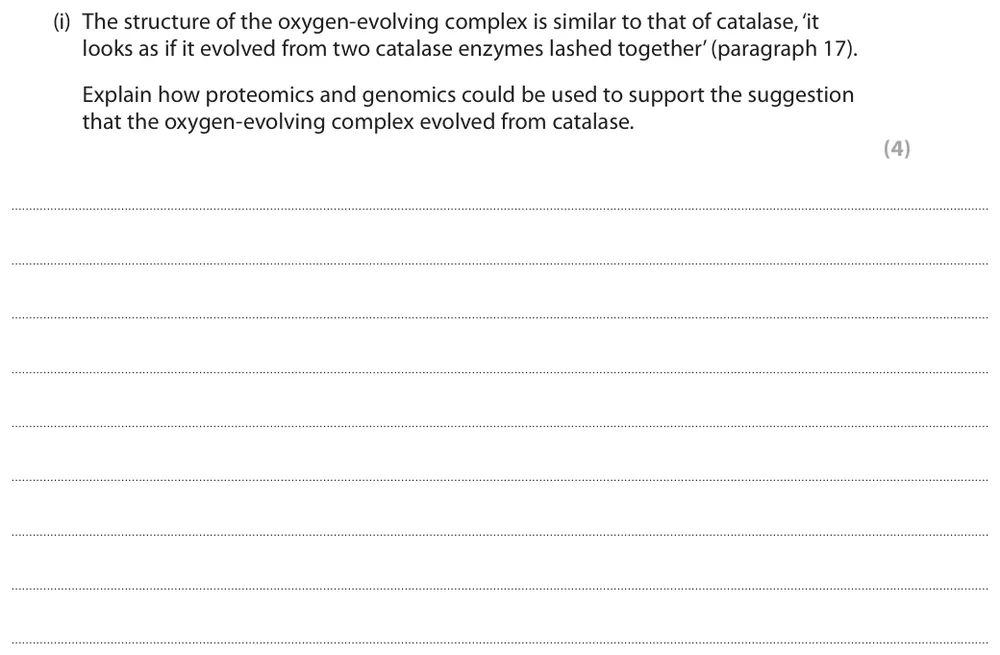
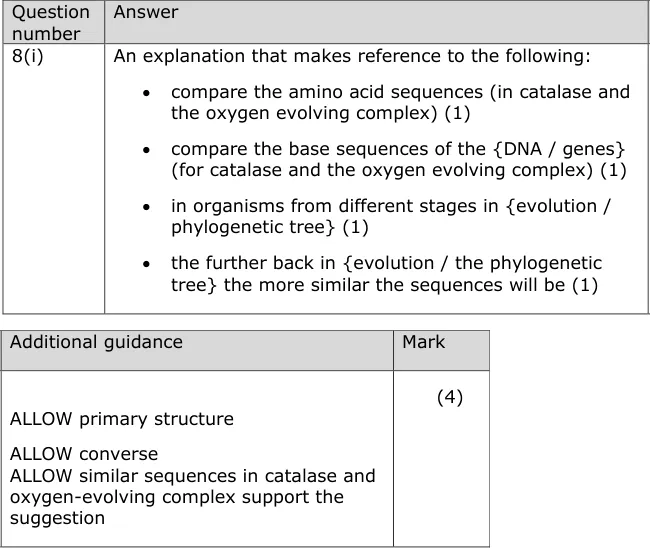
Explain how proteomics and genomics could support the idea that the oxygen-evolving complex evolved from catalase.
Show the mark scheme
Tap an image to open it full size.
From the examiners' report: Compare the amino acid sequences and the gene base sequences of catalase and the oxygen-evolving complex. Very few said to look at organisms from different stages of evolution, and some wrote about mutation and natural selection instead.
Catalase and peroxidase (paragraphs 19–20)
Question 10
A level Paper 3 · June 2023 · Q8(j) · 3 marks · Hard
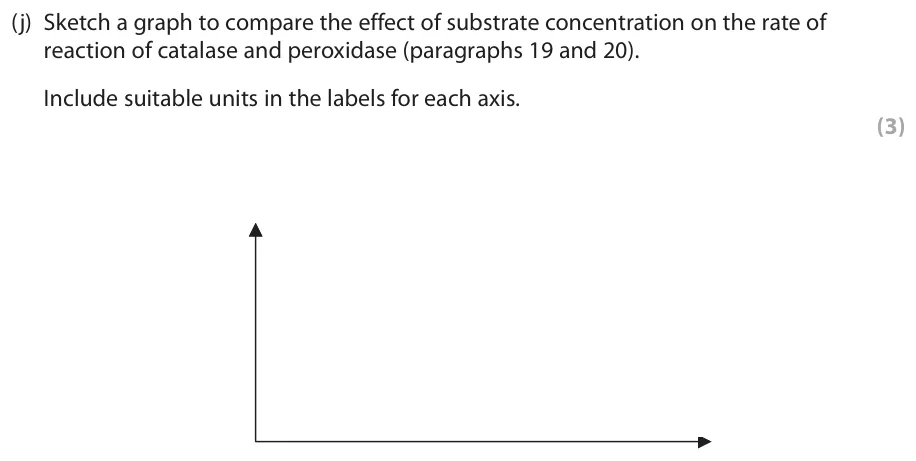
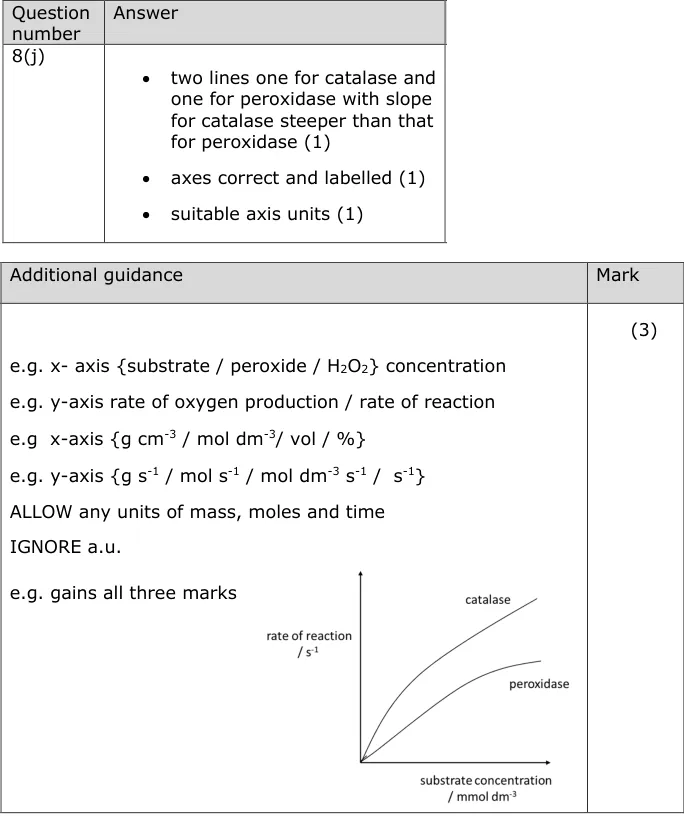
Sketch a graph comparing the effect of substrate concentration on the rate of reaction of catalase and peroxidase.
Show the mark scheme
Tap an image to open it full size.
From the examiners' report: A surprising number drew a single line: draw one for each enzyme, with catalase steeper. Label the axes and give suitable units; many struggled with the units.
Where students lose marks (from Pearson examiners' reports and mark schemes)
Each point below comes from the examiners' report and mark scheme, and is followed by wording that gained marks.
Reduced NADP, with the P. A common error was reduced NAD, and some wrote r or R for reduced, which examiners could not credit.
✔ Gains credit: 'reduced NADP'
Explain ATP, don't list its uses. Many simply described the uses of ATP and gained only one mark.
✔ Gains credit: 'when hydrolysed releases energy' and 'ATP is an immediate source of energy'
ATP and reduced NADP turn GP into GALP. Some mixed up GP and GALP, or left out ATP and reduced NADP from the conversion.
✔ Gains credit: 'CO2 combined with RuBP by RUBISCO, forming molecules of GP; each GP is converted to GALP using ATP and reduced NADP'
Start with isolated chloroplasts. Some planned investigations on whole plants, and others filled the space describing how to prepare chloroplasts.
✔ Gains credit: 'incubate chloroplasts in solution of iron ferricyanide', 'place chloroplasts in the light' and 'observe decolourisation of DCPIP'
Say what the pigments do. Many described features of chloroplasts without linking photosynthetic pigments to absorbing light.
✔ Gains credit: 'thylakoid membrane contains photosynthetic pigments to absorb light'
Protons are pumped into the thylakoid lumen. Some described protons being pumped into the intermembrane space, confusing chloroplasts with mitochondria, or swapped pump and diffuse.
✔ Gains credit: 'used to pump protons into the thylakoid space' and 'protons diffuse down concentration gradient through ATP synthase'
Chlorophyll has no active site. Many treated chlorophyll as a protein and wrote about mutations and active sites.
✔ Gains credit: 'changes shape of light absorbing region, changing the quantity of energy needed to excite an electron'
Two enzymes, two lines. A surprising number sketched a single line, and many struggled to give suitable units.
✔ Gains credit: 'two lines, one for catalase and one for peroxidase, with slope for catalase steeper than that for peroxidase'
Download the questions
Download the PDF pack (10 questions, mark schemes at the end)
Keep practising
- Read the June 2023 scientific article: Green Planet: Radiation and the Evolution of Photosynthesis
- How the Edexcel SNAB Paper 3 scientific article works, and what examiners want
- Edexcel SNAB A level Biology revision resources by topic
- Darwin's Cancer Fix (June 2022 Paper 3 Scientific Article): Edexcel SNAB A Level Biology Exam Questions
- Life in the Sloth Lane (June 2024 Paper 3 Scientific Article): Edexcel SNAB A Level Biology Exam Questions
- All Edexcel SNAB exam questions by topic
- Edexcel SNAB A level Biology past papers, mark schemes and examiners' reports
- Edexcel SNAB A level Biology grade boundaries
- Message Tom on WhatsApp about one-to-one Edexcel SNAB tutoring or an Edexcel group class
Questions, mark schemes and examiners' report extracts © Pearson Education Ltd.