

Variation (17.1): Cambridge (CIE) A Level Biology 9700 Exam Questions by Topic
Variation is sub-topic 17.1 of Topic 17, Selection and evolution, in the Cambridge International AS & A Level Biology syllabus (9700). You need to explain, with examples, that phenotypic variation is due to genetic factors, environmental factors or a combination of the two. You need to explain what is meant by discontinuous variation and continuous variation, explain the genetic basis of each, and use the t-test to compare the means of two different samples; the formula for the t-test is provided. This is A level content, examined on Paper 4.
The examiners' reports return to the same points. Phenotype is affected by genes, by the environment and by the interaction of the two, and few students mention the interaction. When a table of data is given, compare different breeds in the same place to show a genetic cause and the same breed in different places to show an environmental cause, and quote figures with their units. Give each difference between discontinuous and continuous variation as a matched pair. Do not confuse genes with alleles when you describe the genetic basis of variation, and do not write about the environment when the question asks for the genetic basis. After a t-test, say that the difference is significant.
Studying Cambridge International A level Biology and want more help? Tom teaches CIE students one-to-one online, including students in the UAE, Saudi Arabia, Hong Kong, India and Indonesia, and every lesson is recorded. You can book a one-to-one lesson or a free 15-minute discovery chat, or register your interest in a CIE group class starting in September 2027, using the links at the bottom of this page.
What you need from AS Level
Each question on this page assumes you're secure on these ideas. If any of them feels shaky, look it up before you start.
- A gene is a sequence of nucleotides in DNA that codes for a polypeptide.
- A gene mutation is a change in the sequence of base pairs in DNA and may result in an altered polypeptide.
- The mean of a sample is the sum of the values divided by the number of values.
- Give a calculated answer to the number of significant figures or decimal places that the question asks for.
Key terms
These words come up in the questions and mark schemes. Examiners expect you to use them exactly.
- Phenotypic variation: the differences in phenotype between the individuals of a species; it is caused by genetic factors, environmental factors or a combination of both.
- Discontinuous variation: variation in which the phenotypes fall into a few distinct categories with no intermediates, such as blood groups.
- Continuous variation: variation in which the phenotypes form a range of values with many intermediates, such as height or body mass; it often gives a normal distribution.
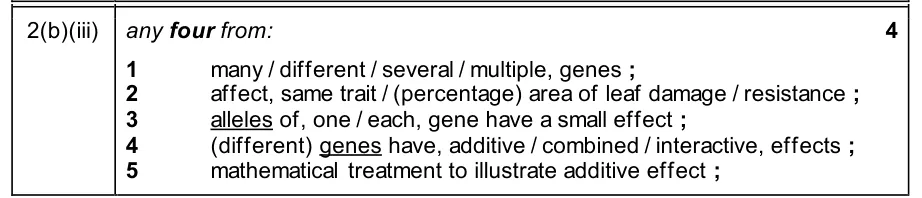
- Polygenic: controlled by many genes; the different genes have an additive effect on the phenotype.
- Additive effect: each of several genes adds a small amount to the phenotype, so their effects combine.
- t-test: a statistical test used to compare the means of two different samples.
- Critical value: the value that t is compared with; if the calculated value of t is greater, the difference between the two means is significant.
- Significant difference: a difference between two means that is not due to chance.
What these questions cover (Cambridge 9700 Topic 17: Selection and evolution)
The questions test these learning outcomes from sub-topic 17.1 of the Cambridge International AS & A Level Biology syllabus (9700) for 2025 to 2027.
- 17.1.1 explain, with examples, that phenotypic variation is due to genetic factors or environmental factors or a combination of genetic and environmental factors
- 17.1.2 explain what is meant by discontinuous variation and continuous variation
- 17.1.3 explain the genetic basis of discontinuous variation and continuous variation
- 17.1.4 use the t-test to compare the means of two different samples
How to use this page
Write your answer on paper before you open the mark scheme. Allow about 1.2 minutes per mark: the 22 questions are worth 54 marks, so about 65 minutes in total. Then mark your answer strictly against the mark scheme and read the examiners' tip underneath it. If you'd rather print the questions, download the PDF pack.
Genetic and environmental causes of variation (17.1.1)
Question 1
Paper 4 · May/June 2024 (42) · Q2(a) · 3 marks · Hard
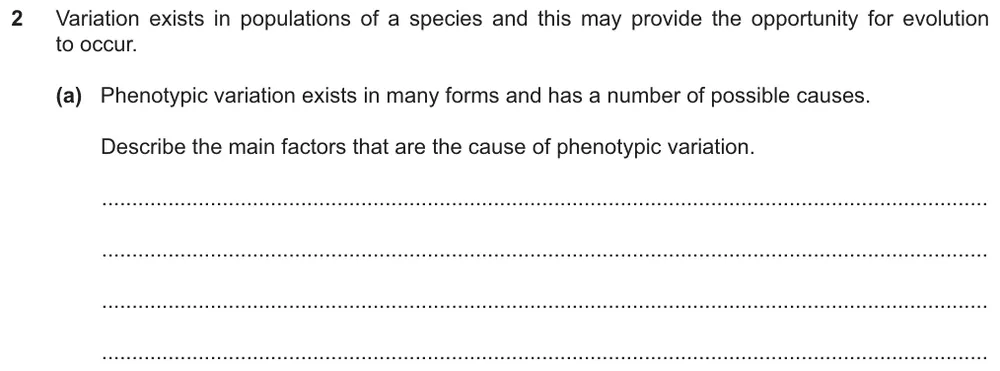
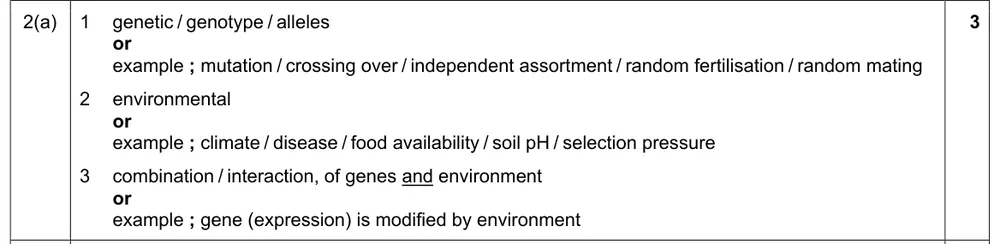
Describe the main factors that cause phenotypic variation.
Show the mark scheme
Tap an image to open it full size.
From the examiners' report: Many said that phenotype is affected by both environmental and genetic factors. Few went on to say that the interaction of genetic and environmental factors is important.
Question 2
Paper 4 · May/June 2024 (43) · Q2(a) · 3 marks · Hard
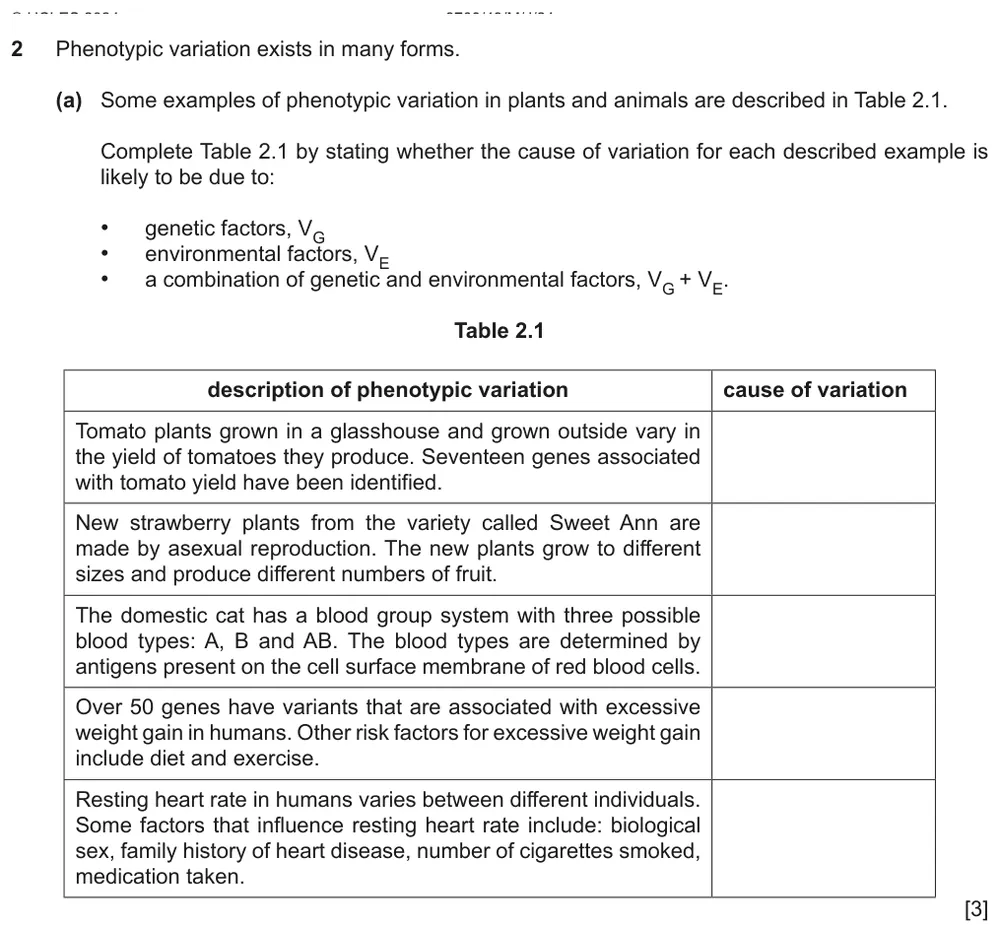
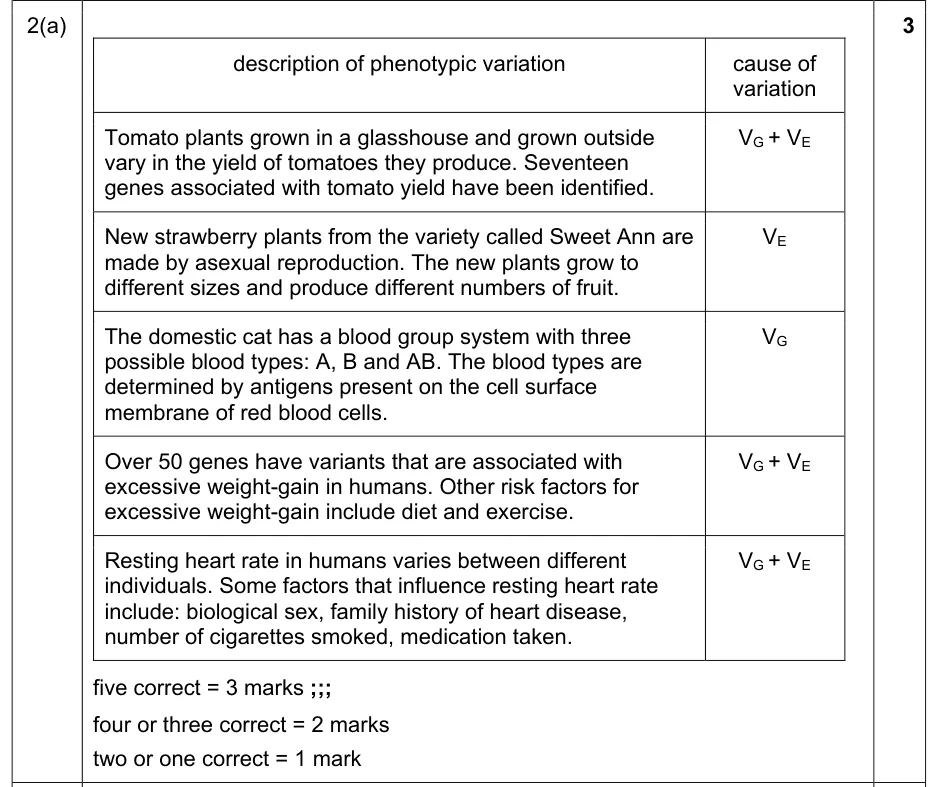
Decide whether each example of variation is due to genetic factors, environmental factors or both.
Show the mark scheme
Tap an image to open it full size.
From the examiners' report: The strawberry plants were made by asexual reproduction, so they are genetically identical and the cause is environmental only: this was the most common error. For the tomato plants, the seventeen genes linked to yield show that there is a genetic cause as well as an environmental one.
Question 3
Paper 4 · October/November 2020 (42) · Q2(b)(i) · 2 marks
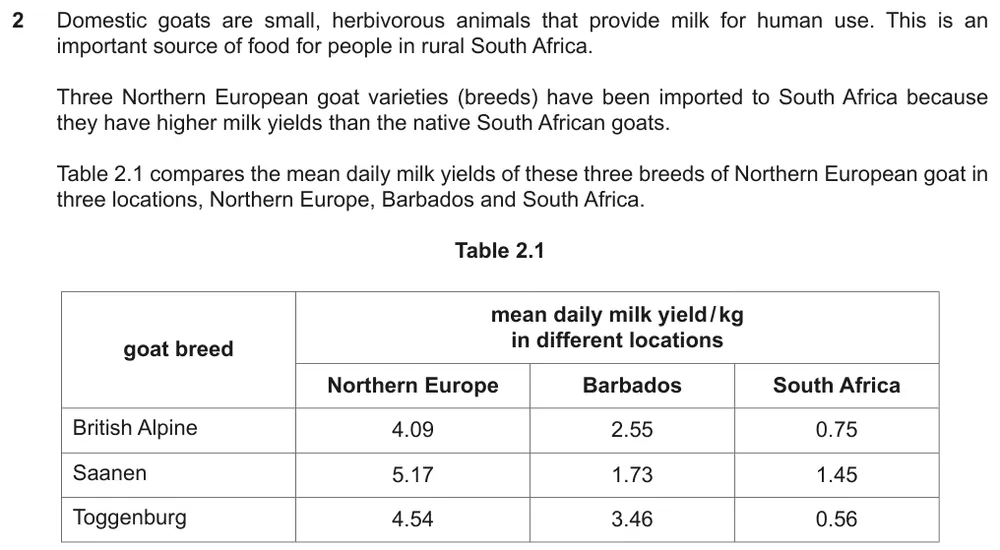
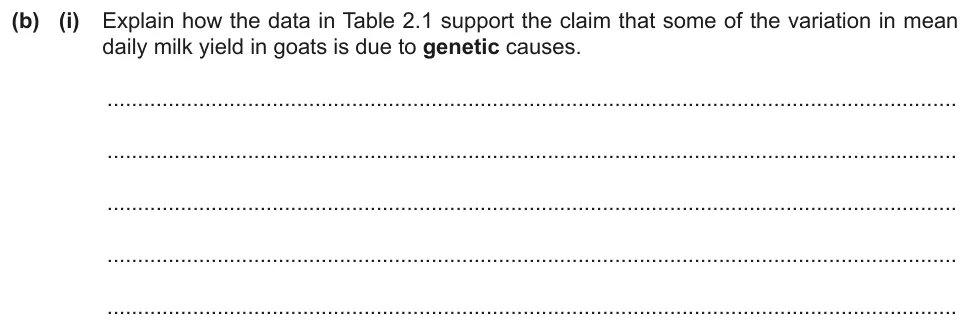
Explain how the table supports the claim that some of the variation in milk yield in goats is genetic.
Information from earlier in this question:
Show the mark scheme

Tap an image to open it full size.
From the examiners' report: Compare different breeds in the same location. Quote figures with their units, and write 'breeds', not 'goats' or 'goat species'. Very few said that different breeds have different gene pools.
Question 4
Paper 4 · October/November 2020 (42) · Q2(b)(ii) · 2 marks
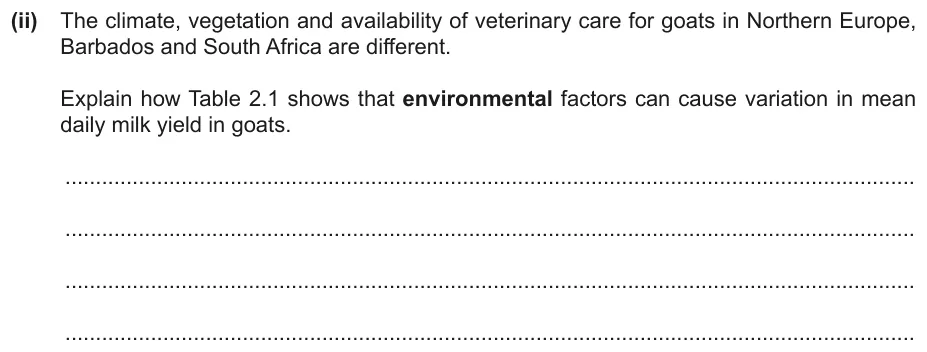
Explain how the table shows that environmental factors can cause variation in milk yield in goats.
Show the mark scheme

Tap an image to open it full size.
From the examiners' report: Compare the same breed in different locations. Say how the environment affects the yield, not just that it 'affects' it. Many did not quote the data correctly, and a significant number wrote the explanation the wrong way round.
Question 5
Paper 4 · May/June 2019 (42) · Q2(b) · 3 marks
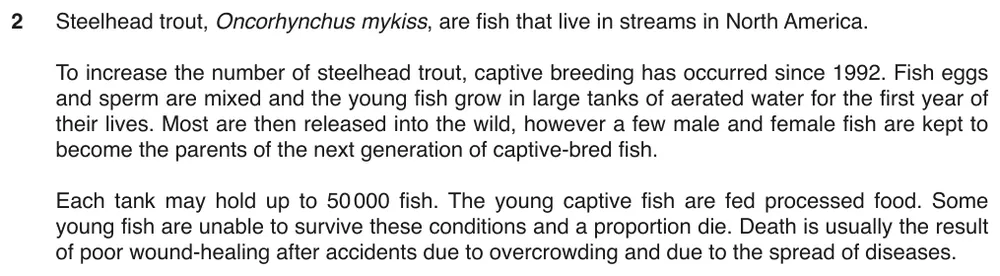
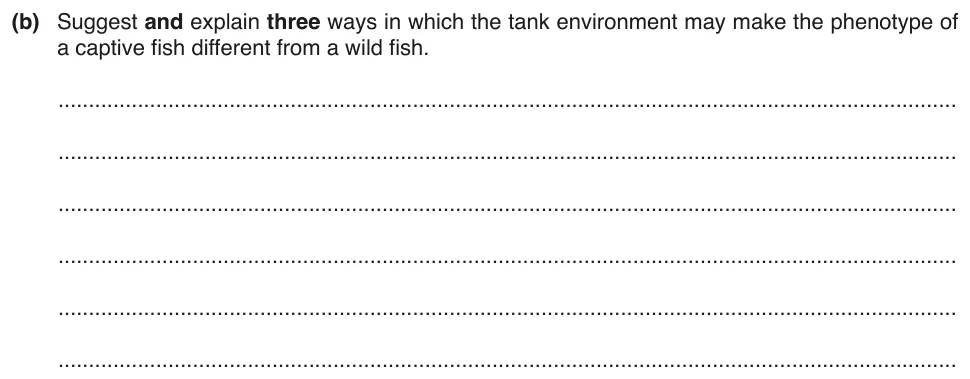
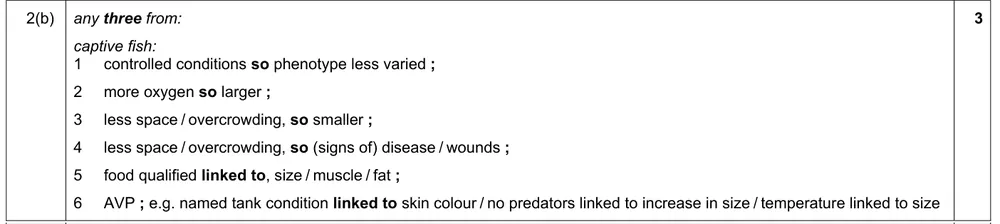
Suggest and explain three ways in which the tank environment may make a captive fish different from a wild fish.
Information from earlier in this question:
Show the mark scheme
Tap an image to open it full size.
From the examiners' report: Link each condition in the tank to a stated difference in phenotype: naming the condition alone, or saying only that the phenotype would differ, was too vague. This is not a question about speciation or selection pressures.
Discontinuous and continuous variation (17.1.2)
Question 6
Paper 4 · October/November 2024 (42) · Q5(a) · 4 marks
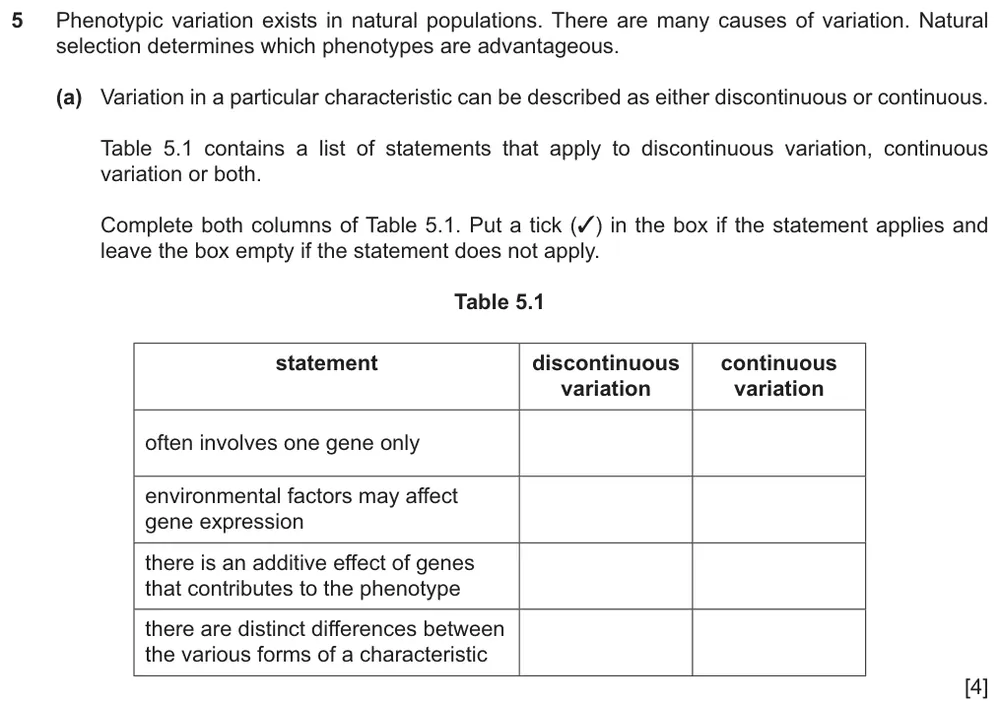
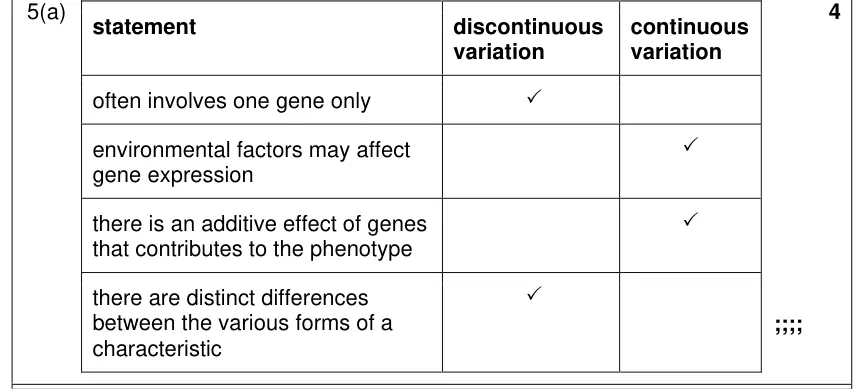
Tick the statements that apply to discontinuous variation and to continuous variation.
Show the mark scheme
Tap an image to open it full size.
Question 7
Paper 4 · May/June 2023 (42) · Q3(a)(i) · 1 mark · Easy
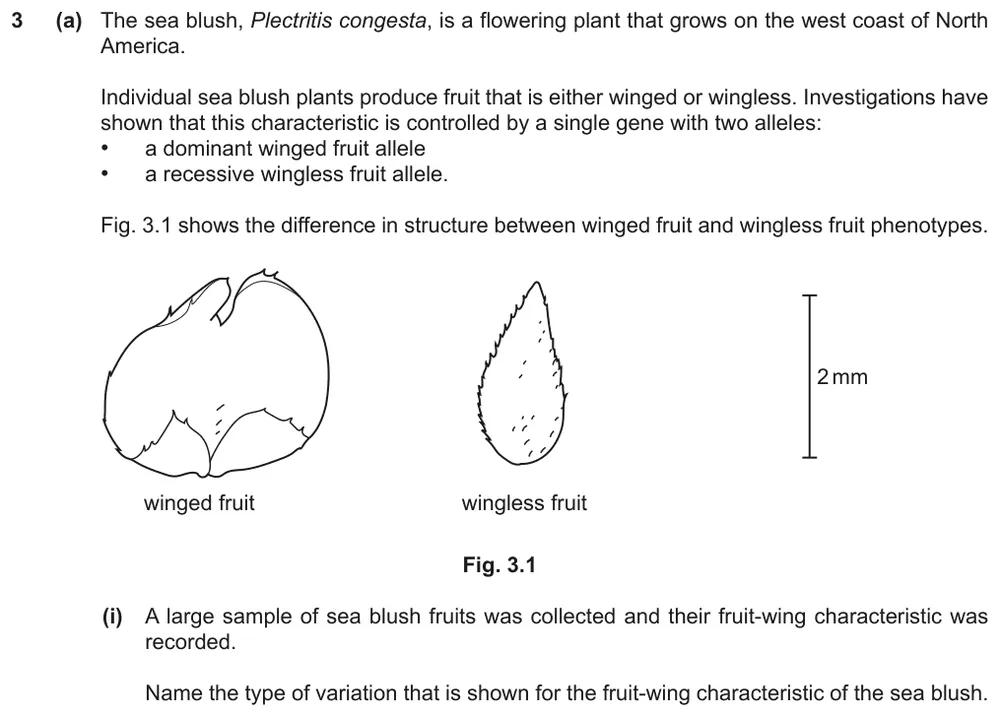
Name the type of variation shown by winged and wingless fruits.
Show the mark scheme

Tap an image to open it full size.
From the examiners' report: Most gave discontinuous. Wrong answers included phenotypic variation and genetic variation.
Question 8
Paper 4 · February/March 2023 (42) · Q3(a) · 3 marks · Easy
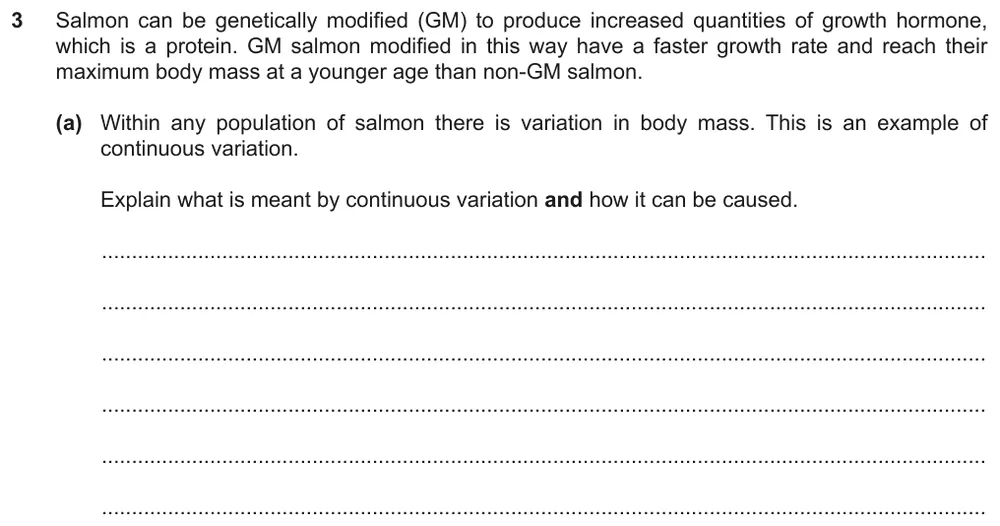
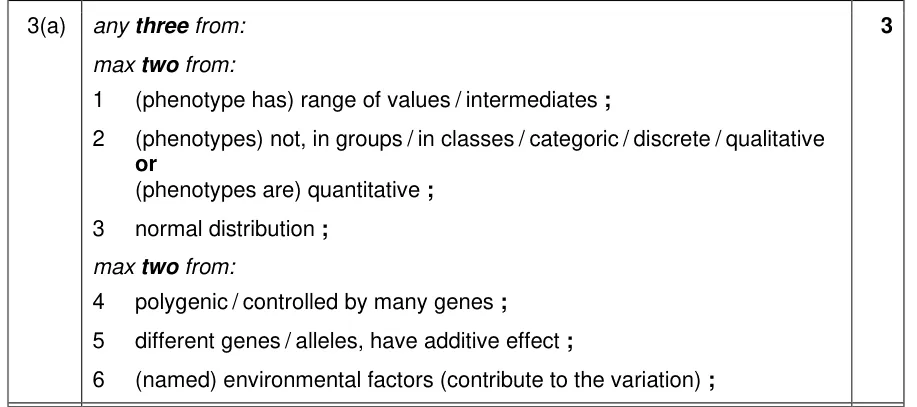
Explain what is meant by continuous variation and how it can be caused.
Show the mark scheme
Tap an image to open it full size.
From the examiners' report: Most described continuous variation very well. A few did not go on to say how it is caused.
Question 9
Paper 4 · October/November 2023 (41) · Q3(b) · 2 marks · Easy
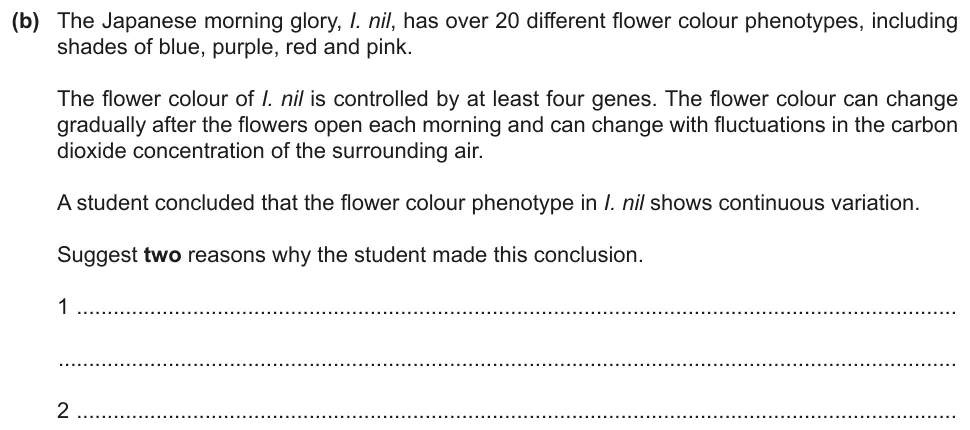
Suggest two reasons why a student concluded that flower colour shows continuous variation.
Show the mark scheme

Tap an image to open it full size.
From the examiners' report: Use the information given: several genes, an effect of the environment, and colours that form a gradual range. The weakest answers described single flowers changing colour and not the range of phenotypes in the whole population.
Question 10
Paper 4 · October/November 2019 (42) · Q2(a) · 2 marks
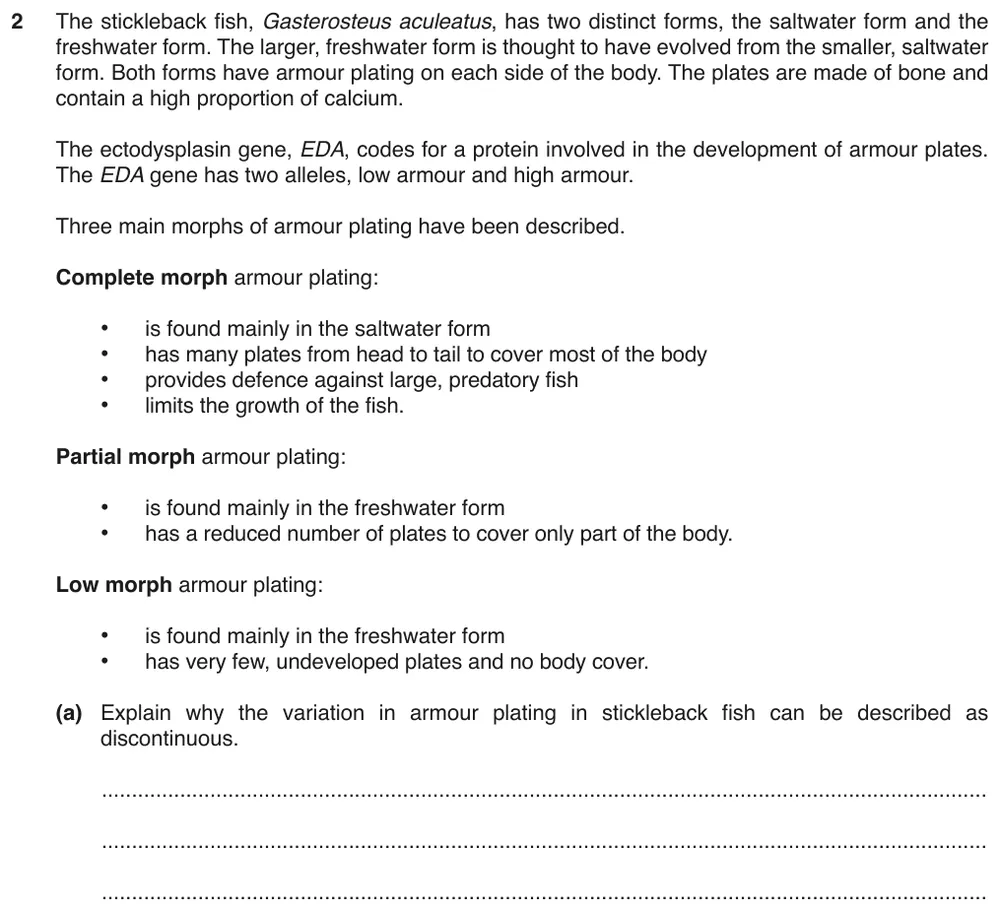
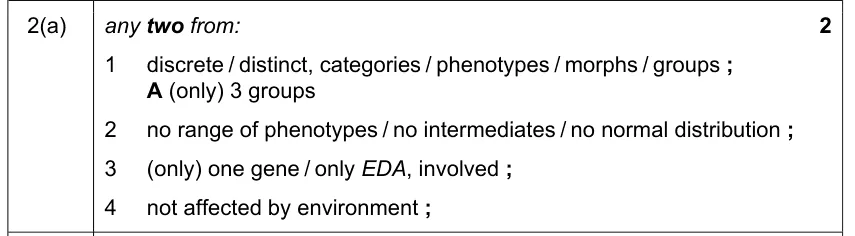
Explain why the variation in armour plating in stickleback fish can be described as discontinuous.
Show the mark scheme
Tap an image to open it full size.
From the examiners' report: Most gave discrete categories and stopped there. Go on to say that there are no intermediates, that the environment has no effect, or that a single gene is involved: write 'gene', not 'genes'.
Types of variation and their genetic basis (17.1.1 to 17.1.3)
Question 11
Paper 4 · May/June 2024 (41) · Q9(a) · 2 marks · Hard
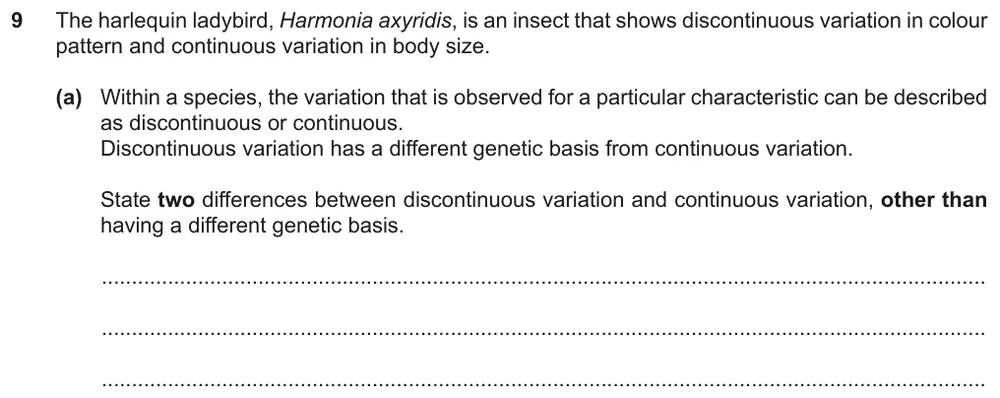
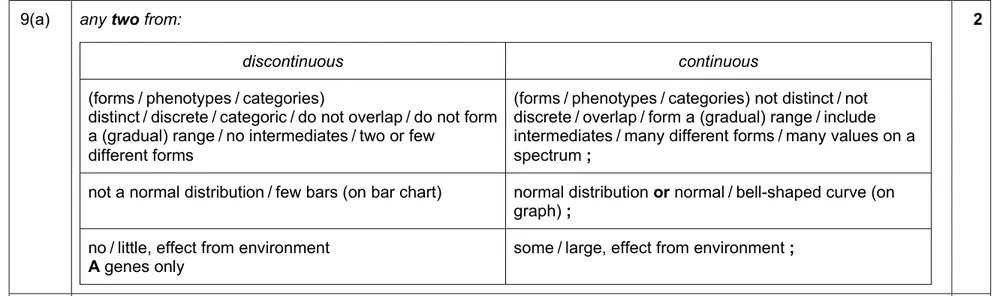
State two differences between discontinuous variation and continuous variation, other than the genetic basis.
Show the mark scheme
Tap an image to open it full size.
From the examiners' report: Give a feature of one type with the matching feature of the other. Some wrote about the genetic basis, which the question ruled out. 'Quantitative' and 'qualitative' did not work here, because in both cases you count the individuals with each phenotype.
Question 12
Paper 4 · May/June 2024 (41) · Q9(b) · 2 marks
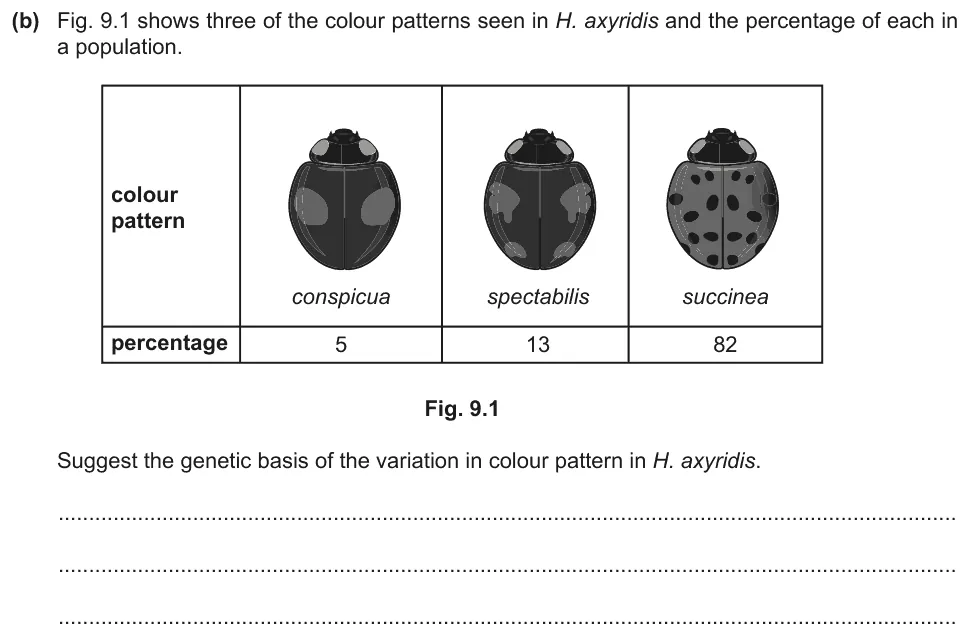
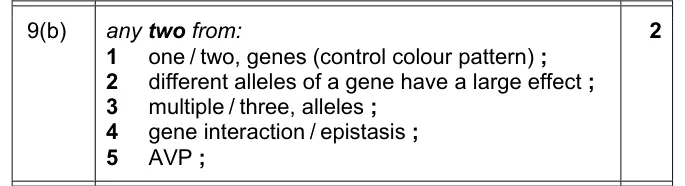
Suggest the genetic basis of the variation in colour pattern in the harlequin ladybird.
Show the mark scheme
Tap an image to open it full size.
From the examiners' report: Some only repeated that the variation is discontinuous, which is stated at the start of the question. The points most often credited were control by one or two genes, and different alleles at a single locus having large effects.
Question 13
Paper 4 · May/June 2024 (41) · Q9(c) · 2 marks · Easy
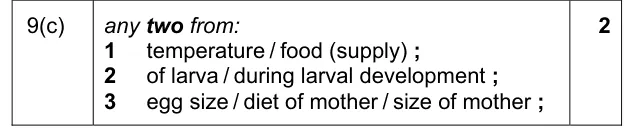
State two environmental factors that may affect adult body size in the harlequin ladybird.

Show the mark scheme
Tap an image to open it full size.
From the examiners' report: Most gained credit for food availability or temperature. The best answers used the question and said that these factors act through growth at the larval stage.
Question 14
Paper 4 · October/November 2025 (41) · Q2(b)(ii) · 1 mark
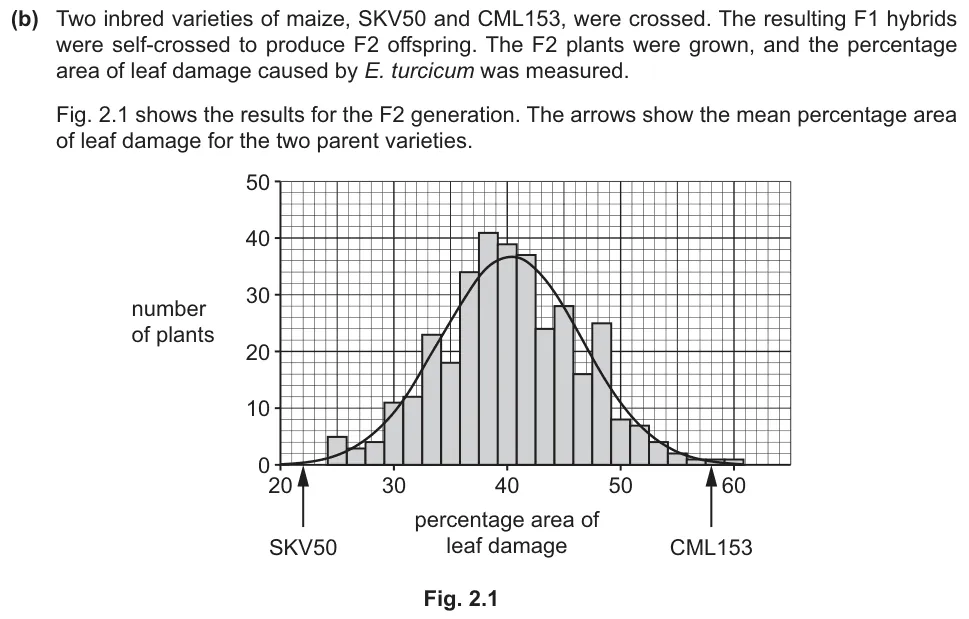
Name the type of variation shown by the F2 maize plants in the graph.
Information from earlier in this question:


Show the mark scheme

Tap an image to open it full size.
Question 15
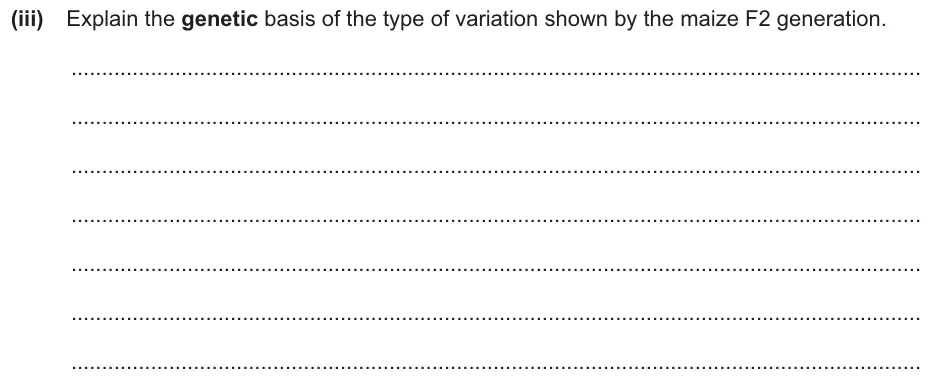
Paper 4 · October/November 2025 (41) · Q2(b)(iii) · 4 marks
Explain the genetic basis of the type of variation shown by the F2 maize plants.
Show the mark scheme
Tap an image to open it full size.
Question 16
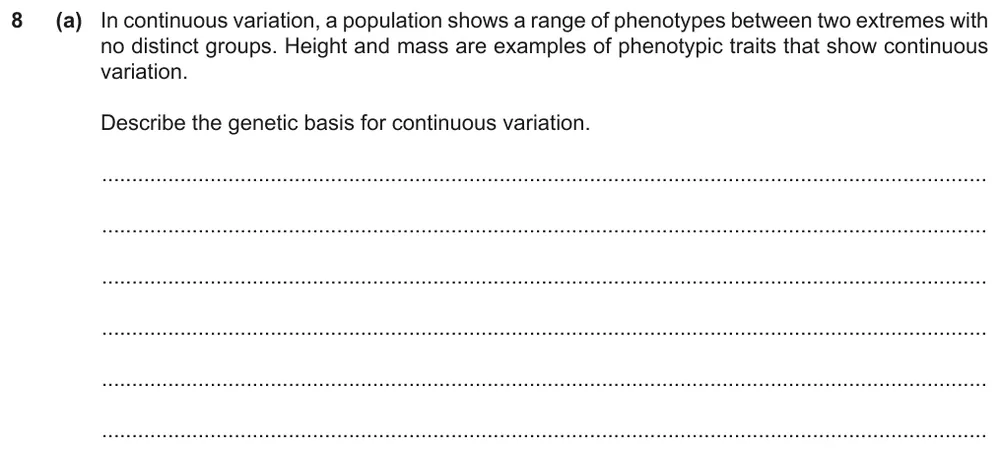
Paper 4 · May/June 2021 (42) · Q8(a) · 3 marks
Describe the genetic basis for continuous variation.
Show the mark scheme

Tap an image to open it full size.
From the examiners' report: Many confused alleles and genes: different alleles at a single gene locus have small effects, and different genes have an additive effect. A large number wrote about the environment, which did not answer the question.
Question 17
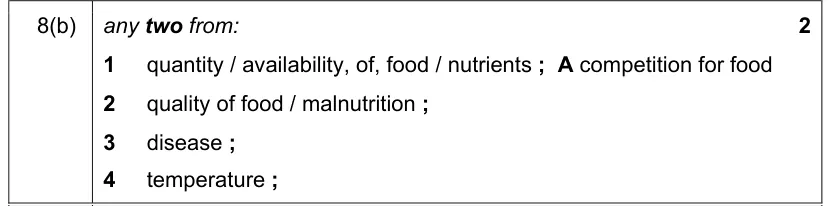
Paper 4 · May/June 2021 (42) · Q8(b) · 2 marks
Suggest two environmental factors that may affect the body mass of an animal.

Show the mark scheme
Tap an image to open it full size.
From the examiners' report: 'Climate' or 'diet' on their own were too vague. Give the quantity or quality of food, disease or temperature. Exercise was a common wrong answer.
The t-test (17.1.4)
Question 18
Paper 4 · February/March 2023 (42) · Q3(b)(i) · 3 marks · Easy
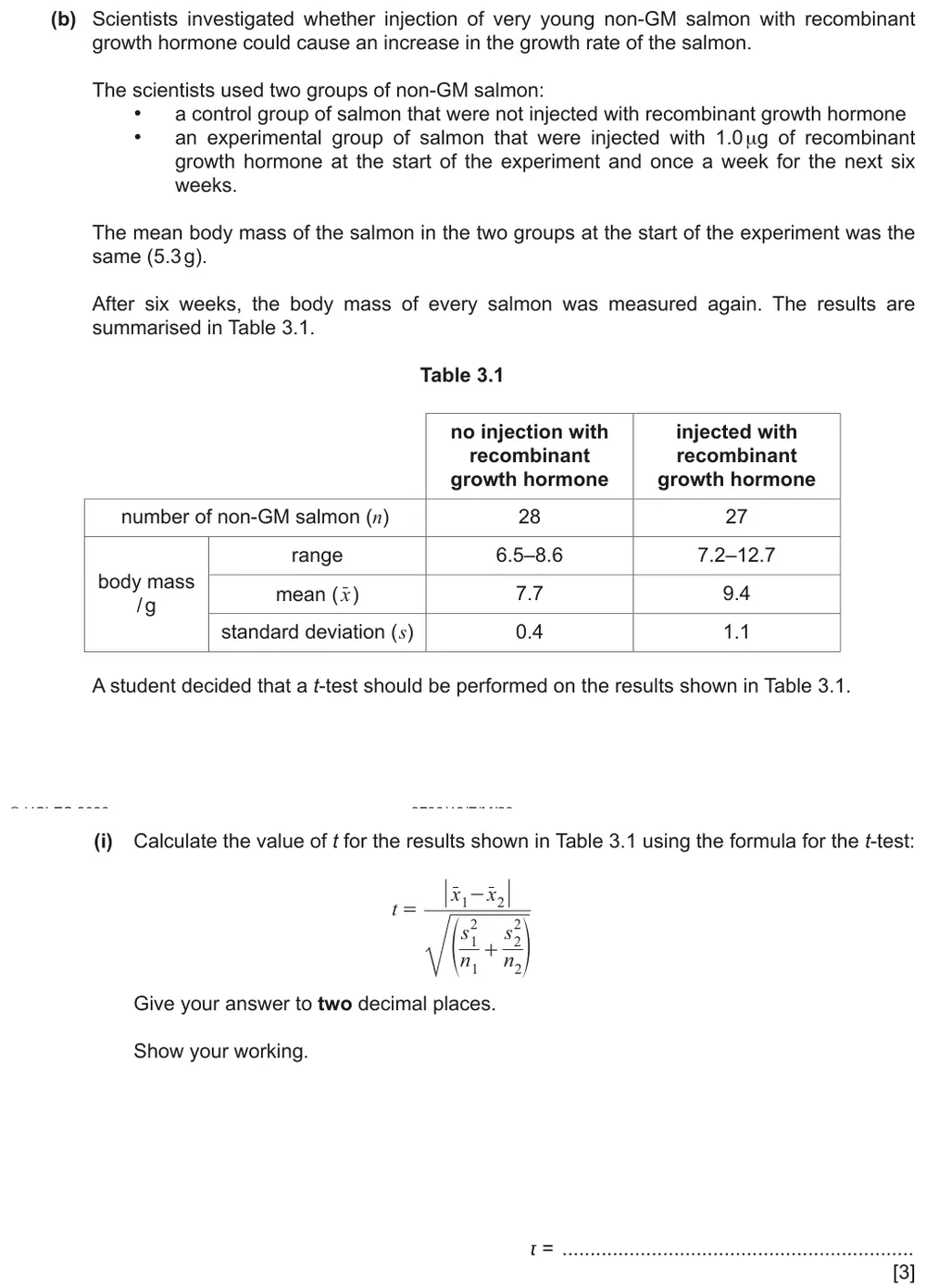
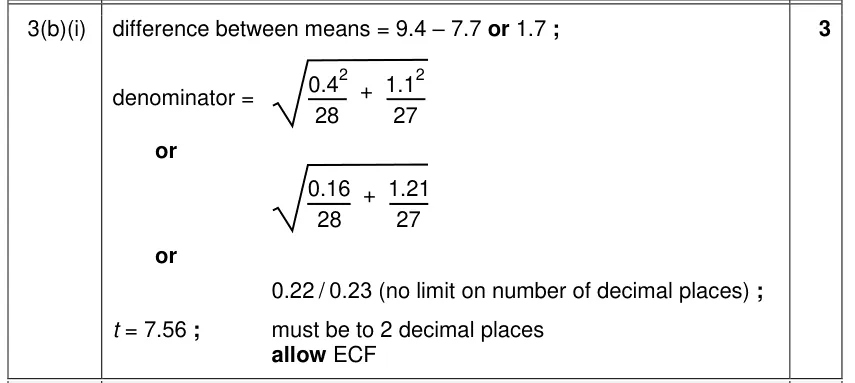
Calculate the value of t for the body mass of salmon with and without injections of growth hormone.
Information from earlier in this question:

Show the mark scheme
Tap an image to open it full size.
From the examiners' report: Most calculated t correctly. The errors were using a negative value for the numerator and forgetting to take the square root of the denominator.
Question 19
Paper 4 · February/March 2023 (42) · Q3(b)(ii) · 3 marks · Easy
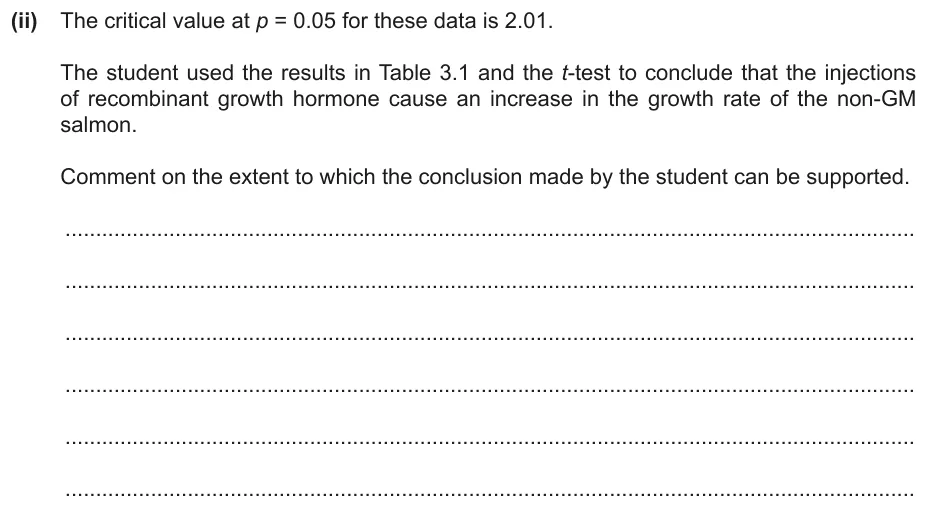
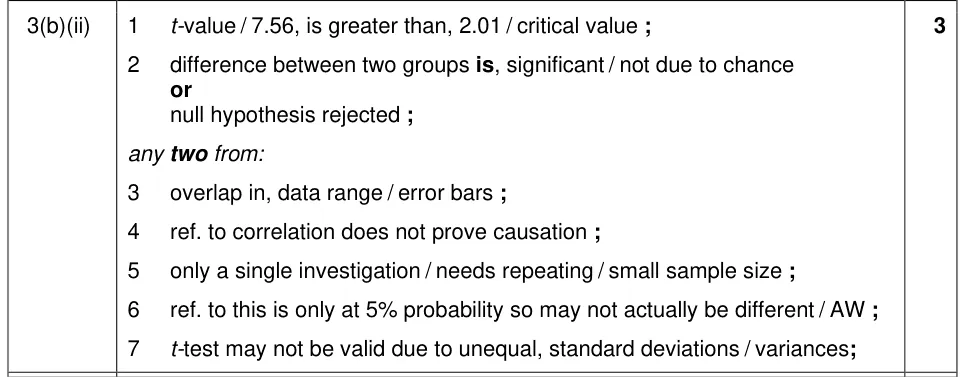
Comment on how far the t-test supports the student's conclusion.
Show the mark scheme
Tap an image to open it full size.
From the examiners' report: Most interpreted the t-test correctly, but the wording did not always give the idea of statistical significance. Few considered that, at a probability of 0.05, 5% of tests where there is no real difference would still show a difference.
The t-test in a vitamin D study (17.1.4 and 17.1.1)
Question 20
Paper 4 · October/November 2024 (42) · Q5(b)(ii) · 3 marks
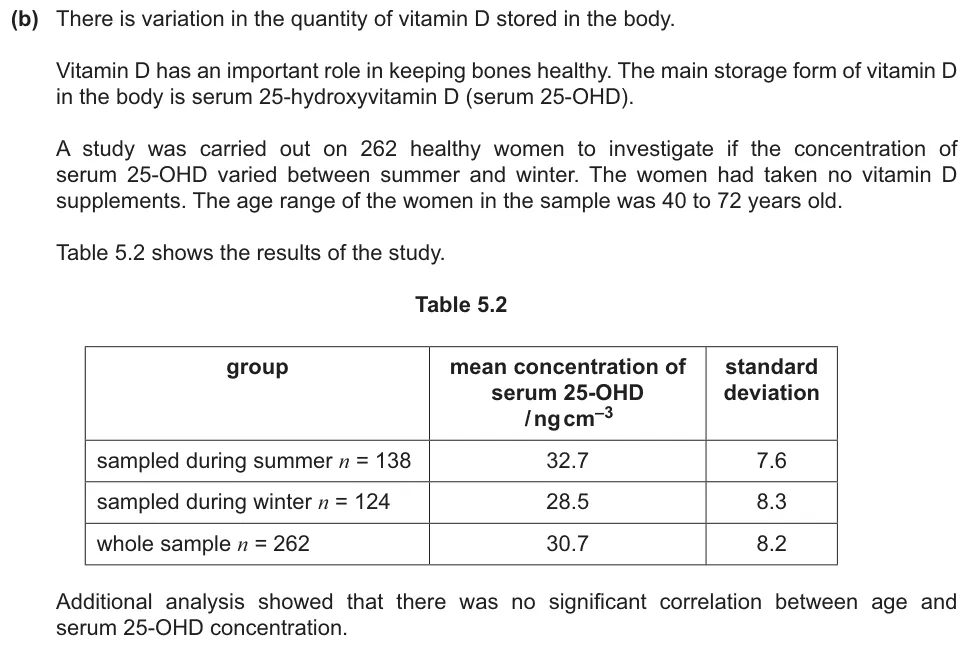
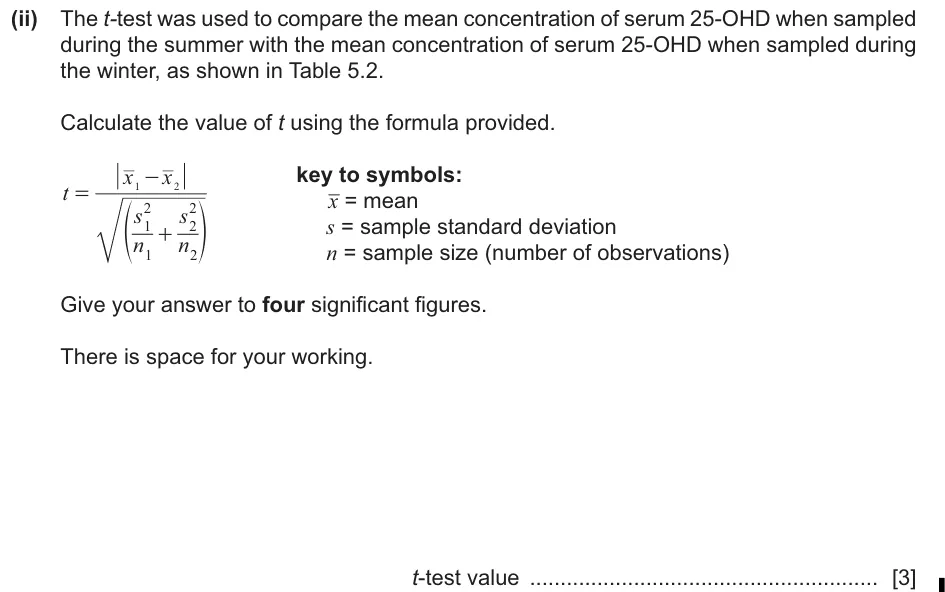
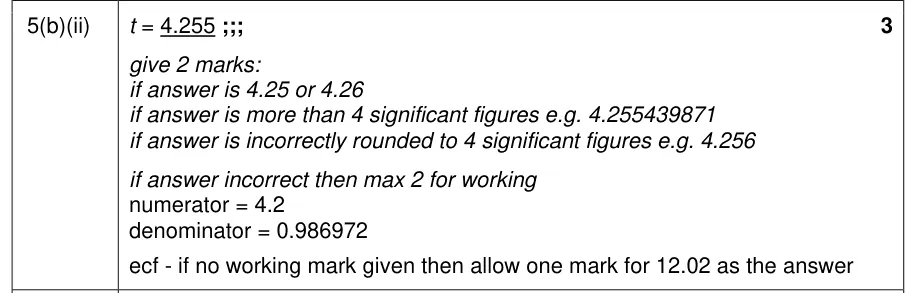
Calculate the value of t, to four significant figures, for vitamin D in summer and in winter.
Information from earlier in this question:
Show the mark scheme
Tap an image to open it full size.
Question 21
Paper 4 · October/November 2024 (42) · Q5(b)(iii) · 3 marks
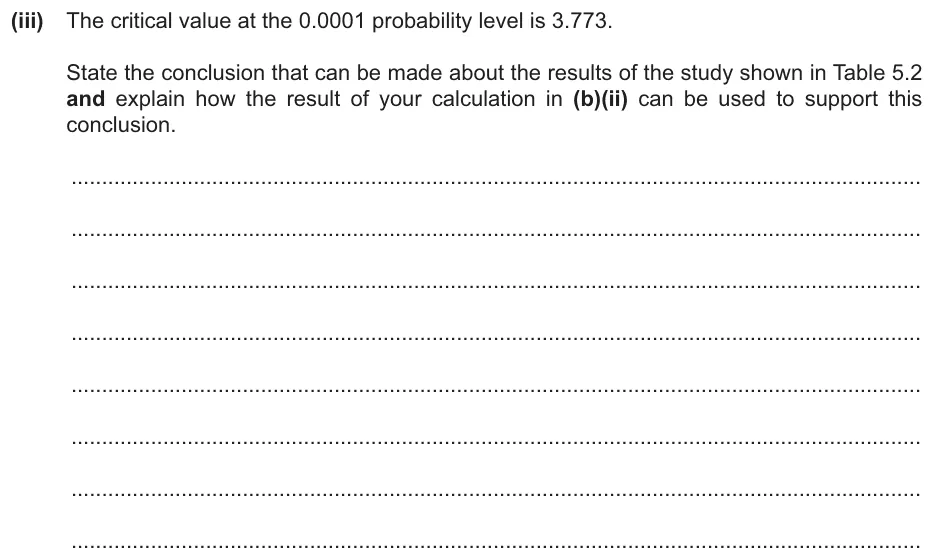
State the conclusion from the study and explain how your value of t supports it.
Show the mark scheme
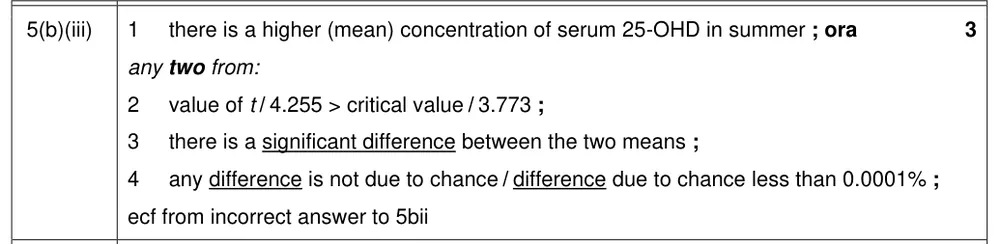
Tap an image to open it full size.
Question 22
Paper 4 · October/November 2024 (42) · Q5(b)(iv) · 1 mark
Suggest the likely causes of variation in the quantity of vitamin D stored in the body in this sample of women.

Show the mark scheme

Tap an image to open it full size.
Where students lose marks (from Cambridge examiners' reports and mark schemes)
Each point below comes from the examiners' reports and mark schemes, and is followed by wording that gained marks.
Genes and environment interact. Students said that phenotype is affected by genetic and environmental factors and stopped there.
✔ Gains credit: 'genetic', 'environmental' and a 'combination / interaction, of genes and environment', for example 'gene (expression) is modified by environment'.
Asexual reproduction means the same genes. Students gave a genetic cause for variation in strawberry plants made by asexual reproduction, or environment only for tomato yield.
✔ Gains credit: 'VE' for the strawberry plants and 'VG + VE' for the tomato plants.
Same place for genes, same breed for environment. Students did not compare the right groups, wrote 'goats' when they meant breeds, or quoted figures without units.
✔ Gains credit: 'different breeds at same location have different milk yields' for genetic causes; 'same breed has different milk yields in different location' for the environment; each with a 'comparative data quote including units'.
Link the condition to the phenotype. Students described the conditions in the tank without saying how the phenotype of the fish would differ, or wrote about speciation.
✔ Gains credit: 'more oxygen so larger', 'less space / overcrowding, so smaller', or food 'linked to size / muscle / fat'.
Give differences in matched pairs. Students gave a feature of one type of variation without the matching feature of the other, or wrote about the genetic basis.
✔ Gains credit: 'discrete' and 'no intermediates' against 'form a (gradual) range' and 'include intermediates'; 'not a normal distribution' against 'normal distribution'; 'no / little, effect from environment' against 'some / large, effect from environment'.
Discontinuous is not a genetic basis. Students only repeated that the variation in colour pattern is discontinuous.
✔ Gains credit: 'one / two, genes' control the colour pattern and 'different alleles of a gene have a large effect'.
Alleles have small effects, genes add up. Students confused alleles with genes, or wrote about the environment when asked for the genetic basis of continuous variation.
✔ Gains credit: 'different alleles at a single gene locus have small effects', 'different genes may have an additive / combined effect', and a reference to 'multiple genes / polygenes'.
Say the difference is significant. Students compared t with the critical value but their wording did not give the idea of statistical significance.
✔ Gains credit: the 't-value is greater than critical value', so the 'difference between two groups is significant / not due to chance'.
Download the questions
Download the PDF pack (22 questions, mark schemes at the end)
Keep practising
- Natural and Artificial Selection (17.2): Cambridge (CIE) exam questions by topic
- Evolution (17.3): Cambridge (CIE) exam questions by topic
- Cambridge (CIE) A level Biology 9700 past papers, mark schemes and examiners' reports
- Cambridge (CIE) A level Biology grade thresholds
- Book a one-to-one CIE lesson or a free 15-minute discovery chat with Tom
- Register your interest in a CIE A level Biology group class
Questions, mark schemes and examiners' report extracts © Cambridge University Press & Assessment.