

Evolution (17.3): Cambridge (CIE) A Level Biology 9700 Exam Questions by Topic
Evolution is sub-topic 17.3 of Topic 17, Selection and evolution, in the Cambridge International AS & A Level Biology syllabus (9700). You need to outline the theory of evolution as a process leading to the formation of new species from pre-existing species over time, as a result of changes to gene pools from generation to generation. You also need to discuss how DNA sequence data can show evolutionary relationships between species, and explain how speciation may occur as a result of genetic isolation by geographical separation (allopatric speciation) and by ecological and behavioural separation (sympatric speciation). This is A level content, examined on Paper 4.
The examiners' reports return to the same points. An outline of the theory of evolution is not a full description of natural selection. When DNA sequences are compared, more similar sequences mean a more recent common ancestor, and details of PCR or gel electrophoresis are rarely what the question wants. In speciation questions, use the information given to decide whether there is a geographical barrier: many answers assumed allopatric speciation when the ranges overlapped. Write about separated populations, not separated species, say that the mutations in each population are different, and remember that selection pressures do not cause mutations.
Studying Cambridge International A level Biology and want more help? Tom teaches CIE students one-to-one online, including students in the UAE, Saudi Arabia, Hong Kong, India and Indonesia, and every lesson is recorded. You can book a one-to-one lesson or a free 15-minute discovery chat, or register your interest in a CIE group class starting in September 2027, using the links at the bottom of this page.
What you need from AS Level
Each question on this page assumes you're secure on these ideas. If any of them feels shaky, look it up before you start.
- DNA is a polynucleotide, and a gene is a sequence of nucleotides that codes for a polypeptide.
- The sequence of bases in a gene determines the sequence of amino acids in the polypeptide (its primary structure).
- A gene mutation is a change in the sequence of base pairs in DNA.
- Mitochondria contain their own small circular DNA.
Key terms
These words come up in the questions and mark schemes. Examiners expect you to use them exactly.
- Evolution: the formation of new species from pre-existing species over time, as a result of changes to gene pools from generation to generation.
- Gene pool: all the alleles of all the genes in a population.
- Gene flow: the movement of alleles between populations when individuals from the populations interbreed.
- Allopatric speciation: speciation that follows geographical separation: a barrier such as sea or mountains stops gene flow between two populations.
- Sympatric speciation: speciation in the same geographical region, caused by ecological or behavioural separation.
- Reproductive isolation: two populations can no longer interbreed to produce fertile offspring.
- Common ancestor: a species from which two or more later species are descended; the more similar their DNA sequences, the more recent the common ancestor.
What these questions cover (Cambridge 9700 Topic 17: Selection and evolution)
The questions test these learning outcomes from sub-topic 17.3 of the Cambridge International AS & A Level Biology syllabus (9700) for 2025 to 2027.
- 17.3.1 outline the theory of evolution as a process leading to the formation of new species from pre-existing species over time, as a result of changes to gene pools from generation to generation
- 17.3.2 discuss how DNA sequence data can show evolutionary relationships between species
- 17.3.3 explain how speciation may occur as a result of genetic isolation by: • geographical separation (allopatric speciation) • ecological and behavioural separation (sympatric speciation)
How to use this page
Write your answer on paper before you open the mark scheme. Allow about 1.2 minutes per mark: the 21 questions are worth 69 marks, so about 83 minutes in total. Then mark your answer strictly against the mark scheme and read the examiners' tip underneath it. If you'd rather print the questions, download the PDF pack.
The theory of evolution (17.3.1)
Question 1
Paper 4 · February/March 2021 (42) · Q1(b) · 2 marks · Hard
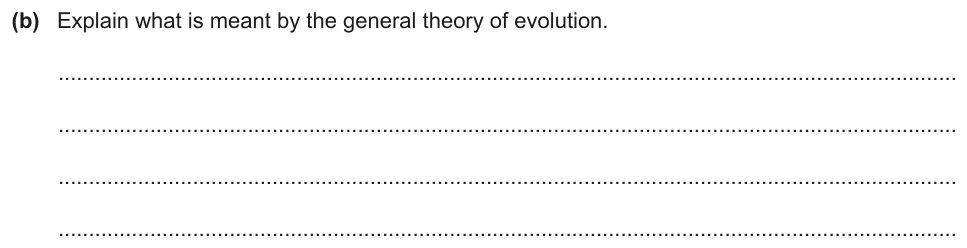
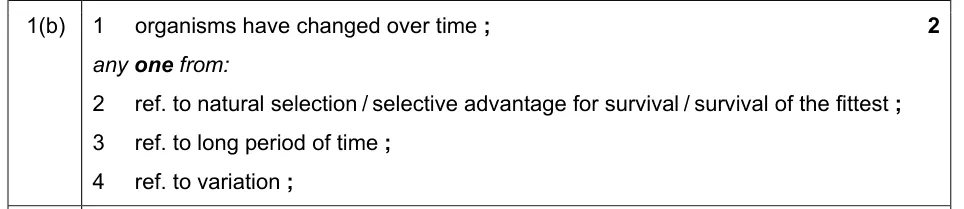
Explain what is meant by the general theory of evolution.
Show the mark scheme
Tap an image to open it full size.
From the examiners' report: Few students managed this. The examiners were looking for the ideas of descent with modification or survival of the fittest.
Question 2
Paper 4 · February/March 2021 (42) · Q1(c) · 3 marks · Easy
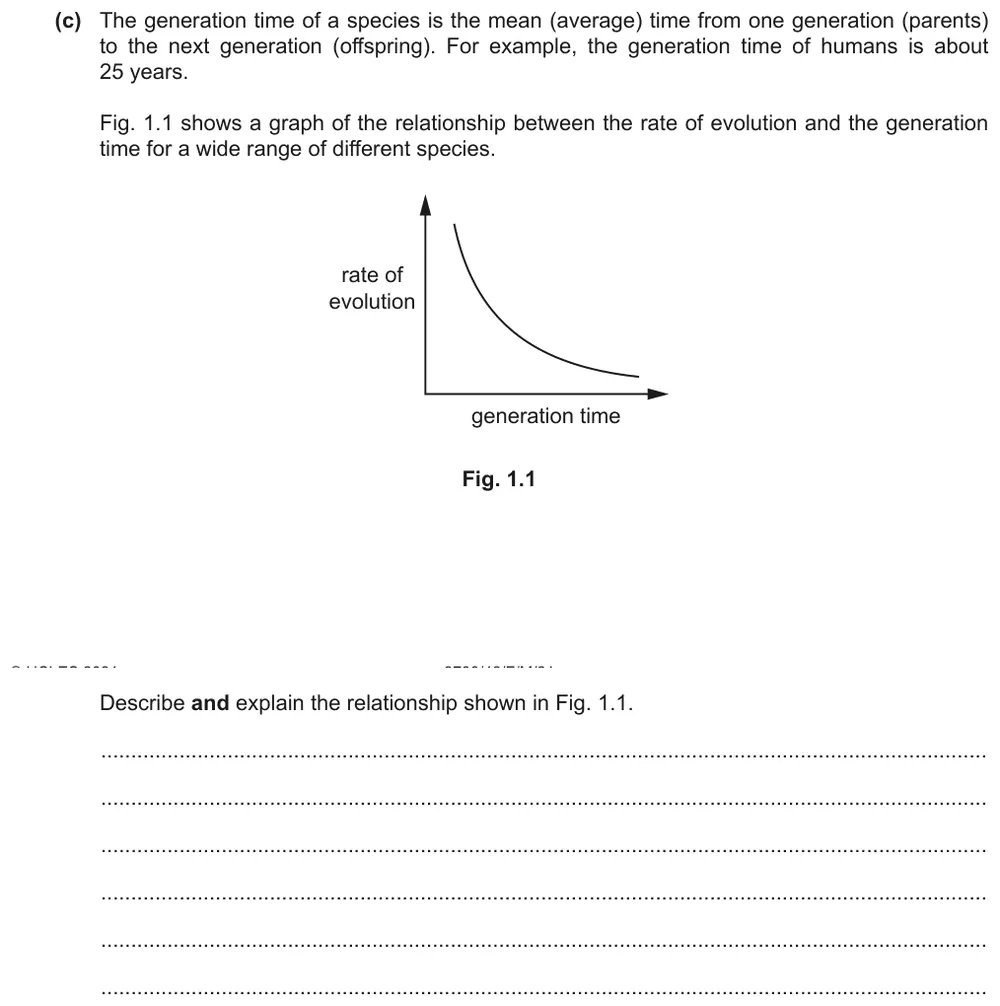
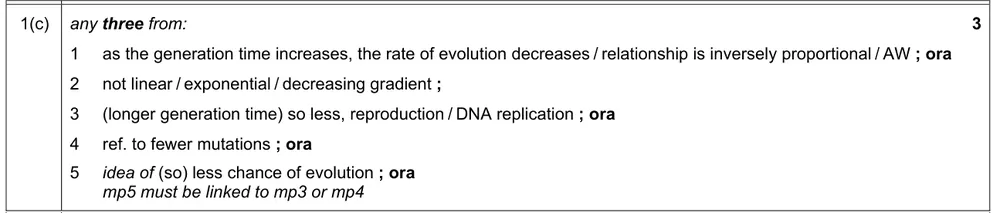
Describe and explain the relationship between generation time and the rate of evolution.
Show the mark scheme
Tap an image to open it full size.
From the examiners' report: Most described the relationship shown in the graph correctly. Go on to explain it: only some suggested why a shorter generation time could be linked to a faster rate of evolution.
Question 3
Paper 4 · February/March 2024 (42) · Q5 · 6 marks
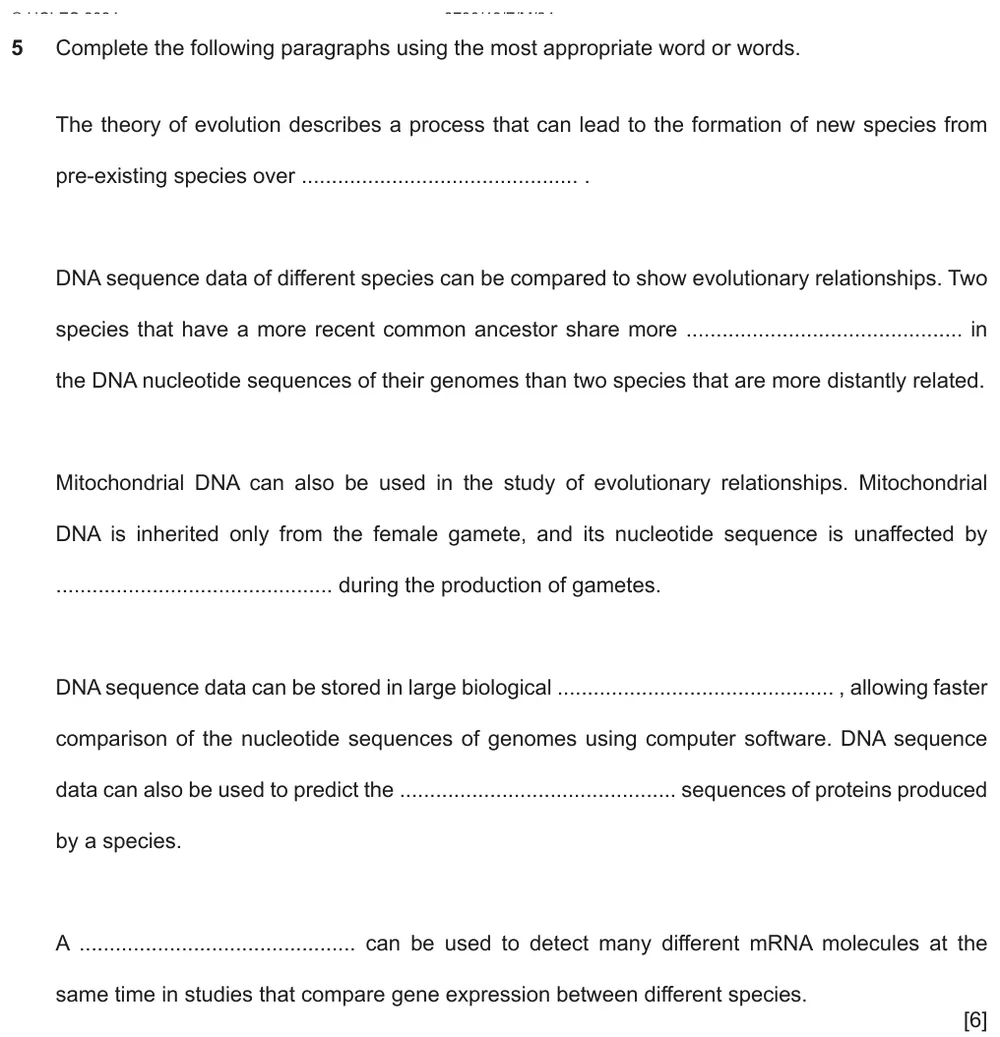
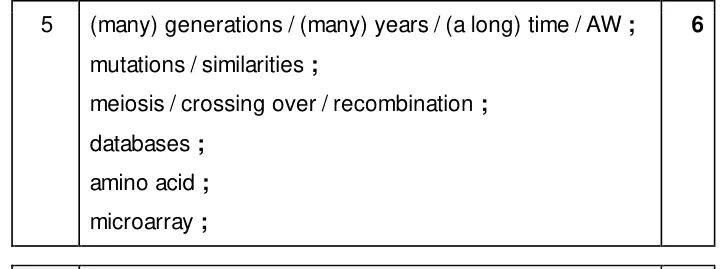
Complete the paragraphs on evolution and DNA sequence data with the most appropriate words.
Show the mark scheme
Tap an image to open it full size.
Question 4
Paper 4 · October/November 2022 (41) · Q5(a) · 5 marks
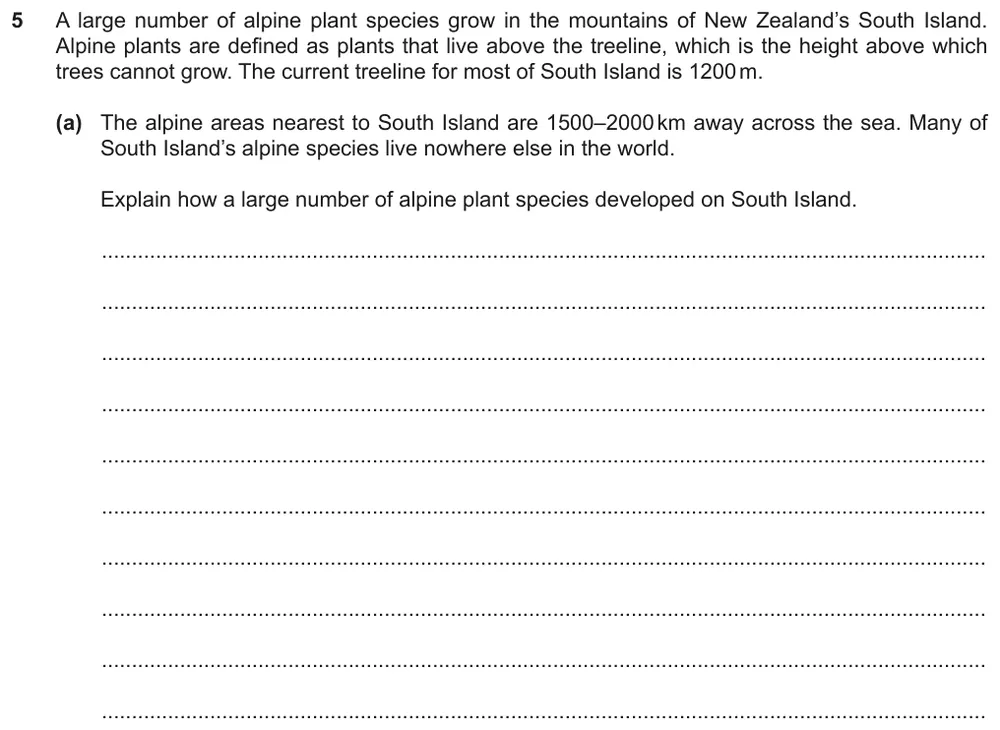
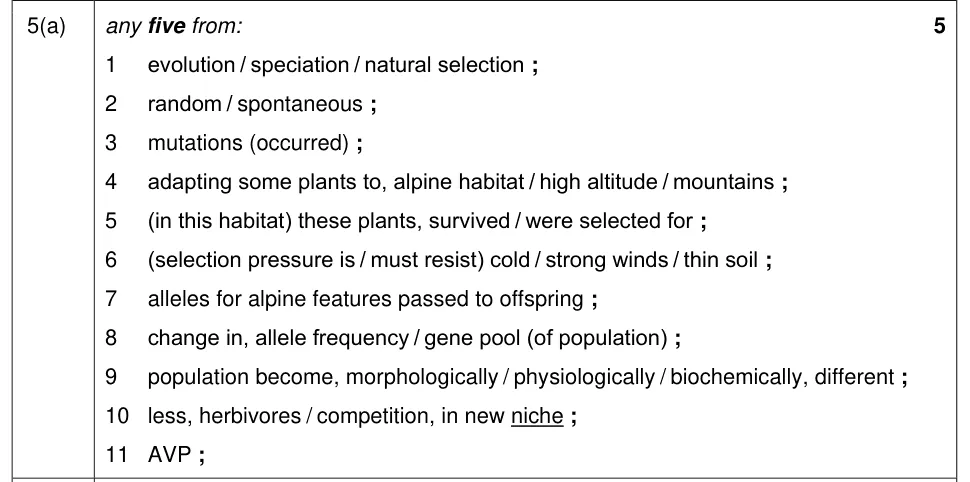
Explain how a large number of alpine plant species developed on South Island.
Show the mark scheme
Tap an image to open it full size.
From the examiners' report: There are no two separated populations here, so recalled mark schemes on allopatric speciation gained no credit. Good answers described lowland plant species adapting to higher ground through mutation and natural selection, and used the demands of the habitat: cold, thin soil and strong winds. Selection pressures do not cause mutations.
Question 5
Paper 4 · May/June 2024 (42) · Q2(b)(i) · 3 marks · Hard
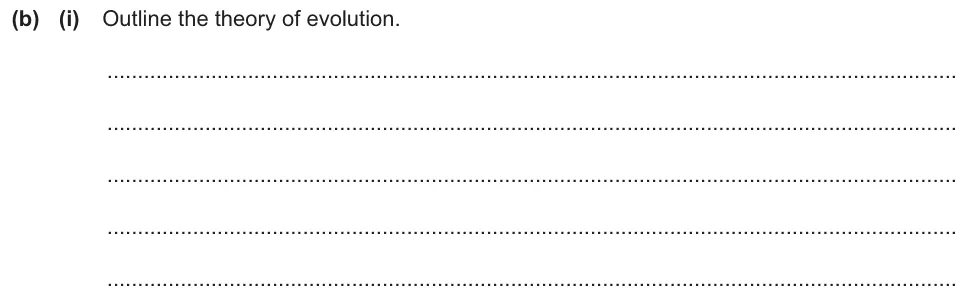
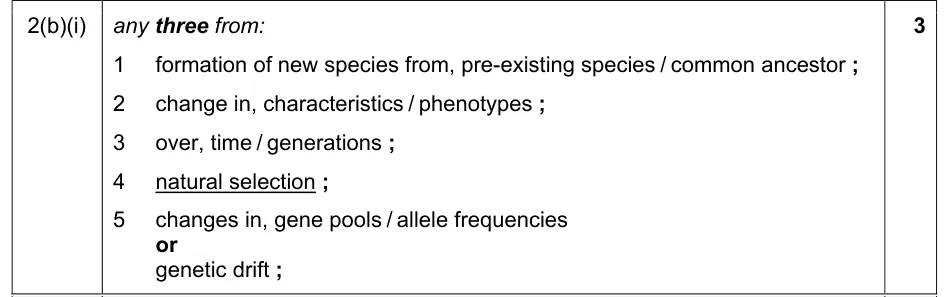
Outline the theory of evolution.
Information from earlier in this question:

Show the mark scheme
Tap an image to open it full size.
From the examiners' report: Many did not gain full marks because they gave a full description of natural selection instead. Take care with the terms organism and species: some used one where they meant the other.
DNA sequence data and evolutionary relationships (17.3.2)
Question 6
Paper 4 · May/June 2024 (42) · Q2(b)(ii) · 3 marks
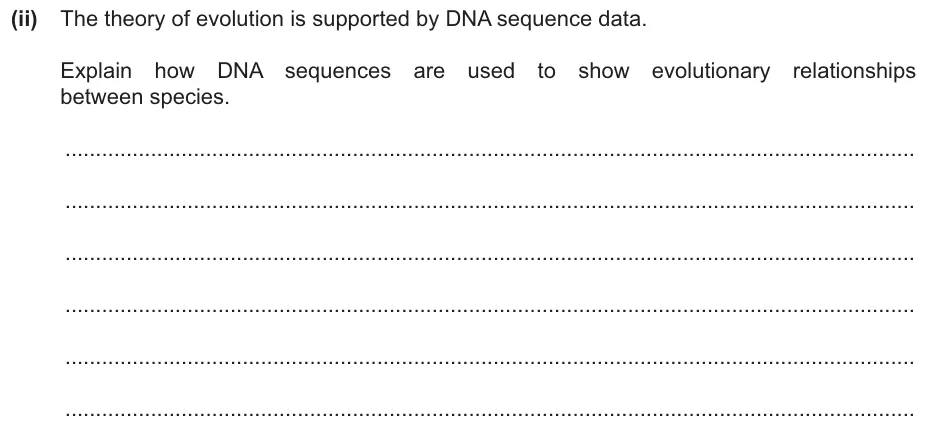
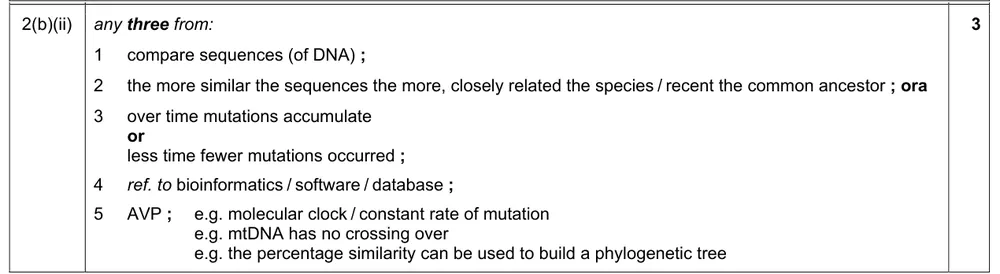
Explain how DNA sequences are used to show evolutionary relationships between species.
Show the mark scheme
Tap an image to open it full size.
From the examiners' report: Say what is compared and how it relates to the evolutionary relationship. Two species with similar sequences have a more recent common ancestor, not just 'a common ancestor'. Detailed descriptions of gel electrophoresis and PCR were not the focus of the question.
Question 7
Paper 4 · May/June 2022 (42) · Q5(c) · 3 marks · Hard
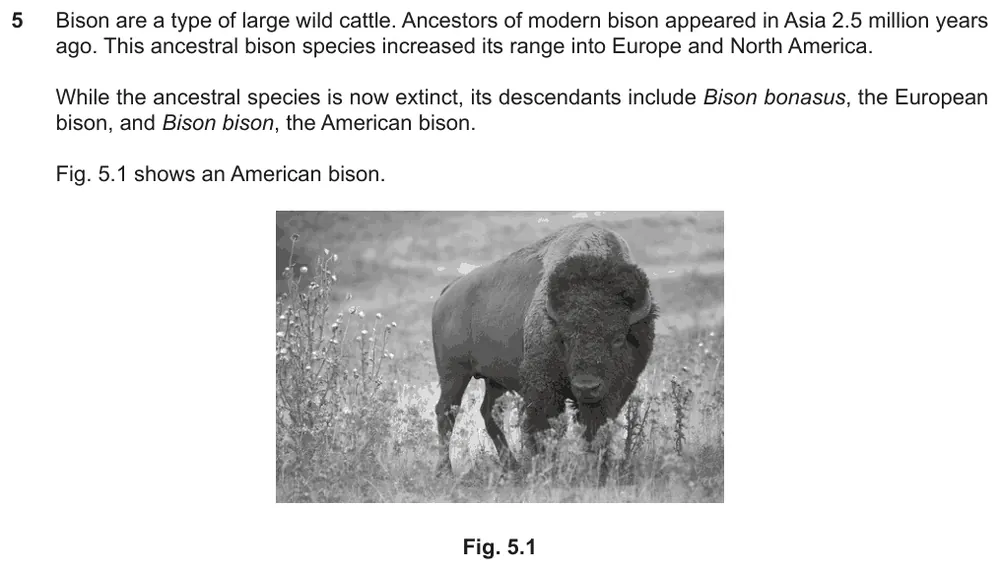
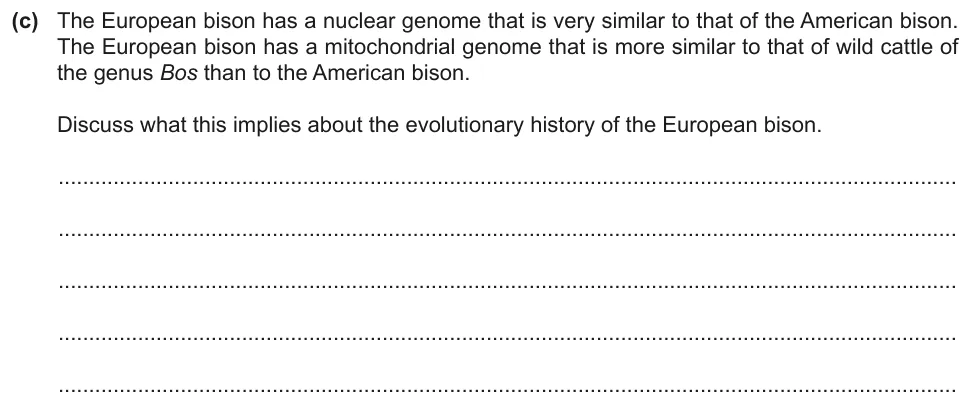
Discuss what the nuclear and mitochondrial genomes imply about the evolutionary history of the European bison.
Information from earlier in this question:
Show the mark scheme

Tap an image to open it full size.
From the examiners' report: A challenging question. Some suggested a relatively recent common ancestor with Bos, and some explained that the mitochondrial genome is inherited through the female line. Very few suggested how the similarities came about, perhaps through breeding between European bison and Bos.
Question 8
Paper 4 · May/June 2022 (42) · Q5(d) · 4 marks
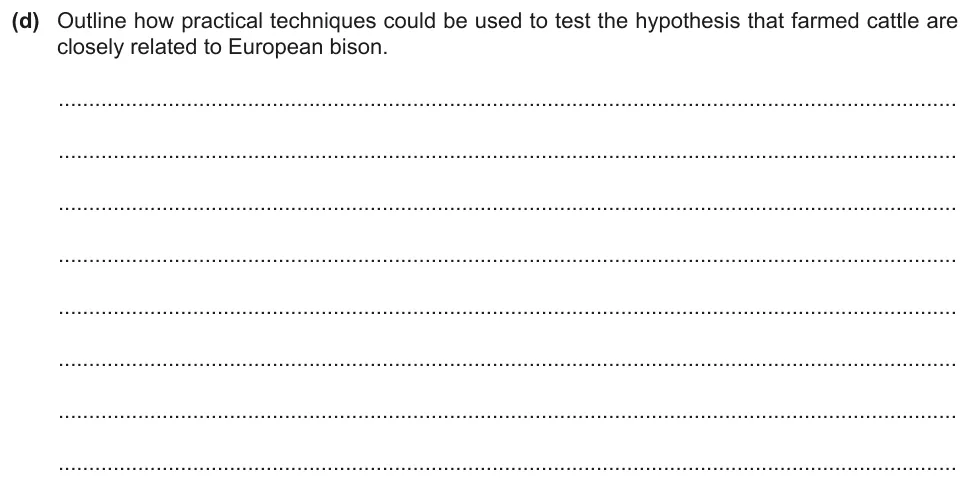
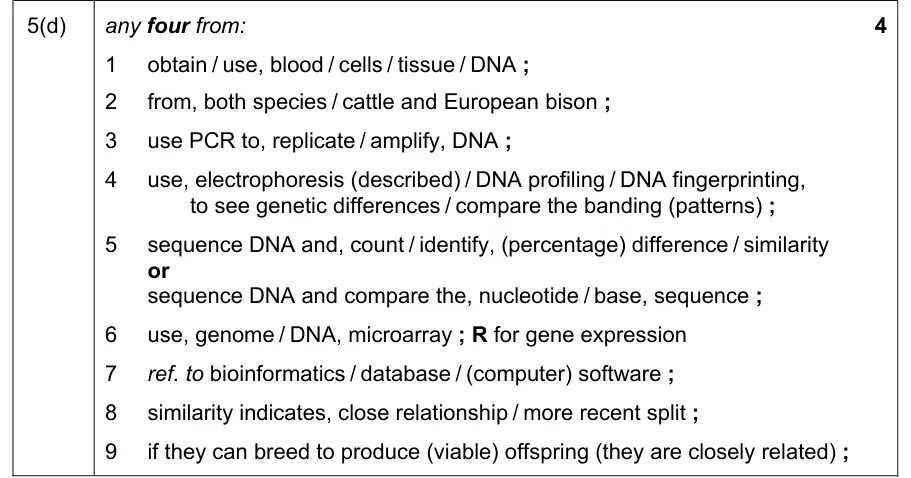
Outline practical techniques that could test whether farmed cattle are closely related to European bison.
Show the mark scheme
Tap an image to open it full size.
From the examiners' report: 'Outline' means summarise the main points of several techniques, not describe one, such as gel electrophoresis, in great detail. Say that DNA is obtained from both species. Making cDNA from mRNA for a microarray shows similarities in gene expression, not in DNA base sequences.
Question 9
Paper 4 · May/June 2019 (42) · Q6(d)(i) · 1 mark · Easy
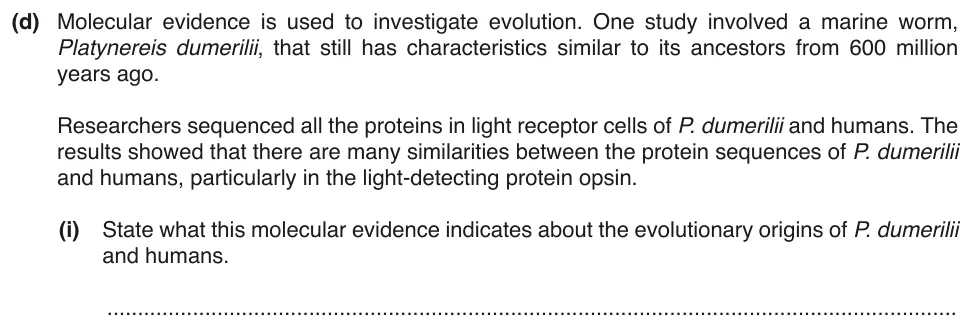
State what the similar protein sequences indicate about the evolutionary origins of the worm and humans.
Show the mark scheme

Tap an image to open it full size.
From the examiners' report: Most used the correct terms. A number treated 600 million years ago as recent.
Question 10
Paper 4 · May/June 2019 (42) · Q6(d)(ii) · 2 marks
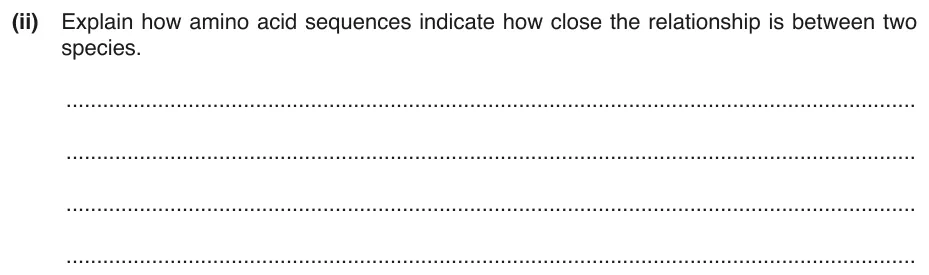
Explain how amino acid sequences indicate how close the relationship is between two species.
Show the mark scheme

Tap an image to open it full size.
From the examiners' report: Few answers were complete. Say that the sequences are compared, and relate the differences to the time that has passed (the molecular clock). The question is about amino acids, so do not write about DNA and nucleotide sequences.
Question 11
Paper 4 · October/November 2017 (42) · Q3(b) · 3 marks
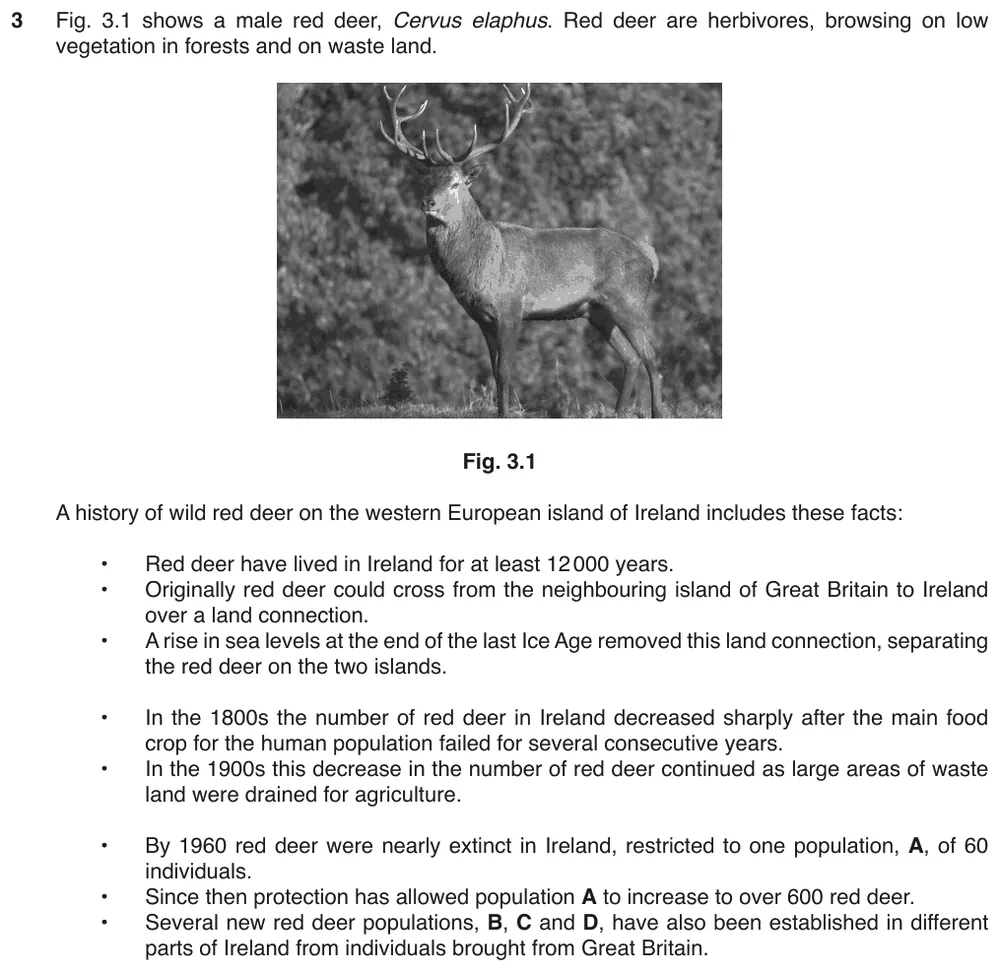
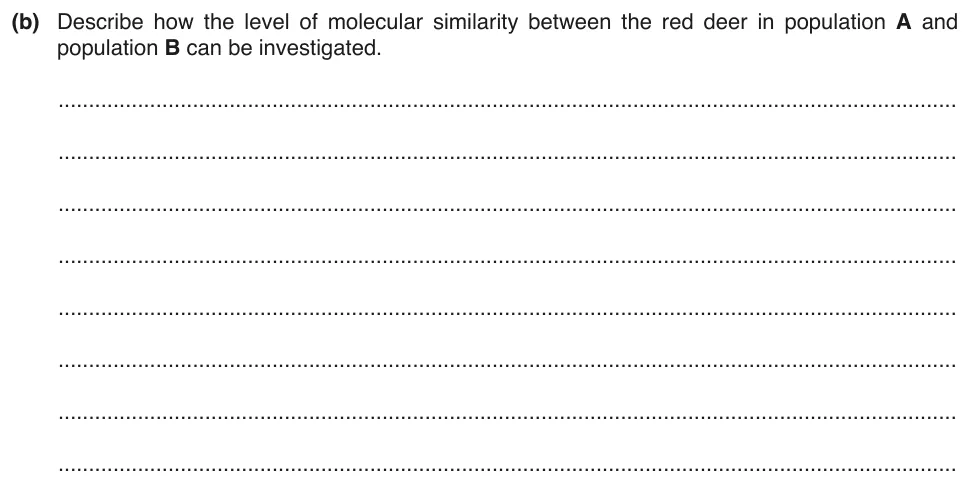
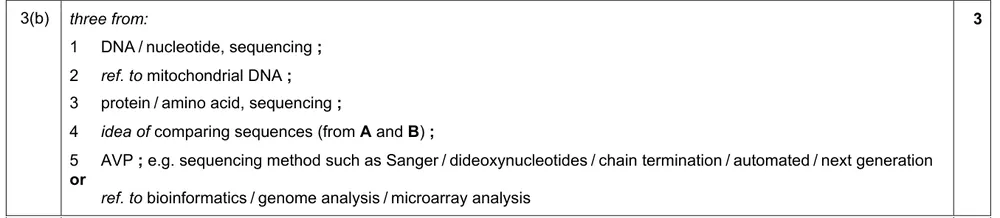
Describe how the molecular similarity between two populations of red deer can be investigated.
Information from earlier in this question:
Show the mark scheme
Tap an image to open it full size.
From the examiners' report: Morphological differences and ways of catching the deer gained no credit: the question is about molecular similarity. The strongest answers compared DNA sequences and amino acid sequences from both populations. Many named a microarray and then described how to carry one out, which gained no further credit.
Question 12
Paper 4 · October/November 2024 (41) · Q7(b) · 3 marks
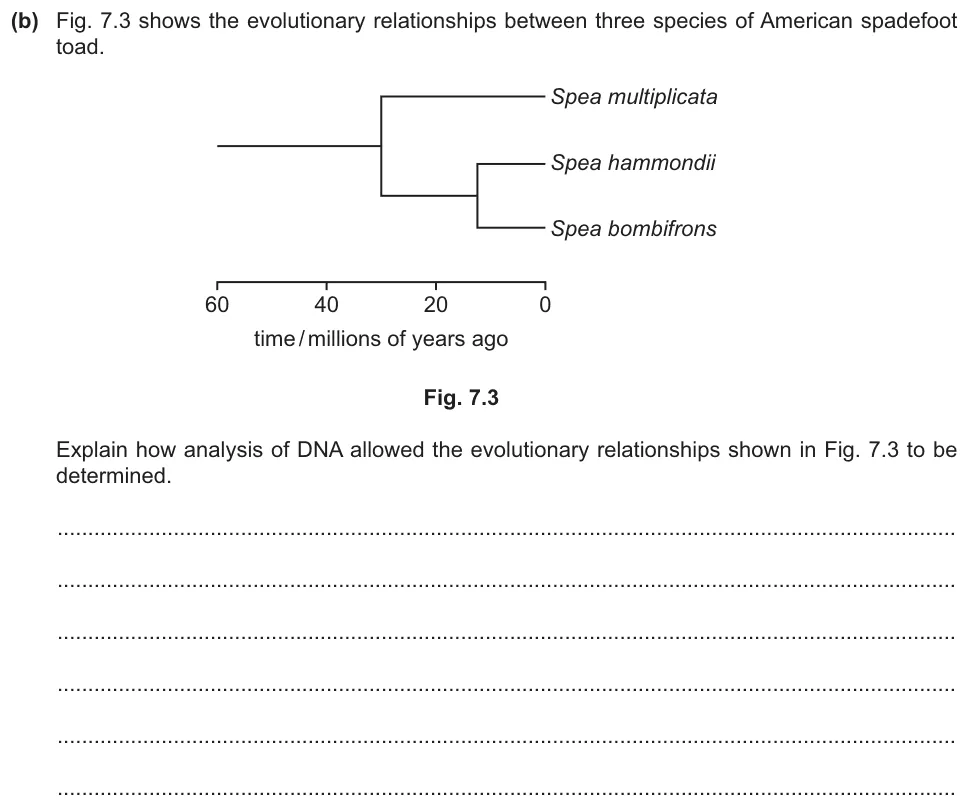
Explain how analysis of DNA allowed the evolutionary relationships between three species of toad to be determined.
Information from earlier in this question:

Show the mark scheme

Tap an image to open it full size.
Allopatric speciation (17.3.3)
Question 13
Paper 4 · October/November 2022 (42) · Q5(b) · 5 marks · Hard
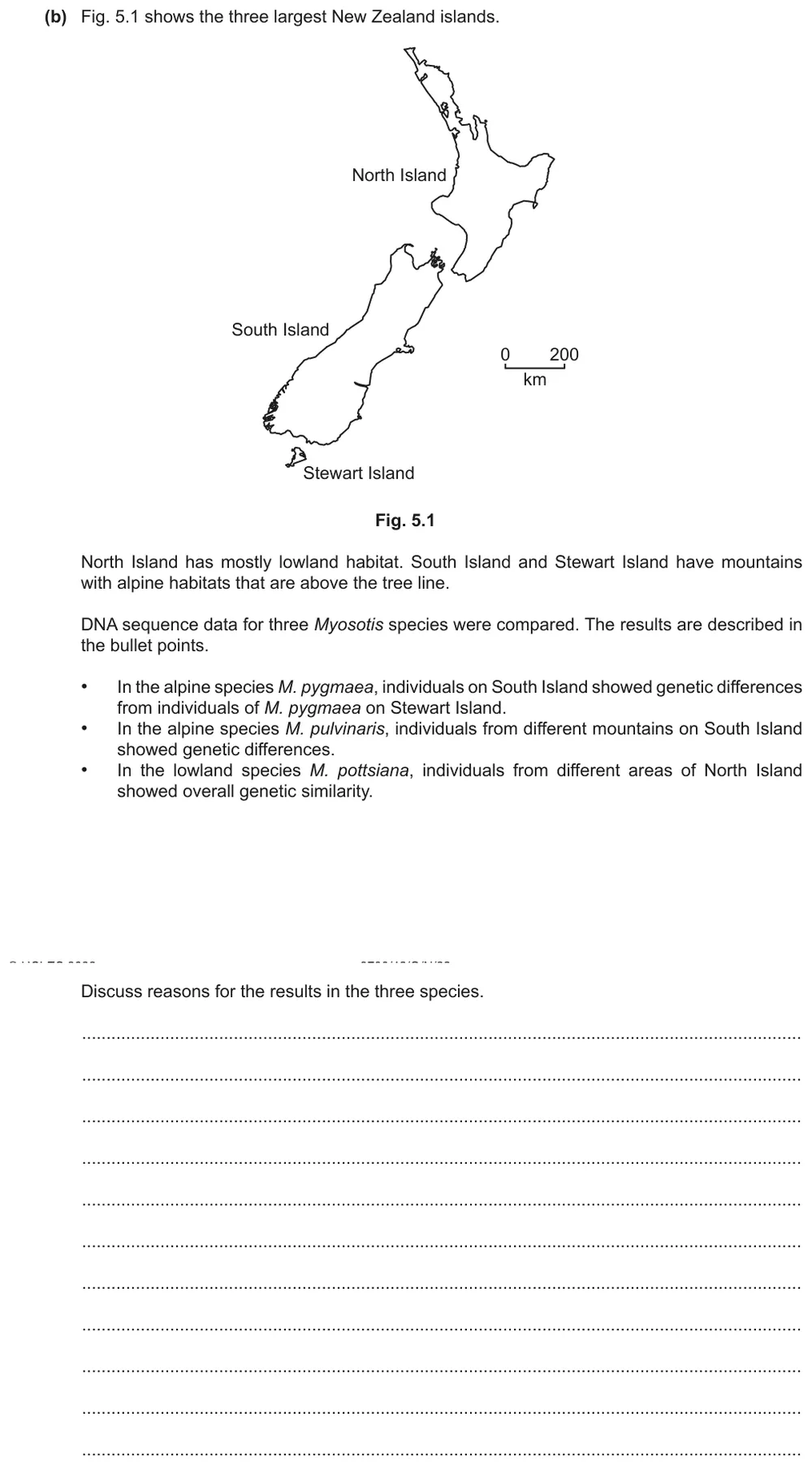
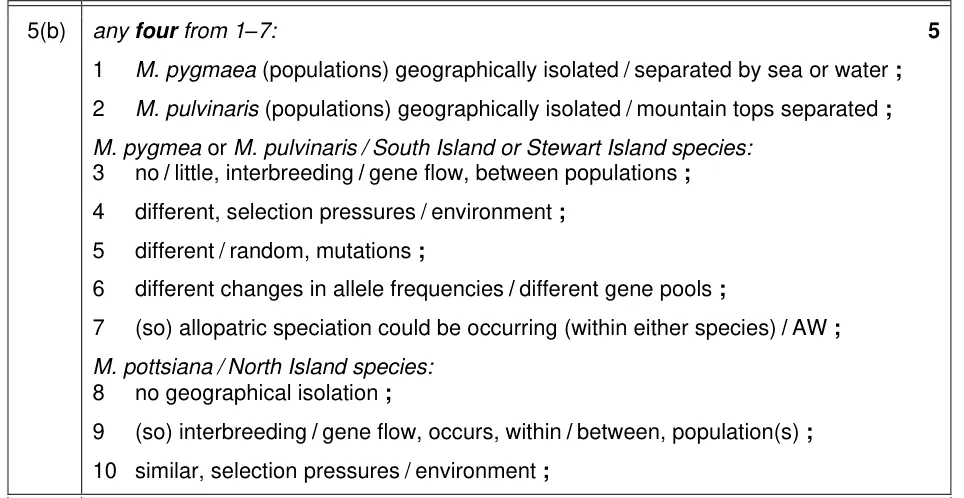
Discuss reasons for the DNA sequence results in three species of Myosotis.
Information from earlier in this question:

Show the mark scheme
Tap an image to open it full size.
From the examiners' report: Deal with each species separately: broad statements about all three were inaccurate. Few went on from different mutations to different changes in allele frequencies or gene pools. Some wrongly believed speciation had already taken place, and marks were lost for confusing 'species' with 'populations'.
Question 14
Paper 4 · October/November 2021 (42) · Q8 · 5 marks · Easy
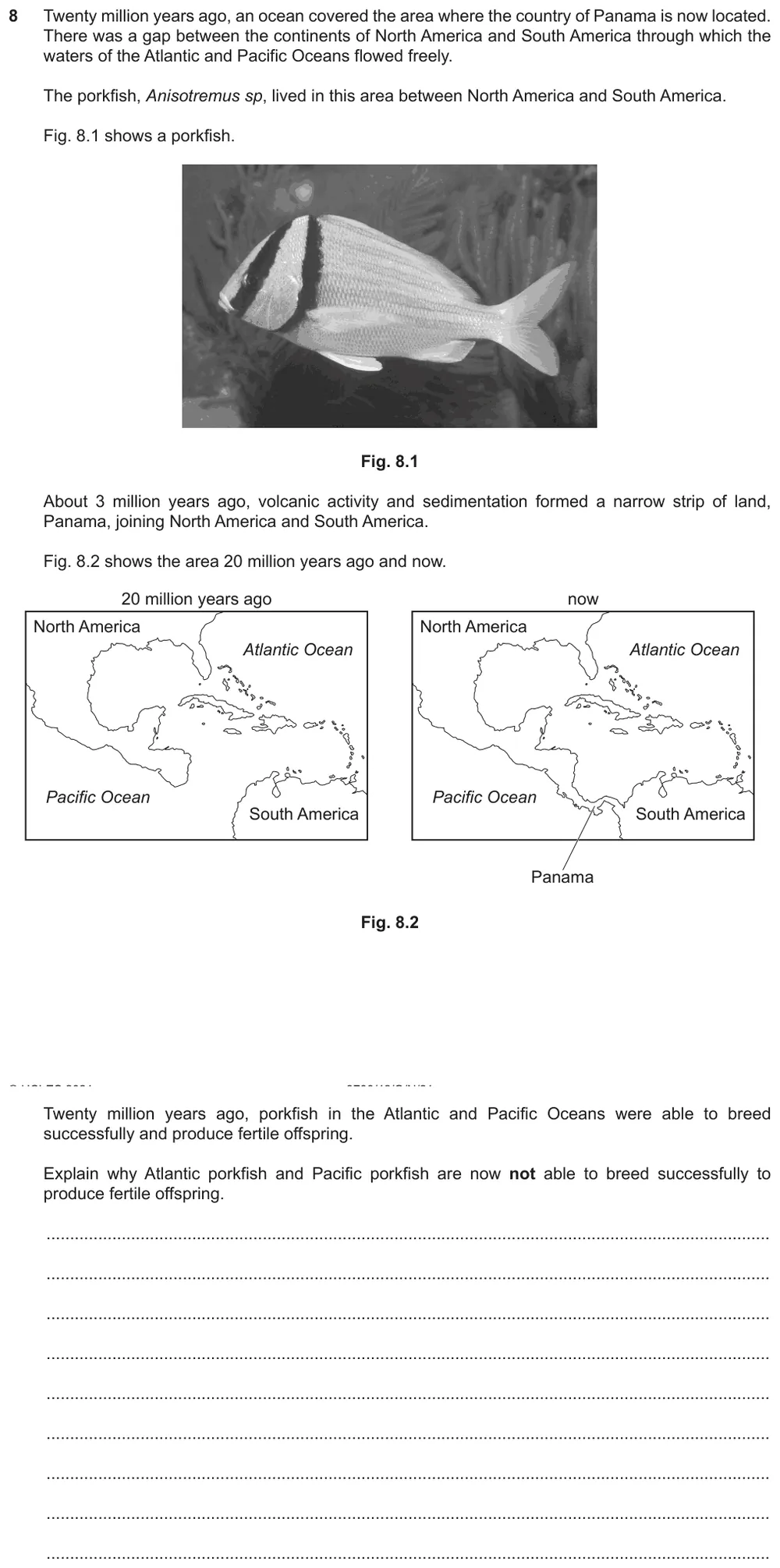
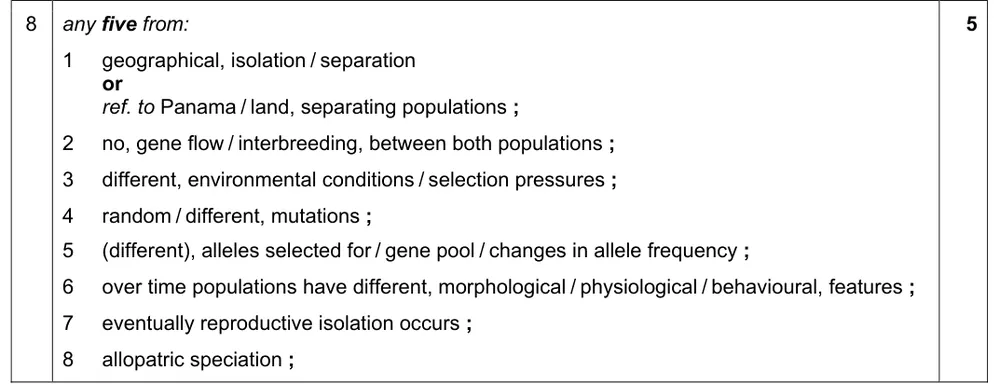
Explain why Atlantic porkfish and Pacific porkfish can no longer breed successfully to produce fertile offspring.
Show the mark scheme
Tap an image to open it full size.
From the examiners' report: Most recognised allopatric speciation and the geographical barrier. Relatively few said that separating the two populations prevents interbreeding or gene flow between them, and few said that reproductive isolation arises only after a long period of time.
Question 15
Paper 4 · October/November 2020 (42) · Q3(a) · 4 marks · Easy
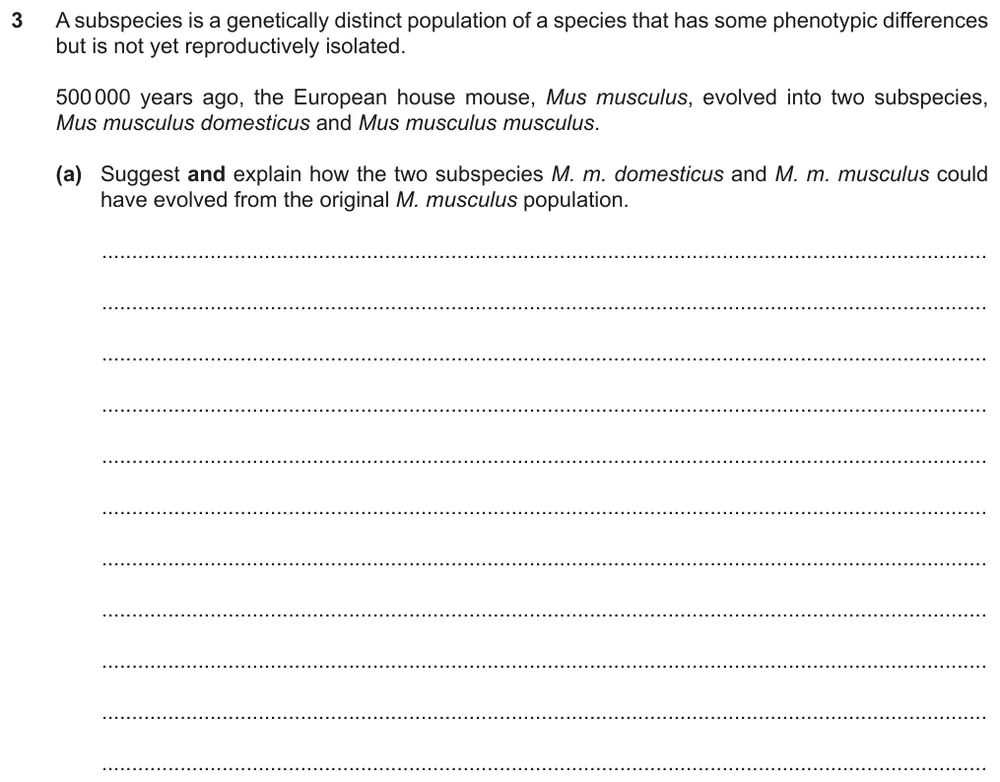
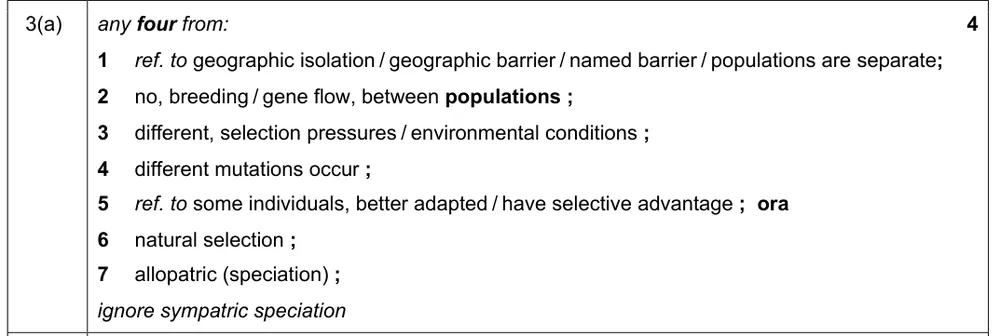
Suggest and explain how two subspecies of house mouse could have evolved from the original population.
Show the mark scheme
Tap an image to open it full size.
From the examiners' report: It is two populations that are separated, not two species. Say that the mutations in each population are different; mice do not develop mutations to enable them to survive. Individuals, not alleles, have a selective advantage.
Question 16
Paper 4 · May/June 2025 (43) · Q4(a) · 4 marks
Suggest and explain how two species of antelope squirrel evolved from an ancestral species.
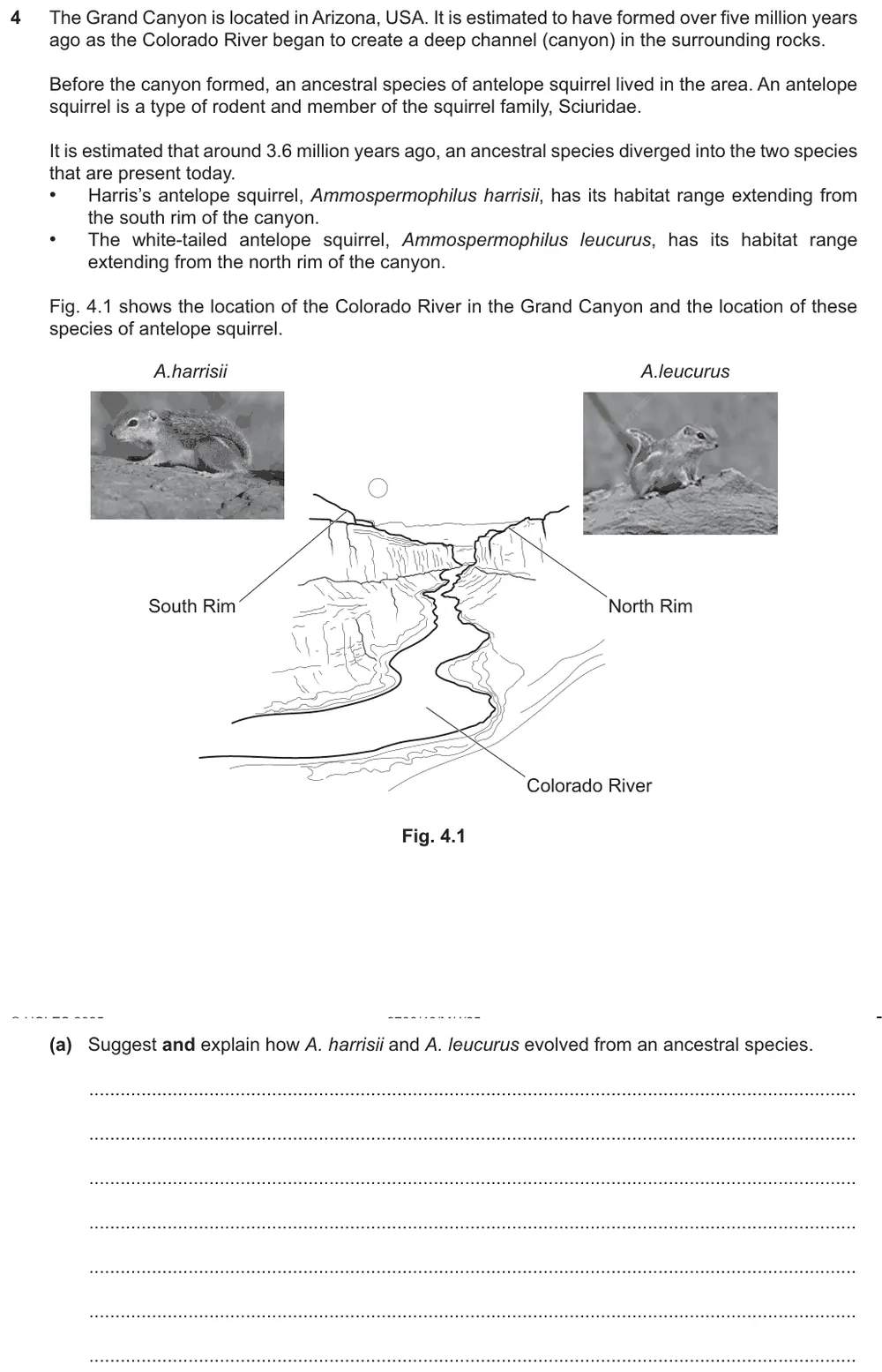
Show the mark scheme
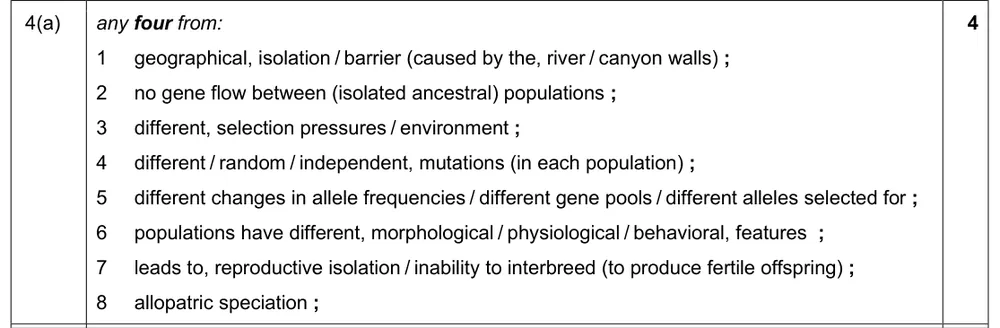
Tap an image to open it full size.
Sympatric speciation (17.3.3)
Question 17
Paper 4 · February/March 2025 (42) · Q2(a)(i) · 1 mark · Easy
Use the map to explain why the speciation occurring in orca is described as sympatric.
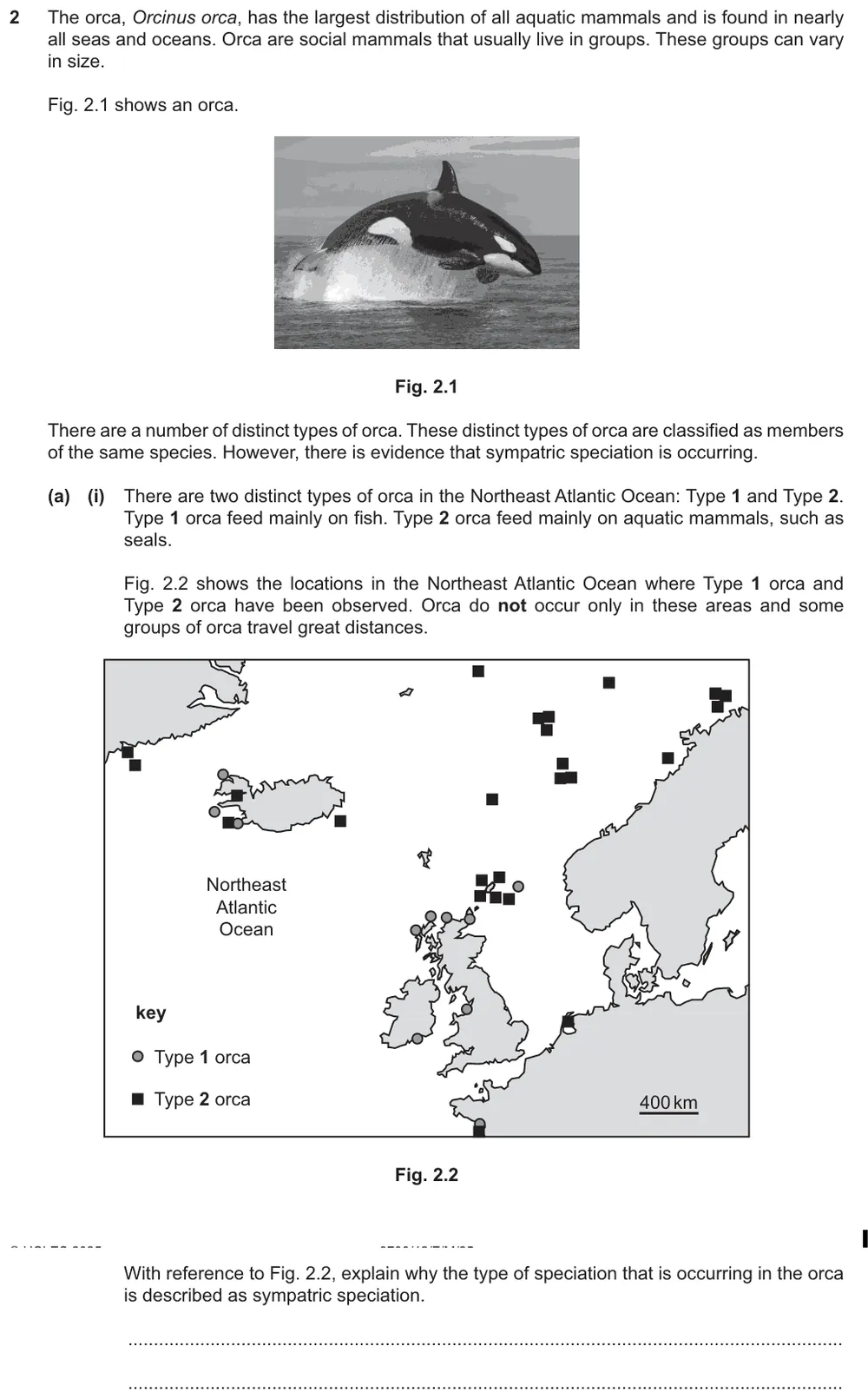
Show the mark scheme

Tap an image to open it full size.
From the examiners' report: Use what the figure shows. Some gave features of sympatric speciation that could not be deduced from the map, such as behavioural isolation.
Question 18
Paper 4 · February/March 2025 (42) · Q2(a)(ii) · 3 marks
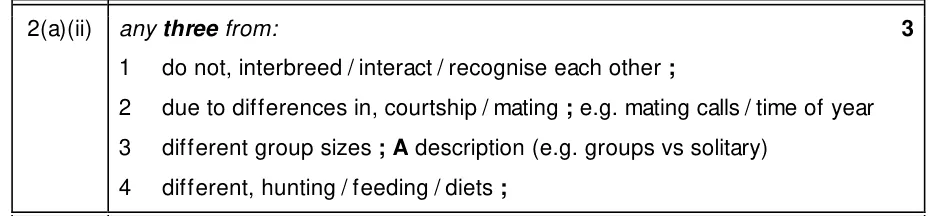
Suggest examples of behavioural separation that would contribute to sympatric speciation in orca.
Show the mark scheme
Tap an image to open it full size.
From the examiners' report: Differences in diet and in mating behaviour were the most frequent suggestions. Fewer gave other examples, such as differences in the size of social groups.
Question 19
Paper 4 · February/March 2022 (42) · Q8(a) · 3 marks
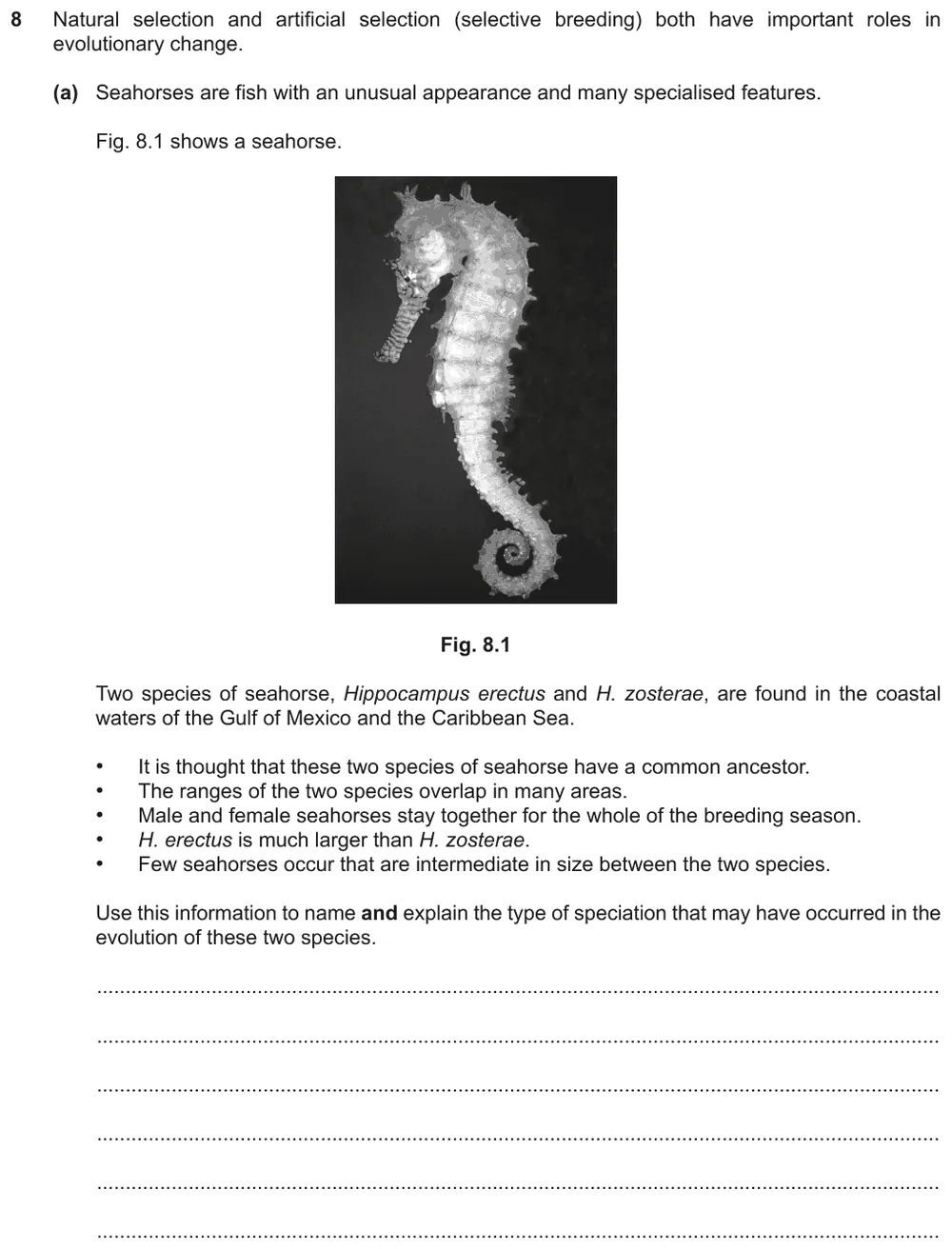
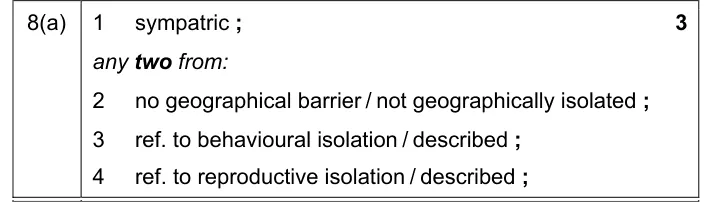
Name and explain the type of speciation that may have occurred in two species of seahorse.
Show the mark scheme
Tap an image to open it full size.
From the examiners' report: Use the information provided: there is no geographical barrier between the two species, so this is sympatric speciation. Weaker answers assumed that allopatric speciation was occurring.
Question 20
Paper 4 · May/June 2023 (41) · Q3(b) · 3 marks
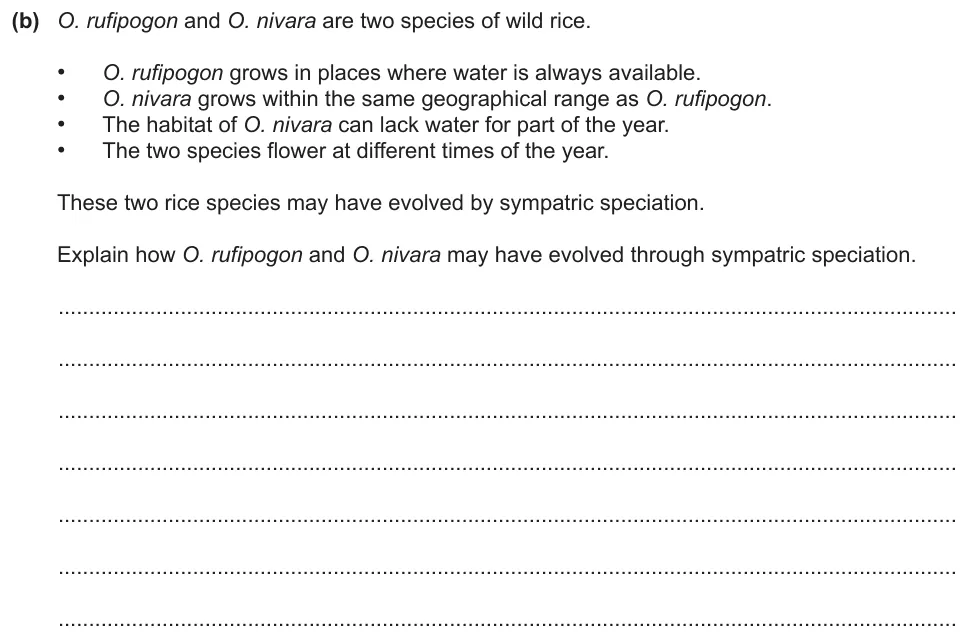
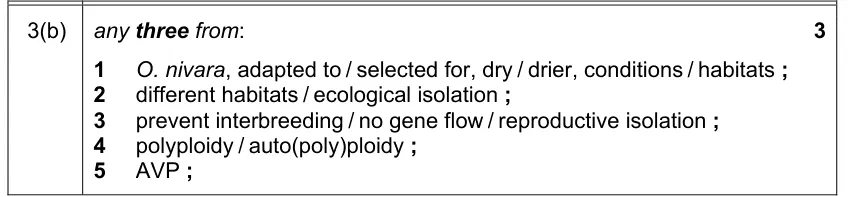
Explain how two species of wild rice may have evolved through sympatric speciation.
Information from earlier in this question:

Show the mark scheme
Tap an image to open it full size.
From the examiners' report: Different flowering times are seasonal or temporal isolation. Many wrongly called this 'behavioural isolation', a term reserved for animals. Many correctly said that the species were not geographically separated but were ecologically separated.
Question 21
Paper 4 · October/November 2023 (41) · Q9(b) · 3 marks
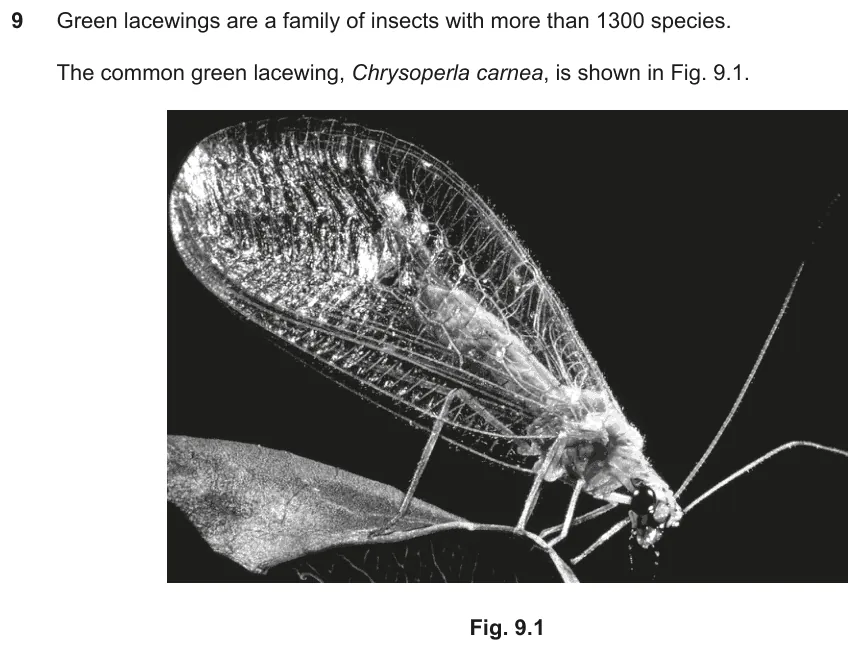
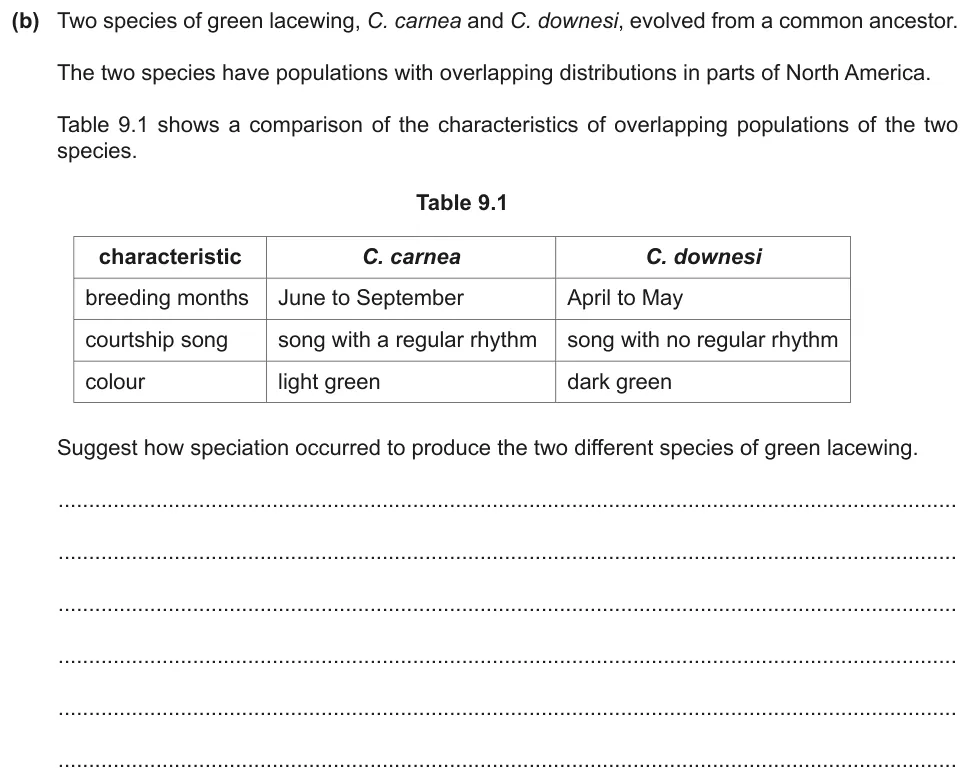
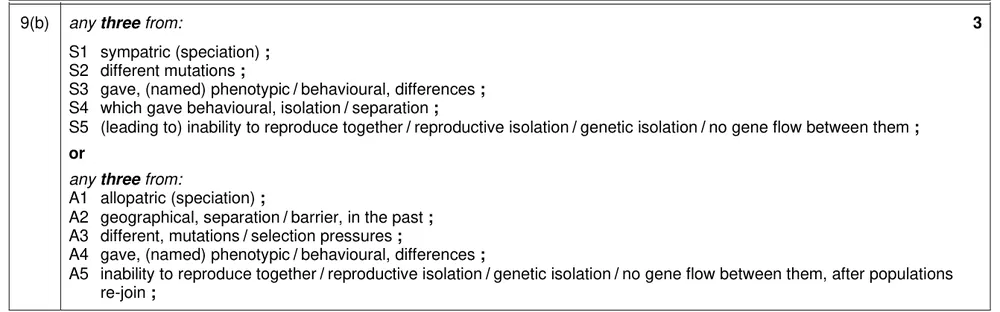
Use the table to suggest how speciation produced two species of green lacewing.
Information from earlier in this question:
Show the mark scheme
Tap an image to open it full size.
From the examiners' report: Name the form of speciation. Strong answers named sympatric speciation and linked a behavioural difference to reproductive isolation. Answers based on allopatric speciation often did not match the information that the ranges of the two species overlap today.
Where students lose marks (from Cambridge examiners' reports and mark schemes)
Each point below comes from the examiners' reports and mark schemes, and is followed by wording that gained marks.
Evolution is more than natural selection. Students asked to outline the theory of evolution wrote a full description of natural selection.
✔ Gains credit: 'formation of new species from, pre-existing species', 'over, time / generations', with 'changes in, gene pools / allele frequencies'.
A more recent common ancestor. Students wrote that two species with similar DNA sequences have a common ancestor, or described PCR and gel electrophoresis in detail.
✔ Gains credit: 'compare sequences'; 'the more similar the sequences the more, closely related the species / recent the common ancestor'; 'over time mutations accumulate'.
Outline several techniques. Students picked one process and described it in great detail, or used mRNA and cDNA in a microarray, which compares gene expression.
✔ Gains credit: 'obtain' 'DNA' 'from, both species', 'use PCR to' 'amplify, DNA', 'sequence DNA and compare the' 'base, sequence', with 'ref. to bioinformatics / database'.
Molecular means DNA or protein. Students wrote about morphological differences, or about how to catch the deer, when the question asked about molecular similarity.
✔ Gains credit: 'DNA / nucleotide, sequencing', 'mitochondrial DNA', 'protein / amino acid, sequencing' and the 'idea of comparing sequences'.
Populations are separated, not species. Students wrote about two species being separated, did not say that the mutations were different, or said the mice developed mutations in order to survive.
✔ Gains credit: 'geographic isolation', 'no' 'gene flow, between populations', 'different, selection pressures' and 'different mutations occur'.
No gene flow, then a long time. Students named allopatric speciation and the barrier but left out the lack of gene flow and the time needed for reproductive isolation.
✔ Gains credit: 'no, gene flow / interbreeding, between both populations', 'over time populations have different' 'features' and 'eventually reproductive isolation occurs'.
Overlapping ranges mean sympatric. Students did not use the information provided and assumed that allopatric speciation was occurring.
✔ Gains credit: 'sympatric', because there is 'no geographical barrier', with 'behavioural isolation' and 'reproductive isolation'.
Flowering time is not behaviour. Students called the different flowering times of two rice species 'behavioural isolation', a term reserved for animals.
✔ Gains credit: 'different habitats / ecological isolation', which 'prevent interbreeding', so there is 'no gene flow' and 'reproductive isolation'.
Download the questions
Download the PDF pack (21 questions, mark schemes at the end)
Keep practising
- Variation (17.1): Cambridge (CIE) exam questions by topic
- Natural and Artificial Selection (17.2): Cambridge (CIE) exam questions by topic
- Cambridge (CIE) A level Biology 9700 past papers, mark schemes and examiners' reports
- Cambridge (CIE) A level Biology grade thresholds
- Book a one-to-one CIE lesson or a free 15-minute discovery chat with Tom
- Register your interest in a CIE A level Biology group class
Questions, mark schemes and examiners' report extracts © Cambridge University Press & Assessment.