

The Immune System (11.1): Cambridge (CIE) A Level Biology 9700 Exam Questions by Topic
The immune system is sub-topic 11.1 of Topic 11, Immunity, in the Cambridge International AS & A Level Biology syllabus (9700). You need to describe the mode of action of phagocytes (macrophages and neutrophils), explain what an antigen is and the difference between self and non-self antigens, describe the events of a primary immune response and the roles of macrophages, B-lymphocytes, plasma cells, T-helper cells and T-killer cells, and explain the role of memory cells in the secondary immune response and in long-term immunity. This is AS content, examined on Papers 1 and 2. A level students meet it again on Paper 4; questions marked A level on this page come from Paper 4.
The examiners' reports return to the same points. When a question asks about phagocytes, describe phagocytosis and do not drift into B-lymphocytes and T-lymphocytes. The lysosome fuses with the phagocytic vacuole, not with the cell or pathogen inside it. A non-self antigen is a molecule, not a whole virus or bacterium, and it is recognised by the immune system. T-lymphocytes do not produce antibodies: plasma cells, which develop from B-lymphocytes after clonal expansion, do. Keep the primary and secondary immune responses separate, and remember that the secondary response is faster because there are more specific cells to start with, not because the cells divide faster.
Studying Cambridge International A level Biology and want more help? Tom teaches CIE students one-to-one online, including students in the UAE, Saudi Arabia, Hong Kong, India and Indonesia, and every lesson is recorded. You can book a one-to-one lesson or a free 15-minute discovery chat, or register your interest in a CIE group class starting in September 2027, using the links at the bottom of this page.
What you need from IGCSE
Each question on this page assumes you're secure on these ideas. If any of them feels shaky, look it up before you start.
- A pathogen is a disease-causing organism.
- White blood cells defend the body: phagocytes engulf pathogens and lymphocytes produce antibodies.
- Each pathogen has its own antigens, which have specific shapes, and antibodies are proteins that bind to antigens.
- Memory cells are produced after an infection or a vaccination and give long-term immunity.
Key terms
These words come up in the questions and mark schemes. Examiners expect you to use them exactly.
- Phagocytosis: a type of endocytosis: the cell surface membrane of a phagocyte surrounds a pathogen or cell and fuses to form a phagocytic vacuole (phagosome).
- Lysosome: a vesicle containing hydrolytic enzymes; it fuses with the phagocytic vacuole and the enzymes digest the contents.
- Non-self antigen: a foreign molecule, usually a protein or glycoprotein, that stimulates an immune response.
- Clonal selection: the binding of an antigen to the lymphocytes that have receptors with a complementary shape, which activates them.
- Clonal expansion: the selected lymphocytes divide many times by mitosis to form a clone of cells.
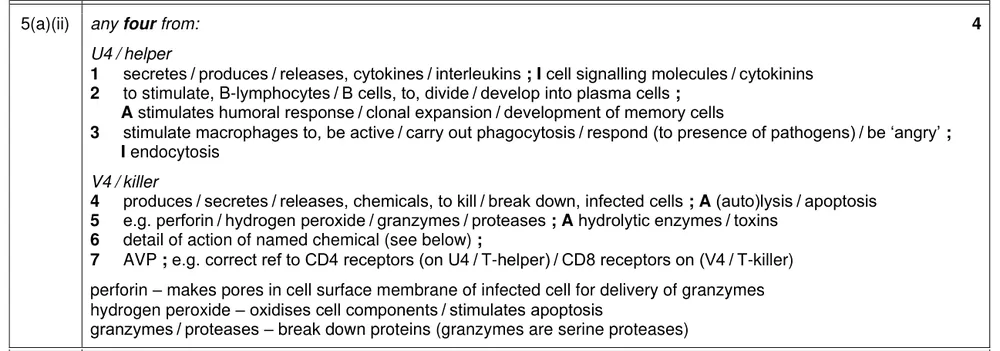
- Cytokine: a cell-signalling molecule secreted by T-helper cells; it stimulates macrophages, B-lymphocytes and T-killer cells.
- Plasma cell: a cell that develops from a B-lymphocyte and secretes antibodies.
- Memory cell: a long-lived B- or T-lymphocyte that stays in the body after a primary immune response and gives a faster secondary immune response.
What these questions cover (Cambridge 9700 Topic 11: Immunity)
The questions test these learning outcomes from sub-topic 11.1 of the Cambridge International AS & A Level Biology syllabus (9700) for 2025 to 2027.
- 11.1.1 describe the mode of action of phagocytes
- 11.1.2 explain what is meant by an antigen
- 11.1.3 describe the sequence of events that occurs during a primary immune response
- 11.1.4 explain the role of memory cells in the secondary immune response and in long-term immunity
How to use this page
Write your answer on paper before you open the mark scheme. Allow about 1.2 minutes per mark: the 22 questions are worth 59 marks, so about 71 minutes in total. Then mark your answer strictly against the mark scheme and read the examiners' tip underneath it. If you'd rather print the questions, download the PDF pack.
Phagocytes and phagocytosis (11.1.1)
Question 1
Paper 2 · May/June 2024 (22) · Q2(b)(i) · 2 marks · Easy
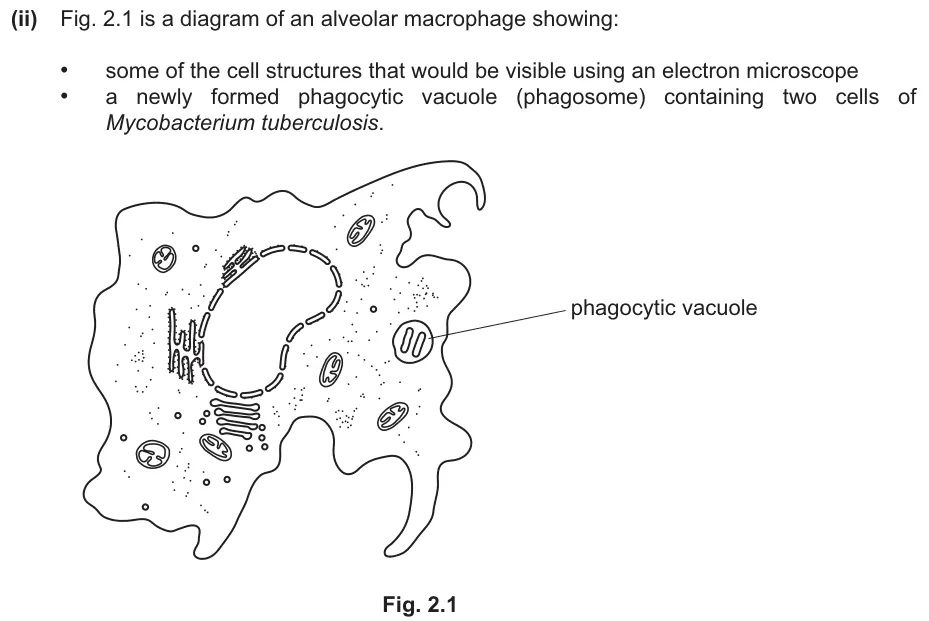
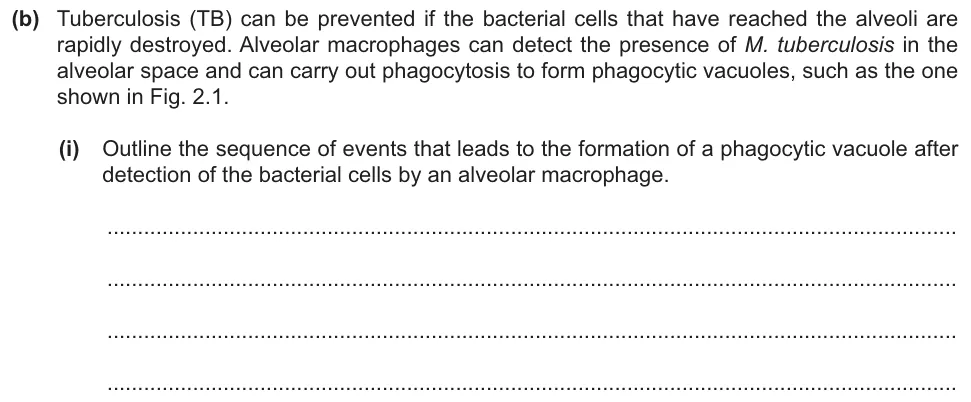
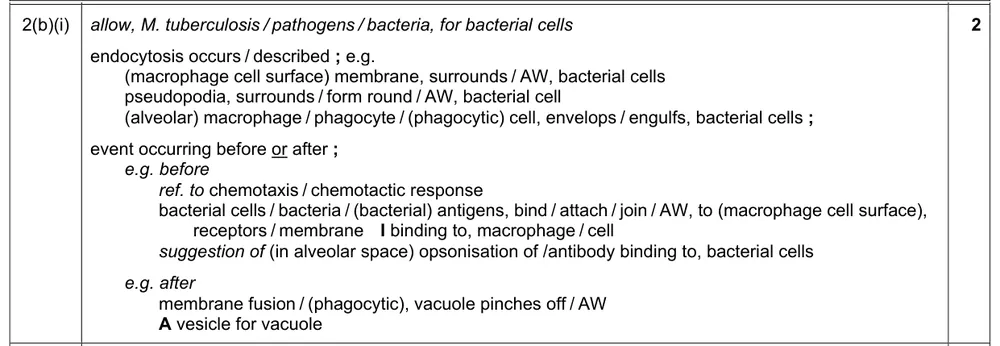
Outline how an alveolar macrophage forms a phagocytic vacuole after detecting bacterial cells.
Information from earlier in this question:

Show the mark scheme
Tap an image to open it full size.
From the examiners' report: For full marks you needed an event before or after the engulfing, such as the bacteria binding to receptors on the macrophage or the membrane fusing once the bacteria are engulfed. 'Detected' was already in the question. What happens after the vacuole has formed was not asked for.
Question 2
Paper 2 · May/June 2024 (22) · Q2(b)(ii) · 1 mark · Easy
Name the cell structures that fuse with the phagocytic vacuole and release hydrolytic enzymes.

Show the mark scheme

Tap an image to open it full size.
From the examiners' report: Almost everyone named lysosomes. Correct spelling was needed: 'lysozomes' and 'lyzosomes' did not gain the mark.
Question 3
Paper 2 · October/November 2023 (22) · Q3(b)(ii) · 4 marks · Easy
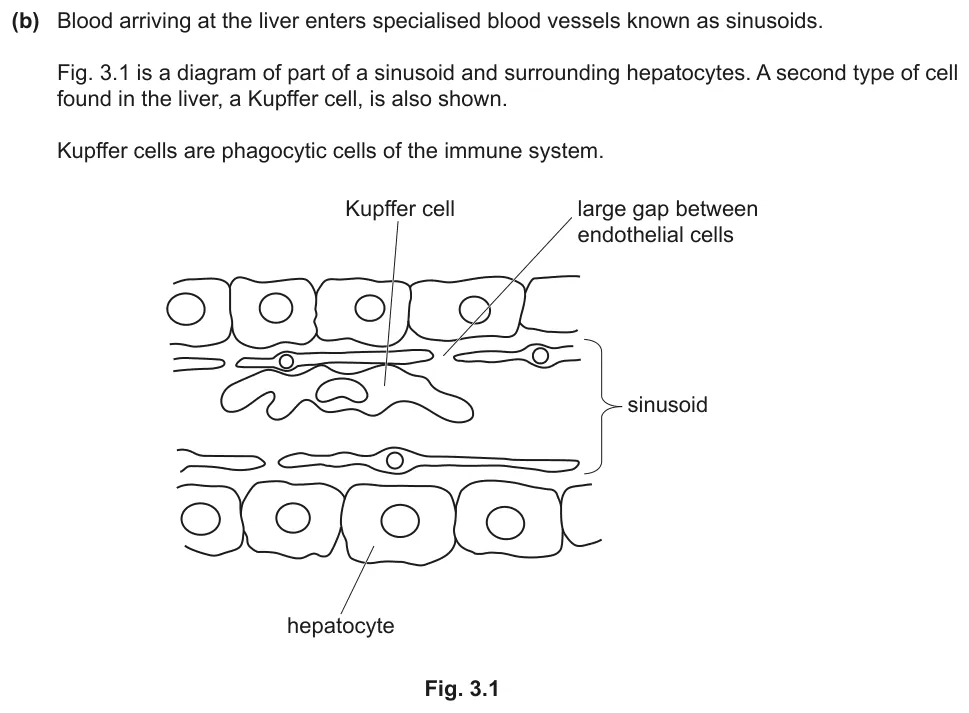
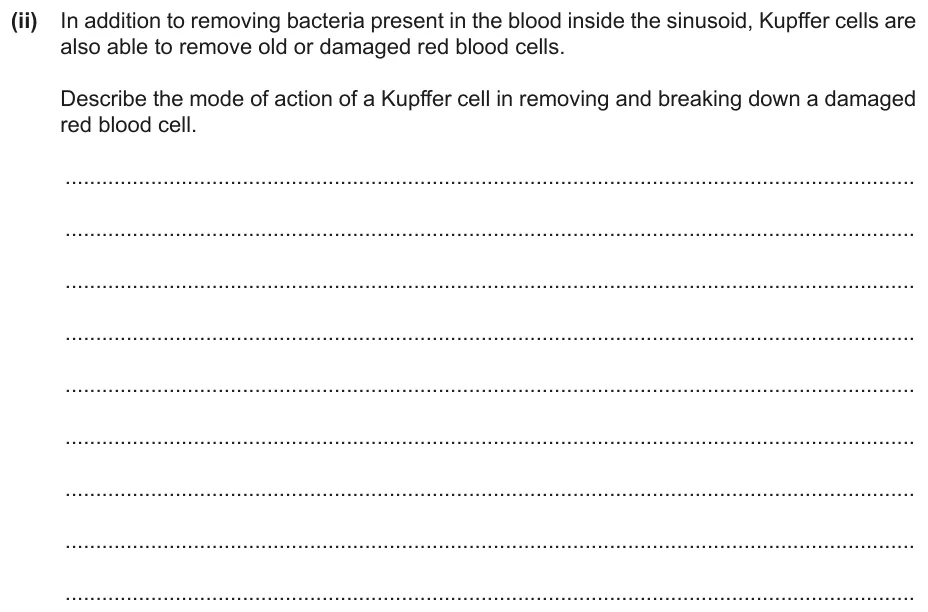
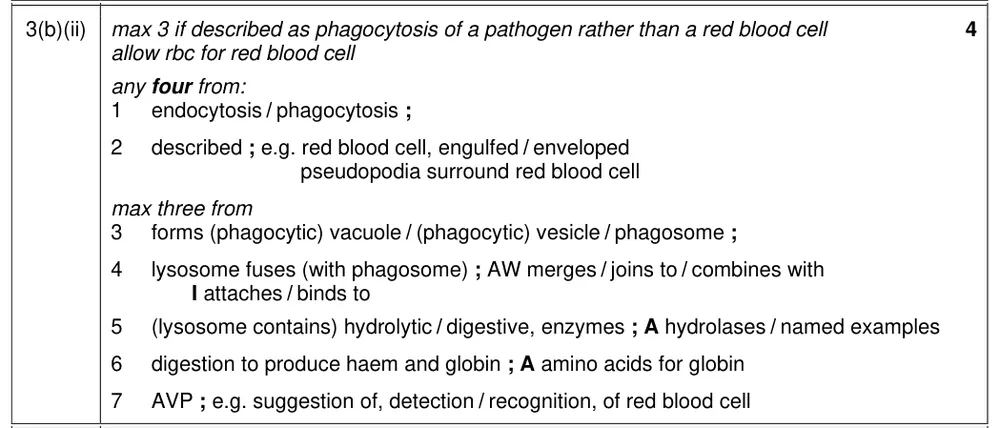
Describe how a Kupffer cell removes and breaks down a damaged red blood cell.
Information from earlier in this question:
Show the mark scheme
Tap an image to open it full size.
From the examiners' report: Give the steps in order and use the correct terms. The lysosome fuses with the phagocytic vacuole that holds the red blood cell, not with the red blood cell itself. Accounts of B-lymphocytes and T-lymphocytes missed the point of the question.
Question 4
Paper 2 · October/November 2022 (23) · Q2(a)(i) · 3 marks · Hard
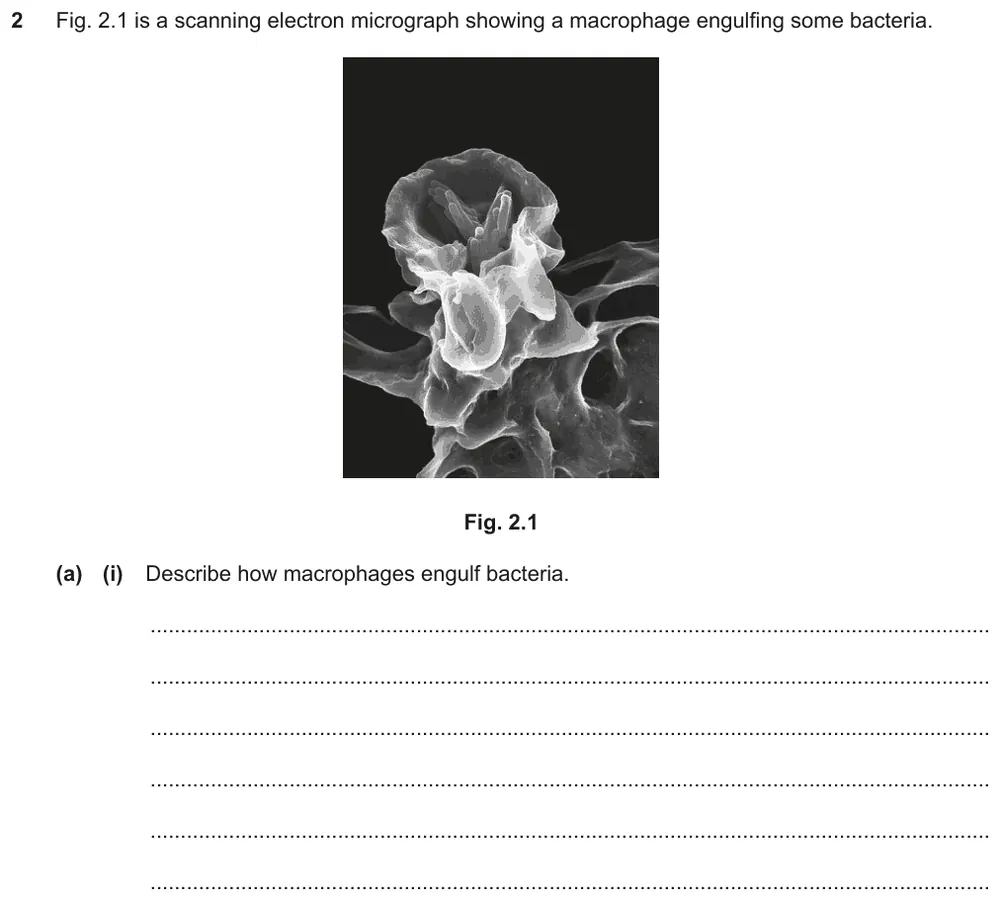
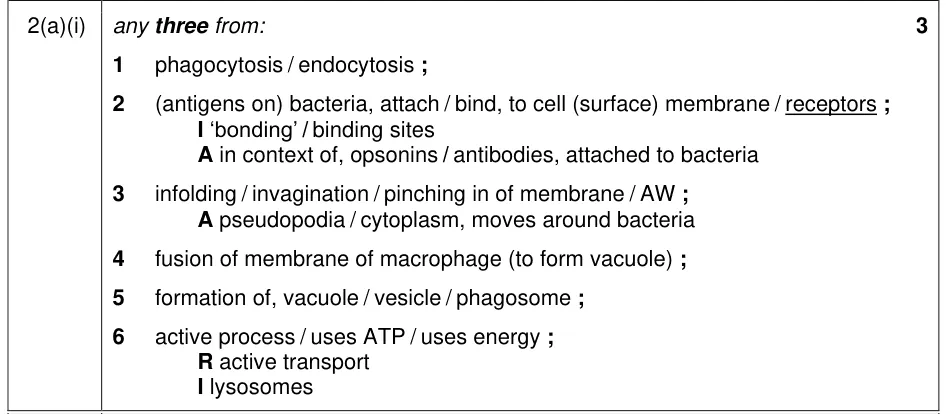
Describe how macrophages engulf bacteria.
Show the mark scheme
Tap an image to open it full size.
From the examiners' report: Stop once the bacteria are inside a vacuole: the fate of the vacuole, and lysosomes, were not relevant. Make clear that the antigens are on the surface of the bacteria and that it is the bacteria that are engulfed. The strongest answers described antibodies on the bacteria binding to receptors on the macrophage.
Question 5
Paper 2 · February/March 2018 (22) · Q2(a)(ii) · 3 marks
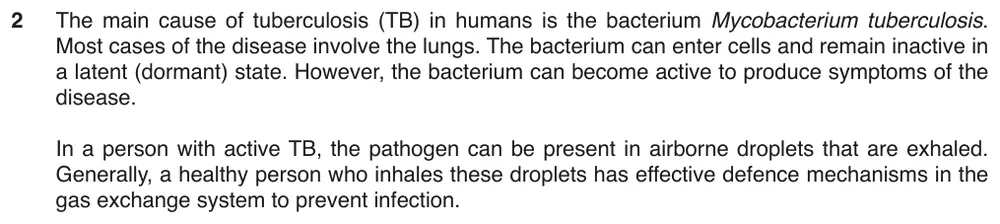
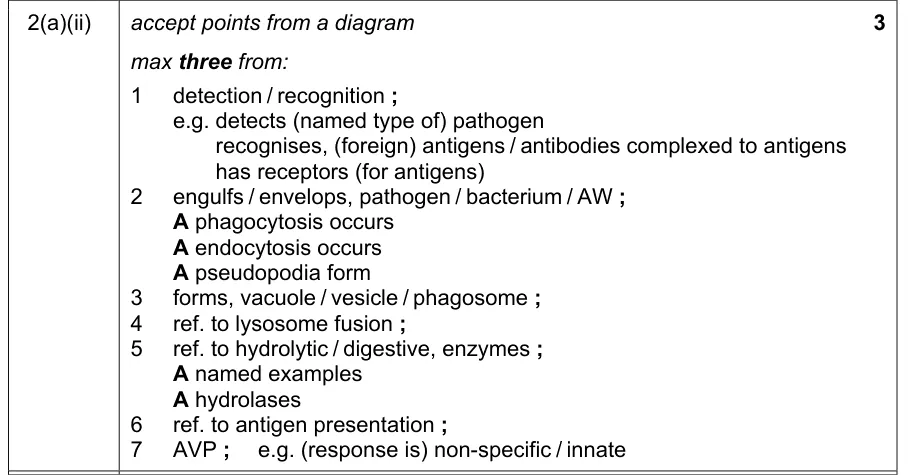
Describe the mode of action of a macrophage.
Information from earlier in this question:

Show the mark scheme
Tap an image to open it full size.
From the examiners' report: Good answers went in order: recognise foreign antigens, engulf the pathogen by phagocytosis, form a vacuole, fuse it with a lysosome and destroy the pathogen with hydrolytic enzymes. Answers that tried to explain the mode of action through antibody production became confused.
Question 6
Paper 2 · February/March 2018 (22) · Q2(a)(iii) · 1 mark
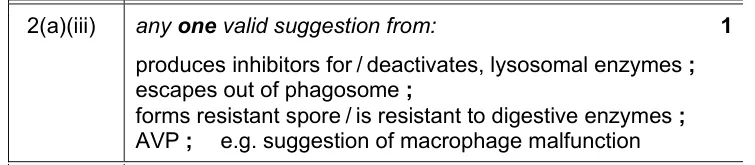
Suggest one way in which M. tuberculosis may survive inside a macrophage.

Show the mark scheme
Tap an image to open it full size.
From the examiners' report: Common correct ideas were that the pathogen produces enzyme inhibitors or forms a resistant spore. 'Antigen concealment' was wrong: the macrophage must already have recognised foreign antigens in order to engulf the pathogen.
Antigens: self and non-self (11.1.2)
Question 7
Paper 2 · May/June 2025 (22) · Q5(a) · 1 mark
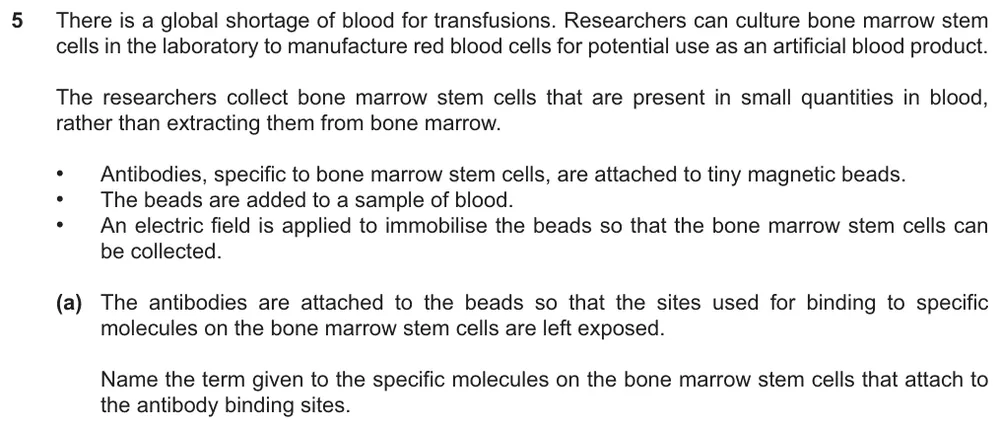
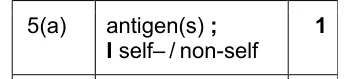
Name the specific molecules on the stem cells that attach to the antibody binding sites.
Show the mark scheme
Tap an image to open it full size.
Question 8
Paper 2 · October/November 2024 (22) · Q4(g) · 3 marks
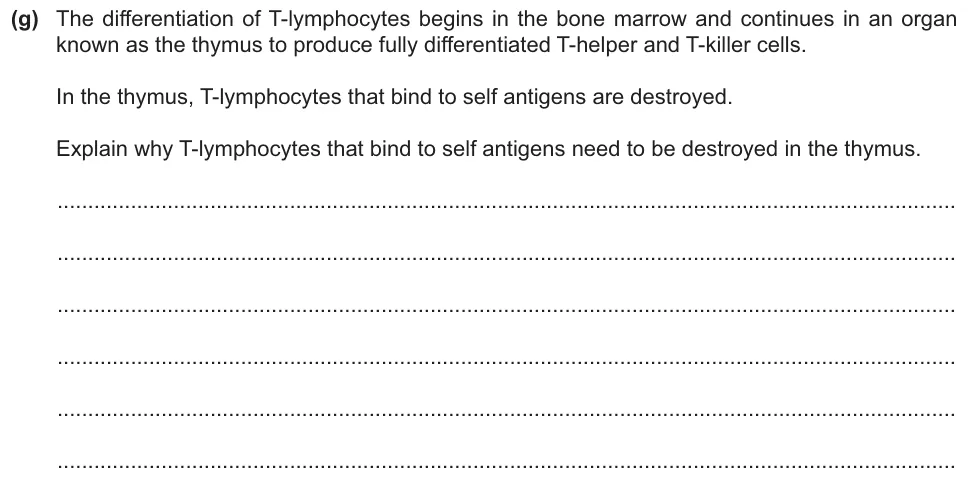
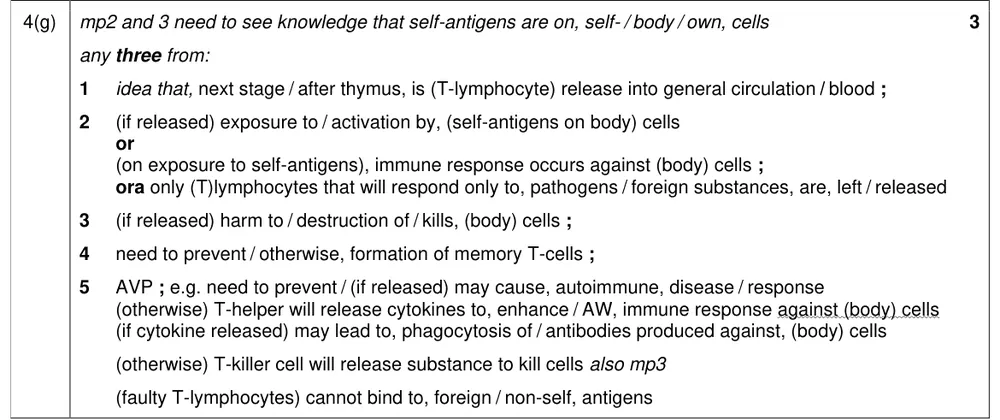
Explain why T-lymphocytes that bind to self antigens need to be destroyed in the thymus.
Show the mark scheme
Tap an image to open it full size.
Question 9
Paper 4 (A level) · May/June 2020 (42) · Q4(c)(i) · 2 marks
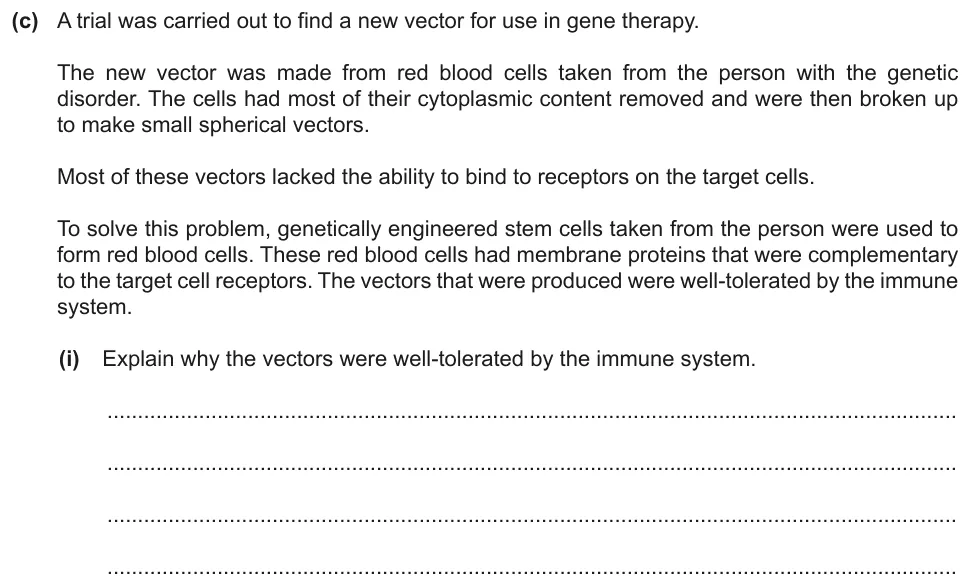
Explain why vectors made from the person's own red blood cells were well tolerated by the immune system.
Information from earlier in this question:

Show the mark scheme

Tap an image to open it full size.
Question 10
Paper 2 · May/June 2023 (22) · Q3(a) · 3 marks
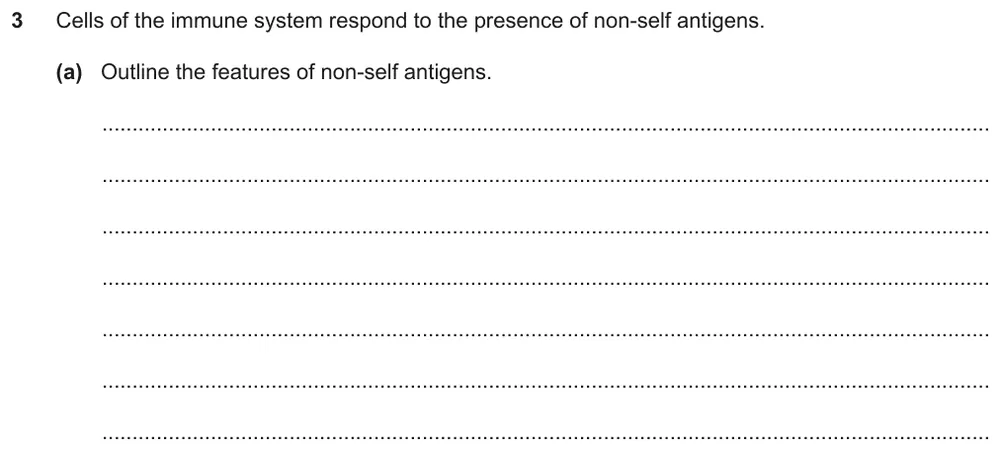
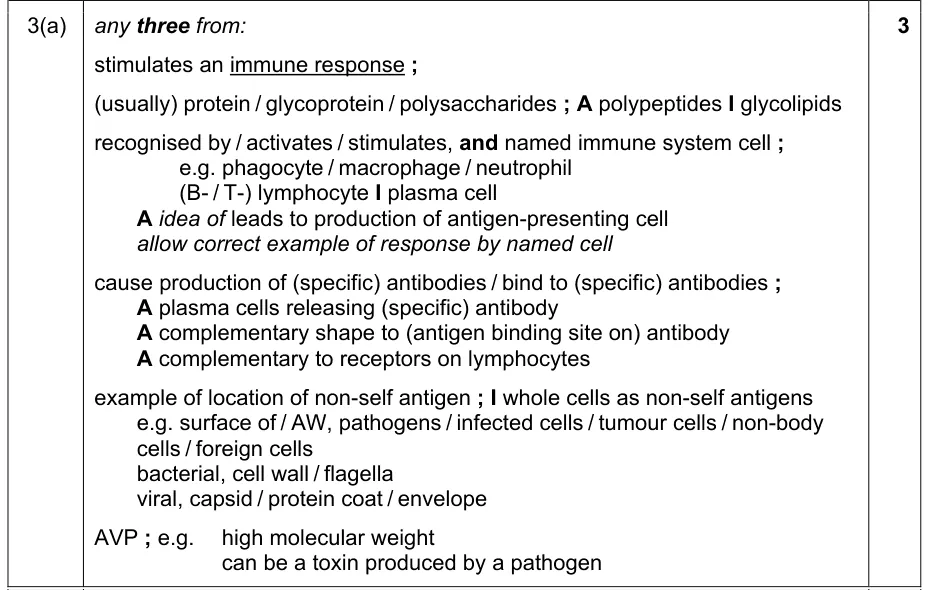
Outline the features of non-self antigens.
Show the mark scheme
Tap an image to open it full size.
From the examiners' report: Two common errors were to treat a non-self antigen as a whole virus or bacterial cell, and to say that receptors are present on antigens. Some answers contradicted themselves: they said a non-self antigen is not recognised by the body and then that it causes an immune response.
The primary immune response (11.1.3)
Question 11
Paper 2 · May/June 2023 (22) · Q3(b) · 4 marks
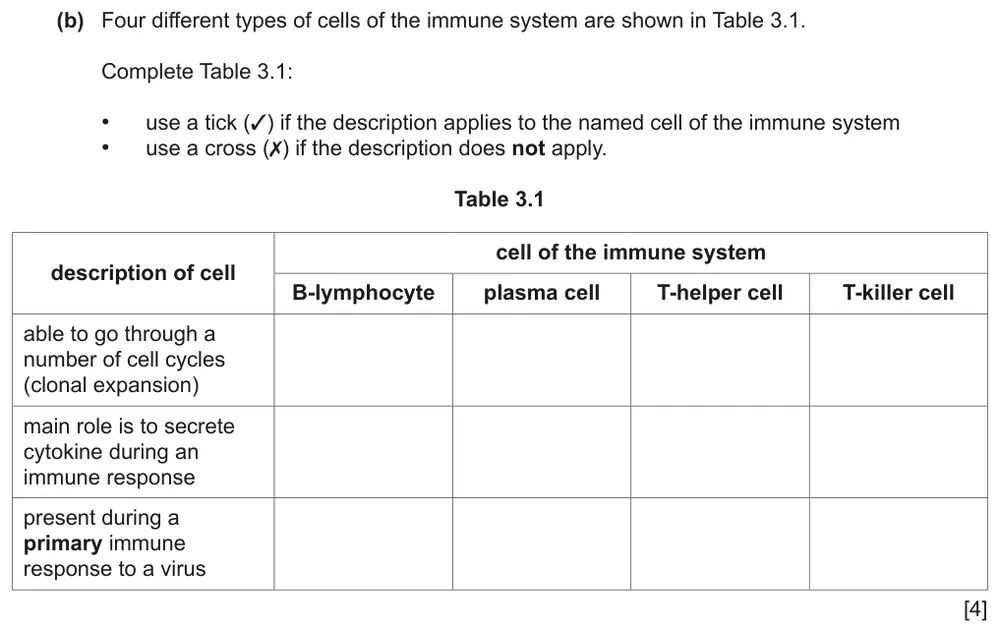
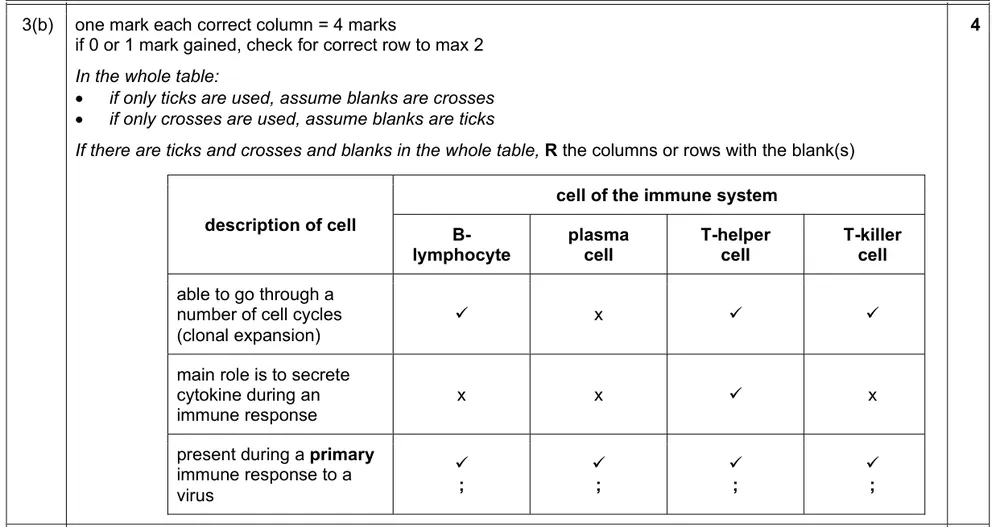
Complete the table to show which descriptions apply to B-lymphocytes, plasma cells, T-helper cells and T-killer cells.
Show the mark scheme
Tap an image to open it full size.
From the examiners' report: The B-lymphocyte column was usually correct. Many wrongly thought that plasma cells can go through clonal expansion. The row most often correct matched secreting cytokine with the T-helper cell.
Question 12
Paper 2 · May/June 2023 (23) · Q4(b)(ii) · 4 marks
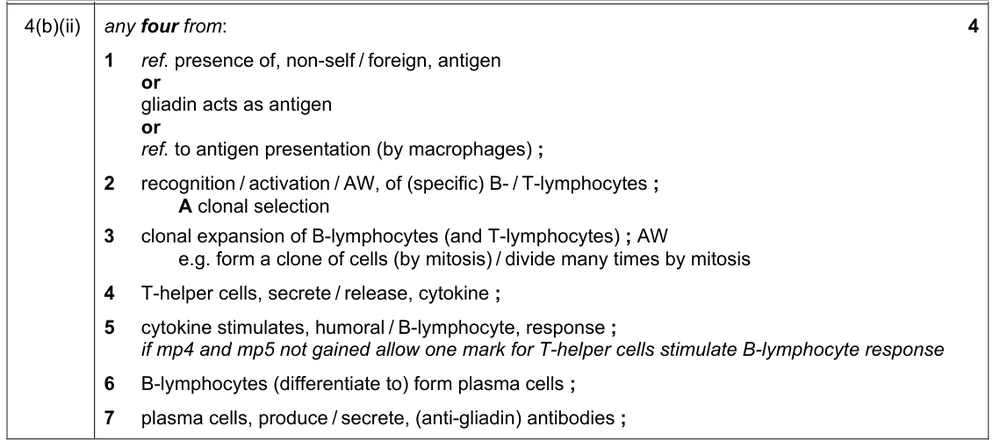
Describe the sequence of events that leads to the immune system producing anti-gliadin antibodies.
Information from earlier in this question:


Show the mark scheme
Tap an image to open it full size.
From the examiners' report: Keep the events in order and stop at antibody production: memory cells and the secondary immune response were not needed. Plasma cells develop from B-lymphocytes after clonal expansion. T-lymphocytes do not produce antibodies.
Question 13
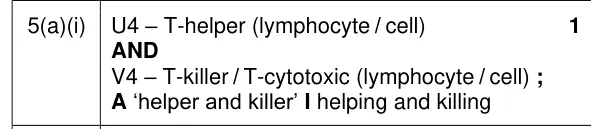
Paper 2 · October/November 2024 (23) · Q5(a)(i) · 1 mark
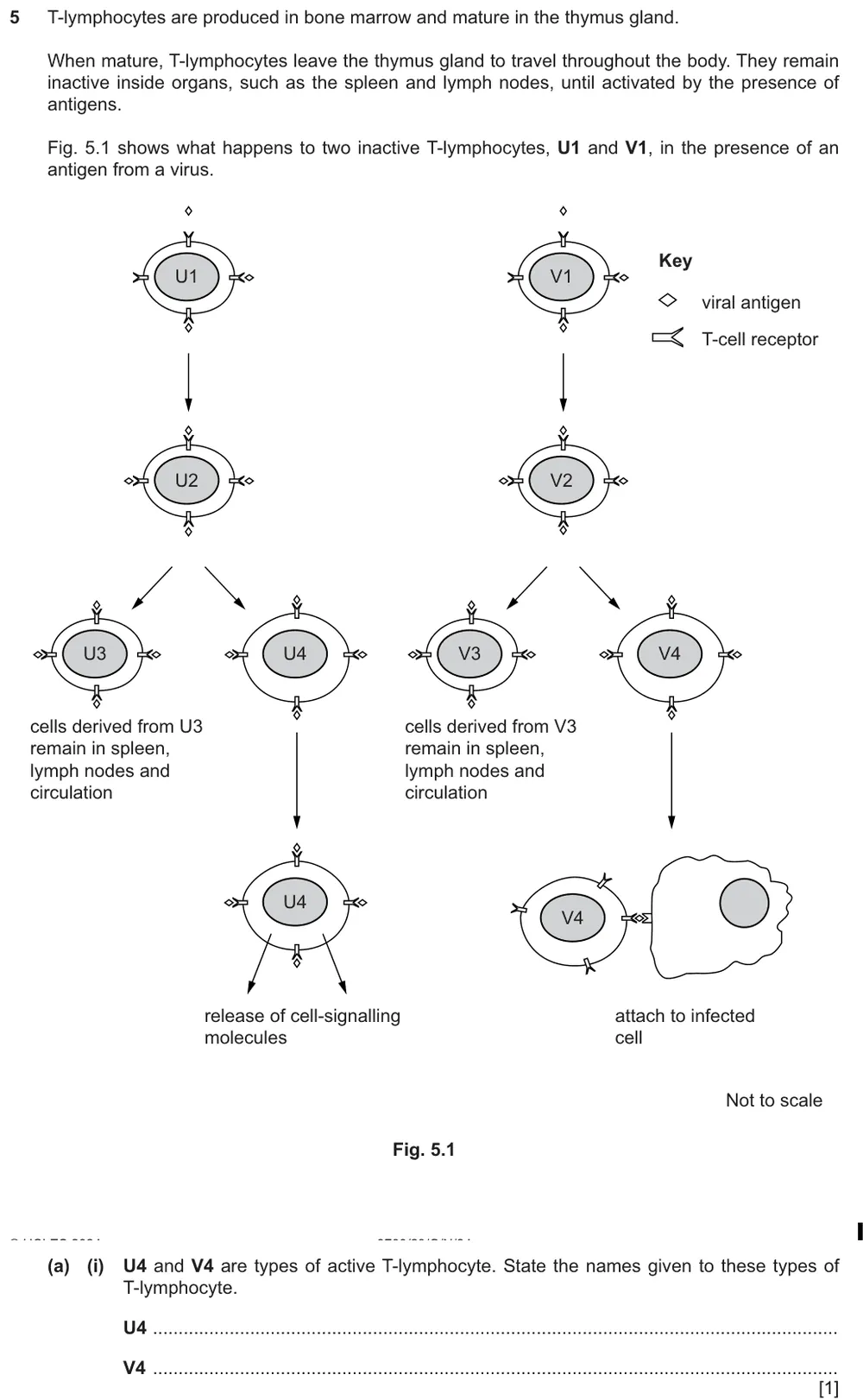
Name the types of T-lymphocyte labelled U4 and V4 in the diagram.
Show the mark scheme
Tap an image to open it full size.
Question 14
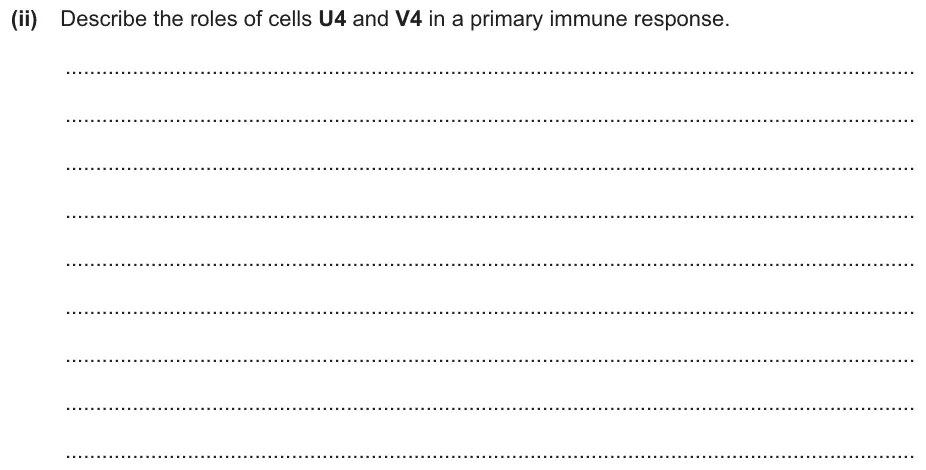
Paper 2 · October/November 2024 (23) · Q5(a)(ii) · 4 marks
Describe the roles of cells U4 and V4 in a primary immune response.
Show the mark scheme
Tap an image to open it full size.
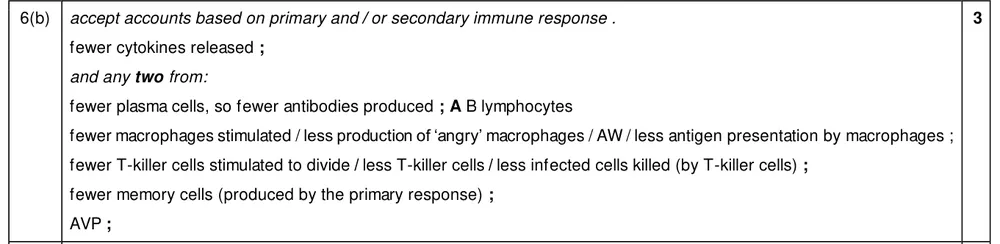
Question 15
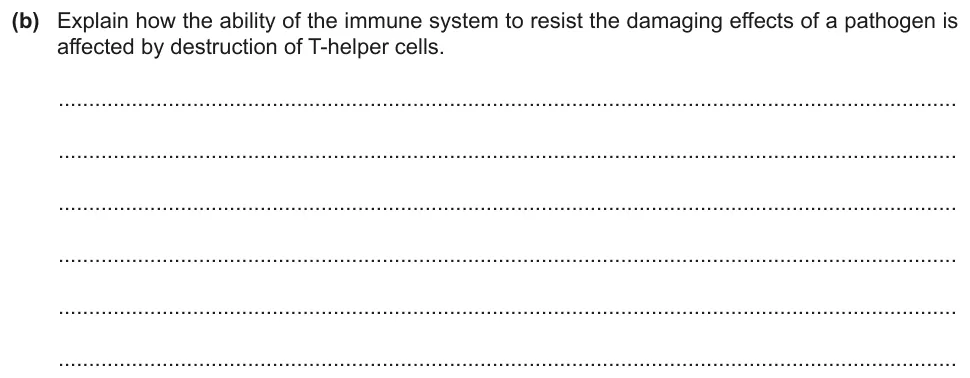
Paper 2 · February/March 2024 (22) · Q6(b) · 3 marks
Explain how the destruction of T-helper cells affects the ability of the immune system to resist a pathogen.
Show the mark scheme
Tap an image to open it full size.
Question 16
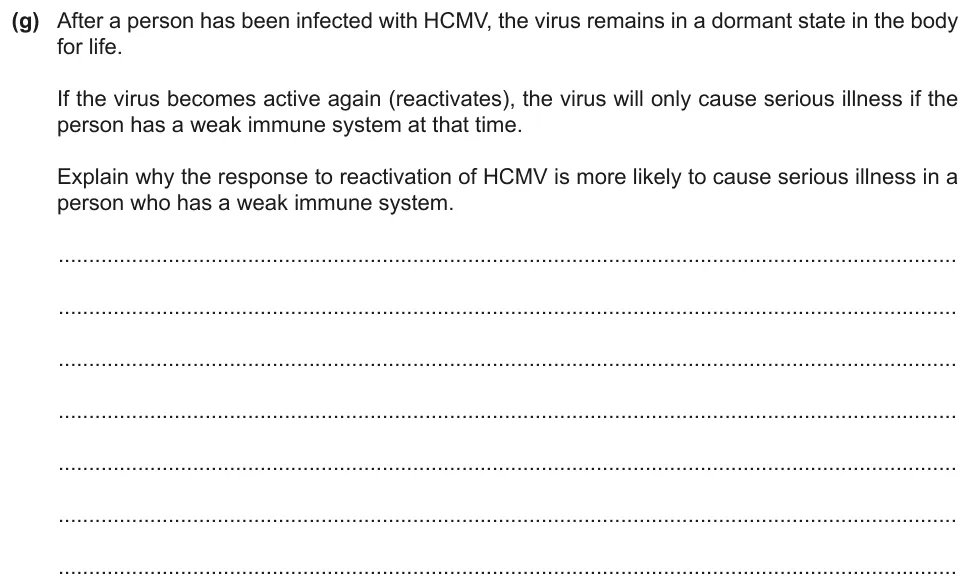
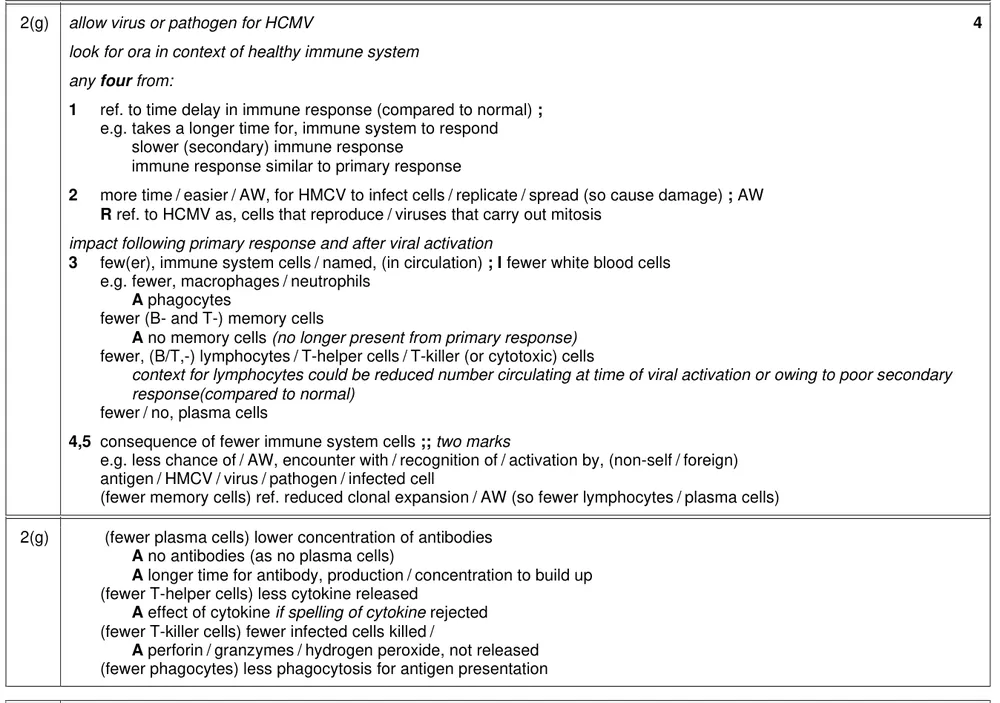
Paper 2 · October/November 2022 (22) · Q2(g) · 4 marks
Explain why reactivation of HCMV is more likely to cause serious illness in a person with a weak immune system.
Show the mark scheme
Tap an image to open it full size.
From the examiners' report: Write about a weak immune system, not no immune system. Many noted the slower secondary immune response; those who named a cell type that would be fewer in number usually went on to give a consequence, such as less or slower antibody production. Viruses replicate: do not describe this as mitosis or cell division.
Question 17
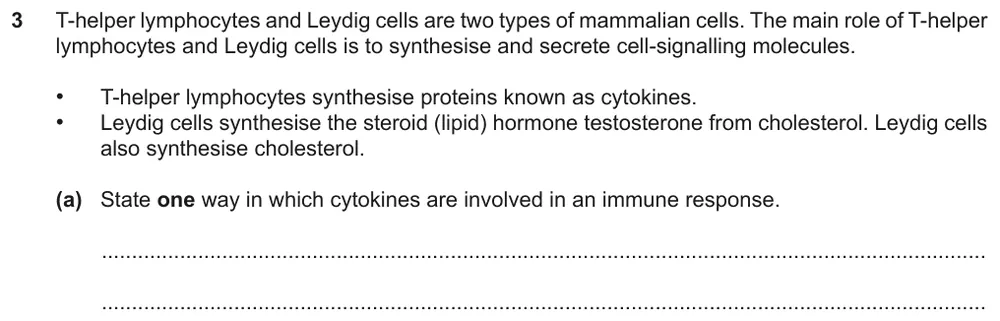
Paper 2 · February/March 2021 (22) · Q3(a) · 1 mark
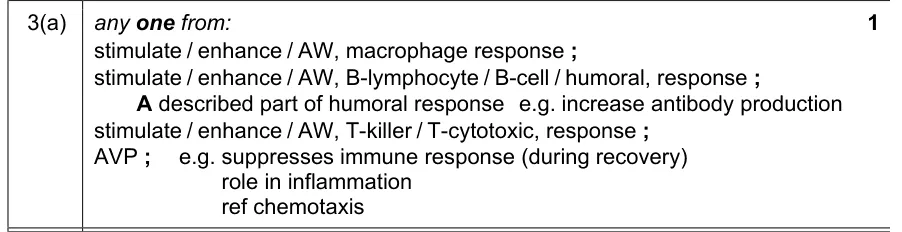
State one way in which cytokines are involved in an immune response.
Show the mark scheme
Tap an image to open it full size.
From the examiners' report: Stimulating T-helper lymphocytes was not the answer, because the cytokines in this question are the ones secreted by T-helper lymphocytes. Some answers confused cytokines with cytokinesis.
Question 18
Paper 2 · February/March 2020 (22) · Q5(c) · 3 marks · Easy
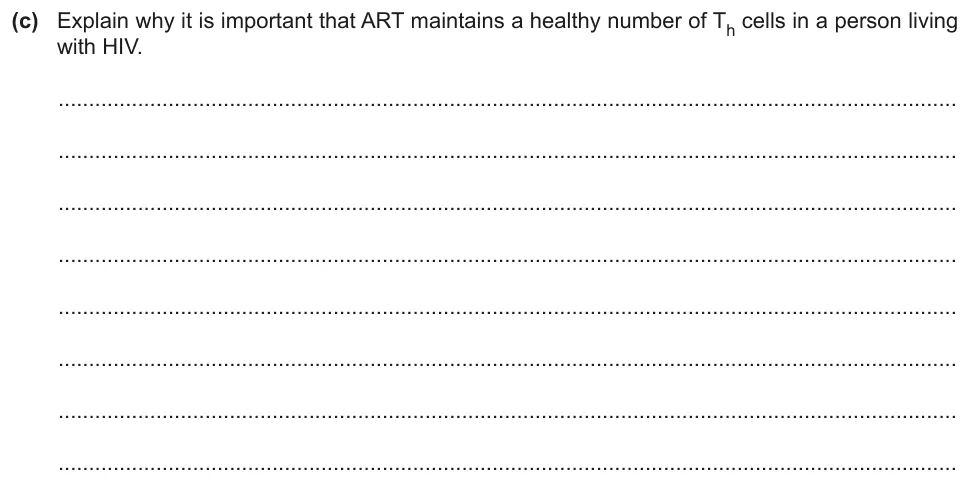
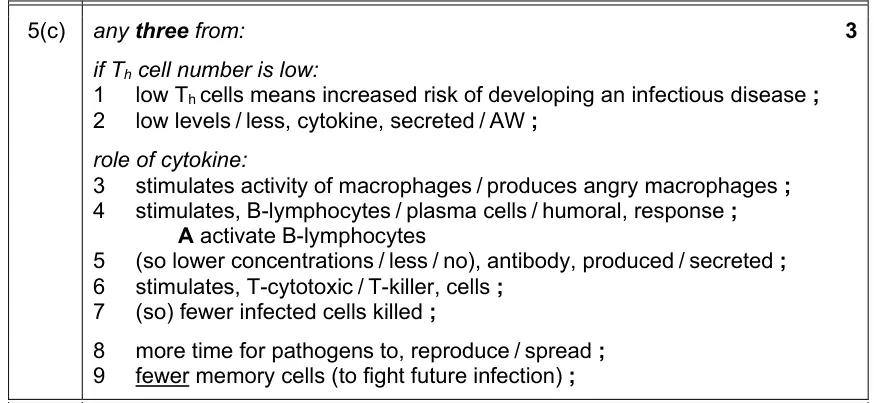
Explain why it is important that ART maintains a healthy number of T-helper cells in a person living with HIV.
Show the mark scheme
Tap an image to open it full size.
From the examiners' report: Most answers covered the role of T-helper cells in stimulating antibody production. The effect of a falling number of T-helper cells on cytokine production was often left out.
Memory cells and the secondary immune response (11.1.4)
Question 19
Paper 2 · February/March 2025 (22) · Q4(a)(ii) · 3 marks
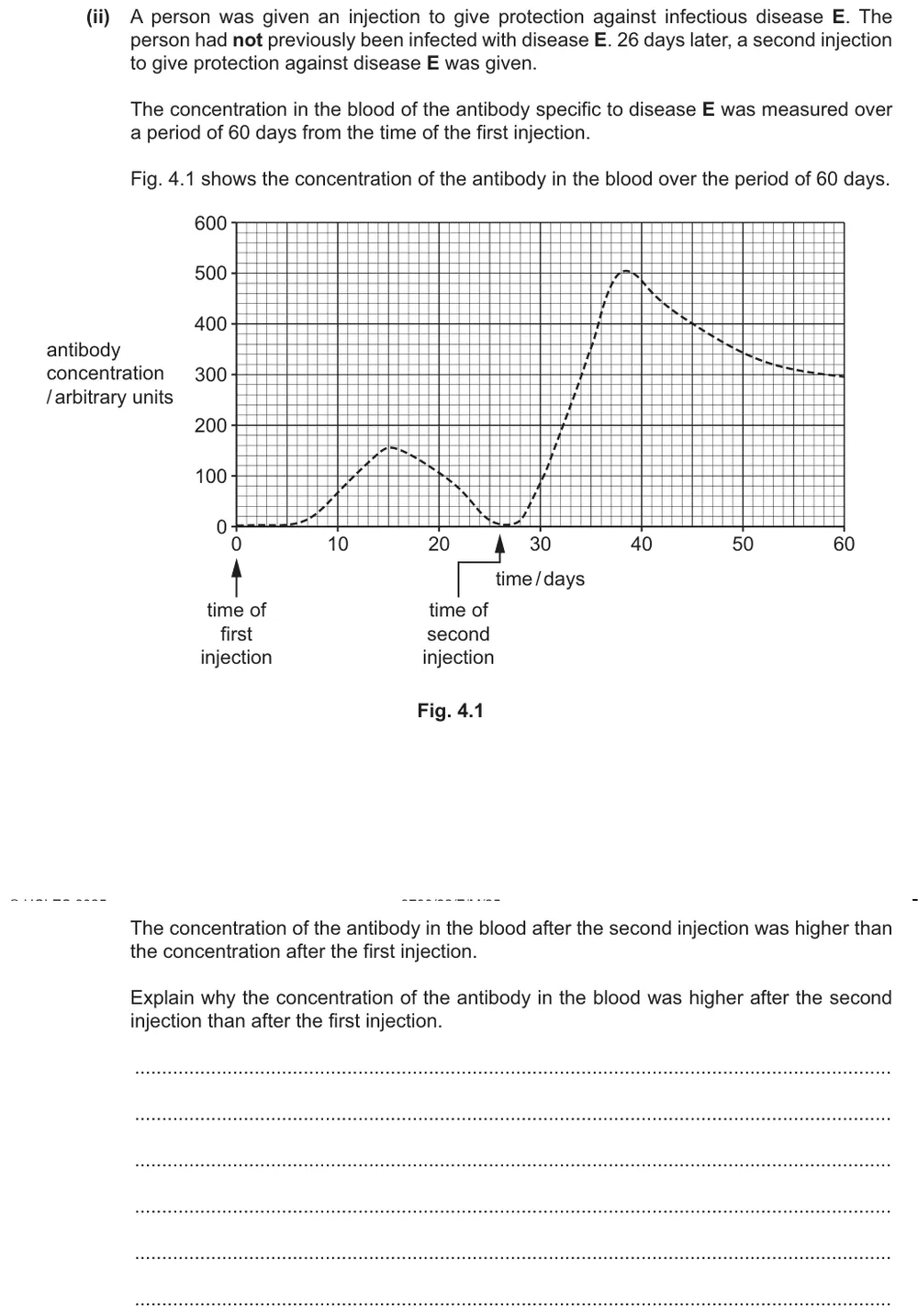
Explain why the antibody concentration was higher after the second injection than after the first.
Information from earlier in this question:

Show the mark scheme

Tap an image to open it full size.
From the examiners' report: Use the terms primary immune response and secondary immune response. Most recognised that memory cells give faster production and a higher concentration of antibodies. Fewer said that the secondary response starts from a larger number of specific lymphocytes, or linked memory cells to the formation of plasma cells.
Question 20
Paper 2 · October/November 2020 (22) · Q4(c) · 3 marks
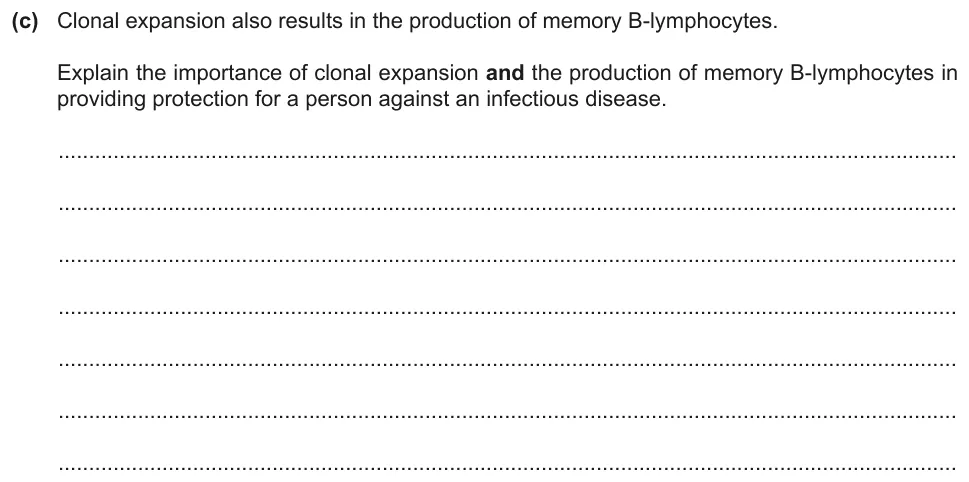
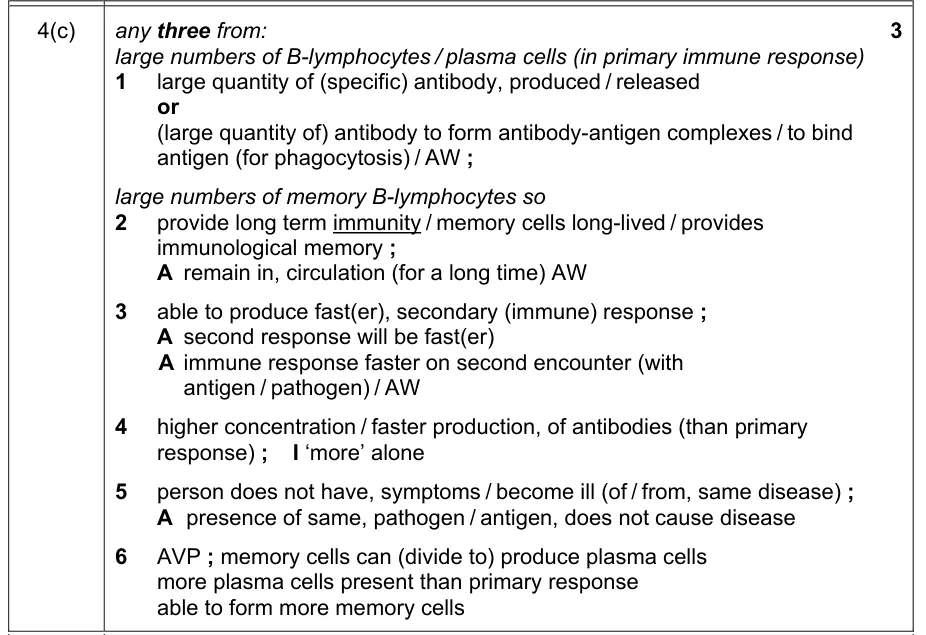
Explain the importance of clonal expansion and memory B-lymphocytes in protecting a person against an infectious disease.
Information from earlier in this question:

Show the mark scheme
Tap an image to open it full size.
From the examiners' report: Make clear whether each point is about the primary or the secondary immune response, and use pathogen, antigen, antibody, infection and disease correctly. Memory B-lymphocytes divide to produce cells that become plasma cells. The secondary response is faster because there are more cells after the primary response, not because the cells divide faster.
Question 21
Paper 2 · May/June 2018 (22) · Q3(c)(ii) · 3 marks
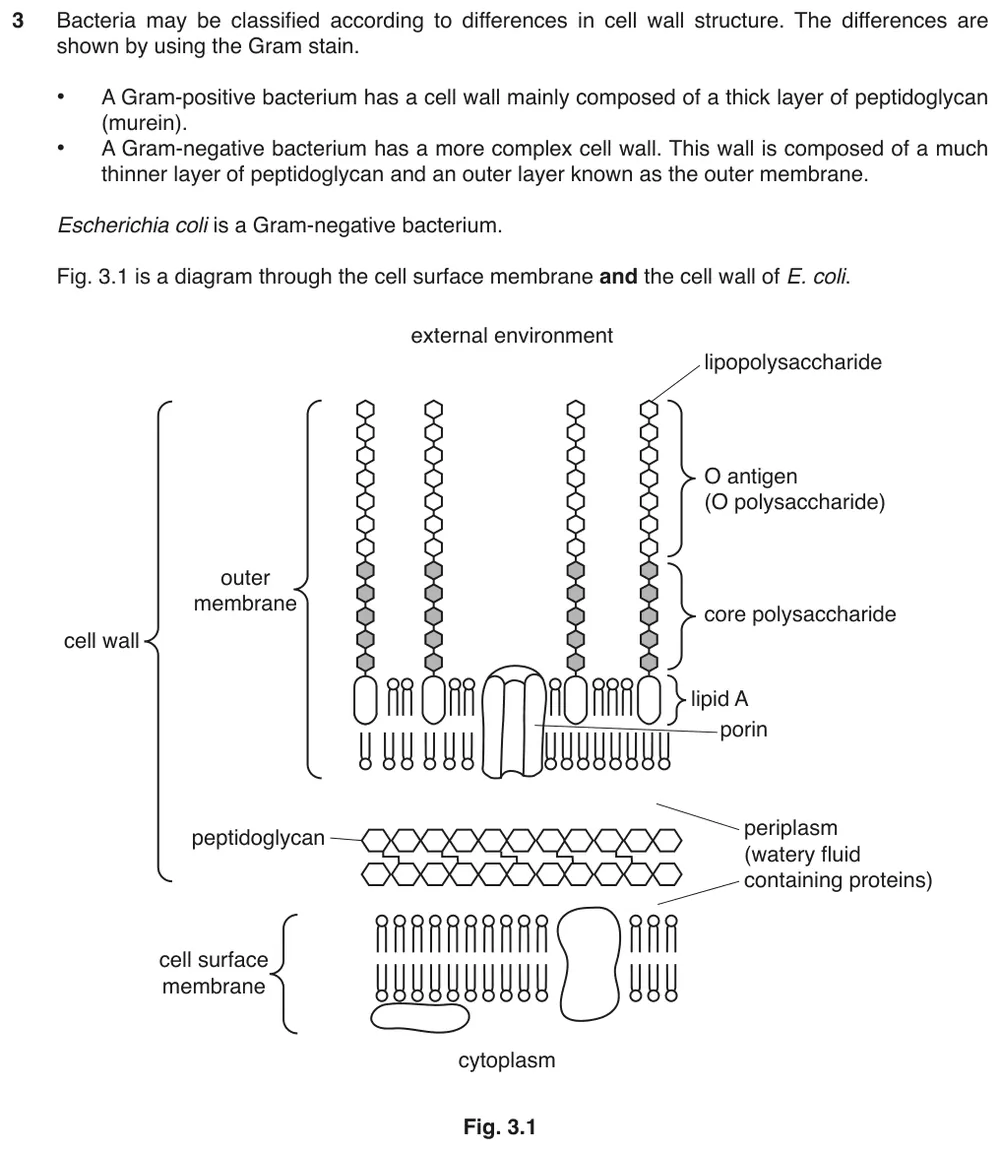
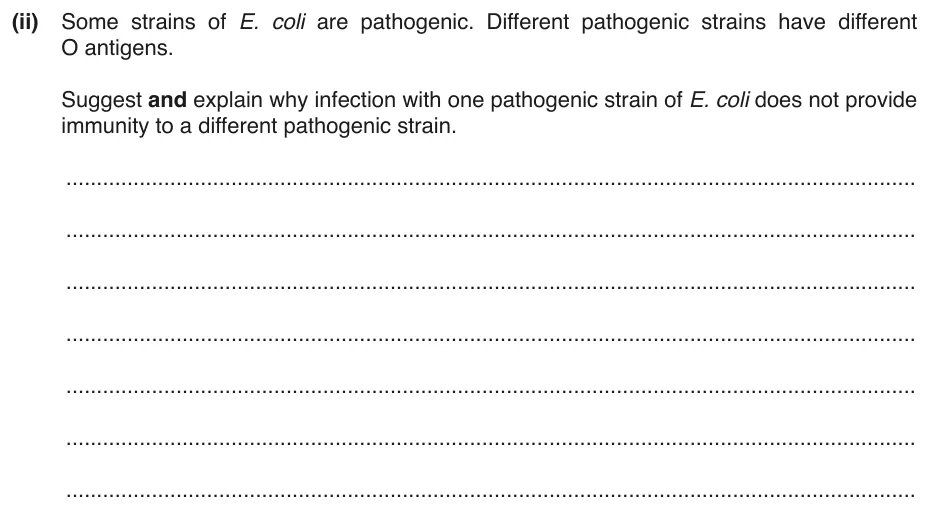
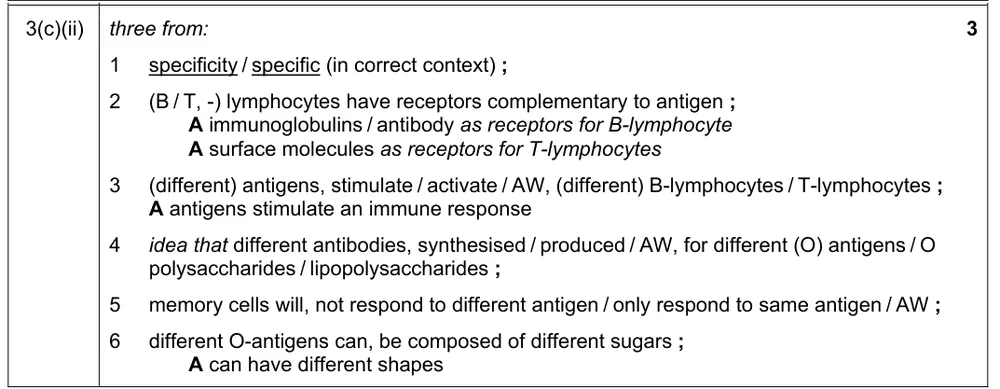
Suggest and explain why infection with one pathogenic strain of E. coli does not give immunity to a different strain.
Information from earlier in this question:

Show the mark scheme
Tap an image to open it full size.
From the examiners' report: Describing the immune response to one strain was not enough. Explain the specificity, and so why there is no immunity to a different strain.
Question 22
Paper 4 (A level) · May/June 2020 (42) · Q4(a) · 3 marks
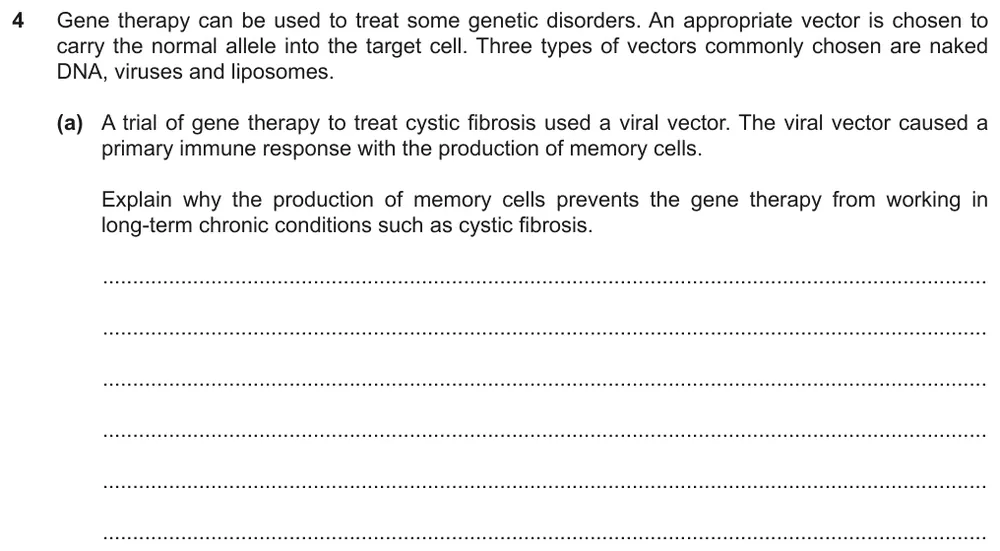
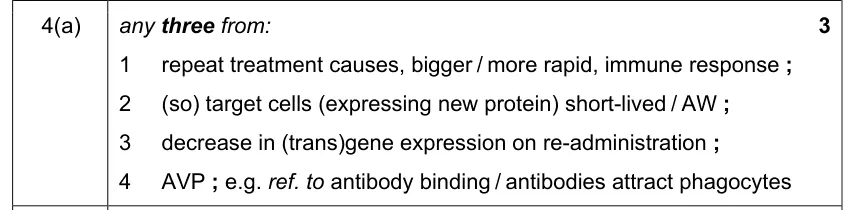
Explain why the production of memory cells stops gene therapy with a viral vector from working in long-term conditions.
Show the mark scheme
Tap an image to open it full size.
Where students lose marks (from Cambridge examiners' reports and mark schemes)
Each point below comes from the examiners' reports and mark schemes, and is followed by wording that gained marks.
Give an event before or after engulfing. Students described the bacteria being engulfed and stopped there, or repeated 'detected' from the question.
✔ Gains credit: bacteria 'bind to receptors' on the macrophage, the 'membrane surrounds bacterial cells', then 'membrane fusion' so the 'vacuole pinches off'.
Lysosomes fuse with the vacuole. Students wrote that the lysosome fused directly with the red blood cell, or only that the Kupffer cell has hydrolytic enzymes.
✔ Gains credit: the cell 'forms phagocytic vacuole', then 'lysosome fuses with phagosome' and the lysosome contains 'hydrolytic enzymes'.
Engulfing ends at the vacuole. Students carried on to lysosomes and the fate of the vacuole, or wrote that antigens were engulfed.
✔ Gains credit: 'phagocytosis', 'bacteria bind to cell surface membrane receptors', 'infolding of membrane', 'fusion of membrane of macrophage' and 'formation of vacuole'.
An antigen is not a whole pathogen. Students treated a non-self antigen as a virus or a bacterial cell, said that antigens have receptors, or said that the body does not recognise it.
✔ Gains credit: a non-self antigen 'stimulates an immune response', is usually a 'protein' or 'glycoprotein', is found on the 'surface of pathogens' and is 'complementary to receptors on lymphocytes'.
T-lymphocytes don't make antibodies. Students said that T-lymphocytes produce antibodies, or were unclear about where plasma cells come from.
✔ Gains credit: 'T-helper cells secrete cytokine', 'B-lymphocytes form plasma cells' and 'plasma cells secrete antibodies'.
Cytokines come from T-helper cells. Students said that the cytokines stimulate T-helper lymphocytes, or confused cytokines with cytokinesis.
✔ Gains credit: cytokines 'stimulate macrophage response', 'stimulate B-lymphocyte response' or 'stimulate T-killer response'.
A weak immune system still responds. Students wrote as if there were no immune system at all, or described viral replication as mitosis.
✔ Gains credit: a 'slower secondary immune response' gives 'more time for HCMV to infect cells'; 'fewer memory cells' and 'fewer plasma cells' mean a 'lower concentration of antibodies'.
More cells, not faster division. Students thought the secondary response is quicker because the cells divide faster, or said that memory cells change into plasma cells.
✔ Gains credit: 'large numbers of memory B-lymphocytes' 'provide long term immunity' and a 'faster secondary immune response'; 'memory cells can divide to produce plasma cells'.
Download the questions
Download the PDF pack (22 questions, mark schemes at the end)
Keep practising
- Antibodies and Vaccination (11.2): Cambridge (CIE) exam questions by topic
- Cambridge (CIE) A level Biology 9700 past papers, mark schemes and examiners' reports
- Cambridge (CIE) A level Biology grade thresholds
- Book a one-to-one CIE lesson or a free 15-minute discovery chat with Tom
- Register your interest in a CIE A level Biology group class
Questions, mark schemes and examiners' report extracts © Cambridge University Press & Assessment.