

Antibodies and Vaccination (11.2): Cambridge (CIE) A Level Biology 9700 Exam Questions by Topic
Antibodies and vaccination is sub-topic 11.2 of Topic 11, Immunity, in the Cambridge International AS & A Level Biology syllabus (9700). You need to relate the molecular structure of antibodies to their functions, outline the hybridoma method for producing monoclonal antibodies and the principles of using them to diagnose and treat disease, describe the differences between active and passive immunity and between natural and artificial immunity, explain how the antigens in vaccines give long-term immunity, and explain how vaccination programmes help to control the spread of infectious diseases. This is AS content, examined on Papers 1 and 2.
The examiners' reports return to the same points. An antibody has antigen-binding sites in its variable regions; do not call them receptors or active sites. In the hybridoma method it is the antigen, not the pathogen, that is injected, and it is cells from the spleen, not antibodies, that are fused with myeloma cells. Name a type of immunity with both words, such as artificial passive. Memory cells, not antibodies, give long-term immunity, and they are formed in the primary immune response. When a question is about a vaccination programme, write about herd immunity and breaking the transmission cycle, not about the immune response.
Studying Cambridge International A level Biology and want more help? Tom teaches CIE students one-to-one online, including students in the UAE, Saudi Arabia, Hong Kong, India and Indonesia, and every lesson is recorded. You can book a one-to-one lesson or a free 15-minute discovery chat, or register your interest in a CIE group class starting in September 2027, using the links at the bottom of this page.
What you need from IGCSE
Each question on this page assumes you're secure on these ideas. If any of them feels shaky, look it up before you start.
- Each pathogen has its own antigens, which have specific shapes, and antibodies are proteins that bind to antigens.
- Active immunity is gained after an infection by a pathogen or by vaccination, and memory cells are produced.
- Passive immunity is a short-term defence in which antibodies come from another individual, for example across the placenta or in breast milk.
- A vaccine contains weakened pathogens or their antigens, which stimulate an immune response.
Key terms
These words come up in the questions and mark schemes. Examiners expect you to use them exactly.
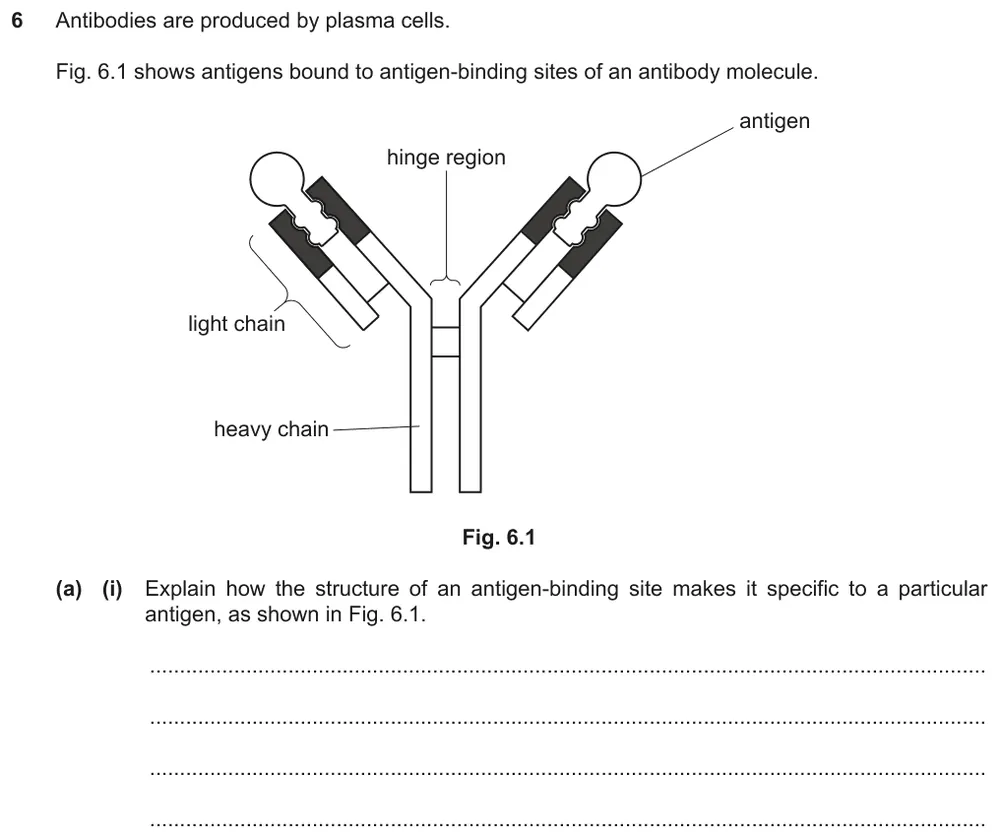
- Antigen-binding site: the part of an antibody, at the end of a variable region, with a shape complementary to one specific antigen.
- Variable region: the part of each heavy and light chain whose sequence of amino acids differs between antibodies, giving each antibody its specificity.
- Hinge region: the flexible part of an antibody that lets the variable regions move, so the antibody can bind to antigens that are different distances apart.
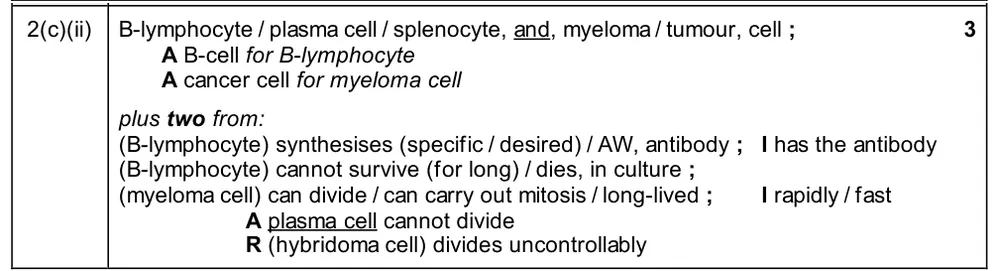
- Monoclonal antibody: an antibody made by a single clone of cells, so every molecule is specific to the same antigen.
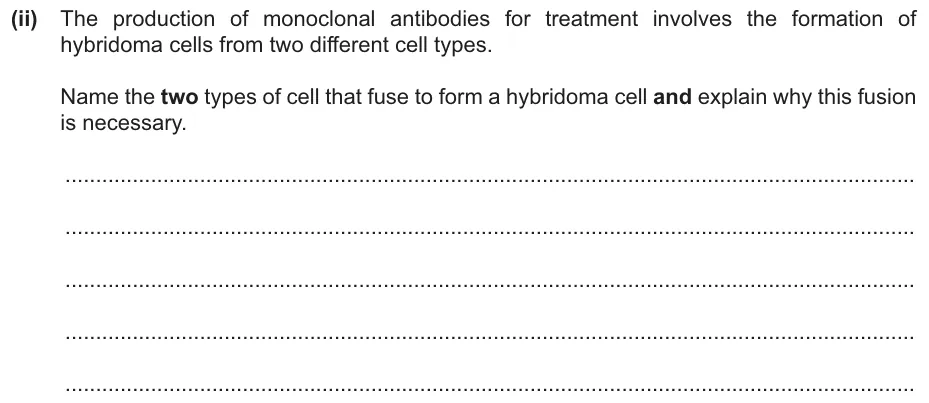
- Hybridoma: a cell made by fusing a plasma cell (B-lymphocyte) with a myeloma cell; it secretes antibody and can divide.
- Active immunity: immunity in which the person's own immune response produces antibodies and memory cells; it is long-lasting.
- Passive immunity: immunity from antibodies made elsewhere; it acts immediately but is temporary, as no memory cells are produced.
- Herd immunity: protection of people without immunity because a large proportion of the population is immune, which breaks the transmission cycle.
What these questions cover (Cambridge 9700 Topic 11: Immunity)
The questions test these learning outcomes from sub-topic 11.2 of the Cambridge International AS & A Level Biology syllabus (9700) for 2025 to 2027.
- 11.2.1 relate the molecular structure of antibodies to their functions
- 11.2.2 outline the hybridoma method for the production of monoclonal antibodies
- 11.2.3 outline the principles of using monoclonal antibodies in the diagnosis of disease and in the treatment of disease
- 11.2.4 describe the differences between active immunity and passive immunity and between natural immunity and artificial immunity
- 11.2.5 explain that vaccines contain antigens that stimulate immune responses to provide long-term immunity
- 11.2.6 explain how vaccination programmes can help to control the spread of infectious diseases
How to use this page
Write your answer on paper before you open the mark scheme. Allow about 1.2 minutes per mark: the 22 questions are worth 47 marks, so about 56 minutes in total. Then mark your answer strictly against the mark scheme and read the examiners' tip underneath it. If you'd rather print the questions, download the PDF pack.
Antibody structure and function (11.2.1)
Question 1
Paper 2 · May/June 2024 (21) · Q6(a)(i) · 2 marks
Explain how the structure of an antigen-binding site makes it specific to a particular antigen.
Show the mark scheme

Tap an image to open it full size.
From the examiners' report: Many wrote about the complementary shapes of the antigen and the antigen-binding site. The strongest answers also used protein structure: the sequence of amino acids and the folding of the variable regions. If you use the word 'epitope', it refers to the antigen, not the antibody.
Question 2
Paper 2 · May/June 2024 (21) · Q6(a)(ii) · 1 mark
State the function of the hinge region of the antibody.

Show the mark scheme

Tap an image to open it full size.
From the examiners' report: Many said that the hinge region gives flexibility but did not say why this is an advantage: the antibody can bind to antigens that are different distances apart on a pathogen. 'To hold the polypeptide chains together' did not gain credit.
Question 3
Paper 2 · February/March 2023 (22) · Q4(c) · 3 marks · Hard
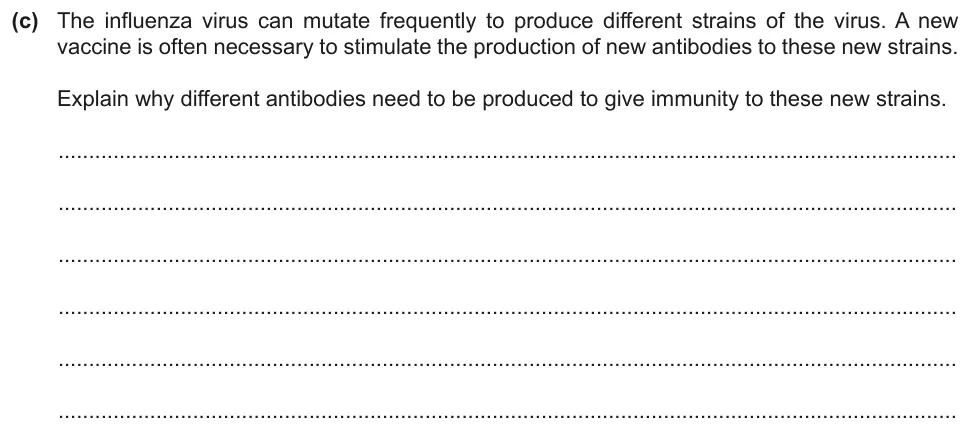
Explain why different antibodies are needed to give immunity to new strains of the influenza virus.
Information from earlier in this question:

Show the mark scheme

Tap an image to open it full size.
From the examiners' report: A common error was to say that the viruses become resistant to the antibodies. Many answers confused antibodies with antibiotics.
The hybridoma method (11.2.2)
Question 4
Paper 2 · October/November 2025 (22) · Q2(c)(ii) · 3 marks
Name the two types of cell that fuse to form a hybridoma cell and explain why the fusion is necessary.
Show the mark scheme
Tap an image to open it full size.
Question 5
Paper 2 · February/March 2024 (22) · Q6(d) · 3 marks
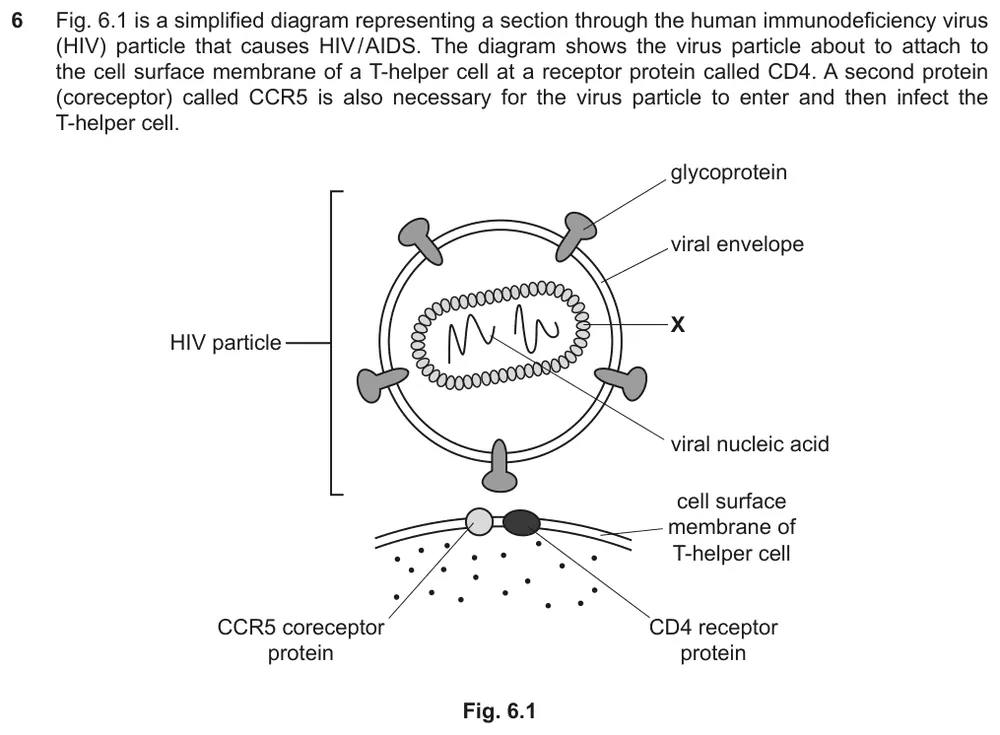
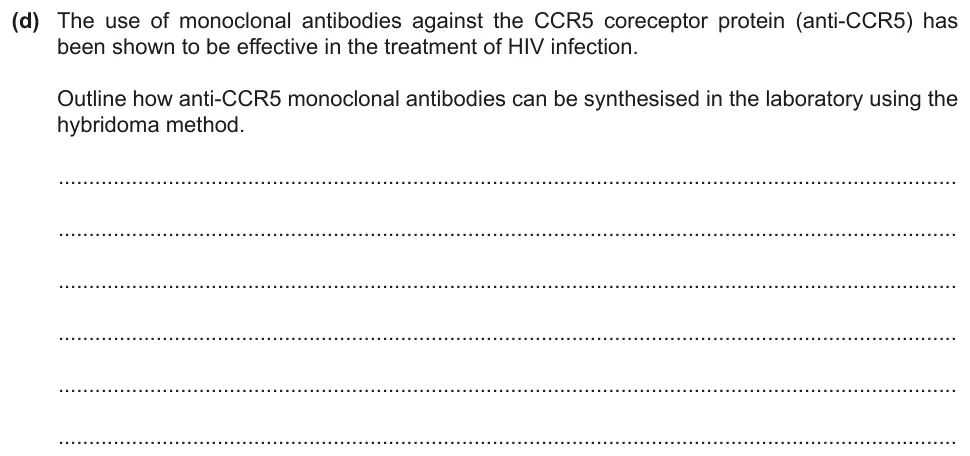
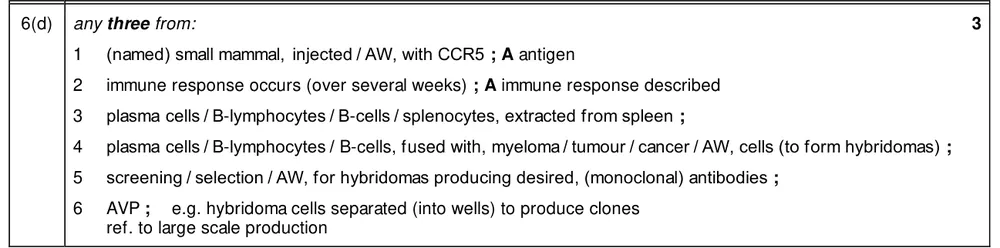
Outline how anti-CCR5 monoclonal antibodies can be made using the hybridoma method.
Information from earlier in this question:
Show the mark scheme
Tap an image to open it full size.
Question 6
Paper 2 · October/November 2018 (22) · Q4(c)(i) · 1 mark
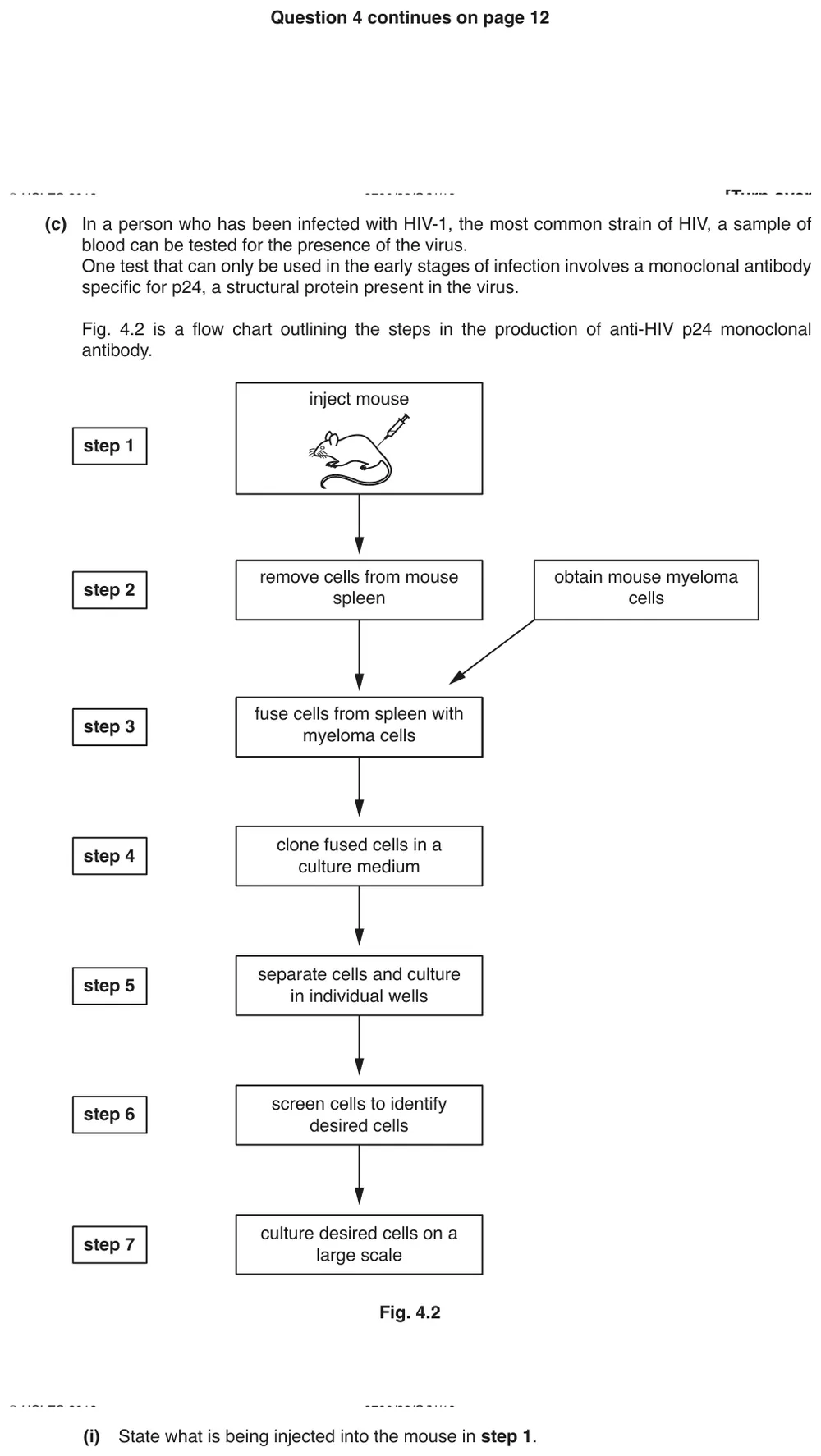
State what is injected into the mouse in step 1 of the flow chart.
Show the mark scheme

Tap an image to open it full size.
From the examiners' report: Most who lost the mark said that the virus itself, HIV-1, was injected. An antigen alone, here the viral protein p24, can stimulate an immune response in the mouse. Human blood and antibodies to HIV-1 were also wrong.
Question 7
Paper 2 · October/November 2018 (22) · Q4(c)(ii) · 1 mark
Explain why several weeks, not several days, separate step 1 and step 2.
Information from earlier in this question:


Show the mark scheme

Tap an image to open it full size.
From the examiners' report: Use the term immune response. The time is not for the mouse to make the antibody: step 2 removes cells from the spleen. Memory cells were not relevant.
Question 8
Paper 2 · October/November 2018 (22) · Q4(c)(iii) · 1 mark
State one feature of the myeloma cells that is essential for the process.

Show the mark scheme

Tap an image to open it full size.
From the examiners' report: Most correct answers were about the ability of myeloma cells to divide; that they are long-lived was the next most common. Myeloma cells do not produce large quantities of antibody.
Question 9
Paper 2 · October/November 2018 (22) · Q4(c)(iv) · 1 mark
Name the fused cells formed in step 4.

Show the mark scheme

Tap an image to open it full size.
From the examiners' report: Most knew that these are hybridoma cells. Plasma cells, B-lymphocytes and 'hybrid cells' were the usual wrong answers.
Question 10
Paper 2 · October/November 2018 (22) · Q4(c)(v) · 1 mark
Suggest why the cells are screened in step 6.

Show the mark scheme

Tap an image to open it full size.
From the examiners' report: Not all hybridoma cells secrete the antibody specific for p24, so the ones that make the desired antibody have to be found and only these cultured. Step 6 is not for harvesting the antibody, and repeating the wording of step 6 gained nothing.
Monoclonal antibodies in diagnosis (11.2.1 and 11.2.3)
Question 11
Paper 2 · May/June 2022 (22) · Q2(b)(i) · 2 marks
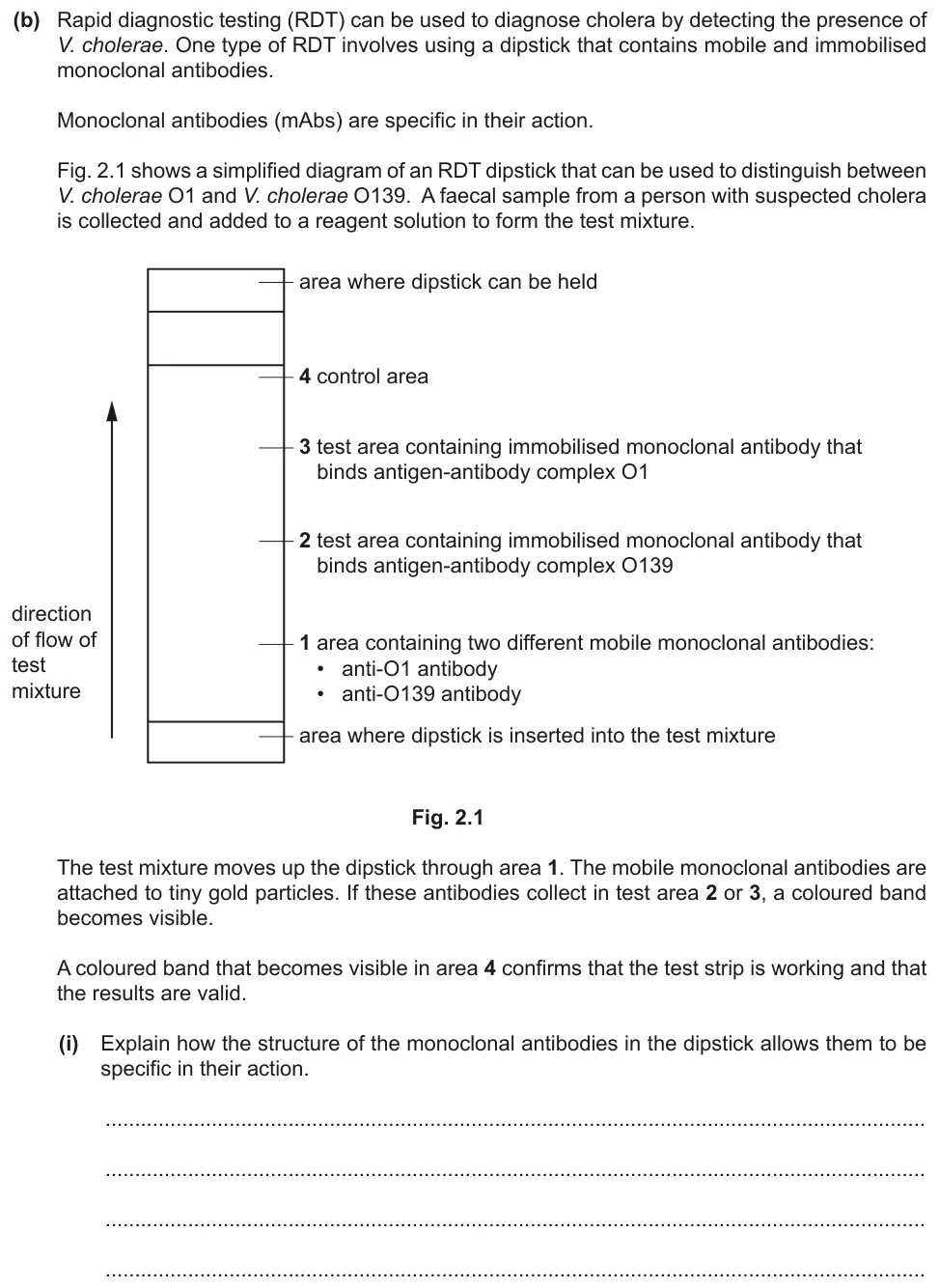
Explain how the structure of the monoclonal antibodies in the dipstick makes them specific.
Information from earlier in this question:

Show the mark scheme

Tap an image to open it full size.
From the examiners' report: Give the structural detail: antigen-binding sites, variable regions and a shape complementary to the antigen. The hinge region and constant regions were not relevant. 'Receptor' and 'active site' are the wrong terms for an antibody.
Question 12
Paper 2 · May/June 2022 (22) · Q2(b)(ii) · 3 marks · Easy
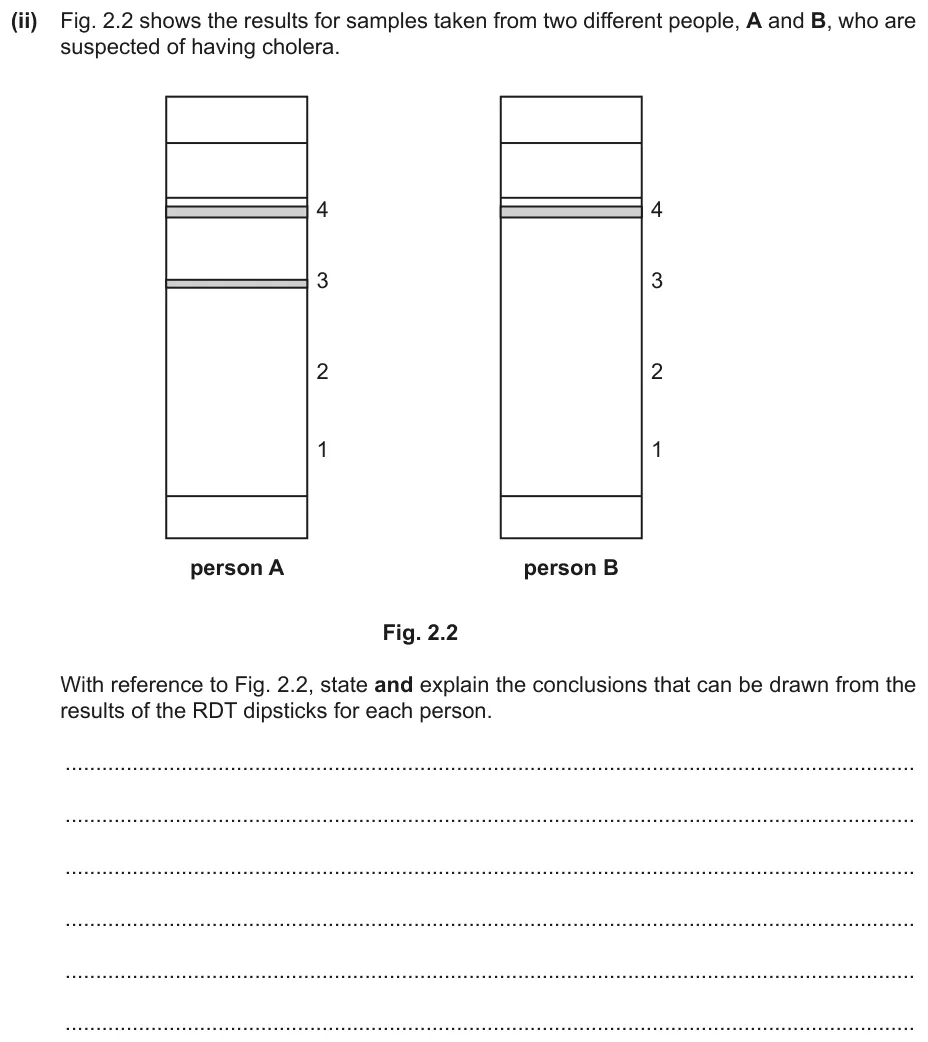
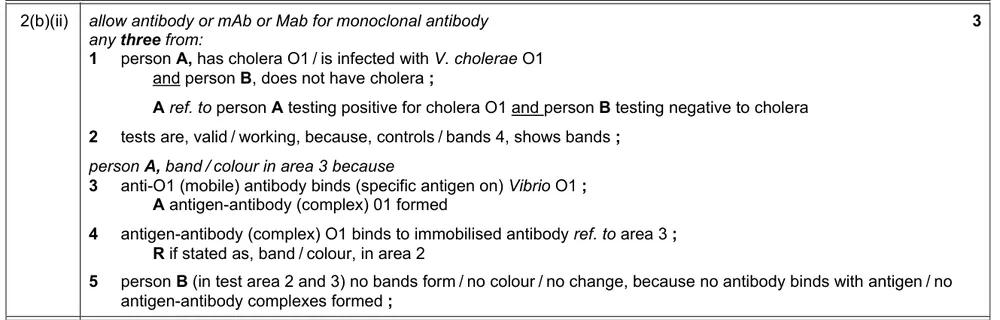
State and explain what the dipstick results show for person A and person B.
Show the mark scheme
Tap an image to open it full size.
From the examiners' report: Most made the correct diagnoses and explained that the band in control area 4 shows the results are valid. Be precise: say that antigen-antibody complex O1 has formed for person A. The complexes form on the dipstick, not inside the body.
Question 13
Paper 2 · May/June 2025 (22) · Q6(c)(i) · 1 mark
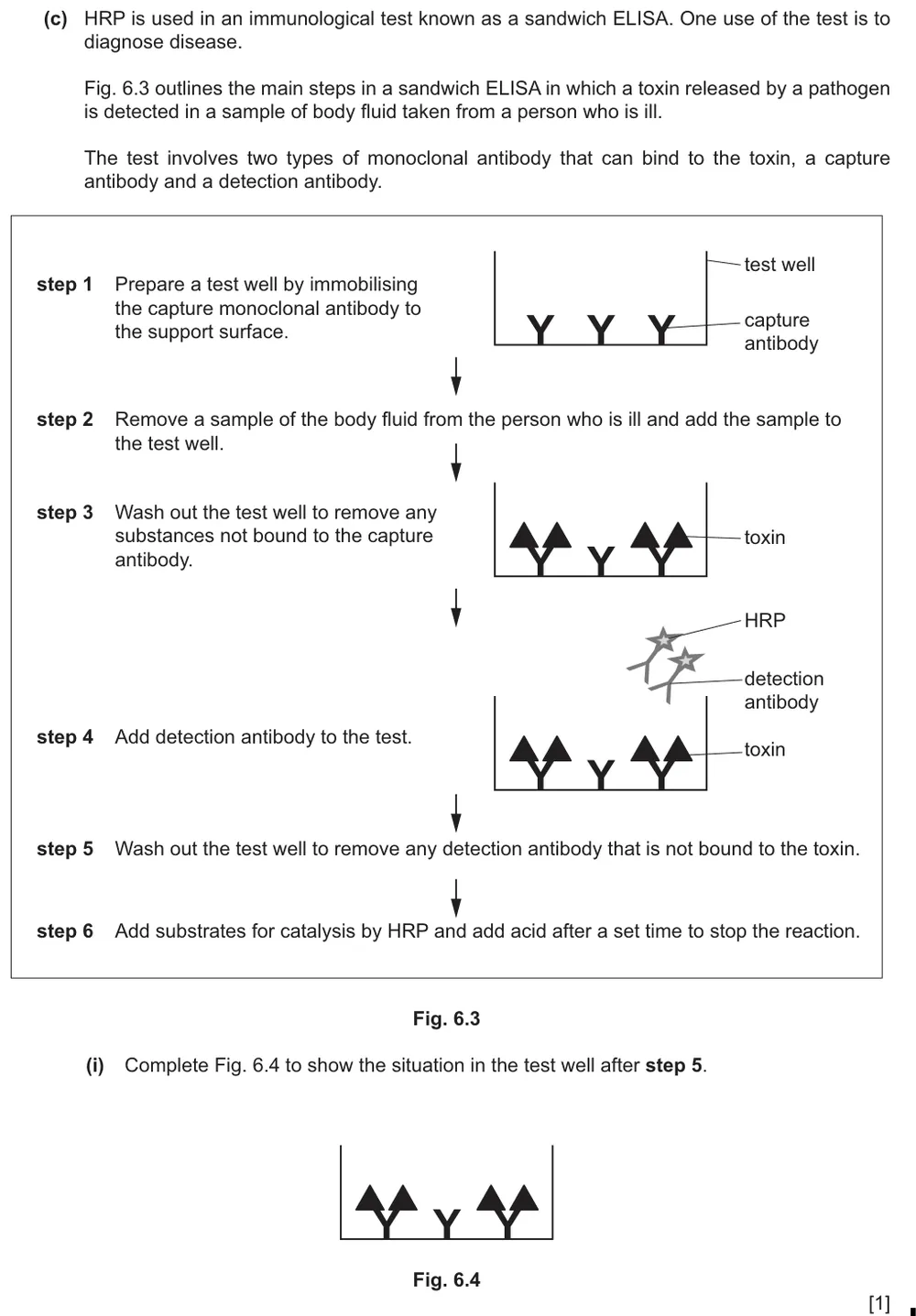
Complete the diagram to show the test well after step 5 of the sandwich ELISA.
Information from earlier in this question:
Show the mark scheme

Tap an image to open it full size.
Question 14
Paper 2 · May/June 2025 (22) · Q6(c)(ii) · 1 mark
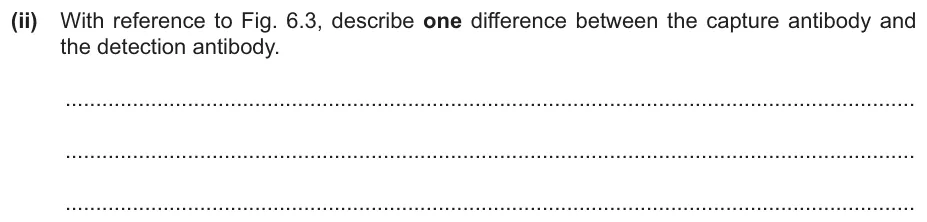
Describe one difference between the capture antibody and the detection antibody.
Show the mark scheme

Tap an image to open it full size.
Monoclonal antibodies in treatment (11.2.3)
Question 15
Paper 2 · May/June 2018 (22) · Q6(b) · 2 marks
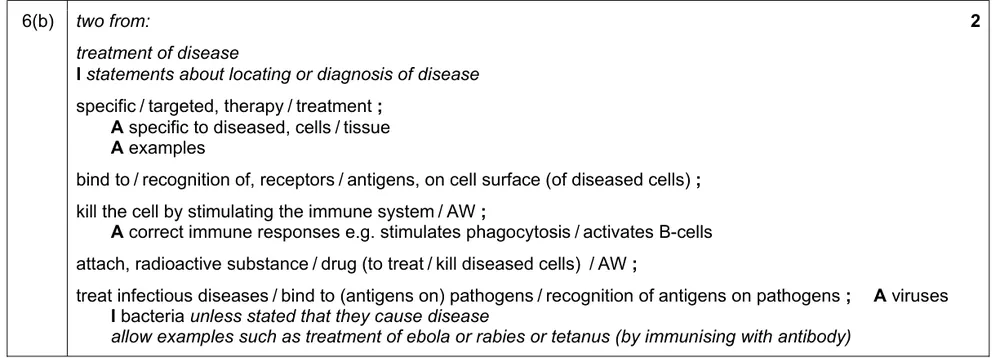
Outline the use of monoclonal antibodies in the treatment of disease.
Information from earlier in this question:

Show the mark scheme
Tap an image to open it full size.
From the examiners' report: Vague answers said that monoclonal antibodies are put into the body of a person with a disease but gave little detail of how they act. Writing about detecting or diagnosing disease, or about how monoclonal antibodies are produced, did not answer the question.
Active, passive, natural and artificial immunity (11.2.4)
Question 16
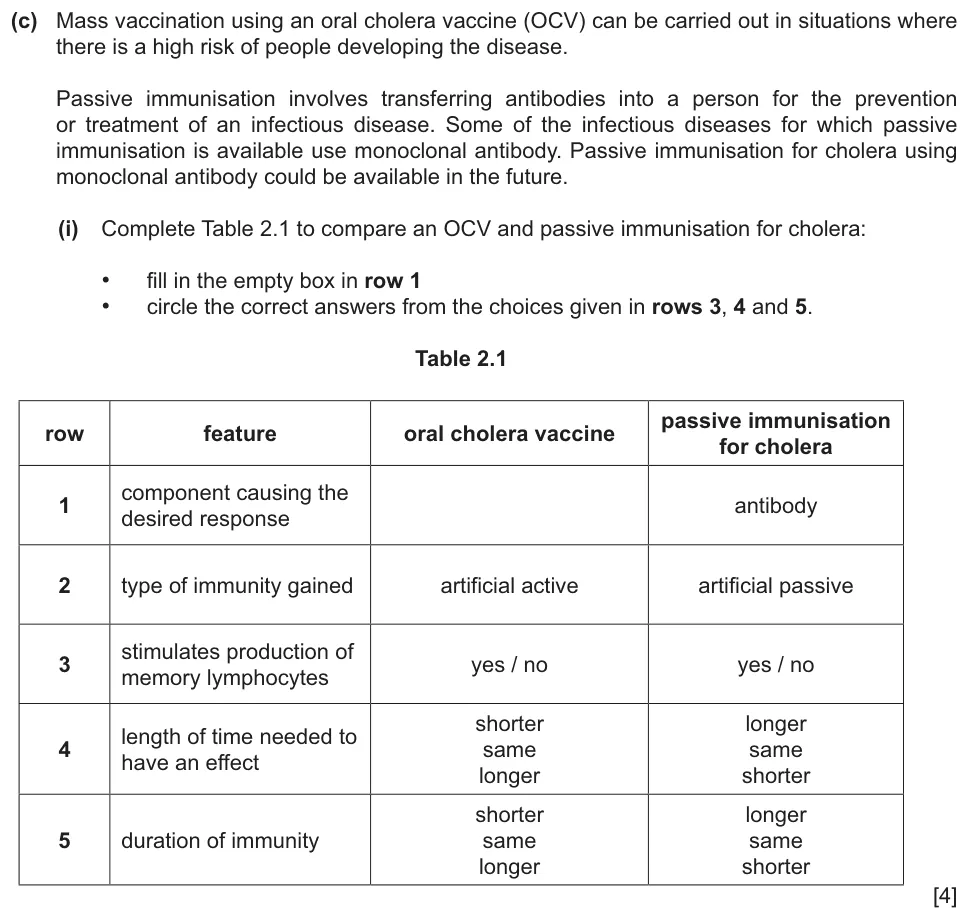
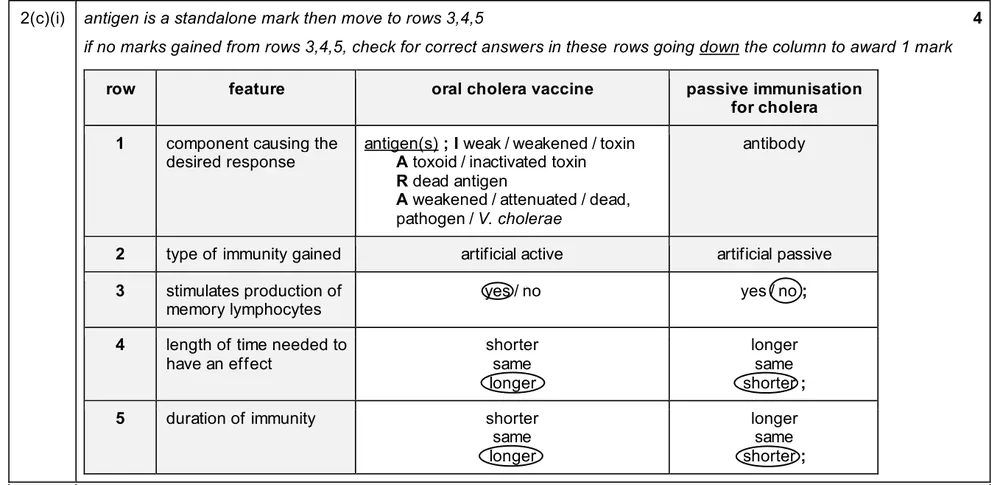
Paper 2 · October/November 2025 (22) · Q2(c)(i) · 4 marks
Complete the table to compare an oral cholera vaccine with passive immunisation for cholera.
Information from earlier in this question:

Show the mark scheme
Tap an image to open it full size.
Question 17
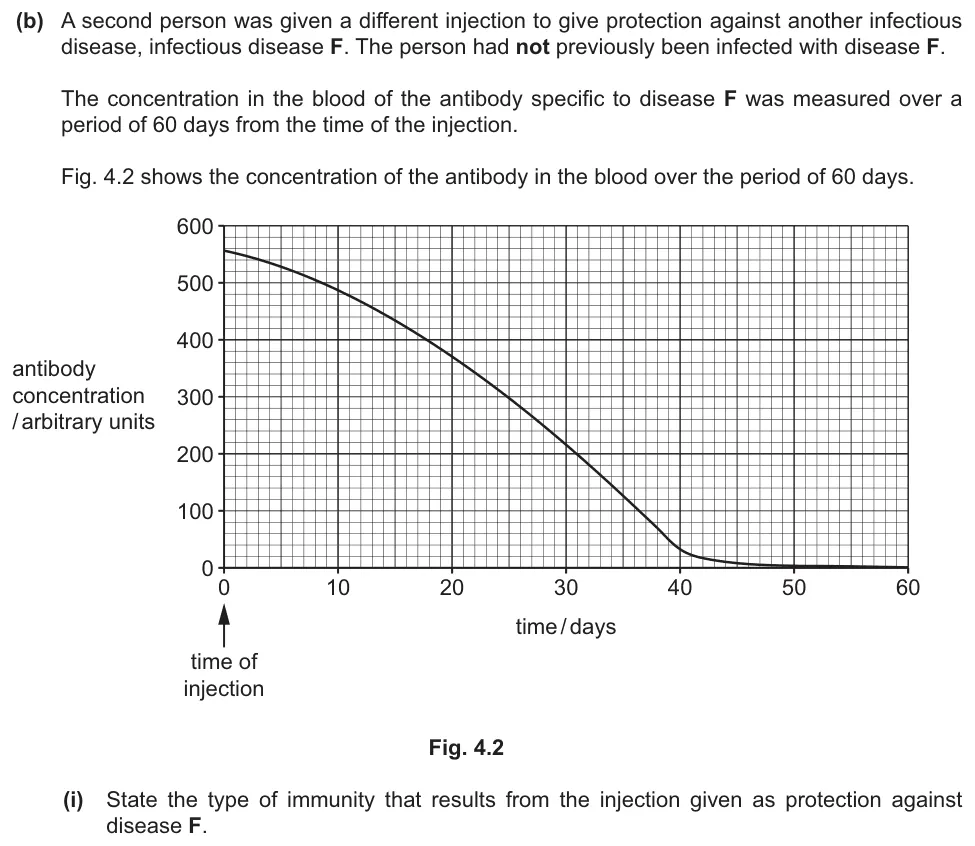
Paper 2 · February/March 2025 (22) · Q4(b)(i) · 1 mark
Use the graph of antibody concentration to state the type of immunity that results from the injection.
Show the mark scheme

Tap an image to open it full size.
From the examiners' report: Not everyone gave both words. The answer needed passive and artificial.
Question 18
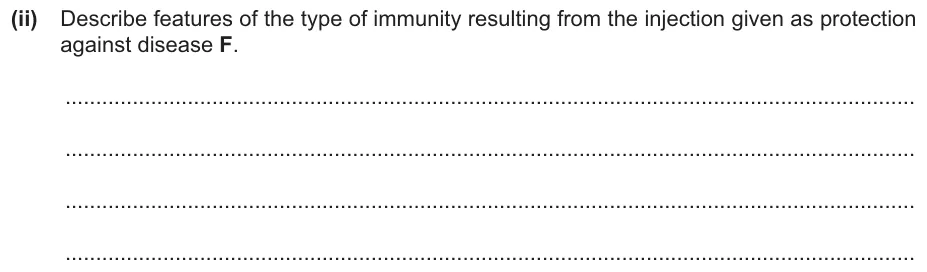
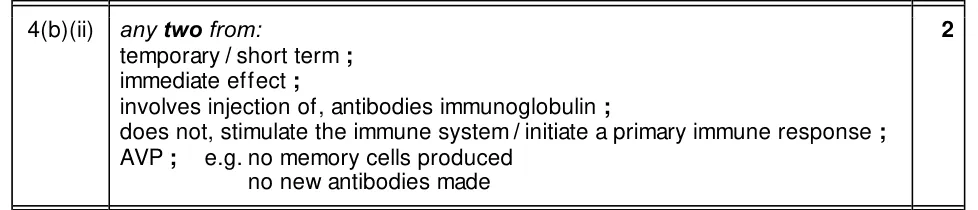
Paper 2 · February/March 2025 (22) · Q4(b)(ii) · 2 marks
Describe features of the type of immunity that results from the injection.
Show the mark scheme
Tap an image to open it full size.
From the examiners' report: Many said that an injection of antibodies gives immediate immunity, and some added that it is only short term. Some included the idea that there is no immune response, so no memory cells are produced.
Vaccines and long-term immunity (11.2.5)
Question 19
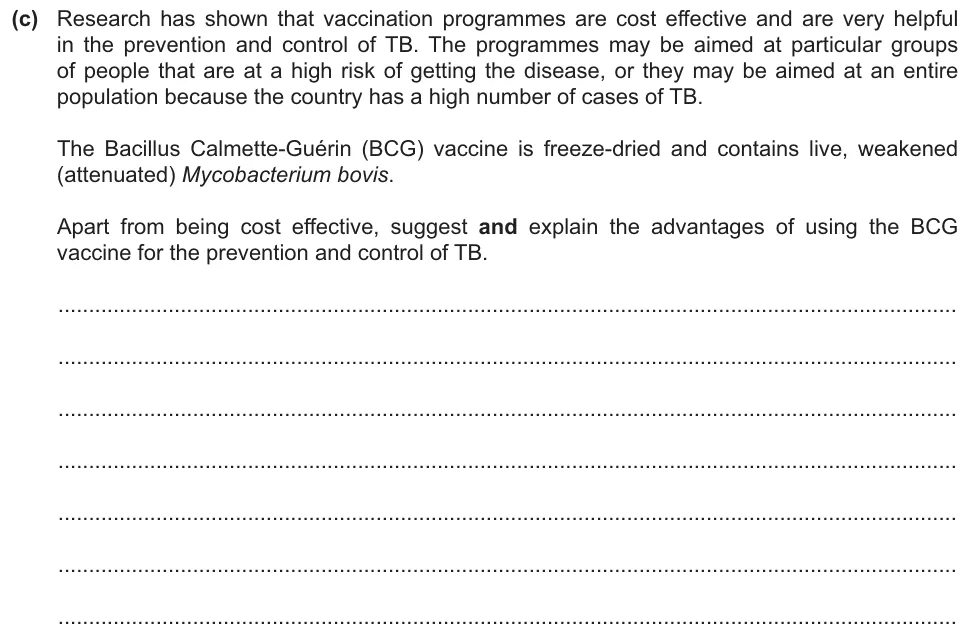
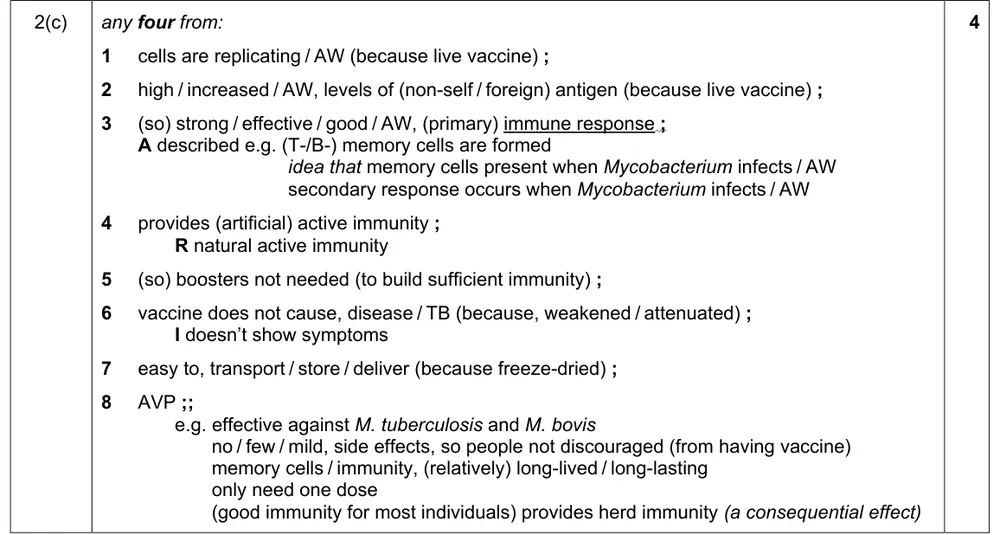
Paper 2 · May/June 2024 (22) · Q2(c) · 4 marks
Suggest and explain the advantages of using the BCG vaccine to prevent and control TB.
Show the mark scheme
Tap an image to open it full size.
From the examiners' report: Freeze-dried does not mean that the vaccine has to be kept frozen or cold. Say that memory cells form as a result of the primary immune response; antibodies are not memory cells and do not stay in the blood ready for a secondary response. Very few saw that a live vaccine means more antigen and so a stronger immune response.
Question 20
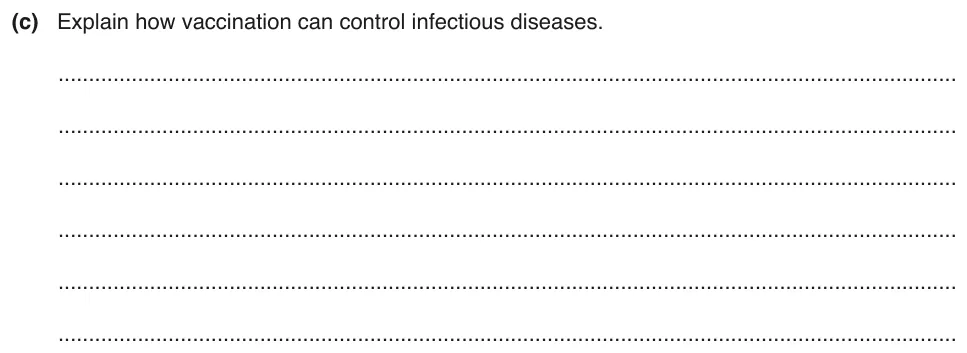
Paper 2 · October/November 2016 (22) · Q5(c) · 3 marks · Hard
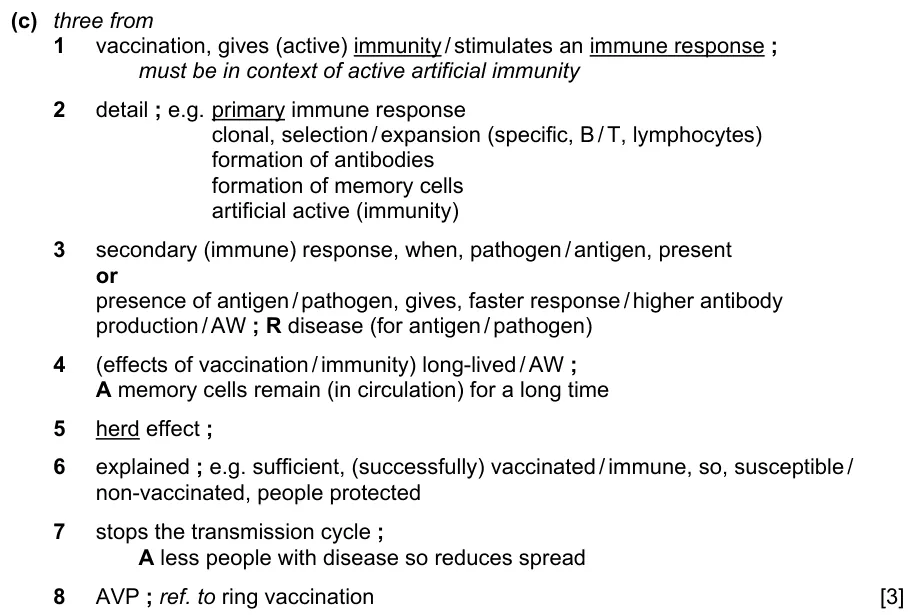
Explain how vaccination can control infectious diseases.
Show the mark scheme
Tap an image to open it full size.
From the examiners' report: The best answers covered herd immunity and breaking the transmission cycle as well as immunity in the individual. Memory cells, not antibodies, remain after a primary response. A secondary immune response is a response to the pathogen and its antigens, not to 'disease' or 'infection'.
Vaccination programmes (11.2.6)
Question 21
Paper 2 · February/March 2023 (22) · Q4(d)(i) · 3 marks
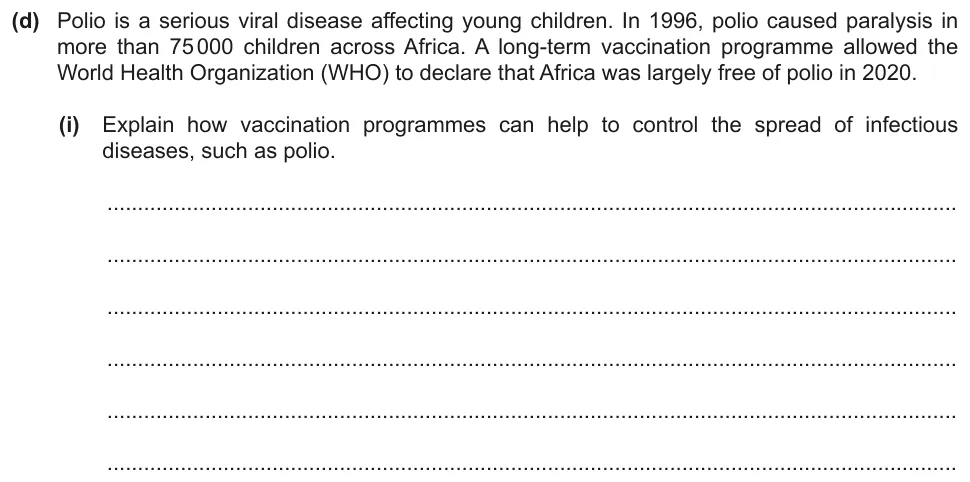
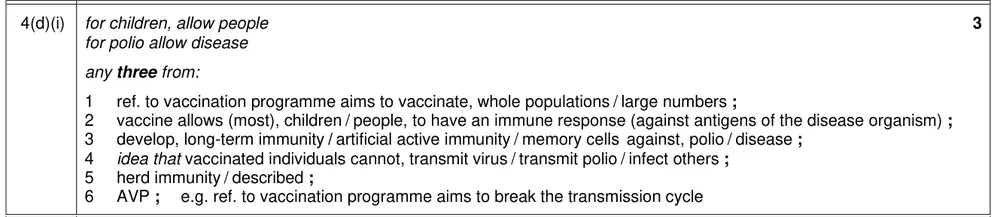
Explain how vaccination programmes can help to control the spread of infectious diseases such as polio.
Information from earlier in this question:
Show the mark scheme
Tap an image to open it full size.
From the examiners' report: Strong answers referred to herd immunity, and the more detailed ones to breaking the transmission cycle. Some wrote about how a vaccination works and not about vaccination programmes.
Question 22
Paper 2 · October/November 2019 (22) · Q5(e) · 4 marks · Hard
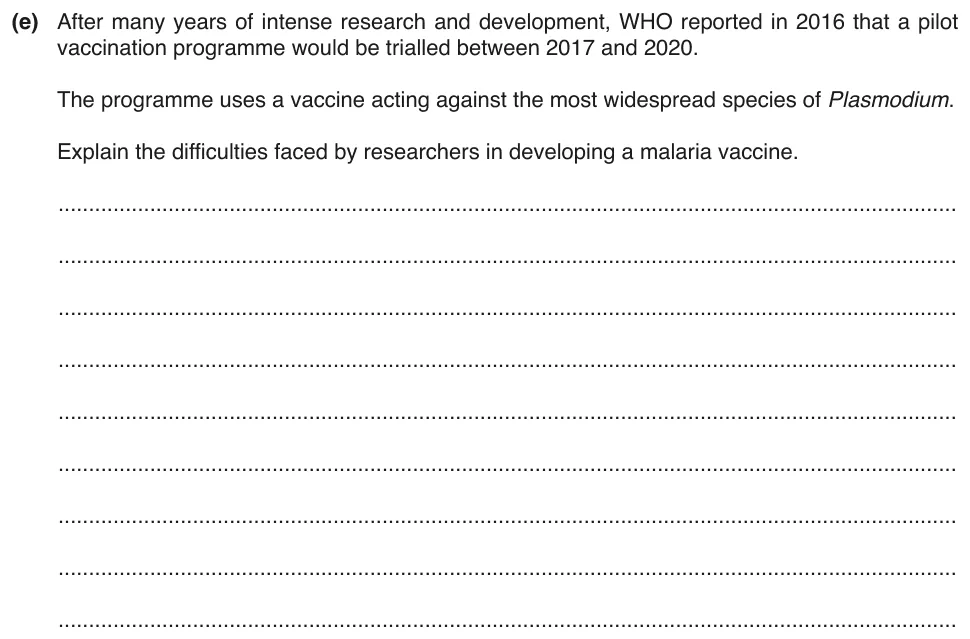
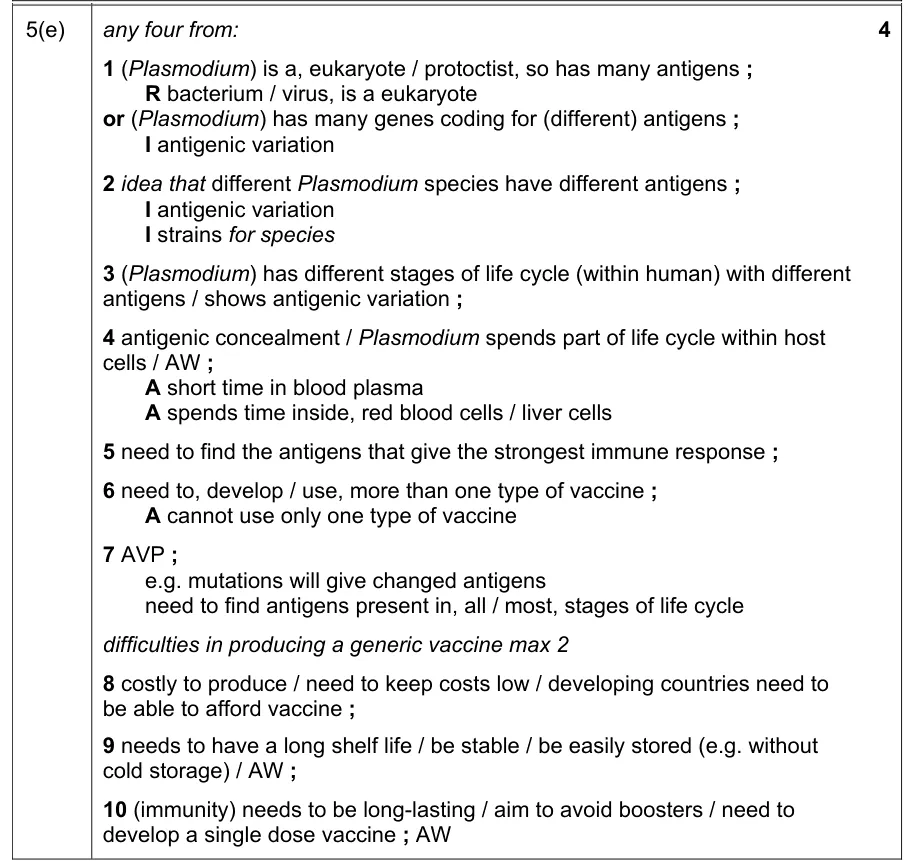
Explain the difficulties faced by researchers in developing a malaria vaccine.
Show the mark scheme
Tap an image to open it full size.
From the examiners' report: Write about developing a vaccine, not the general problems of vaccines already in use. Different species of Plasmodium have different antigens: 'strains' is the wrong word. As a eukaryote, each species has many antigens, not one.
Where students lose marks (from Cambridge examiners' reports and mark schemes)
Each point below comes from the examiners' reports and mark schemes, and is followed by wording that gained marks.
Antibodies don't have active sites. Students used 'receptor' or 'active site' for the part of the antibody that binds the antigen, or wrote about the hinge and constant regions.
✔ Gains credit: 'specific antigen-binding sites', a 'specific variable region', and 'binding site and antigen have complementary shapes'.
Say why the hinge matters. Students wrote 'flexibility' with no reason, or 'to hold the polypeptide chains together'.
✔ Gains credit: the hinge region 'allows flexibility for binding to antigens', or 'allows variable regions to move'.
Inject the antigen, not the pathogen. Students said that the virus, HIV-1, was injected into the mouse.
✔ Gains credit: 'HIV antigen' or 'p24'; the mark scheme rejects 'HIV'.
Myeloma cells divide; they don't make antibody. Students suggested that myeloma cells produce large quantities of antibody.
✔ Gains credit: myeloma cells are 'immortal' or 'long-lived', 'capable of cell division' and 'can survive in cell culture'.
Screening finds the right hybridomas. Students thought step 6 was for harvesting the antibody, or for checking that the cells were safe to give to people.
✔ Gains credit: the cells are checked for 'production of anti-HIVp24 antibody' because you 'only want cells that produce desired antibody'.
Name both parts of the immunity. Students gave only 'passive' or only 'artificial' for immunity from an injection of antibodies.
✔ Gains credit: 'passive and artificial'; it is 'temporary', has an 'immediate effect' and there are 'no memory cells produced'.
Memory cells, not antibodies, last. Students suggested that antibodies act as memory cells or stay in the blood for a secondary response, or wrote about memory cells 'remembering' the infection.
✔ Gains credit: 'memory cells are formed' in a 'strong primary immune response', which 'provides artificial active immunity', so a 'secondary response occurs when Mycobacterium infects'.
Programmes protect the population. Students explained how a vaccination works and did not write about vaccination programmes.
✔ Gains credit: a programme 'aims to vaccinate whole populations', giving 'herd immunity'; 'vaccinated individuals cannot transmit virus', which helps to 'break the transmission cycle'.
Download the questions
Download the PDF pack (22 questions, mark schemes at the end)
Keep practising
- The Immune System (11.1): Cambridge (CIE) exam questions by topic
- Cambridge (CIE) A level Biology 9700 past papers, mark schemes and examiners' reports
- Cambridge (CIE) A level Biology grade thresholds
- Book a one-to-one CIE lesson or a free 15-minute discovery chat with Tom
- Register your interest in a CIE A level Biology group class
Questions, mark schemes and examiners' report extracts © Cambridge University Press & Assessment.