

The Circulatory System (8.1): Cambridge (CIE) A Level Biology 9700 Exam Questions by Topic
The circulatory system is sub-topic 8.1 of Topic 8, Transport in mammals, in the Cambridge International AS & A Level Biology syllabus (9700). You need to know that mammals have a closed double circulation, describe the functions of the pulmonary artery, pulmonary vein, aorta and vena cava, recognise arteries, veins, capillaries and blood cells in micrographs, explain how the structure of each type of blood vessel is related to its function, relate the properties of water to transport, and describe how tissue fluid forms in a capillary network. This is AS content, examined on Papers 1 and 2. A level students meet it again on Paper 4; questions marked A level on this page come from Paper 4.
The examiners' reports return to the same points. Spell the names correctly: 'systematic' is not accepted for systemic, and aorta, pulmonary and venule are often misspelt. A capillary is not 'one cell thick'; its wall is, and it is a wall of endothelial cells, never a 'cell wall'. Smooth muscle contracts and relaxes, elastic fibres stretch and recoil, and there is no such thing as 'elastic muscle'. Arteries and veins do not pump blood. When you compare blood with tissue fluid, remember that it is the large plasma proteins that stay in the blood.
Studying Cambridge International A level Biology and want more help? Tom teaches CIE students one-to-one online, including students in the UAE, Saudi Arabia, Hong Kong, India and Indonesia, and every lesson is recorded. You can book a one-to-one lesson or a free 15-minute discovery chat, or register your interest in a CIE group class starting in September 2027, using the links at the bottom of this page.
What you need from IGCSE
Each question on this page assumes you're secure on these ideas. If any of them feels shaky, look it up before you start.
- The heart pumps blood around the body through arteries, capillaries and veins.
- Arteries carry blood away from the heart at high pressure; veins carry blood back to the heart at low pressure and have valves.
- Mammals have a double circulation: blood passes through the heart twice for each complete circuit of the body.
- Blood is made of plasma, red blood cells, white blood cells and platelets.
Key terms
These words come up in the questions and mark schemes. Examiners expect you to use them exactly.
- Closed double circulation: blood is contained within blood vessels and flows through the heart twice in one complete circuit of the body.
- Systemic circulation: the circuit that carries blood from the heart to the body and back; the pulmonary circulation carries blood from the heart to the lungs and back.
- Venule: the type of blood vessel that connects capillaries and veins. An arteriole connects an artery to a capillary network.
- Tunica media: the middle layer of the wall of an artery or vein, containing smooth muscle and elastic fibres.
- Endothelium: the single layer of thin cells that lines blood vessels and forms the whole of the capillary wall.
- Tissue fluid: the fluid that surrounds body cells, formed when water and small solutes are forced out of capillaries by high hydrostatic pressure.
- Specific heat capacity: the amount of heat needed to raise the temperature of a unit mass of a substance by one degree; it is high for water, so the temperature of blood stays fairly constant.
What these questions cover (Cambridge 9700 Topic 8: Transport in mammals)
The questions test these learning outcomes from sub-topic 8.1 of the Cambridge International AS & A Level Biology syllabus (9700) for 2025 to 2027.
- 8.1.1 state that the mammalian circulatory system is a closed double circulation consisting of a heart, blood and blood vessels
- 8.1.2 describe the functions of the main blood vessels of the pulmonary and systemic circulations
- 8.1.3 recognise arteries, veins and capillaries from microscope slides, photomicrographs and electron micrographs
- 8.1.4 explain how the structure of muscular arteries, elastic arteries, veins and capillaries are each related to their functions
- 8.1.5 recognise and draw red blood cells, monocytes, neutrophils and lymphocytes from microscope slides, photomicrographs and electron micrographs
- 8.1.6 state that water is the main component of blood and tissue fluid and relate the properties of water to its role in transport in mammals
- 8.1.7 state the functions of tissue fluid and describe the formation of tissue fluid in a capillary network
How to use this page
Write your answer on paper before you open the mark scheme. Allow about 1.2 minutes per mark: the 22 questions are worth 48 marks, so about 58 minutes in total. Then mark your answer strictly against the mark scheme and read the examiners' tip underneath it. If you'd rather print the questions, download the PDF pack.
Closed double circulation (8.1.1)
Question 1
Paper 2 · October/November 2022 (22) · Q1(a) · 3 marks
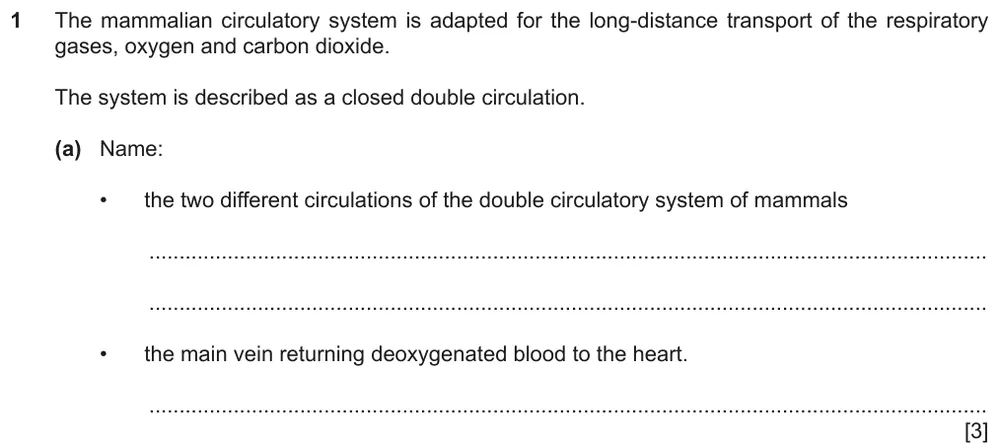
Name the two circulations of the double circulatory system and the main vein returning deoxygenated blood to the heart.
Show the mark scheme

Tap an image to open it full size.
From the examiners' report: Pulmonary was the better known of the two circulations. Very many wrote 'systematic' for systemic, which was not credited. The most common wrong blood vessel was the pulmonary vein.
Question 2
Paper 2 · October/November 2022 (22) · Q1(b) · 1 mark
Name the type of blood vessel that connects capillaries and veins.

Show the mark scheme

Tap an image to open it full size.
From the examiners' report: Many knew the answer, but far fewer could spell 'venule' correctly.
Question 3
Paper 2 · May/June 2021 (22) · Q4(e) · 2 marks
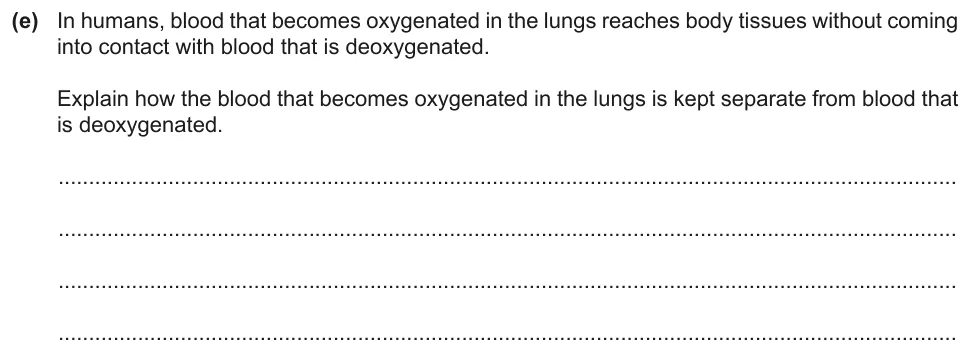
Explain how blood that becomes oxygenated in the lungs is kept separate from deoxygenated blood.
Show the mark scheme

Tap an image to open it full size.
From the examiners' report: Weaker answers said that arteries carry oxygenated blood and veins carry deoxygenated blood, forgetting that the opposite is true of the pulmonary artery and pulmonary vein. Name the septum, and state which side of the heart each type of blood passes through.
Question 4
Paper 2 · May/June 2022 (22) · Q3(c) · 1 mark
State the term for a circulatory system in which blood is kept within vessels and passes through the heart twice in each circuit.

Show the mark scheme

Tap an image to open it full size.
From the examiners' report: Both words, 'closed' and 'double', were needed for the mark.
Main blood vessels (8.1.2)
Question 5
Paper 2 · May/June 2022 (22) · Q3(e) · 3 marks · Easy
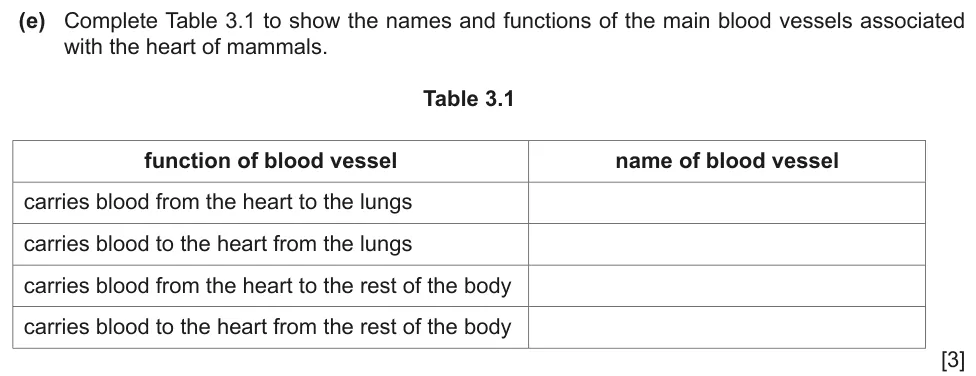
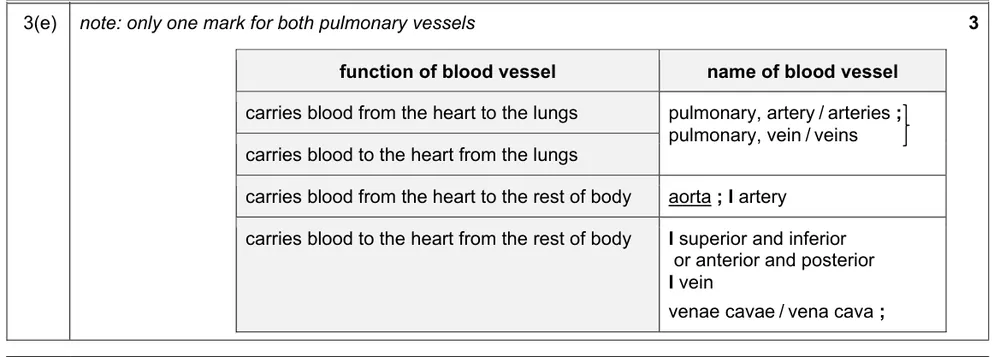
Complete the table with the names of the main blood vessels associated with the heart.
Show the mark scheme
Tap an image to open it full size.
From the examiners' report: The names were generally well known, but they must be spelled correctly. 'Arota' and 'aota' were not accepted for aorta, and 'plumonary' and 'pulmonery' were common misspellings.
Question 6
Paper 2 · October/November 2023 (22) · Q3(a) · 1 mark · Hard
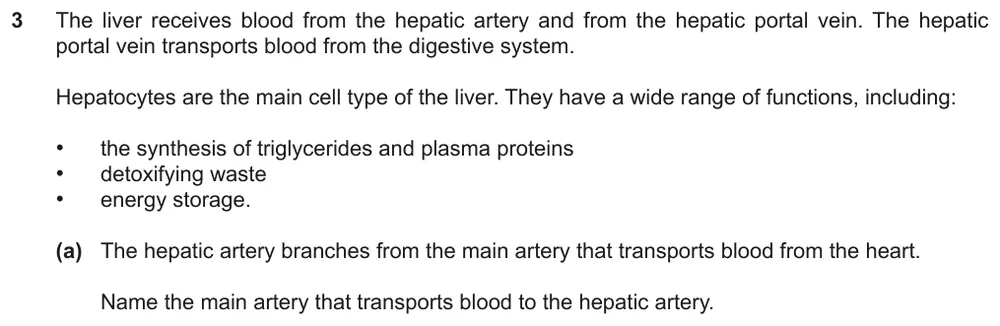
Name the main artery that transports blood to the hepatic artery.
Show the mark scheme

Tap an image to open it full size.
From the examiners' report: Most named the aorta and spelled it correctly. The most common error was to name the pulmonary artery.
Question 7
Paper 2 · May/June 2024 (21) · Q2(b)(i) · 1 mark · Easy
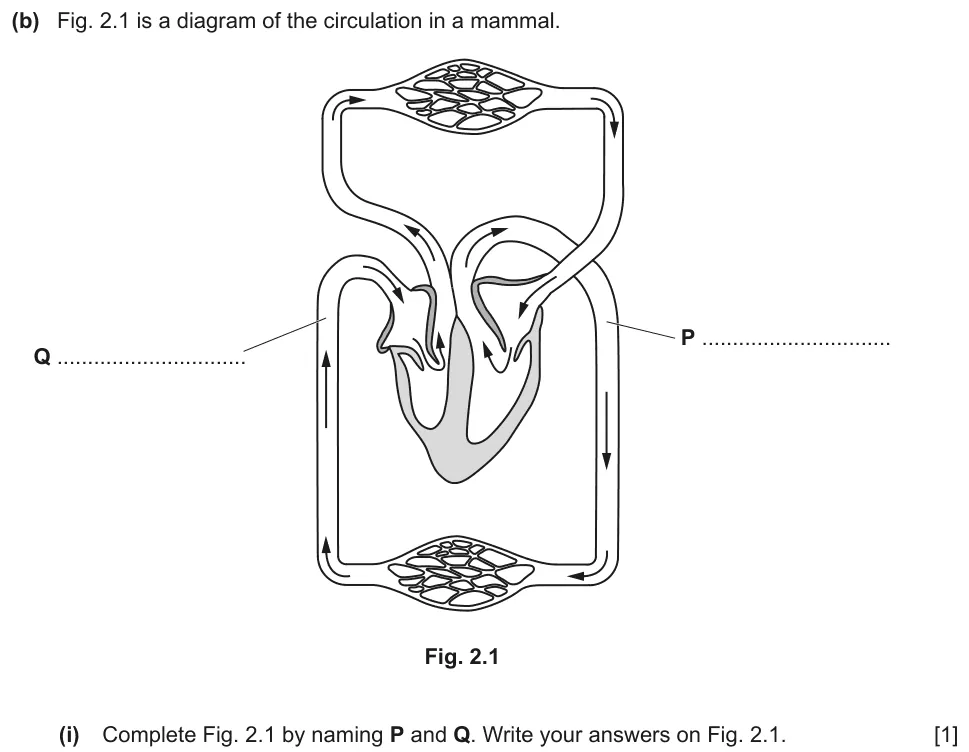
Name blood vessels P and Q on a diagram of the circulation in a mammal.
Show the mark scheme

Tap an image to open it full size.
From the examiners' report: Most named and spelled both vessels correctly. The most common error was to label P as the pulmonary artery and Q as the pulmonary vein.
Question 8
Paper 2 · May/June 2024 (21) · Q2(b)(ii) · 2 marks · Easy
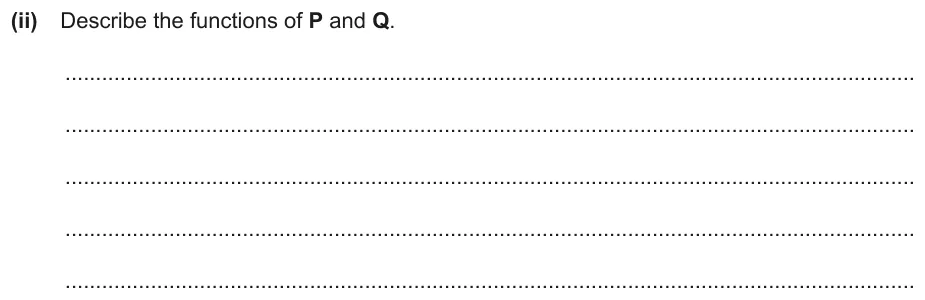
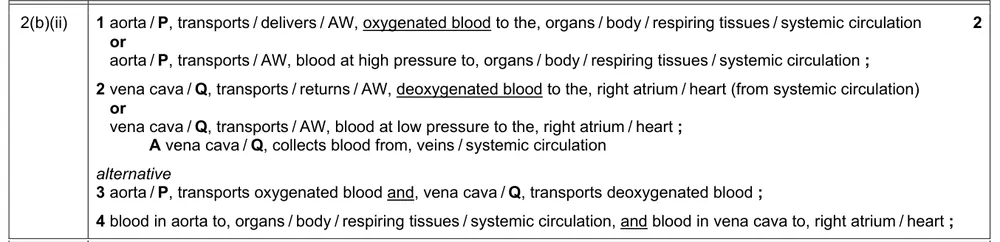
Describe the functions of blood vessels P and Q.
Show the mark scheme
Tap an image to open it full size.
From the examiners' report: Most described the blood carried by each vessel and where it goes. Answers about the blood pressure in the two vessels, rather than how oxygenated the blood is, also gained credit. Arteries and veins do not pump blood.
Capillaries: recognition, structure and function (8.1.3 and 8.1.4)
Question 9
Paper 2 · May/June 2024 (22) · Q1(c)(i) · 2 marks
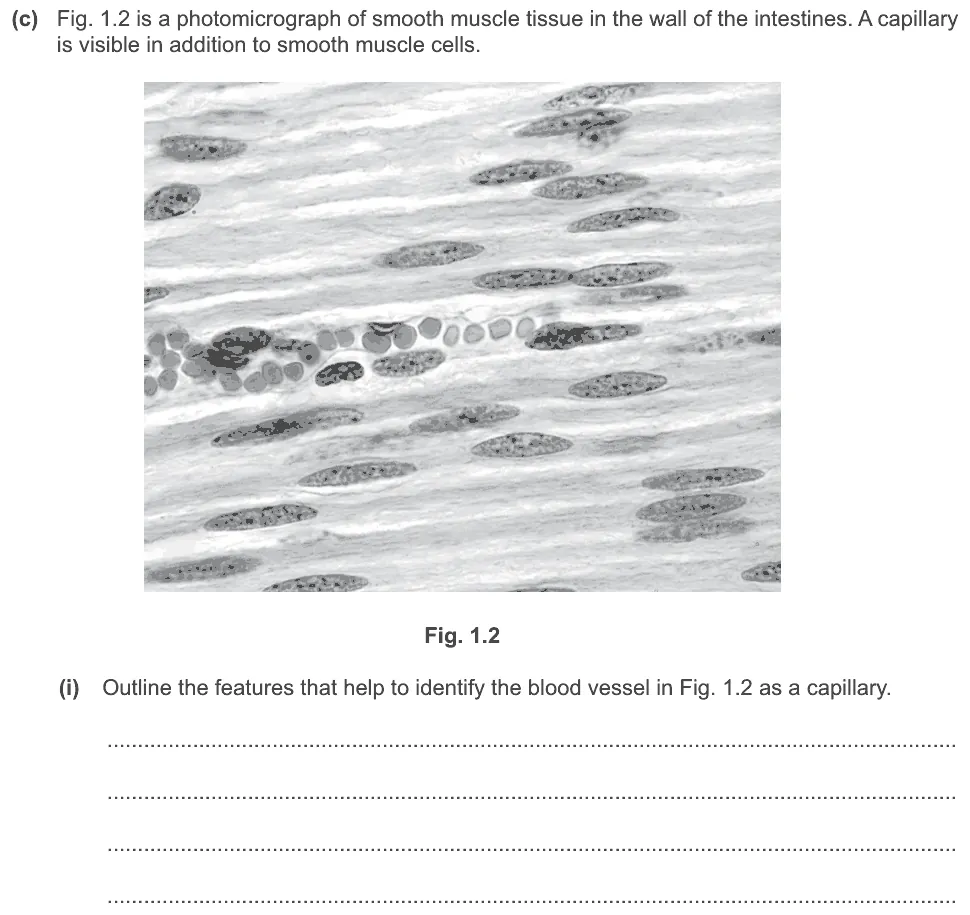
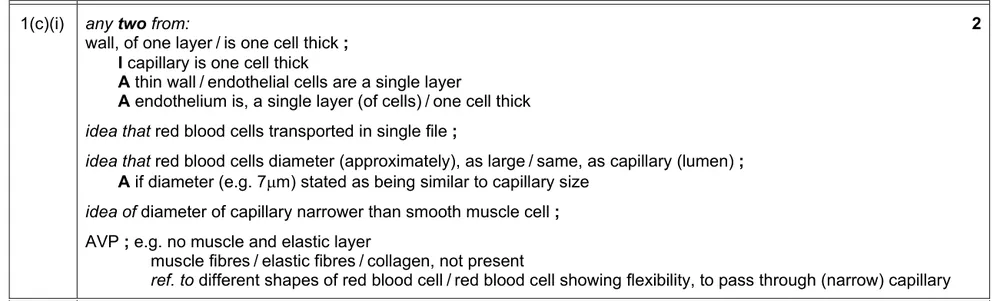
Outline the features in a photomicrograph that help to identify a blood vessel as a capillary.
Information from earlier in this question:

Show the mark scheme
Tap an image to open it full size.
From the examiners' report: Most noticed the red blood cells in a single line, each one filling the space available. Fewer described the wall precisely: 'a thin membrane' or 'the capillary is one cell thick' was not enough. The capillary wall is not a 'cell wall'.
Question 10
Paper 2 · May/June 2024 (22) · Q1(c)(ii) · 3 marks
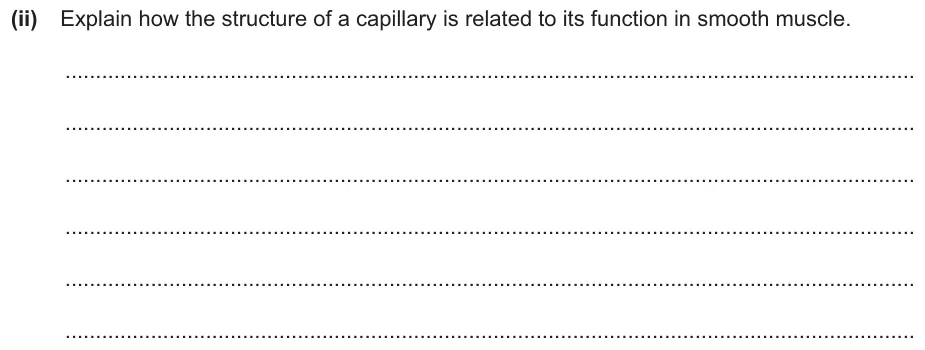
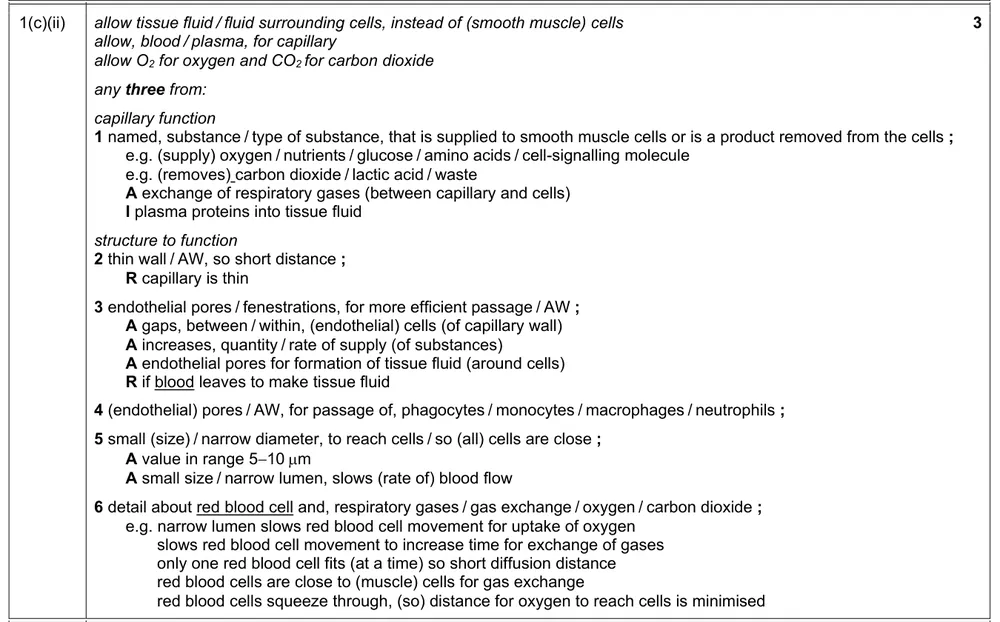
Explain how the structure of a capillary is related to its function in smooth muscle.
Show the mark scheme
Tap an image to open it full size.
From the examiners' report: The strongest answers named a substance the capillary supplies or removes, then explained how each structural feature helps. Say that a thin wall gives a short distance, not that movement is 'easier' or 'faster'. Small size has to be linked to reaching all the muscle cells.
Arteries: structure and function (8.1.4)
Question 11
Paper 2 · February/March 2023 (22) · Q5(c) · 3 marks
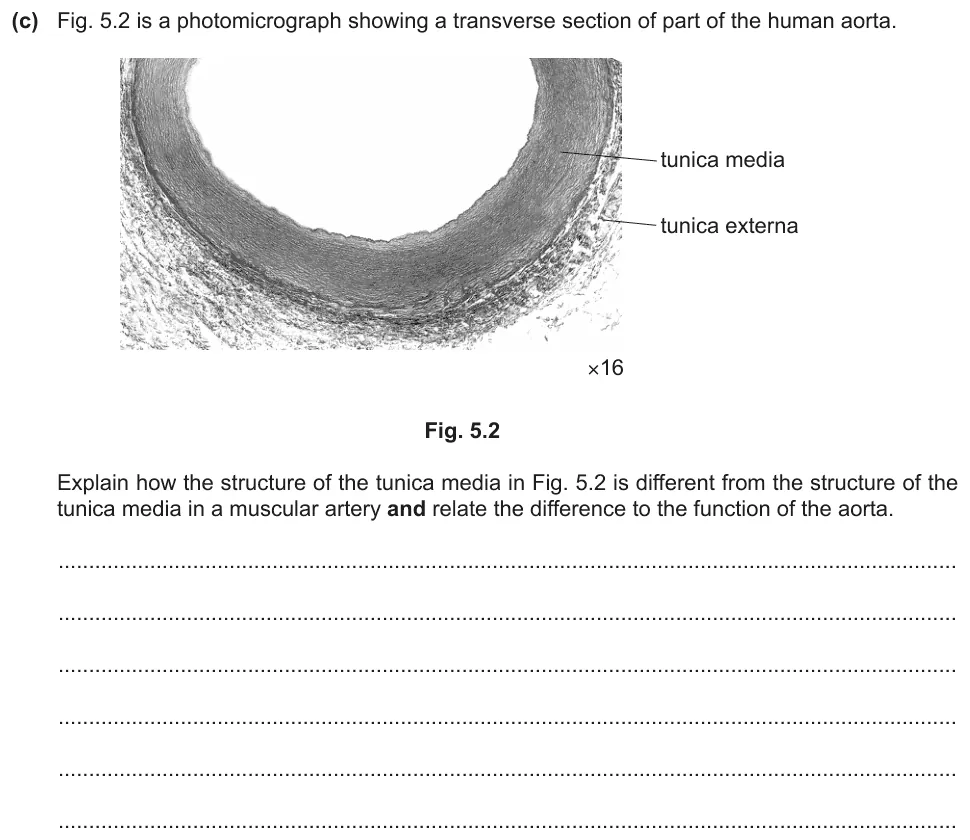
Explain how the tunica media of the aorta differs from the tunica media of a muscular artery, and relate the difference to the function of the aorta.
Show the mark scheme

Tap an image to open it full size.
From the examiners' report: Compare the amounts of elastic fibres and smooth muscle, then link this to the aorta stretching and recoiling. Elastic tissue does not 'contract and relax', and smooth muscle does not 'stretch and recoil'. The thickness of the tunica media is not a relevant difference between muscular and elastic arteries.
Question 12
Paper 2 · October/November 2023 (22) · Q5(e) · 3 marks
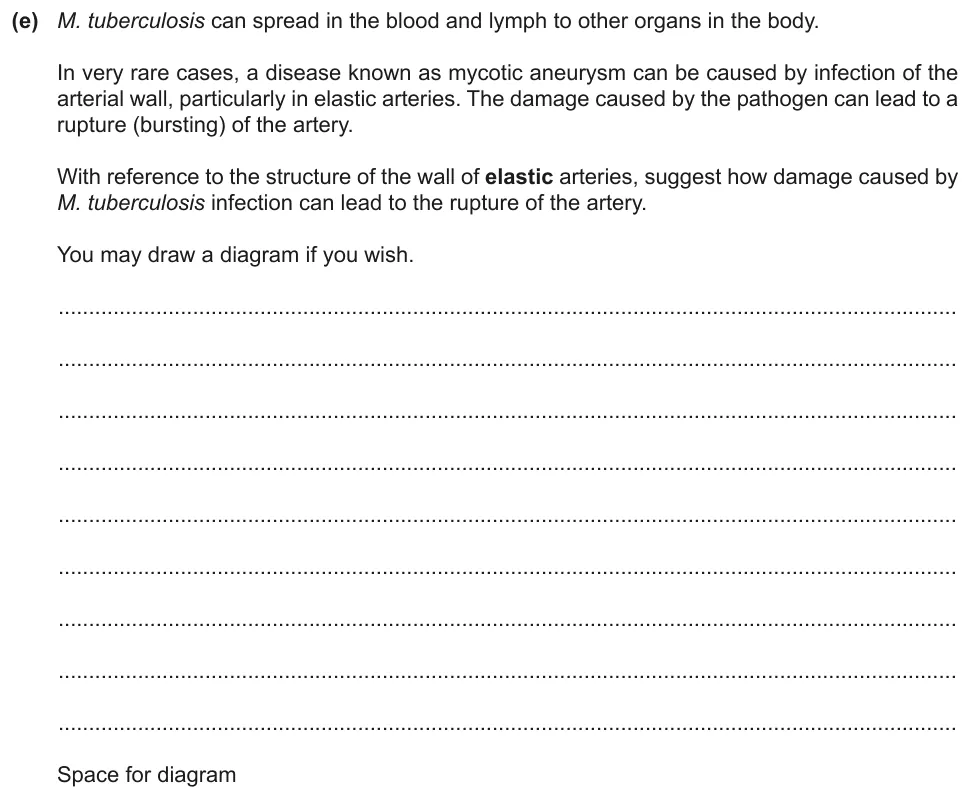
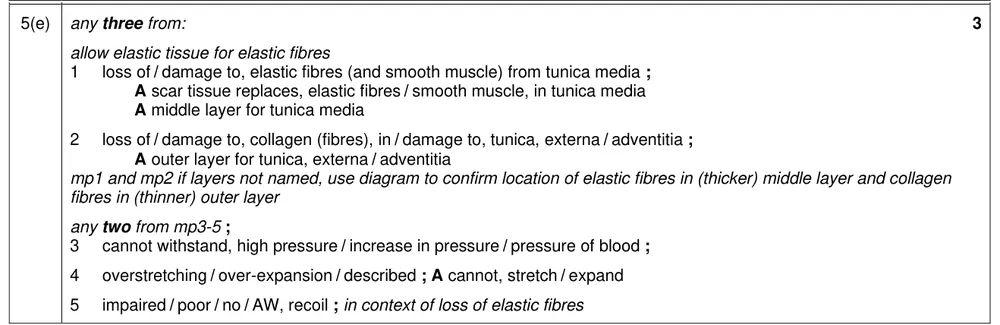
Suggest how damage to the wall of an elastic artery can lead to the artery bursting.
Show the mark scheme
Tap an image to open it full size.
From the examiners' report: Those who did well made clear that elastic fibres form the major part of the tunica media, so losing them stops the artery working properly; a labelled diagram of the three layers helped. An inability to 'contract and relax' was not credited. Some confused elastic arteries with alveoli.
Capillaries and red blood cells (8.1.4 and 8.1.5)
Question 13
Paper 2 · May/June 2023 (21) · Q5(a) · 2 marks · Easy
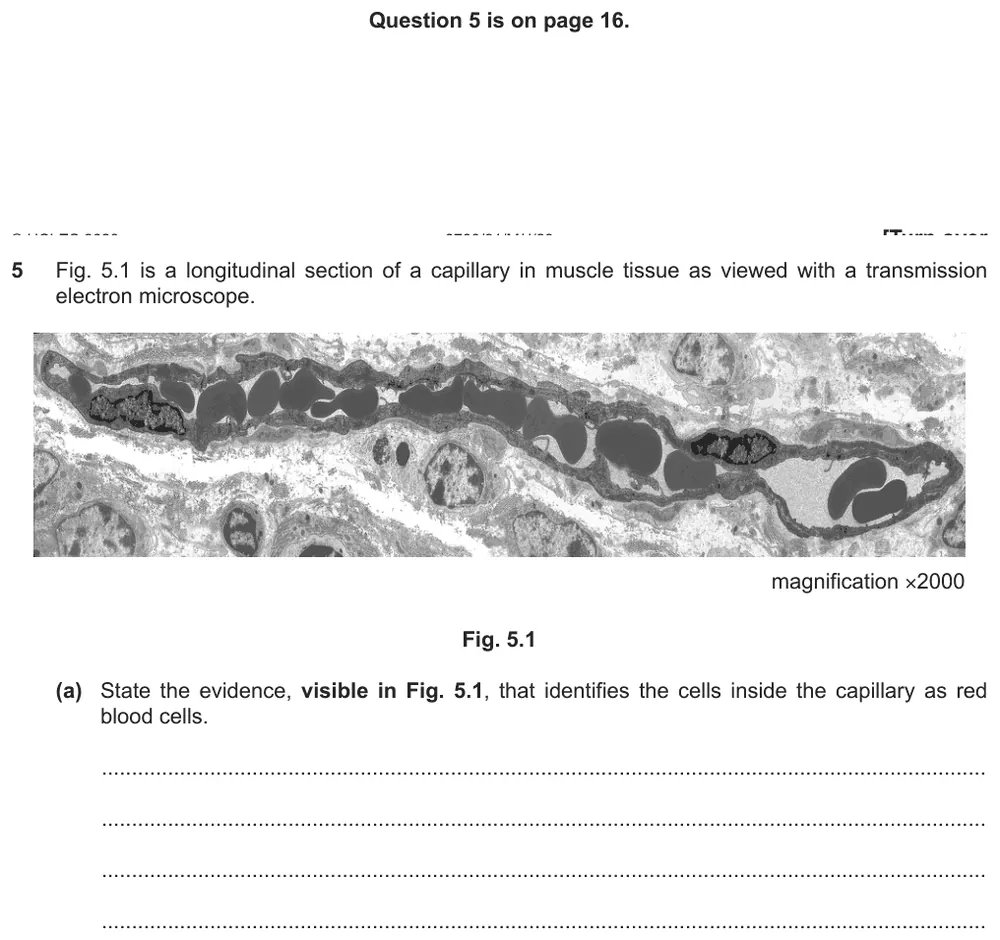
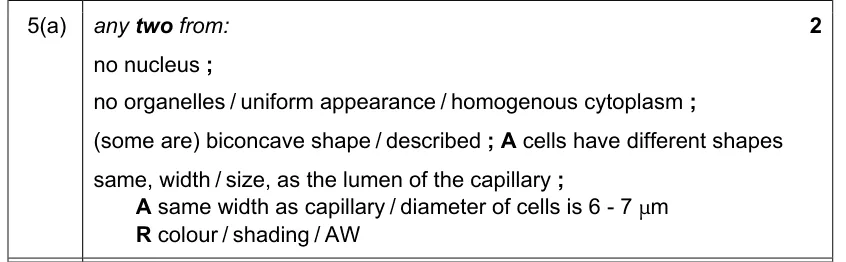
State the evidence in an electron micrograph that identifies the cells inside a capillary as red blood cells.
Show the mark scheme
Tap an image to open it full size.
From the examiners' report: Most gave biconcave shape and no nucleus. 'Flexible' on its own was not accepted. The cells are the same diameter as the lumen of the capillary, not the capillary, and the diameter is about 7 µm, not 7 nm.
Question 14
Paper 2 · May/June 2023 (21) · Q5(b) · 3 marks
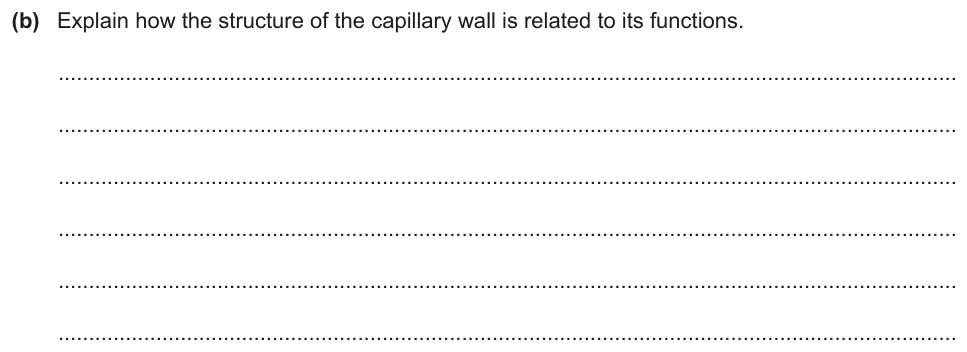
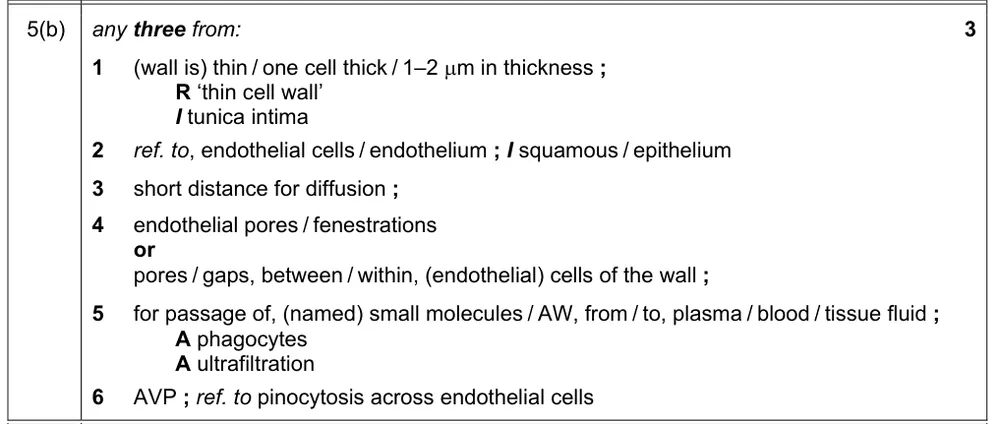
Explain how the structure of the capillary wall is related to its functions.
Show the mark scheme
Tap an image to open it full size.
From the examiners' report: Many missed the word 'wall' and wrote about the lumen or the functions of capillaries. The wall is made of endothelial cells, not squamous epithelial cells. If you mention pores or gaps, say that they are within or between the cells of the wall.
White blood cells (8.1.5)
Question 15
Paper 2 · May/June 2019 (22) · Q3(a) · 3 marks · Hard
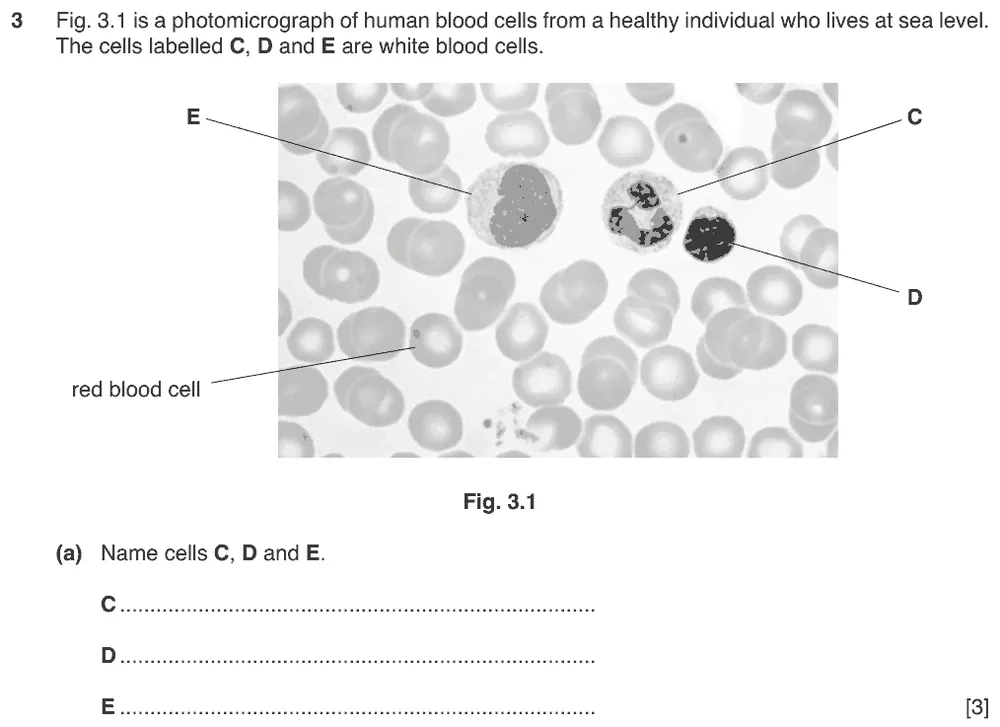
Name three types of white blood cell in a photomicrograph of human blood.
Show the mark scheme

Tap an image to open it full size.
From the examiners' report: Some had no difficulty naming the cells from the photomicrograph. E was a monocyte, although macrophage was also accepted.
Water in blood (8.1.6)
Question 16
Paper 2 · May/June 2024 (21) · Q2(a) · 3 marks · Easy
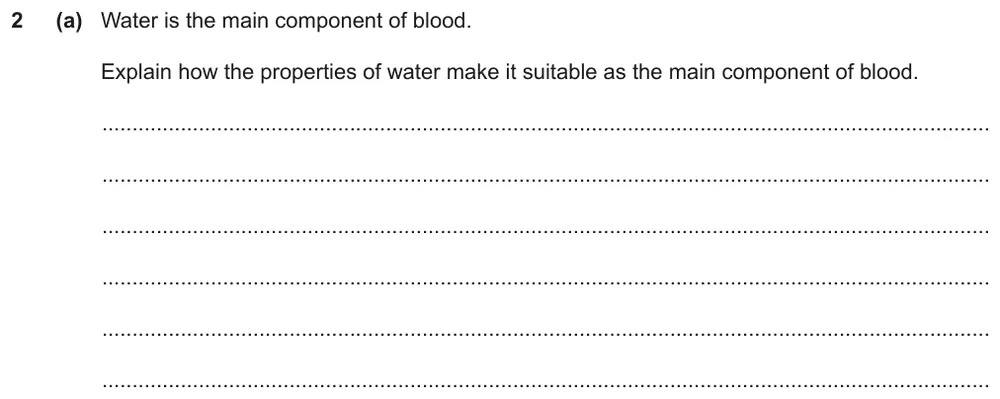
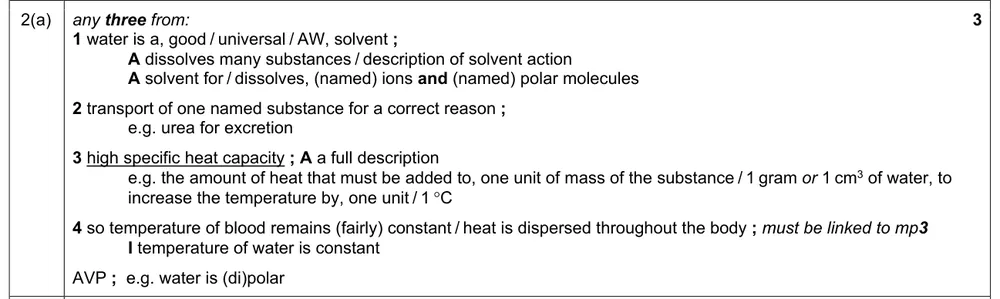
Explain how the properties of water make it suitable as the main component of blood.
Show the mark scheme
Tap an image to open it full size.
From the examiners' report: If you only say that water is a solvent, explain that ions and polar molecules dissolve in it. 'High heat capacity' without the word 'specific' gained no credit. Latent heat of vaporisation, cohesion and adhesion were not relevant to blood.
Arterioles and the formation of tissue fluid (8.1.1 and 8.1.7)
Question 17
Paper 2 · October/November 2025 (22) · Q1(c)(i) · 1 mark
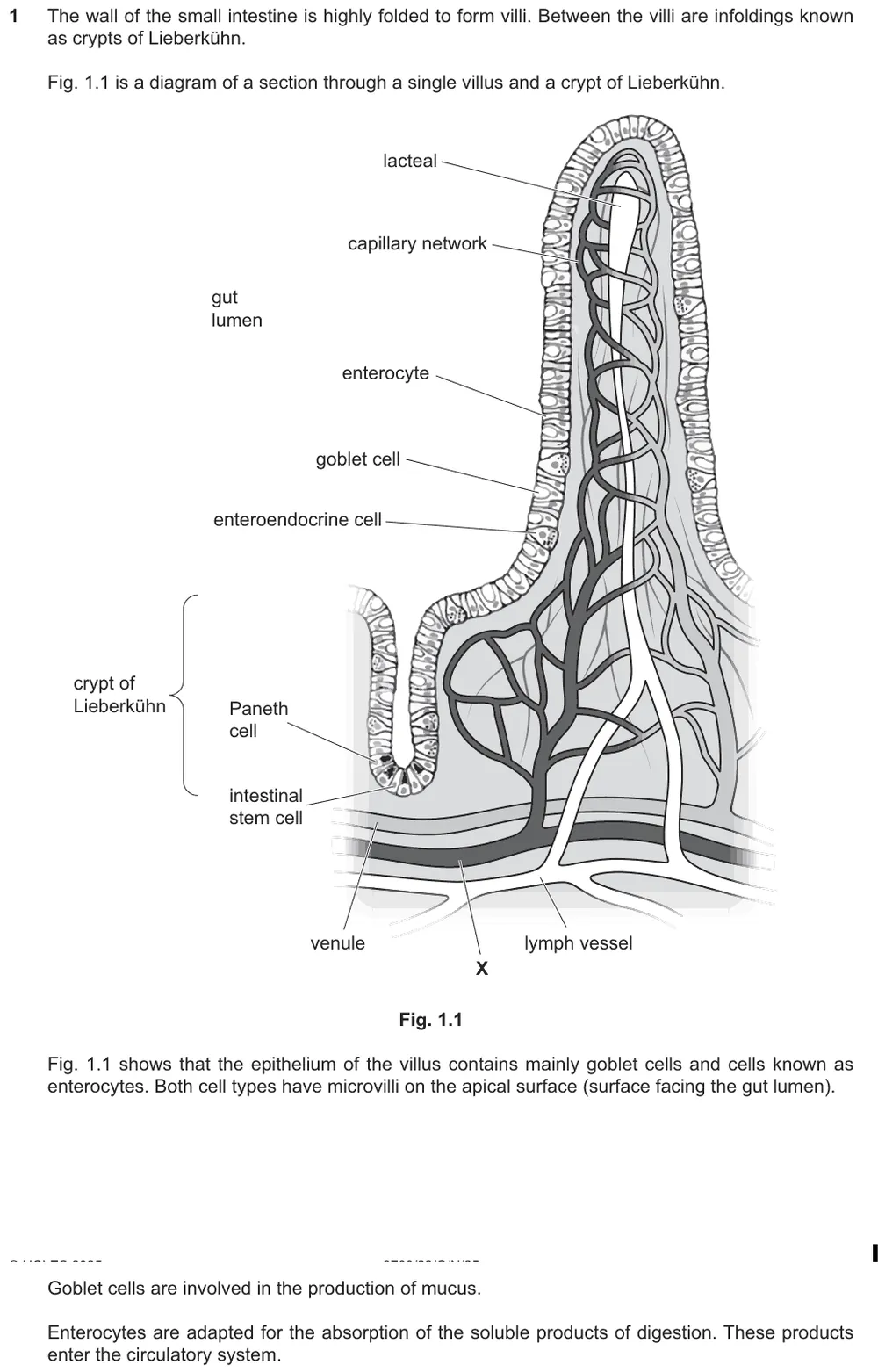
Name the type of blood vessel that receives blood from an artery and delivers it to a capillary network.
Information from earlier in this question:

Show the mark scheme

Tap an image to open it full size.
Question 18
Paper 2 · October/November 2025 (22) · Q1(c)(ii) · 2 marks
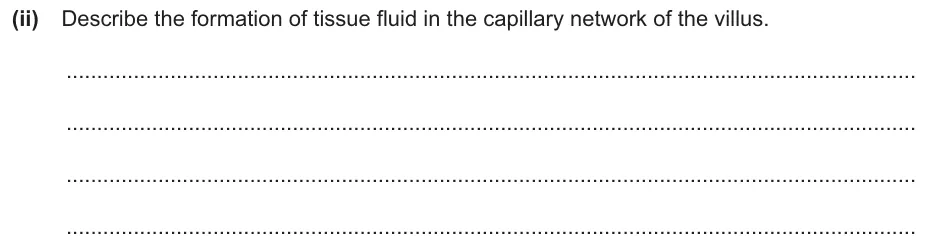
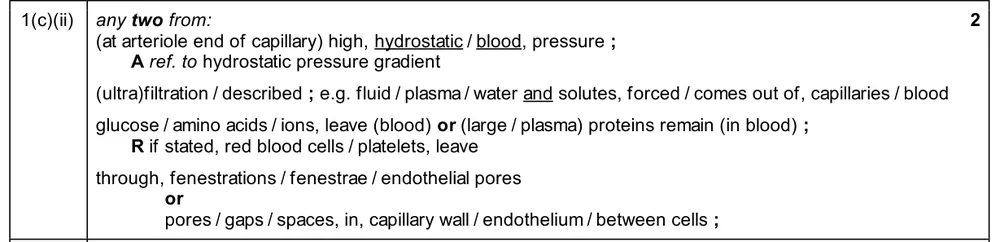
Describe the formation of tissue fluid in the capillary network of a villus.
Show the mark scheme
Tap an image to open it full size.
Tissue fluid (8.1.7)
Question 19
Paper 2 · October/November 2021 (22) · Q2(a) · 2 marks
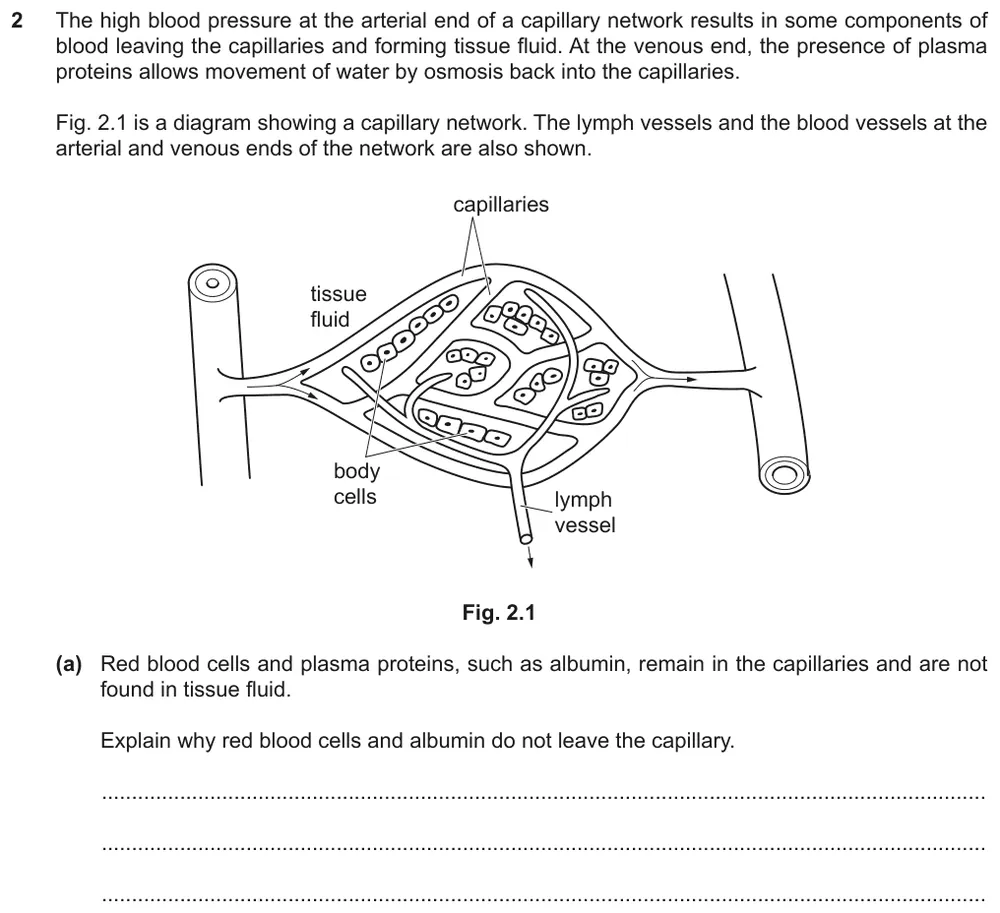
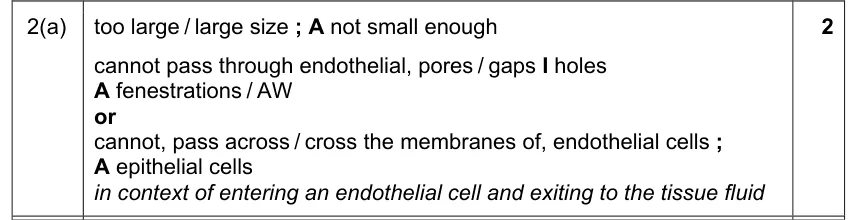
Explain why red blood cells and albumin do not leave the capillary.
Show the mark scheme
Tap an image to open it full size.
From the examiners' report: Most knew that red blood cells and plasma proteins are too large to leave. Full marks needed the endothelial pores as well. Albumin is a molecule, not a cell, and red blood cells are cells, not molecules.
Question 20
Paper 2 · October/November 2021 (22) · Q2(d) · 3 marks
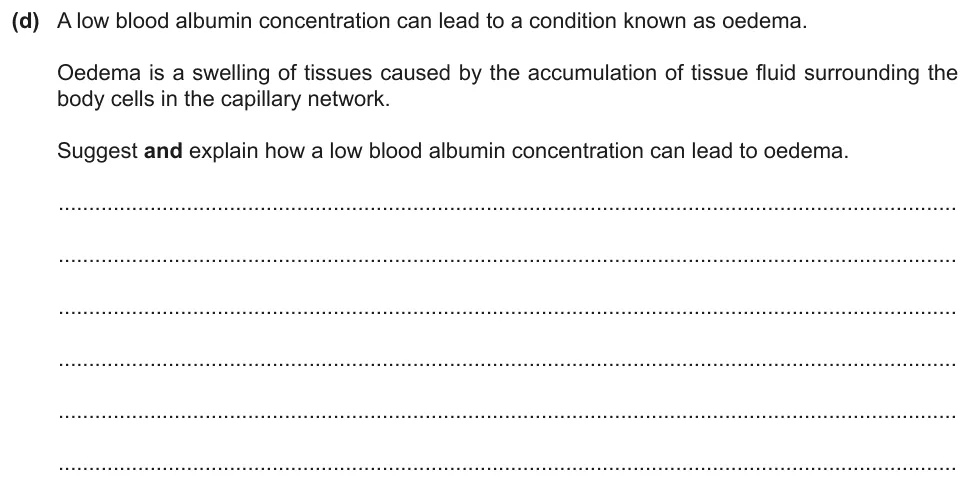
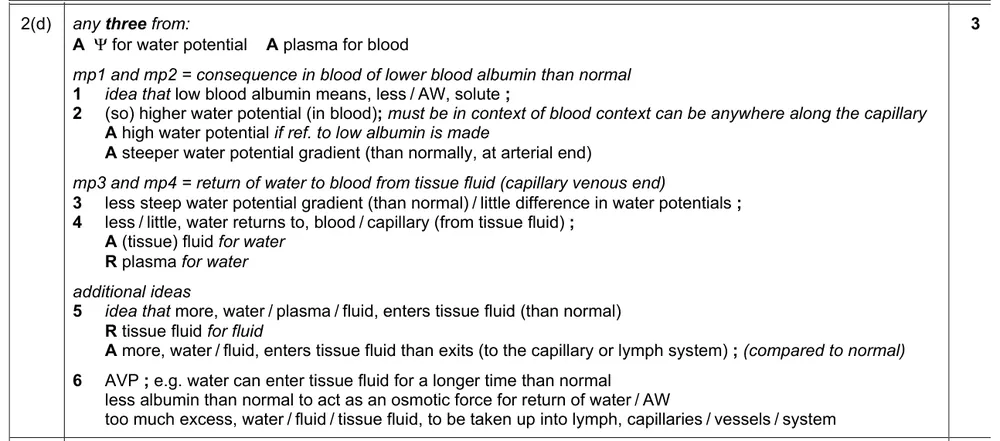
Suggest and explain how a low blood albumin concentration can lead to oedema.
Show the mark scheme
Tap an image to open it full size.
From the examiners' report: Less albumin means fewer solutes, so the blood has a higher (less negative) water potential than normal. Saying only that tissue fluid has a lower water potential gained no credit, as this is also true in people without the condition. Good answers added that less water than normal returns to the capillary at the venous end.
Question 21
Paper 2 · May/June 2021 (22) · Q3(a)(i) · 3 marks
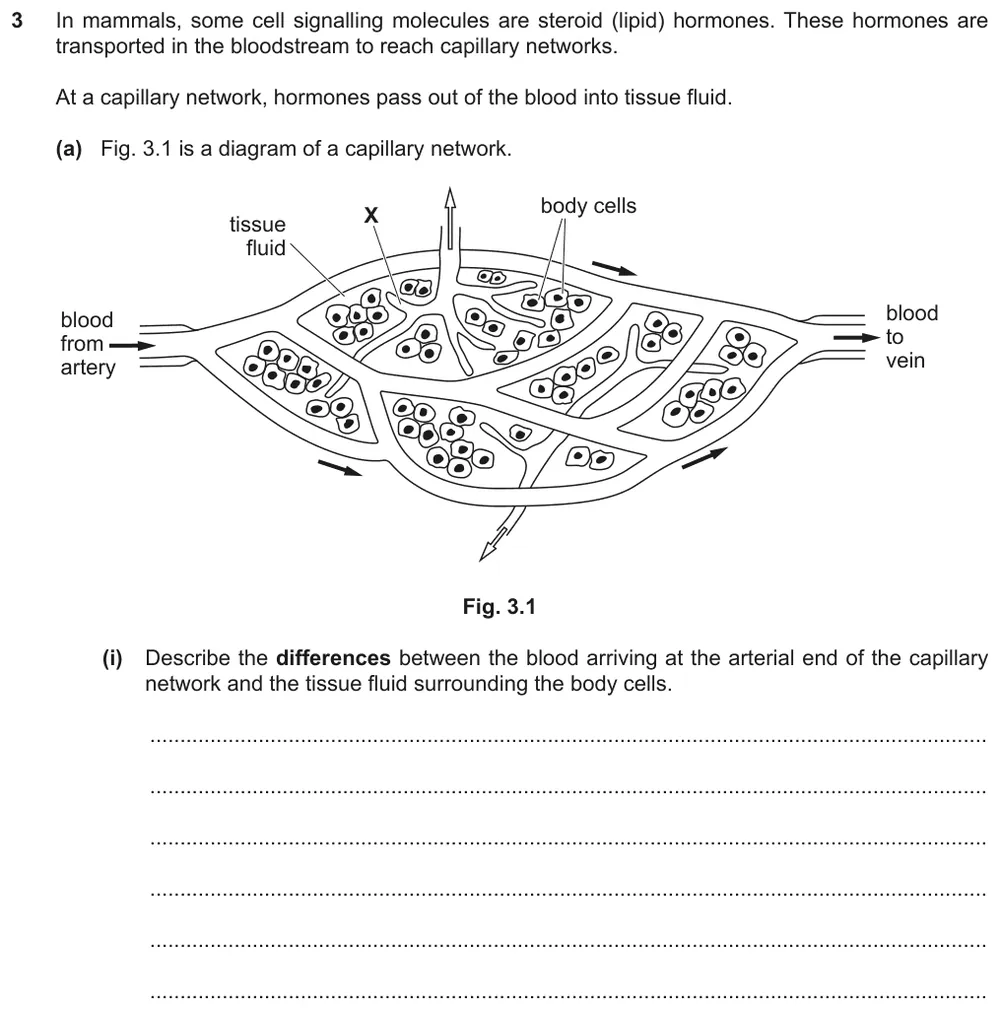
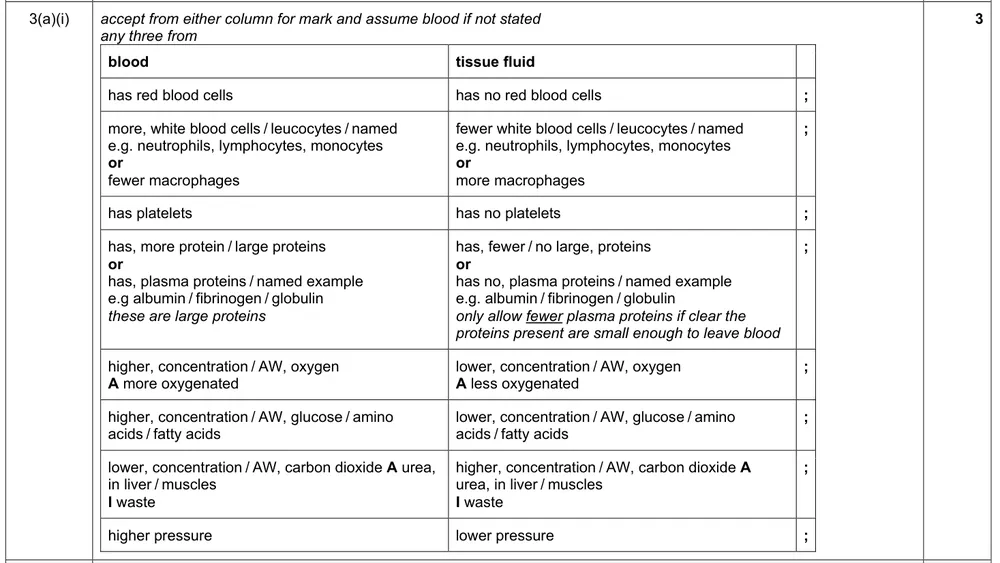
Describe the differences between blood arriving at the arterial end of a capillary network and tissue fluid.
Show the mark scheme
Tap an image to open it full size.
From the examiners' report: Write comparative sentences. 'No proteins in tissue fluid' was not credited: some proteins, such as protein hormones and antibodies, do leave the blood, and it is the large plasma proteins that stay. Some compared arterial blood with venous blood instead of with tissue fluid.
Question 22
Paper 4 (A level) · February/March 2022 (42) · Q3(b)(ii) · 1 mark · Hard
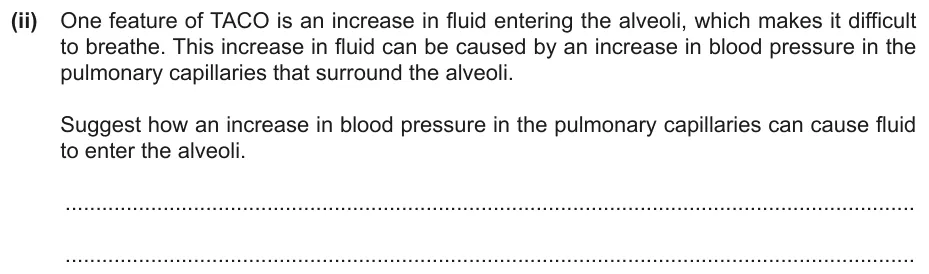
Suggest how an increase in blood pressure in the pulmonary capillaries can cause fluid to enter the alveoli.
Information from earlier in this question:

Show the mark scheme

Tap an image to open it full size.
From the examiners' report: Few linked the increase in blood pressure to more fluid entering the alveoli. Those who thought about the similar effect of high blood pressure in the glomeruli, in ultrafiltration, were best placed to make the link.
Where students lose marks (from Cambridge examiners' reports and mark schemes)
Each point below comes from the examiners' reports and mark schemes, and is followed by wording that gained marks.
Systemic, not systematic. Students wrote 'systematic circulation', which was not credited, and named the pulmonary vein as the main vein returning deoxygenated blood to the heart.
✔ Gains credit: 'pulmonary' and 'systemic' for the two circulations, and 'vena cava' for the vein.
Pulmonary vessels are the exception. Students said that arteries carry oxygenated blood and veins carry deoxygenated blood, and did not name the septum or the sides of the heart.
✔ Gains credit: 'oxygenated blood in left side and deoxygenated blood in right side of heart' and 'septum in heart separates' the blood.
Arteries and veins do not pump. Students described the aorta or the vena cava as pumping blood.
✔ Gains credit: the aorta 'transports' 'oxygenated blood to the' 'body' and the vena cava 'returns' 'deoxygenated blood to the' 'right atrium'.
The capillary wall is one cell thick. Students wrote about 'a thin membrane', said 'the capillary is one cell thick', or called the capillary wall a 'cell wall'.
✔ Gains credit: 'wall' 'is one cell thick', or 'endothelial cells are a single layer', and 'red blood cells transported in single file'.
Thin wall, short distance. Students said that a thin capillary wall makes movement 'easier' or 'faster', or that small capillaries go close to tissues.
✔ Gains credit: 'thin wall' 'so short distance' and 'narrow diameter, to reach cells'.
Muscle contracts, elastic tissue recoils. Students wrote that elastic tissue contracts and relaxes or that smooth muscle stretches and recoils, or said the difference was the thickness of the tunica media.
✔ Gains credit: the tunica media of the aorta contains 'more elastic fibres' 'than the muscular artery'; this 'allows the aorta to stretch' during 'ventricular contraction', then 'the aorta recoils'.
Large plasma proteins stay in the blood. Students wrote that tissue fluid contains no proteins, or compared arterial blood with venous blood.
✔ Gains credit: blood 'has red blood cells' and 'has' 'plasma proteins'; tissue fluid 'has no red blood cells' and 'has' 'no large' 'proteins'.
Less albumin, higher water potential. Students said only that tissue fluid has a lower water potential, or that a low albumin concentration lowers the water potential of the blood.
✔ Gains credit: 'low blood albumin means' 'less' 'solute', so 'higher water potential' in the blood, a 'less steep water potential gradient' and 'less' 'water returns to' the 'capillary'.
Download the questions
Download the PDF pack (22 questions, mark schemes at the end)
Keep practising
- Transport of Oxygen and Carbon Dioxide (8.2): Cambridge (CIE) exam questions by topic
- The Heart (8.3): Cambridge (CIE) exam questions by topic
- Cambridge (CIE) A level Biology 9700 past papers, mark schemes and examiners' reports
- Cambridge (CIE) A level Biology grade thresholds
- Book a one-to-one CIE lesson or a free 15-minute discovery chat with Tom
- Register your interest in a CIE A level Biology group class
Questions, mark schemes and examiners' report extracts © Cambridge University Press & Assessment.