

Protein Synthesis (6.2): Cambridge (CIE) A Level Biology 9700 Exam Questions by Topic
Protein synthesis is sub-topic 6.2 of Topic 6, Nucleic acids and protein synthesis, in the Cambridge International AS & A Level Biology syllabus (9700). You need to know that a gene is a sequence of nucleotides, forming part of a DNA molecule, that codes for a polypeptide; describe the universal genetic code, including start and stop codons; describe transcription and translation and the roles of RNA polymerase, mRNA, codons, tRNA, anticodons and ribosomes; explain how the primary transcript is modified by removing introns and joining exons; and explain how substitution, deletion and insertion of nucleotides may affect the polypeptide. This is AS content, examined on Papers 1 and 2. A level students meet it again on Paper 4; questions marked A level on this page come from Paper 4.
The examiners' reports make the same points. A gene is not a strand of DNA or a sequence of amino acids. The genetic code is degenerate, not 'degenerative'. RNA contains uracil, so a tRNA anticodon never includes T, and a DNA sequence never includes U. The RNA made by transcription in a eukaryote is the primary transcript; keep the term mRNA for the molecule left after the introns are removed. When you explain a gene mutation, say that the change is in DNA and go on to the polypeptide.
Studying Cambridge International A level Biology and want more help? Tom teaches CIE students one-to-one online, including students in the UAE, Saudi Arabia, Hong Kong, India and Indonesia, and every lesson is recorded. You can book a one-to-one lesson or a free 15-minute discovery chat, or register your interest in a CIE group class starting in September 2027, using the links at the bottom of this page.
What you need from IGCSE
Each question on this page assumes you're secure on these ideas. If any of them feels shaky, look it up before you start.
- A gene is a length of DNA that codes for a protein.
- The sequence of bases in a gene determines the sequence of amino acids in the protein that is made.
- mRNA carries a copy of the gene from the nucleus to the cytoplasm, where ribosomes assemble amino acids into a protein.
- A gene mutation is a random change in the base sequence of DNA.
Key terms
These words come up in the questions and mark schemes. Examiners expect you to use them exactly.
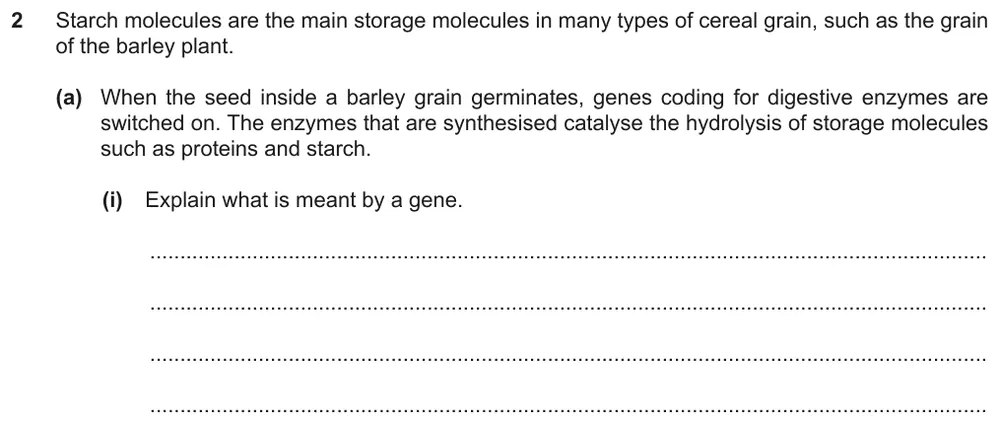
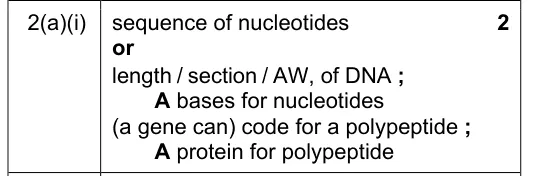
- Gene: a sequence of nucleotides that forms part of a DNA molecule and codes for a polypeptide.
- Codon: a triplet of bases in mRNA that codes for one amino acid, or is a start or stop codon.
- Anticodon: the triplet of bases on a tRNA molecule that pairs with a complementary mRNA codon.
- Transcribed (template) strand: the strand of DNA that is used in transcription; the other strand is the non-transcribed strand.
- Primary transcript: the RNA molecule formed by transcription in eukaryotes, before it is modified to form mRNA.
- Introns: non-coding sequences that are removed from the primary transcript.
- Exons: coding sequences that are joined together to form mRNA.
- Frameshift: a change in the reading frame caused by the deletion or insertion of a nucleotide, so that every triplet after the mutation is different.
What these questions cover (Cambridge 9700 Topic 6: Nucleic acids and protein synthesis)
The questions test these learning outcomes from sub-topic 6.2 of the Cambridge International AS & A Level Biology syllabus (9700) for 2025 to 2027.
- 6.2.1 state that a polypeptide is coded for by a gene and that a gene is a sequence of nucleotides that forms part of a DNA molecule
- 6.2.2 describe the principle of the universal genetic code in which different triplets of DNA bases either code for specific amino acids or correspond to start and stop codons
- 6.2.3 describe how the information in DNA is used during transcription and translation to construct polypeptides
- 6.2.4 state that the strand of a DNA molecule that is used in transcription is called the transcribed or template strand and that the other strand is called the non-transcribed strand
- 6.2.5 explain that, in eukaryotes, the RNA molecule formed following transcription (primary transcript) is modified by the removal of non-coding sequences (introns) and the joining together of coding sequences (exons) to form mRNA
- 6.2.6 state that a gene mutation is a change in the sequence of base pairs in a DNA molecule that may result in an altered polypeptide
- 6.2.7 explain that a gene mutation is a result of substitution or deletion or insertion of nucleotides in DNA and outline how each of these types of mutation may affect the polypeptide produced
How to use this page
Write your answer on paper before you open the mark scheme. Allow about 1.2 minutes per mark: the 22 questions are worth 51 marks, so about 61 minutes in total. Then mark your answer strictly against the mark scheme and read the examiners' tip underneath it. If you'd rather print the questions, download the PDF pack.
Genes (6.2.1)
Question 1
Paper 2 · October/November 2025 (22) · Q3(a) · 3 marks
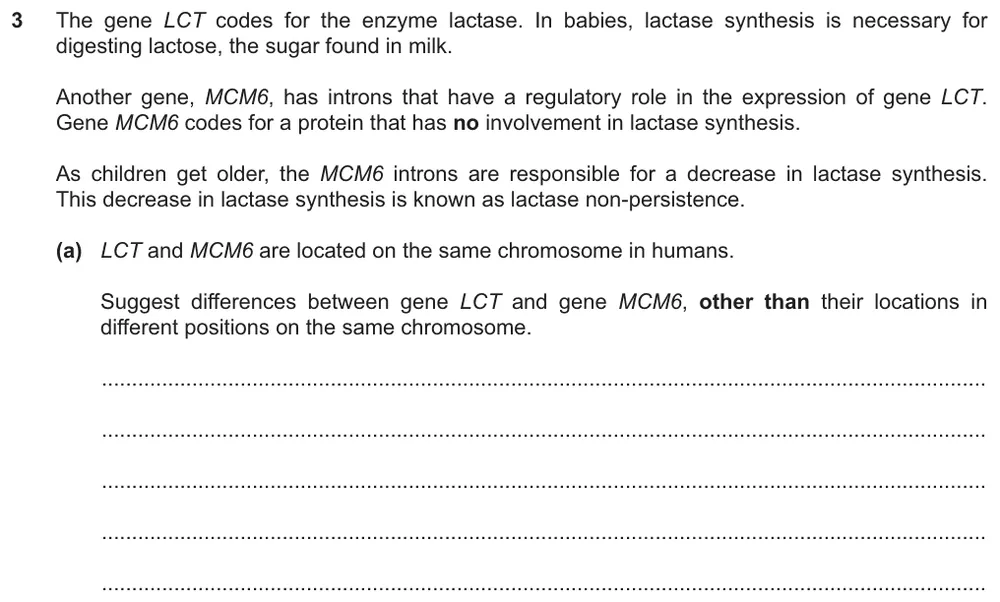
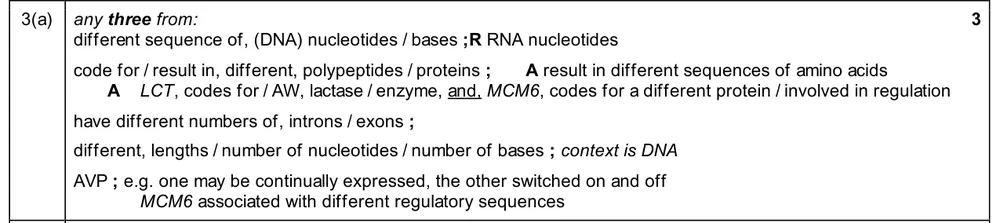
Suggest differences between two genes on the same chromosome, other than their positions.
Show the mark scheme
Tap an image to open it full size.
Question 2
Paper 2 · February/March 2021 (22) · Q2(a)(i) · 2 marks
Explain what is meant by a gene.
Show the mark scheme
Tap an image to open it full size.
From the examiners' report: Wrong answers described a gene as a strand of DNA or as a sequence of amino acids, or said that a gene codes for a sequence of nucleotides. Vague statements about genes holding information to control characteristics needed more specific detail.
The genetic code (6.2.2)
Question 3
Paper 2 · May/June 2025 (22) · Q6(b) · 2 marks
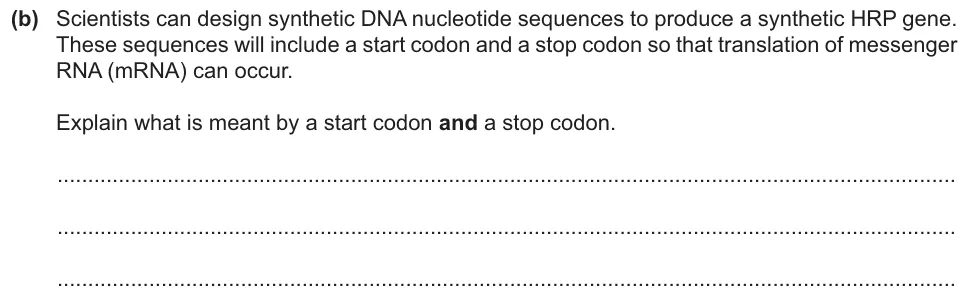
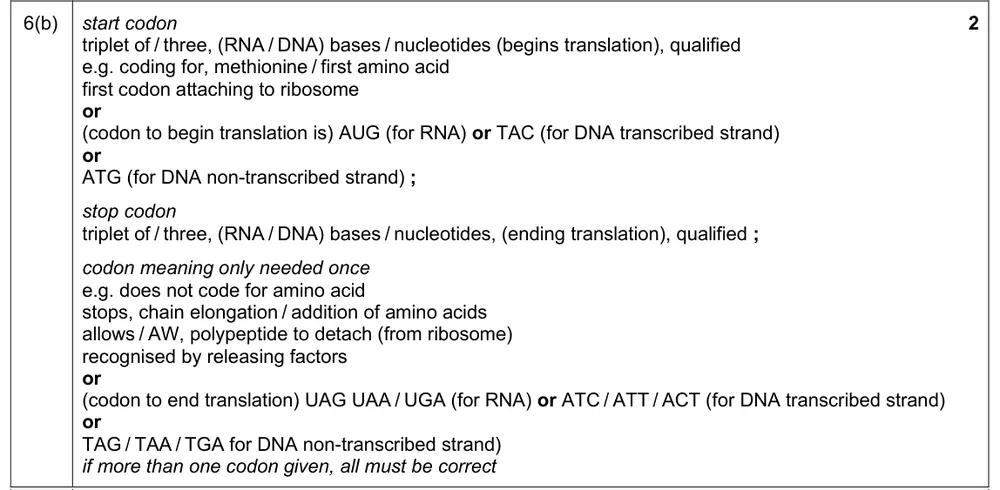
Explain what is meant by a start codon and a stop codon.
Show the mark scheme
Tap an image to open it full size.
Question 4
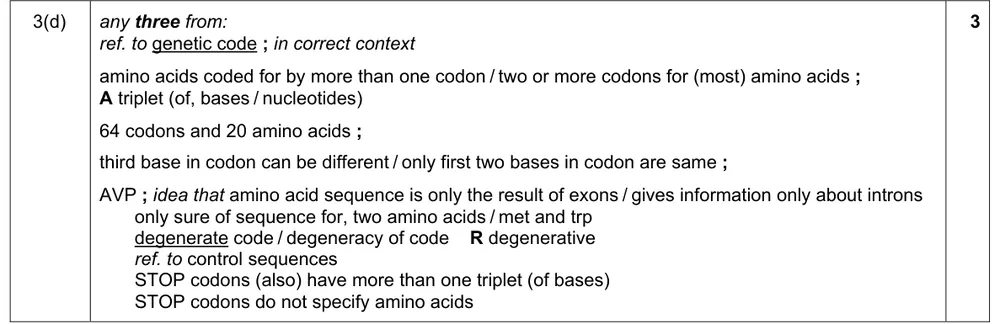
Paper 2 · October/November 2021 (22) · Q3(d) · 3 marks
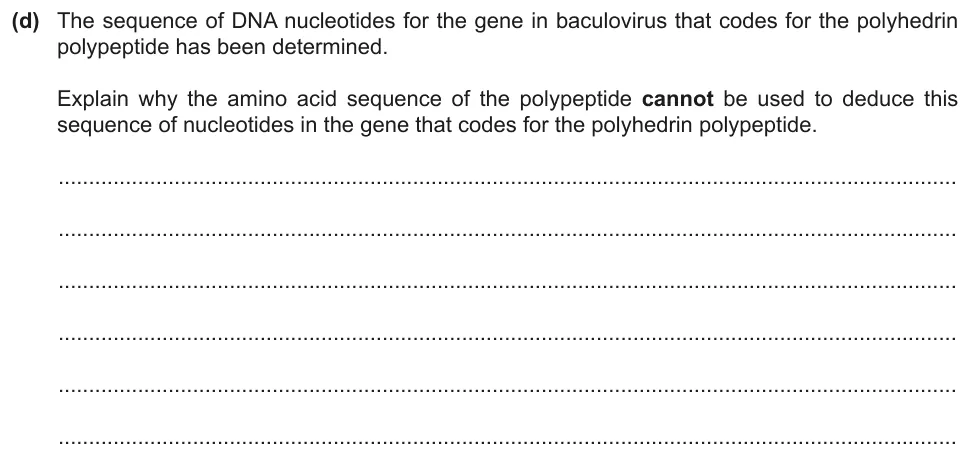
Explain why the amino acid sequence of a polypeptide cannot be used to work out the nucleotide sequence of its gene.
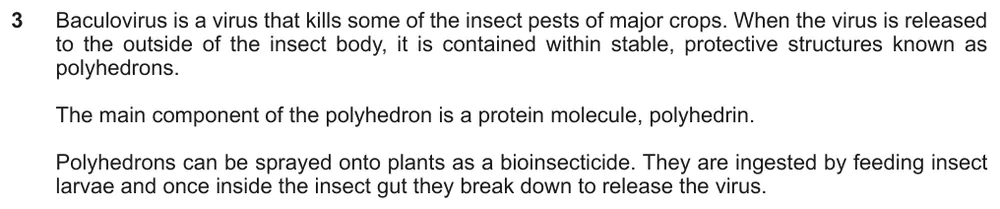
Information from earlier in this question:
Show the mark scheme
Tap an image to open it full size.
From the examiners' report: Stronger answers used the correct terms, mRNA codons or DNA triplets, named the genetic code and said that it is degenerate. 'Degenerative' is not correct, and 'code' does not mean 'codon'. Make it clear that a group of three nucleotides codes for an amino acid. Weaker answers gave vague descriptions of translation.
From template strand to amino acids, and two mutations (6.2.2, 6.2.3 and 6.2.7)
Question 5
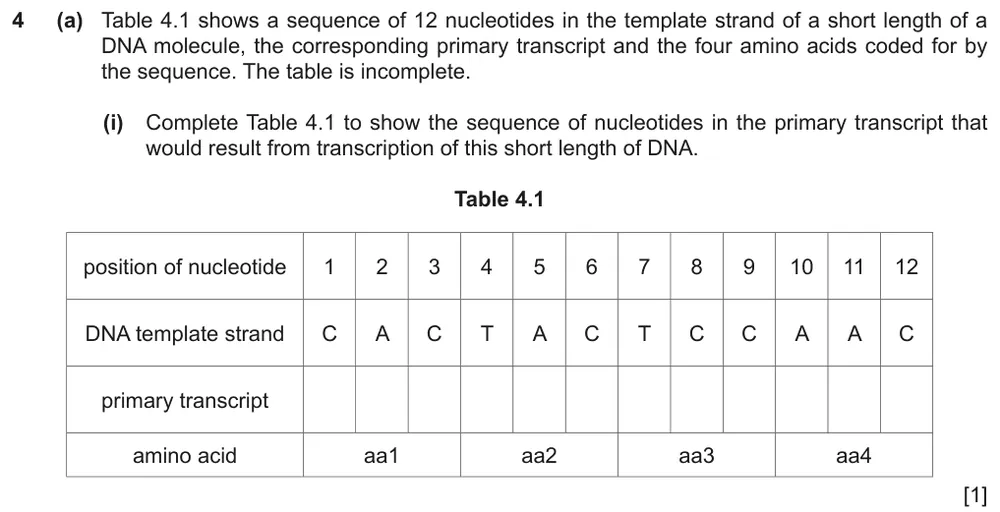
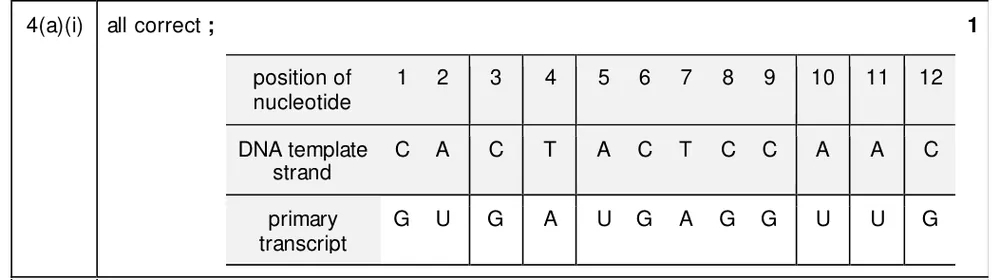
Paper 2 · February/March 2024 (22) · Q4(a)(i) · 1 mark
Complete the table with the primary transcript made from a 12-nucleotide DNA template strand.
Show the mark scheme
Tap an image to open it full size.
Question 6
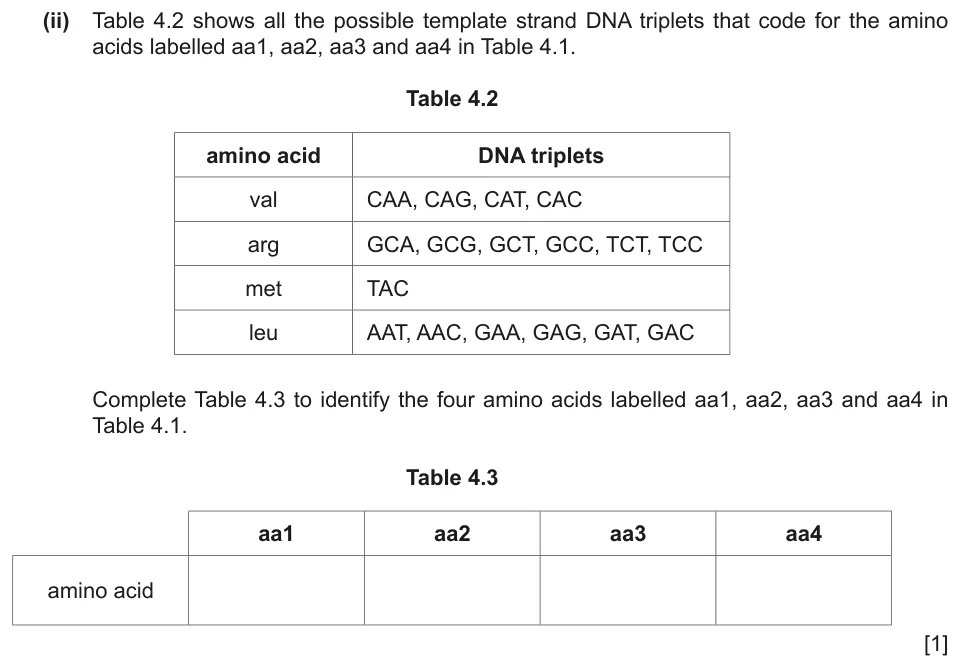
Paper 2 · February/March 2024 (22) · Q4(a)(ii) · 1 mark
Use the table of DNA triplets to identify the four amino acids.
Show the mark scheme

Tap an image to open it full size.
Question 7
Paper 2 · February/March 2024 (22) · Q4(a)(iii) · 2 marks
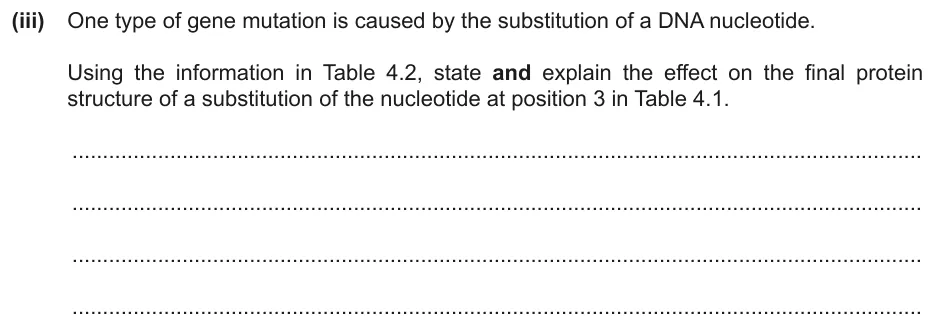
State and explain the effect on the protein of substituting the nucleotide at position 3.
Show the mark scheme

Tap an image to open it full size.
Question 8
Paper 2 · February/March 2024 (22) · Q4(a)(iv) · 3 marks
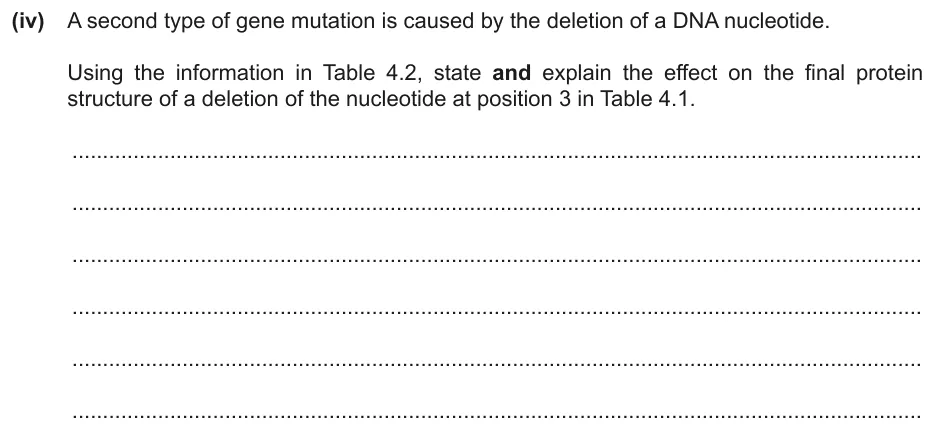
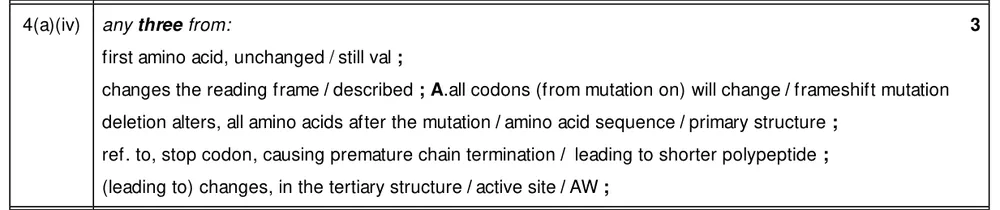
State and explain the effect on the protein of deleting the nucleotide at position 3.
Show the mark scheme
Tap an image to open it full size.
Transcription and translation (6.2.3)
Question 9
Paper 2 · May/June 2017 (22) · Q6(b) · 2 marks
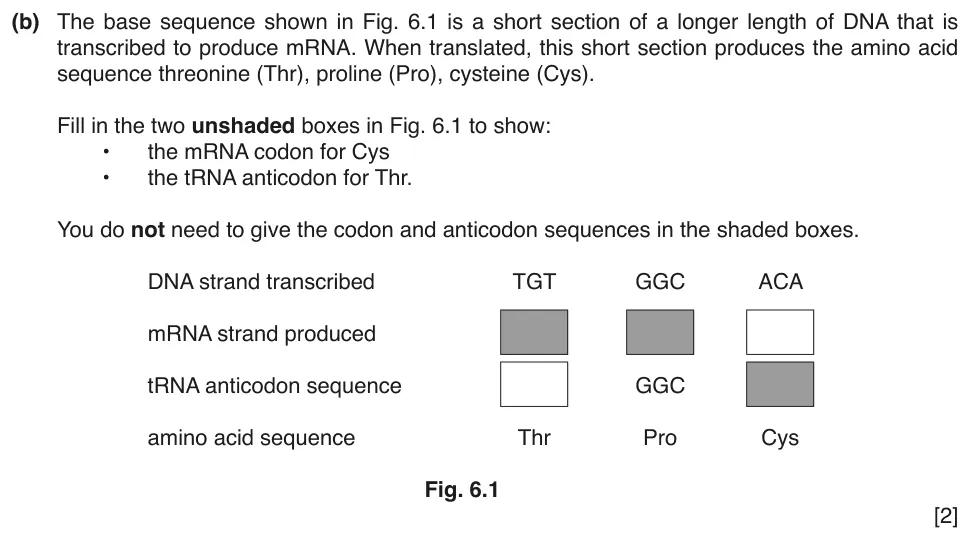
Fill in the mRNA codon for cysteine and the tRNA anticodon for threonine.
Show the mark scheme

Tap an image to open it full size.
From the examiners' report: Thymine in DNA is replaced by uracil in all forms of RNA, yet the tRNA anticodon was often given as TGT. ACA was also seen quite often. Some students wrote an amino acid in the boxes.
Question 10
Paper 2 · May/June 2022 (21) · Q6(c)(i) · 4 marks
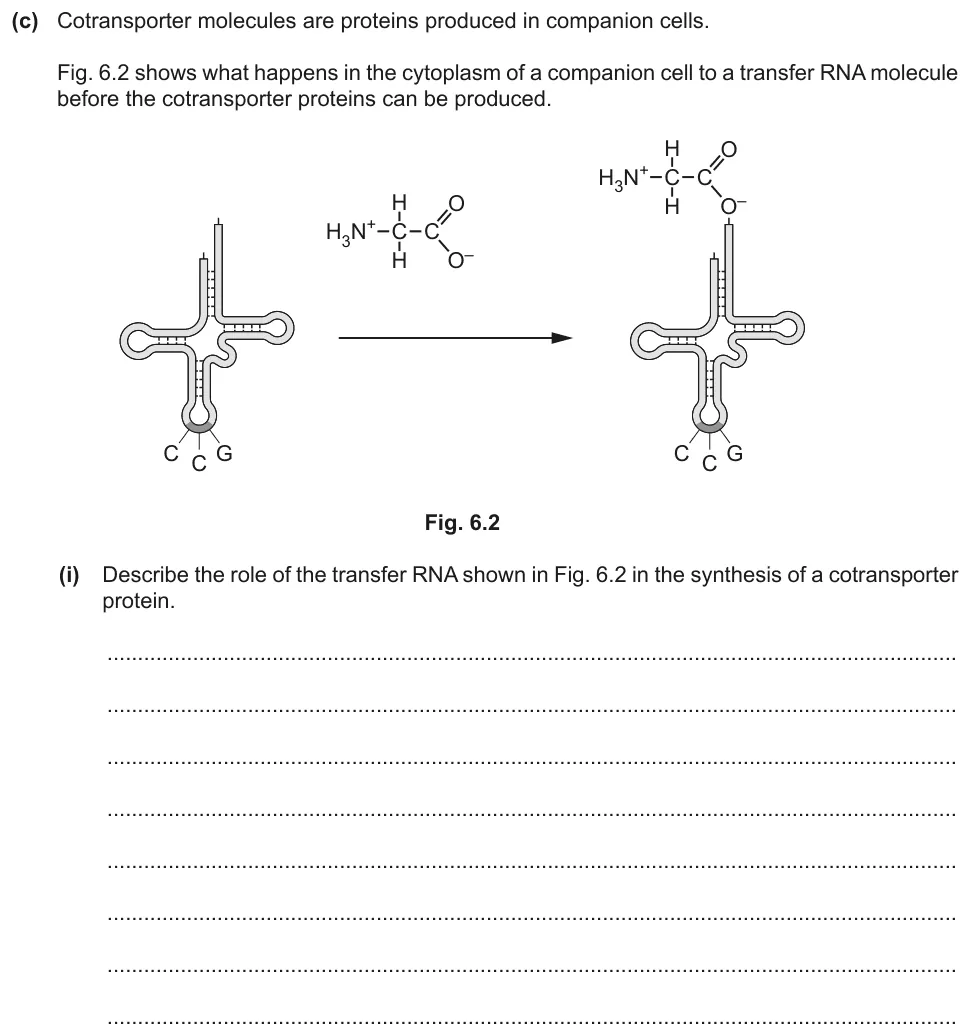
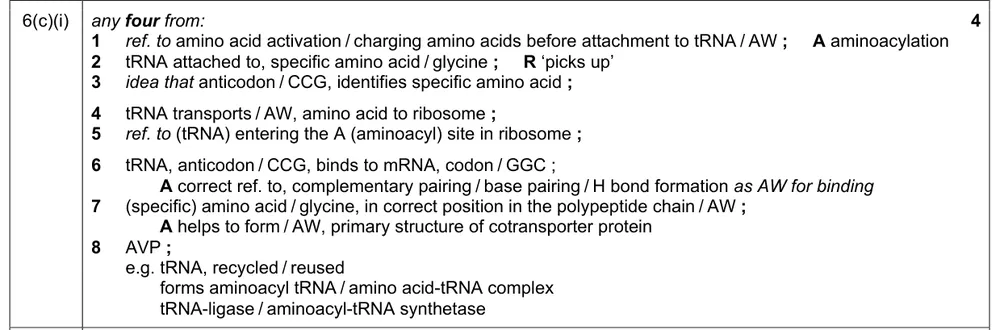
Describe the role of the transfer RNA shown in the diagram in the synthesis of a cotransporter protein.
Information from earlier in this question:

Show the mark scheme
Tap an image to open it full size.
From the examiners' report: The best answers kept to the role of the transfer RNA and did not describe the whole of translation. Events that come afterwards, such as the folding of the polypeptide or the formation of the tertiary structure, are not part of the role of tRNA and were not needed.
Transcription, modifying the transcript and translation (6.2.3 and 6.2.5)
Question 11
Paper 2 · February/March 2022 (22) · Q6(b) · 1 mark
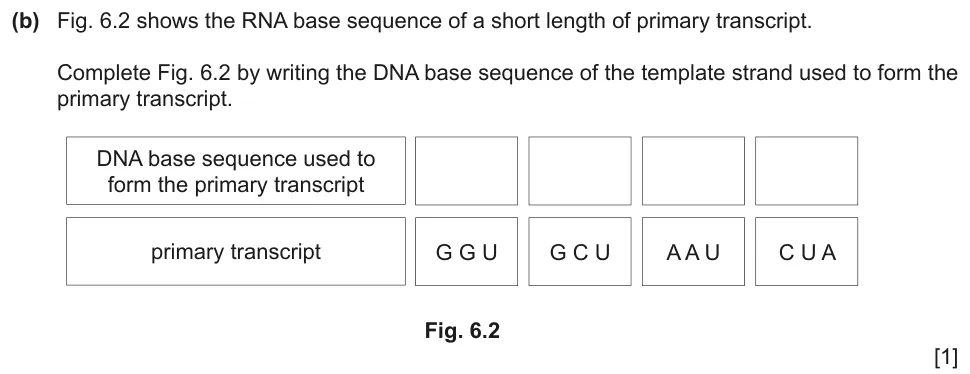
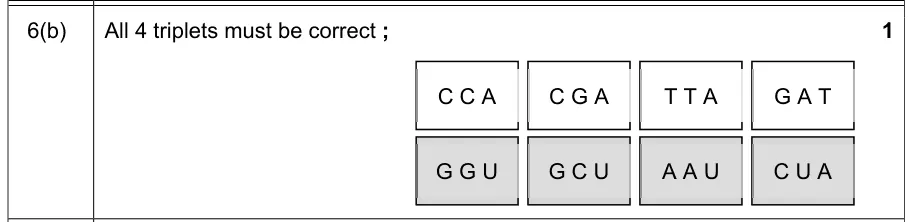
Write the DNA base sequence of the template strand used to form a short primary transcript.
Show the mark scheme
Tap an image to open it full size.
From the examiners' report: The most common error was to include U in the DNA sequence. Some students put only one or two bases in each of the four boxes.
Question 12
Paper 2 · February/March 2022 (22) · Q6(c) · 2 marks
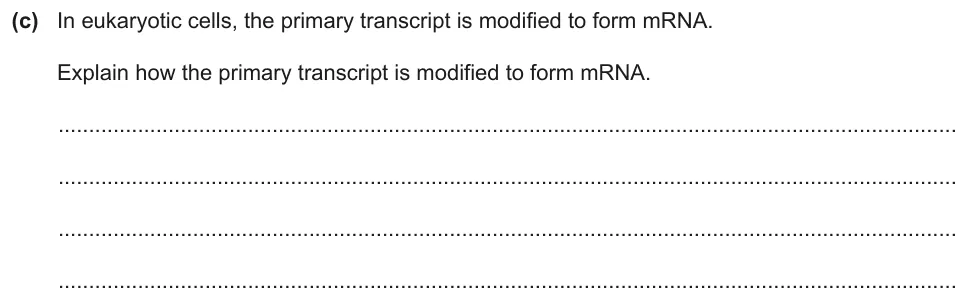
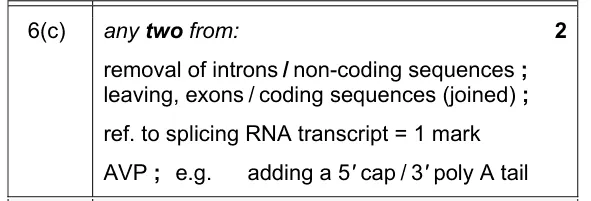
Explain how the primary transcript is modified to form mRNA.
Show the mark scheme
Tap an image to open it full size.
From the examiners' report: Some students tried to answer in terms of transcription or translation.
Question 13
Paper 2 · February/March 2022 (22) · Q6(d) · 5 marks
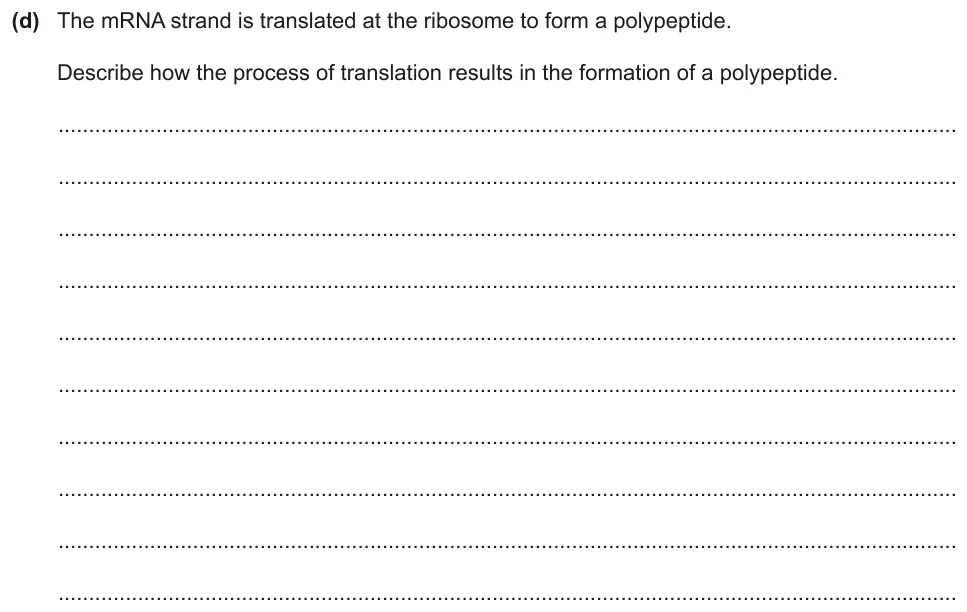
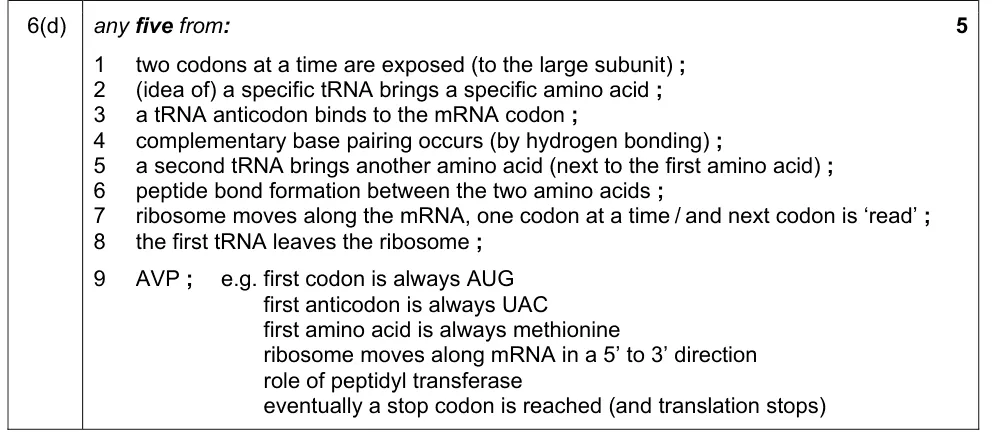
Describe how translation results in the formation of a polypeptide.
Show the mark scheme
Tap an image to open it full size.
From the examiners' report: A significant number left out relevant details such as the complementary base pairing between codons and anticodons. The weakest answers mixed up details of translation with details of DNA replication.
Transcribed strand and primary transcript (6.2.3, 6.2.4 and 6.2.5)
Question 14
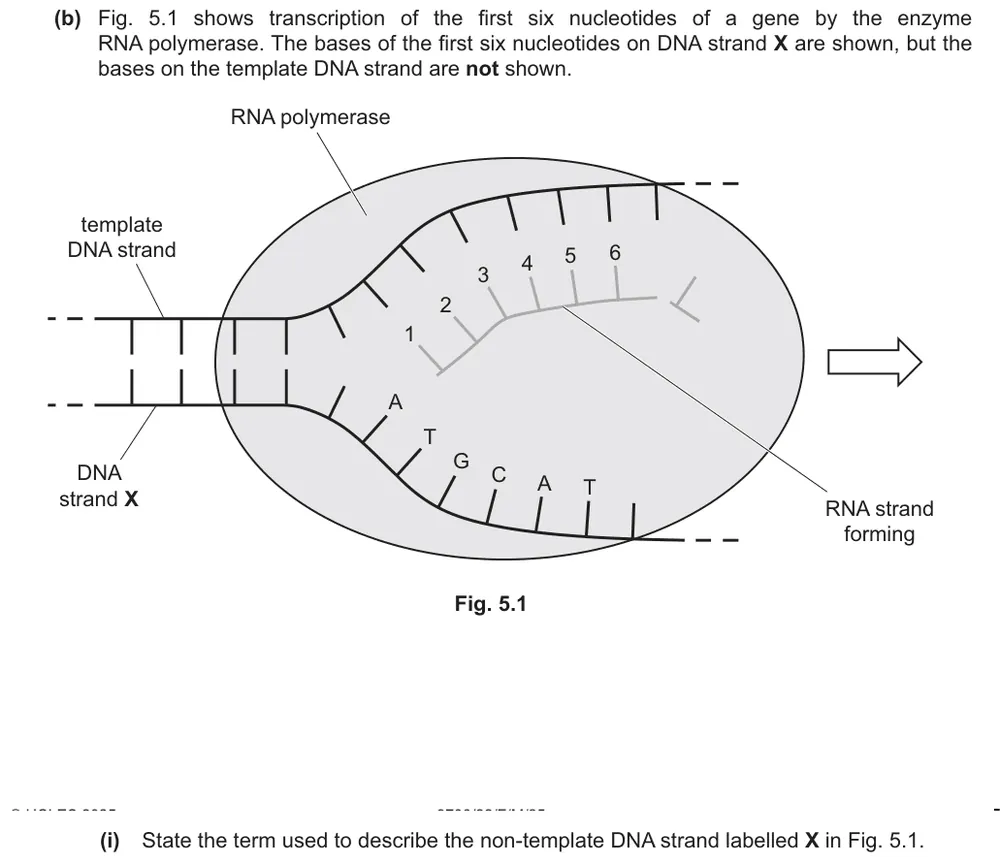
Paper 2 · February/March 2025 (22) · Q5(b)(i) · 1 mark · Easy
State the term for the non-template DNA strand in a diagram of transcription.
Show the mark scheme

Tap an image to open it full size.
Question 15
Paper 2 · February/March 2025 (22) · Q5(b)(ii) · 1 mark · Hard
Name the RNA strand formed during transcription of a eukaryotic gene.

Show the mark scheme

Tap an image to open it full size.
From the examiners' report: Some students wrote messenger RNA or mRNA. In eukaryotes, mRNA is produced only after further processing of the primary transcript.
Question 16
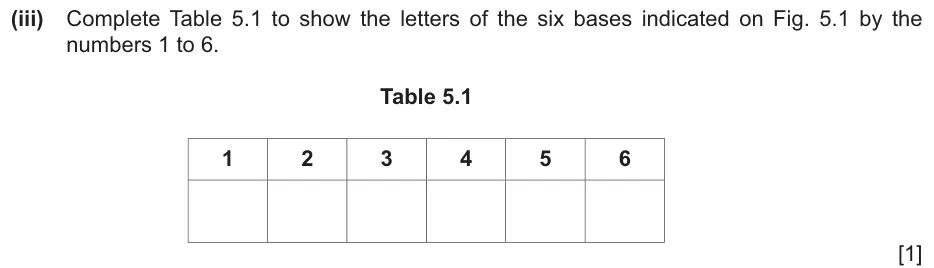
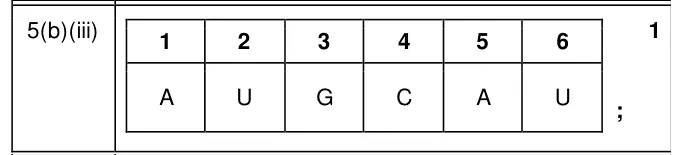
Paper 2 · February/March 2025 (22) · Q5(b)(iii) · 1 mark · Easy
Complete the table with the six bases numbered on the diagram of transcription.
Show the mark scheme
Tap an image to open it full size.
Question 17
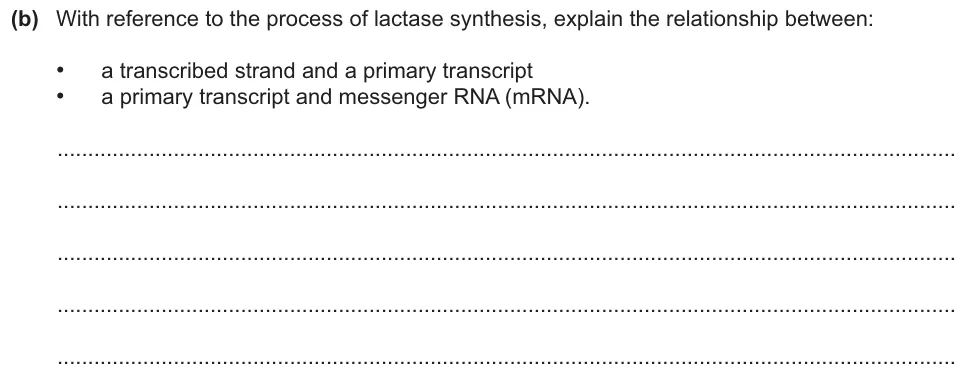
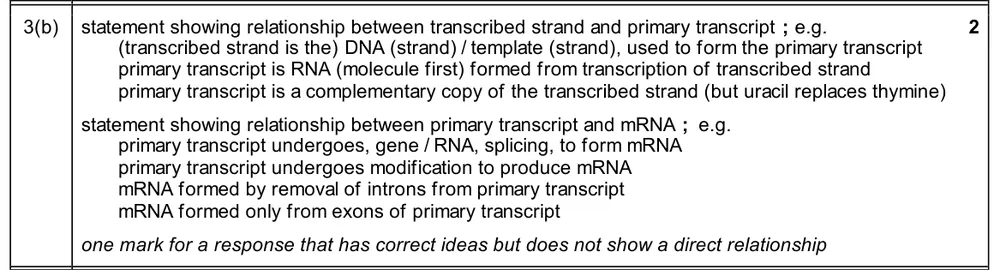
Paper 2 · October/November 2025 (22) · Q3(b) · 2 marks
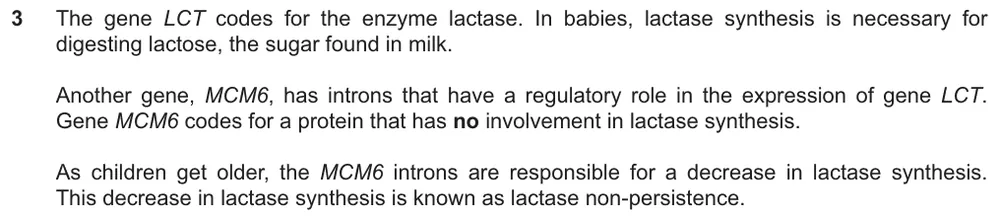
Explain how a transcribed strand is related to a primary transcript, and a primary transcript to mRNA.
Information from earlier in this question:
Show the mark scheme
Tap an image to open it full size.
Introns and exons (6.2.5)
Question 18
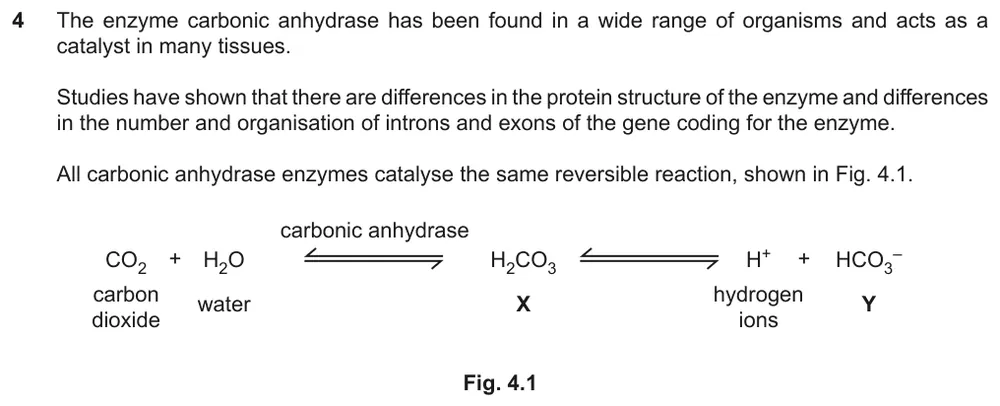
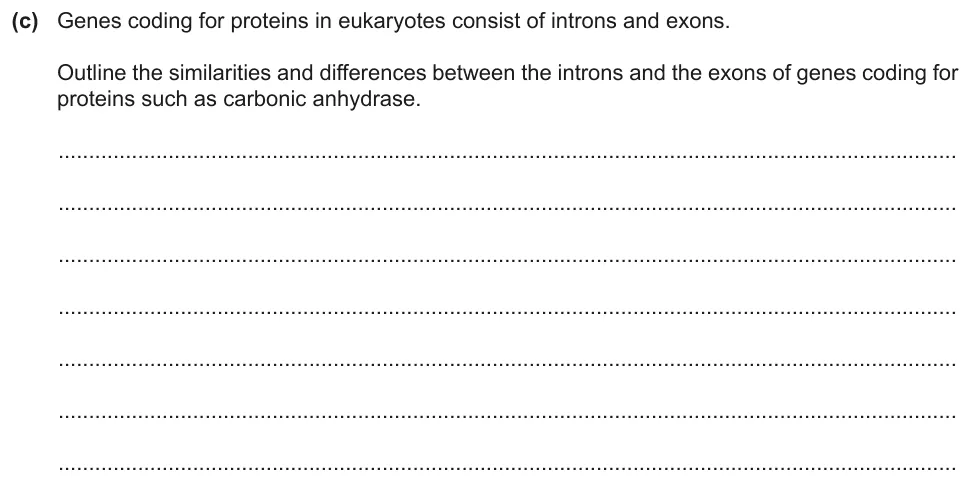
Paper 2 · May/June 2022 (22) · Q4(c) · 3 marks
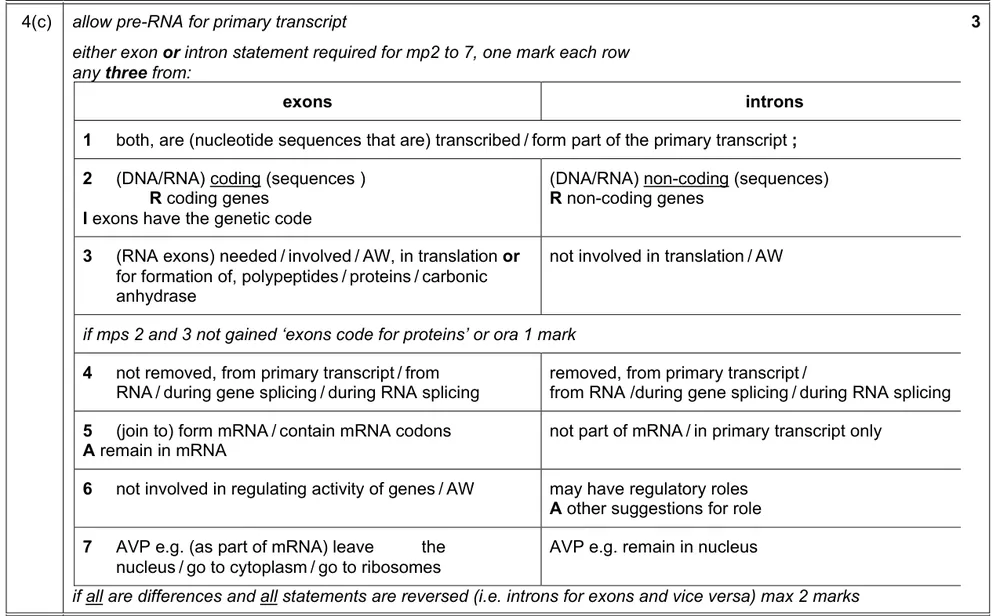
Outline the similarities and differences between the introns and the exons of a gene.
Information from earlier in this question:
Show the mark scheme
Tap an image to open it full size.
From the examiners' report: Do not call introns and exons 'genes': they are non-coding and coding sequences that are part of a gene. Good answers used 'mRNA' only for the final RNA that leaves the nucleus, containing the exons joined during splicing of the primary transcript. Some students had the two the wrong way round, saying that exons are the non-coding sequences.
Gene mutation and RNA splicing (6.2.5 and 6.2.6)
Question 19
Paper 2 · May/June 2024 (22) · Q1(d)(i) · 2 marks
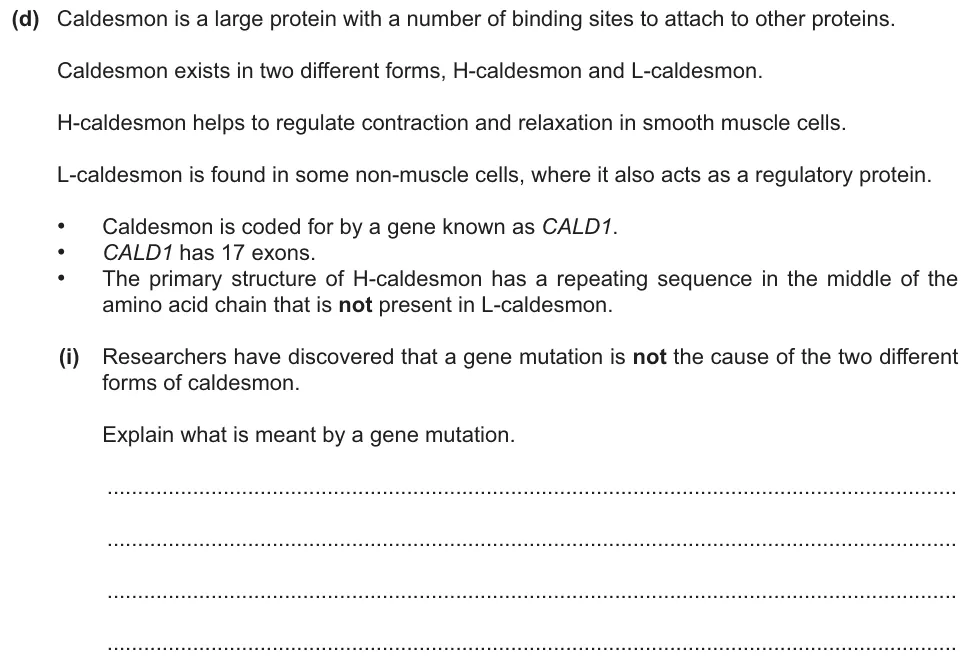
Explain what is meant by a gene mutation.
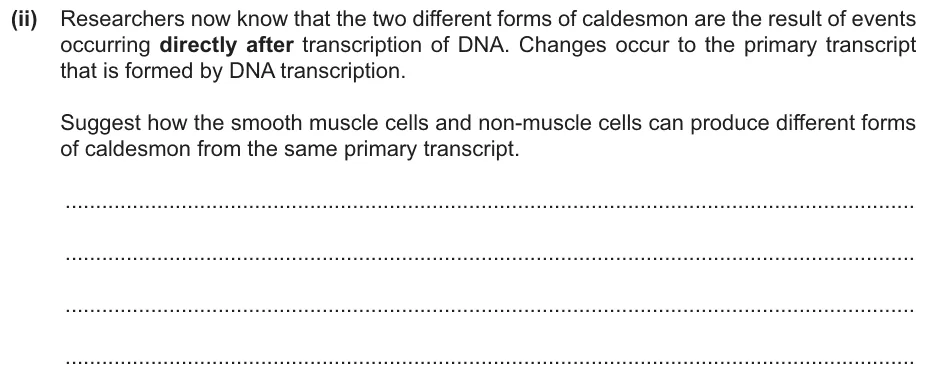
Information from earlier in this question:

Show the mark scheme

Tap an image to open it full size.
From the examiners' report: Some students did not say that the change is in DNA, and others needed to add that it may result in an altered polypeptide. Naming the types of mutation, or mutagens, was not relevant. Amino acids are not part of the DNA sequence, and nucleotides are not part of a polypeptide chain.
Question 20
Paper 2 · May/June 2024 (22) · Q1(d)(ii) · 2 marks
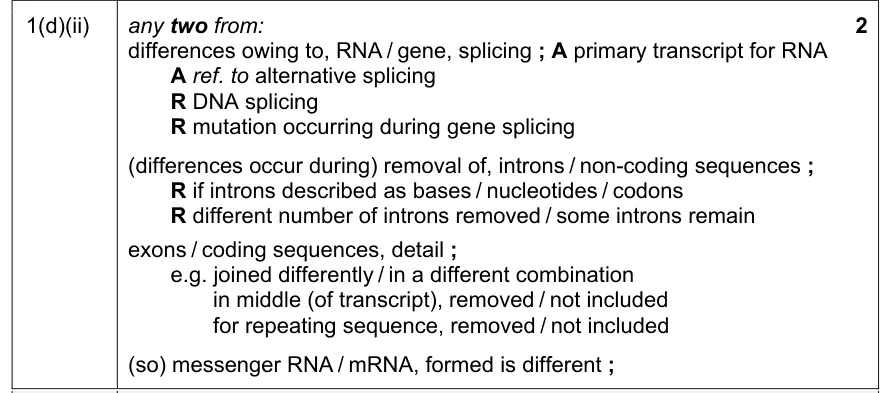
Suggest how two types of cell can make different forms of a protein from the same primary transcript.
Show the mark scheme
Tap an image to open it full size.
From the examiners' report: Many students wrongly thought that some introns could be left in the final mRNA. Introns are removed; it is the joining of the exons that can differ. Mutation was an incorrect suggestion, as were differences during transcription or translation.
Gene mutations and the polypeptide (6.2.6 and 6.2.7)
Question 21
Paper 4 (A level) · October/November 2017 (42) · Q8(c) · 3 marks · Easy
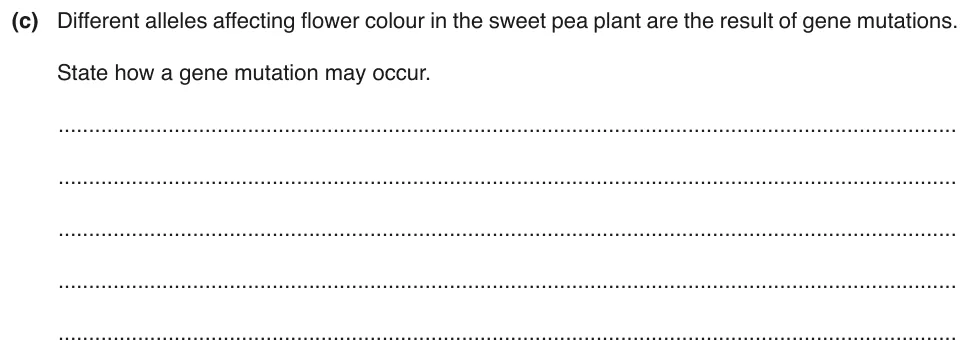
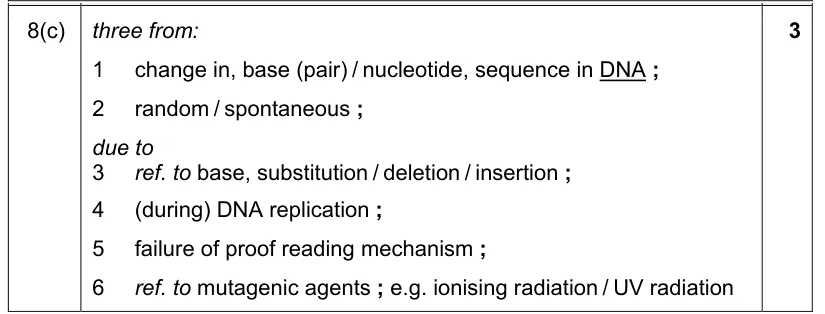
State how a gene mutation may occur.
Show the mark scheme
Tap an image to open it full size.
From the examiners' report: Detail about transcription, translation, polypeptides and tertiary structure was not needed. Most students wrote about a change in base sequence without saying that it is in DNA, and many wrote substitution, deletion or insertion without mentioning bases. Most quoted 'radiation' without saying which type.
Question 22
Paper 4 (A level) · February/March 2019 (42) · Q3(b) · 5 marks
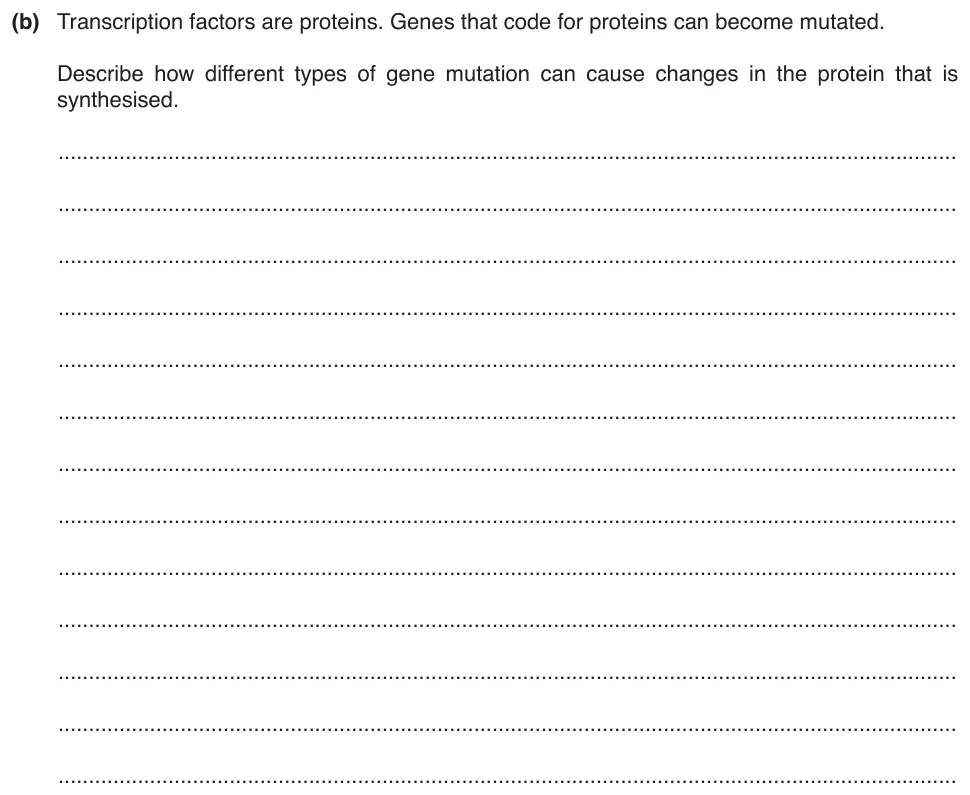
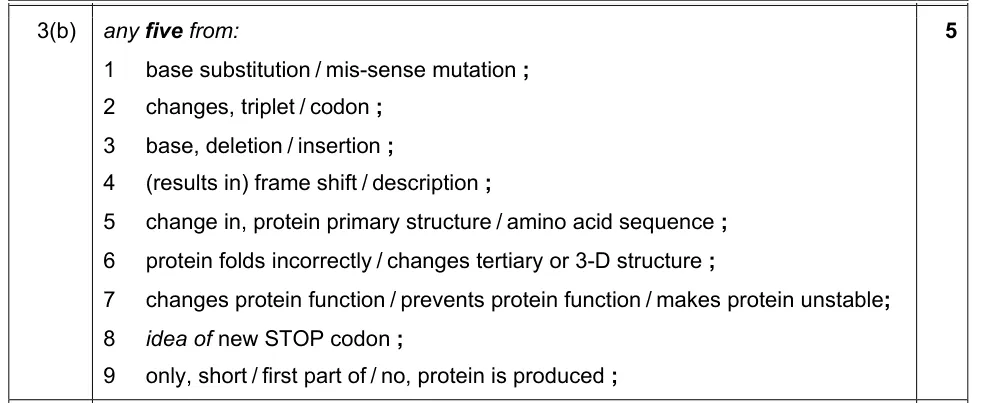
Describe how different types of gene mutation can change the protein that is synthesised.
Show the mark scheme
Tap an image to open it full size.
From the examiners' report: Many students stopped at the effects of the mutation on transcription and did not go on to describe the changes in the protein. Only a small number considered a premature stop codon. Silent mutations were not relevant, because they do not change the protein.
Where students lose marks (from Cambridge examiners' reports and mark schemes)
Each point below comes from the examiners' reports and mark schemes, and is followed by wording that gained marks.
A gene is part of a DNA molecule. Students described a gene as a strand of DNA or a sequence of amino acids, or said that a gene codes for a sequence of nucleotides.
✔ Gains credit: a 'sequence of nucleotides' or 'section' 'of DNA' that can 'code for a polypeptide'.
Degenerate, not degenerative. Students wrote 'degenerative', used 'code' when they meant 'codon', or described translation.
✔ Gains credit: 'amino acids coded for by more than one codon', '64 codons and 20 amino acids', 'degenerate code'.
Uracil in RNA, thymine in DNA. Students gave the tRNA anticodon as TGT, or included U in the DNA sequence of the template strand.
✔ Gains credit: the mRNA codon and the tRNA anticodon are both 'UGU'; the template strand is 'C C A C G A T T A G A T'.
Codon and anticodon pair up. Students left out the complementary base pairing between codons and anticodons, or mixed up translation with DNA replication.
✔ Gains credit: 'a tRNA anticodon binds to the mRNA codon', 'complementary base pairing occurs', then 'peptide bond formation between the two amino acids'.
Primary transcript first, then mRNA. Students named the RNA strand formed by transcription of a eukaryotic gene as messenger RNA.
✔ Gains credit: 'primary transcript'.
Introns are always removed. Students thought that some introns could be left in the final mRNA, or suggested a mutation.
✔ Gains credit: 'RNA' or 'gene' 'splicing', with 'removal of' 'introns' and exons 'joined differently' so that the 'mRNA' 'formed is different'.
A mutation is a change in DNA. Students did not say that the change is in DNA, or left out the effect on the polypeptide.
✔ Gains credit: a 'change in the sequence of base pairs in a DNA molecule' that 'may result in' 'an altered' 'polypeptide'.
Follow the mutation through to the protein. Students stopped at the effect of the mutation on transcription, or described silent mutations, which do not change the protein.
✔ Gains credit: 'base substitution' 'changes' a 'triplet'; 'base' 'deletion' or 'insertion' gives a 'frame shift'; then a 'change in' 'amino acid sequence' or a 'new STOP codon'.
Download the questions
Download the PDF pack (22 questions, mark schemes at the end)
Keep practising
- Structure of Nucleic Acids and Replication of DNA (6.1): Cambridge (CIE) exam questions by topic
- Cambridge (CIE) A level Biology 9700 past papers, mark schemes and examiners' reports
- Cambridge (CIE) A level Biology grade thresholds
- Book a one-to-one CIE lesson or a free 15-minute discovery chat with Tom
- Register your interest in a CIE A level Biology group class
Questions, mark schemes and examiners' report extracts © Cambridge University Press & Assessment.