

Structure of Nucleic Acids and Replication of DNA (6.1): Cambridge (CIE) A Level Biology 9700 Exam Questions by Topic
Structure of nucleic acids and replication of DNA is sub-topic 6.1 of Topic 6, Nucleic acids and protein synthesis, in the Cambridge International AS & A Level Biology syllabus (9700). You need to describe the structure of nucleotides, including ATP, know which bases are purines and which are pyrimidines, describe DNA as a double helix of two antiparallel strands with complementary base pairing, describe semi-conservative replication and the roles of DNA polymerase and DNA ligase, and describe the structure of RNA. This is AS content, examined on Papers 1 and 2. A level students meet it again on Paper 4; questions marked A level on this page come from Paper 4.
The examiners' reports repeat a few warnings. Spell the names of the bases correctly: thiamine, cysteine and glycine are different molecules. When a question says 'identify', give the exact name, so write deoxyribose and not 'pentose sugar'. The bond that links the nucleotides in a strand is a phosphodiester bond; hydrogen bonds form only between complementary bases. In replication, write DNA polymerase in full, remember that DNA ligase joins the fragments and helicase does not, and keep replication separate from transcription: mRNA and stop codons have no place in an answer about replication.
Studying Cambridge International A level Biology and want more help? Tom teaches CIE students one-to-one online, including students in the UAE, Saudi Arabia, Hong Kong, India and Indonesia, and every lesson is recorded. You can book a one-to-one lesson or a free 15-minute discovery chat, or register your interest in a CIE group class starting in September 2027, using the links at the bottom of this page.
What you need from IGCSE
Each question on this page assumes you're secure on these ideas. If any of them feels shaky, look it up before you start.
- DNA is the genetic material, and a gene is a length of DNA that codes for a protein.
- A DNA molecule has two strands coiled together to form a double helix.
- The bases on the two strands pair up: A with T and C with G.
- The chromosomes are copied exactly before a cell divides by mitosis.
Key terms
These words come up in the questions and mark schemes. Examiners expect you to use them exactly.
- Nucleotide: a phosphate group, a pentose sugar and a nitrogenous organic base joined together. The sugar is deoxyribose in DNA and ribose in RNA.
- Purine: a base with a double ring structure: adenine and guanine.
- Pyrimidine: a base with a single ring structure: cytosine, thymine and uracil.
- Phosphodiester bond: the covalent bond that links one nucleotide to the next in a polynucleotide strand, forming the sugar-phosphate backbone.
- Complementary base pairing: A pairs with T (two hydrogen bonds) and C pairs with G (three hydrogen bonds); in RNA, U takes the place of T.
- Antiparallel: the two strands of DNA run in opposite directions: one is 5′ to 3′ and the other is 3′ to 5′.
- Semi-conservative replication: each new DNA molecule has one original strand and one newly synthesised strand.
- DNA ligase: the enzyme that joins the Okazaki fragments on the lagging strand by forming phosphodiester bonds.
What these questions cover (Cambridge 9700 Topic 6: Nucleic acids and protein synthesis)
The questions test these learning outcomes from sub-topic 6.1 of the Cambridge International AS & A Level Biology syllabus (9700) for 2025 to 2027.
- 6.1.1 describe the structure of nucleotides, including the phosphorylated nucleotide ATP
- 6.1.2 state that the bases adenine and guanine are purines with a double ring structure, and that the bases cytosine, thymine and uracil are pyrimidines with a single ring structure
- 6.1.3 describe the structure of a DNA molecule as a double helix
- 6.1.4 describe the semi-conservative replication of DNA during the S phase of the cell cycle
- 6.1.5 describe the structure of an RNA molecule, using the example of messenger RNA
How to use this page
Write your answer on paper before you open the mark scheme. Allow about 1.2 minutes per mark: the 22 questions are worth 62 marks, so about 74 minutes in total. Then mark your answer strictly against the mark scheme and read the examiners' tip underneath it. If you'd rather print the questions, download the PDF pack.
Nucleotides and ATP (6.1.1)
Question 1
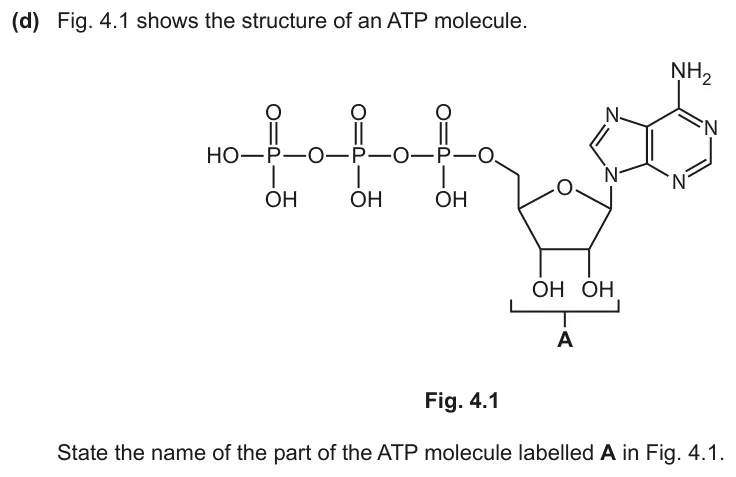
Paper 2 · February/March 2024 (22) · Q4(d) · 1 mark
Name the part of an ATP molecule labelled on a diagram.
Show the mark scheme

Tap an image to open it full size.
Question 2
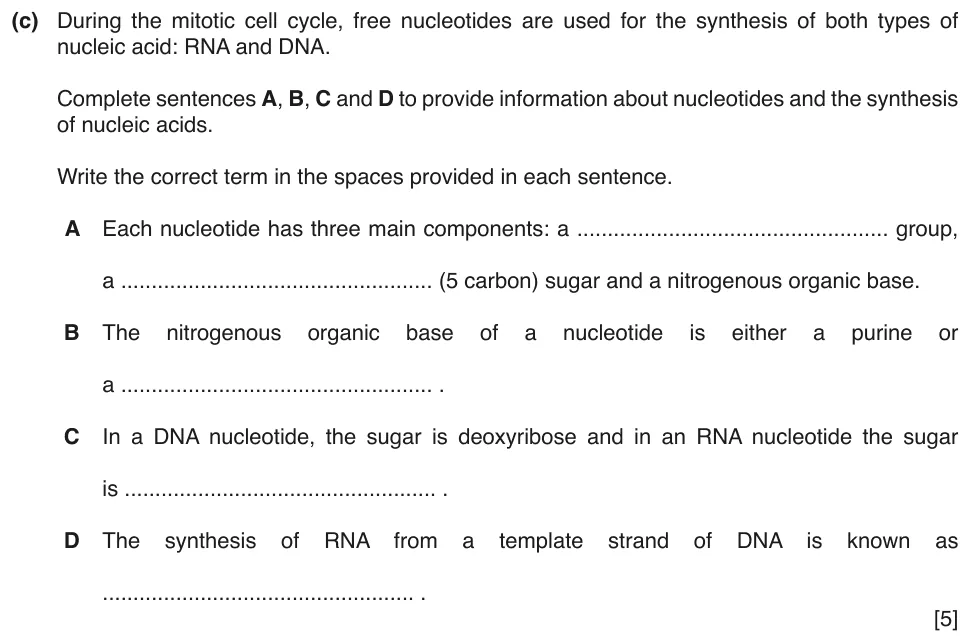
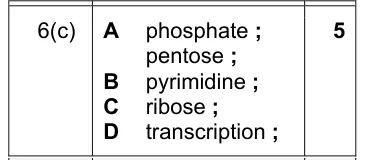
Paper 2 · February/March 2019 (22) · Q6(c) · 5 marks · Easy
Complete four sentences about nucleotides and the synthesis of nucleic acids.
Show the mark scheme
Tap an image to open it full size.
From the examiners' report: In sentence D, a number of students wrote translation or transpiration when the term needed was transcription.
Question 3
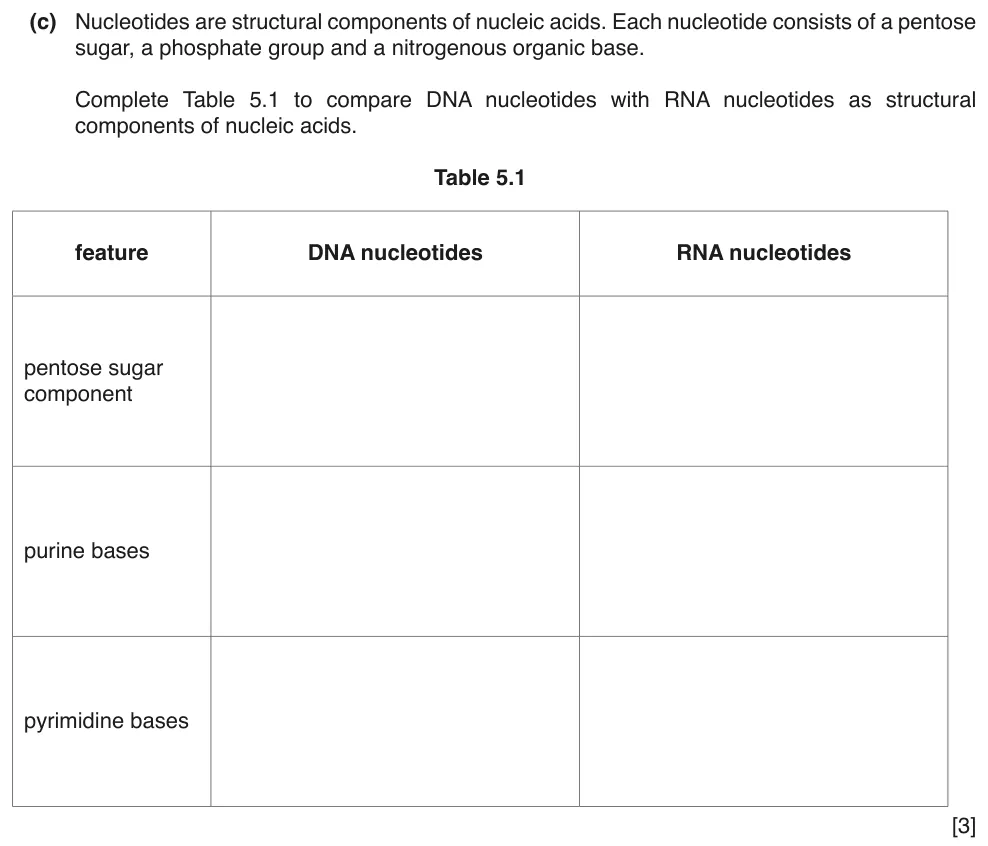
Paper 2 · October/November 2018 (22) · Q5(c) · 3 marks · Hard
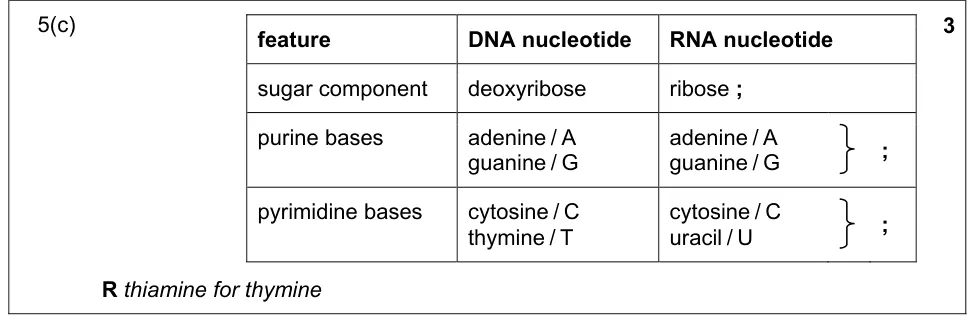
Complete the table to compare the sugar and the bases of DNA nucleotides and RNA nucleotides.
Show the mark scheme
Tap an image to open it full size.
From the examiners' report: Students who gained only some of the marks usually knew the two pentose sugars but found it harder to name the correct purine and pyrimidine bases.
Question 4
Paper 4 (A level) · May/June 2016 (42) · Q1(a)(i) · 2 marks
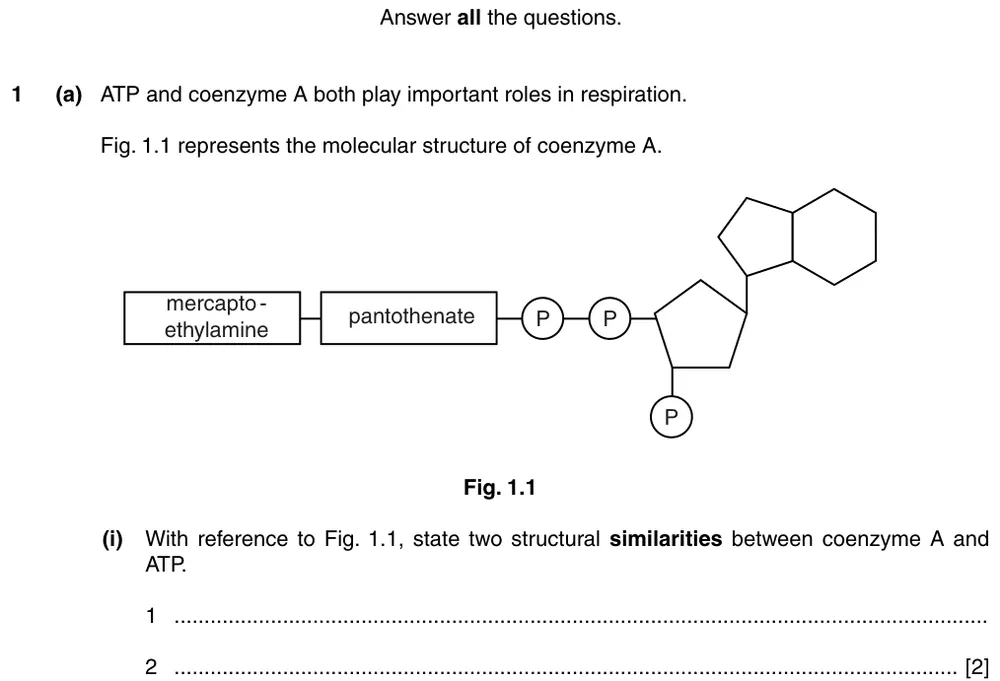
State two ways in which the structure of coenzyme A is similar to the structure of ATP.
Show the mark scheme

Tap an image to open it full size.
Purines and pyrimidines (6.1.2)
Question 5
Paper 2 · May/June 2023 (22) · Q5(a) · 4 marks
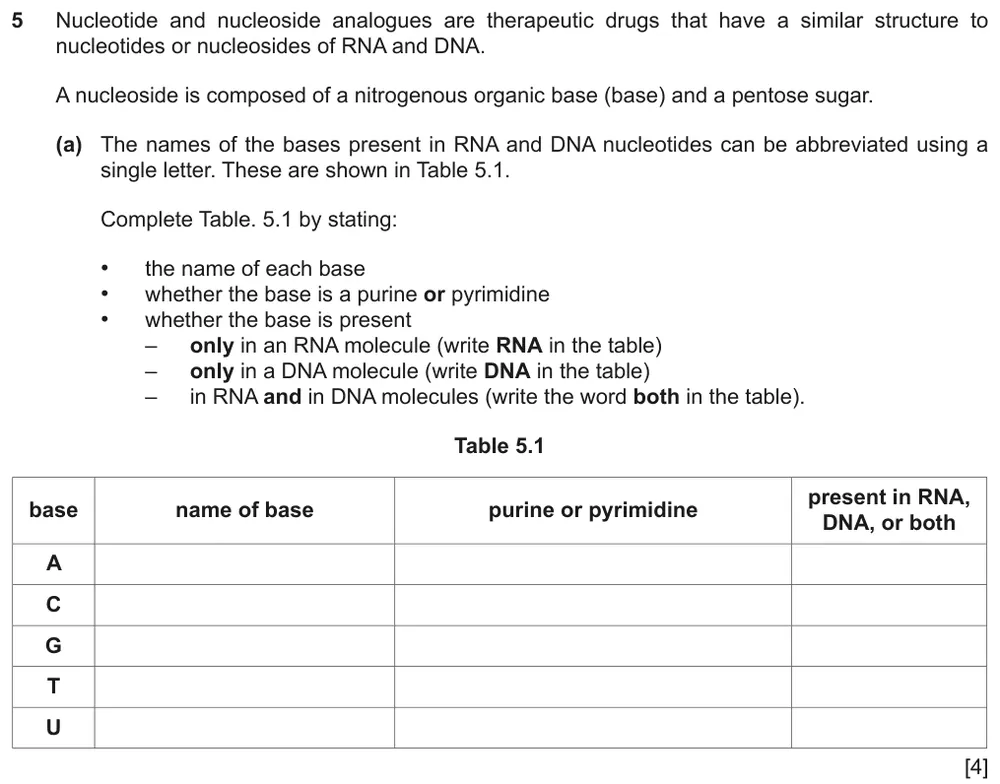
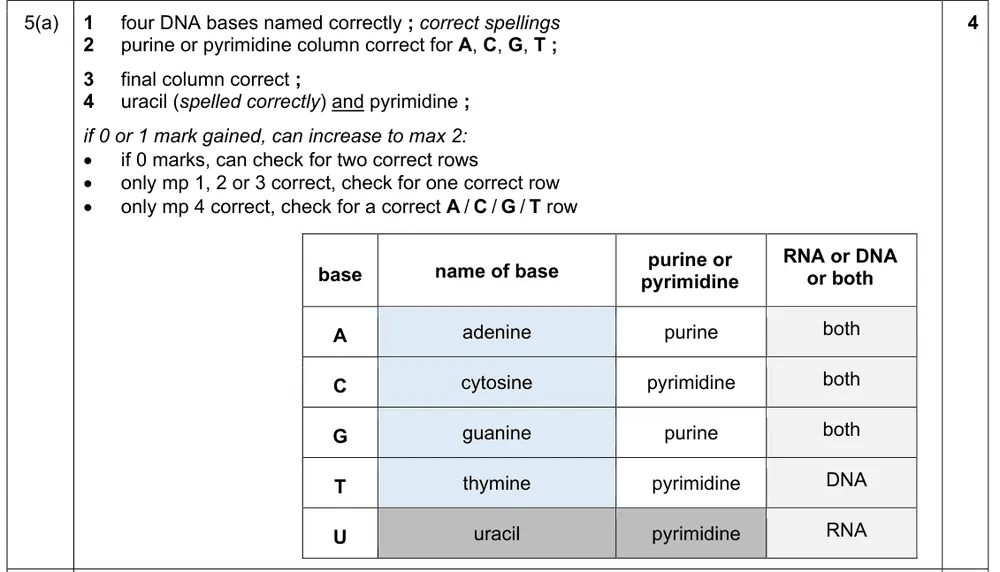
Complete the table with the name of each base, whether it is a purine or a pyrimidine, and whether it is found in RNA, DNA or both.
Show the mark scheme
Tap an image to open it full size.
From the examiners' report: Marks were often lost for misspelt names of the bases. Some students wrote the names of other molecules: the vitamin thiamine for thymine, and the amino acids cysteine for cytosine and glycine for guanine.
Question 6
Paper 2 · May/June 2023 (22) · Q5(b)(i) · 1 mark
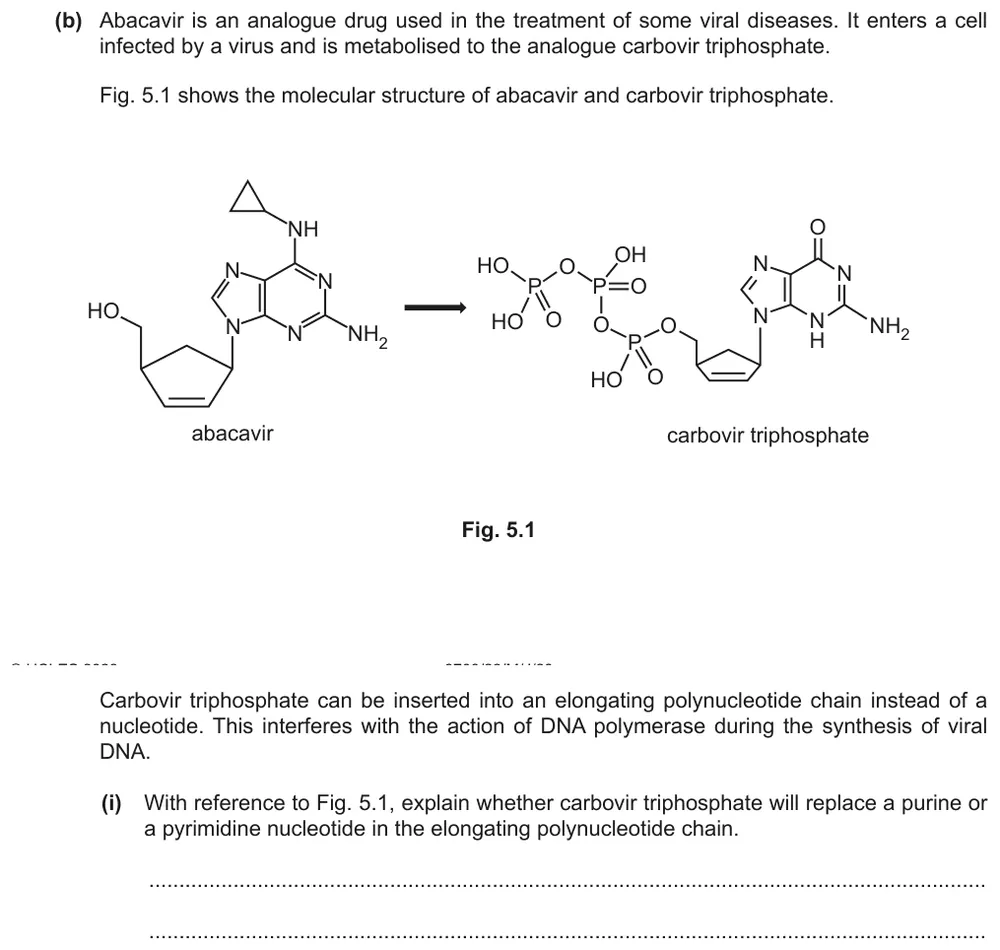
Use the diagram to explain whether carbovir triphosphate will replace a purine or a pyrimidine nucleotide.
Show the mark scheme

Tap an image to open it full size.
From the examiners' report: Many students correctly linked the double ring structure in carbovir triphosphate to purine nucleotides.
Question 7
Paper 2 · October/November 2022 (21) · Q3(b)(i) · 3 marks
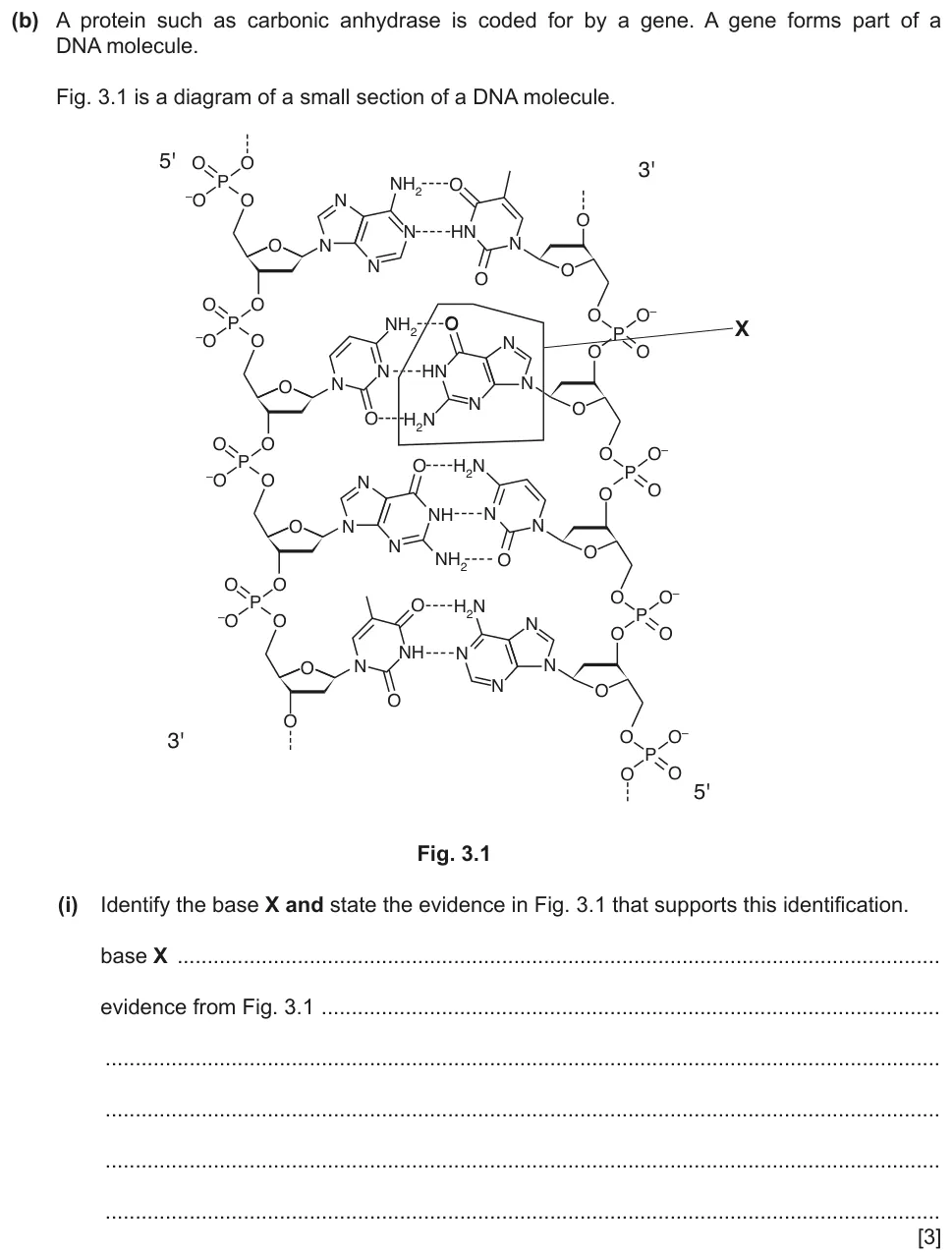
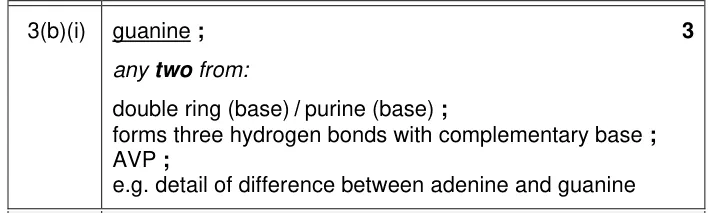
Identify base X in a diagram of DNA and give the evidence from the diagram.
Show the mark scheme
Tap an image to open it full size.
From the examiners' report: The most common error was to name the base as adenine, and some answers gained no credit because the name of the base was misspelt. For the three hydrogen bonds, you had to say that they form between complementary bases.
The structure of DNA (6.1.3)
Question 8
Paper 2 · October/November 2024 (22) · Q3(a) · 1 mark
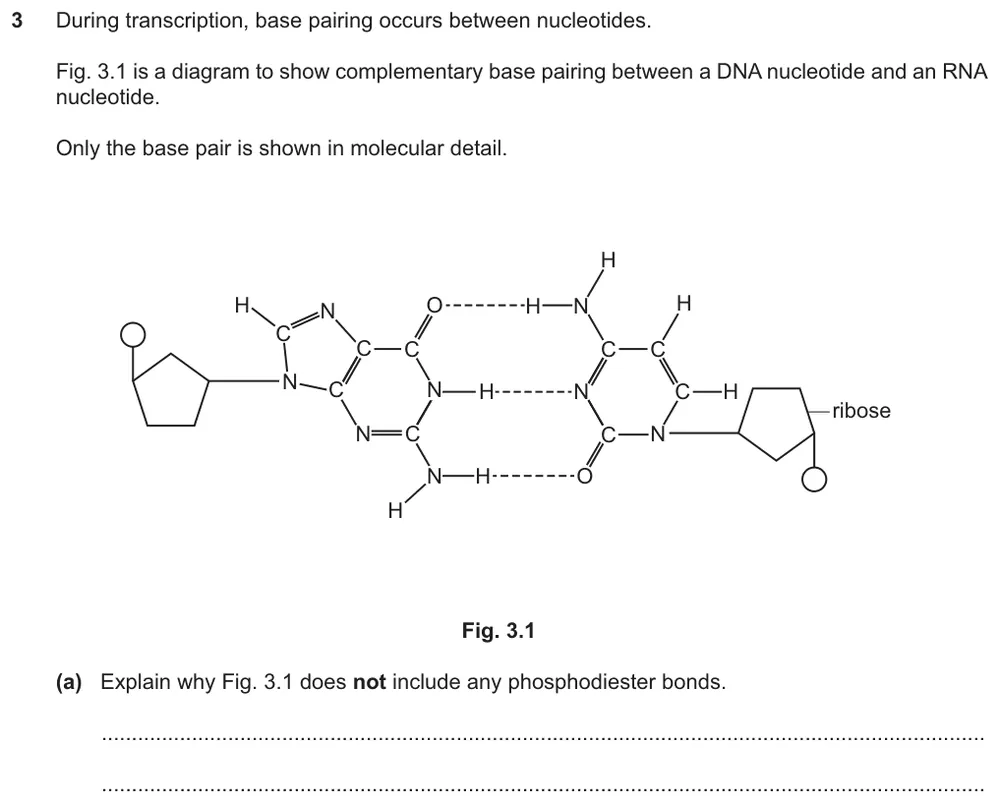
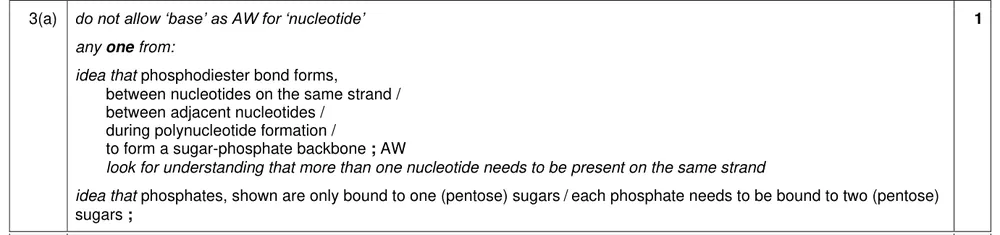
Explain why a diagram of one DNA-RNA base pair shows no phosphodiester bonds.
Show the mark scheme
Tap an image to open it full size.
Question 9
Paper 2 · October/November 2024 (22) · Q3(b) · 4 marks
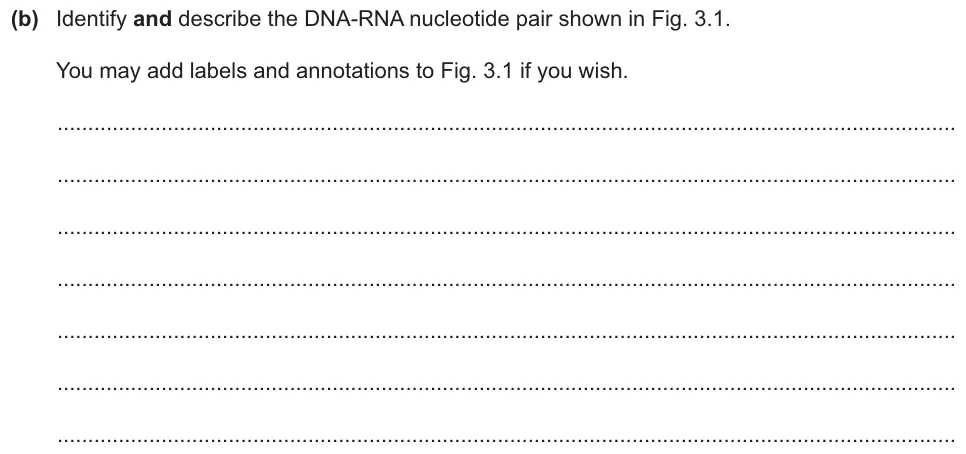
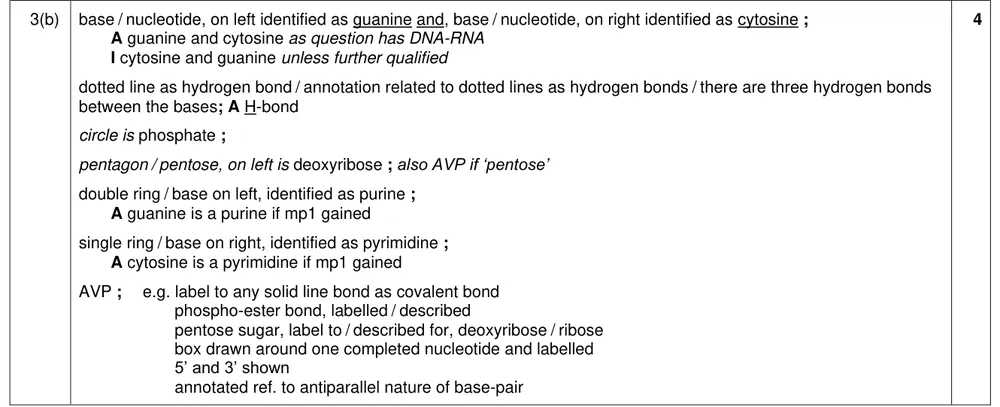
Identify and describe the DNA-RNA nucleotide pair shown in the diagram.
Show the mark scheme
Tap an image to open it full size.
Reading a diagram of DNA (6.1.1 and 6.1.3)
Question 10
Paper 2 · February/March 2022 (22) · Q6(a)(i) · 2 marks
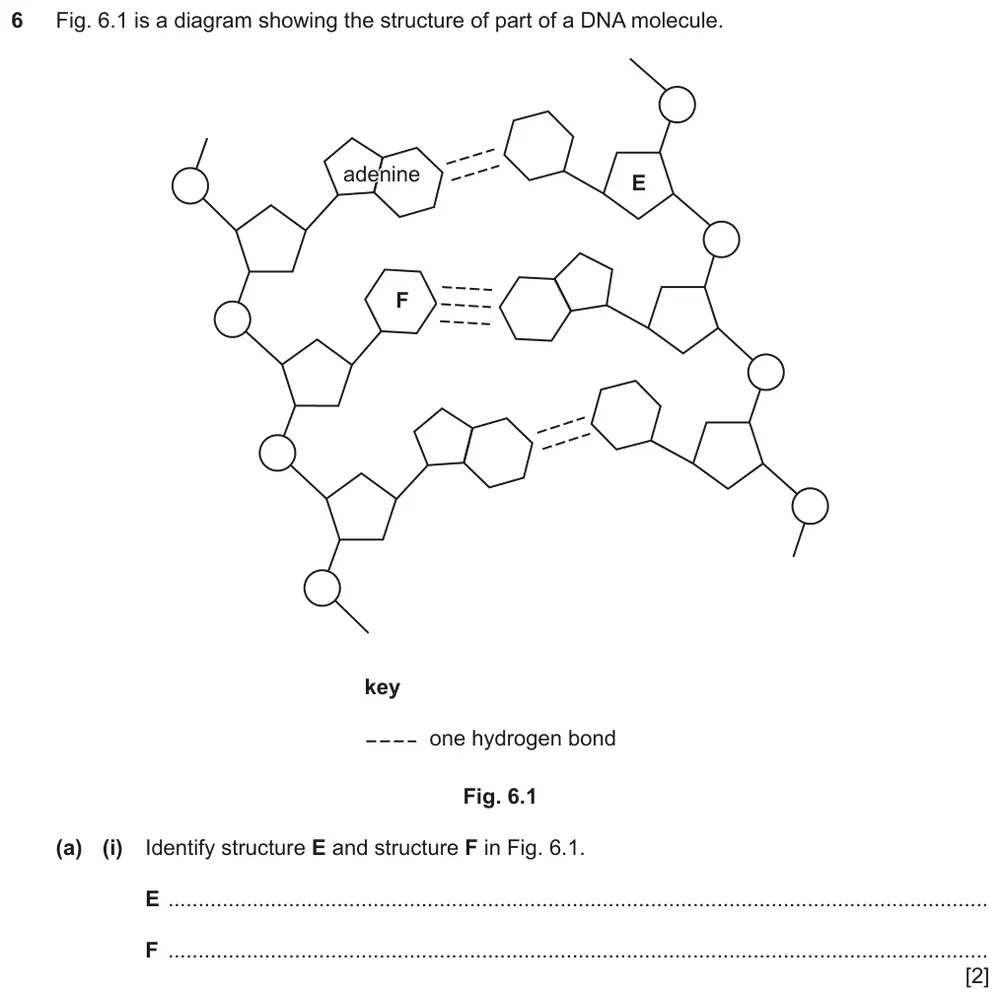
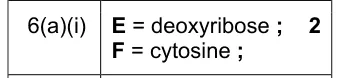
Identify the sugar and the base labelled on a diagram of part of a DNA molecule.
Show the mark scheme
Tap an image to open it full size.
From the examiners' report: 'Pentose sugar' was too vague for E because the question says 'identify', and ribose was wrong. Guanine was the most frequent wrong answer for F: these students may have understood the number of hydrogen bonds but seemed unsure of the structural difference between purines and pyrimidines.
Question 11
Paper 2 · February/March 2022 (22) · Q6(a)(ii) · 1 mark · Easy
Draw a circle around one nucleotide on the diagram of DNA.

Show the mark scheme

Tap an image to open it full size.
From the examiners' report: The most common errors were to circle only a base or part of a nucleotide. Some students circled a pair of complementary bases, and a few circled two nucleotides joined by hydrogen bonds.
Question 12
Paper 2 · February/March 2022 (22) · Q6(a)(iii) · 1 mark · Easy
Name the covalent bond that links two nucleotides together.

Show the mark scheme

Tap an image to open it full size.
From the examiners' report: The most frequent wrong answers were hydrogen bonds and peptide bonds. A few students wrote 'nucleotide bonds'.
The structure of DNA (6.1.3)
Question 13
Paper 2 · February/March 2017 (22) · Q3(c) · 4 marks · Easy
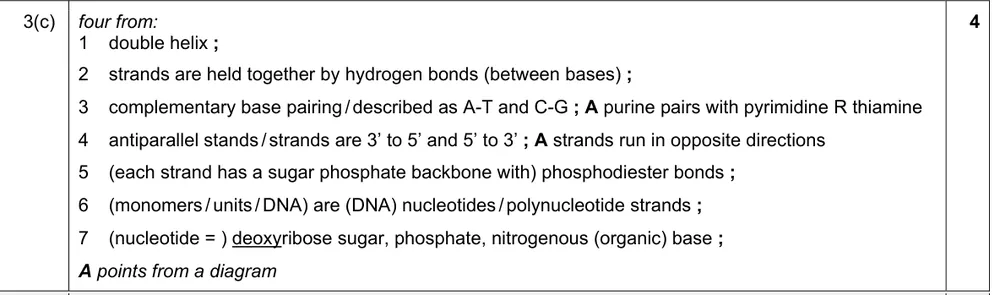
Describe the structure of DNA.
Show the mark scheme
Tap an image to open it full size.
From the examiners' report: Where students made errors, it was often by calling the sugar a pentose sugar or ribose, or by confusing bases with nucleotides.
Question 14
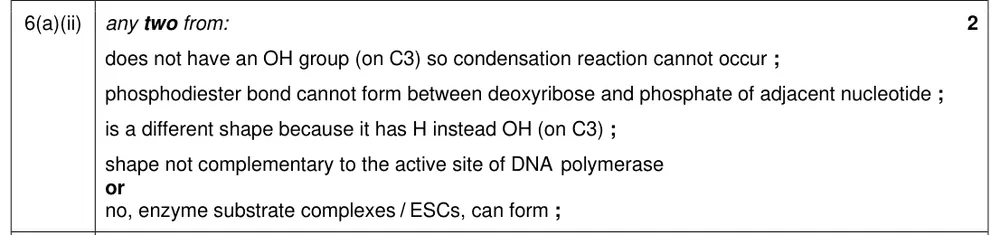
Paper 2 · October/November 2023 (21) · Q6(a)(ii) · 2 marks
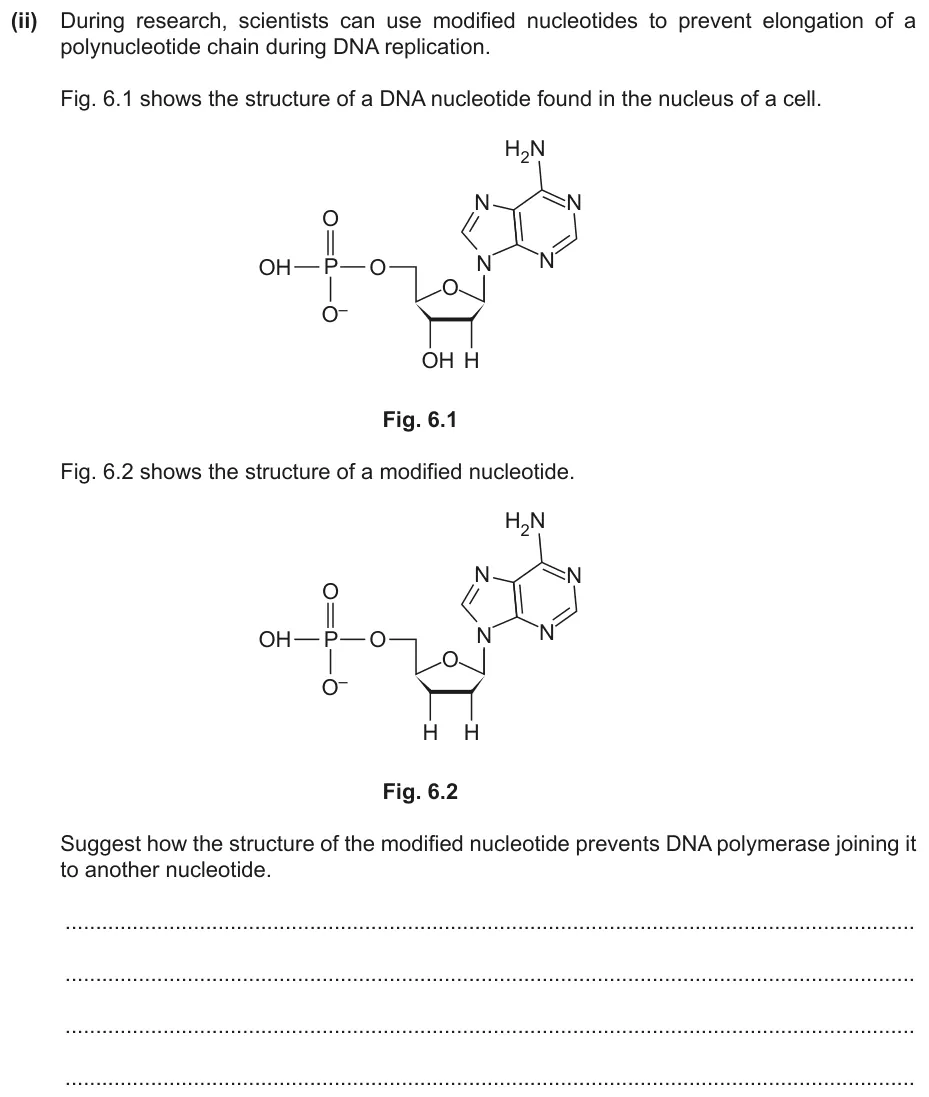
Suggest how the structure of a modified nucleotide stops DNA polymerase joining it to another nucleotide.
Show the mark scheme
Tap an image to open it full size.
From the examiners' report: Most who gained credit saw that the difference in structure would stop a phosphodiester bond forming, and some added that the condensation reaction could not take place. Answers such as 'without the O in the –OH group a bond cannot be created' did not have enough detail. Some students confused the modified nucleotide with ribose.
Question 15
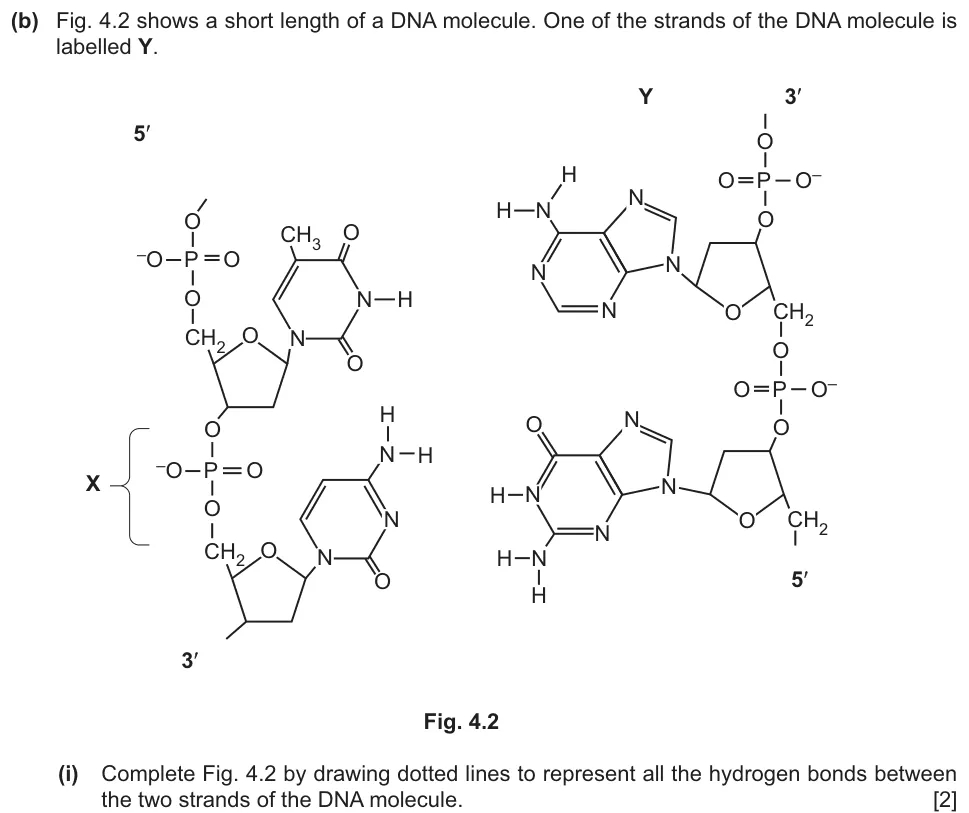
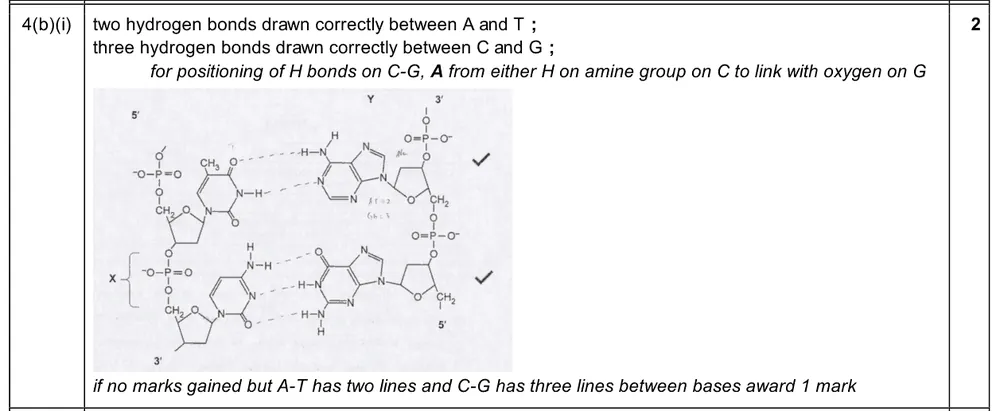
Paper 2 · October/November 2025 (23) · Q4(b)(i) · 2 marks
Draw dotted lines to show all the hydrogen bonds between the two strands of a short length of DNA.
Show the mark scheme
Tap an image to open it full size.
Semi-conservative replication of DNA (6.1.4)
Question 16
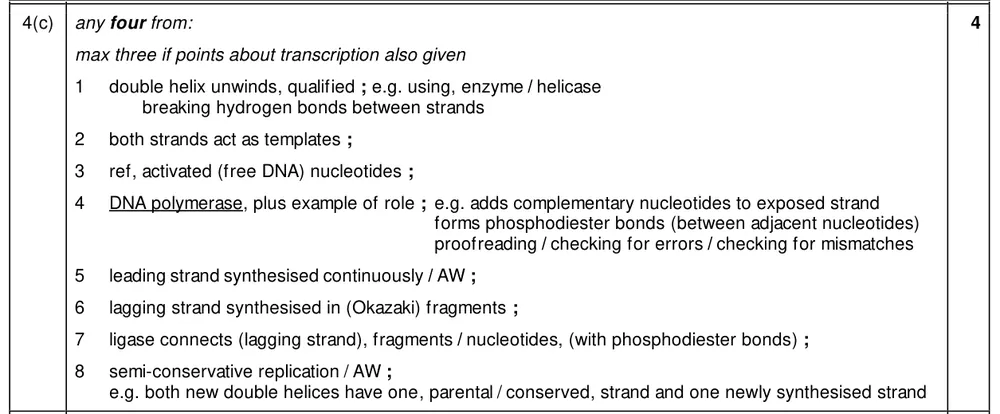
Paper 2 · February/March 2024 (22) · Q4(c) · 4 marks
Outline how DNA is replicated inside the nucleus.
Show the mark scheme
Tap an image to open it full size.
Question 17
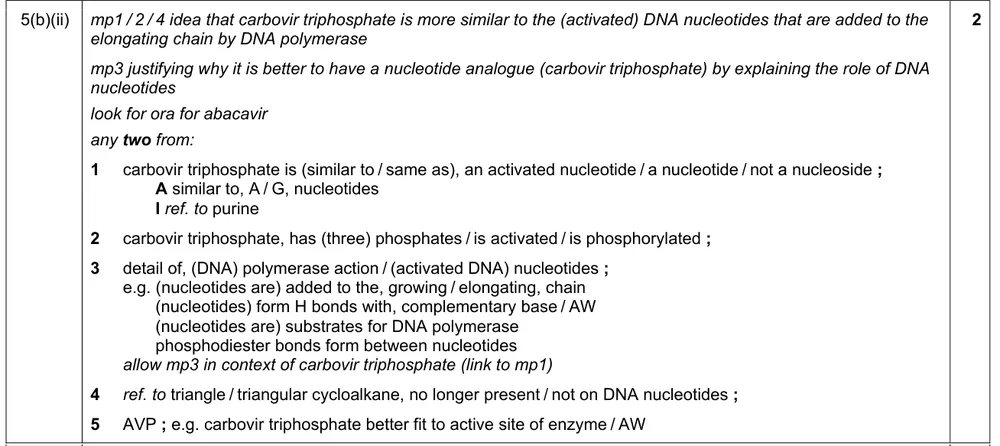
Paper 2 · May/June 2023 (22) · Q5(b)(ii) · 2 marks
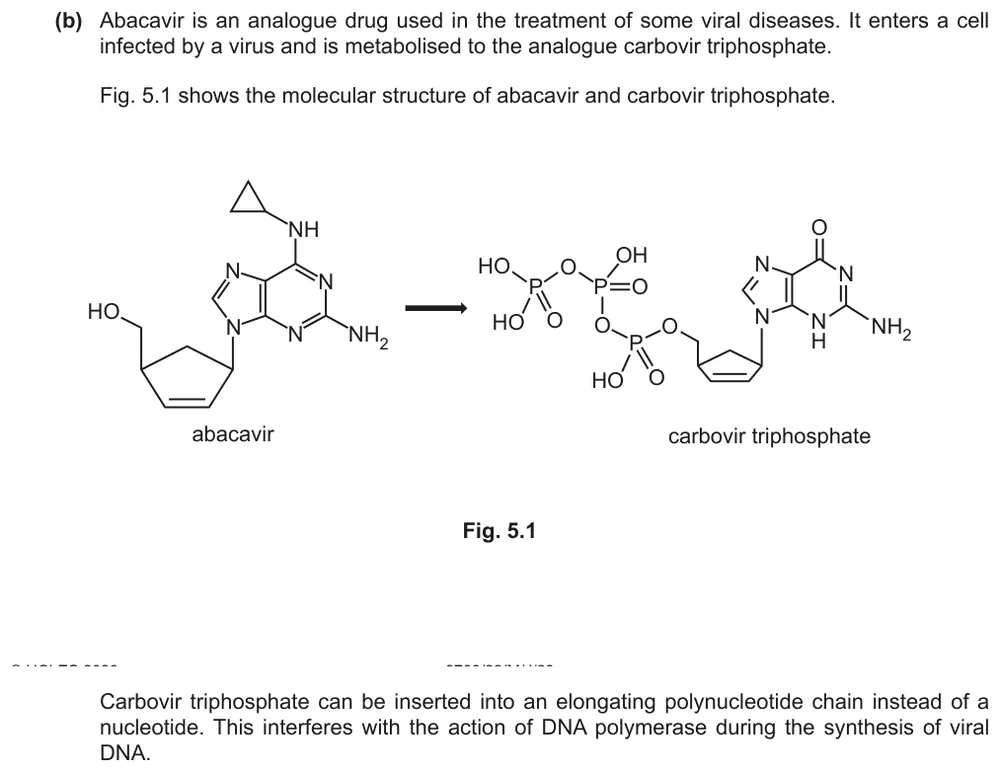
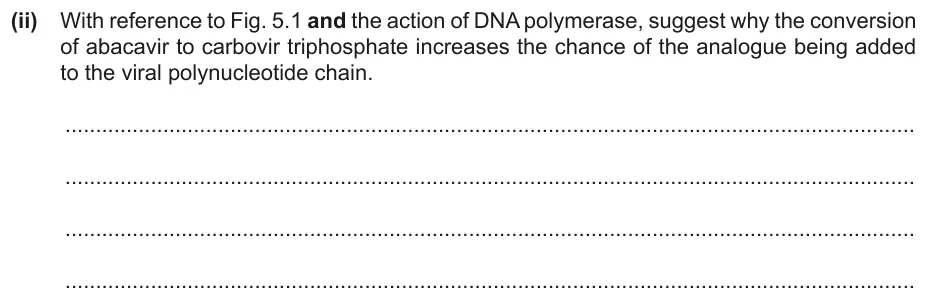
Suggest why converting abacavir to carbovir triphosphate makes it more likely to be added to the viral polynucleotide chain.
Information from earlier in this question:

Show the mark scheme
Tap an image to open it full size.
From the examiners' report: Look back at the diagram: carbovir triphosphate looks more like an activated purine nucleotide than abacavir does. Many students noted the added phosphate groups or gave a detail of how DNA polymerase works. Some weak answers called the phosphate groups 'phosphate heads', confusing the structure with a phospholipid.
Question 18
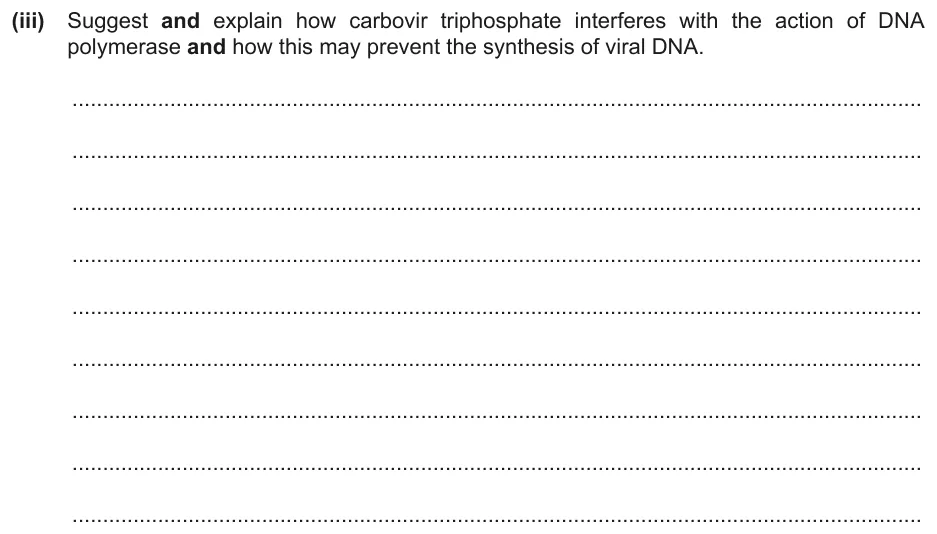
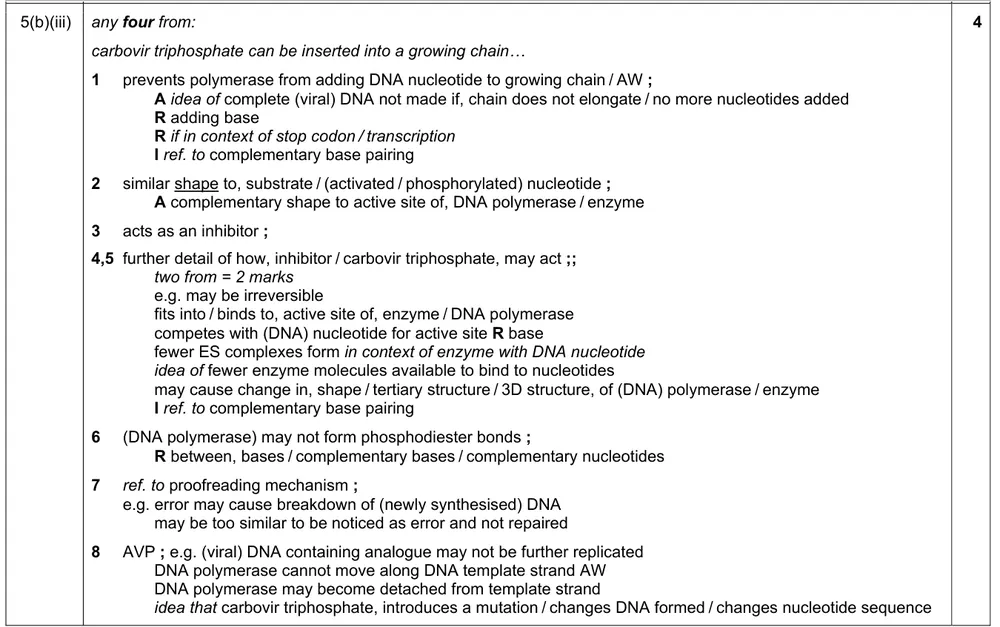
Paper 2 · May/June 2023 (22) · Q5(b)(iii) · 4 marks
Suggest and explain how carbovir triphosphate interferes with DNA polymerase and may stop viral DNA being made.
Show the mark scheme
Tap an image to open it full size.
From the examiners' report: All reasonable suggestions were credited. The extra two phosphates are what an activated nucleotide has, so the analogue is not 'too long to fit'. Some students mixed up replication with transcription and wrote about stop codons, and it was quite common to write 'base' where 'nucleotide' was meant.
Question 19
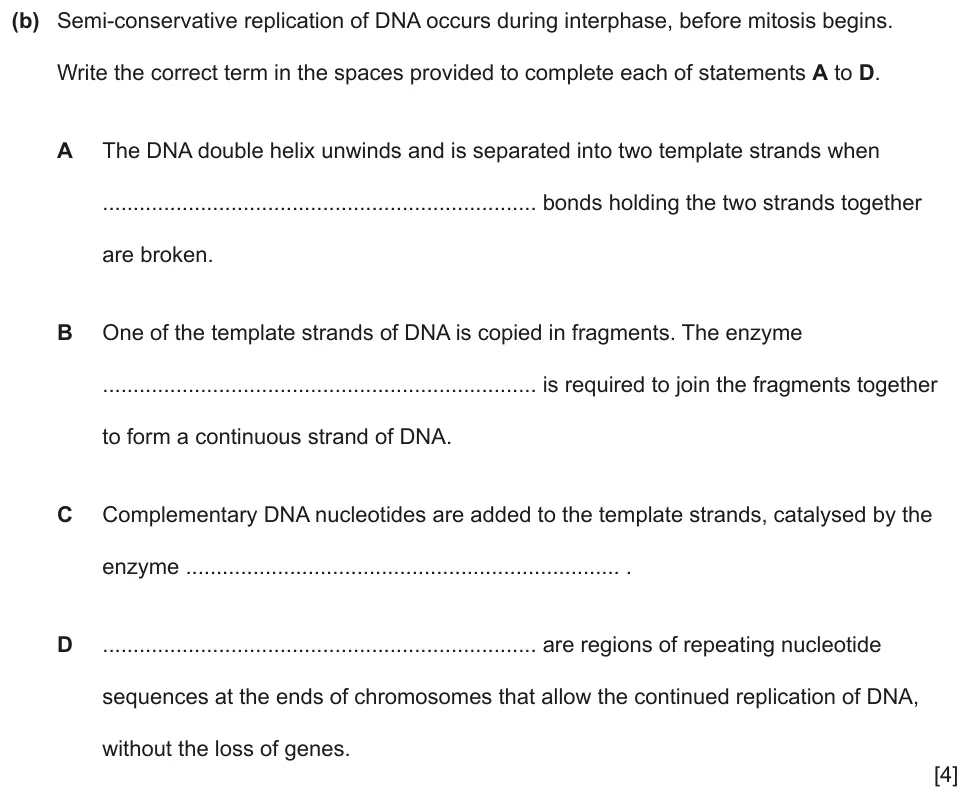
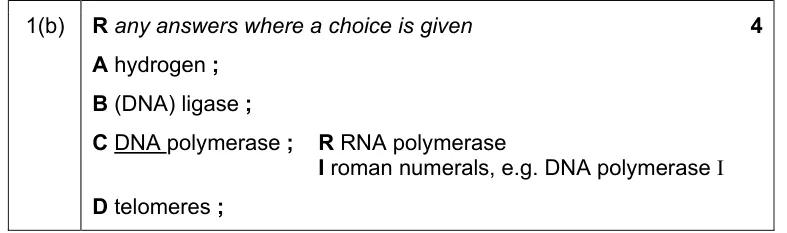
Paper 2 · May/June 2021 (22) · Q1(b) · 4 marks · Easy
Complete four statements about semi-conservative replication and the ends of chromosomes.
Show the mark scheme
Tap an image to open it full size.
From the examiners' report: Many students named helicase, not ligase, as the enzyme that joins the fragments. 'Polymerase' was not enough: it had to be DNA polymerase. In D, some wrote centromeres when the answer was telomeres.
Question 20
Paper 2 · May/June 2023 (21) · Q4(b)(i) · 5 marks
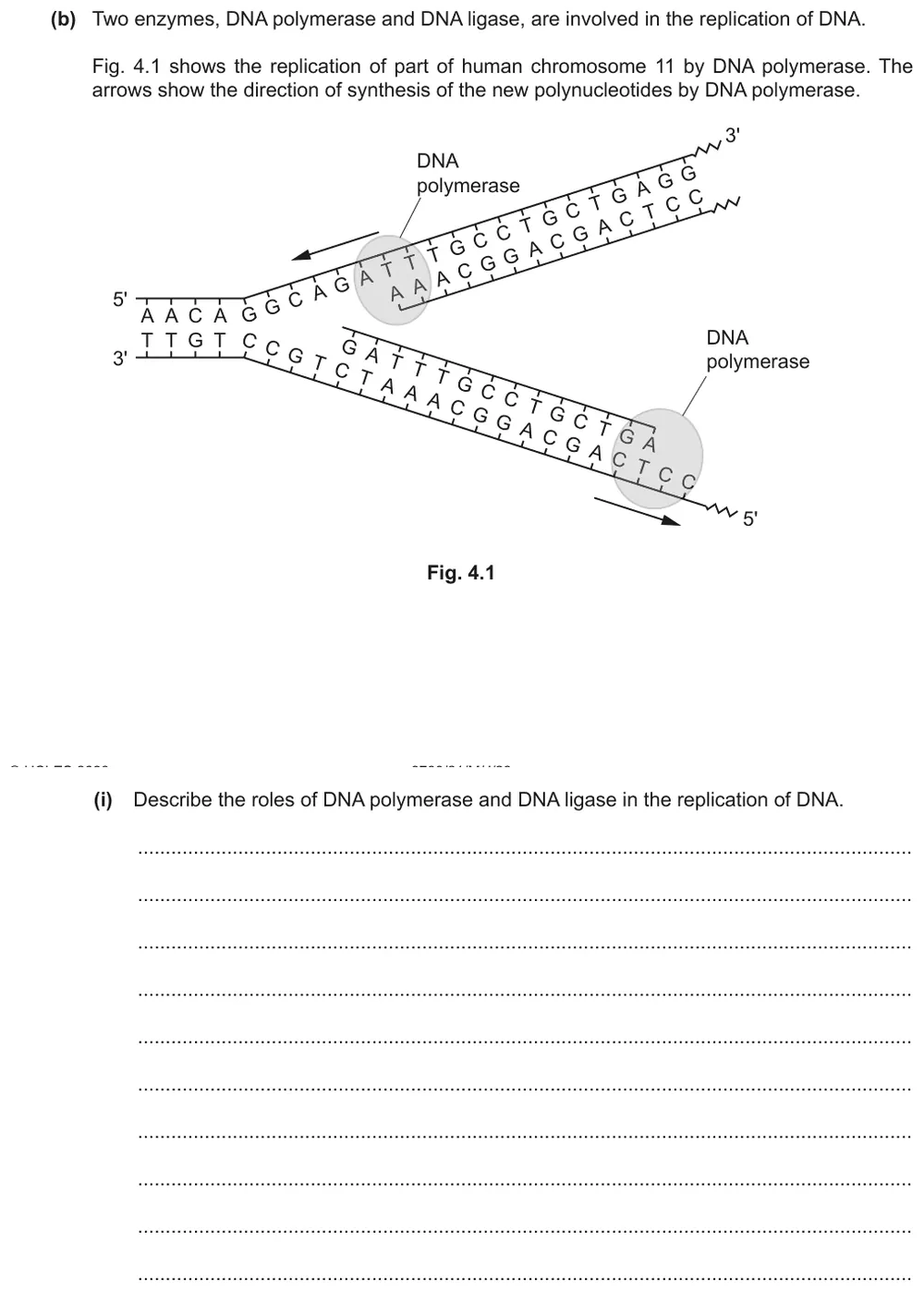
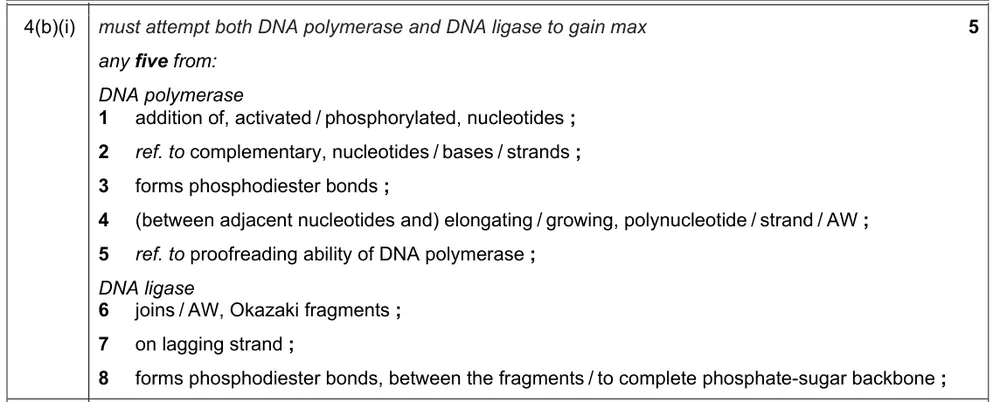
Describe the roles of DNA polymerase and DNA ligase in the replication of DNA.
Show the mark scheme
Tap an image to open it full size.
From the examiners' report: Good answers did not confuse replication with transcription; weaker ones wrote about making mRNA or about 'stop codes'. Phosphodiester bonds do not form between complementary bases, and neither enzyme unzips DNA or forms the hydrogen bonds between the bases. Few explained that activated nucleotides are added to the growing strand.
The structure of RNA (6.1.5)
Question 21
Paper 2 · October/November 2021 (22) · Q5(a) · 4 marks · Hard
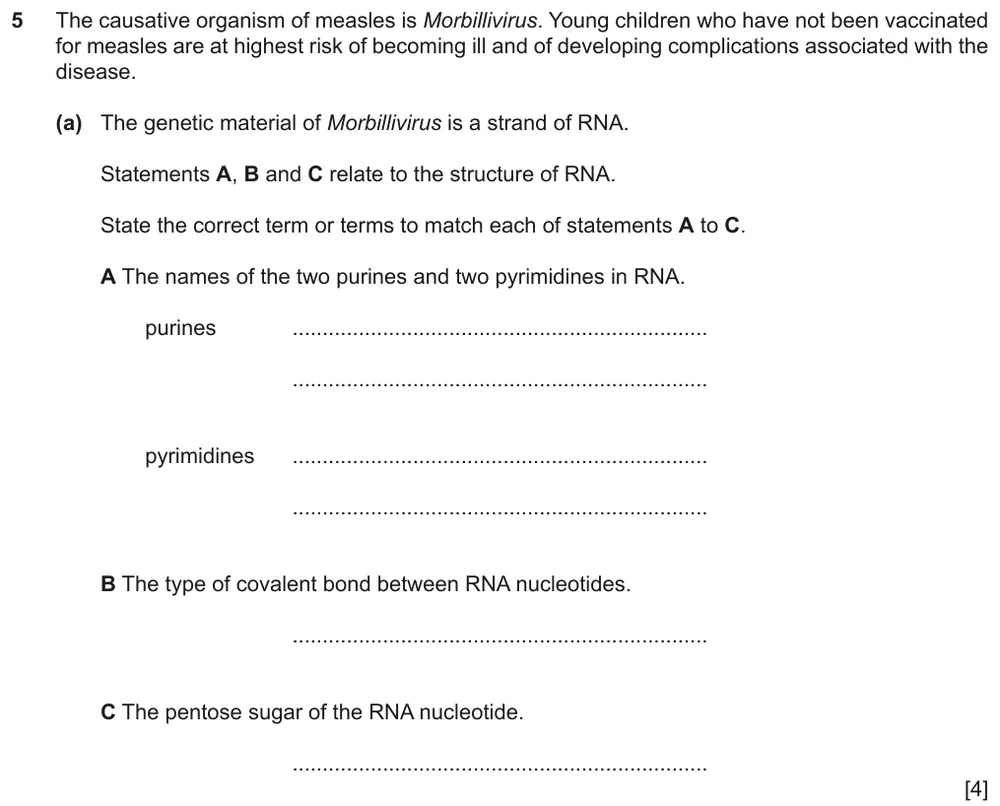
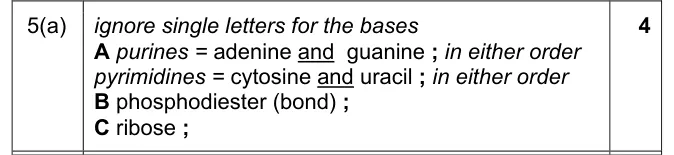
Give the terms that match three statements about the structure of RNA.
Show the mark scheme
Tap an image to open it full size.
From the examiners' report: Errors in A were to give the two sets of base pairs, or to name thymine when the base in RNA is uracil. Far fewer students named the covalent bond between RNA nucleotides: hydrogen bond was a very frequent wrong answer.
Question 22
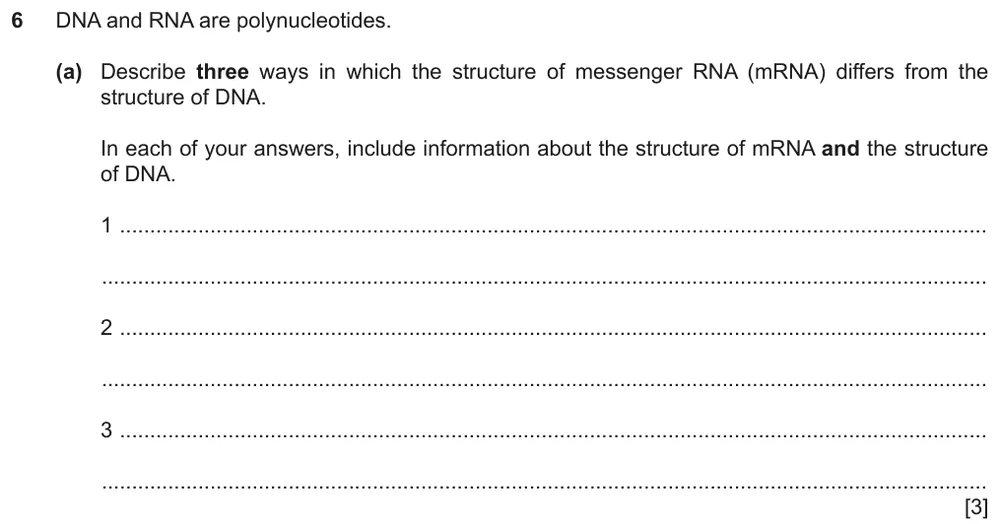
Paper 2 · May/June 2024 (23) · Q6(a) · 3 marks
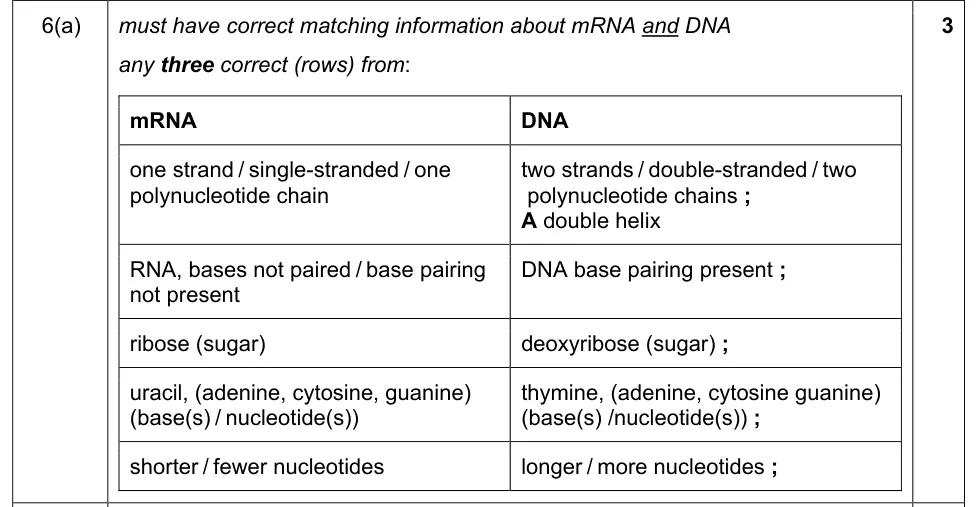
Describe three ways in which the structure of mRNA differs from the structure of DNA.
Show the mark scheme
Tap an image to open it full size.
From the examiners' report: Make it clear in each answer which fact is about mRNA and which is about DNA, and make it a comparison of structure. If you compare the bases, uracil and thymine must be spelt correctly.
Where students lose marks (from Cambridge examiners' reports and mark schemes)
Each point below comes from the examiners' reports and mark schemes, and is followed by wording that gained marks.
Spell the bases correctly. Students misspelt the names of the bases, or wrote thiamine for thymine, cysteine for cytosine and glycine for guanine.
✔ Gains credit: 'adenine', 'cytosine', 'guanine', 'thymine' and 'uracil', with 'correct spellings'.
Deoxyribose, not just a pentose. Students called the sugar in DNA a pentose sugar or ribose, or confused bases with nucleotides.
✔ Gains credit: 'E = deoxyribose'; each DNA nucleotide is 'deoxyribose sugar, phosphate, nitrogenous (organic) base'.
Purine or pyrimidine decides the base. Students gave guanine for base F: they seemed unsure of the structural difference between purines and pyrimidines.
✔ Gains credit: 'F = cytosine'.
Hydrogen bonds join complementary bases. Students named base X as adenine, or mentioned three hydrogen bonds without saying that they form between complementary bases.
✔ Gains credit: 'guanine', a 'double ring' or 'purine' base that 'forms three hydrogen bonds with complementary base'.
Phosphodiester, not hydrogen bond. Students named the bond that links nucleotides in a strand as a hydrogen bond or a peptide bond, or wrote 'nucleotide bonds'.
✔ Gains credit: 'phosphodiester'.
No OH group, no phosphodiester bond. Students gave answers without enough detail, such as 'without the O in the –OH group a bond cannot be created', or confused the modified nucleotide with ribose.
✔ Gains credit: 'does not have an OH group (on C3) so condensation reaction cannot occur' and 'phosphodiester bond cannot form between deoxyribose and phosphate of adjacent nucleotide'.
Ligase joins, helicase unwinds. Students named helicase as the enzyme that joins the fragments, or wrote 'polymerase' without saying DNA polymerase.
✔ Gains credit: '(DNA) ligase' joins the fragments and 'DNA polymerase' adds the complementary nucleotides.
Replication is not transcription. Students wrote about making mRNA or 'stop codes', or said that phosphodiester bonds form between complementary bases.
✔ Gains credit: DNA polymerase 'forms phosphodiester bonds' in the 'elongating' strand; DNA ligase 'joins' the 'Okazaki fragments' 'on lagging strand'.
Download the questions
Download the PDF pack (22 questions, mark schemes at the end)
Keep practising
- Protein Synthesis (6.2): Cambridge (CIE) exam questions by topic
- Cambridge (CIE) A level Biology 9700 past papers, mark schemes and examiners' reports
- Cambridge (CIE) A level Biology grade thresholds
- Book a one-to-one CIE lesson or a free 15-minute discovery chat with Tom
- Register your interest in a CIE A level Biology group class
Questions, mark schemes and examiners' report extracts © Cambridge University Press & Assessment.