

Movement Into and Out of Cells (4.2): Cambridge (CIE) A Level Biology 9700 Exam Questions by Topic
Movement into and out of cells is sub-topic 4.2 of Topic 4, Cell membranes and transport, in the Cambridge International AS & A Level Biology syllabus (9700). You need to describe and explain simple diffusion, facilitated diffusion, osmosis, active transport, endocytosis and exocytosis, calculate surface area to volume ratios and link them to diffusion, and explain the movement of water in terms of water potential. This is AS content, examined on Papers 1 and 2. A level students meet it again on Paper 4, where it appears inside questions on respiration, homeostasis and coordination; questions marked A level on this page come from Paper 4.
The examiners' reports return to the same points. Decide the mechanism from the direction of the concentration gradient, and remember that ions cannot cross the hydrophobic core of the phospholipid bilayer by simple diffusion. Write about water potential and water potential gradients, never the 'concentration of water'. Say which membrane a vesicle fuses with: the cell surface membrane. When a question gives you a table of results, compare each experiment with the control and quote the figures with their units.
Studying Cambridge International A level Biology and want more help? Tom teaches CIE students one-to-one online, including students in the UAE, Saudi Arabia, Hong Kong, India and Indonesia, and every lesson is recorded. You can book a one-to-one lesson or a free 15-minute discovery chat, or register your interest in a CIE group class starting in September 2027, using the links at the bottom of this page.
What you need from IGCSE
Each question on this page assumes you're secure on these ideas. If any of them feels shaky, look it up before you start.
- Diffusion is the net movement of particles from a region of higher concentration to a region of lower concentration.
- Osmosis is the movement of water through a partially permeable membrane.
- Active transport moves substances against a concentration gradient and needs energy from respiration.
- The surface area of a cube is 6 × side², and its volume is side³.
Key terms
These words come up in the questions and mark schemes. Examiners expect you to use them exactly.
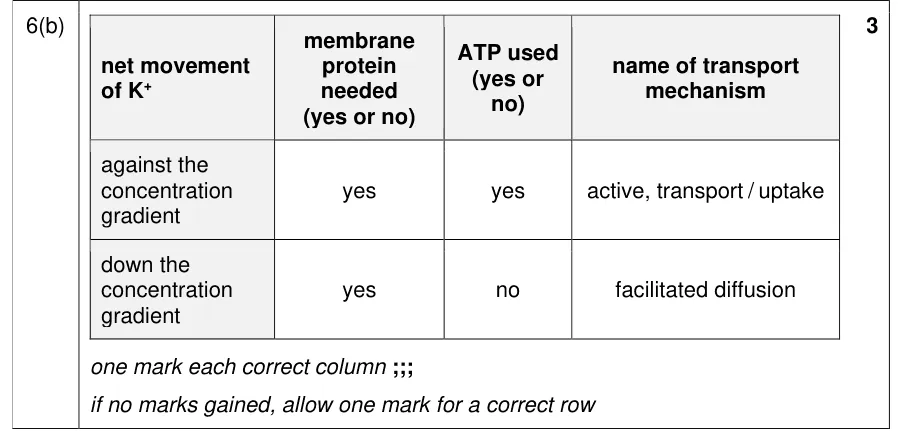
- Facilitated diffusion: movement of ions or polar molecules down a concentration gradient through channel or carrier proteins; it is passive, so no ATP is used.
- Active transport: movement of substances against a concentration gradient through carrier proteins, using energy from ATP.
- Exocytosis: bulk transport out of a cell: a vesicle moves to the cell surface membrane and fuses with it, releasing its contents. It needs ATP.
- Water potential: the tendency of water to move from one place to another; water moves by osmosis from a higher (less negative) to a lower (more negative) water potential.
- Water potential gradient: the difference in water potential between two places, such as a cell and the solution around it.
- Surface area to volume ratio: surface area divided by volume; it decreases as an object gets larger.
- Turgid: describes a plant cell whose vacuole is full of water, so the contents push outwards on the cell wall.
What these questions cover (Cambridge 9700 Topic 4: Cell membranes and transport)
The questions test these learning outcomes from sub-topic 4.2 of the Cambridge International AS & A Level Biology syllabus (9700) for 2025 to 2027.
- 4.2.1 describe and explain the processes of simple diffusion, facilitated diffusion, osmosis, active transport, endocytosis and exocytosis
- 4.2.2 investigate simple diffusion and osmosis using plant tissue and non-living materials, including dialysis
- 4.2.3 illustrate the principle that surface area to volume ratios decrease with increasing size by calculating surface areas and volumes of simple 3-D shapes
- 4.2.4 investigate the effect of changing surface area to volume ratio on diffusion using agar blocks of different sizes
- 4.2.6 explain the movement of water between cells and solutions in terms of water potential and explain the different effects of the movement of water on plant cells and animal cells
How to use this page
Write your answer on paper before you open the mark scheme. Allow about 1.2 minutes per mark: the 22 questions are worth 51 marks, so about 61 minutes in total. Then mark your answer strictly against the mark scheme and read the examiners' tip underneath it. If you'd rather print the questions, download the PDF pack.
Diffusion, facilitated diffusion and active transport (4.2.1)
Question 1
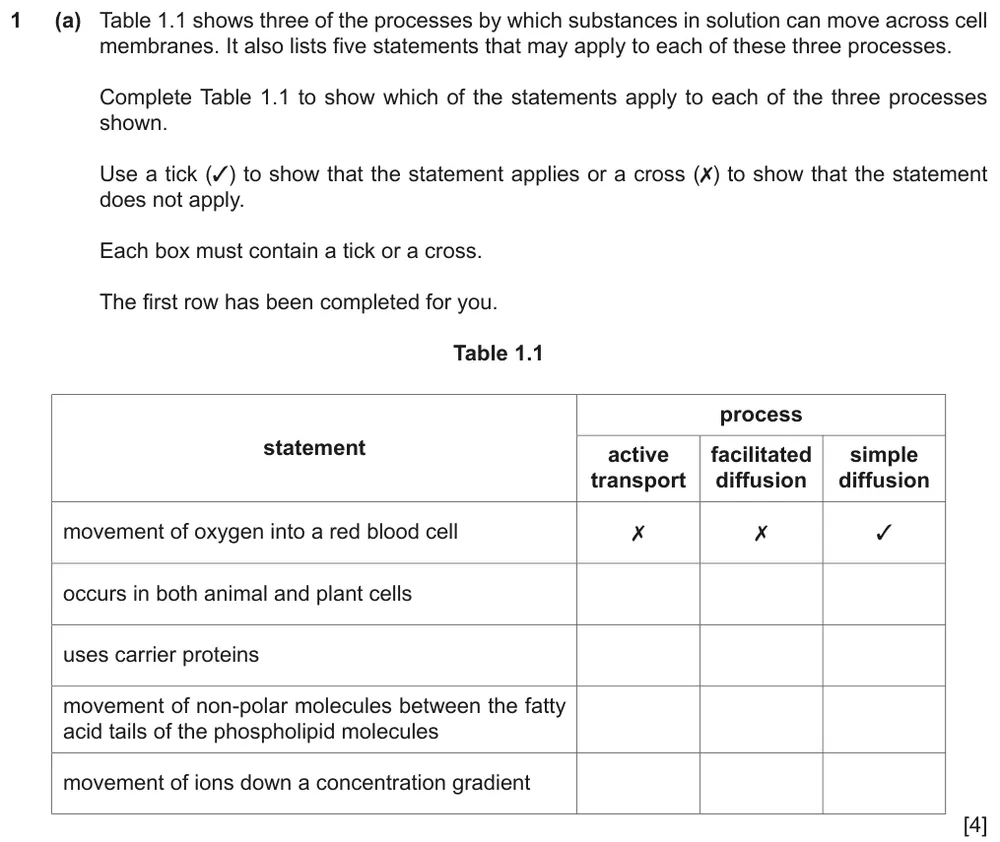
Paper 2 · February/March 2022 (22) · Q1(a) · 4 marks
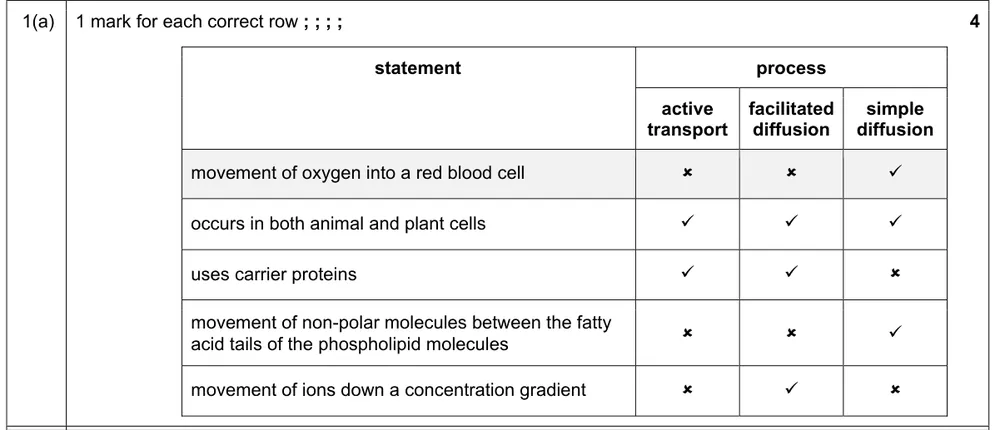
Complete the table to show which statements apply to active transport, facilitated diffusion and simple diffusion.
Show the mark scheme
Tap an image to open it full size.
Question 2
Paper 2 · February/March 2024 (22) · Q1(b)(i) · 1 mark
Explain why sodium ions cannot cross a phospholipid bilayer by simple diffusion.

Show the mark scheme

Tap an image to open it full size.
Question 3
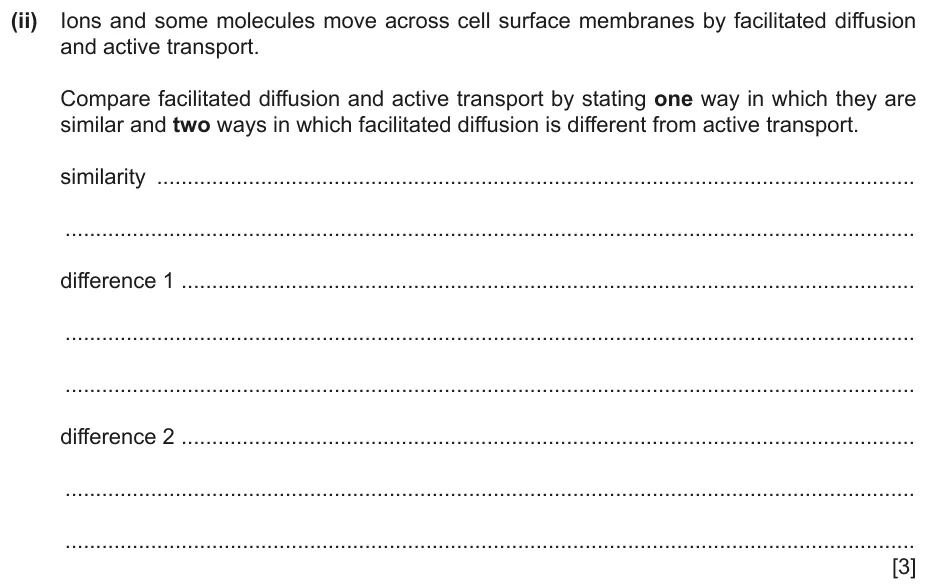
Paper 2 · February/March 2024 (22) · Q1(b)(ii) · 3 marks
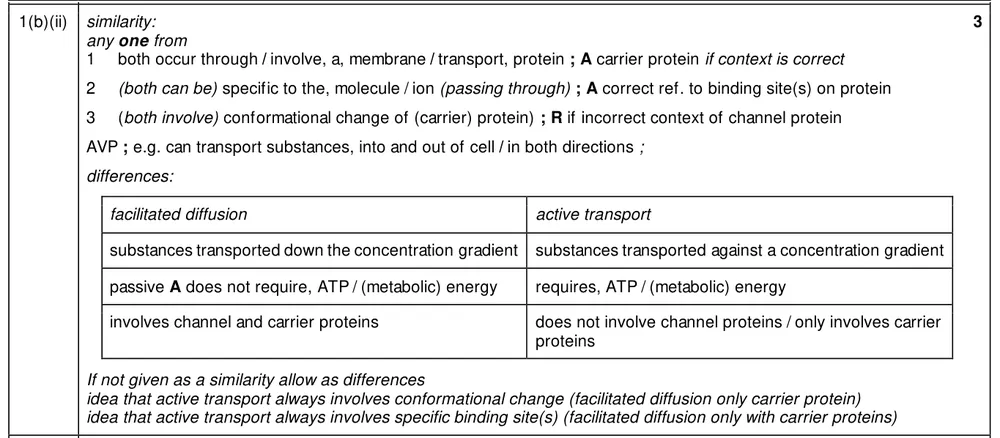
Give one similarity and two differences between facilitated diffusion and active transport.
Show the mark scheme
Tap an image to open it full size.
Question 4
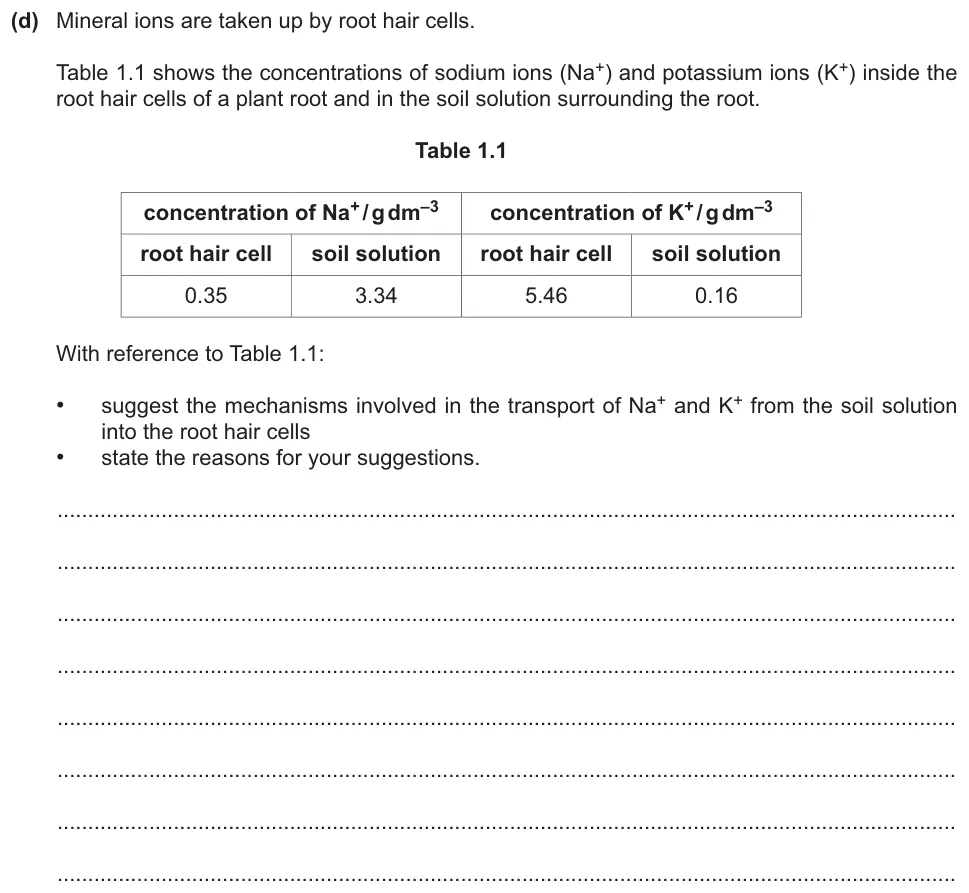
Paper 2 · February/March 2025 (22) · Q1(d) · 3 marks
Use the ion concentrations in the table to suggest how sodium ions and potassium ions enter root hair cells.
Show the mark scheme

Tap an image to open it full size.
From the examiners' report: Work out the direction of each concentration gradient first, as that decides the mechanism. Not everyone realised that ions cannot cross the hydrophobic core of the phospholipid bilayer, so simple diffusion could not be one of the mechanisms. Some confused answers referred to sodium-potassium pumps.
Question 5
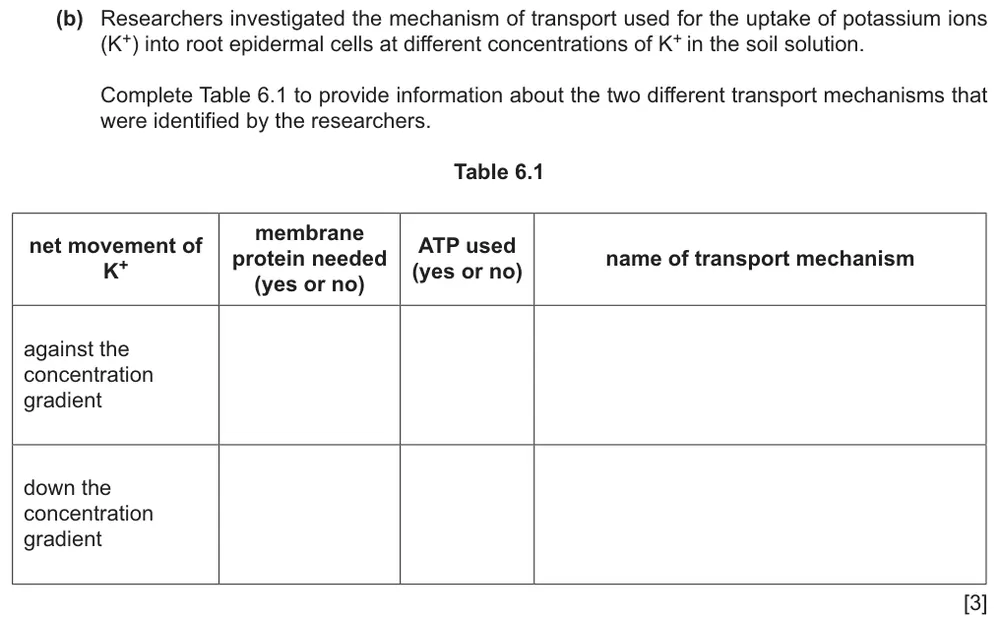
Paper 2 · October/November 2024 (22) · Q6(b) · 3 marks
Complete the table for the two mechanisms by which potassium ions are taken up by root cells.
Information from earlier in this question:

Show the mark scheme
Tap an image to open it full size.
Question 6
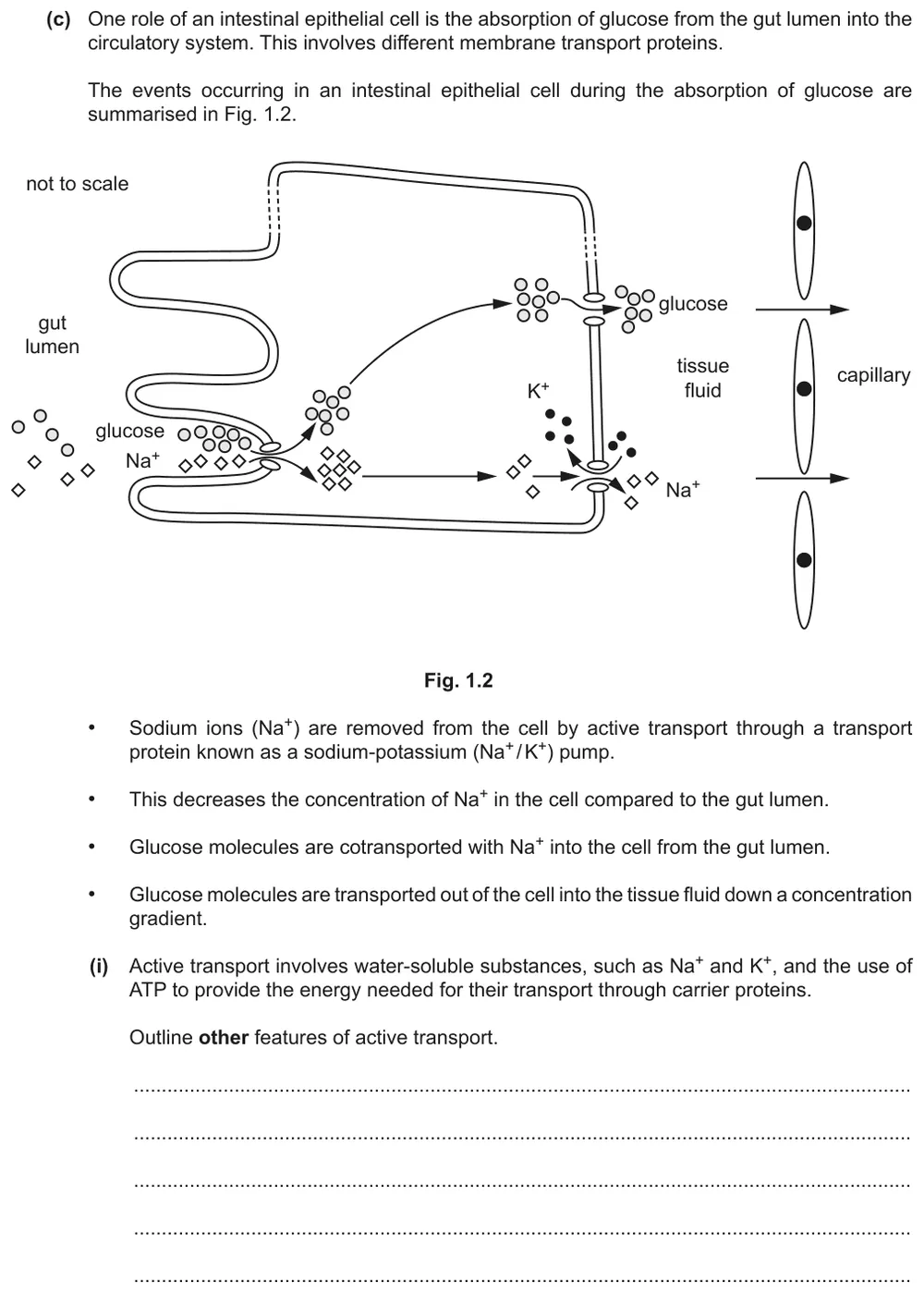
Paper 2 · May/June 2022 (22) · Q1(c)(i) · 2 marks
State features of active transport that are not already given in the question.
Show the mark scheme

Tap an image to open it full size.
From the examiners' report: Using ATP and carrier proteins gained no credit because both were given in the question. Some answers contradicted themselves, writing 'against the concentration gradient' and then 'from high to low concentration'. Few mentioned that the carrier protein is specific, has a binding site or changes shape. Endocytosis and exocytosis are not active transport.
Question 7
Paper 2 · May/June 2022 (22) · Q1(c)(ii) · 2 marks
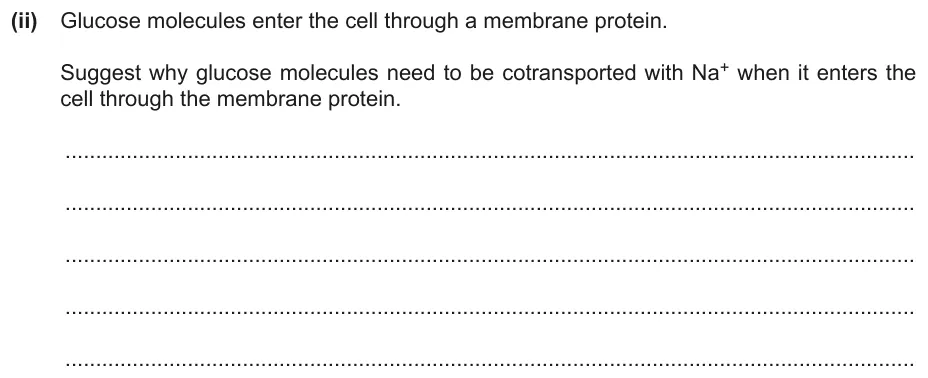
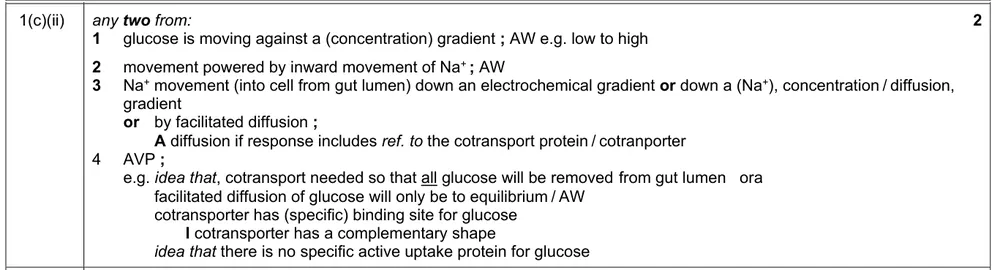
Suggest why glucose needs to be cotransported with sodium ions into the cell.
Show the mark scheme
Tap an image to open it full size.
From the examiners' report: Many knew that glucose has to move against its concentration gradient. Full marks needed the role of the sodium ions as well. Some answers only explained why hydrophilic substances need carrier proteins, which did not answer the question.
Question 8
Paper 2 · May/June 2024 (22) · Q4(e) · 4 marks
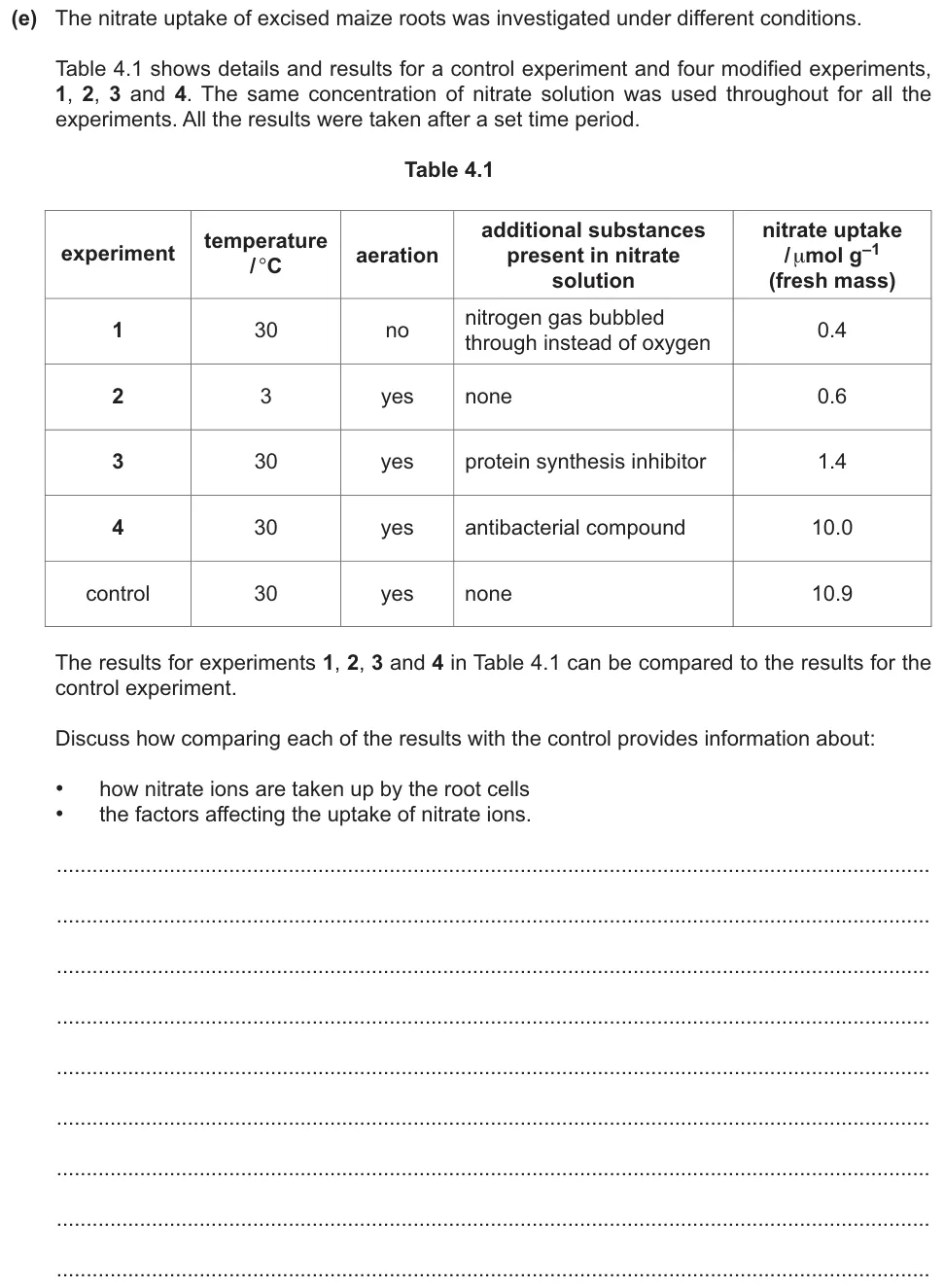
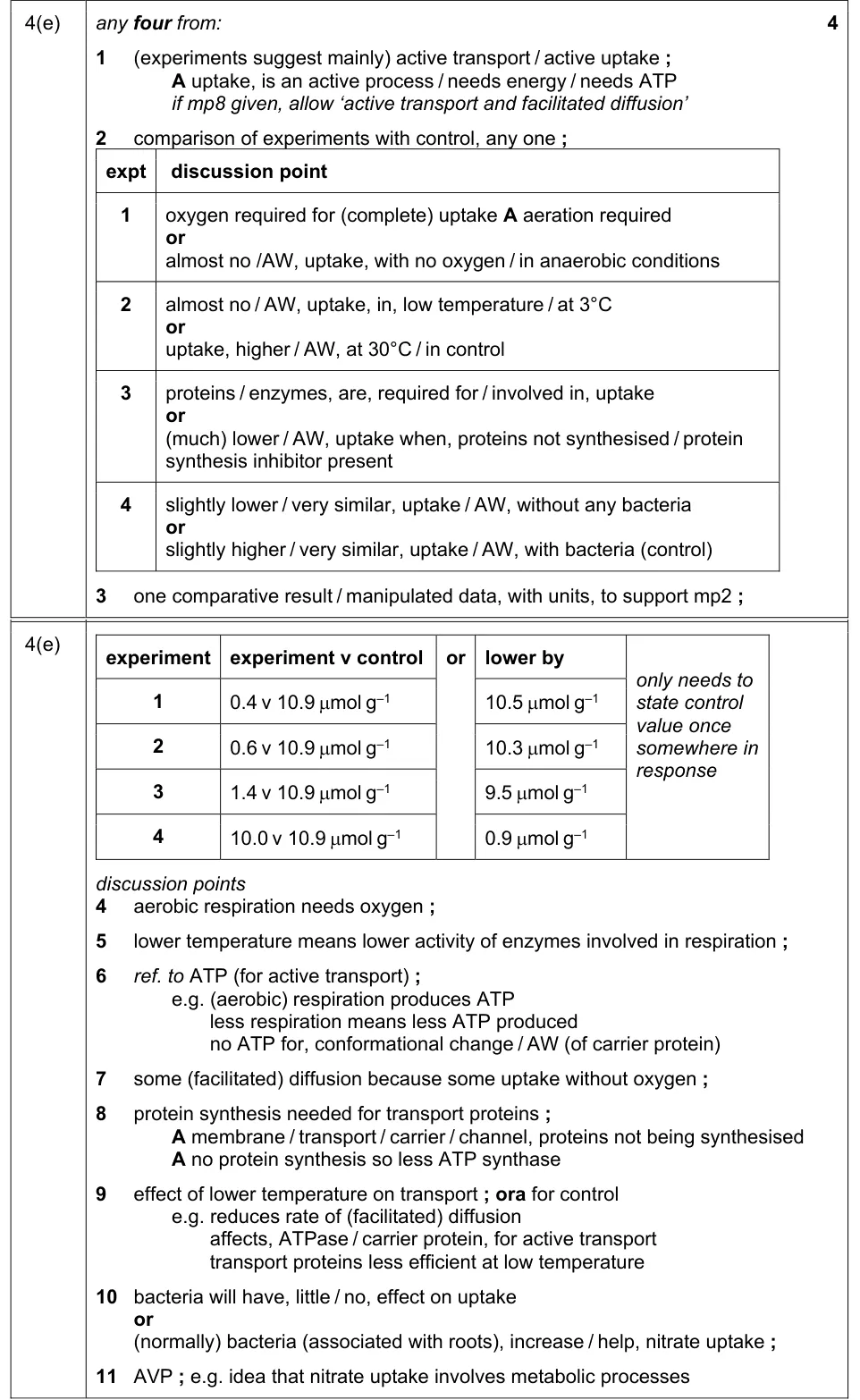
Use the results in the table to work out how maize roots take up nitrate ions.
Information from earlier in this question:

Show the mark scheme
Tap an image to open it full size.
From the examiners' report: The strongest answers named the mechanism and compared each experiment with the control to explain the effect of each factor. Weaker answers only described the results, or compared the experiments with each other. Many could have gained more credit by quoting figures from the table, with units.
Question 9
Paper 2 · October/November 2023 (22) · Q4(c) · 3 marks
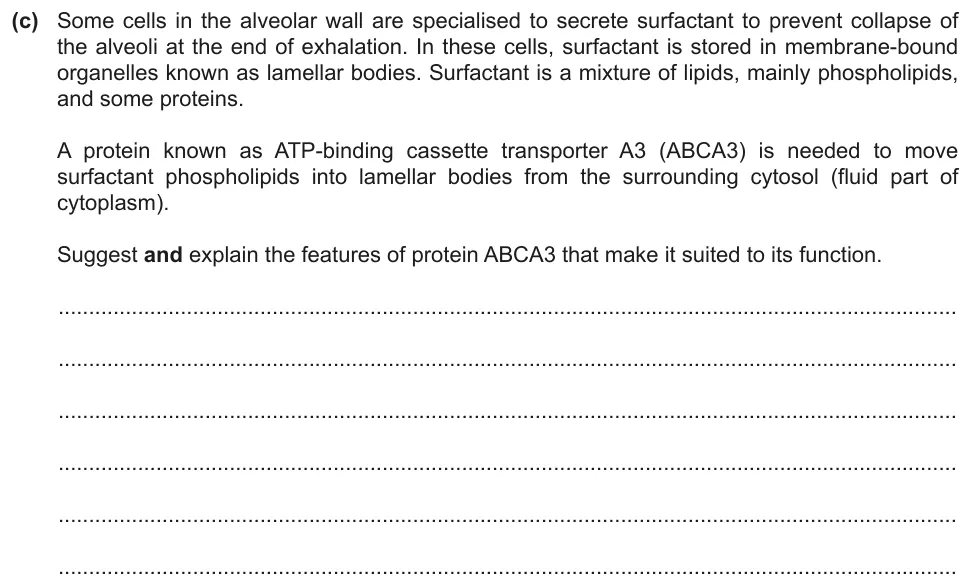
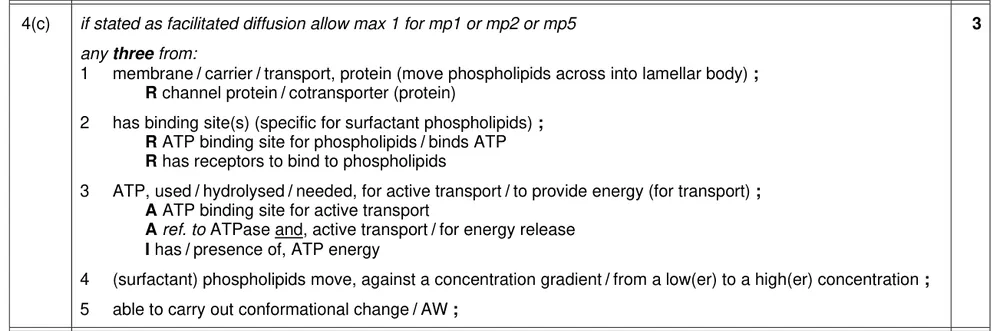
Suggest and explain how the protein ABCA3 moves phospholipids into lamellar bodies.
Information from earlier in this question:

Show the mark scheme
Tap an image to open it full size.
From the examiners' report: The name of the protein tells you ATP is involved, so this is active transport by a carrier protein, not facilitated diffusion. Answers about the hydrophobic and hydrophilic structure of the membrane, or about bulk transport, could not be credited. The phospholipids are the molecules being moved; they are not part of the membrane here.
Question 10
Paper 4 (A level) · May/June 2024 (42) · Q6(a) · 1 mark · Hard
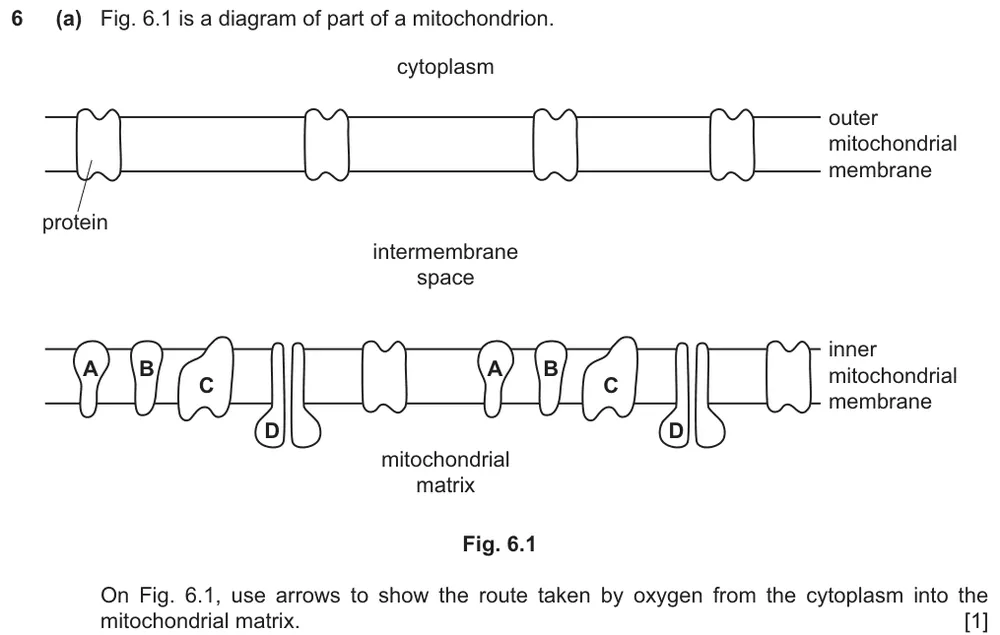
Draw arrows to show the route taken by oxygen from the cytoplasm into the mitochondrial matrix.
Show the mark scheme

Tap an image to open it full size.
From the examiners' report: Many put the arrow through the membrane proteins, and a significant number left the question blank. Others showed only half the journey, or arrows that did not start or finish in the right place.
Question 11
Paper 4 (A level) · October/November 2022 (41) · Q3(b)(ii) · 2 marks · Easy
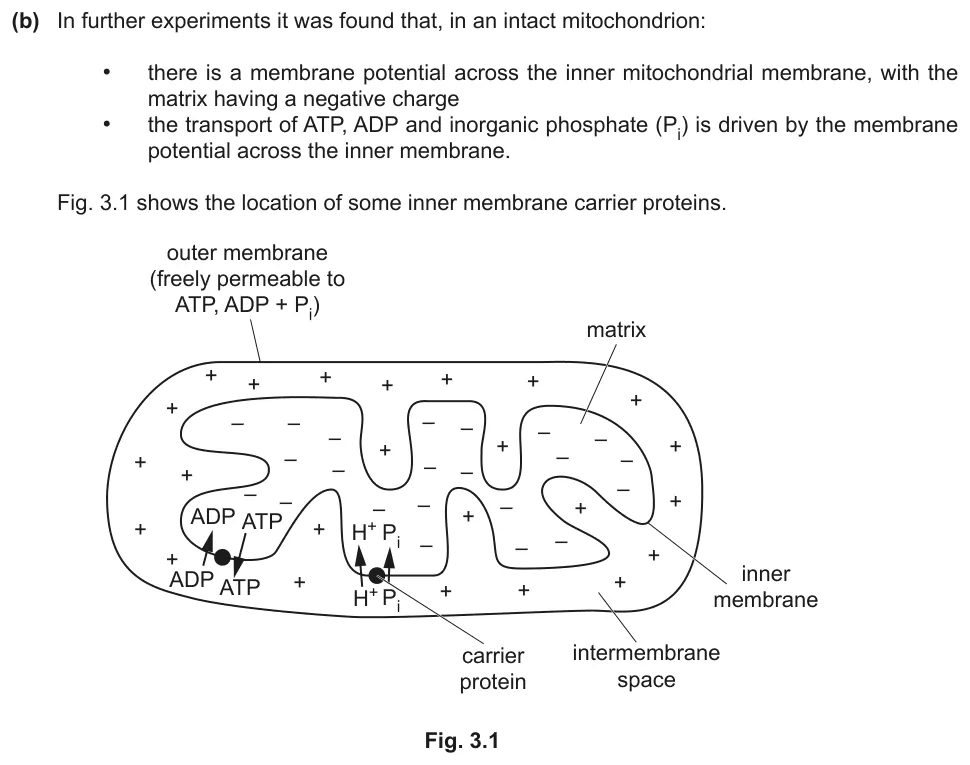
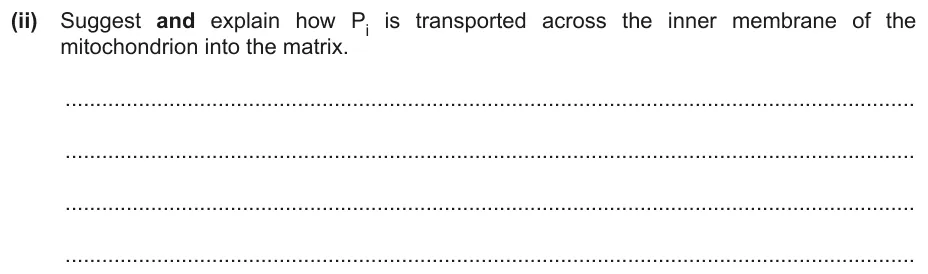
Suggest and explain how phosphate ions cross the inner mitochondrial membrane into the matrix.
Information from earlier in this question:
Show the mark scheme

Tap an image to open it full size.
From the examiners' report: Most described phosphate ions moving by facilitated diffusion or through a carrier protein, and many linked this to protons diffusing into the matrix.
Exocytosis (4.2.1)
Question 12
Paper 2 · February/March 2023 (22) · Q2(b)(ii) · 3 marks · Easy
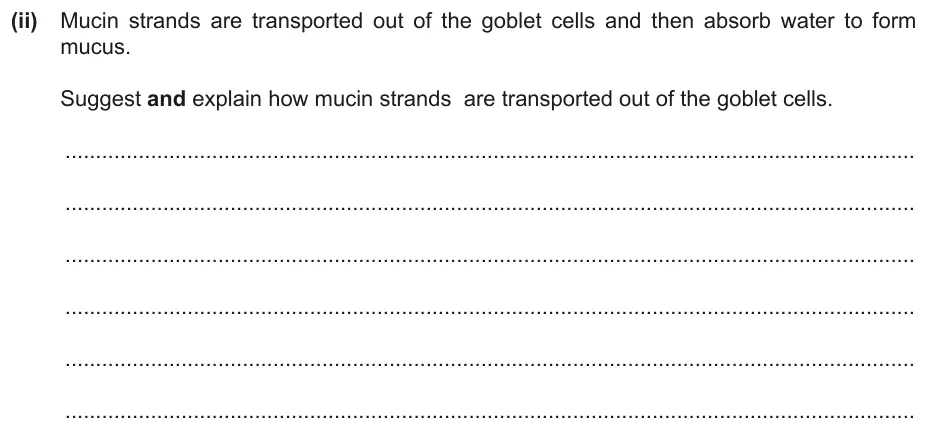
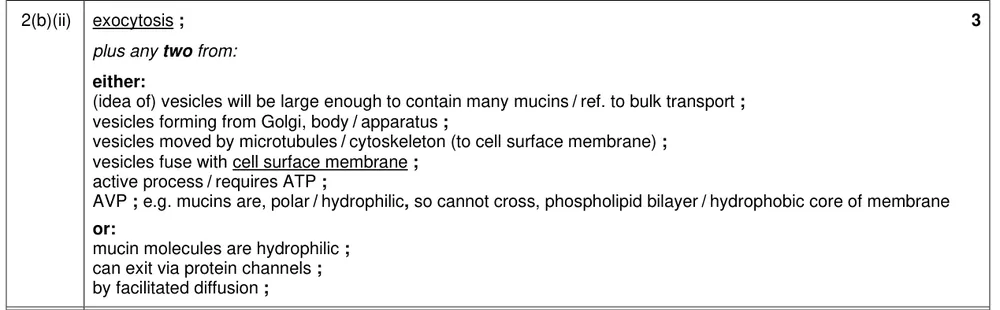
Suggest and explain how mucin strands are transported out of goblet cells.
Information from earlier in this question:

Show the mark scheme
Tap an image to open it full size.
From the examiners' report: Good answers named exocytosis and then explained the process. Some left out the role of the Golgi body, or did not make clear that the vesicles fuse with the cell surface membrane and not with one of the membranes inside the cell.
Investigating diffusion and osmosis (4.2.2)
Question 13
Paper 2 · October/November 2016 (22) · Q2(a)(i) · 1 mark
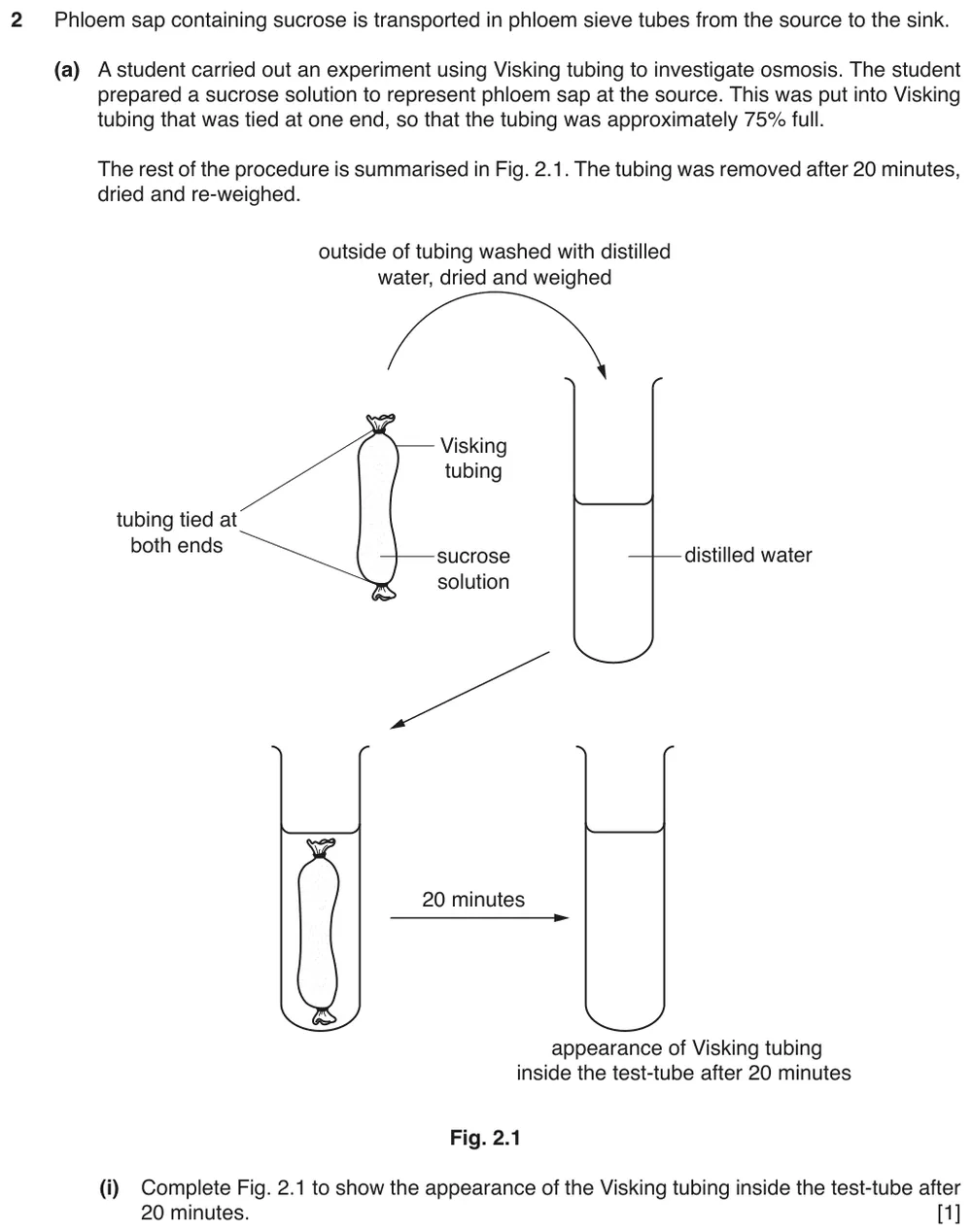
Complete the diagram to show the Visking tubing after 20 minutes in distilled water.
Show the mark scheme

Tap an image to open it full size.
From the examiners' report: Most knew the tubing would look more swollen. A few who understood that water would enter the tubing wrongly said it would burst.
Surface area to volume ratio and diffusion (4.2.3 and 4.2.4)
Question 14
Paper 2 · May/June 2021 (22) · Q4(b) · 2 marks · Easy
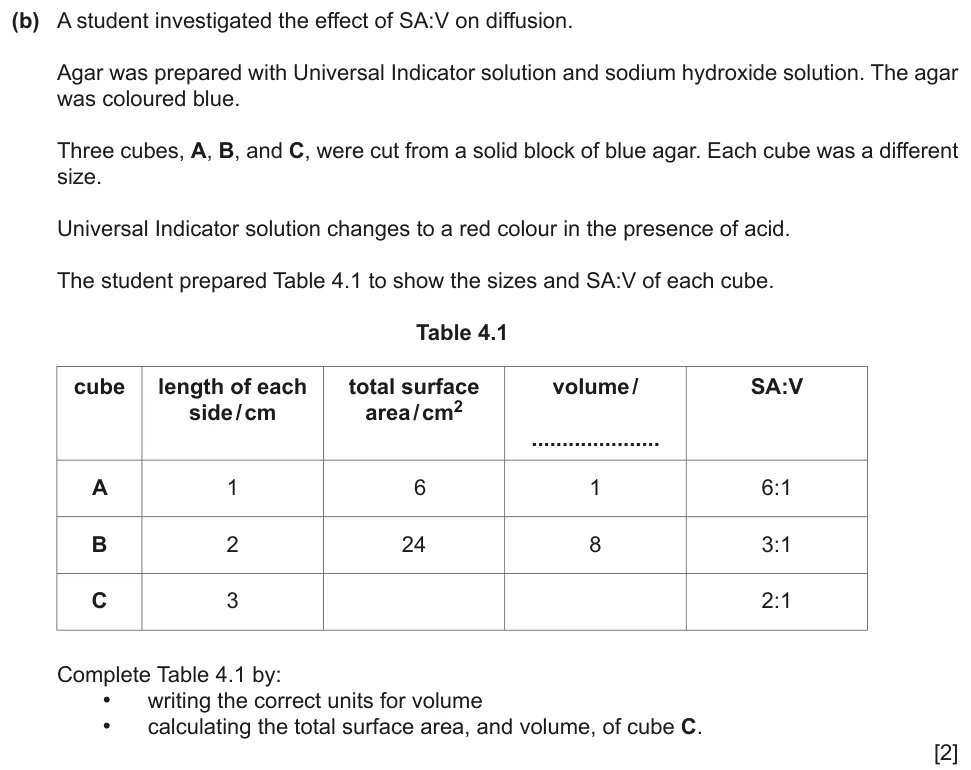
Complete the table with the units for volume and the surface area and volume of cube C.
Show the mark scheme

Tap an image to open it full size.
From the examiners' report: A small number gave cm2 or m3 as the unit for volume, or made errors with cube C. The last column of the table gives a ratio of 2:1 for cube C, so use it to check your surface area and volume.
Question 15
Paper 2 · May/June 2021 (22) · Q4(c) · 1 mark
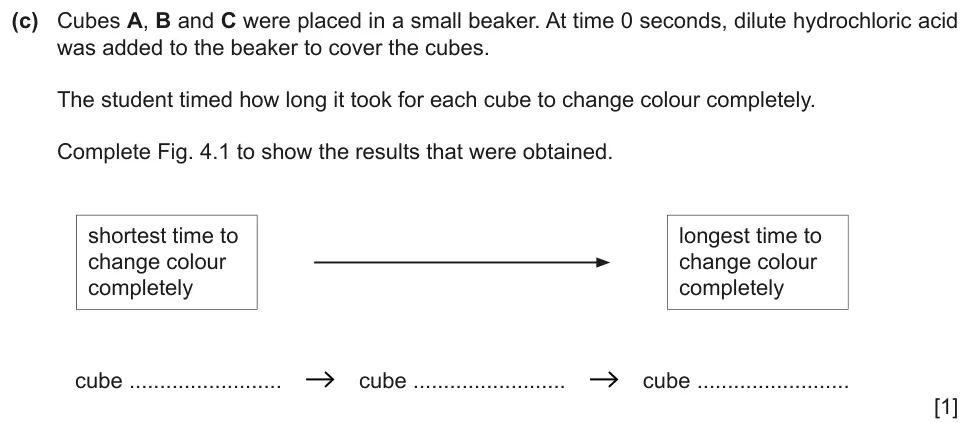
Put the three agar cubes in order of the time they take to change colour completely.
Show the mark scheme

Tap an image to open it full size.
From the examiners' report: Usually correct. Those who lost the mark gave the reverse order: C, B, A.
Question 16
Paper 2 · February/March 2017 (22) · Q6(a)(i) · 2 marks
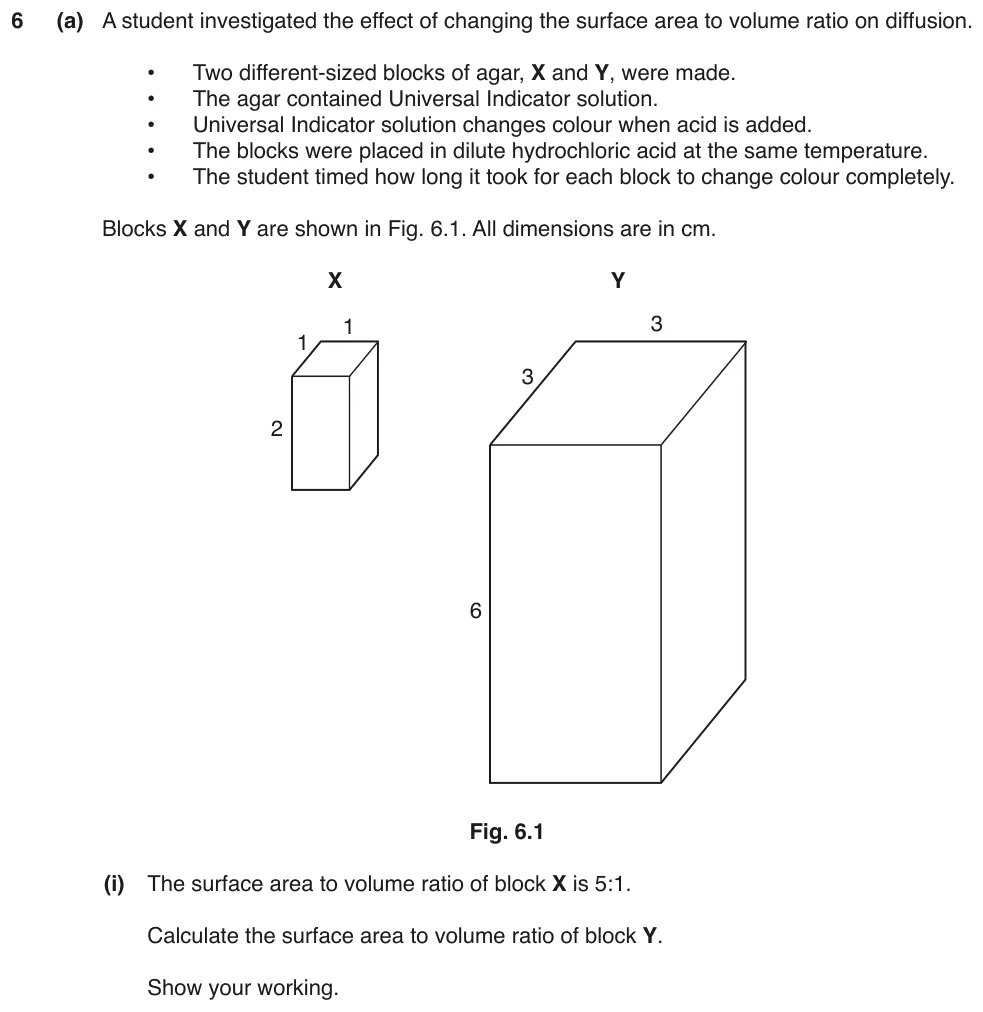
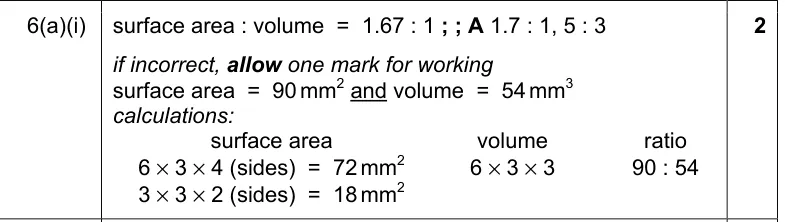
Calculate the surface area to volume ratio of block Y.
Show the mark scheme
Tap an image to open it full size.
From the examiners' report: A number of students left this blank. 5:3, 1.67:1 and 1.7:1 were all accepted. A correct surface area of 90 and volume of 54 gained one mark when the ratio was wrong, so show your working.
Question 17
Paper 2 · February/March 2017 (22) · Q6(a)(ii) · 2 marks · Easy
Explain why block X changed colour completely in a much shorter time than block Y.
Show the mark scheme

Tap an image to open it full size.
From the examiners' report: Many said block X has a larger surface area, which is not the same as a larger surface area to volume ratio. Most did not go on to say that the diffusion distance from the surface to the centre is shorter in block X.
Question 18
Paper 2 · February/March 2017 (22) · Q6(a)(iii) · 2 marks · Hard
Suggest how the results help to explain why plants need a transport system.
Show the mark scheme

Tap an image to open it full size.
From the examiners' report: Many answers were unclear because they started from the idea that plants have a small surface area to volume ratio. Stronger answers said that diffusion alone would be too slow over the distances needed to reach all the cells.
Osmosis and water potential (4.2.6)
Question 19
Paper 2 · February/March 2025 (22) · Q1(e) · 2 marks
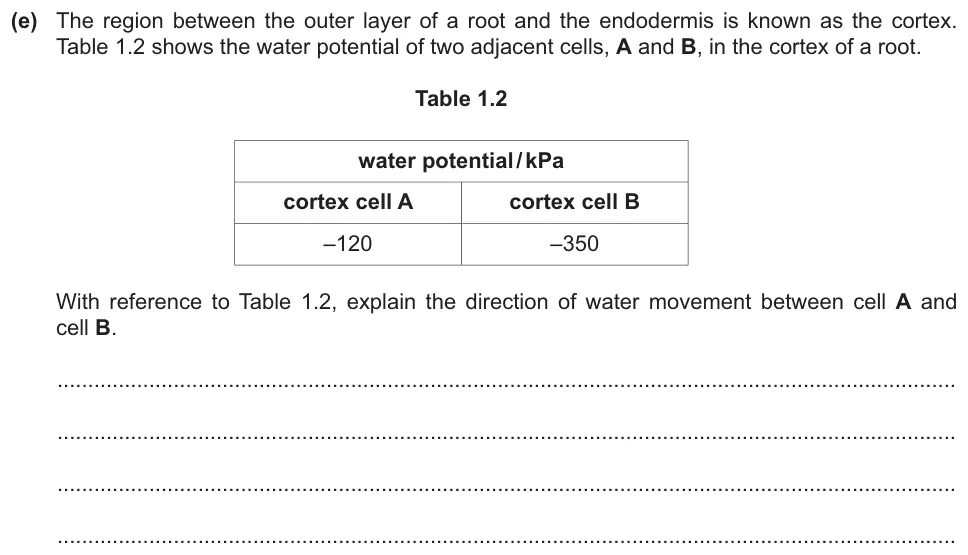
Use the water potentials in the table to explain which way water moves between two root cortex cells.
Show the mark scheme

Tap an image to open it full size.
From the examiners' report: Not everyone referred to osmosis. Some thought cell A had the lower water potential and so gave the wrong direction. It is often easier to write 'more negative' and 'less negative' than 'lower' and 'higher'.
Question 20
Paper 2 · May/June 2023 (22) · Q2(d)(iii) · 3 marks
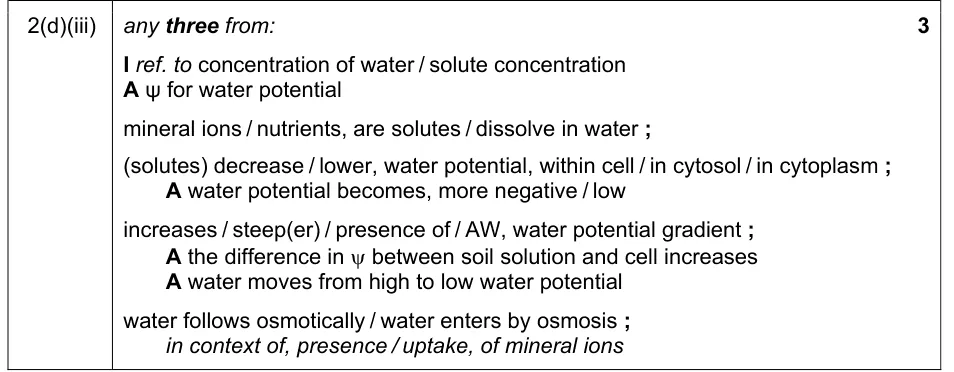
Suggest and explain how mineral ions in a root hair cell increase the absorption of water.
Information from earlier in this question:

Show the mark scheme
Tap an image to open it full size.
From the examiners' report: Some confused water potential with water potential gradient. Write 'water potential', not 'concentration of water', and 'water potential gradient', not 'concentration gradient'. A number misread the question and described how mineral ions are taken up.
Question 21
Paper 2 · February/March 2020 (22) · Q6(a) · 2 marks · Easy
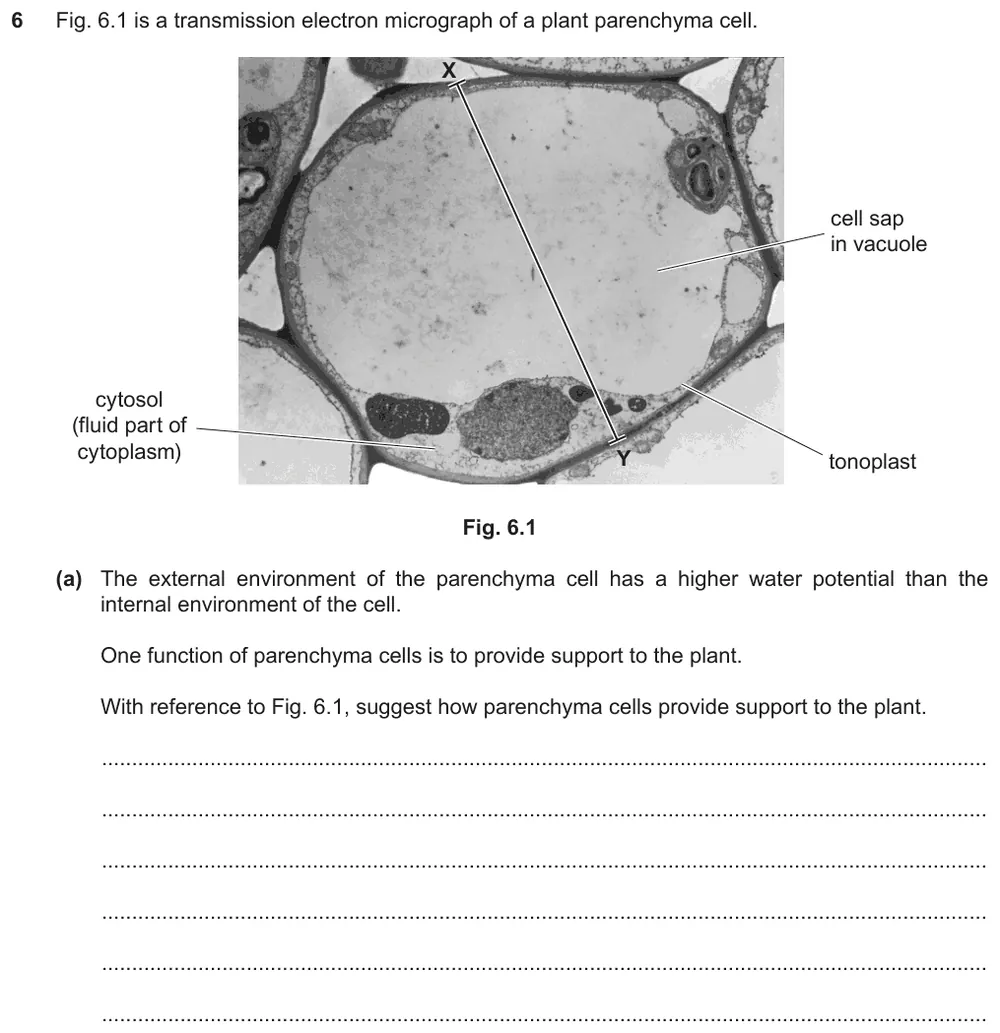
Suggest how parenchyma cells provide support to the plant.
Show the mark scheme

Tap an image to open it full size.
From the examiners' report: Most referred to turgor pressure. Fewer explained that it results from water entering the vacuole by osmosis. Some wrongly said that parenchyma cells have particularly thick or lignified cell walls.
Question 22
Paper 2 · May/June 2019 (22) · Q2(d) · 3 marks
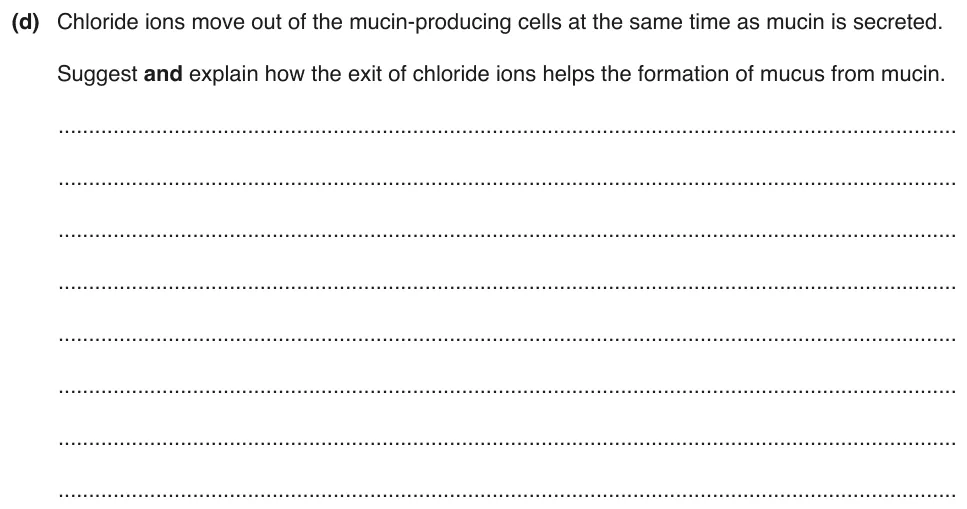
Suggest and explain how chloride ions leaving the cell help mucus to form from mucin.
Information from earlier in this question:

Show the mark scheme

Tap an image to open it full size.
From the examiners' report: Avoid 'concentration of water'. Write 'lower water potential' and 'higher water potential'; 'lower water potential gradient' is wrong. Say that water leaves the cell, or crosses the cell surface membrane, by osmosis.
Where students lose marks (from Cambridge examiners' reports and mark schemes)
Each point below comes from the examiners' reports and mark schemes, and is followed by wording that gained marks.
Ions cannot use simple diffusion. Students suggested that sodium and potassium ions diffuse straight through the membrane, or wrote about sodium-potassium pumps.
✔ Gains credit: 'ions cannot pass through the phospholipid bilayer', so 'facilitated diffusion uses channel or carrier proteins' and 'active transport uses carrier proteins'.
The gradient decides the mechanism. Students named a mechanism without using the concentrations they were given.
✔ Gains credit: 'facilitated diffusion because higher concentration of Na+ in soil solution' and 'active transport because higher concentration of K+ in root hair cells'.
Don't repeat the question. Students gave ATP and carrier proteins as features of active transport when both were already in the question.
✔ Gains credit: 'against concentration gradient', the protein 'has binding sites', is 'specific', and binding causes a 'conformational change'.
ATP means active transport. Students missed that ATP was involved and called the movement facilitated diffusion.
✔ Gains credit: a 'carrier protein' with a 'binding site', 'ATP used for active transport', moving phospholipids 'against a concentration gradient'.
Vesicles fuse with the cell surface membrane. Students left out the Golgi body or did not say which membrane the vesicles fuse with.
✔ Gains credit: 'exocytosis', 'vesicles forming from Golgi body', 'vesicles fuse with cell surface membrane', 'requires ATP'.
Compare with the control. Students described the results in the table, or compared the experiments with each other.
✔ Gains credit: 'active transport', with a 'comparison of experiments with control', such as 'almost no uptake in low temperature'.
Surface area is not the ratio. Students said the smaller block has a larger surface area and stopped there.
✔ Gains credit: the block 'has higher surface area to volume ratio' and a 'shorter distance for diffusion to centre'.
Water potential, not water concentration. Students wrote about the concentration of water, mixed up water potential with water potential gradient, or gave the wrong direction of movement.
✔ Gains credit: water moves 'by osmosis' 'from higher water potential to lower water potential', or 'from less negative to more negative'.
Download the questions
Download the PDF pack (22 questions, mark schemes at the end)
Keep practising
- Fluid Mosaic Membranes (4.1): Cambridge (CIE) exam questions by topic
- Cambridge (CIE) A level Biology 9700 past papers, mark schemes and examiners' reports
- Cambridge (CIE) A level Biology grade thresholds
- Book a one-to-one CIE lesson or a free 15-minute discovery chat with Tom
- Register your interest in a CIE A level Biology group class
Questions, mark schemes and examiners' report extracts © Cambridge University Press & Assessment.