

Fluid Mosaic Membranes (4.1): Cambridge (CIE) A Level Biology 9700 Exam Questions by Topic
Fluid mosaic membranes is sub-topic 4.1 of Topic 4, Cell membranes and transport, in the Cambridge International AS & A Level Biology syllabus (9700). You need to describe the fluid mosaic model, including the hydrophobic and hydrophilic interactions that form the phospholipid bilayer and arrange the proteins, describe the arrangement and roles of cholesterol, glycolipids, proteins and glycoproteins in stability, fluidity, permeability, transport, cell signalling and cell recognition, and outline the main stages of cell signalling. This is AS content, examined on Papers 1 and 2. A level students meet it again on Paper 4; questions marked A level on this page come from Paper 4.
The examiners' reports return to the same points. When a question gives you a micrograph or a diagram, use it and do not draw a membrane from memory. A phospholipid has two fatty acid tails, and a membrane has two layers of phospholipids. Polar molecules such as glucose cannot pass through the hydrophobic core of the phospholipid bilayer; 'too large' did not gain the mark. In cell signalling, write that the ligand binds to a receptor with a complementary shape, say that the receptor is in the cell surface membrane, and include the secretion of the ligand and its transport to the target cell. Ligands and receptors are not antigens, enzymes or substrates.
Studying Cambridge International A level Biology and want more help? Tom teaches CIE students one-to-one online, including students in the UAE, Saudi Arabia, Hong Kong, India and Indonesia, and every lesson is recorded. You can book a one-to-one lesson or a free 15-minute discovery chat, or register your interest in a CIE group class starting in September 2027, using the links at the bottom of this page.
What you need from IGCSE
Each question on this page assumes you're secure on these ideas. If any of them feels shaky, look it up before you start.
- The cell membrane controls which substances enter and leave a cell.
- Fats and oils are made from fatty acids and glycerol.
- Proteins are made from amino acids, and the shape of a protein molecule is important for its function.
- Hormones are chemical substances carried by the blood that change the activity of target organs.
Key terms
These words come up in the questions and mark schemes. Examiners expect you to use them exactly.
- Fluid mosaic model: the model of membrane structure: a phospholipid bilayer in which the molecules can move, with proteins scattered through it.
- Phospholipid bilayer: two layers of phospholipids with the hydrophilic phosphate heads facing outwards and the hydrophobic fatty acid tails facing inwards.
- Hydrophobic core: the middle of the bilayer, made of fatty acid tails; polar molecules and ions cannot pass through it.
- Cholesterol: a lipid found among the phospholipids that regulates the fluidity and stability of the membrane.
- Glycoprotein: a membrane protein with a carbohydrate chain attached; it can act as a receptor in cell signalling or as a cell surface antigen in cell recognition.
- Channel protein: a membrane protein with a hydrophilic channel through which ions and polar molecules pass by facilitated diffusion.
- Ligand: a cell signalling molecule that is secreted by a cell and binds to a specific receptor on a target cell.
- Receptor: a protein or glycoprotein with a shape complementary to its ligand; binding sets off a response in the target cell.
What these questions cover (Cambridge 9700 Topic 4: Cell membranes and transport)
The questions test these learning outcomes from sub-topic 4.1 of the Cambridge International AS & A Level Biology syllabus (9700) for 2025 to 2027.
- 4.1.1 describe the fluid mosaic model of membrane structure with reference to the hydrophobic and hydrophilic interactions that account for the formation of the phospholipid bilayer and the arrangement of proteins
- 4.1.2 describe the arrangement of cholesterol, glycolipids and glycoproteins in cell surface membranes
- 4.1.3 describe the roles of phospholipids, cholesterol, glycolipids, proteins and glycoproteins in cell surface membranes
- 4.1.4 outline the main stages in the process of cell signalling leading to specific responses
How to use this page
Write your answer on paper before you open the mark scheme. Allow about 1.2 minutes per mark: the 22 questions are worth 51 marks, so about 61 minutes in total. Then mark your answer strictly against the mark scheme and read the examiners' tip underneath it. If you'd rather print the questions, download the PDF pack.
Phospholipid bilayer and the fluid mosaic model (4.1.1)
Question 1
Paper 2 · February/March 2023 (22) · Q1(b) · 3 marks
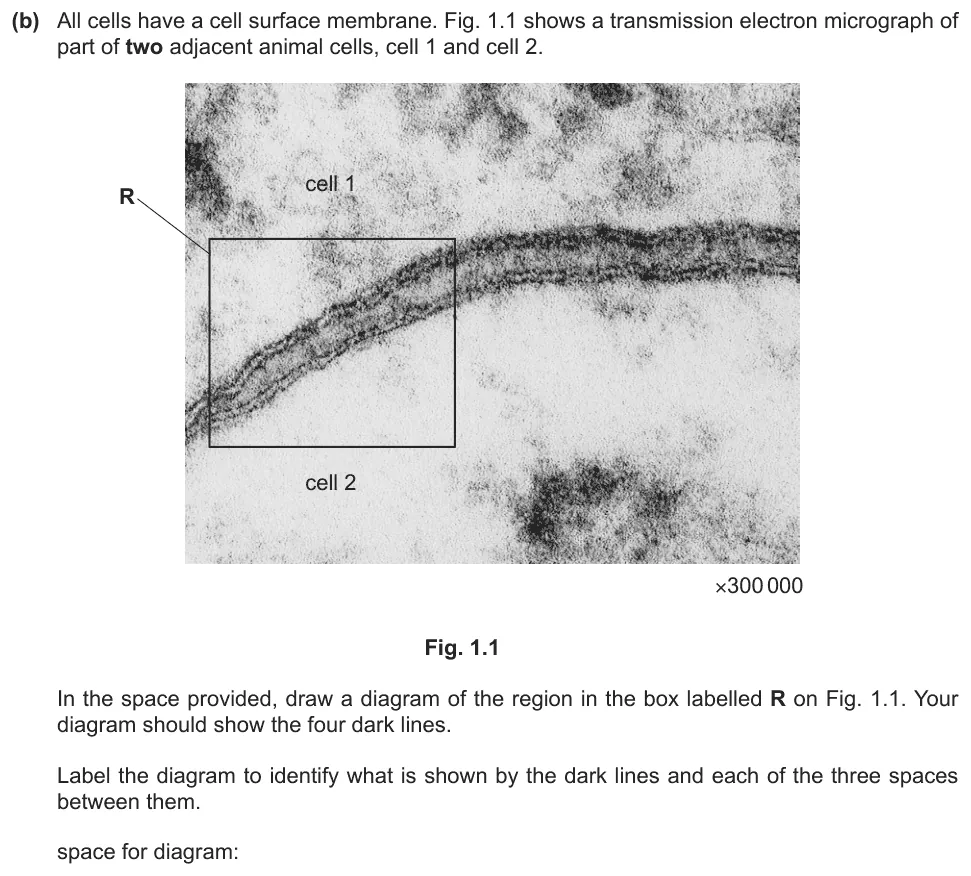
Draw and label a diagram of the four dark lines where two cell surface membranes meet in an electron micrograph.
Show the mark scheme

Tap an image to open it full size.
From the examiners' report: Some drew an accurate labelled diagram of the four dark lines in the box. Many others drew a textbook diagram of a cell surface membrane without using the micrograph, and some of these drew only one membrane. The space between the two cells was not always labelled correctly.
Question 2
Paper 2 · October/November 2025 (22) · Q4(a) · 3 marks
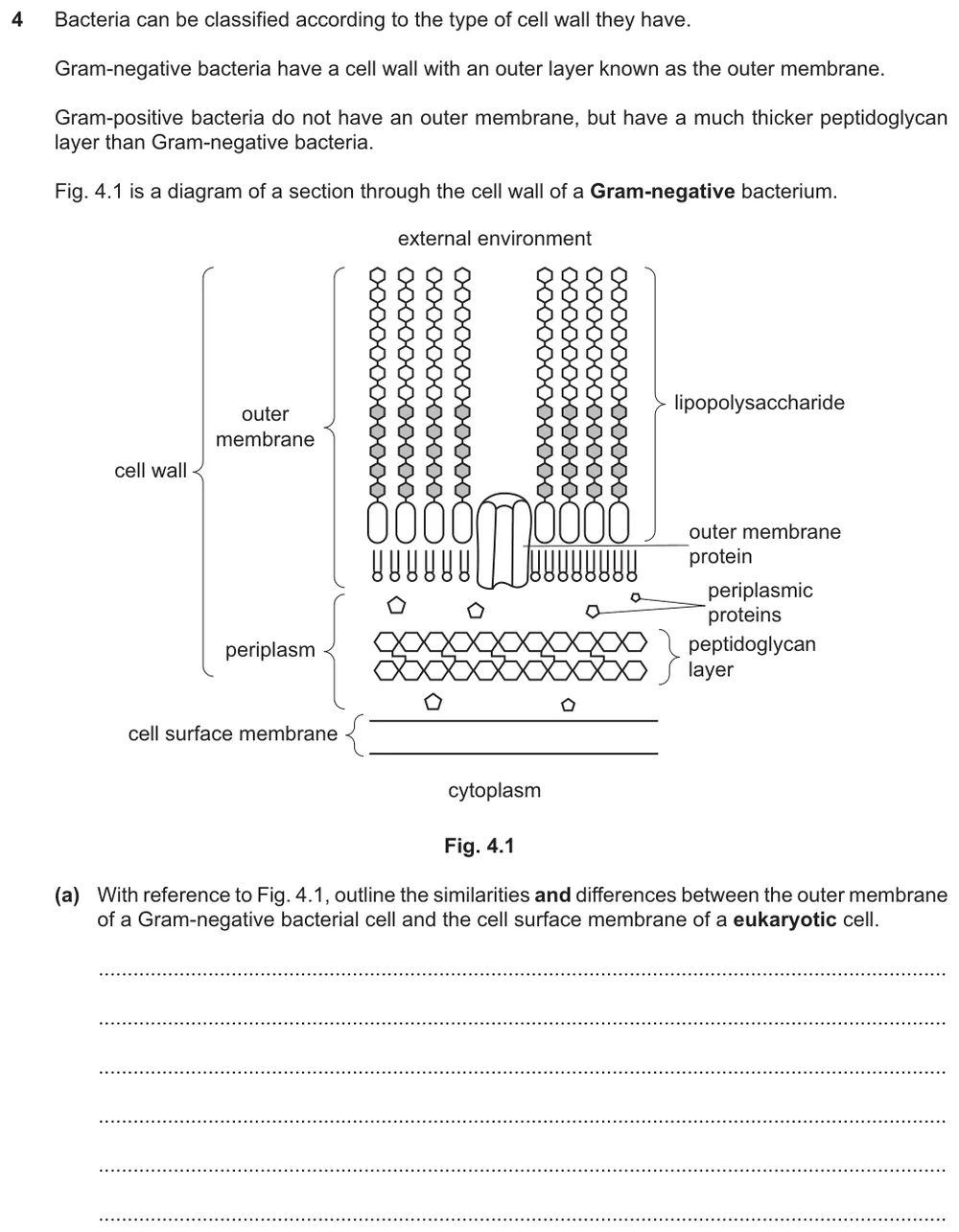
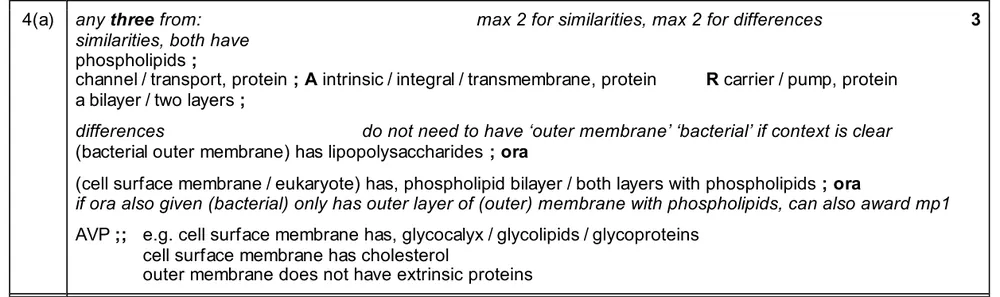
Outline the similarities and differences between the outer membrane of a Gram-negative bacterium and a eukaryotic cell surface membrane.
Show the mark scheme
Tap an image to open it full size.
Question 3
Paper 2 · October/November 2022 (21) · Q4(a)(ii) · 2 marks
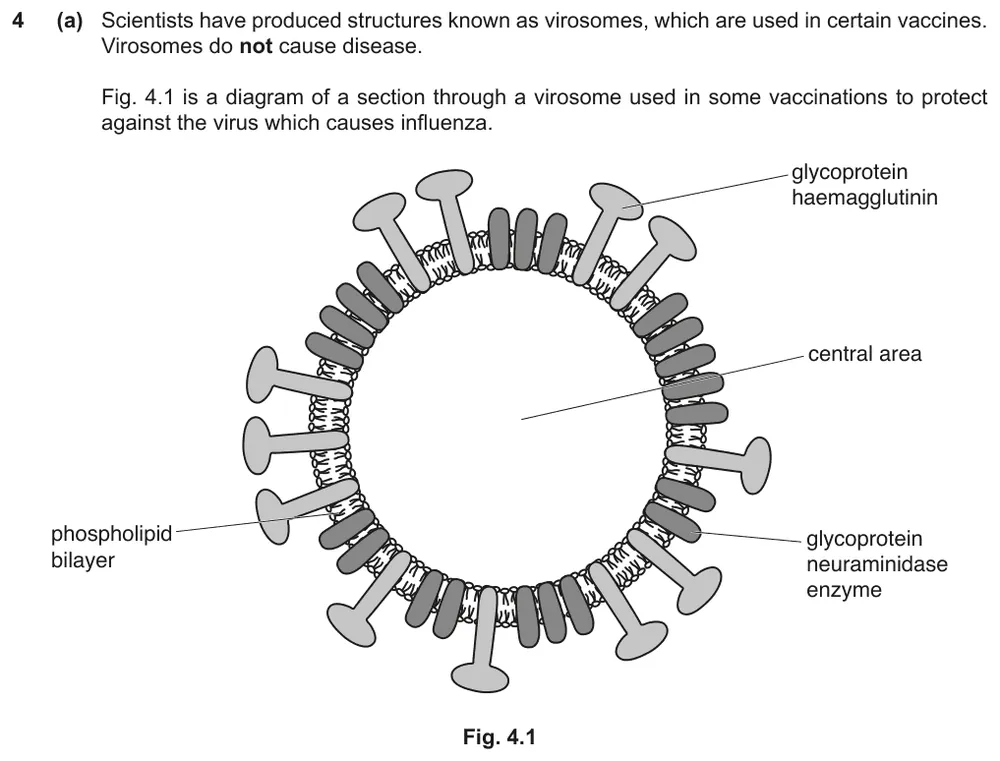
Explain how the structure of the virosome suggests that its central area is aqueous.
Information from earlier in this question:
Show the mark scheme

Tap an image to open it full size.
From the examiners' report: Start from the phospholipid bilayer. The best answers explained that the hydrophilic phosphate heads face the aqueous central area and the hydrophobic fatty acid tails face away from it.
Question 4
Paper 2 · February/March 2021 (22) · Q3(c)(ii) · 2 marks · Easy
Suggest and explain why cytokine molecules cannot cross the cell surface membrane.
Information from earlier in this question:


Show the mark scheme

Tap an image to open it full size.
From the examiners' report: Most suggested that cytokines are polar or that the molecules are too large. Fewer thought about the need for a specific membrane transport protein, which might be absent.
Phospholipid bilayer and cholesterol (4.1.1 and 4.1.3)
Question 5
Paper 2 · October/November 2023 (21) · Q5(b)(i) · 2 marks · Easy
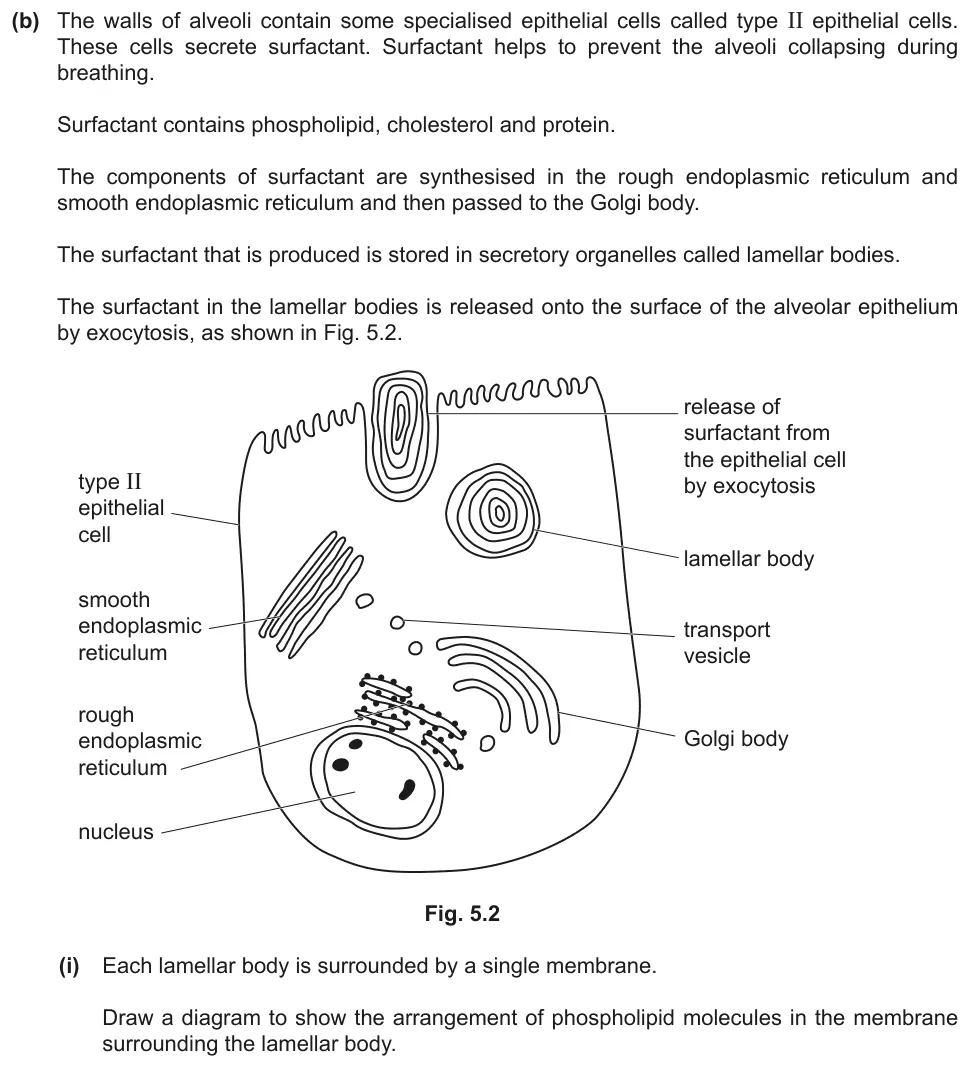
Draw the arrangement of phospholipid molecules in the membrane around a lamellar body.
Show the mark scheme

Tap an image to open it full size.
From the examiners' report: Some drew a single layer of phospholipids instead of a bilayer, and gained credit only for the structure of the phospholipid. Some drew three fatty acid tails, confusing a phospholipid with a triglyceride. You did not need to draw the whole lamellar body; if you draw many molecules, keep each one accurate.
Question 6
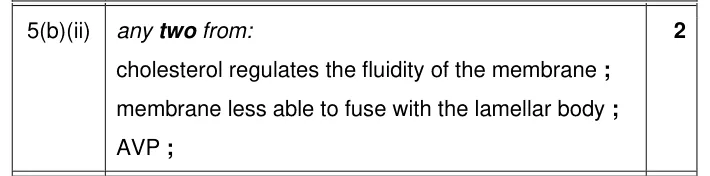
Paper 2 · October/November 2023 (21) · Q5(b)(ii) · 2 marks
Suggest why less cholesterol in the cell surface membrane reduces the secretion of surfactant.
Show the mark scheme
Tap an image to open it full size.
From the examiners' report: Most knew that cholesterol regulates the fluidity of membranes, and the best answers linked this to exocytosis. Some misread the question and wrote that less cholesterol would reduce the synthesis of surfactant. Read the introduction carefully: surfactant is made in the endoplasmic reticulum and Golgi body, not in the cell surface membrane.
Arrangement of cholesterol, glycolipids and glycoproteins (4.1.2)
Question 7
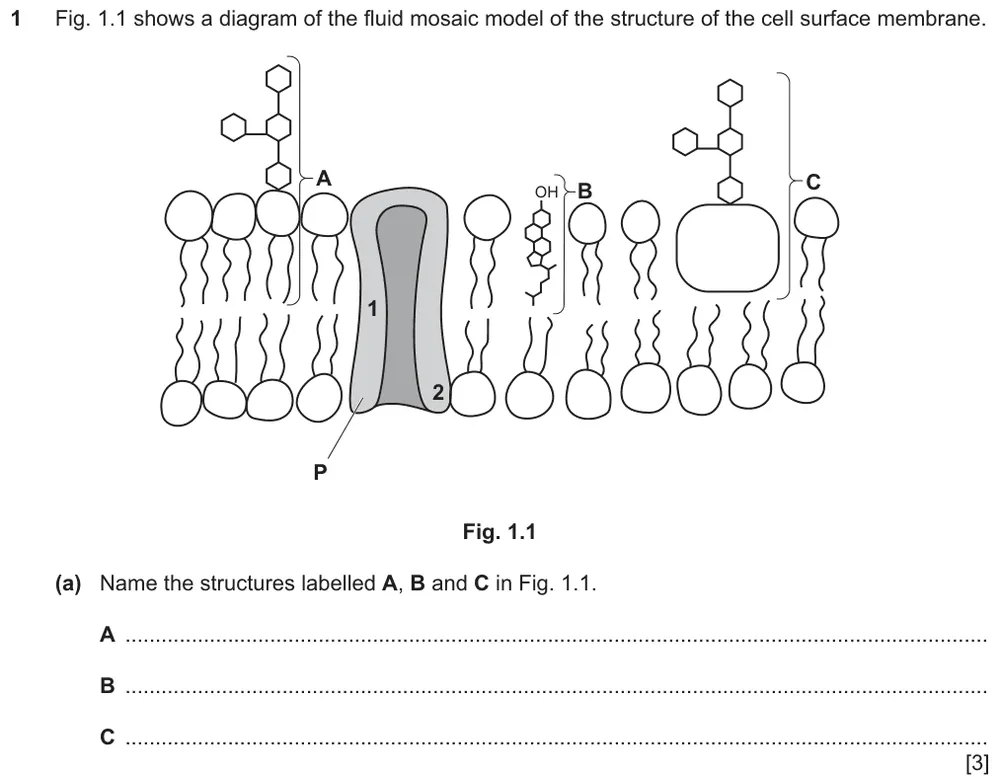
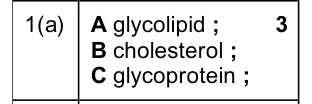
Paper 2 · October/November 2025 (21) · Q1(a) · 3 marks
Name three structures labelled on a diagram of the fluid mosaic model.
Show the mark scheme
Tap an image to open it full size.
Arrangement and role of cholesterol (4.1.2 and 4.1.3)
Question 8
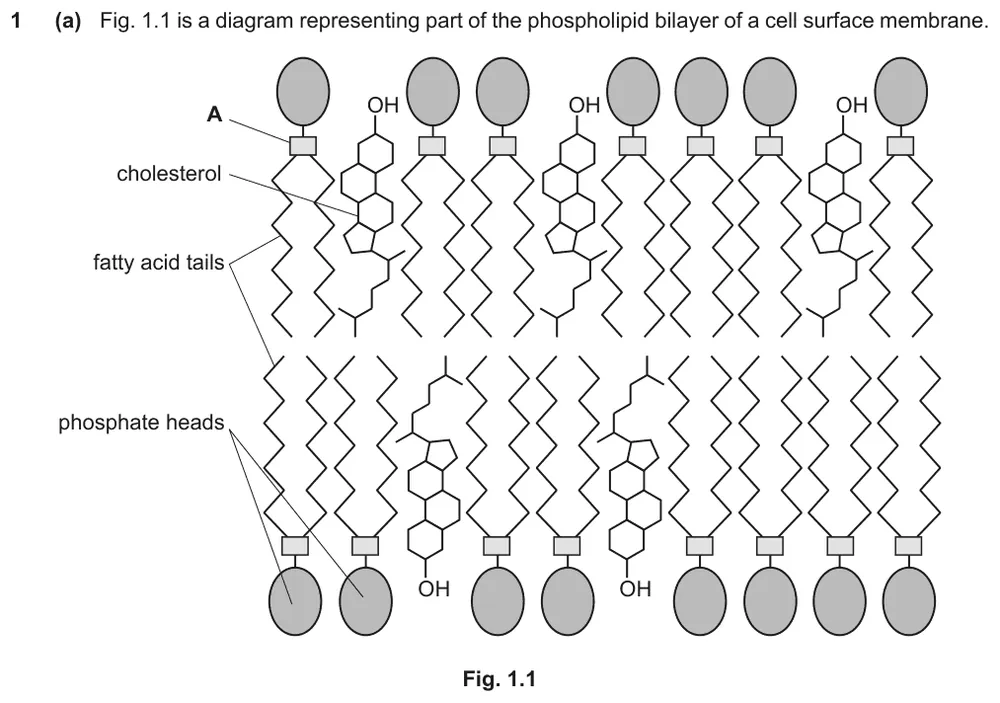
Paper 2 · February/March 2024 (22) · Q1(a)(ii) · 1 mark
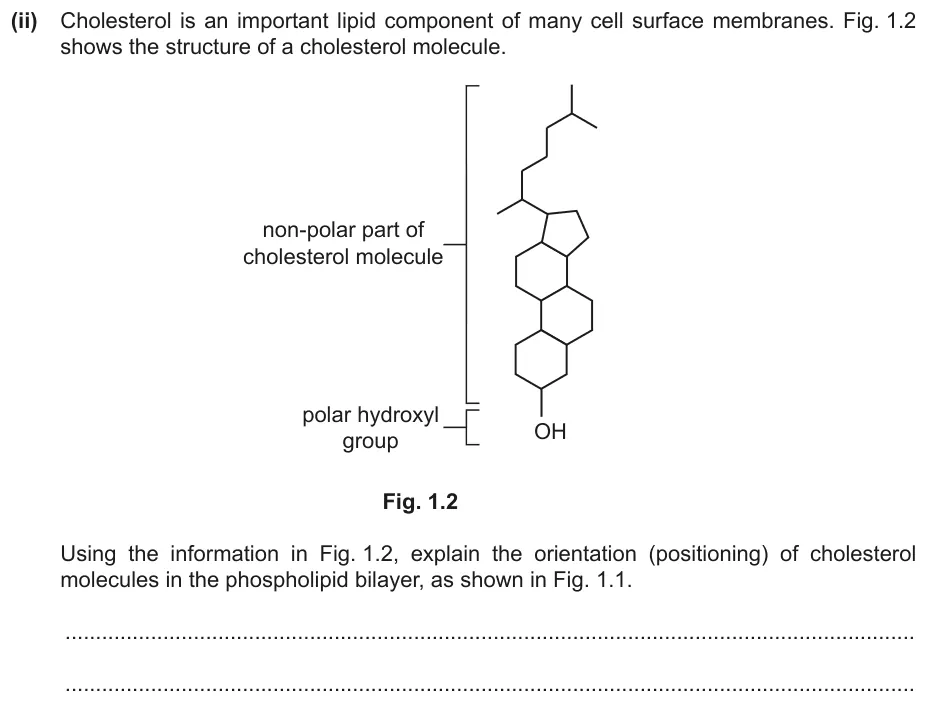
Use the structure of cholesterol to explain how the molecules are positioned in the phospholipid bilayer.
Information from earlier in this question:
Show the mark scheme

Tap an image to open it full size.
Question 9
Paper 2 · February/March 2024 (22) · Q1(a)(iii) · 1 mark
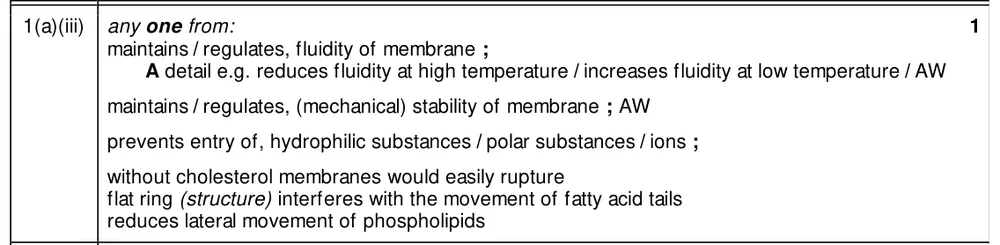
State one role of cholesterol in phospholipid bilayers.

Show the mark scheme
Tap an image to open it full size.
Roles of membrane components (4.1.3)
Question 10
Paper 2 · May/June 2024 (21) · Q1(a)(ii) · 4 marks
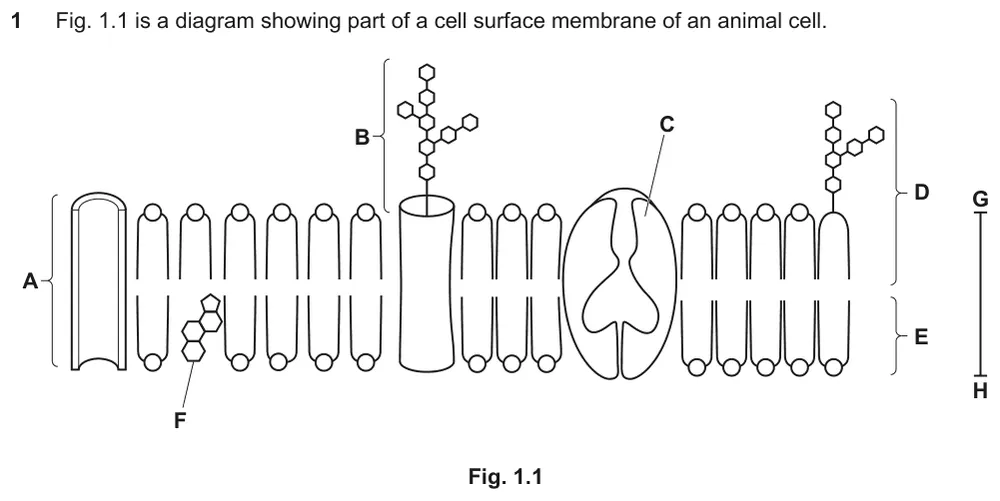
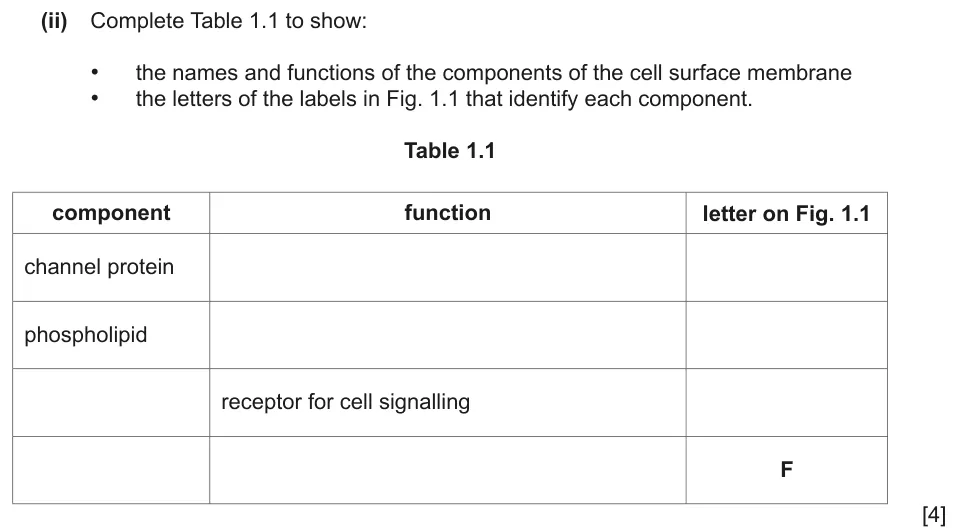
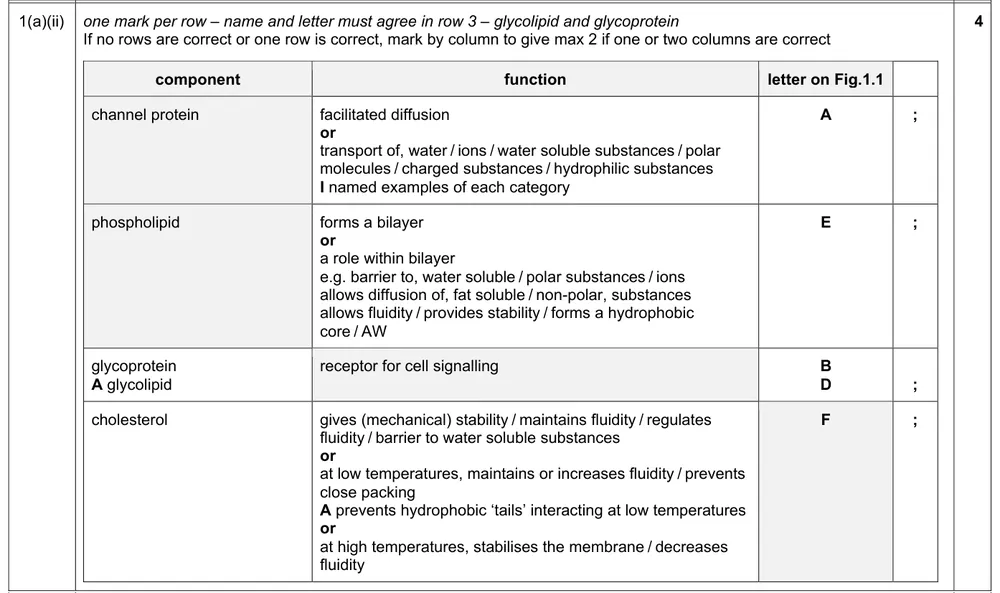
Complete the table with the names, functions and label letters of four components of the cell surface membrane.
Information from earlier in this question:
Show the mark scheme
Tap an image to open it full size.
From the examiners' report: Many chose C instead of A for the channel protein: C is a carrier protein. The simplest function for the phospholipid was 'forms a bilayer'. Many described the phospholipid molecule when they needed to give its function in the membrane.
Question 11
Paper 2 · February/March 2025 (22) · Q2(b)(ii) · 1 mark
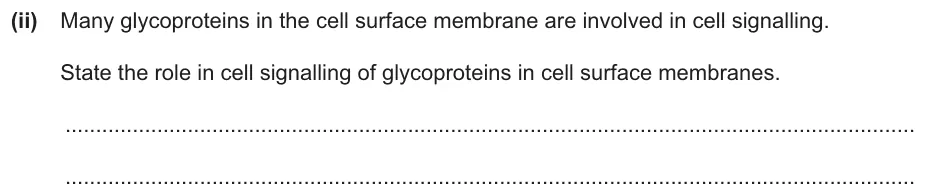
State the role of glycoproteins in cell signalling.
Show the mark scheme

Tap an image to open it full size.
From the examiners' report: Some answers referred only to ligand binding, which happens in many situations other than cell signalling. You needed to qualify it, for example with an immediate result of the ligand binding.
Question 12
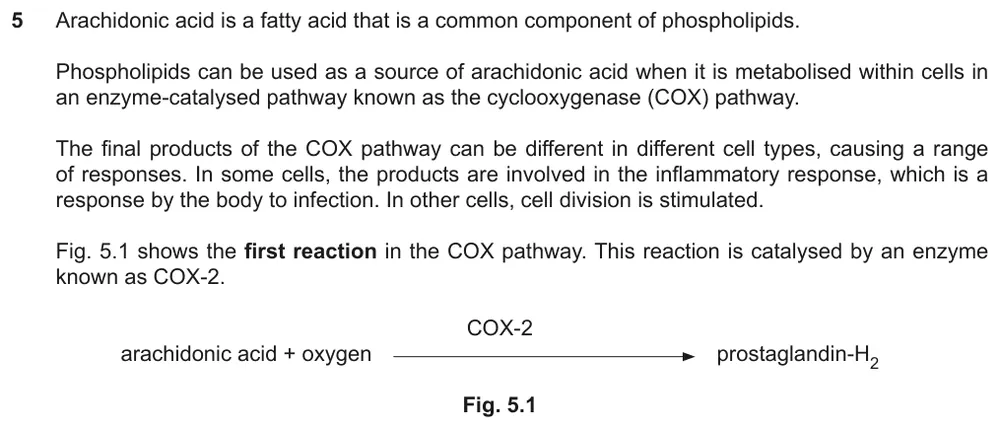
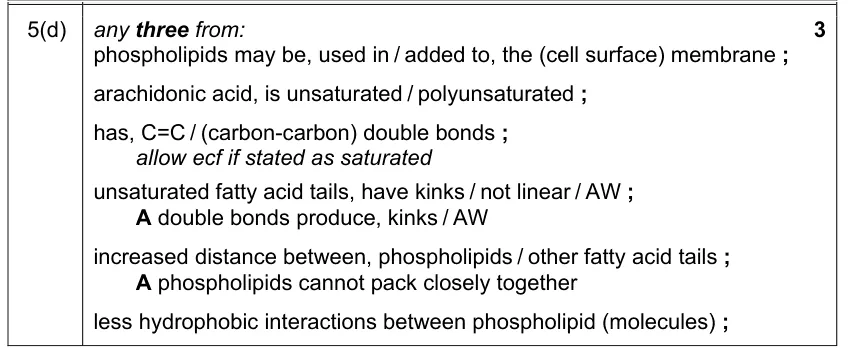
Paper 2 · May/June 2022 (23) · Q5(d) · 3 marks
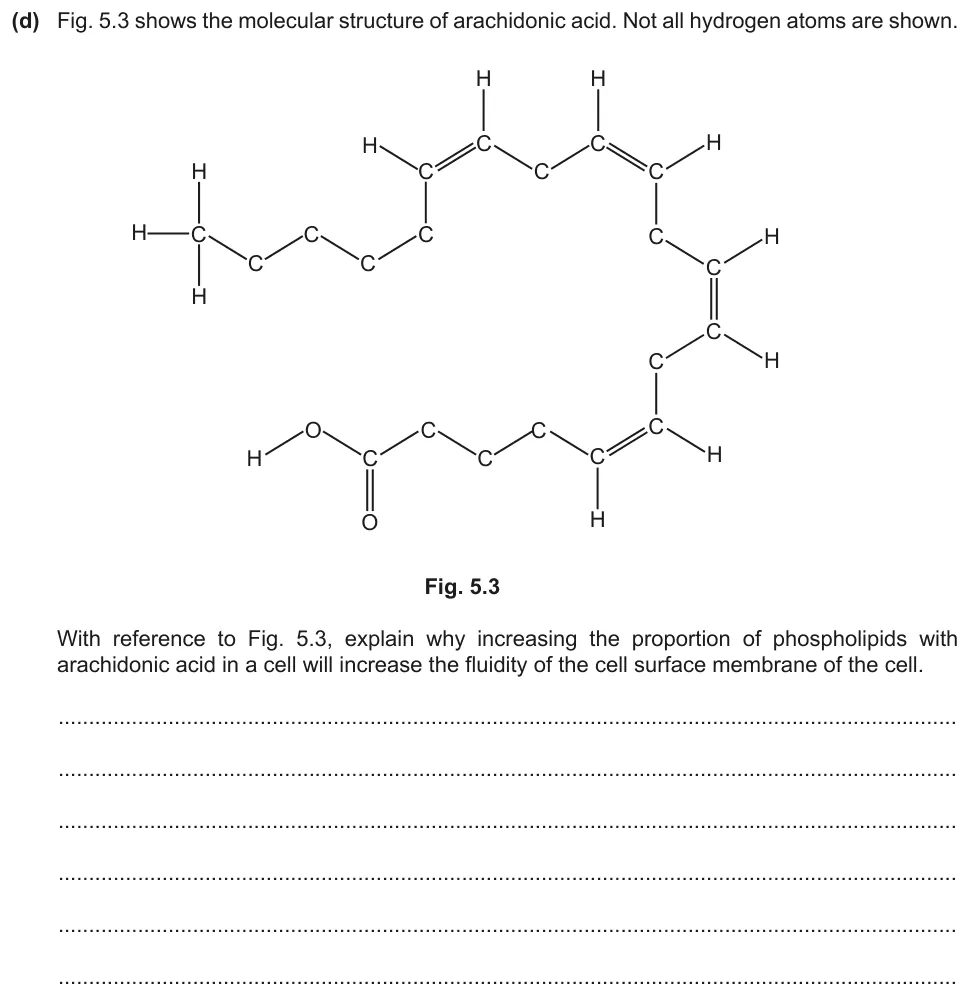
Use the structure of arachidonic acid to explain why it increases the fluidity of the cell surface membrane.
Information from earlier in this question:
Show the mark scheme
Tap an image to open it full size.
From the examiners' report: Many identified arachidonic acid as unsaturated, referred to the C=C double bonds in the figure and explained how they increase fluidity. Weaker answers did not realise that the fatty acid becomes part of a phospholipid, and treated it as a separate membrane component.
Question 13
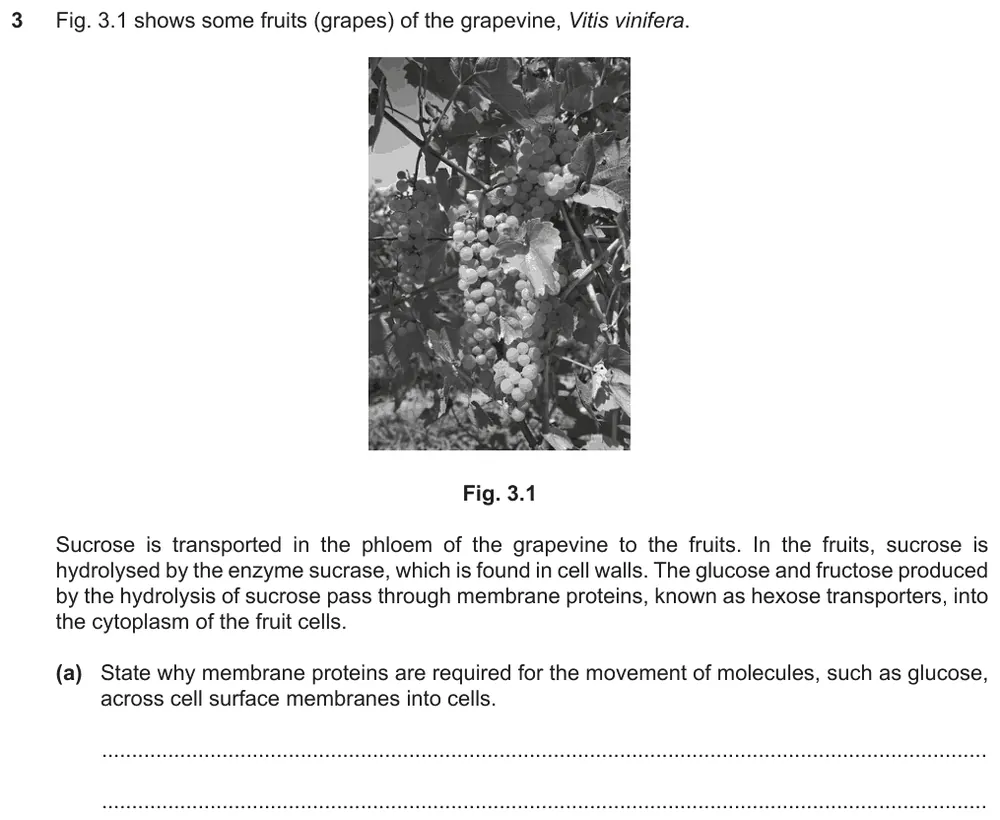
Paper 2 · May/June 2023 (21) · Q3(a) · 1 mark
State why membrane proteins are needed for molecules such as glucose to cross cell surface membranes.
Show the mark scheme

Tap an image to open it full size.
From the examiners' report: The strongest answers said that glucose is polar or water soluble and cannot pass through the hydrophobic core of the phospholipid bilayer. Most wrong answers said glucose is too large. 'Fatty acid tails' alone was not enough: make clear there are two layers, for example by writing 'bilayer'.
Question 14
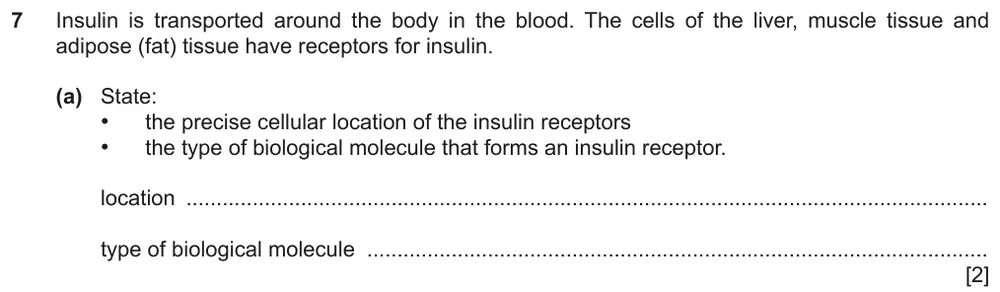
Paper 4 (A level) · October/November 2020 (42) · Q7(a) · 2 marks · Easy
State the precise location of insulin receptors and the type of molecule they are made of.
Show the mark scheme

Tap an image to open it full size.
From the examiners' report: Nearly everyone knew the receptor is a protein, although some confused it with insulin and called it a hormone. For the location, many repeated the cell types given in the question. You needed to say that the receptor is on the cell surface membrane.
Question 15
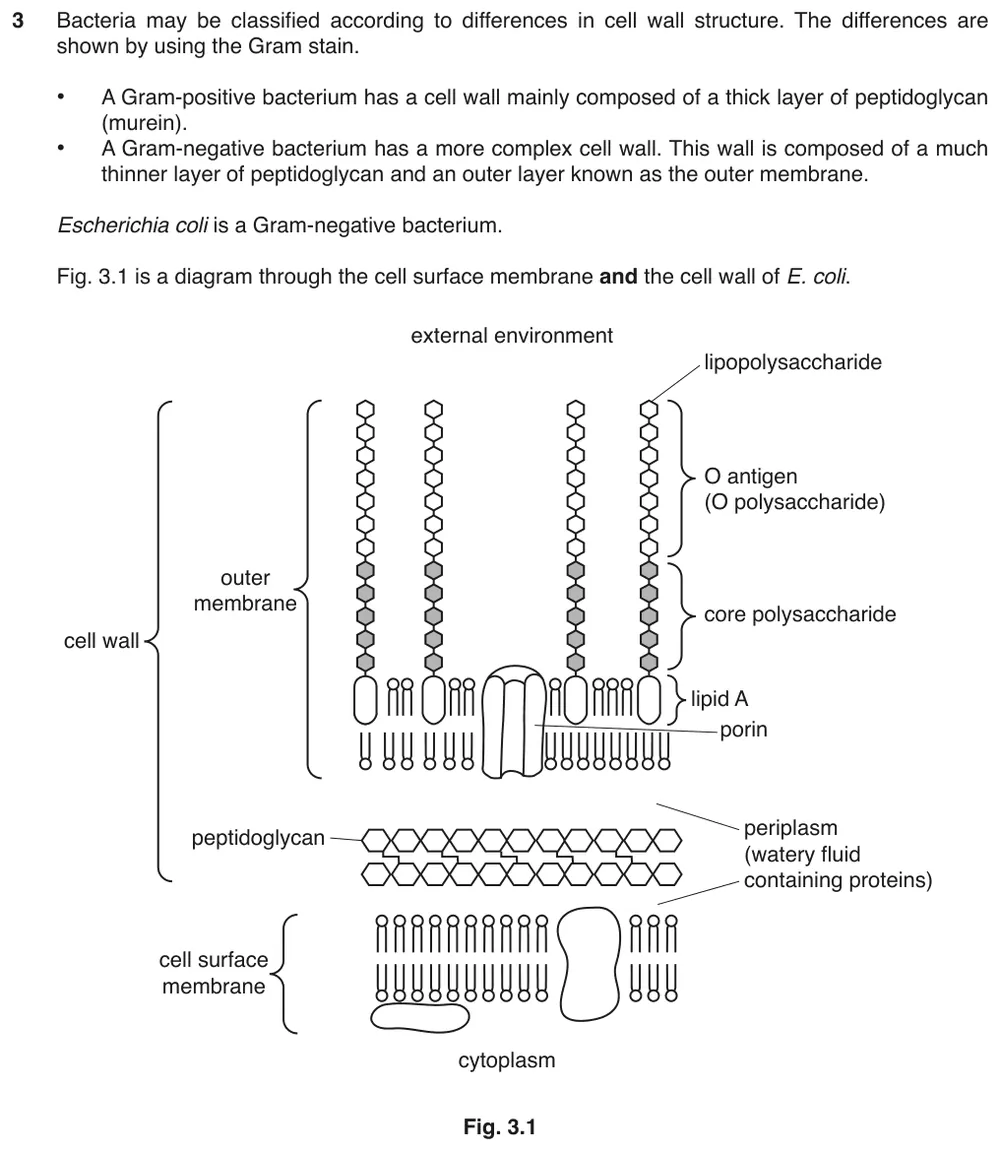
Paper 2 · May/June 2018 (22) · Q3(b)(ii) · 4 marks
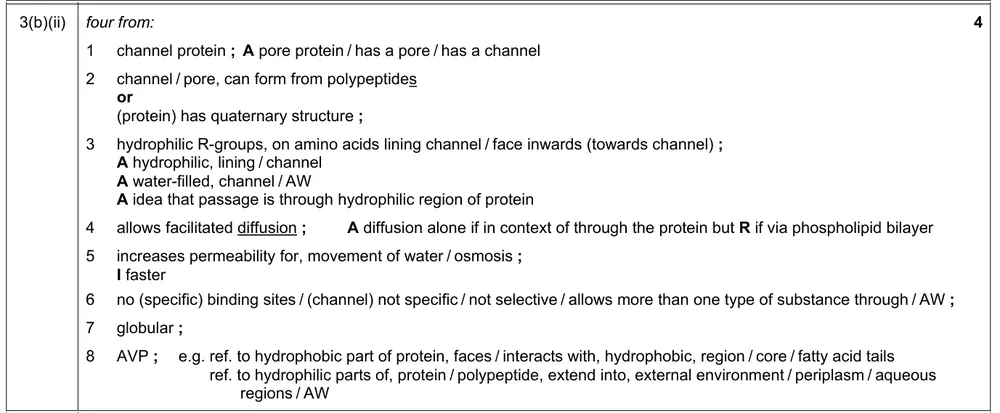
Suggest and explain the features of an OmpF porin as a membrane transport protein.
Information from earlier in this question:

Show the mark scheme
Tap an image to open it full size.
From the examiners' report: Do not repeat information from the introduction. A common misconception was that the protein is specific to one substance. Some wrote 'channel or carrier protein' or 'facilitated diffusion or active transport': a channel protein allows facilitated diffusion, not active transport.
Cell signalling (4.1.4)
Question 16
Paper 2 · October/November 2025 (22) · Q1(d) · 3 marks
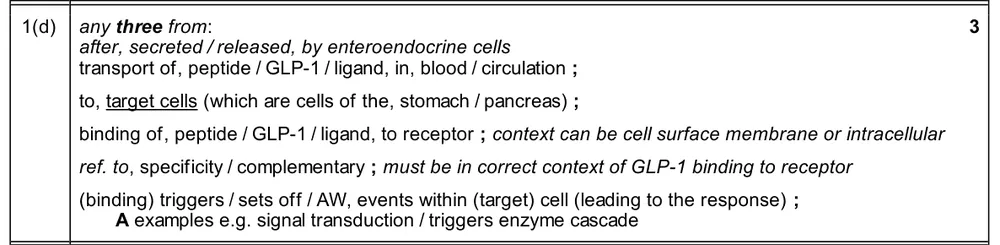
Outline, in sequence, the main stages of cell signalling by GLP-1.
Show the mark scheme
Tap an image to open it full size.
Question 17
Paper 2 · May/June 2024 (23) · Q5(a) · 2 marks
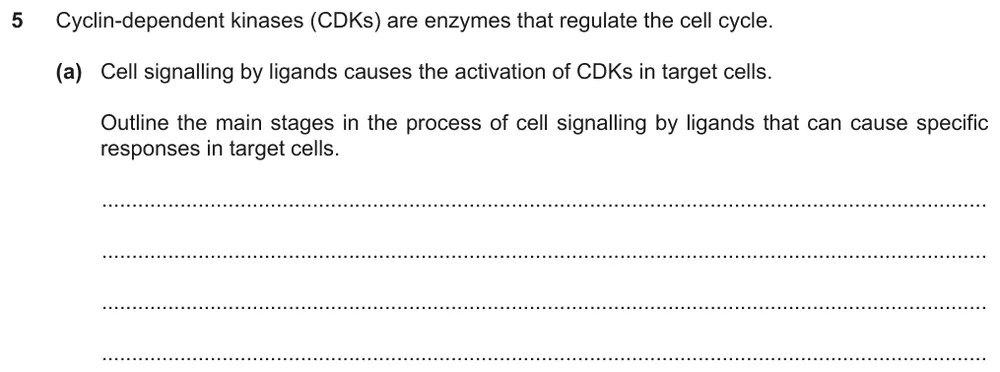
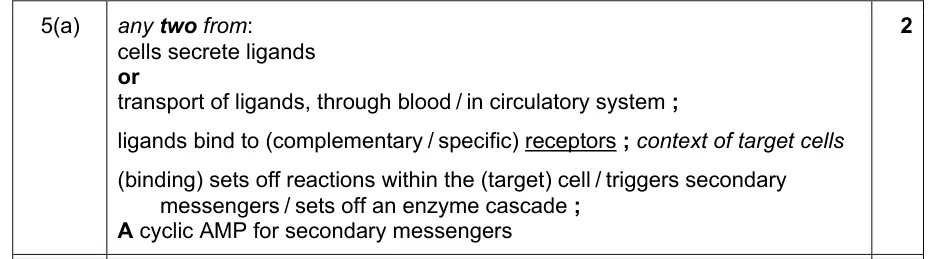
Outline the main stages of cell signalling by ligands that lead to specific responses in target cells.
Show the mark scheme
Tap an image to open it full size.
From the examiners' report: Most began with the ligand binding to a receptor. Fewer mentioned the release of the ligand from a secreting cell or its transport to the target cell. Some wrongly described antigens on the receptors, or receptors entering the cell.
Question 18
Paper 4 (A level) · May/June 2024 (41) · Q2(a)(i) · 2 marks · Easy
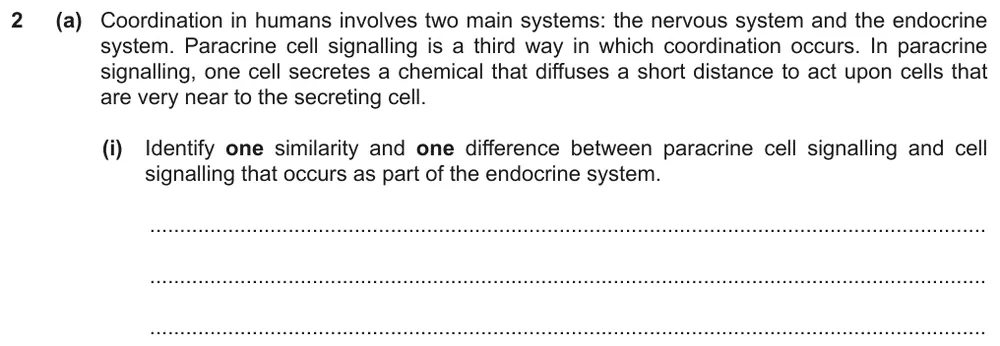
Give one similarity and one difference between paracrine signalling and signalling by the endocrine system.
Show the mark scheme

Tap an image to open it full size.
From the examiners' report: Most gave the similarity that both use a chemical. Fewer gave the difference that the signalling molecule travels in the blood in the endocrine system. Do not write that the molecules diffuse through the blood: the circulatory system gives faster transport by mass flow.
Question 19
Paper 2 · October/November 2022 (23) · Q5(a)(i) · 2 marks · Easy
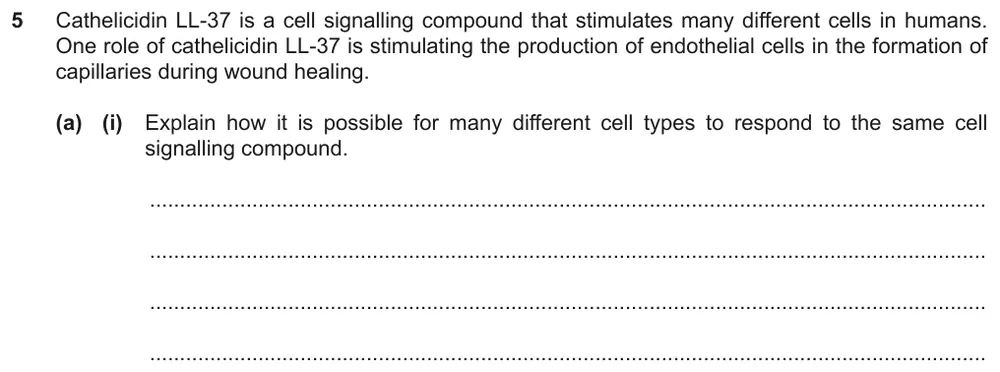
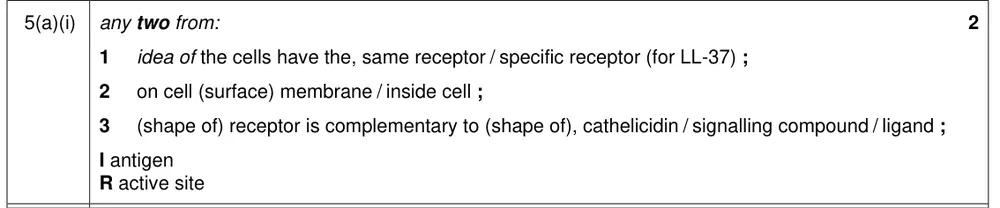
Explain how many different cell types can respond to the same cell signalling compound.
Show the mark scheme
Tap an image to open it full size.
From the examiners' report: Be clear that all the different cells have the same receptor. There was no extra credit for events inside the target cell after the signalling molecule binds. Some confused cell signalling with enzymes and induced fit.
Question 20
Paper 2 · May/June 2021 (22) · Q3(c) · 1 mark · Easy
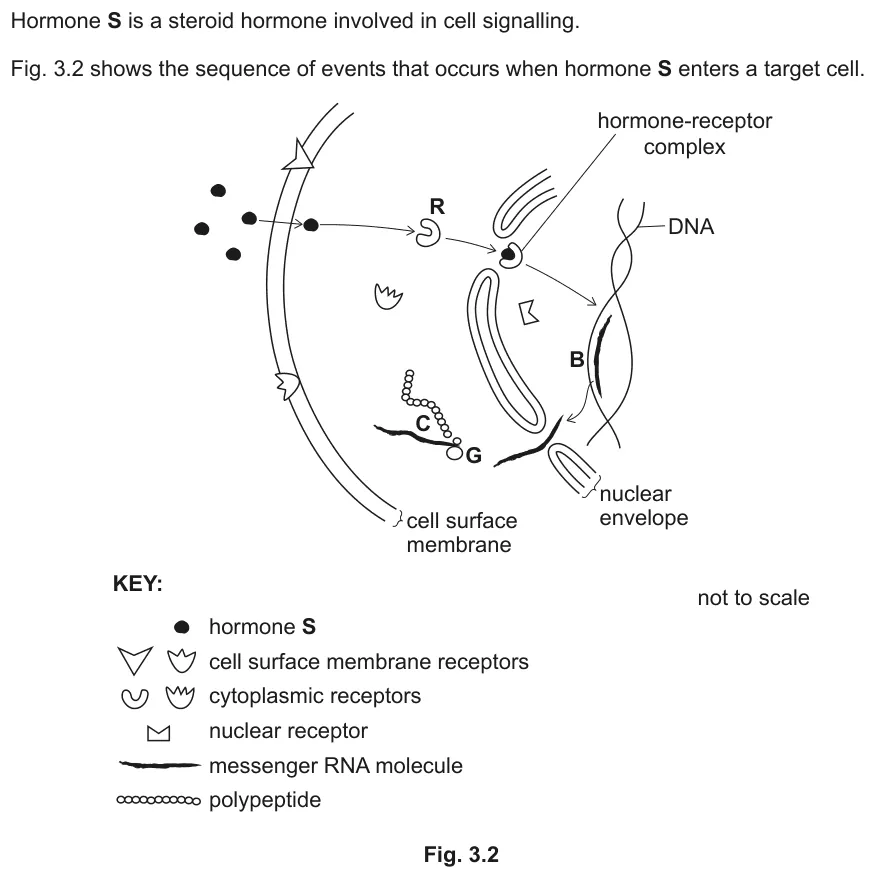
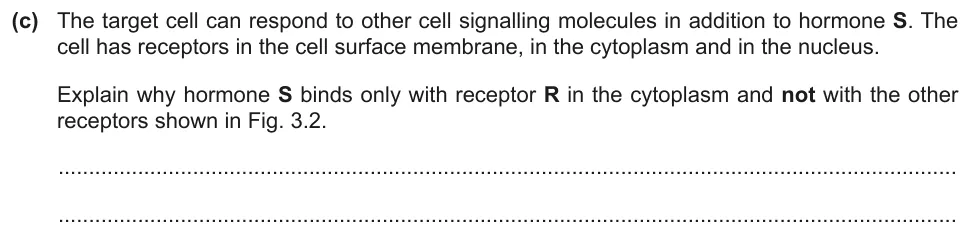
Explain why hormone S binds only with receptor R and not with the other receptors.
Information from earlier in this question:

Show the mark scheme

Tap an image to open it full size.
From the examiners' report: The most accurate answers referred to the binding site of receptor R. Do not call the hormone a substrate, the receptor an enzyme, or either of them an antigen. 'Matching' shapes was not accepted, because it suggests similar shapes and not complementary shapes.
Question 21
Paper 2 · October/November 2018 (22) · Q3(c) · 3 marks
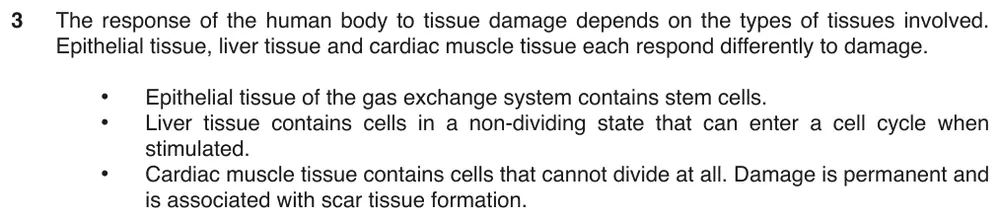
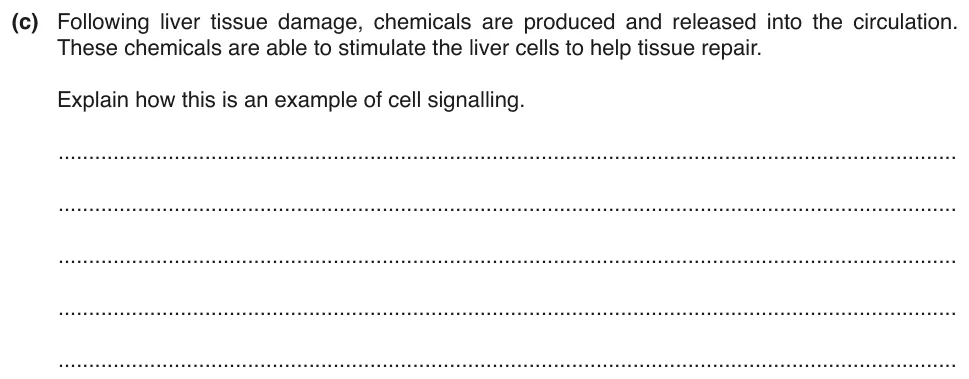
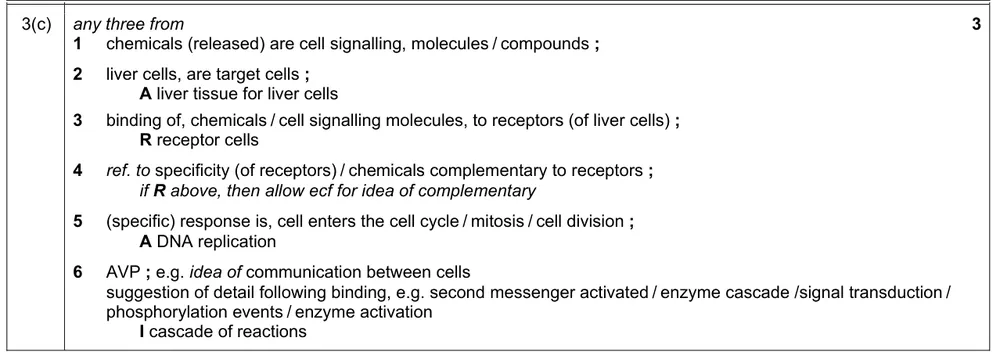
Explain how chemicals released after liver damage are an example of cell signalling.
Information from earlier in this question:
Show the mark scheme
Tap an image to open it full size.
From the examiners' report: Say that the chemical binds to a receptor, not just to the liver cell or its cell surface membrane. Fewer answers said that the liver cells are target cells, or that the specific response is the cell entering the cell cycle. 'The cells help to repair tissue' was too vague.
Question 22
Paper 2 · May/June 2017 (22) · Q5(d) · 4 marks
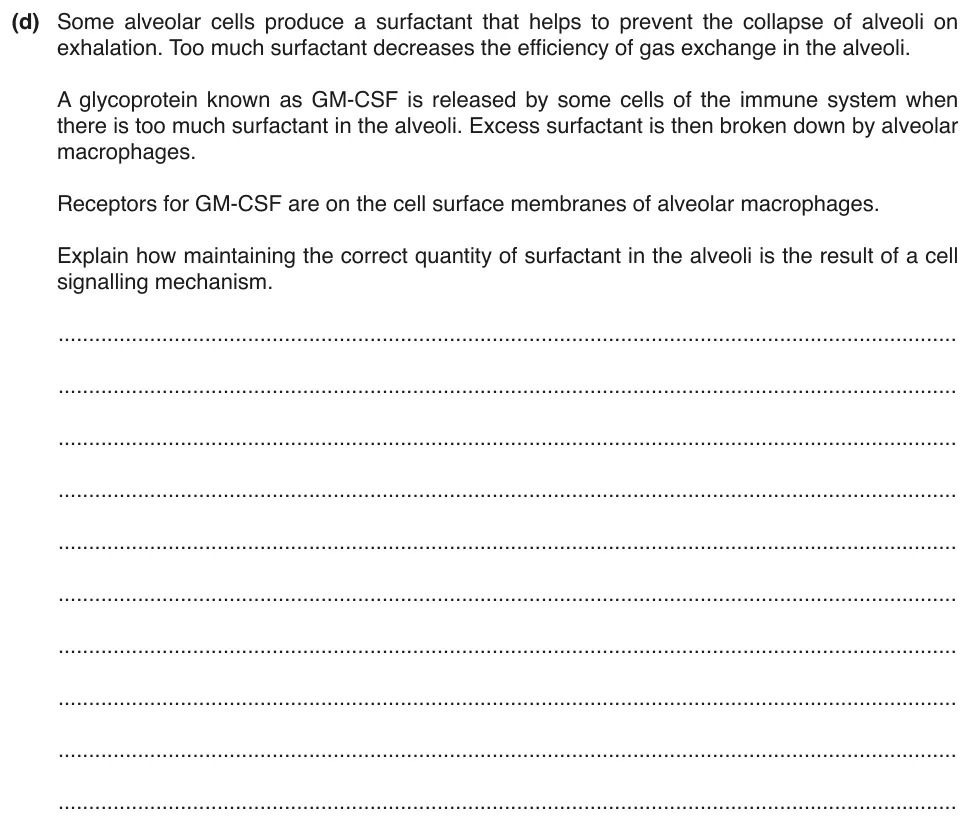
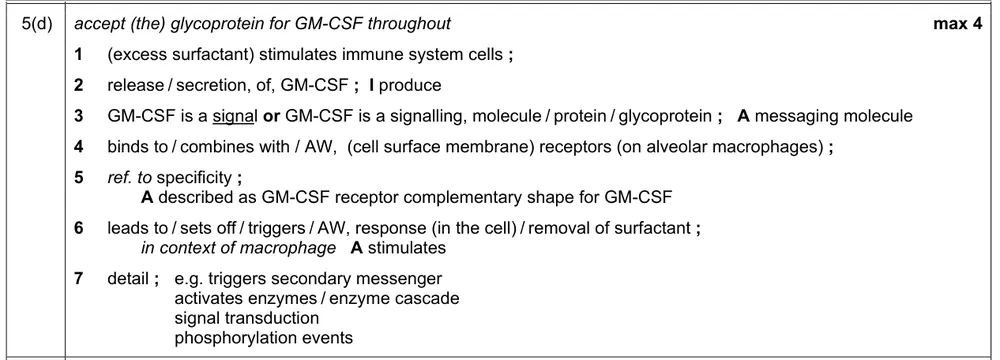
Explain how the quantity of surfactant in the alveoli is controlled by a cell signalling mechanism.
Show the mark scheme
Tap an image to open it full size.
From the examiners' report: GM-CSF is the signal, and it is released by cells of the immune system, not by 'the immune system'. Some thought that surfactant was the signal, that GM-CSF digests the surfactant, or that the receptor is on GM-CSF. Details of secondary messengers and signal transduction were not needed for full credit.
Where students lose marks (from Cambridge examiners' reports and mark schemes)
Each point below comes from the examiners' reports and mark schemes, and is followed by wording that gained marks.
Draw what the micrograph shows. Students drew a textbook diagram of one membrane and did not use the four dark lines in the micrograph.
✔ Gains credit: dark lines labelled 'phosphate heads', the clear areas between each pair labelled 'fatty acid tails' or 'hydrophobic core', and the space between the two membranes labelled 'intercellular space' or 'tissue fluid'.
Two tails, two layers. Students drew a single layer of phospholipids, or gave each phospholipid three fatty acid tails like a triglyceride.
✔ Gains credit: a 'phospholipid with a head and two tails' and a 'bilayer shown'.
Glucose is polar, not too large. Students said that glucose is too large to cross the membrane, or wrote 'fatty acid tails' without making clear there are two layers.
✔ Gains credit: 'polar', 'water soluble' or 'hydrophilic' substances 'cannot pass through the phospholipid bilayer' or its 'hydrophobic core'.
Tell channel proteins from carrier proteins. Students picked the carrier protein on the diagram when asked for the channel protein, and described the phospholipid molecule when asked for its function.
✔ Gains credit: the channel protein is for 'facilitated diffusion' or 'transport of ions', and the phospholipid 'forms a bilayer' or is a 'barrier to water soluble substances'.
Cholesterol and membrane fusion. Students wrote that less cholesterol means less surfactant can be made, when the question was about secretion.
✔ Gains credit: 'cholesterol regulates the fluidity of the membrane', so the 'membrane is less able to fuse with the lamellar body'.
Say where the receptor is. Students repeated the cell types from the question when asked for the precise location of the insulin receptor, or called the receptor a hormone.
✔ Gains credit: the location is the 'cell surface membrane' or 'plasma membrane', and the molecule is a 'glycoprotein' or 'protein'.
Complementary, not matching. Students wrote that the hormone and receptor have matching shapes, or called them a substrate, an enzyme or an antigen.
✔ Gains credit: the hormone is 'complementary' in shape to the receptor, or 'only fits into' receptor R.
Signalling starts with secretion. Students began with the ligand binding to the receptor and left out the stages before it.
✔ Gains credit: 'cells secrete ligands', 'transport of ligands through blood', 'ligands bind to receptors', and binding 'sets off reactions within the cell'.
Download the questions
Download the PDF pack (22 questions, mark schemes at the end)
Keep practising
- Movement Into and Out of Cells (4.2): Cambridge (CIE) exam questions by topic
- Cambridge (CIE) A level Biology 9700 past papers, mark schemes and examiners' reports
- Cambridge (CIE) A level Biology grade thresholds
- Book a one-to-one CIE lesson or a free 15-minute discovery chat with Tom
- Register your interest in a CIE A level Biology group class
Questions, mark schemes and examiners' report extracts © Cambridge University Press & Assessment.