

Mode of Action of Enzymes (3.1): Cambridge (CIE) A Level Biology 9700 Exam Questions by Topic
Mode of action of enzymes is sub-topic 3.1 of Topic 3, Enzymes, in the Cambridge International AS & A Level Biology syllabus (9700). You need to know that enzymes are globular proteins that work inside cells or are secreted to work outside them, and to explain how they work in terms of the active site, the enzyme-substrate complex, the lowering of activation energy and specificity, using the lock-and-key and induced-fit hypotheses. You need to know how the progress of a reaction is followed, including with a colorimeter. This is AS content, examined on Papers 1 and 2. A level students meet it again on Paper 4; questions marked A level on this page come from Paper 4.
The examiners' reports return to the same points. Use the exact terms: 'intracellular' is not 'intercellular', and a mechanism is either induced fit or lock and key, not both. Say that the substrate binds to the active site, and remember that the active site is part of the enzyme. Read what is asked: several answers described induced fit or optimum pH when something else was wanted. In practical questions, measure a volume or a concentration at timed intervals, not an 'amount'. A colorimeter gives quantitative results that do not depend on judging colour by eye; 'more accurate' on its own gains no credit.
Studying Cambridge International A level Biology and want more help? Tom teaches CIE students one-to-one online, including students in the UAE, Saudi Arabia, Hong Kong, India and Indonesia, and every lesson is recorded. You can book a one-to-one lesson or a free 15-minute discovery chat, or register your interest in a CIE group class starting in September 2027, using the links at the bottom of this page.
What you need from IGCSE
Each question on this page assumes you're secure on these ideas. If any of them feels shaky, look it up before you start.
- Enzymes are proteins that act as biological catalysts: they speed up reactions and are not changed by them.
- The substrate fits into the active site of the enzyme because their shapes are complementary.
- Catalase breaks down hydrogen peroxide into water and oxygen.
- Amylase breaks down starch, and iodine solution turns blue-black when starch is present.
Key terms
These words come up in the questions and mark schemes. Examiners expect you to use them exactly.
- Active site: the part of an enzyme molecule where the substrate binds; its shape is complementary to the substrate.
- Enzyme-substrate complex: the temporary structure formed when a substrate binds to the active site of an enzyme.
- Activation energy: the energy that the reactants need before they can form products; enzymes lower it.
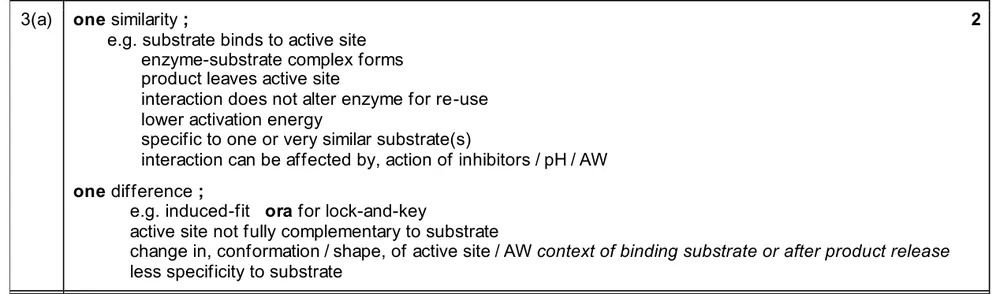
- Lock-and-key hypothesis: the active site has a fixed shape that is complementary to the substrate before the substrate binds.
- Induced-fit hypothesis: the active site is not fully complementary to the substrate; it changes shape as the substrate binds, to give a better fit.
- Intracellular enzyme: an enzyme that catalyses a reaction inside the cell that makes it.
- Extracellular enzyme: an enzyme that is secreted and catalyses a reaction outside the cell that makes it.
- Colorimeter: an instrument that measures how much light a coloured solution absorbs or transmits, giving a numerical reading.
What these questions cover (Cambridge 9700 Topic 3: Enzymes)
The questions test these learning outcomes from sub-topic 3.1 of the Cambridge International AS & A Level Biology syllabus (9700) for 2025 to 2027.
- 3.1.1 enzymes are globular proteins that catalyse reactions inside cells (intracellular enzymes) or are secreted to catalyse reactions outside cells (extracellular enzymes)
- 3.1.2 explain the mode of action of enzymes in terms of an active site, enzyme–substrate complex, lowering of activation energy and enzyme specificity
- 3.1.3 investigate the progress of enzyme-catalysed reactions by measuring rates of formation of products using catalase and rates of disappearance of substrate using amylase
- 3.1.4 outline the use of a colorimeter for measuring the progress of enzyme-catalysed reactions that involve colour changes
How to use this page
Write your answer on paper before you open the mark scheme. Allow about 1.2 minutes per mark: the 22 questions are worth 44 marks, so about 53 minutes in total. Then mark your answer strictly against the mark scheme and read the examiners' tip underneath it. If you'd rather print the questions, download the PDF pack.
Enzymes as globular proteins (3.1.1)
Question 1
Paper 2 · February/March 2019 (22) · Q2(a) · 4 marks
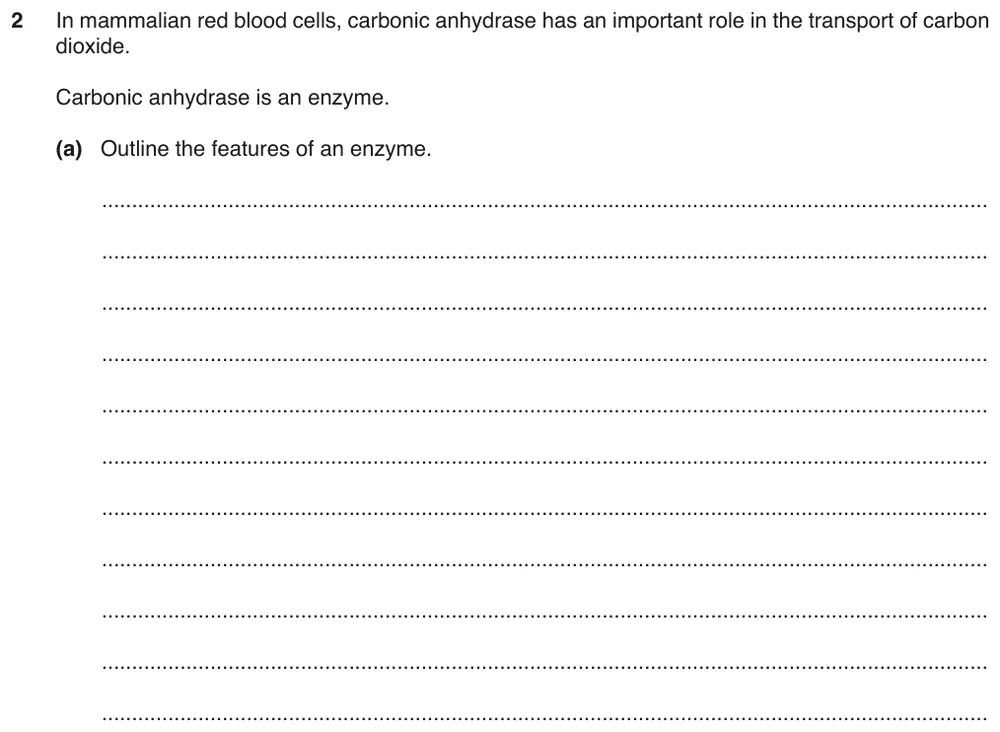
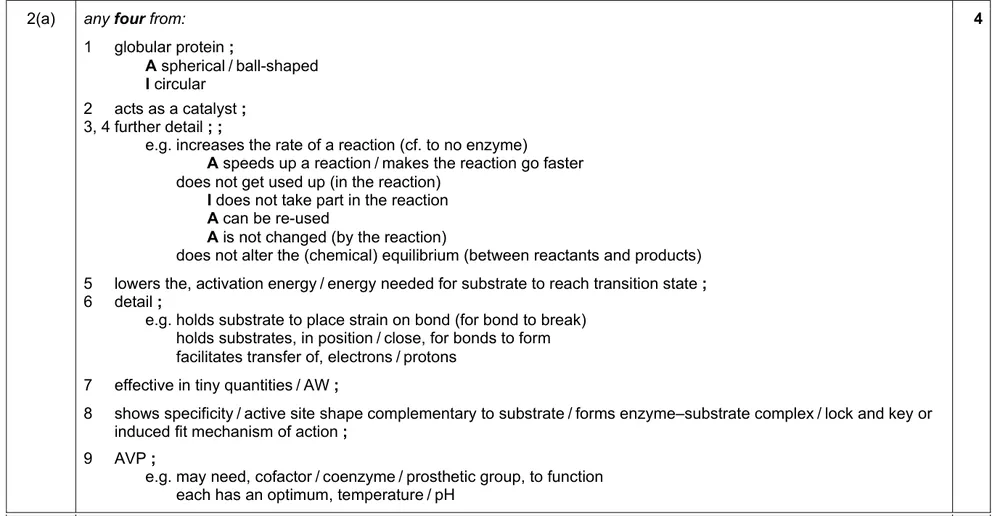
Outline the features of an enzyme.
Show the mark scheme
Tap an image to open it full size.
From the examiners' report: Most said that enzymes are globular proteins that act as catalysts. The best answers linked one feature to the next: the faster rate of reaction is linked to a lower activation energy, and enzymes can be reused because they are not changed by the reaction.
Intracellular and extracellular enzymes (3.1.1)
Question 2
Paper 2 · May/June 2023 (22) · Q2(c) · 1 mark · Easy
State the term for enzymes that act outside the cells that make them.

Show the mark scheme

Tap an image to open it full size.
Question 3
Paper 2 · October/November 2017 (22) · Q3(a) · 1 mark
State the term for an enzyme that functions within the cell.

Show the mark scheme

Tap an image to open it full size.
From the examiners' report: The term is 'intracellular'. 'Intercellular', 'intrinsic' and 'interacellular' were not credited. Weaker answers gave 'biological catalyst' or 'endocytosis'.
Question 4
Paper 4 (A level) · February/March 2022 (42) · Q6(b)(i) · 1 mark · Hard
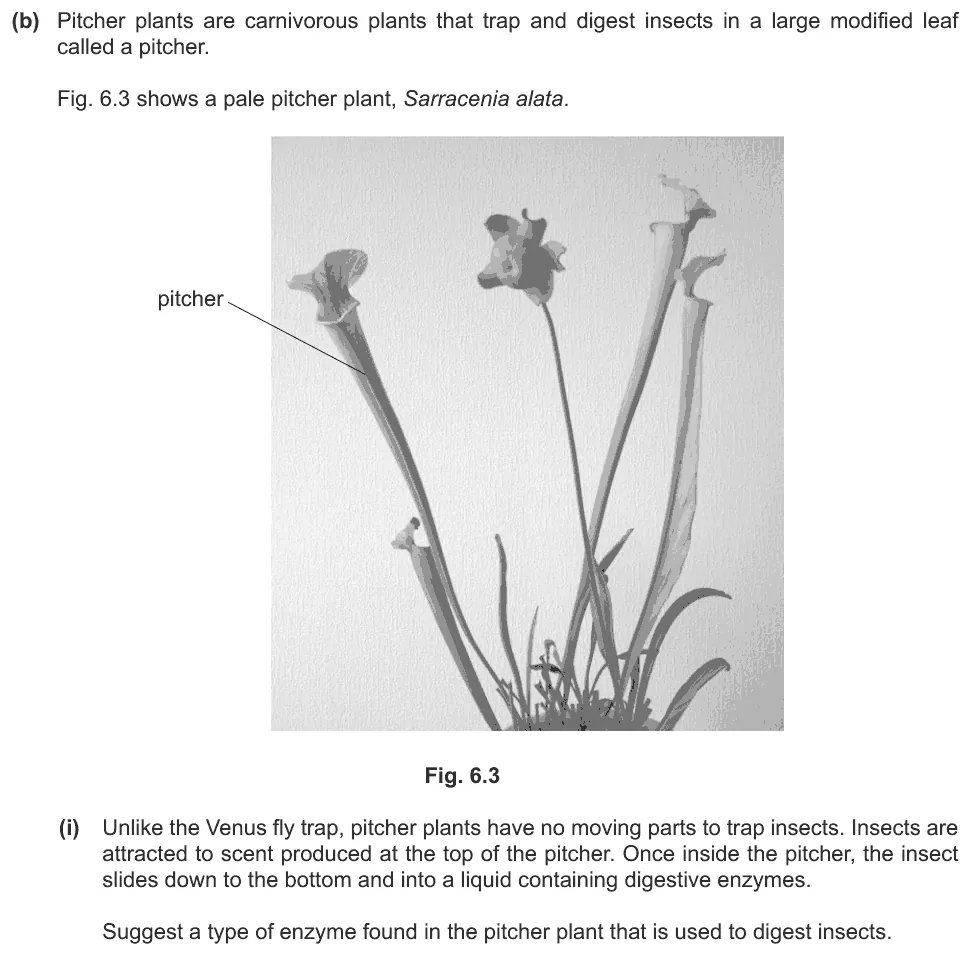
Suggest a type of enzyme that a pitcher plant uses to digest insects.
Show the mark scheme

Tap an image to open it full size.
From the examiners' report: Name a type of enzyme. A few students simply copied 'digestive enzymes' from the question.
Lock and key and induced fit (3.1.2)
Question 5
Paper 2 · October/November 2019 (22) · Q6(c) · 1 mark · Easy
Name the theory in which the active site changes shape slightly to bind the substrate.
Information from earlier in this question:


Show the mark scheme

Tap an image to open it full size.
From the examiners' report: Give one theory only. 'Induced fit lock and key', or one of the two in brackets, could not be credited.
Question 6
Paper 2 · May/June 2024 (22) · Q3(a) · 3 marks
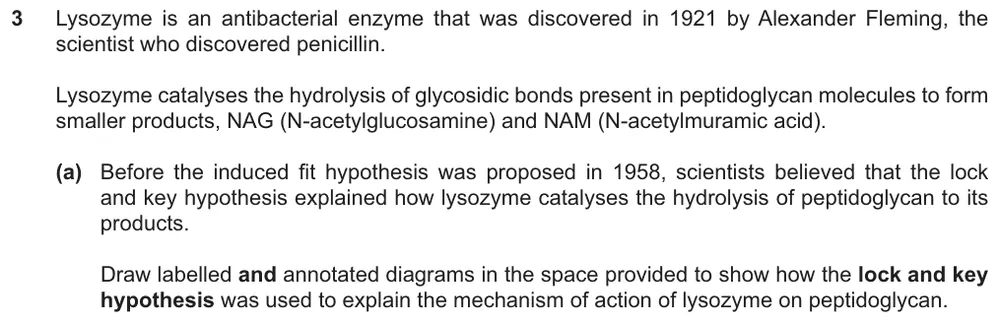
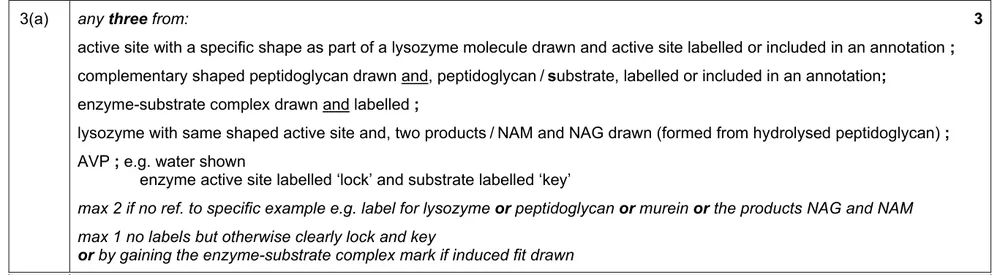
Draw labelled diagrams to show the lock and key hypothesis for lysozyme and peptidoglycan.
Show the mark scheme
Tap an image to open it full size.
From the examiners' report: Link your labels to this example: lysozyme is the enzyme, peptidoglycan is the substrate and the active site is part of the lysozyme. Some students labelled these the wrong way round. Others annotated their diagrams with the induced fit model and could only gain credit for the enzyme-substrate complex.
Question 7
Paper 2 · October/November 2025 (21) · Q3(a) · 2 marks
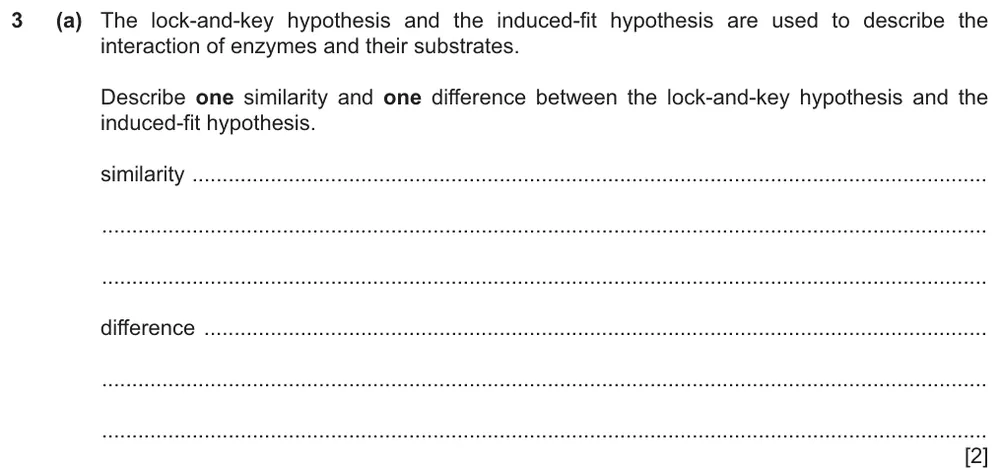
Give one similarity and one difference between the lock-and-key and induced-fit hypotheses.
Show the mark scheme
Tap an image to open it full size.
Question 8
Paper 2 · May/June 2024 (23) · Q4(b) · 5 marks · Easy
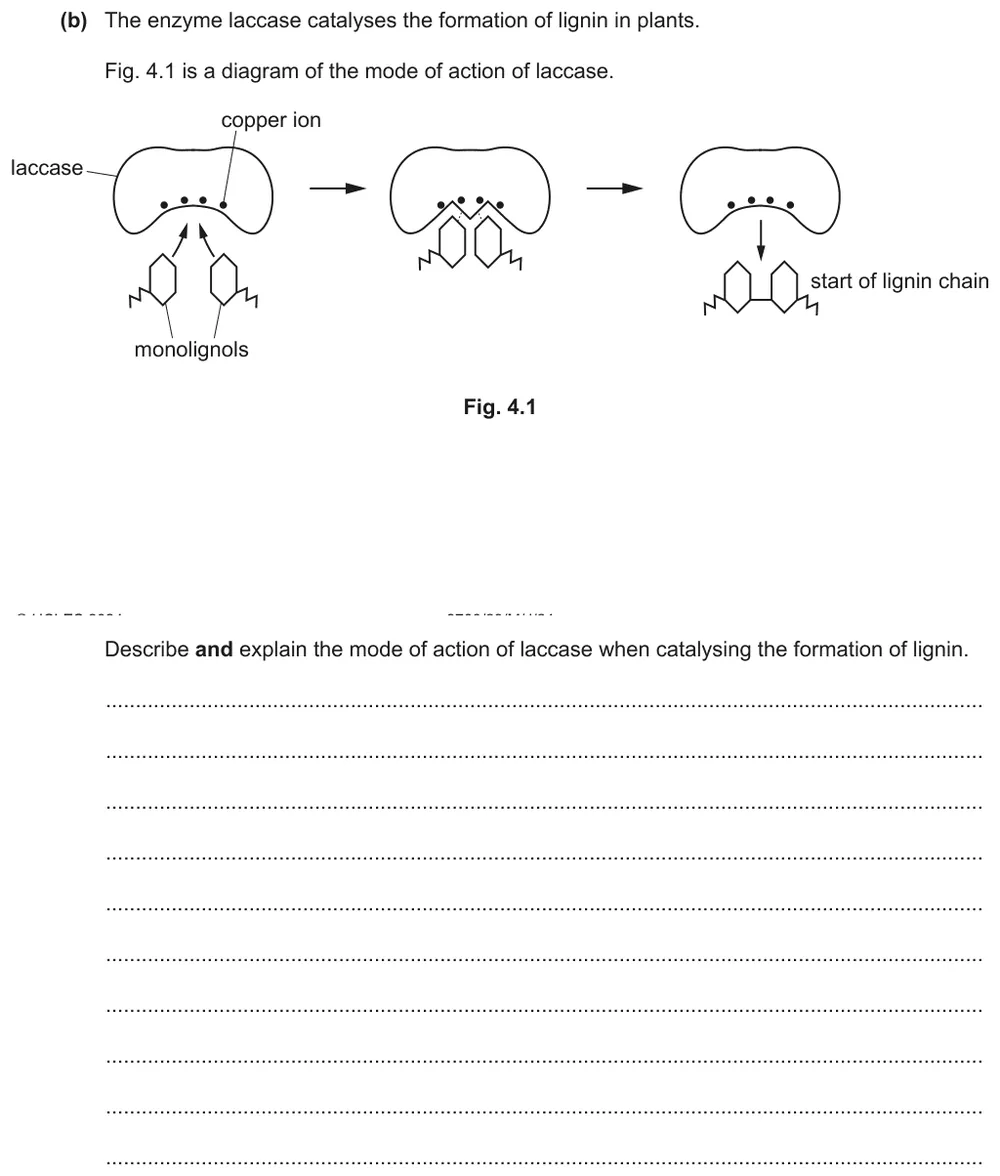
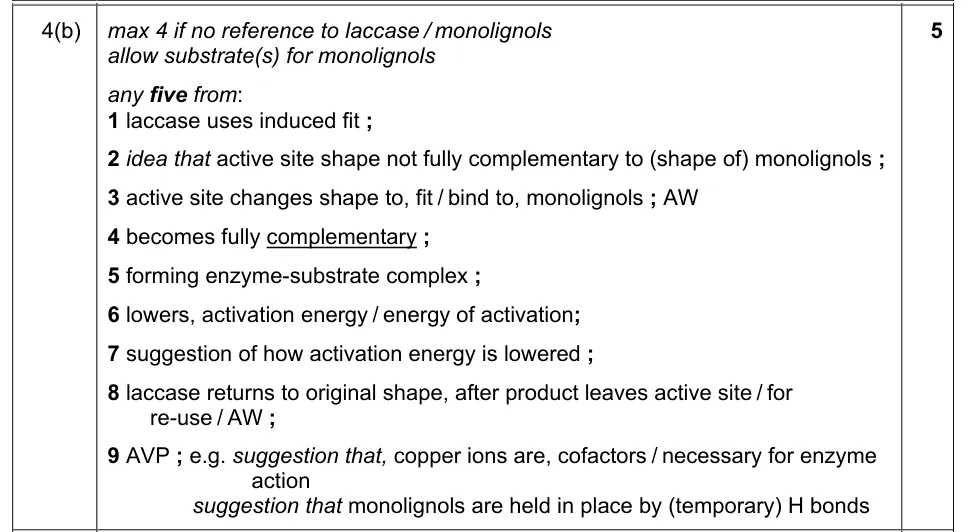
Use the diagram to describe and explain how laccase catalyses the formation of lignin.
Information from earlier in this question:

Show the mark scheme
Tap an image to open it full size.
From the examiners' report: Most worked out from the diagram that this is induced fit. The best answers gave the events in order: binding, the enzyme-substrate complex, the lowering of activation energy and the release of the product. Some suggested that the copper ions are cofactors.
Active site, specificity and activation energy (3.1.2)
Question 9
Paper 2 · October/November 2020 (22) · Q5(b) · 2 marks · Easy
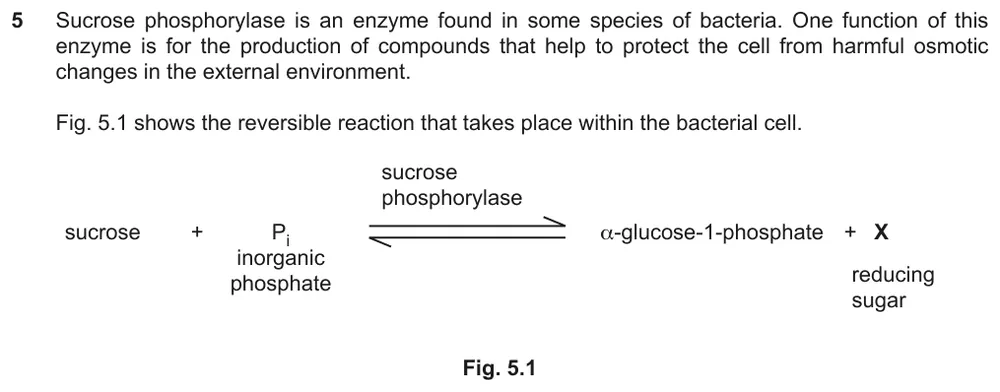
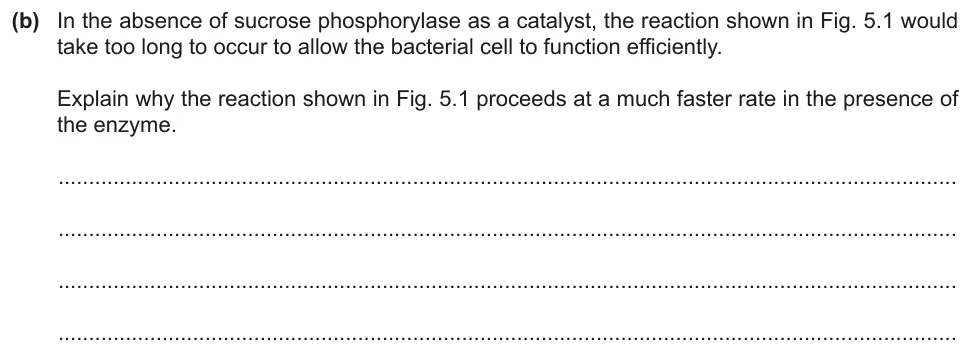
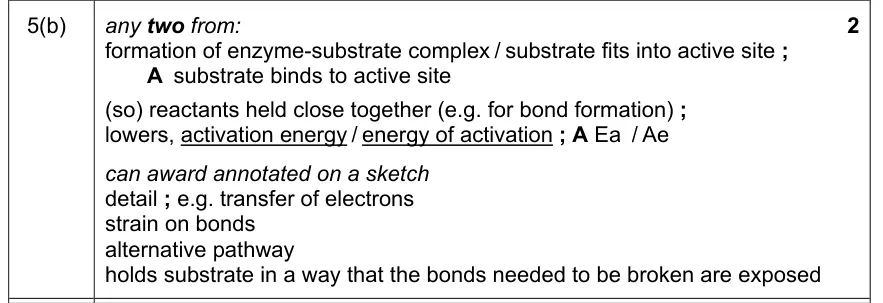
Explain why the reaction is much faster when the enzyme is present.
Information from earlier in this question:
Show the mark scheme
Tap an image to open it full size.
From the examiners' report: More students explained that enzymes lower the activation energy than wrote about the formation of the enzyme-substrate complex. Both points gain credit.
Question 10
Paper 2 · May/June 2022 (21) · Q3(a) · 2 marks · Easy
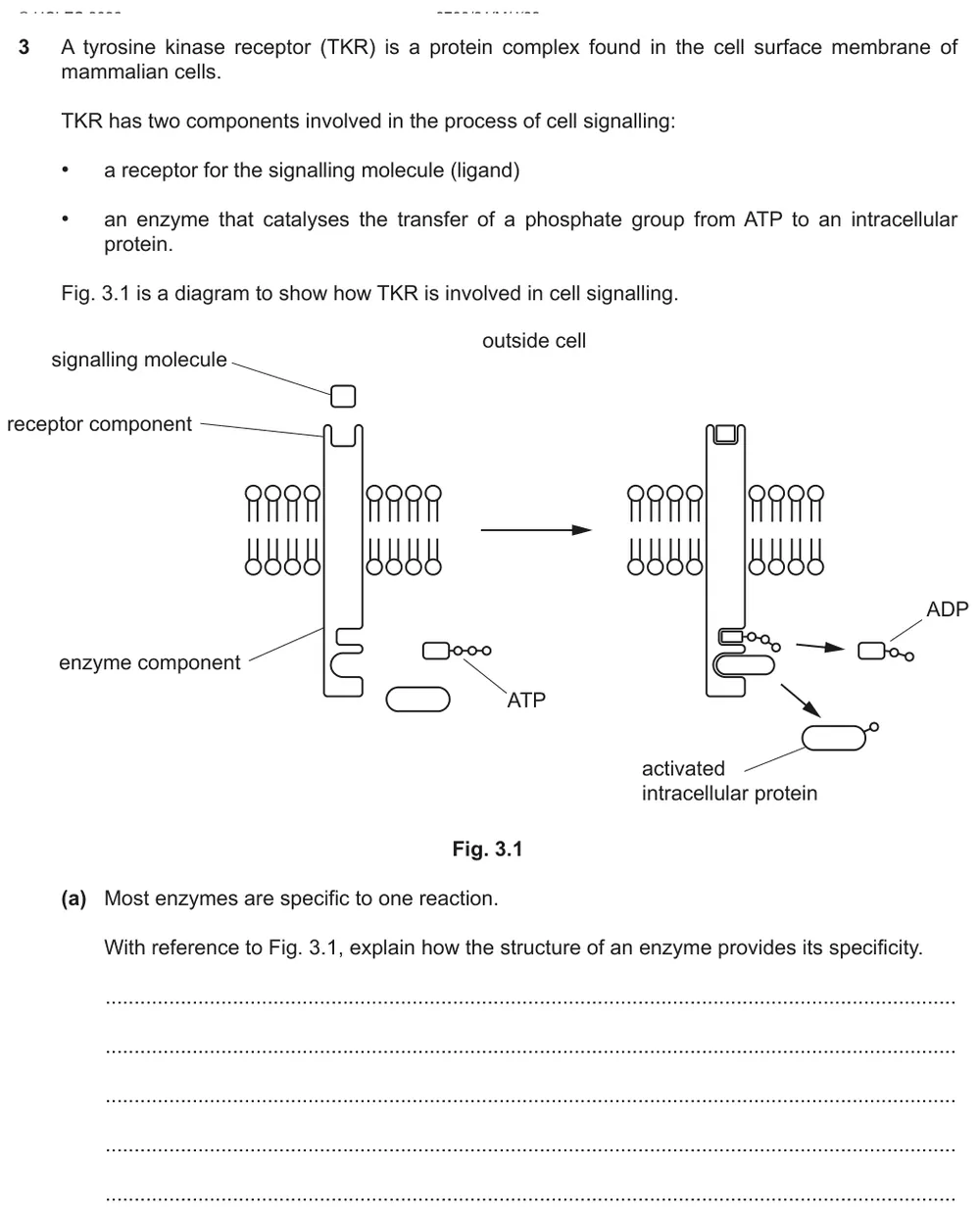
Explain how the structure of an enzyme makes it specific.
Show the mark scheme

Tap an image to open it full size.
From the examiners' report: Most gained both marks by saying that the active site has a shape that is complementary to the substrate, which here is ATP or the intracellular protein.
Question 11
Paper 2 · October/November 2023 (22) · Q2(b) · 1 mark
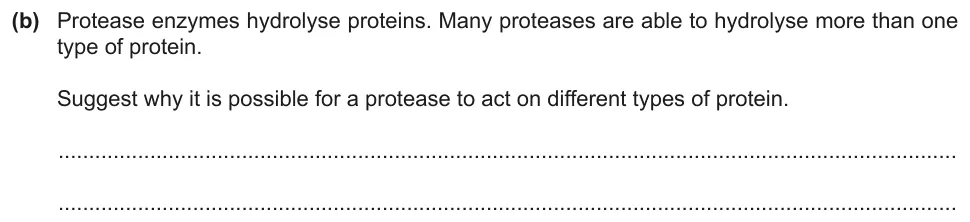
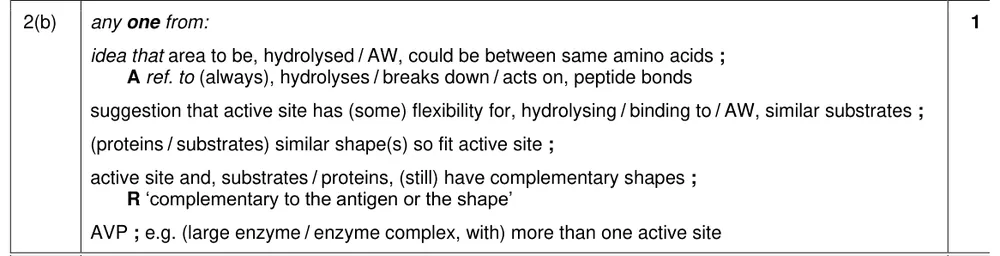
Suggest why one protease can act on different types of protein.
Show the mark scheme
Tap an image to open it full size.
From the examiners' report: Accepted suggestions were that the protein substrates have similar shapes that are complementary to the active site, that the active site can change shape so different substrates can bind, and that it is always the peptide bond that is hydrolysed.
Question 12
Paper 2 · May/June 2022 (22) · Q4(b) · 1 mark
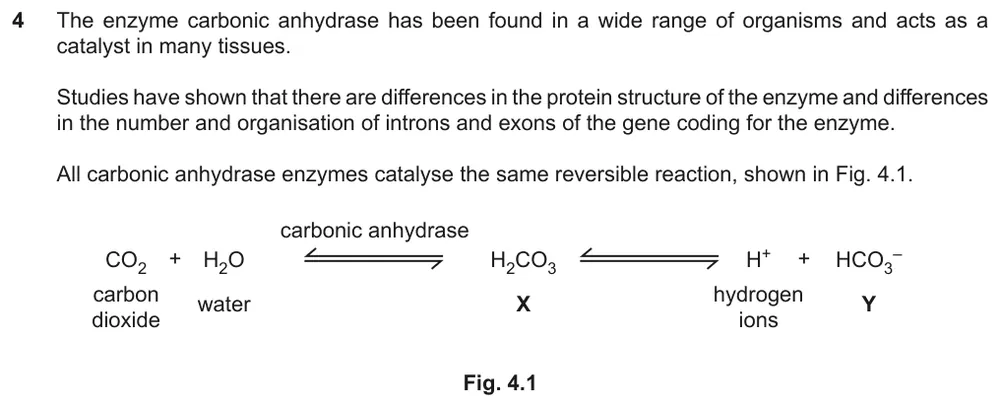
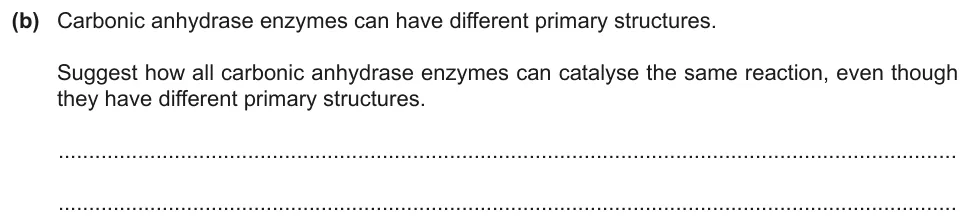
Suggest how enzymes with different primary structures can catalyse the same reaction.
Information from earlier in this question:
Show the mark scheme

Tap an image to open it full size.
From the examiners' report: The point is that the active site, or the tertiary structure, is the same or similar in all of these enzymes. Some students described induced fit, which was not needed.
Question 13
Paper 2 · October/November 2022 (21) · Q4(c) · 2 marks
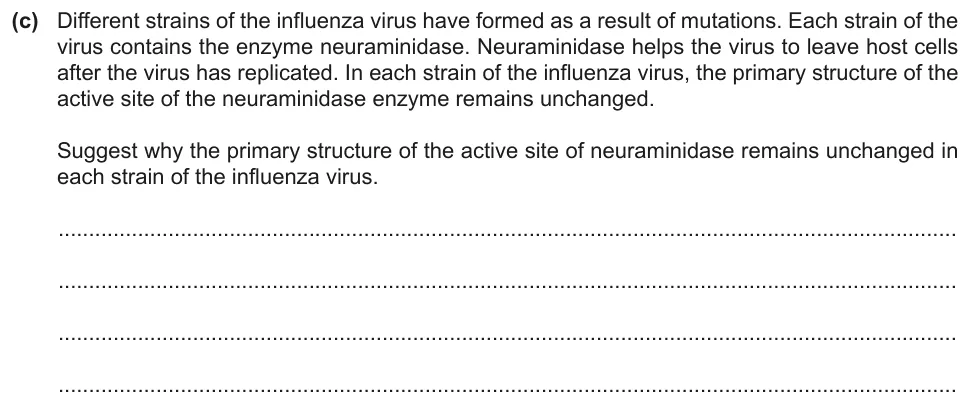
Suggest why the primary structure of the active site of neuraminidase is unchanged in each strain.
Show the mark scheme

Tap an image to open it full size.
From the examiners' report: The best answers linked protein structure to how enzymes work: a change in primary structure could change the tertiary structure and so the shape of the active site, and the substrate must bind for the virus to leave the host cell. Some students mentioned substrate binding but did not take the answer further.
Question 14
Paper 2 · October/November 2022 (21) · Q5(c)(iii) · 2 marks
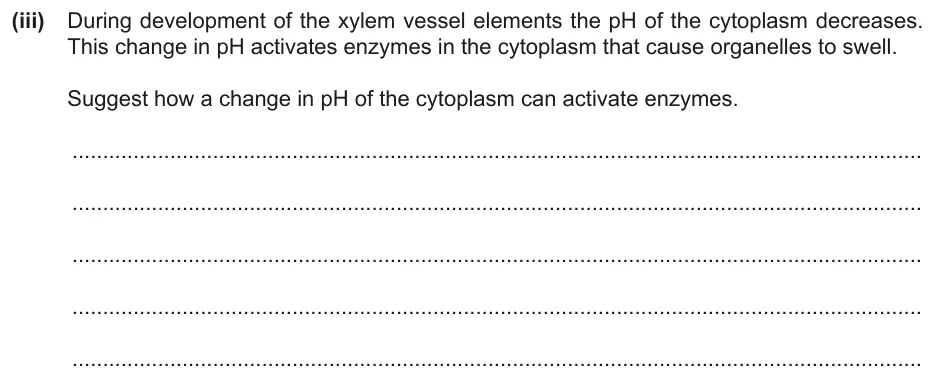
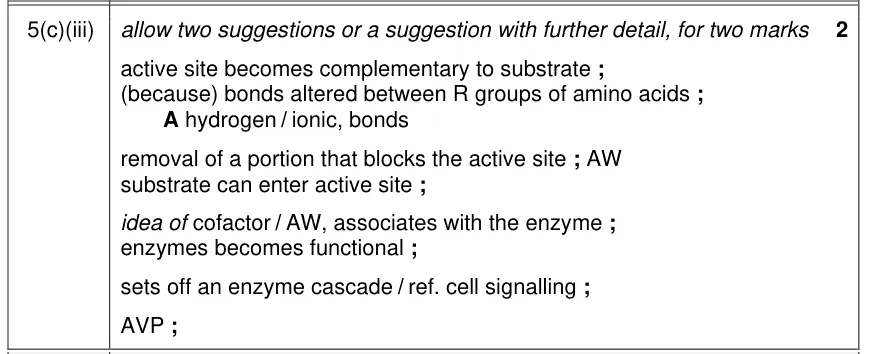
Suggest how a change in the pH of the cytoplasm can activate enzymes.
Information from earlier in this question:

Show the mark scheme
Tap an image to open it full size.
From the examiners' report: The question asks how an enzyme is activated, so describe a change to the enzyme, such as the active site changing shape so that it becomes complementary to the substrate. Many students wrote about the optimum pH of the enzyme instead.
Question 15
Paper 4 (A level) · May/June 2023 (42) · Q8(a)(ii) · 1 mark · Easy
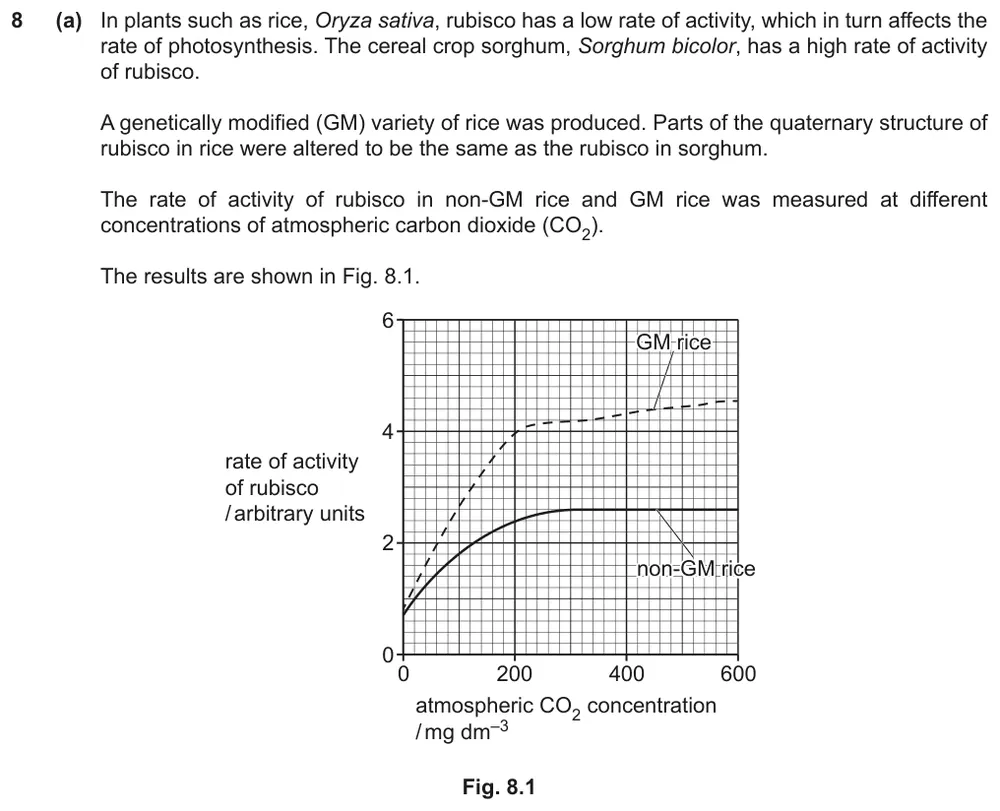
Suggest which part of the rubisco molecule was altered in the GM rice.
Information from earlier in this question:

Show the mark scheme

Tap an image to open it full size.
From the examiners' report: Most stated the active site. Wrong answers usually named some other part of the enzyme's structure.
Following the progress of a reaction (3.1.3)
Question 16
Paper 2 · May/June 2019 (22) · Q6(a)(i) · 2 marks
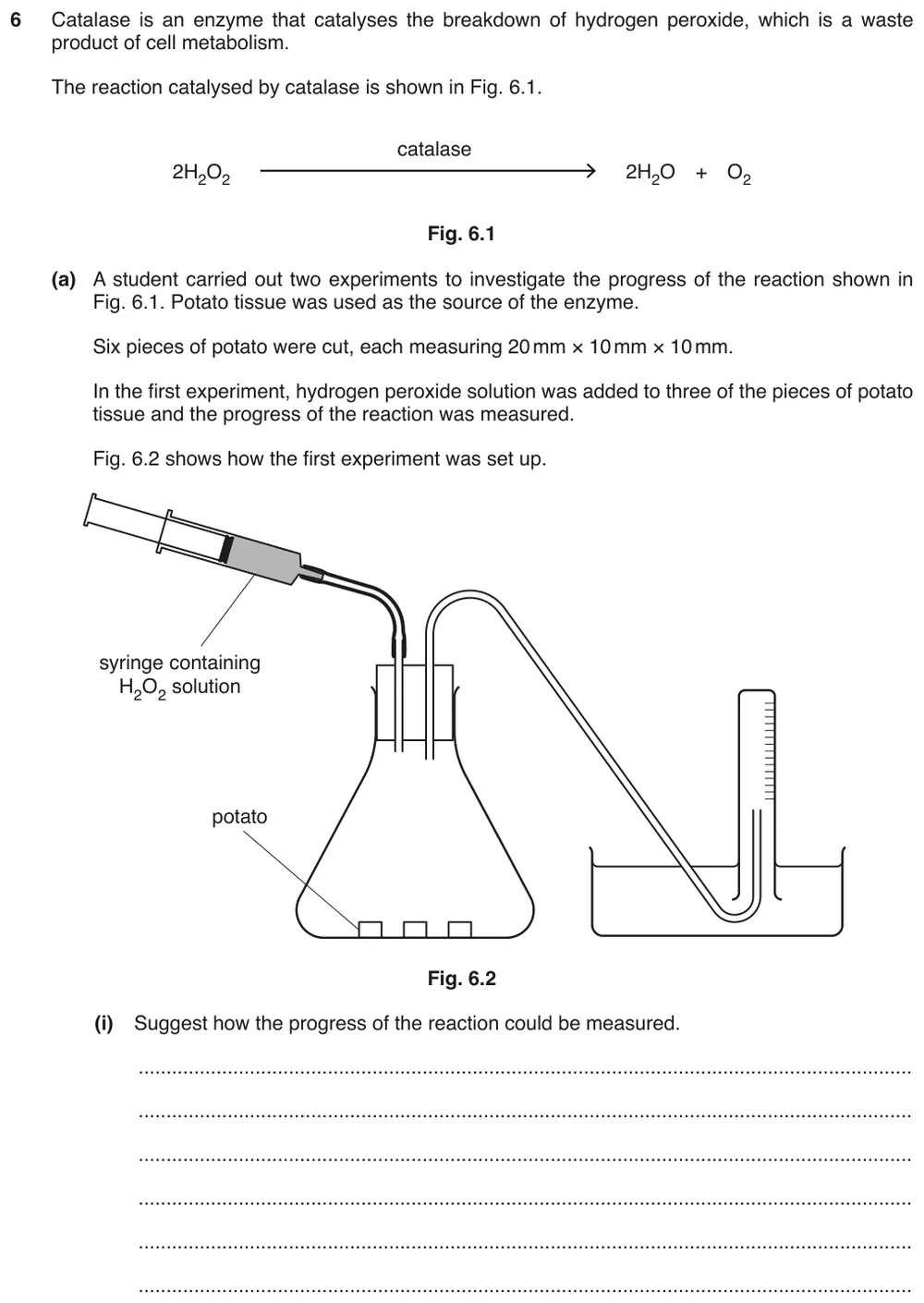
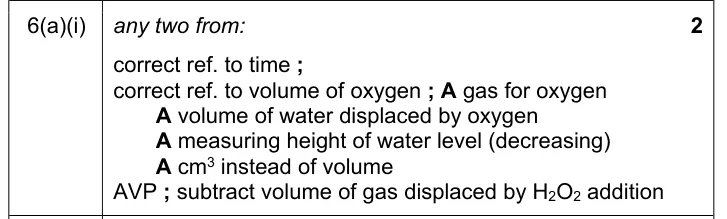
Suggest how the progress of the catalase reaction could be measured with the apparatus shown.
Show the mark scheme
Tap an image to open it full size.
From the examiners' report: Measure the volume of oxygen, not the 'amount', at timed intervals. Counting bubbles was not credited, because the reaction is too fast and the bubbles are not all the same size. Some students wrongly said that hydrogen is produced.
Question 17
Paper 2 · February/March 2018 (22) · Q3(c) · 3 marks
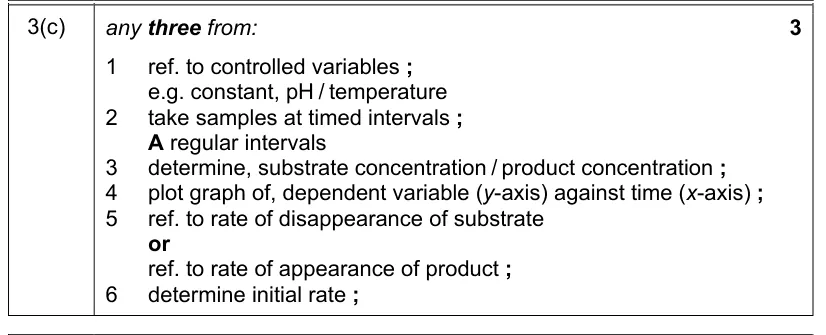
Outline how the progress of an enzyme-catalysed reaction can be investigated.
Show the mark scheme
Tap an image to open it full size.
From the examiners' report: Many answers were vague about the 'amount' of enzyme, substrate or product. Say that variables such as pH and temperature are controlled, that the substrate or product concentration is measured at timed intervals, and that a graph is plotted against time.
Question 18
Paper 2 · May/June 2025 (21) · Q3(a)(i) · 3 marks
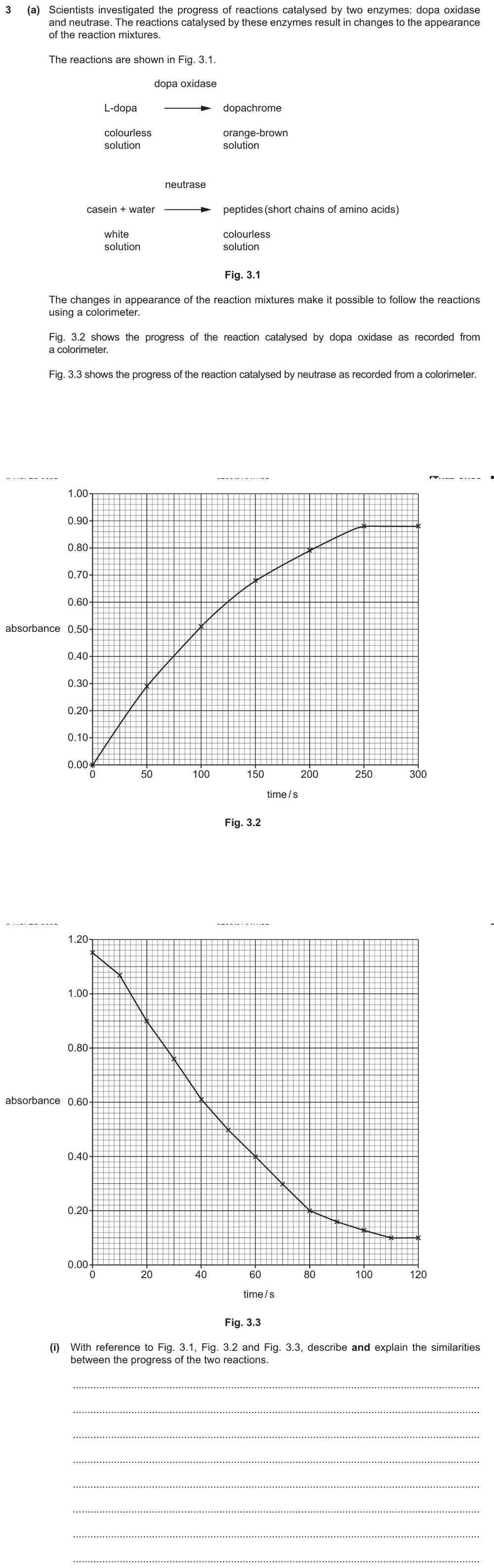
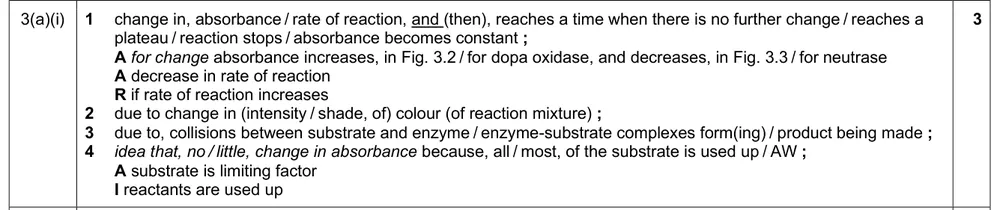
Describe and explain the colorimeter curves for the two enzyme-catalysed reactions.
Show the mark scheme
Tap an image to open it full size.
Using a colorimeter (3.1.4)
Question 19
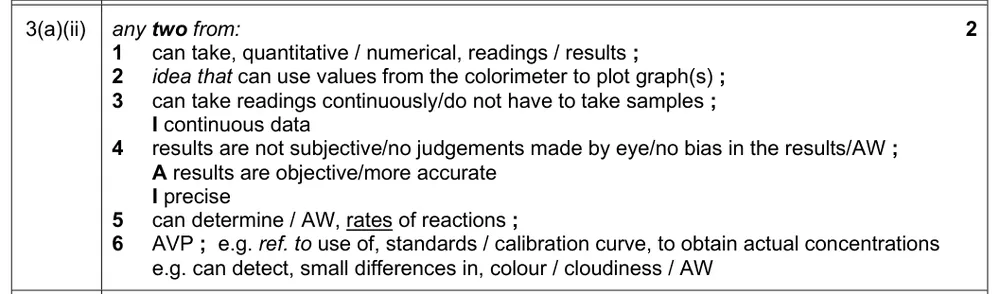
Paper 2 · May/June 2025 (21) · Q3(a)(ii) · 2 marks
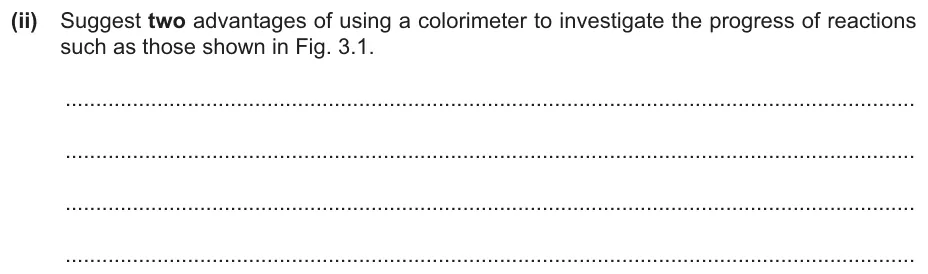
Suggest two advantages of using a colorimeter to follow these reactions.
Show the mark scheme
Tap an image to open it full size.
Question 20
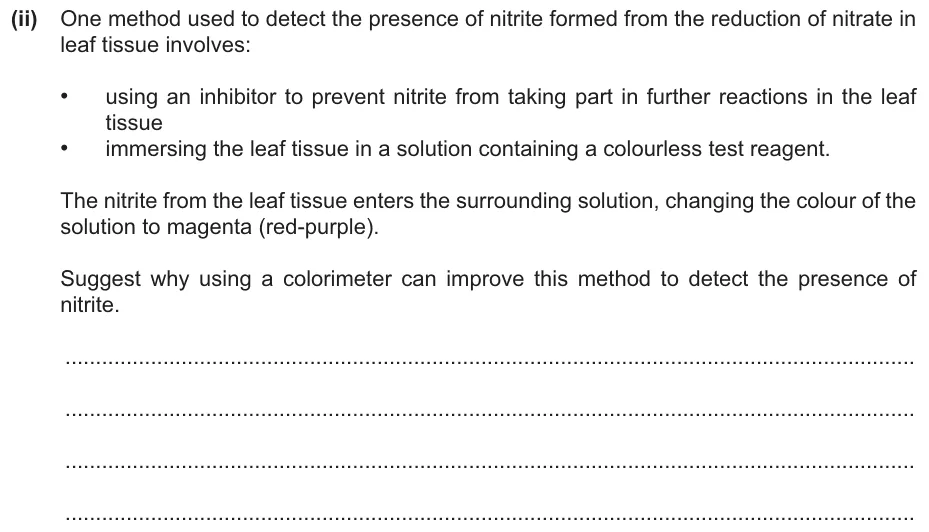
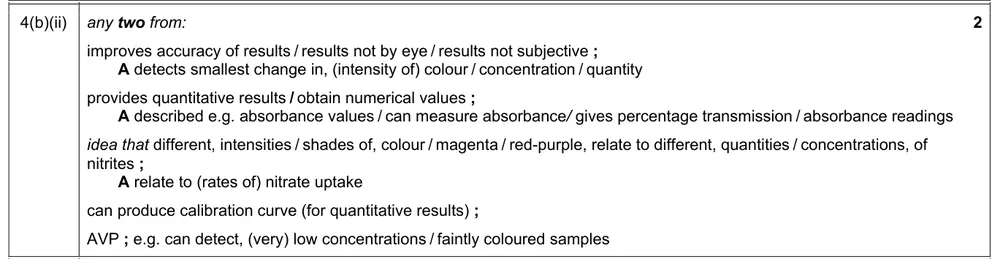
Paper 2 · May/June 2024 (22) · Q4(b)(ii) · 2 marks
Suggest why a colorimeter improves the method for detecting nitrite.
Information from earlier in this question:

Show the mark scheme
Tap an image to open it full size.
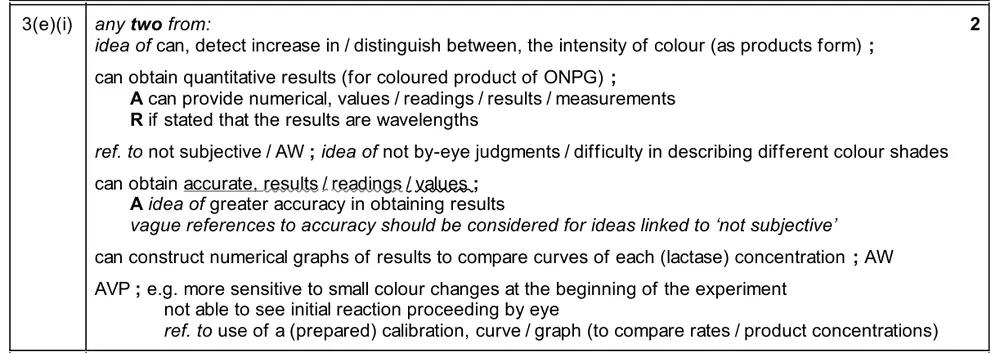
From the examiners' report: Many explained that a colorimeter is more accurate than judging colour by eye, but fewer gave a second point, such as quantitative results or a calibration curve. Write about the 'intensity' of the colour, not 'different' or 'changing' colours. The readings are absorbance or transmission values, not wavelengths of light.
Question 21
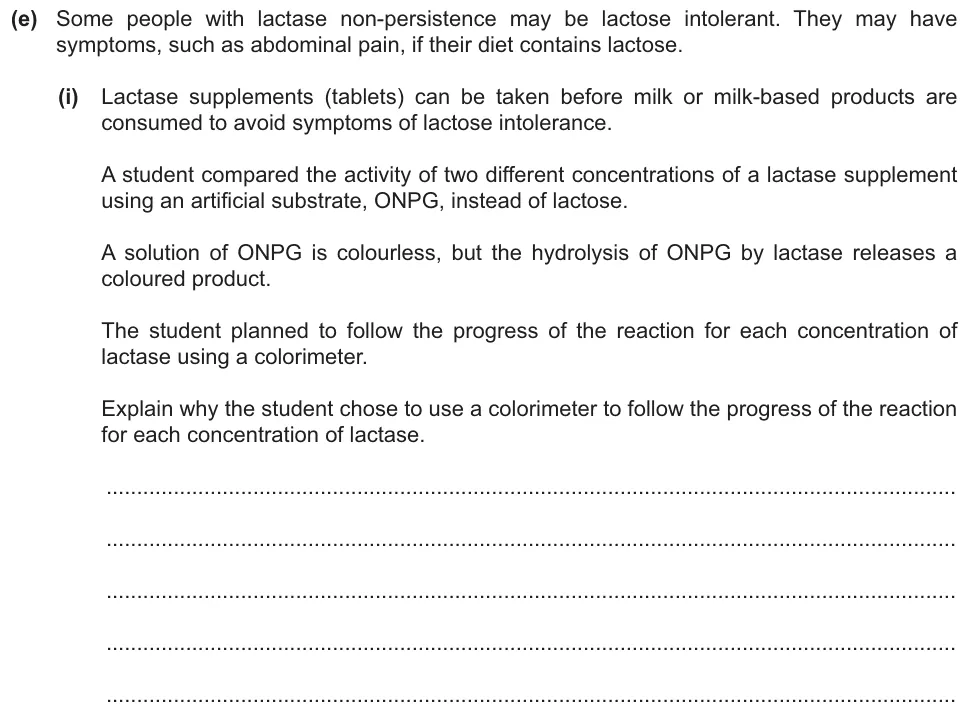
Paper 2 · October/November 2025 (22) · Q3(e)(i) · 2 marks
Explain why the student chose a colorimeter to follow the reaction.
Show the mark scheme
Tap an image to open it full size.
Question 22
Paper 2 · October/November 2023 (23) · Q2(a)(iii) · 1 mark
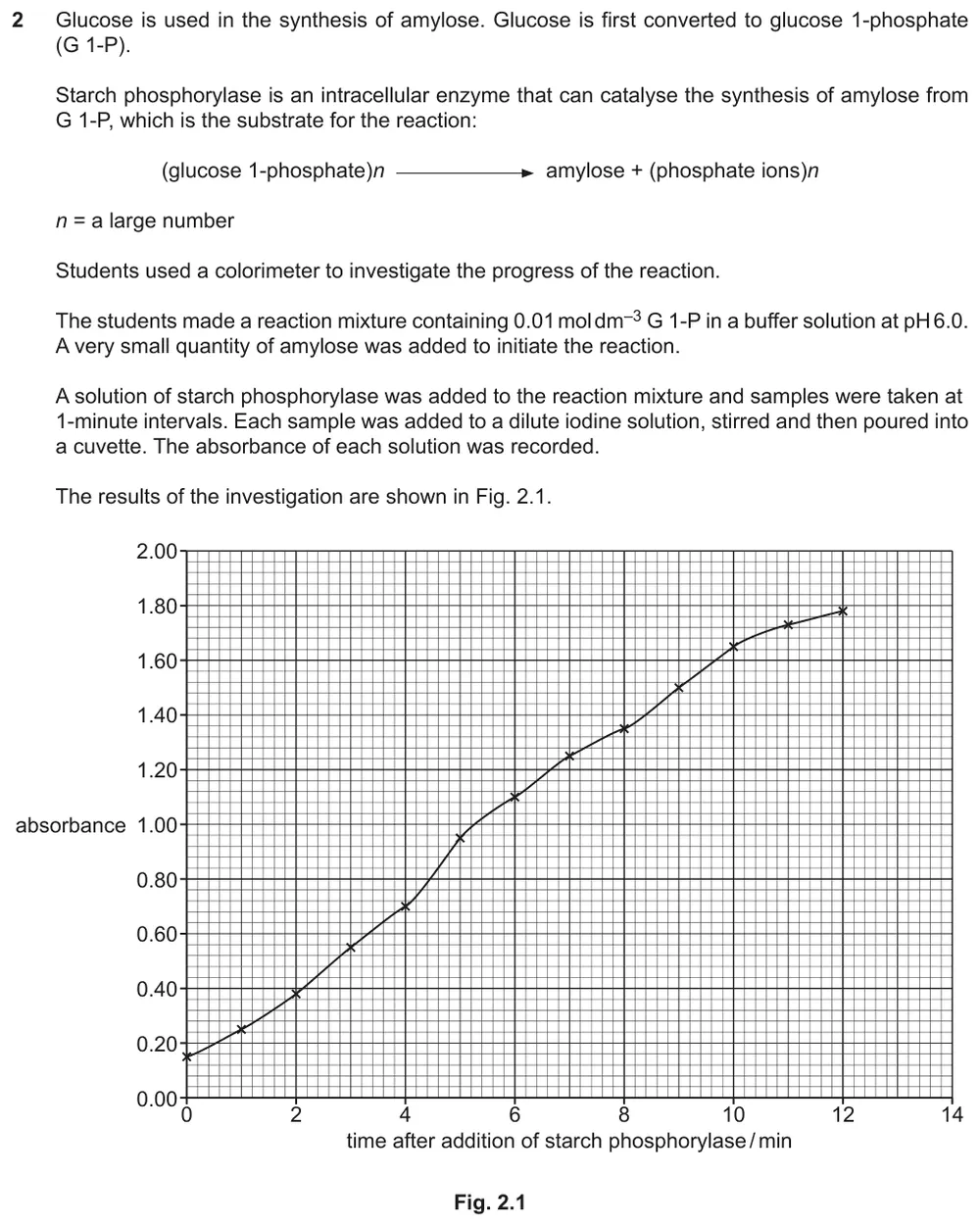
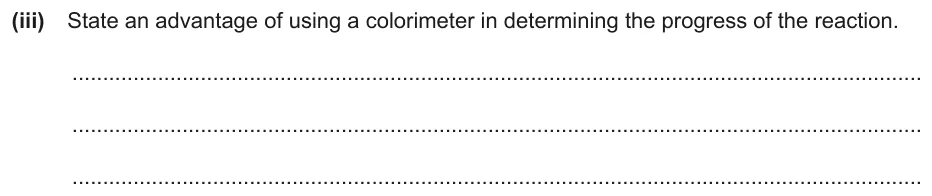
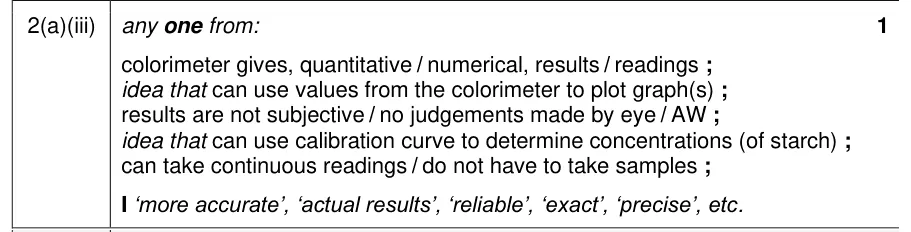
State an advantage of using a colorimeter to follow the progress of the reaction.
Information from earlier in this question:
Show the mark scheme
Tap an image to open it full size.
From the examiners' report: 'More accurate' and 'more precise' were not enough. Say that the results are quantitative and do not depend on judgements made by eye. Few students mentioned calibration curves or plotting graphs.
Where students lose marks (from Cambridge examiners' reports and mark schemes)
Each point below comes from the examiners' reports and mark schemes, and is followed by wording that gained marks.
Intracellular, not intercellular. Students wrote 'intercellular', 'interacellular' or 'intrinsic' for an enzyme that functions within the cell.
✔ Gains credit: 'intracellular (enzyme)'.
Name one theory only. Students wrote 'induced fit lock and key', or put one of the two names in brackets.
✔ Gains credit: 'induced fit'.
The active site belongs to the enzyme. Students labelled peptidoglycan as the enzyme or lysozyme as the substrate, or drew the active site as part of the peptidoglycan.
✔ Gains credit: an 'active site with a specific shape as part of a lysozyme molecule', a 'complementary shaped peptidoglycan' and an 'enzyme-substrate complex drawn and labelled'.
Same active site, same reaction. Students described the induced fit mechanism and did not say what the different enzymes have in common.
✔ Gains credit: the enzymes have a 'similar' or 'same' 'active site', or the 'same tertiary structure'.
Activation is a change to the enzyme. Students wrote about the optimum pH of the enzyme without saying how the change in pH makes the enzyme active.
✔ Gains credit: 'active site becomes complementary to substrate' because 'bonds altered between R groups of amino acids', so the 'substrate can enter active site'.
Volume of oxygen, not amount. Students wrote about the 'amount' of oxygen, suggested counting bubbles, or left out the time.
✔ Gains credit: a correct reference to 'time' and to the 'volume of oxygen', or the 'volume of water displaced by oxygen'.
Say how progress is measured. Students made vague statements about the amount of enzyme, substrate or product and did not mention controlling variables.
✔ Gains credit: 'constant' pH and temperature, 'take samples at timed intervals', 'determine' the 'substrate concentration' or 'product concentration', and 'plot graph' of the dependent variable 'against time'.
More accurate is not enough. Students said only that a colorimeter gives more accurate or more precise results, or thought the readings were wavelengths of light.
✔ Gains credit: the colorimeter 'gives quantitative' or 'numerical' results, the 'results are not subjective', with 'no judgements made by eye'.
Download the questions
Download the PDF pack (22 questions, mark schemes at the end)
Keep practising
- Factors That Affect Enzyme Action (3.2): Cambridge (CIE) exam questions by topic
- Cambridge (CIE) A level Biology 9700 past papers, mark schemes and examiners' reports
- Cambridge (CIE) A level Biology grade thresholds
- Book a one-to-one CIE lesson or a free 15-minute discovery chat with Tom
- Register your interest in a CIE A level Biology group class
Questions, mark schemes and examiners' report extracts © Cambridge University Press & Assessment.