

Factors That Affect Enzyme Action (3.2): Cambridge (CIE) A Level Biology 9700 Exam Questions by Topic
Factors that affect enzyme action is sub-topic 3.2 of Topic 3, Enzymes, in the Cambridge International AS & A Level Biology syllabus (9700). You need to explain how temperature, pH, enzyme concentration, substrate concentration and inhibitor concentration affect the rate of an enzyme-catalysed reaction. You need to know how Vmax is used to derive the Michaelis-Menten constant, Km, and what Km shows about the affinity of an enzyme for its substrate. You also need to explain the effects of competitive and non-competitive inhibitors, and compare immobilised enzymes with enzymes free in solution. This is AS content, examined on Papers 1 and 2. A level students meet it again on Paper 4; questions marked A level on this page come from Paper 4.
The examiners' reports return to the same points. When a question says explain, describing the graph is not enough: write about active sites, enzyme-substrate complexes and limiting factors. Keep pH and temperature apart, as kinetic energy belongs to temperature. A lower Km means a higher affinity, and a non-competitive inhibitor lowers Vmax but leaves Km the same. Quote data accurately, with both the x-axis and y-axis values, and use every figure the question names. In questions on immobilised enzymes, make clear which form of the enzyme each point is about.
Studying Cambridge International A level Biology and want more help? Tom teaches CIE students one-to-one online, including students in the UAE, Saudi Arabia, Hong Kong, India and Indonesia, and every lesson is recorded. You can book a one-to-one lesson or a free 15-minute discovery chat, or register your interest in a CIE group class starting in September 2027, using the links at the bottom of this page.
What you need from IGCSE
Each question on this page assumes you're secure on these ideas. If any of them feels shaky, look it up before you start.
- Enzyme activity increases with temperature up to an optimum, then falls as the enzyme is denatured.
- Each enzyme has an optimum pH; a pH far from the optimum changes the shape of the active site.
- A higher temperature gives molecules more kinetic energy, so they collide more often.
- The substrate must fit into the active site of the enzyme for the reaction to take place.
Key terms
These words come up in the questions and mark schemes. Examiners expect you to use them exactly.
- Optimum: the temperature or pH at which an enzyme has its maximum activity.
- Denatured: describes an enzyme whose tertiary structure has changed, so that the active site is no longer complementary to the substrate.
- Vmax: the maximum rate of reaction, reached when all the active sites are occupied (saturated).
- Michaelis-Menten constant (Km): the substrate concentration at which the rate of reaction is half of Vmax; the lower the Km, the higher the affinity.
- Affinity: how readily an enzyme binds its substrate.
- Competitive inhibitor: a molecule with a similar shape to the substrate that binds to the active site; Vmax stays the same and Km increases.
- Non-competitive inhibitor: a molecule that binds to a site other than the active site (an allosteric site) and changes the shape of the active site; Vmax decreases and Km stays the same.
- Immobilised enzyme: an enzyme that is fixed in place, for example trapped in alginate beads, so that it stays out of the product and can be reused.
What these questions cover (Cambridge 9700 Topic 3: Enzymes)
The questions test these learning outcomes from sub-topic 3.2 of the Cambridge International AS & A Level Biology syllabus (9700) for 2025 to 2027.
- 3.2.1 investigate and explain the effects of the following factors on the rate of enzyme-catalysed reactions
- 3.2.2 explain that the maximum rate of reaction (Vₘₐₓ) is used to derive the Michaelis–Menten constant (Kₘ), which is used to compare the affinity of different enzymes for their substrates
- 3.2.3 explain the effects of reversible inhibitors, both competitive and non-competitive, on enzyme activity
- 3.2.4 investigate the difference in activity between an enzyme immobilised in alginate and the same enzyme free in solution, and state the advantages of using immobilised enzymes
How to use this page
Write your answer on paper before you open the mark scheme. Allow about 1.2 minutes per mark: the 22 questions are worth 54 marks, so about 65 minutes in total. Then mark your answer strictly against the mark scheme and read the examiners' tip underneath it. If you'd rather print the questions, download the PDF pack.
Effect of pH (3.2.1)
Question 1
Paper 2 · February/March 2023 (22) · Q6(b) · 2 marks · Easy
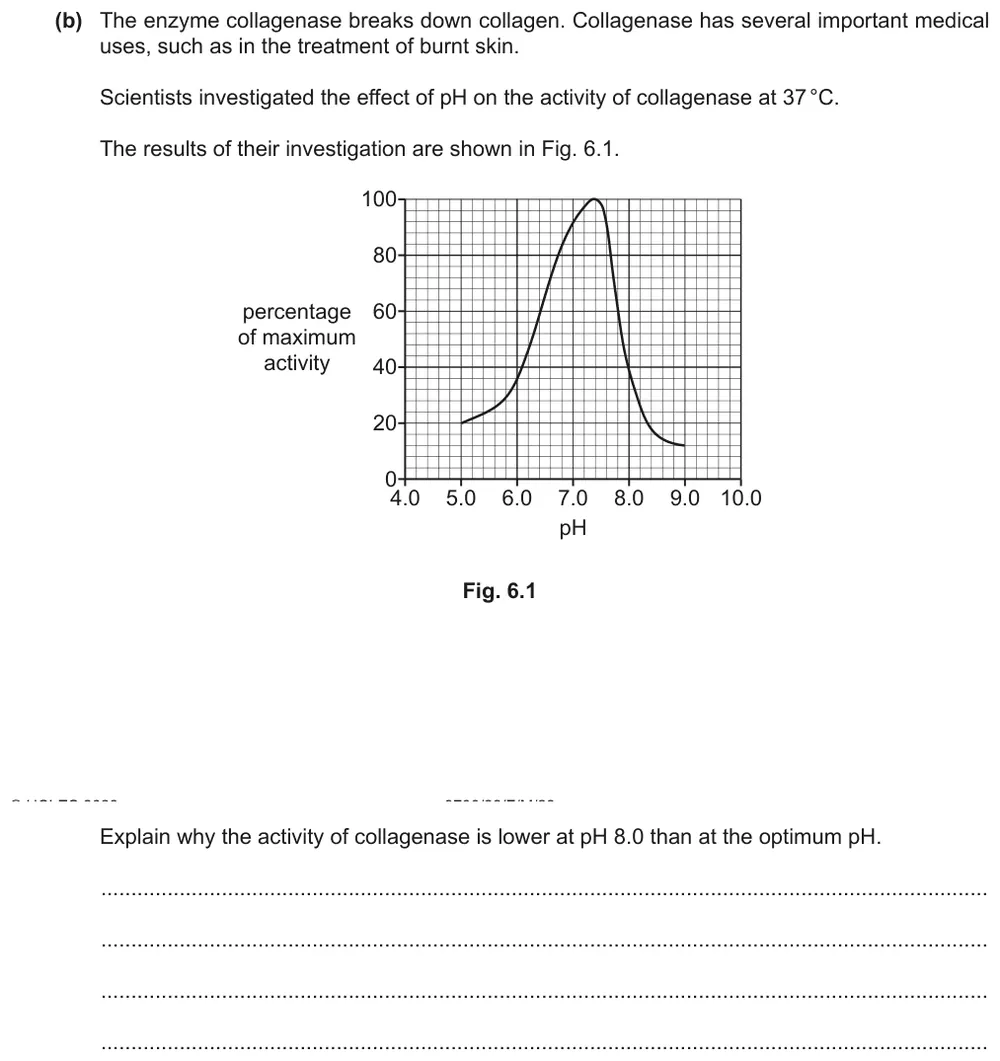
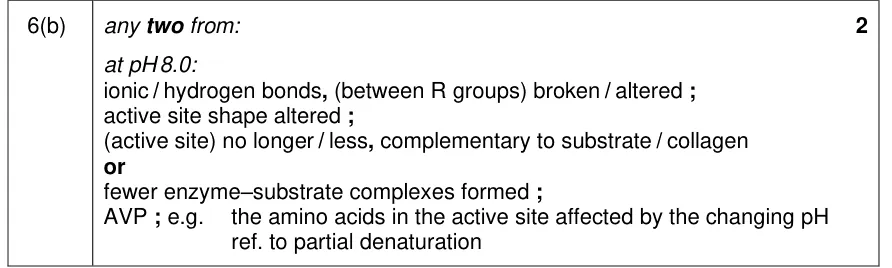
Explain why the activity of collagenase is lower at pH 8.0 than at the optimum pH.
Show the mark scheme
Tap an image to open it full size.
From the examiners' report: Most explanations were full. Some students misread the question and wrote about factors that belong to temperature, such as kinetic energy, instead of pH.
Question 2
Paper 2 · October/November 2023 (22) · Q2(e) · 3 marks
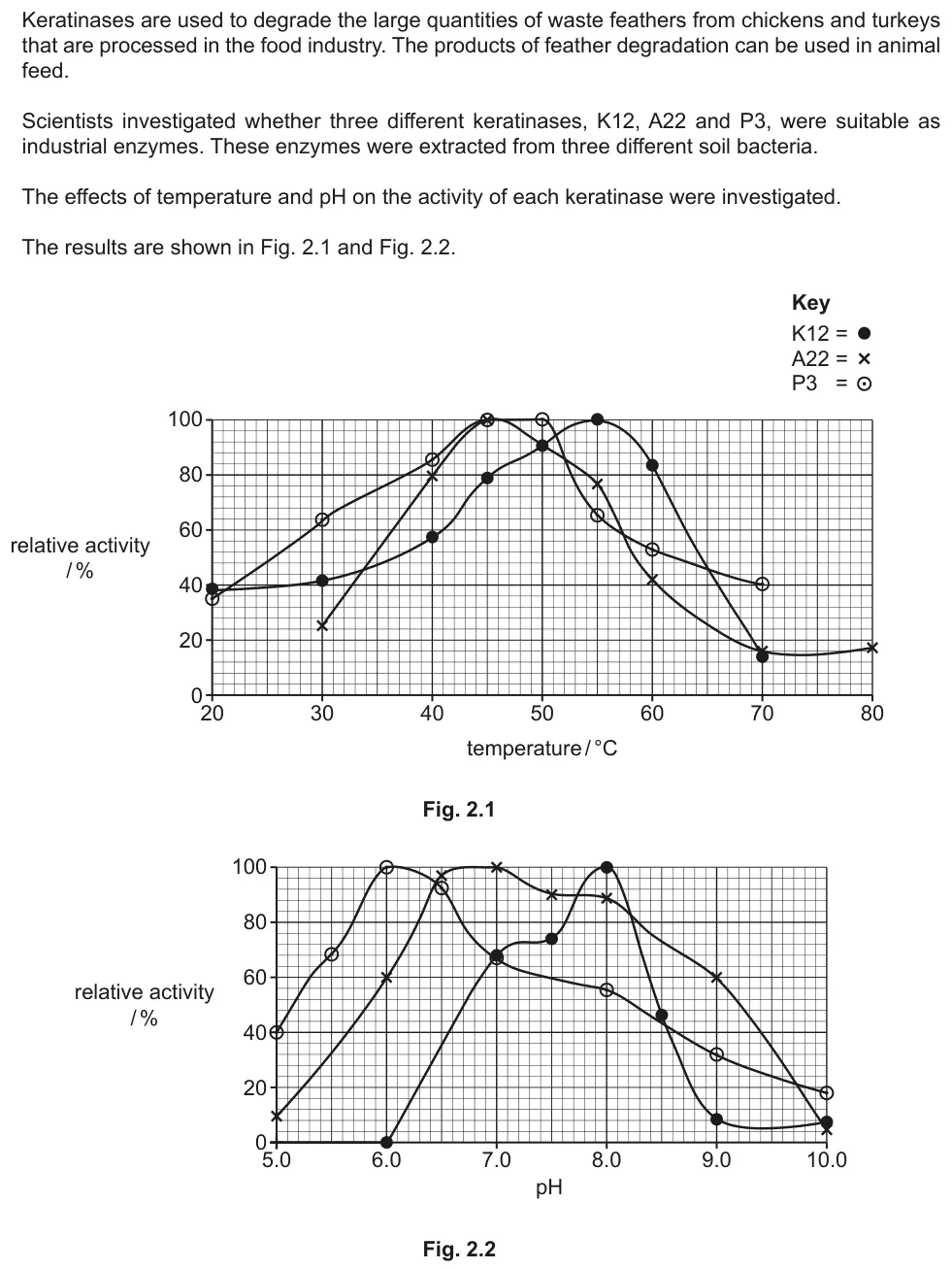
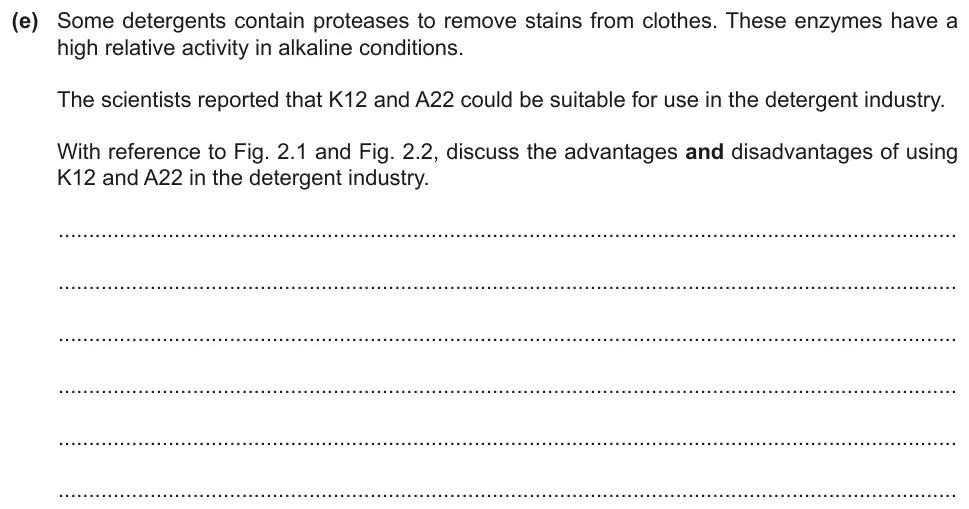
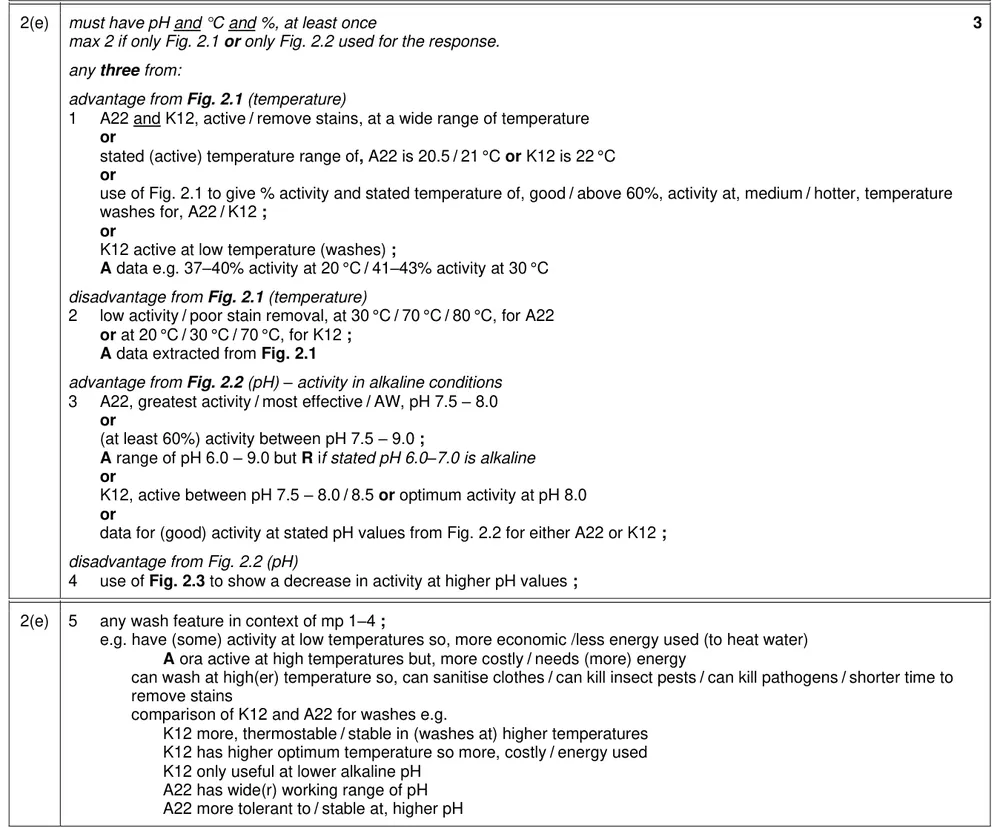
Use the two graphs to discuss the advantages and disadvantages of two enzymes for use in detergents.
Information from earlier in this question:
Show the mark scheme
Tap an image to open it full size.
From the examiners' report: Use both figures and quote values from them accurately. Some students discussed only pH, and weaker answers made statements about alkaline conditions and temperatures with no data to support them. Others wrote about denaturation where the graphs showed the enzyme was still active, or compared all three enzymes, which was not required.
Effect of temperature (3.2.1)
Question 3
Paper 2 · February/March 2021 (22) · Q2(d)(i) · 3 marks
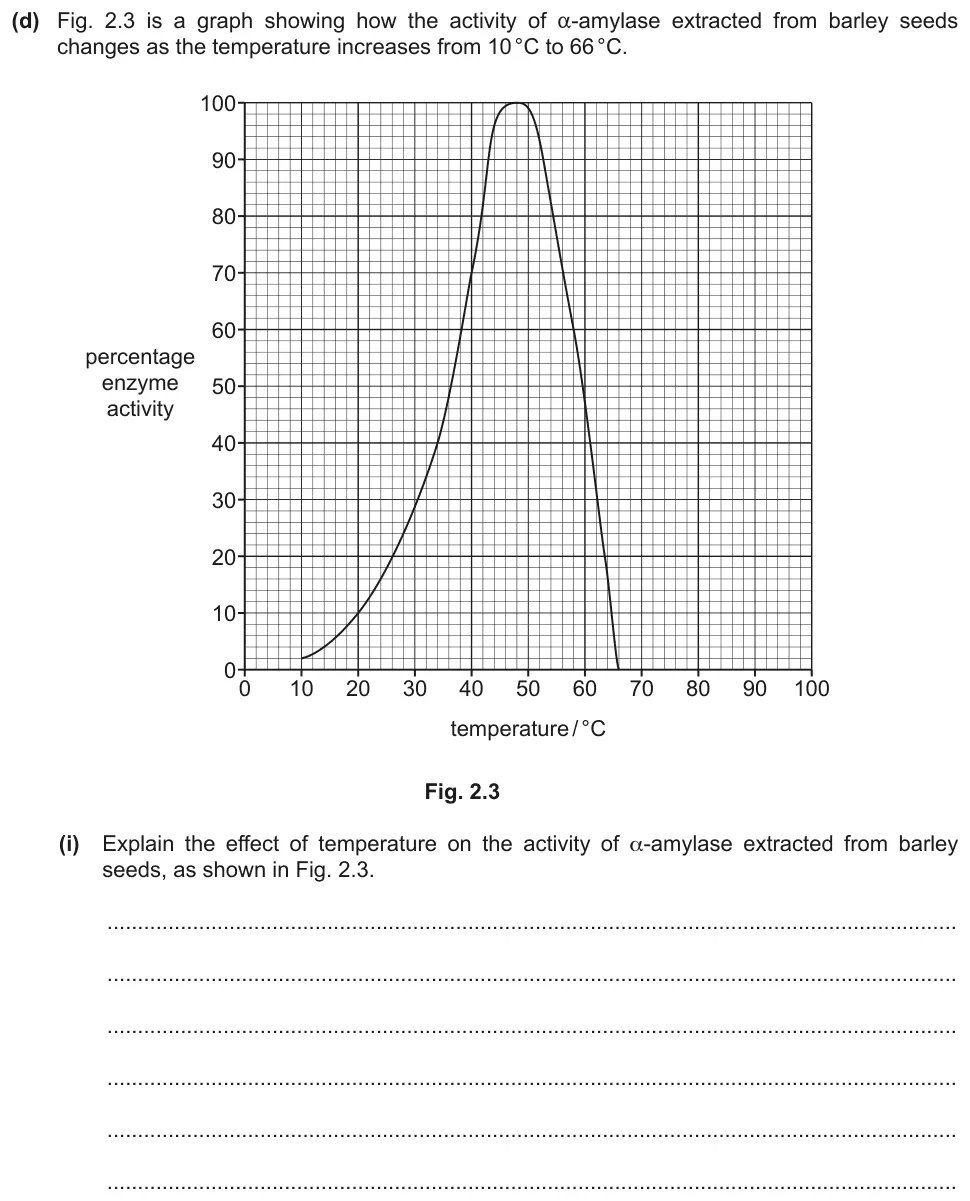
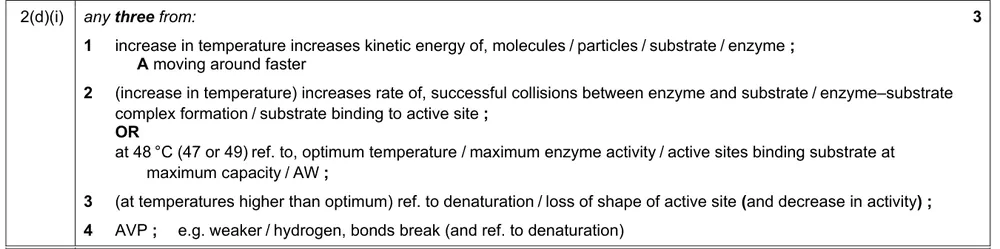
Explain the effect of temperature on the activity of α-amylase shown in the graph.
Information from earlier in this question:

Show the mark scheme
Tap an image to open it full size.
From the examiners' report: Good answers used the correct terms and explained the effect of temperature up to and then beyond the optimum: kinetic energy, successful collisions, enzyme-substrate complex formation and denaturation.
Question 4
Paper 2 · February/March 2021 (22) · Q2(d)(ii) · 2 marks
Sketch the curve for an α-amylase that is heat stable.

Show the mark scheme

Tap an image to open it full size.
From the examiners' report: Not everyone realised that a heat-stable enzyme still has an optimum temperature.
Question 5
Paper 4 (A level) · October/November 2021 (42) · Q3(c)(i) · 3 marks
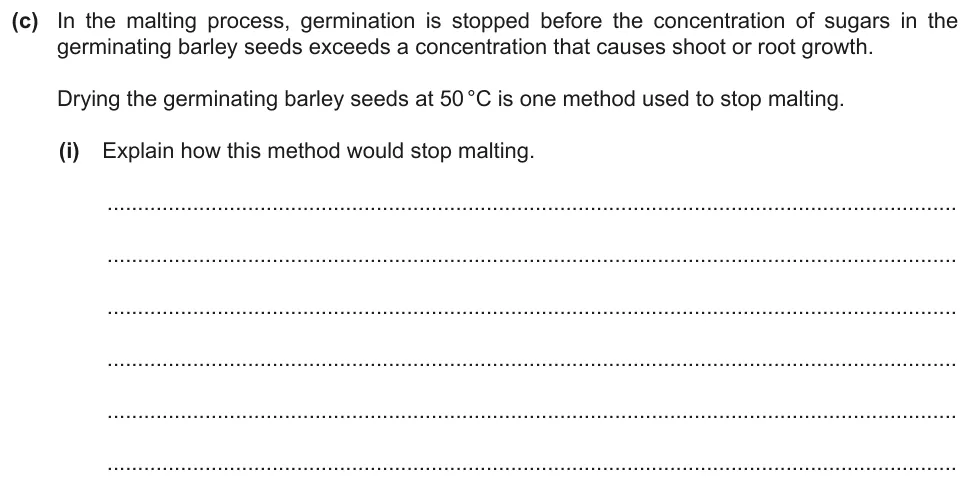
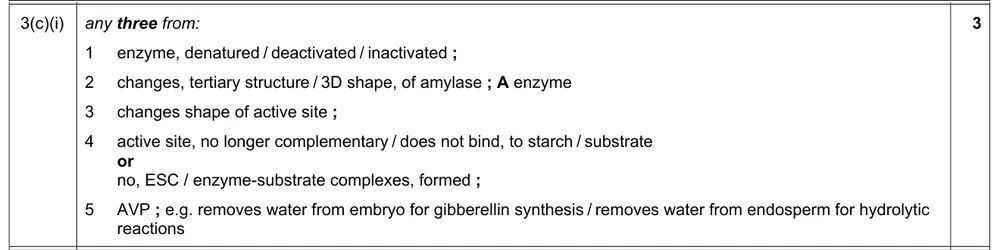
Explain how drying germinating barley seeds at 50 °C stops malting.
Information from earlier in this question:

Show the mark scheme
Tap an image to open it full size.
From the examiners' report: Most knew that the enzyme is denatured, which changes its tertiary structure and the shape of the active site, so starch does not fit and no enzyme-substrate complexes form. Few mentioned that drying would reduce the synthesis of gibberellin.
Enzyme and substrate concentration (3.2.1)
Question 6
Paper 2 · October/November 2019 (22) · Q6(d) · 2 marks · Hard
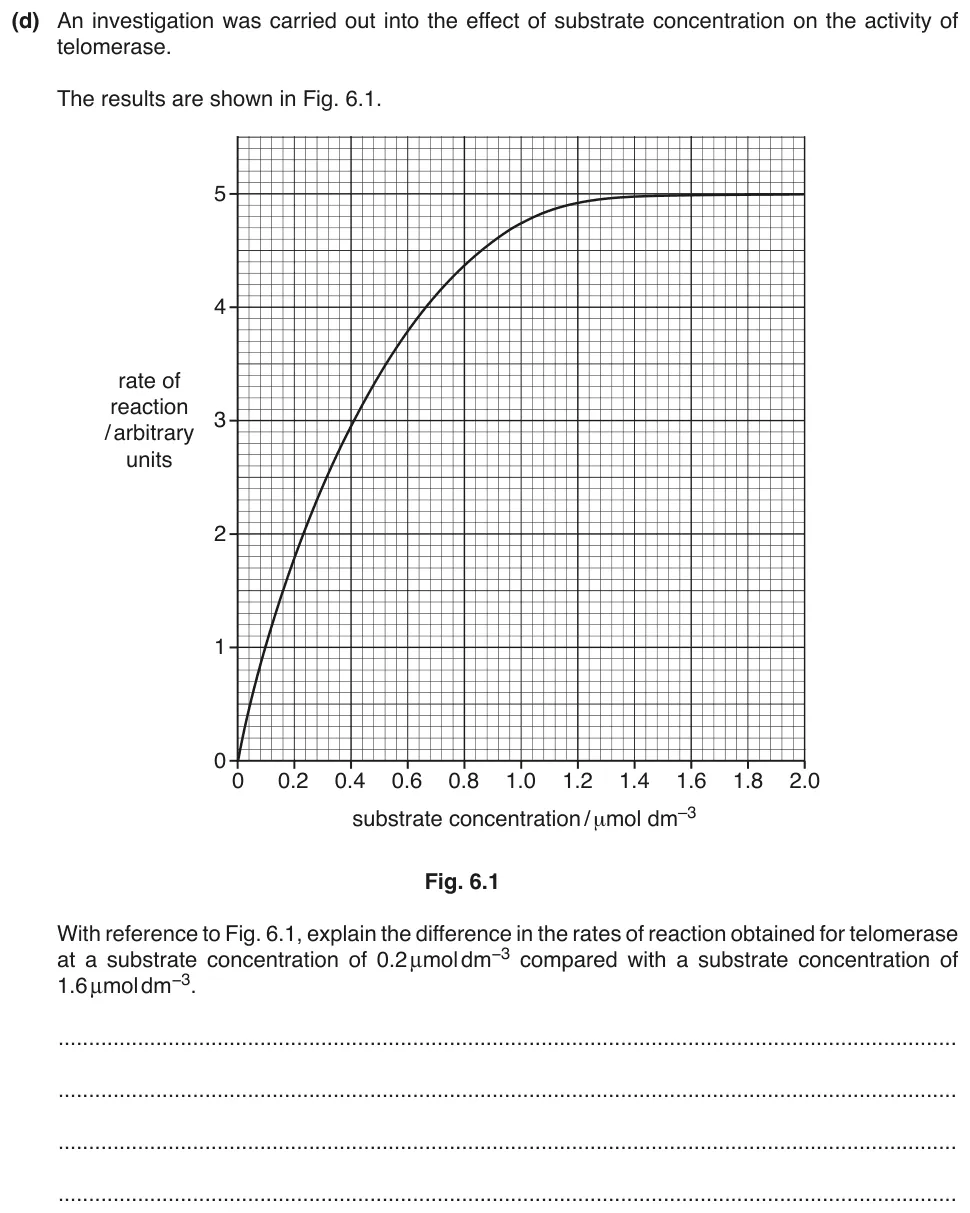
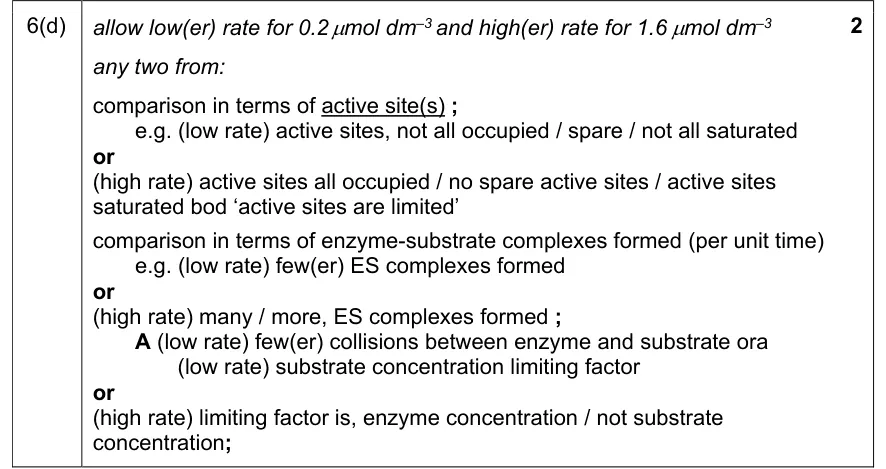
Explain the difference in the rate of reaction at a low and a high substrate concentration.
Information from earlier in this question:

Show the mark scheme
Tap an image to open it full size.
From the examiners' report: Many students described the two rates when the question asked them to explain the difference. Compare the two concentrations in terms of active sites, enzyme-substrate complexes or limiting factors. A common error was to think that more enzyme-substrate complexes form at the lower substrate concentration because the rate is still rising there.
Question 7
Paper 2 · February/March 2022 (22) · Q3(b)(ii) · 1 mark
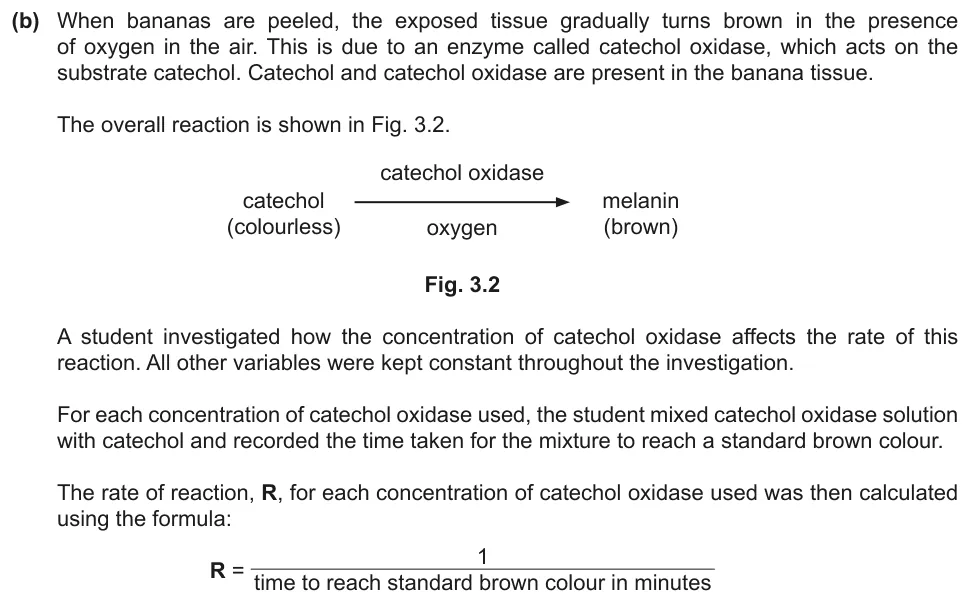
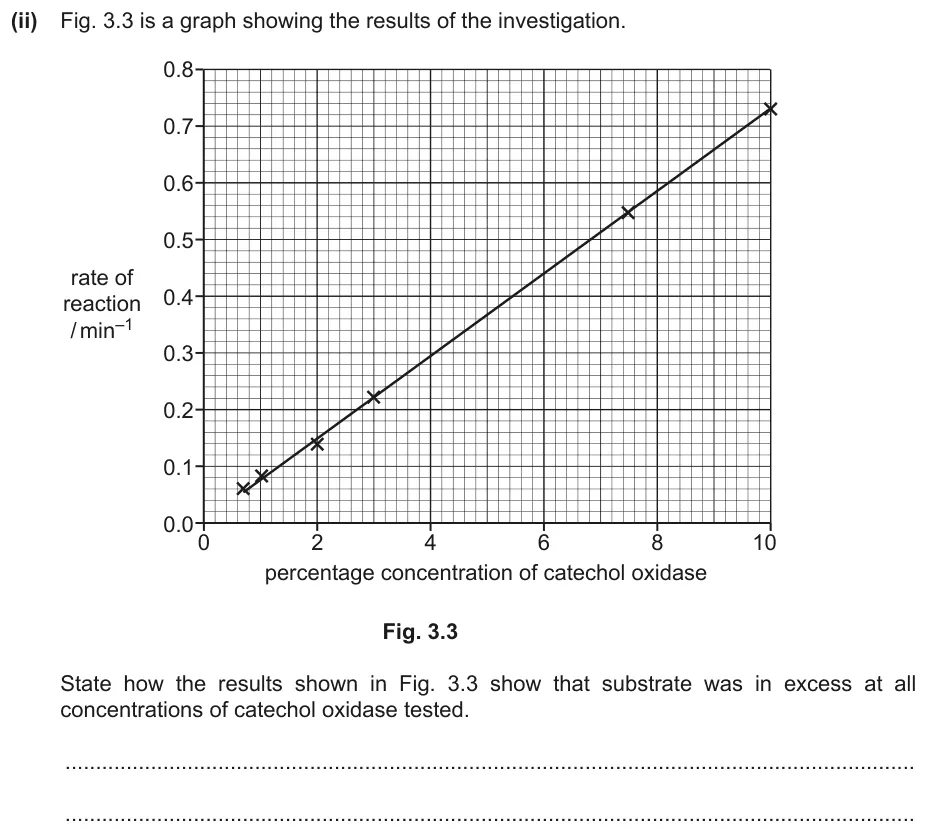
State how the graph shows that the substrate was in excess at every enzyme concentration.
Information from earlier in this question:
Show the mark scheme

Tap an image to open it full size.
From the examiners' report: Saying that the rate increases as the enzyme concentration increases only describes the graph. More detail is needed to show that the substrate was always in excess.
Question 8
Paper 2 · February/March 2022 (22) · Q3(c)(i) · 3 marks
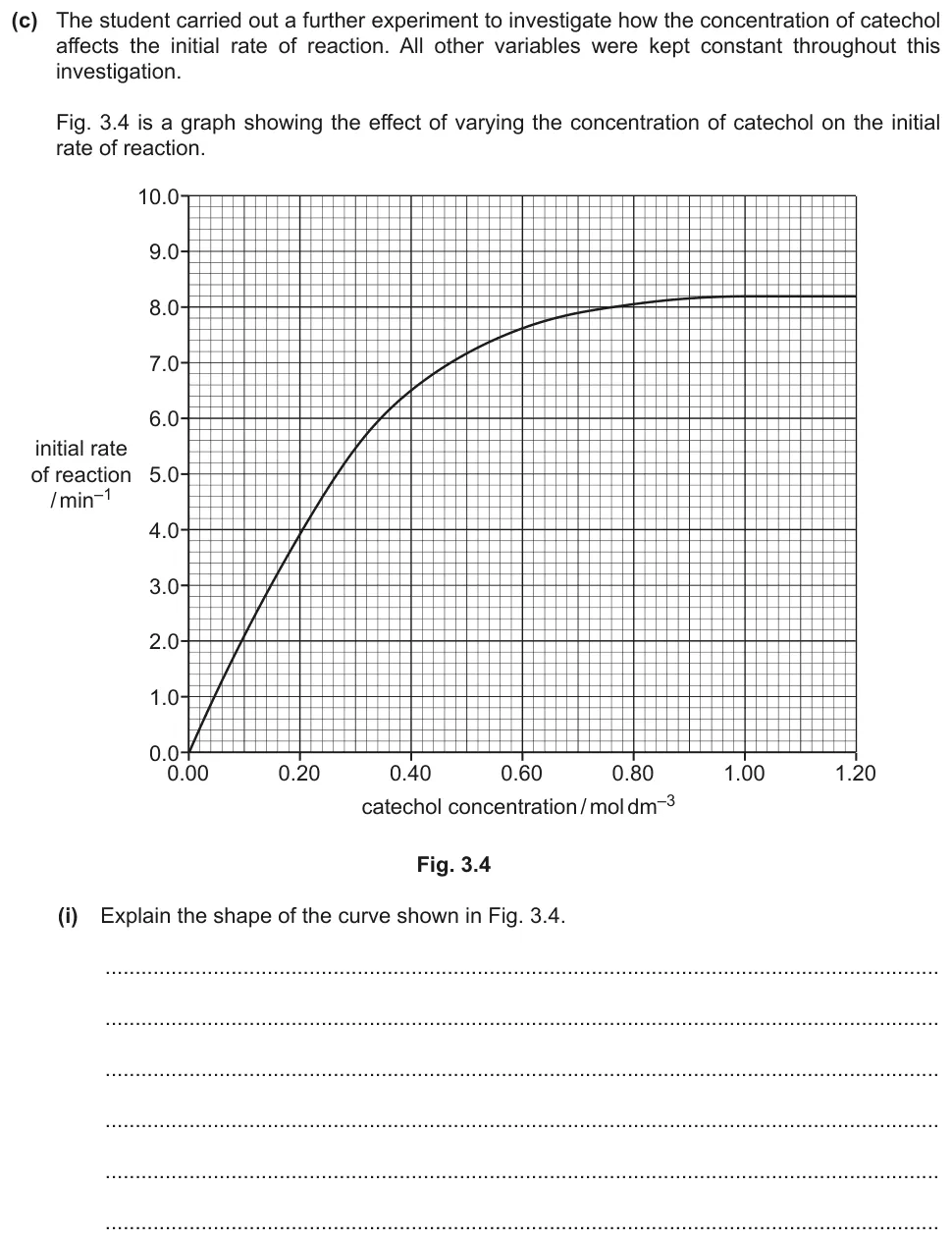
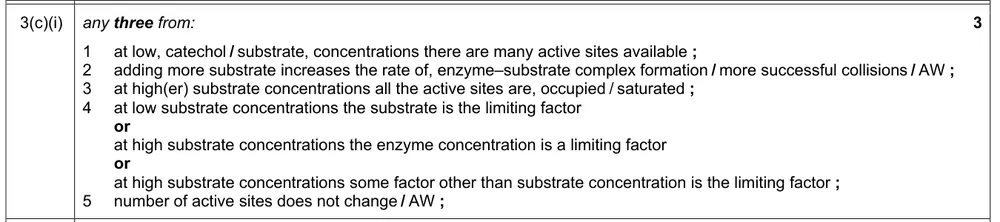
Explain the shape of the curve of initial rate against substrate concentration.
Show the mark scheme
Tap an image to open it full size.
From the examiners' report: Explain, do not just describe. Strong answers gave molecular explanations for the steep rise, the levelling off and the plateau. A number of answers did not mention the active site at all.
Vmax, Km and affinity (3.2.2)
Question 9
Paper 2 · February/March 2022 (22) · Q3(c)(ii) · 1 mark
Use the graph to find the Michaelis-Menten constant, Km.

Show the mark scheme

Tap an image to open it full size.
From the examiners' report: Many understood how to find Km, but only some of them read the graph accurately.
Question 10
Paper 2 · February/March 2022 (22) · Q3(c)(iii) · 1 mark
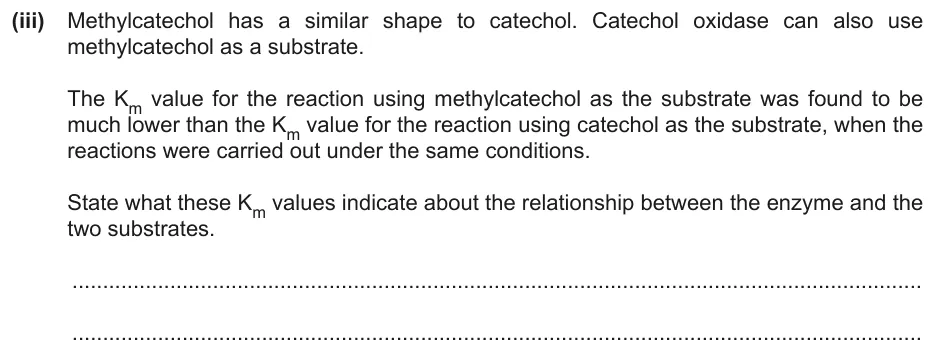
State what a lower Km shows about an enzyme and its substrate.
Show the mark scheme

Tap an image to open it full size.
From the examiners' report: Many knew that a lower Km means a higher affinity, but some then contradicted themselves by concluding that the enzyme has a higher affinity for catechol than for methylcatechol. Check your answer.
Question 11
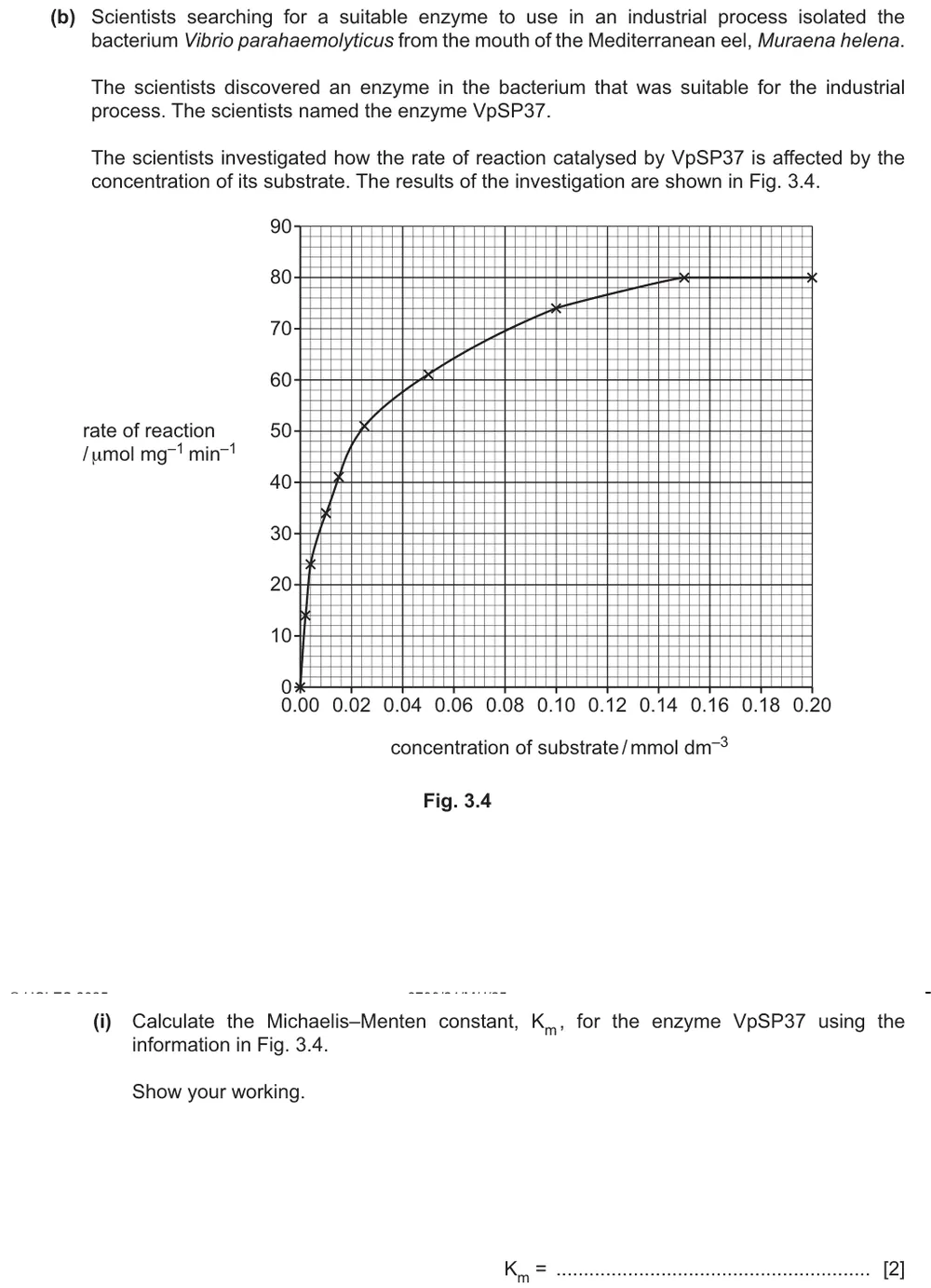
Paper 2 · May/June 2025 (21) · Q3(b)(i) · 2 marks
Use the graph to find Vmax and Km for the enzyme.
Show the mark scheme

Tap an image to open it full size.
Question 12
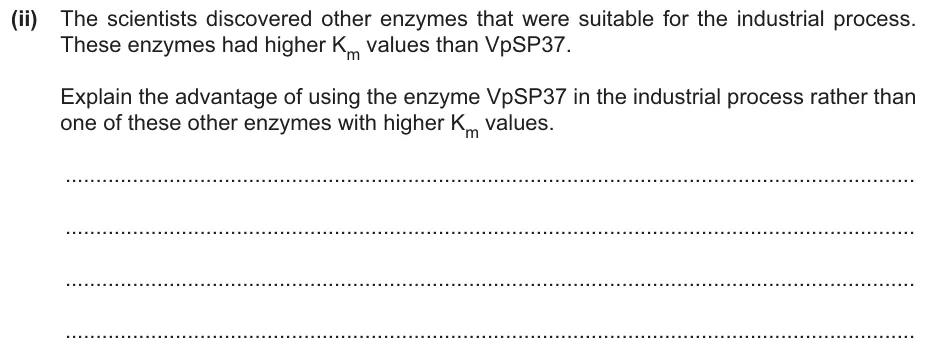
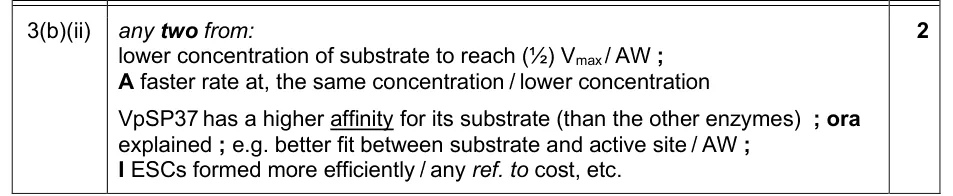
Paper 2 · May/June 2025 (21) · Q3(b)(ii) · 2 marks
Explain the advantage of using an enzyme with a lower Km in an industrial process.
Show the mark scheme
Tap an image to open it full size.
Question 13
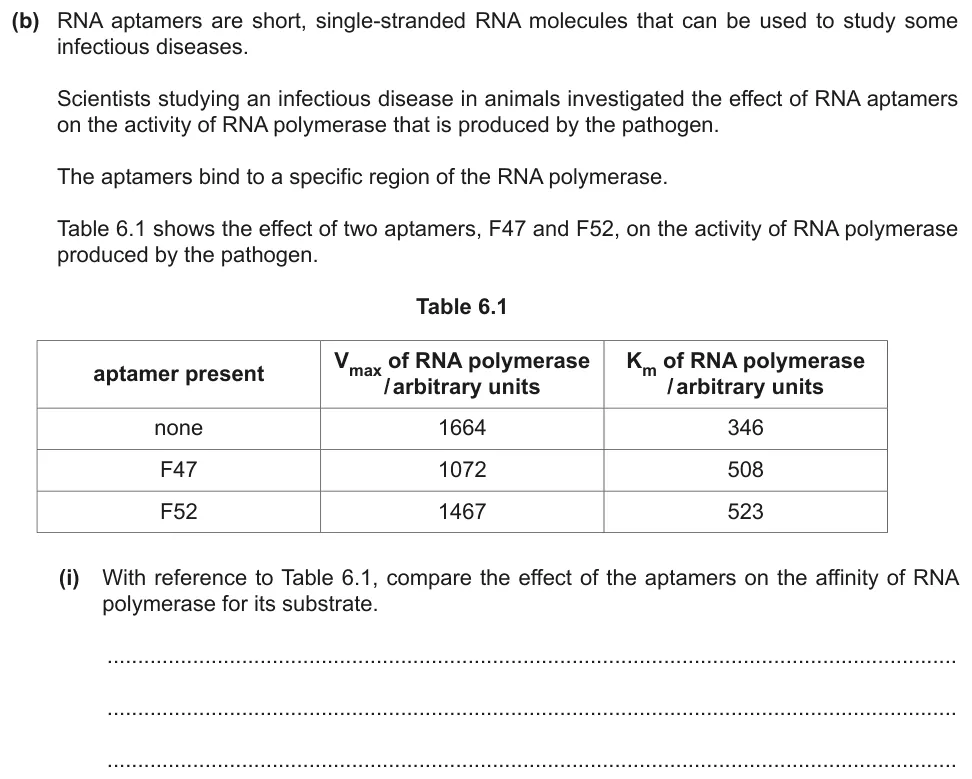
Paper 2 · October/November 2023 (21) · Q6(b)(i) · 2 marks
Use the Km values in the table to describe the effect of two aptamers on affinity.
Show the mark scheme

Tap an image to open it full size.
From the examiners' report: Link the increase in Km to a decrease in the affinity of the enzyme for its substrate. The strongest answers also looked at each aptamer separately and said which one reduced the affinity more. Weaker answers tried to use Vmax to draw conclusions about affinity.
Competitive and non-competitive inhibitors (3.2.3)
Question 14
Paper 2 · October/November 2023 (21) · Q6(b)(ii) · 3 marks · Hard
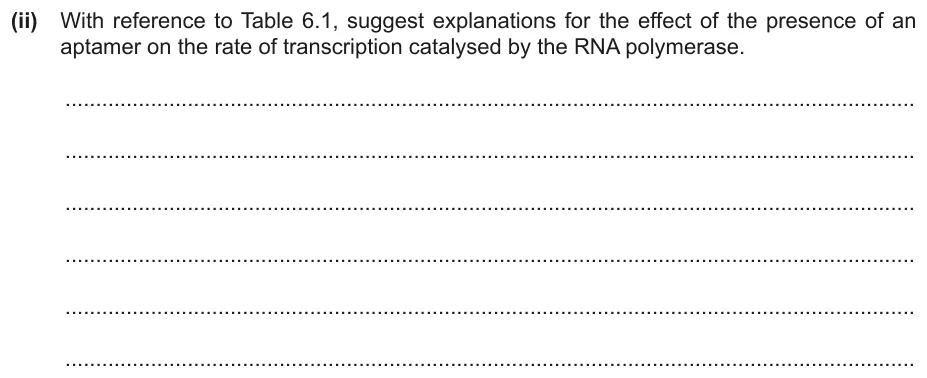
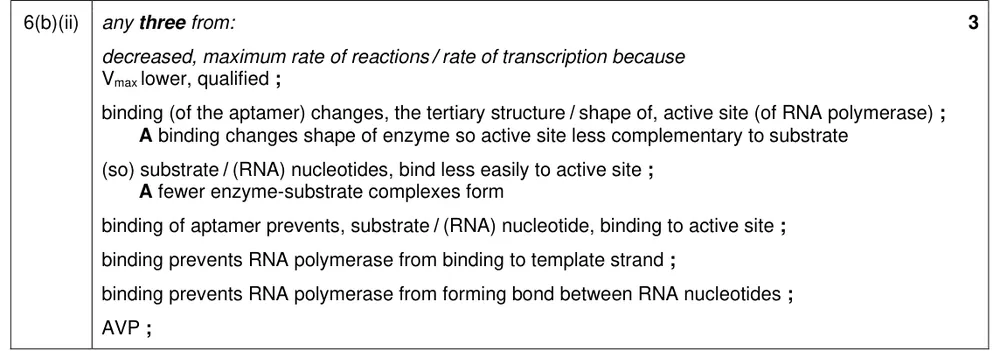
Suggest explanations for the effect of an aptamer on the rate of transcription.
Show the mark scheme
Tap an image to open it full size.
From the examiners' report: The rate of transcription is shown by the Vmax reached with each aptamer. Few students went on to explain why Vmax was lower. The usual correct ideas were a change in the shape of the active site or fewer enzyme-substrate complexes.
Question 15
Paper 2 · February/March 2025 (22) · Q5(c) · 3 marks · Easy
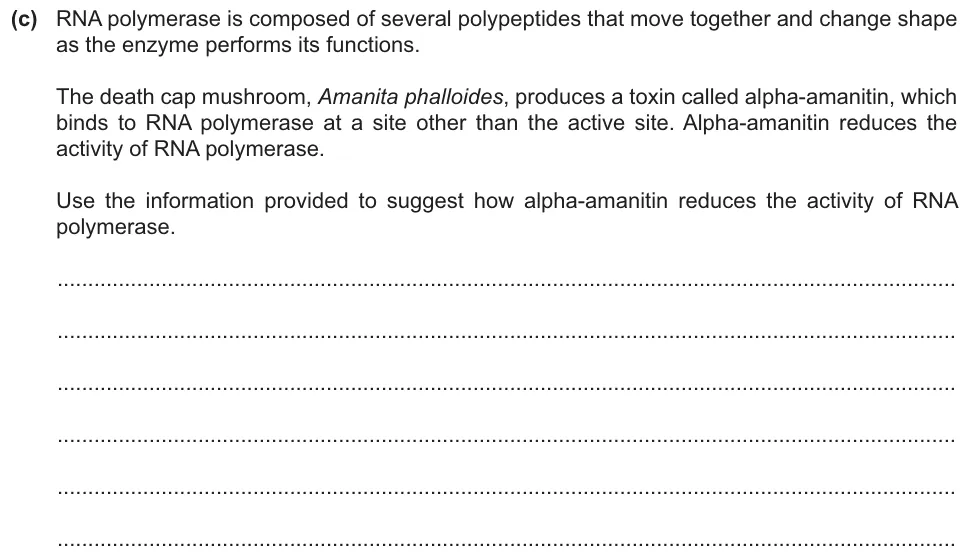
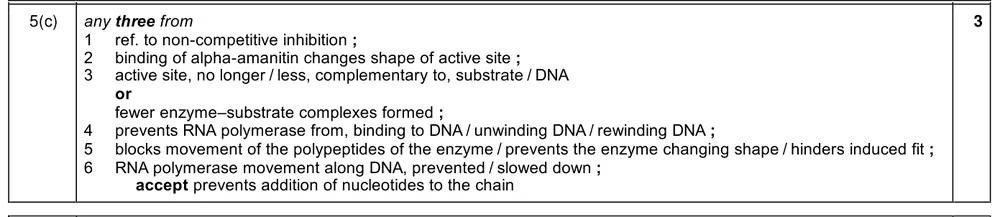
Suggest how a toxin that binds away from the active site reduces the activity of RNA polymerase.
Show the mark scheme
Tap an image to open it full size.
From the examiners' report: Most recognised non-competitive inhibition and a change in the shape of the active site. Many added a consequence, such as a lower rate of formation of enzyme-substrate complexes.
Question 16
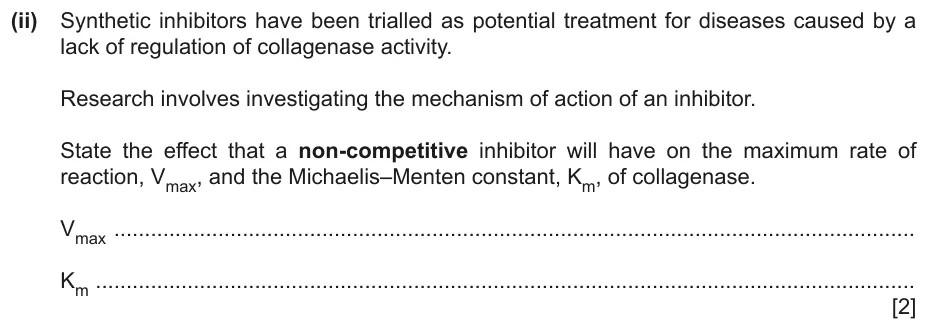
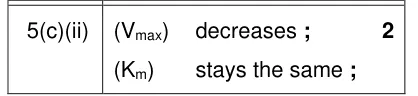
Paper 2 · October/November 2022 (22) · Q5(c)(ii) · 2 marks
State the effect of a non-competitive inhibitor on Vmax and Km.
Information from earlier in this question:

Show the mark scheme
Tap an image to open it full size.
From the examiners' report: More students knew the effect on Vmax than the effect on Km. Many wrongly suggested that Km would increase.
Question 17
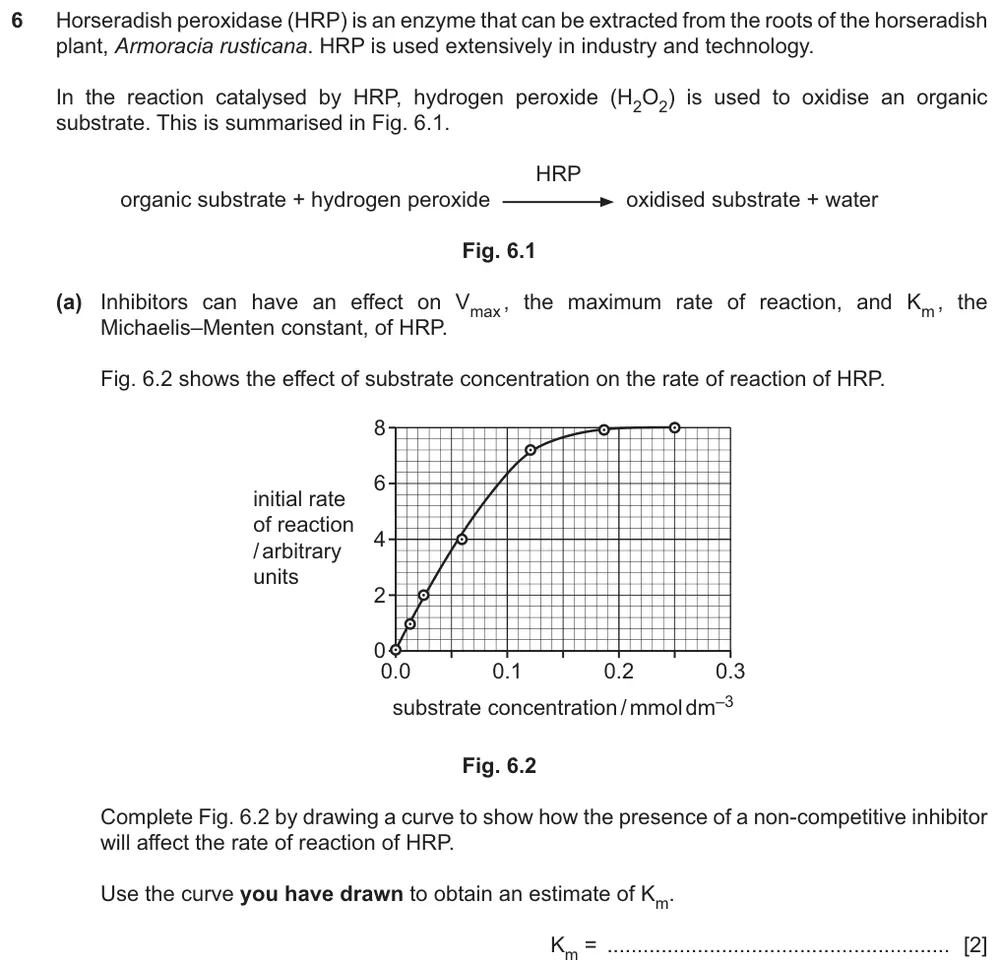
Paper 2 · May/June 2025 (22) · Q6(a) · 2 marks
Sketch the curve for the reaction with a non-competitive inhibitor and use it to estimate Km.
Show the mark scheme

Tap an image to open it full size.
Question 18
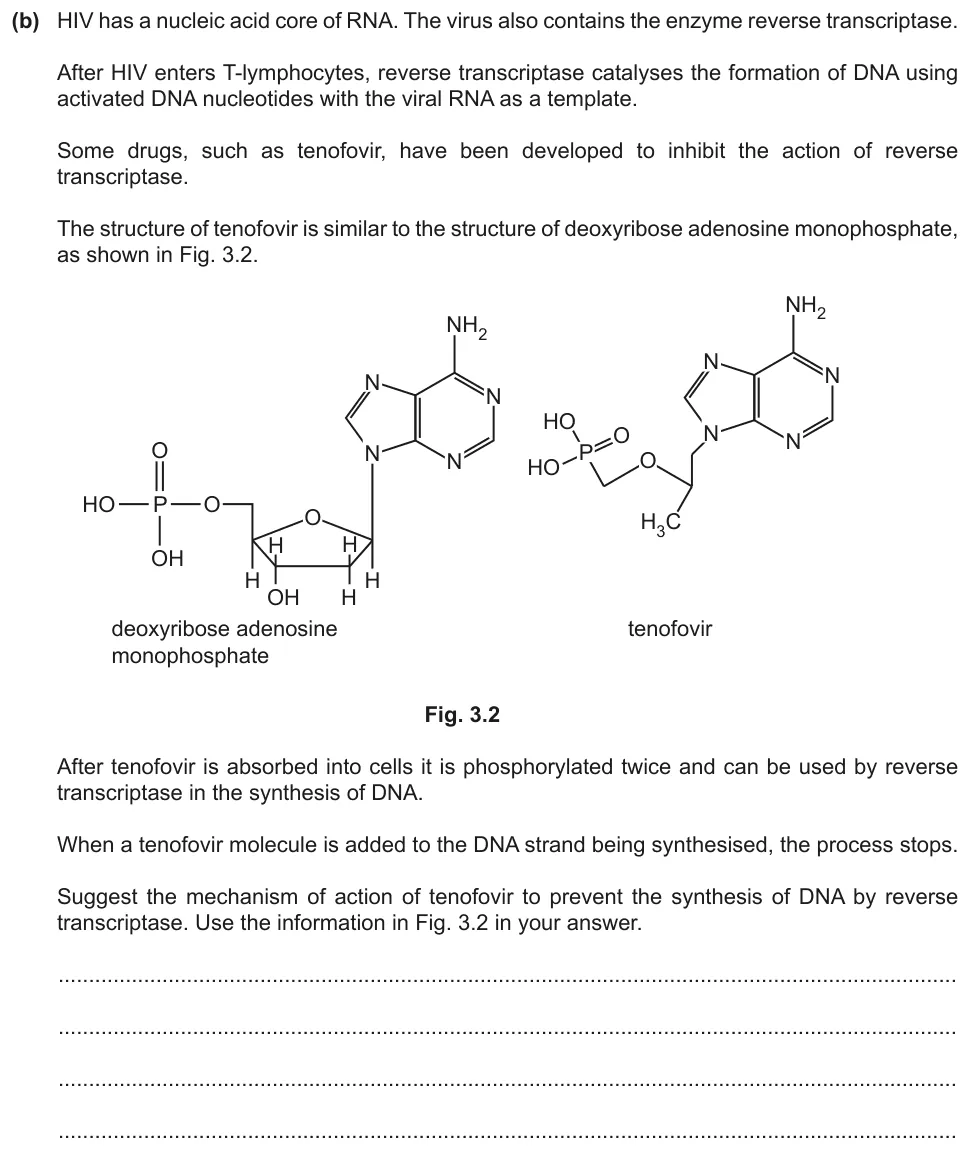
Paper 2 · May/June 2024 (21) · Q3(b) · 2 marks
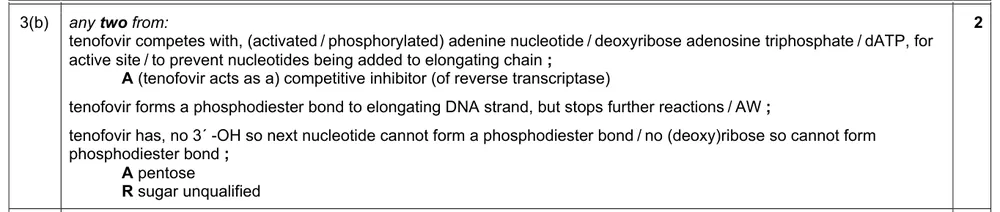
Use the two structures to suggest how tenofovir stops reverse transcriptase making DNA.
Show the mark scheme
Tap an image to open it full size.
From the examiners' report: Use all the information, including the two structures in the figure. Students who noticed how similar the molecules are gained credit for saying that tenofovir acts as a competitive inhibitor. The strongest saw that tenofovir is added to the DNA strand and, as it has no pentose and so no 3' OH group, no phosphodiester bond can form with the next nucleotide.
Question 19
Paper 4 (A level) · February/March 2025 (42) · Q8(b) · 4 marks
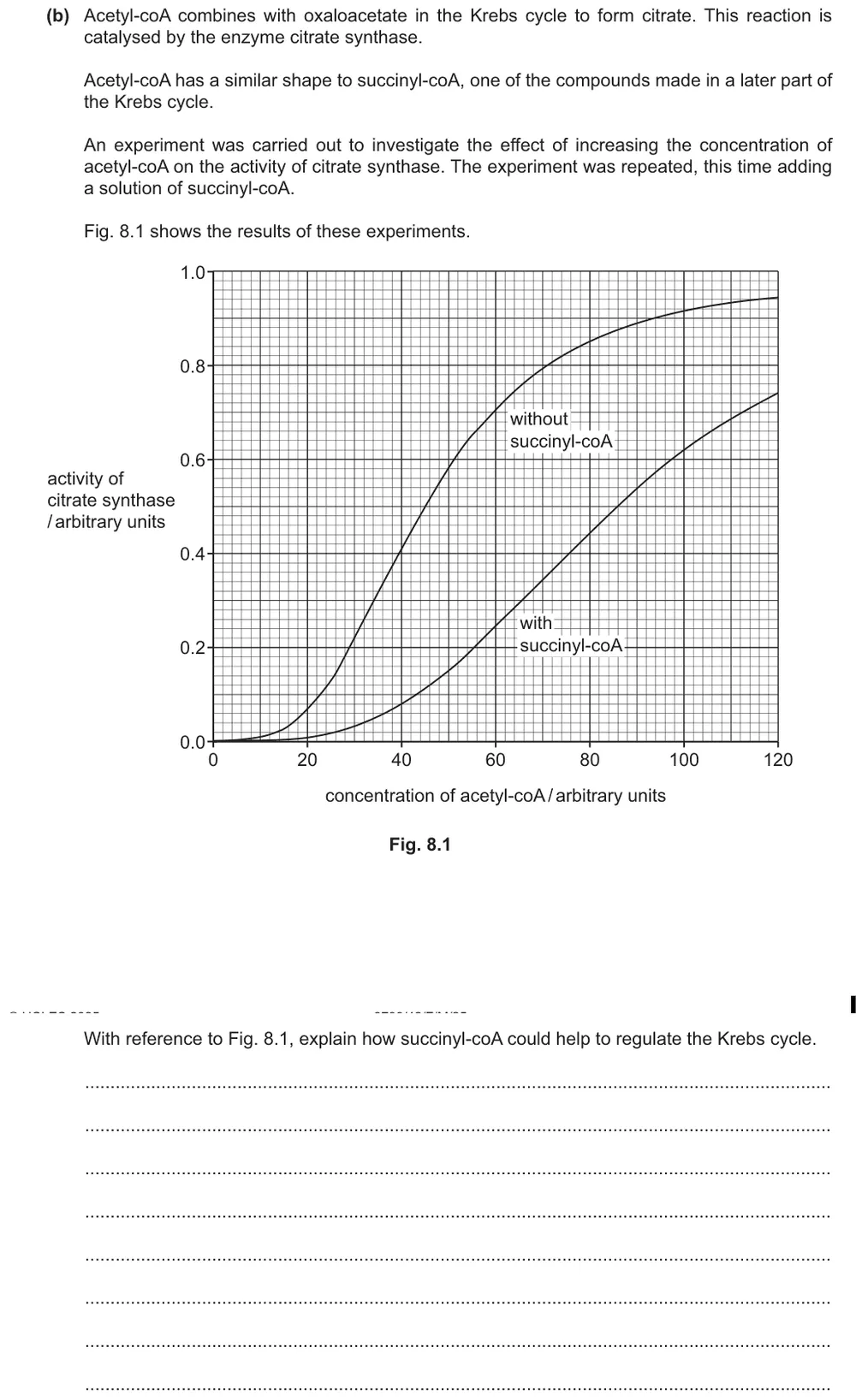
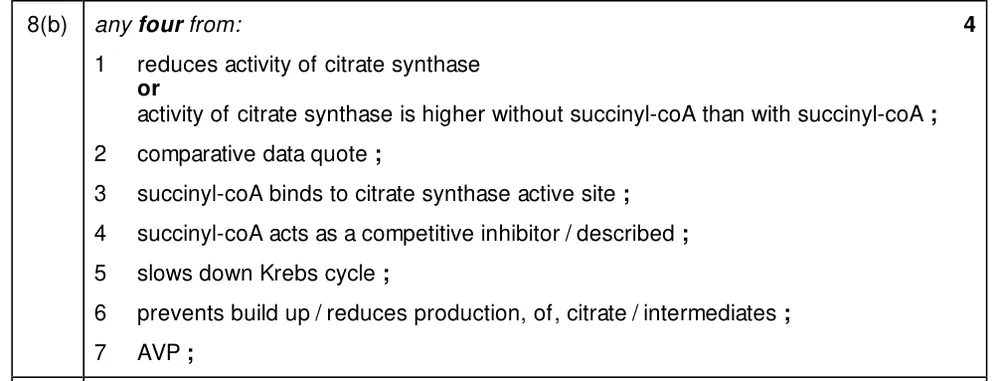
Use the graph to explain how succinyl-coA could help to regulate the Krebs cycle.
Show the mark scheme
Tap an image to open it full size.
From the examiners' report: A significant minority only said that the activity was reduced. Data quotes were often inaccurate or incomplete: give both the x-axis and the y-axis value. A common error was to call succinyl-coA a non-competitive inhibitor, ignoring the statement that it has a similar shape to acetyl-coA.
Immobilised enzymes (3.2.4)
Question 20
Paper 2 · October/November 2025 (22) · Q3(e)(ii) · 4 marks
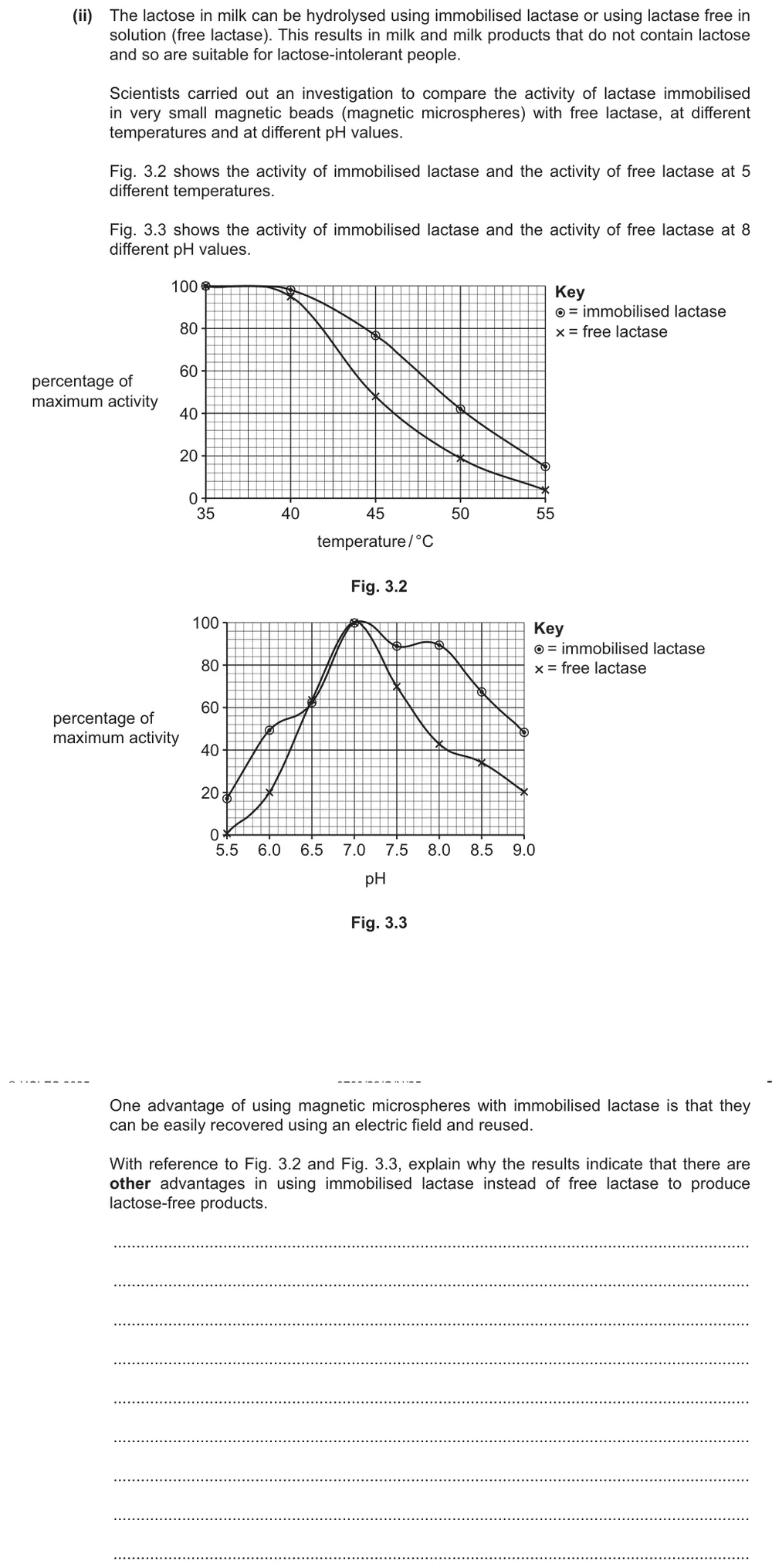
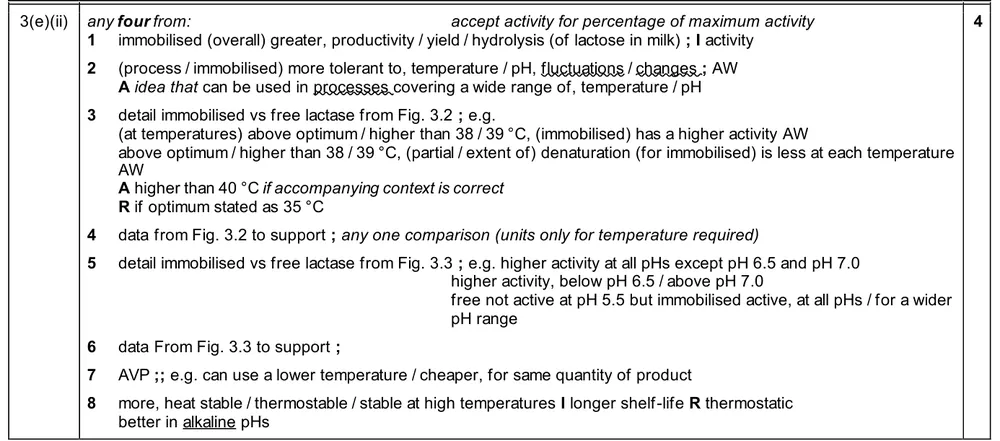
Use the graphs to compare immobilised lactase with lactase free in solution.
Information from earlier in this question:

Show the mark scheme
Tap an image to open it full size.
Question 21
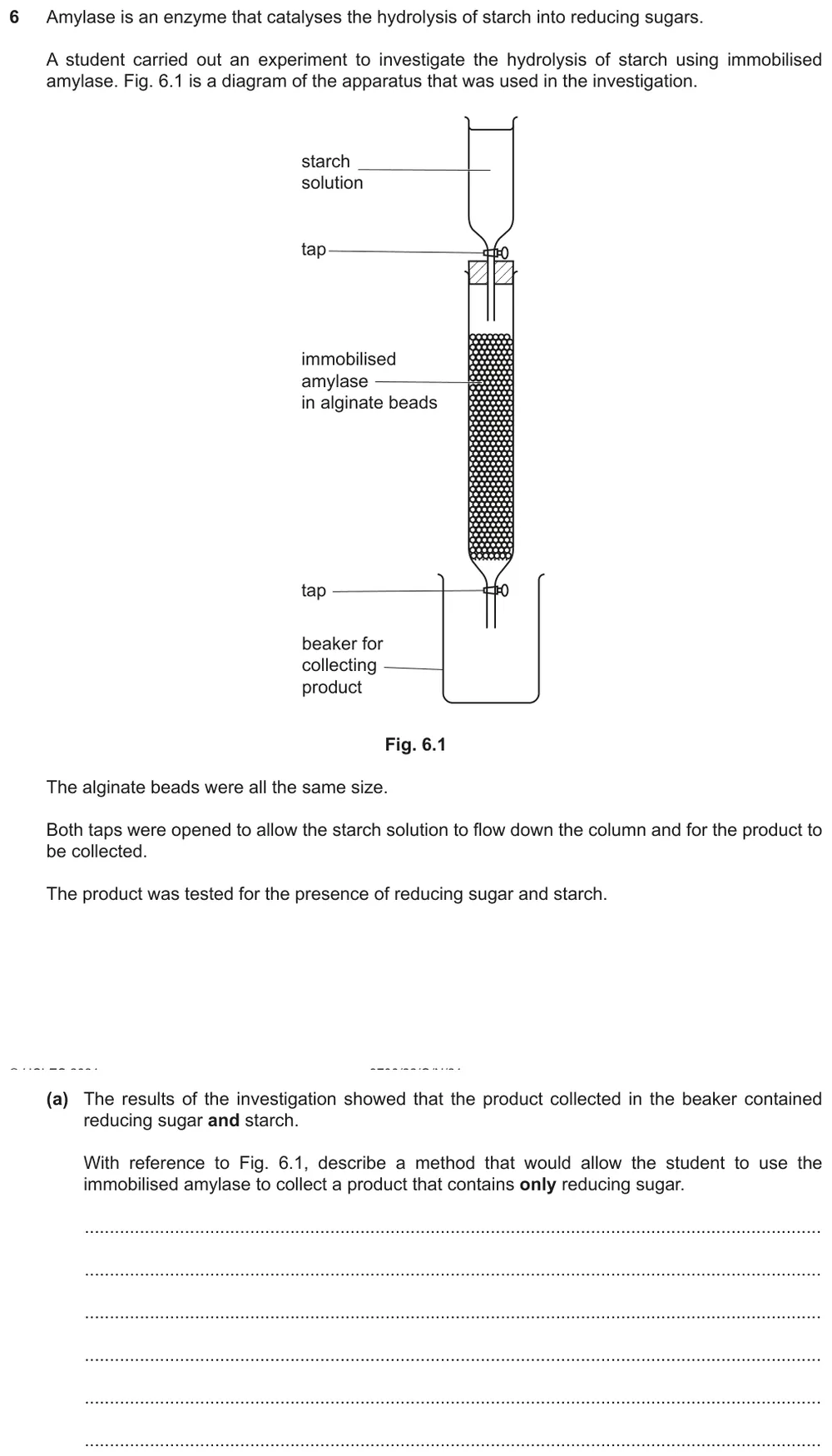
Paper 2 · October/November 2021 (22) · Q6(a) · 3 marks
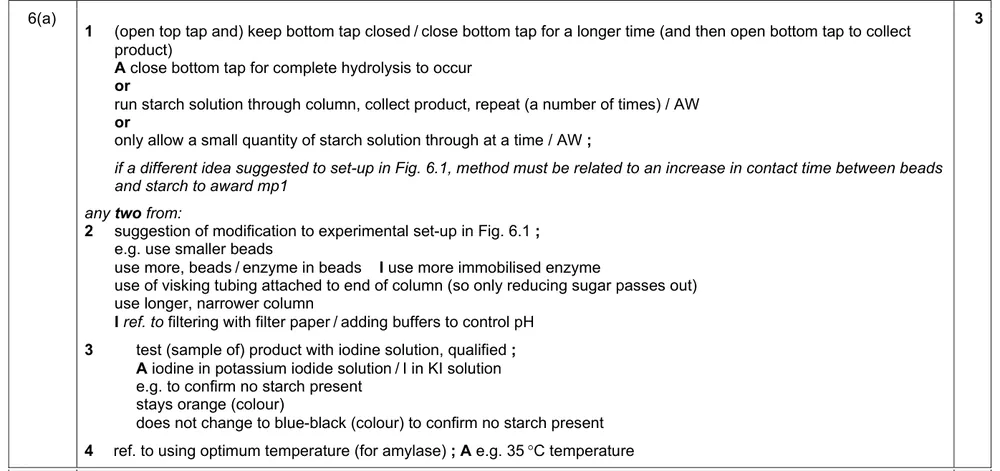
Describe how to improve the method so that all the starch is hydrolysed.
Show the mark scheme
Tap an image to open it full size.
From the examiners' report: Good answers increased the contact time between the starch and the immobilised amylase, used the optimum temperature and checked that the product contained no starch. Many referred to the Benedict's test instead. Take samples for testing, so that the product is not contaminated with the reagent.
Question 22
Paper 2 · October/November 2020 (22) · Q5(c) · 4 marks
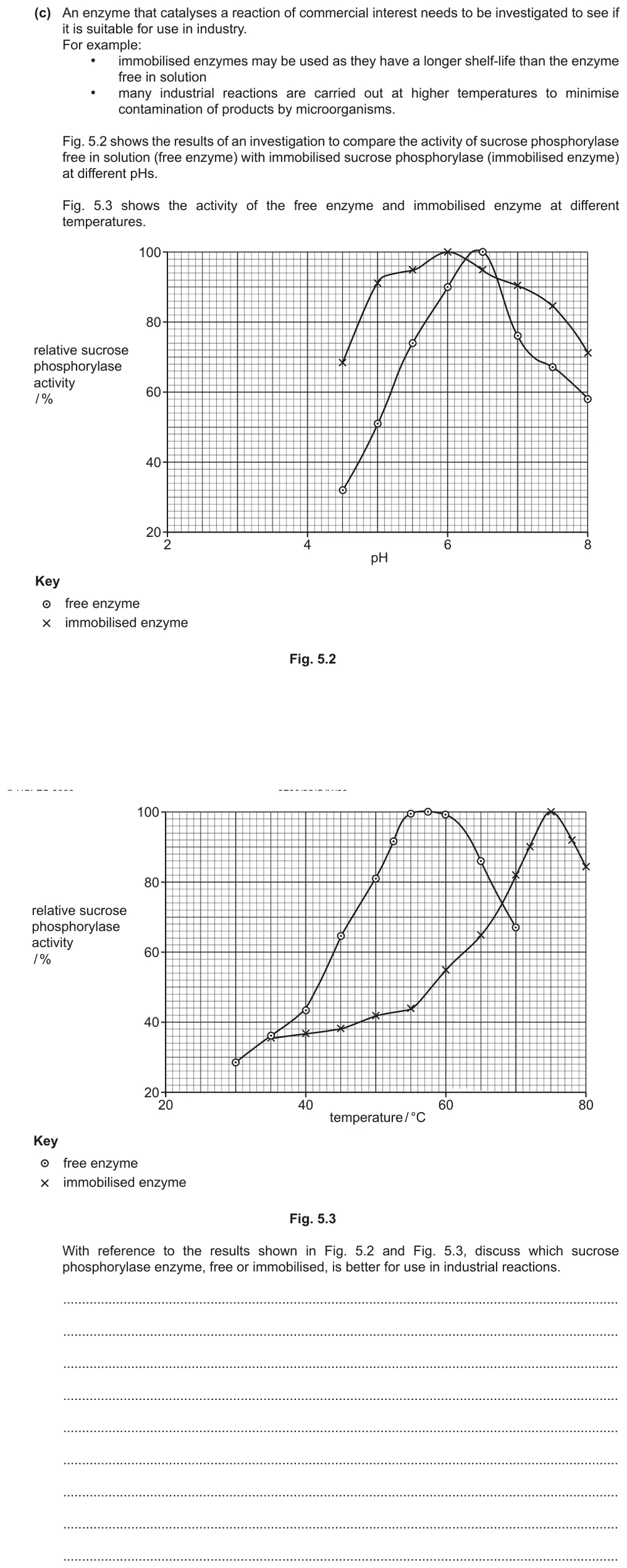
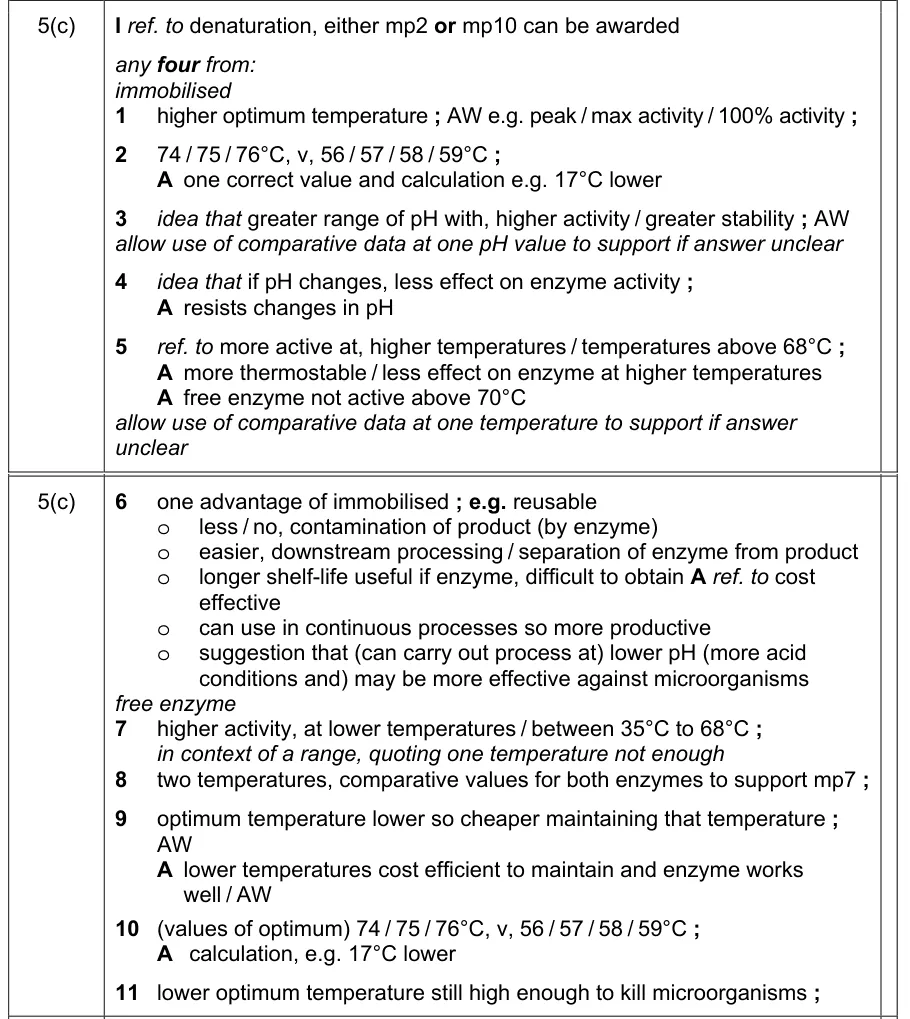
Use the graphs to discuss whether the immobilised enzyme or the free enzyme suits industrial use.
Show the mark scheme
Tap an image to open it full size.
From the examiners' report: Make it clear whether each point is about the immobilised enzyme or the enzyme free in solution, and use the data in both graphs. Weaker answers made errors in reading the data, gave very general statements or described the results without saying which form of the enzyme is better to use.
Where students lose marks (from Cambridge examiners' reports and mark schemes)
Each point below comes from the examiners' reports and mark schemes, and is followed by wording that gained marks.
pH is not temperature. Students misread the question and wrote about factors that belong to temperature, such as kinetic energy.
✔ Gains credit: 'ionic' or 'hydrogen bonds' 'broken', 'active site shape altered', so it is 'no longer' 'complementary to substrate' and there are 'fewer enzyme–substrate complexes formed'.
A heat-stable enzyme still has an optimum. Students did not show an optimum temperature on their curve for the heat-stable enzyme.
✔ Gains credit: a curve with its 'optimum' 'to right of original', and the 'line beyond optimum' also 'to right'.
Explain the two rates, don't describe them. Students described the rates at the two substrate concentrations, or described the trend between them, when an explanation was asked for.
✔ Gains credit: at the low concentration the 'active sites' are 'not all occupied' and 'substrate concentration' is the 'limiting factor'; at the high concentration the 'active sites' are 'all occupied' or 'saturated'.
Mention the active site. Students wrote in general terms about enzymes, or only described the curve.
✔ Gains credit: 'at low' 'substrate' 'concentrations there are many active sites available'; 'at high(er) substrate concentrations all the active sites are' 'occupied' or 'saturated'.
Lower Km, higher affinity. Students said that a lower Km means a higher affinity and then gave the opposite conclusion, or used Vmax to judge affinity.
✔ Gains credit: 'catechol oxidase has a higher affinity for methylcatechol than for catechol'; aptamers that increase Km 'reduce the affinity'.
Non-competitive: Km stays the same. Students suggested that Km increases with a non-competitive inhibitor.
✔ Gains credit: Vmax 'decreases' and Km 'stays the same'.
Similar shape means competitive. Students called succinyl-coA a non-competitive inhibitor, or gave data quotes without both the x-axis and y-axis values.
✔ Gains credit: 'succinyl-coA binds to citrate synthase active site' and 'acts as a competitive inhibitor', with a 'comparative data quote'.
Say which form of the enzyme you mean. Students gave very general statements or described the results without saying which form of the enzyme is better to use.
✔ Gains credit: the immobilised enzyme has a 'higher optimum temperature', a 'greater range of pH' with 'higher activity', and is 'more active at' 'higher temperatures'.
Download the questions
Download the PDF pack (22 questions, mark schemes at the end)
Keep practising
- Mode of Action of Enzymes (3.1): Cambridge (CIE) exam questions by topic
- Cambridge (CIE) A level Biology 9700 past papers, mark schemes and examiners' reports
- Cambridge (CIE) A level Biology grade thresholds
- Book a one-to-one CIE lesson or a free 15-minute discovery chat with Tom
- Register your interest in a CIE A level Biology group class
Questions, mark schemes and examiners' report extracts © Cambridge University Press & Assessment.