

Control and Coordination in Plants (15.2): Cambridge (CIE) A Level Biology 9700 Exam Questions by Topic
Control and coordination in plants is sub-topic 15.2 of Topic 15, Control and coordination, in the Cambridge International AS & A Level Biology syllabus (9700). You need to describe the rapid response of the Venus fly trap when the sensory hairs on its modified leaves are stimulated and explain how the trap closes, explain how auxin causes elongation growth by stimulating proton pumping to acidify cell walls, and describe the role of gibberellin in the germination of barley. This is A level content, examined on Paper 4.
The examiners' reports return to the same points. In the Venus fly trap it is calcium ions, not sodium or potassium ions, that enter the cells at the base of the sensory hairs, and the lobes become concave when the trap closes. For auxin, write that protons are pumped into the cell wall and that hydrogen bonds between cellulose microfibrils break; 'loosening' and 'weakening' are too vague. For germination, know the parts of the grain: gibberellin moves from the embryo to the aleurone layer, amylase moves to the endosperm and hydrolyses starch there, and the embryo uses the sugars. Gibberellin binds to a receptor, which leads to the breakdown of DELLA proteins. On a graph with two y-axes, read each line against its own axis.
Studying Cambridge International A level Biology and want more help? Tom teaches CIE students one-to-one online, including students in the UAE, Saudi Arabia, Hong Kong, India and Indonesia, and every lesson is recorded. You can book a one-to-one lesson or a free 15-minute discovery chat, or register your interest in a CIE group class starting in September 2027, using the links at the bottom of this page.
What you need from AS Level
Each question on this page assumes you're secure on these ideas. If any of them feels shaky, look it up before you start.
- Water moves by osmosis from a higher (less negative) to a lower (more negative) water potential, and a plant cell that takes in water becomes turgid.
- Plant cell walls contain cellulose microfibrils, in which cellulose molecules are held together by hydrogen bonds.
- Amylase is an enzyme that hydrolyses starch to maltose.
- Active transport uses carrier proteins and ATP to move ions, such as protons, against a concentration gradient.
Key terms
These words come up in the questions and mark schemes. Examiners expect you to use them exactly.
- Sensory hairs: the hairs on the lobes of a Venus fly trap leaf that detect touch; at least two must be touched within a short time, or one touched twice, before the trap closes.
- Auxin: a plant growth regulator that stimulates elongation growth by binding to receptors and stimulating proton pumps.
- Expansins: proteins in the cell wall that are activated by a low pH and loosen the links between cellulose microfibrils, so the wall can stretch.
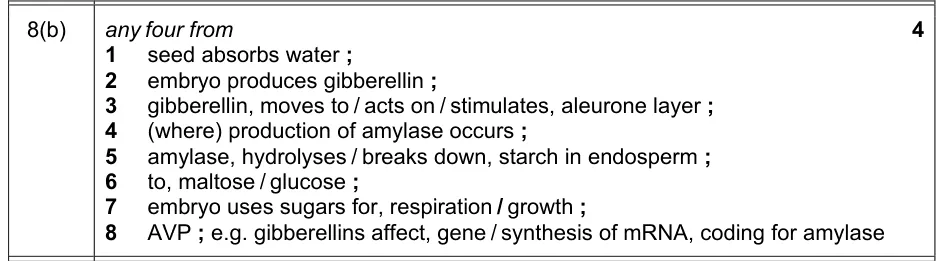
- Gibberellin: a plant growth regulator made by the embryo of a seed that has absorbed water; it stimulates the aleurone layer to make amylase.
- Aleurone layer: the layer of cells around the endosperm of a cereal grain; it makes amylase in response to gibberellin.
- Endosperm: the tissue in a cereal grain that stores starch.
- DELLA protein: a protein that stops the gene for amylase being transcribed; it is broken down after gibberellin binds to its receptor.
What these questions cover (Cambridge 9700 Topic 15: Control and coordination)
The questions test these learning outcomes from sub-topic 15.2 of the Cambridge International AS & A Level Biology syllabus (9700) for 2025 to 2027.
- 15.2.1 describe the rapid response of the Venus fly trap to stimulation of hairs on the lobes of modified leaves and explain how the closure of the trap is achieved
- 15.2.2 explain the role of auxin in elongation growth by stimulating proton pumping to acidify cell walls
- 15.2.3 describe the role of gibberellin in the germination of barley
How to use this page
Write your answer on paper before you open the mark scheme. Allow about 1.2 minutes per mark: the 22 questions are worth 58 marks, so about 70 minutes in total. Then mark your answer strictly against the mark scheme and read the examiners' tip underneath it. If you'd rather print the questions, download the PDF pack.
The Venus fly trap (15.2.1)
Question 1
Paper 4 · October/November 2025 (42) · Q7(a)(iv) · 1 mark
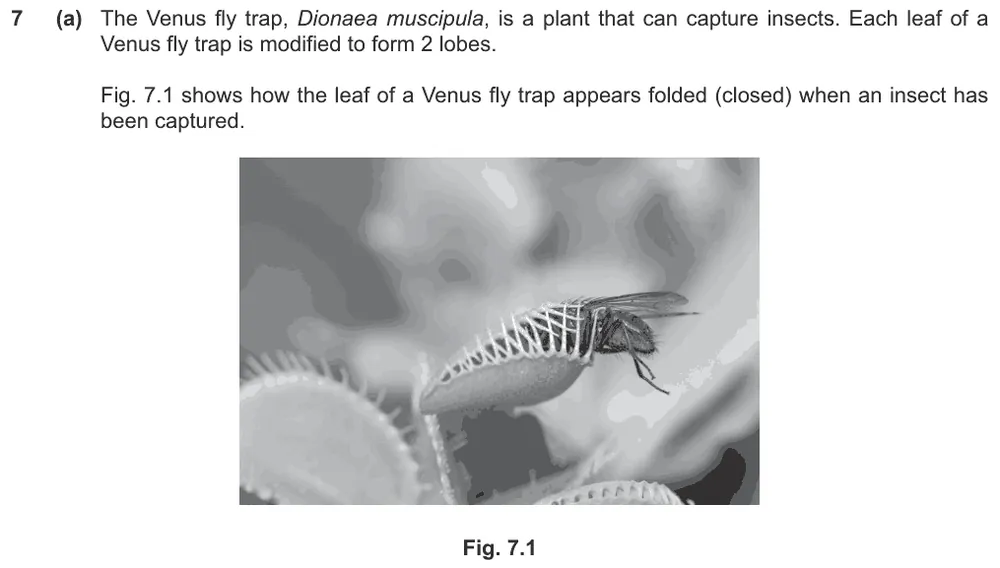
Suggest why the leaves have to stay closed for several days after an insect has been trapped.
Information from earlier in this question:
Show the mark scheme

Tap an image to open it full size.
Question 2
Paper 4 · October/November 2024 (41) · Q4(a) · 3 marks
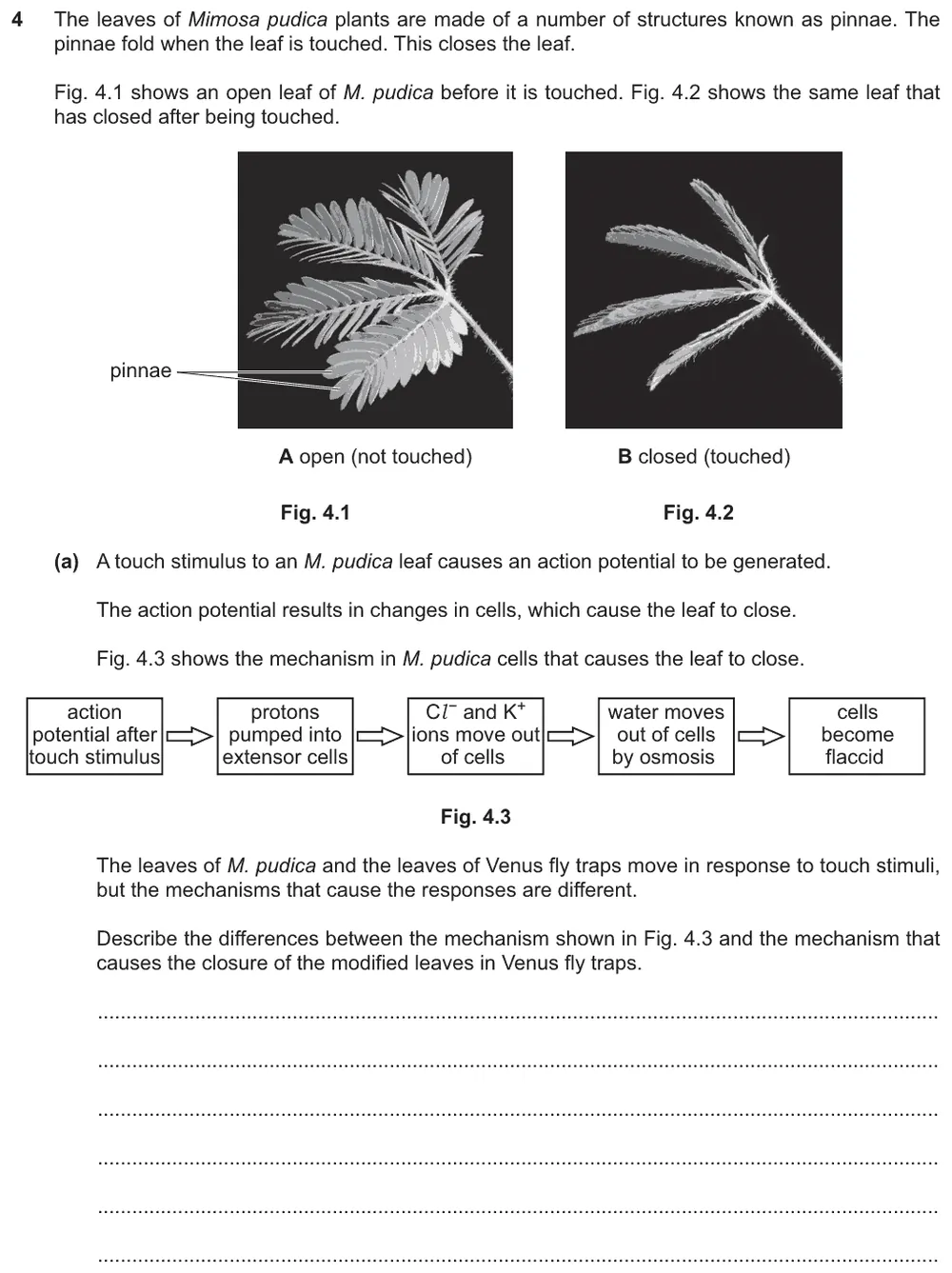
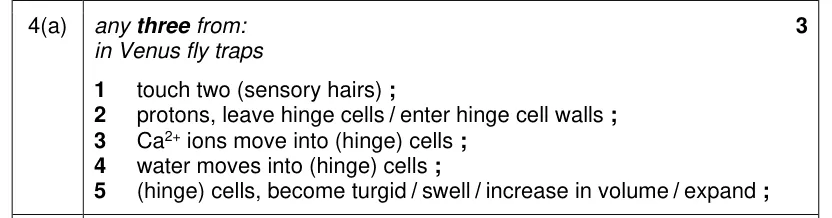
Describe how the mechanism that closes a Venus fly trap differs from the one shown for Mimosa pudica.
Show the mark scheme
Tap an image to open it full size.
Question 3
Paper 4 · February/March 2021 (42) · Q5(b)(i) · 1 mark · Hard
Name the ion that moves into the cells at the base of the sensory hairs to generate receptor potentials.

Show the mark scheme

Tap an image to open it full size.
From the examiners' report: Only a minority named the ion correctly. Many wrongly gave sodium ions or potassium ions.
Question 4
Paper 4 · February/March 2021 (42) · Q5(b)(ii) · 1 mark
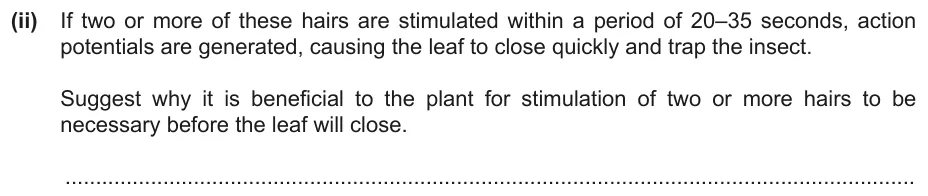
Suggest why it benefits the plant that two or more hairs must be stimulated before the leaf closes.
Show the mark scheme

Tap an image to open it full size.
Question 5
Paper 4 · October/November 2019 (42) · Q7(b)(i) · 1 mark · Easy
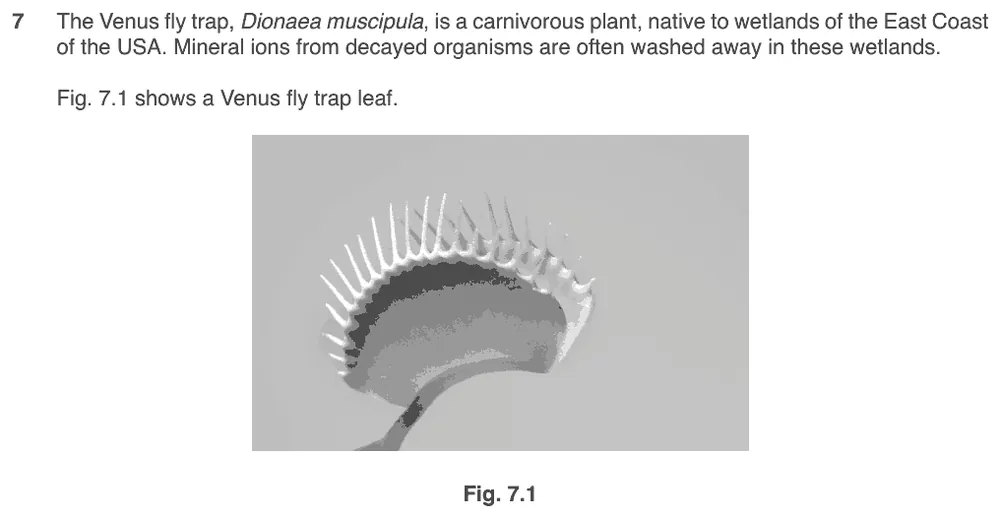
State which part of the leaf detects the stimulus.
Information from earlier in this question:

Show the mark scheme

Tap an image to open it full size.
From the examiners' report: Most gave the hairs. Other suggestions, which were wrong, included stomata, spikes and cilia.
Question 6
Paper 4 · October/November 2019 (42) · Q7(b)(ii) · 1 mark
Explain how the plant avoids wasting energy by closing when it does not need to.

Show the mark scheme

Tap an image to open it full size.
From the examiners' report: Some explanations were vague. Stronger answers said that one hair must be stimulated twice in close succession, or two or more hairs at the same time or within 35 seconds.
Question 7
Paper 4 · October/November 2019 (42) · Q7(d) · 5 marks
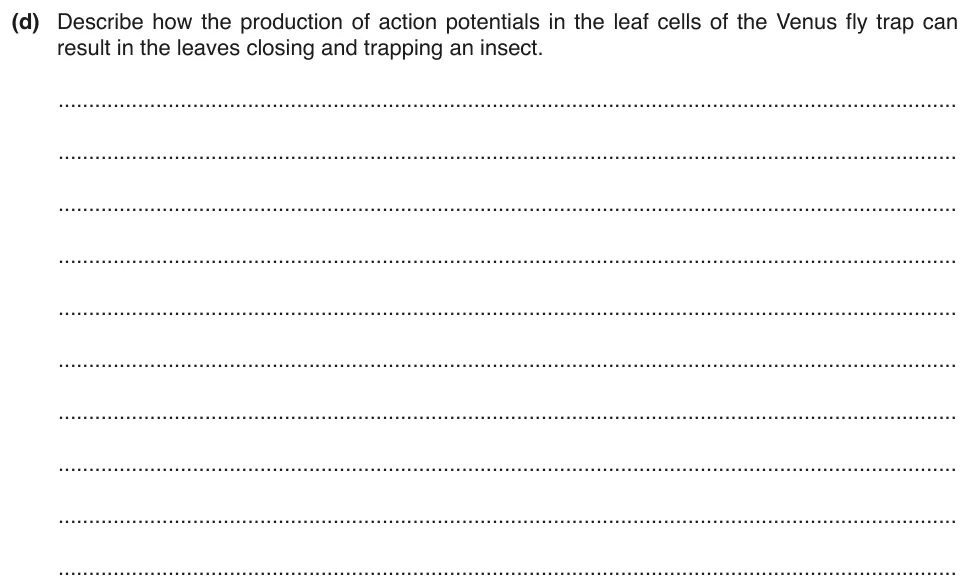
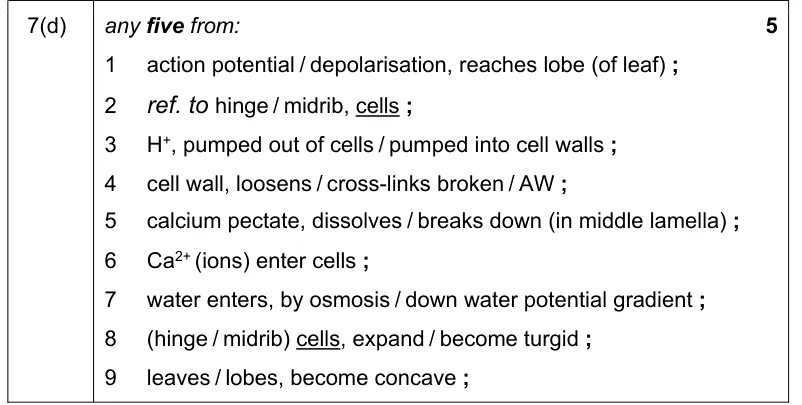
Describe how action potentials in the leaf cells lead to the leaves closing and trapping an insect.
Show the mark scheme
Tap an image to open it full size.
From the examiners' report: The breaking of cross-links that loosens the cell walls was mentioned less often than the other steps. Some confused concave with convex. Weaker answers described nerve transmission, the digestion of the insect, or calcium pectate acting as a glue.
Auxin and elongation growth (15.2.2)
Question 8
Paper 4 · February/March 2024 (42) · Q9(b) · 7 marks
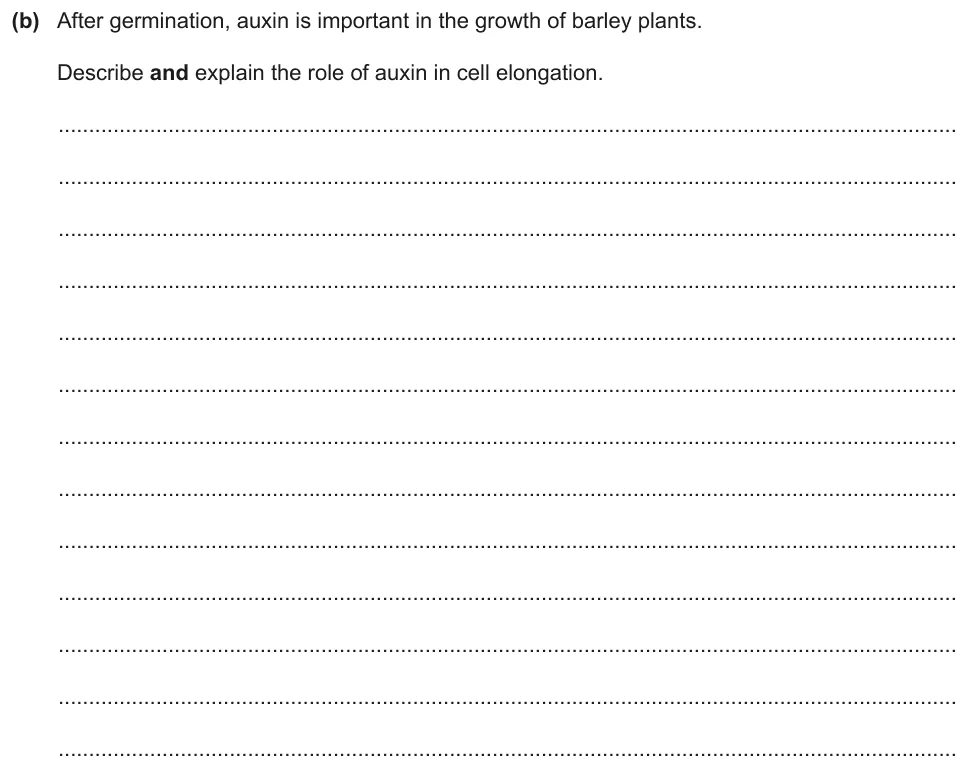
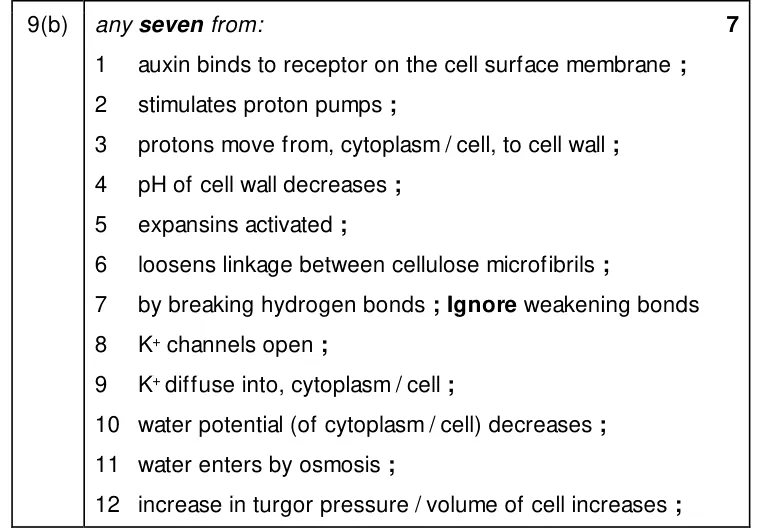
Describe and explain the role of auxin in cell elongation.
Show the mark scheme
Tap an image to open it full size.
Question 9
Paper 4 · October/November 2023 (41) · Q3(d)(ii) · 2 marks
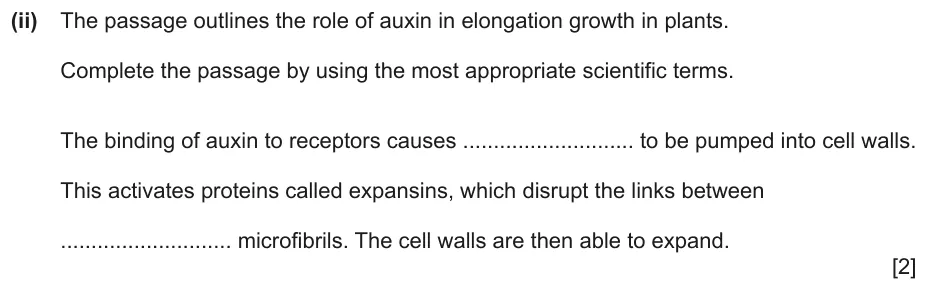
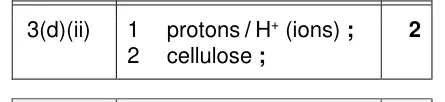
Complete the passage on the role of auxin in elongation growth.
Show the mark scheme
Tap an image to open it full size.
Question 10
Paper 4 · May/June 2023 (41) · Q3(a)(iv) · 3 marks
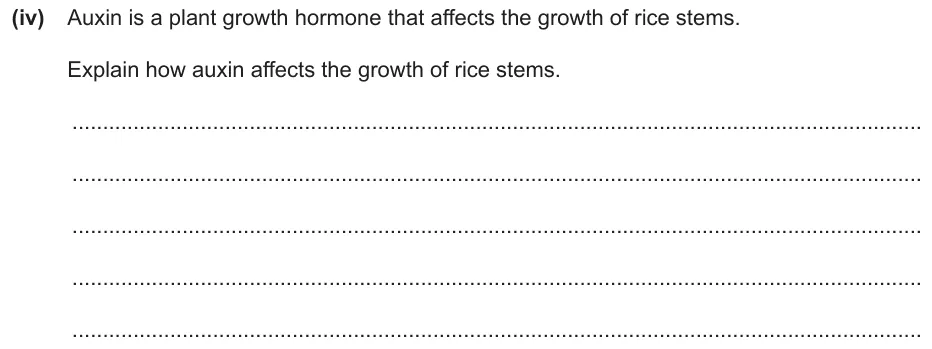
Explain how auxin affects the growth of rice stems.
Show the mark scheme

Tap an image to open it full size.
From the examiners' report: Well-prepared students described proton pumps moving protons from the cytoplasm to the cell wall, and water entering by osmosis so that the cells expand. Avoid 'loosening' and 'weakening': say that hydrogen bonds between cellulose molecules or microfibrils break.
Question 11
Paper 4 · February/March 2017 (42) · Q3(b)(ii) · 2 marks
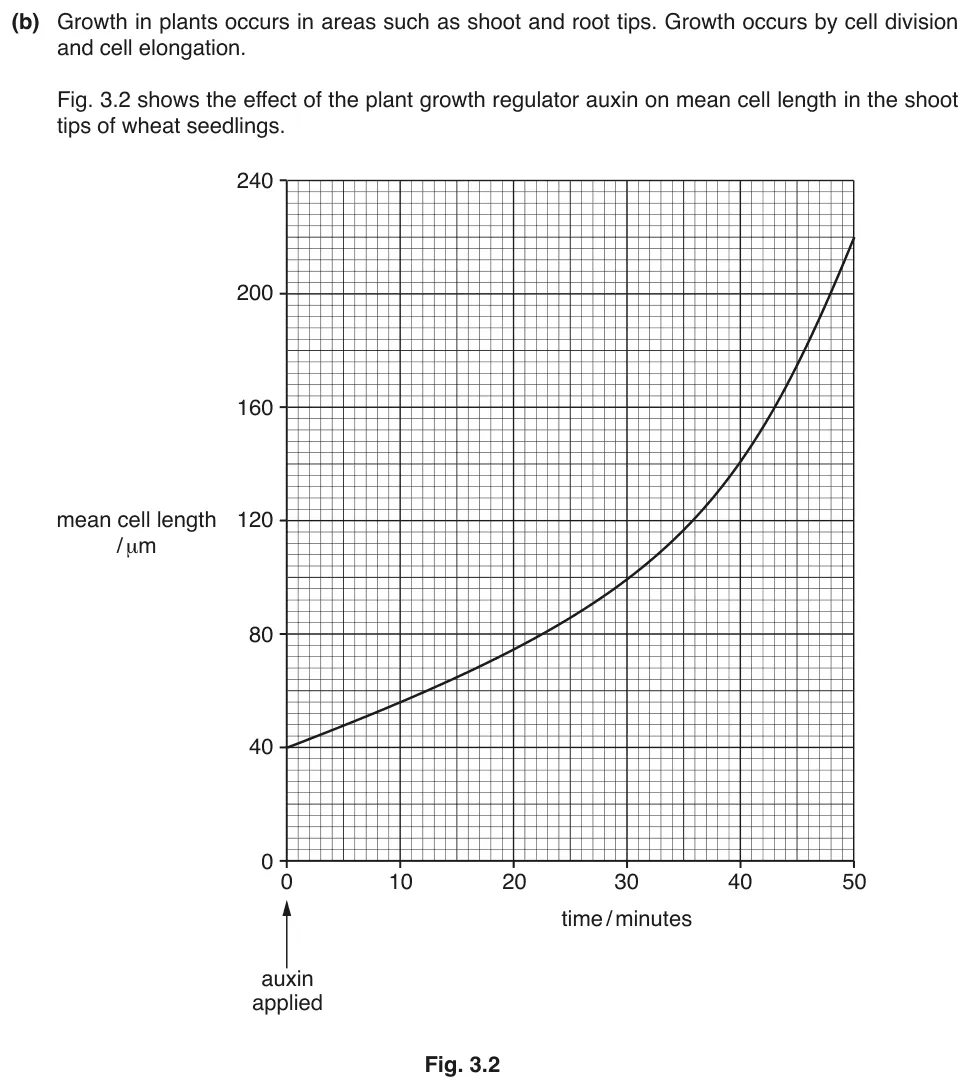
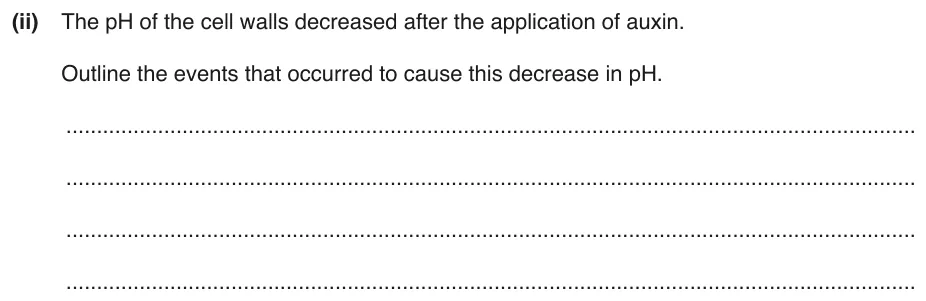
Outline the events that cause the pH of the cell walls to fall after auxin is applied.
Information from earlier in this question:
Show the mark scheme

Tap an image to open it full size.
From the examiners' report: Only a small number of students answered correctly. Knowledge of exactly how auxin acts was not secure.
Question 12
Paper 4 · February/March 2017 (42) · Q3(b)(iii) · 3 marks
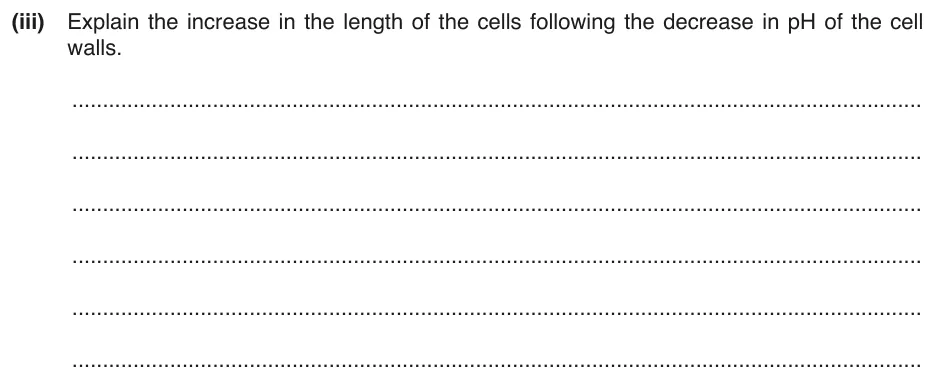
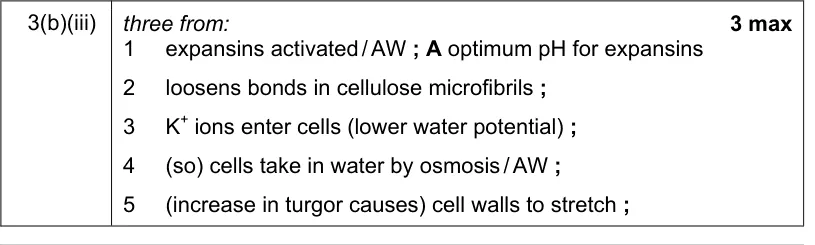
Explain why the cells get longer after the pH of the cell walls falls.
Show the mark scheme
Tap an image to open it full size.
From the examiners' report: Many knew that expansins are activated. Stronger answers explained that this loosens the bonds in the microfibrils, and that water enters by osmosis because potassium ions have entered, which stretches the wall.
Gibberellin and germination (15.2.3)
Question 13
Paper 4 · May/June 2022 (42) · Q6(a) · 2 marks
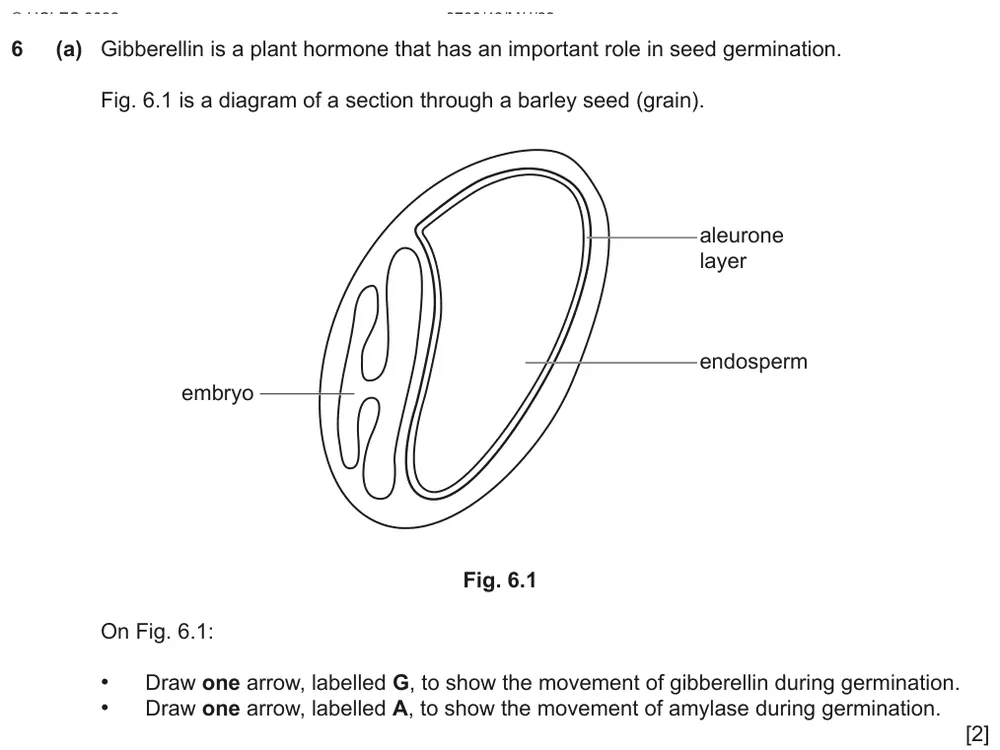
Draw arrows on the barley seed to show the movement of gibberellin and of amylase.
Show the mark scheme

Tap an image to open it full size.
From the examiners' report: Gibberellin moves from the embryo to the aleurone layer, and amylase from the aleurone layer to the endosperm. Wrong arrows took gibberellin to the endosperm, started or ended in the testa, or stayed inside the endosperm.
Question 14
Paper 4 · May/June 2022 (42) · Q6(b) · 3 marks · Easy
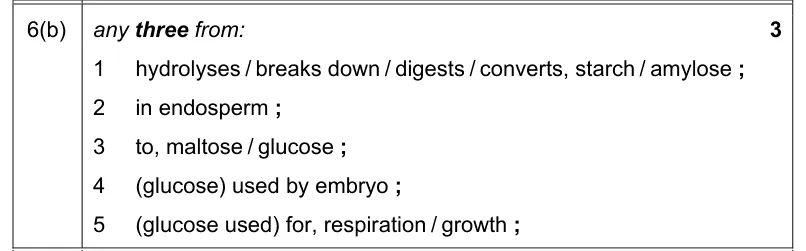
Outline the role of amylase in seed germination.
Show the mark scheme
Tap an image to open it full size.
From the examiners' report: Weaker answers did not say where the starch is hydrolysed, or gave the wrong products, such as fructose. Detail about how amylase is made was not needed.
Question 15
Paper 4 · October/November 2021 (42) · Q3(a) · 3 marks
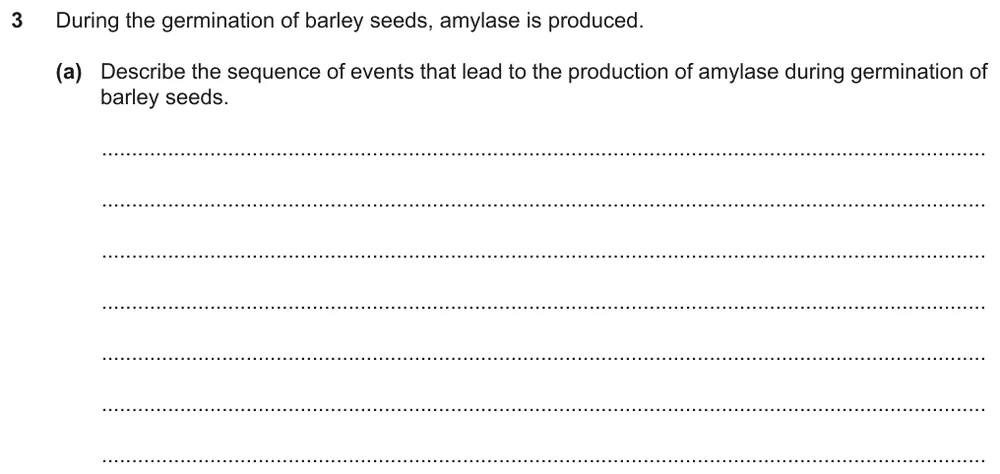
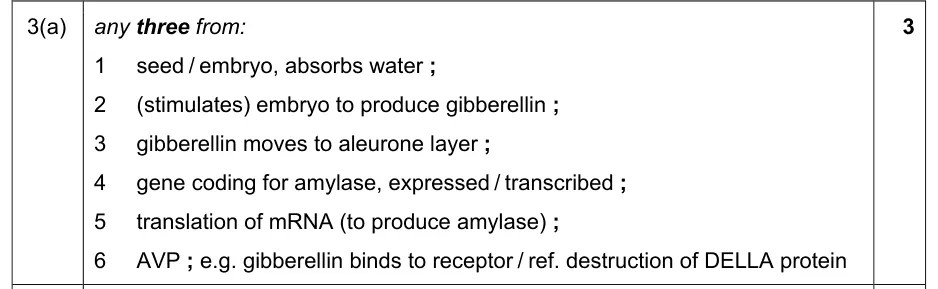
Describe the sequence of events that leads to amylase being produced in germinating barley seeds.
Show the mark scheme
Tap an image to open it full size.
From the examiners' report: Gibberellin binds to a receptor, and this leads to the destruction of DELLA proteins; many wrote that gibberellin destroys DELLA itself. The genetics was often incomplete, with no mention of the gene coding for amylase or of mRNA.
Question 16
Paper 4 · October/November 2021 (42) · Q3(b)(i) · 1 mark
State the precise location of the starch reserves in a barley seed.
Show the mark scheme

Tap an image to open it full size.
From the examiners' report: Many named the endosperm. Some thought that starch was stored in the chloroplasts, roots or leaves.
Question 17
Paper 4 · October/November 2021 (42) · Q3(b)(ii) · 4 marks
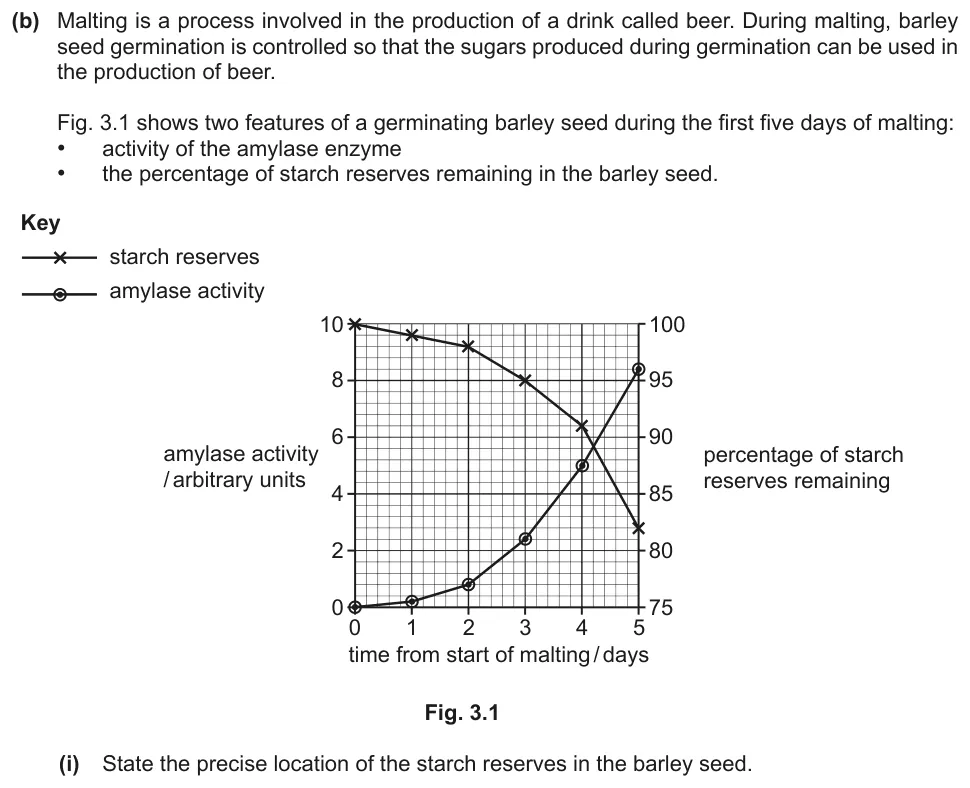
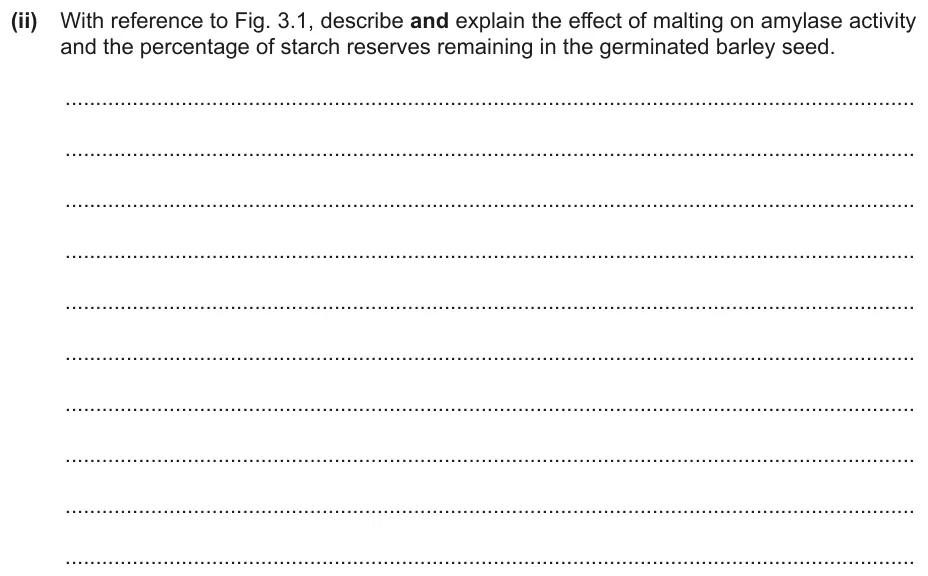
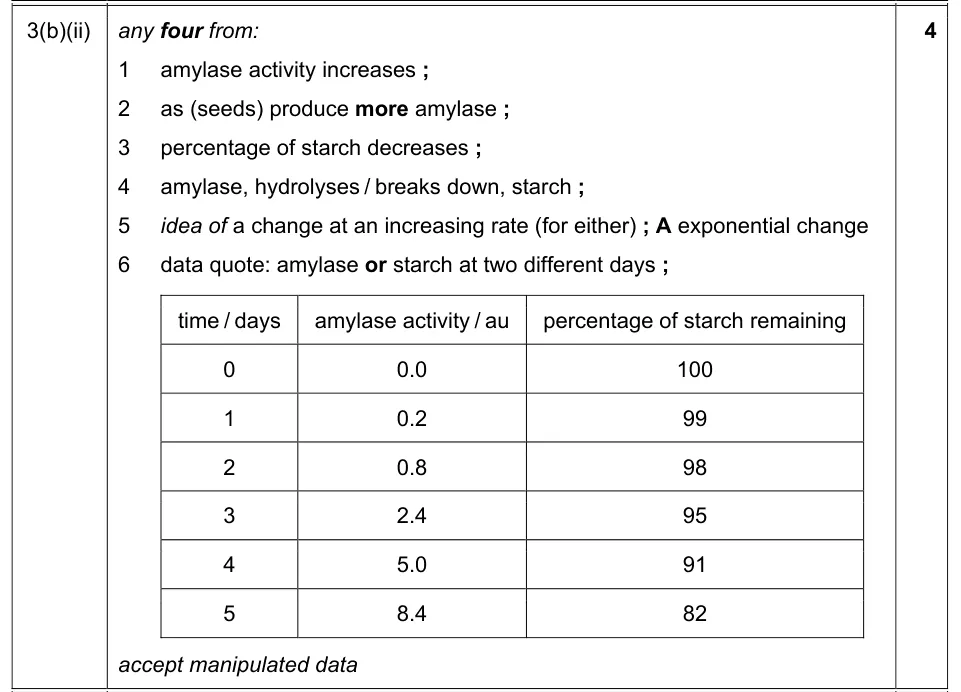
Describe and explain how malting affects amylase activity and the starch reserves left in the seed.
Show the mark scheme
Tap an image to open it full size.
From the examiners' report: The graph has two y-axes. Some students used the wrong units and values for amylase and starch, so they gained no credit for their figures.
Question 18
Paper 4 · October/November 2021 (42) · Q3(c)(ii) · 1 mark
Suggest why malting is stopped before shoot or root growth occurs.
Information from earlier in this question:


Show the mark scheme

Tap an image to open it full size.
From the examiners' report: The question says that the sugars made in malting are used to make beer. A large minority did not link their answer to keeping the sugars for the beer.
Question 19
Paper 4 · October/November 2018 (42) · Q8(b) · 4 marks
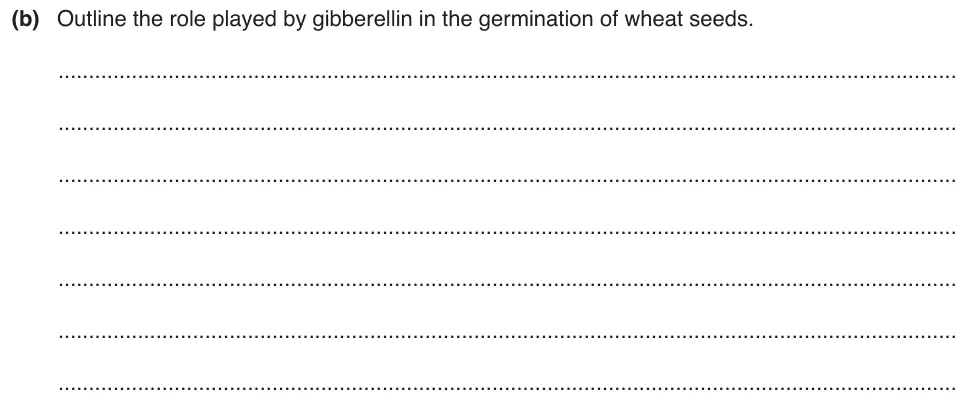
Outline the role of gibberellin in the germination of wheat seeds.
Information from earlier in this question:

Show the mark scheme
Tap an image to open it full size.
From the examiners' report: Answered well by most. A main error was leaving out the breakdown of starch by amylase in the endosperm. Many wrongly wrote that the seed uses the glucose.
Question 20
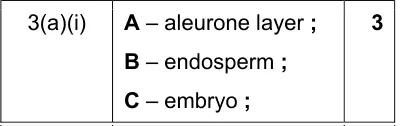
Paper 4 · February/March 2017 (42) · Q3(a)(i) · 3 marks · Hard
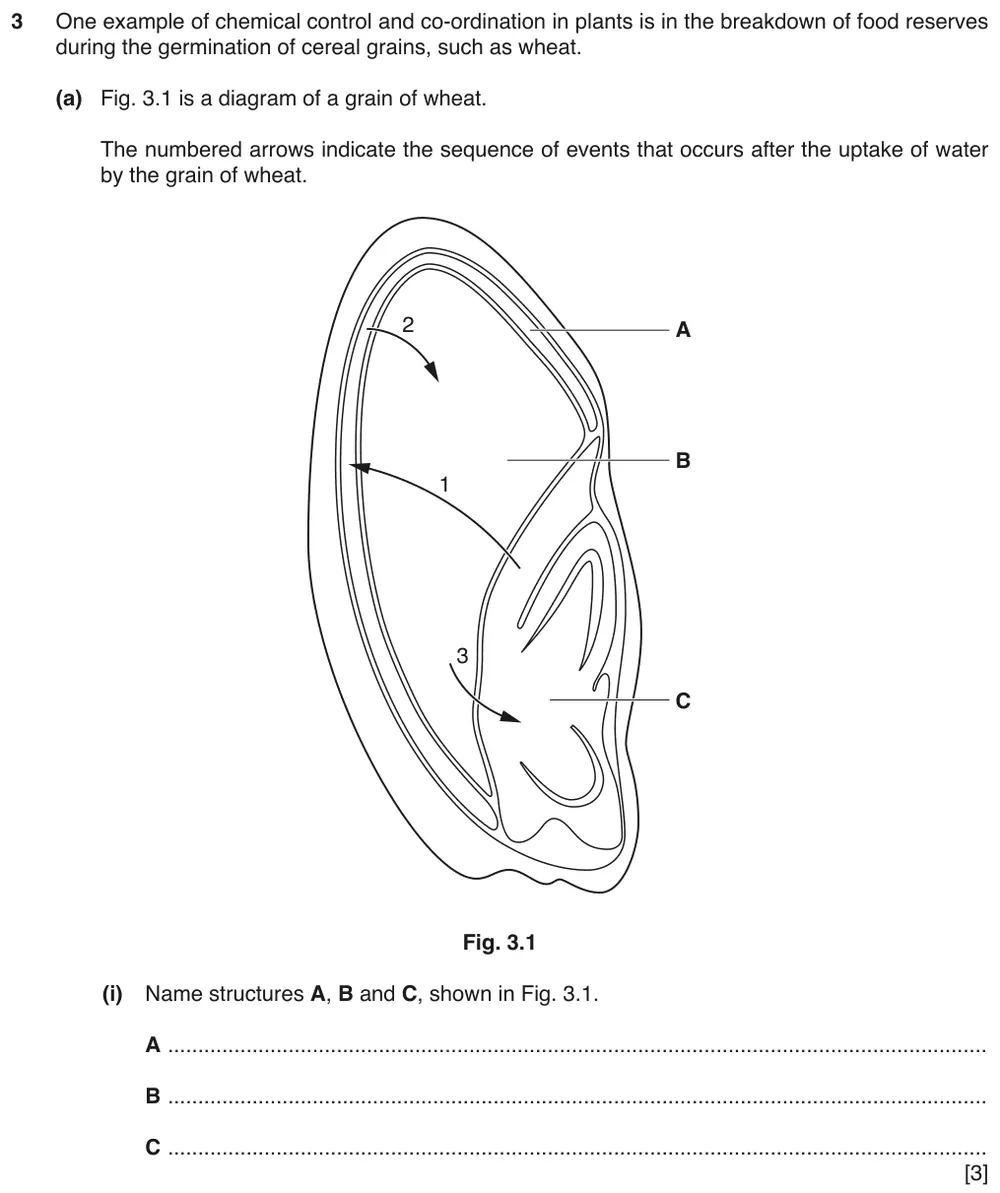
Name structures A, B and C on the diagram of a grain of wheat.
Show the mark scheme
Tap an image to open it full size.
From the examiners' report: A large number of students did not know the structure of a grain of wheat, and some left the question blank.
Question 21
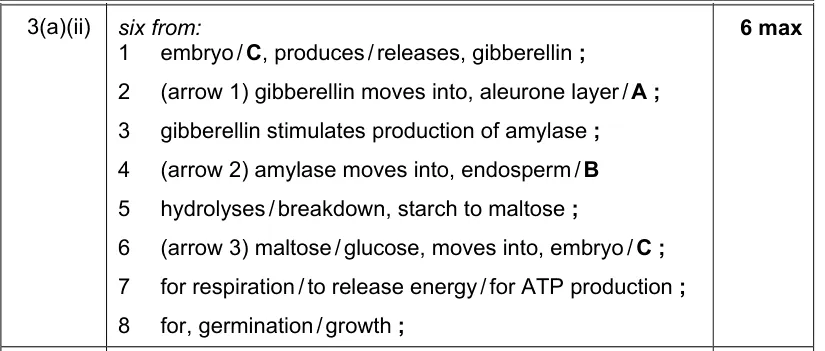
Paper 4 · February/March 2017 (42) · Q3(a)(ii) · 6 marks
Use the three numbered arrows to describe what happens after the grain of wheat takes up water.
Show the mark scheme
Tap an image to open it full size.
From the examiners' report: Some students did not refer to the diagram and gave the events in the wrong order.
Question 22
Paper 4 · October/November 2016 (42) · Q8(a) · 1 mark
Name the plant growth regulator that starts the germination of seeds.

Show the mark scheme

Tap an image to open it full size.
From the examiners' report: Most knew that gibberellins are involved, though the spelling was not always accurate.
Where students lose marks (from Cambridge examiners' reports and mark schemes)
Each point below comes from the examiners' reports and mark schemes, and is followed by wording that gained marks.
Calcium ions make the receptor potential. Students named sodium ions or potassium ions as the ions that move into the cells at the base of the sensory hairs.
✔ Gains credit: 'Ca2+' or 'calcium ions'.
Two hairs, or one hair twice. Students gave vague explanations of how the plant avoids closing when it does not need to.
✔ Gains credit: 'at least two hairs must be touched within' '35 seconds', or 'one hair touched twice' within a 'short time period'.
Concave, not convex. Students mixed up concave and convex, or described nerve transmission, digestion of the insect or calcium pectate acting as a glue.
✔ Gains credit: 'H+ pumped' 'into cell walls', 'calcium pectate dissolves', 'Ca2+ (ions) enter cells', 'water enters by osmosis', the hinge cells 'become turgid' and the 'lobes become concave'.
Hydrogen bonds break. Students described the effect of acid on the cell wall vaguely, as 'loosening' or 'weakening'.
✔ Gains credit: 'protons' 'pumped into cell wall(s)', expansins 'break' '(H) bonds between cellulose' 'microfibrils', and 'water enters cell(s) by osmosis'.
Know how auxin lowers the pH. Students could not give the events that make the cell wall more acidic after auxin is applied.
✔ Gains credit: 'auxin binds with receptor', 'proton pumps activated' and 'H+ pumped into cell wall'.
Gibberellin goes to the aleurone layer. Students drew the gibberellin arrow to the endosperm, or drew arrows that started or ended in the testa or stayed inside the endosperm.
✔ Gains credit: gibberellin: 'embryo to aleurone layer'; amylase: 'aleurone layer to endosperm'.
A receptor comes before DELLA. Students wrote that gibberellin destroys DELLA itself, and left out the gene coding for amylase or the mRNA.
✔ Gains credit: 'gibberellin binds to receptor', 'destruction of DELLA protein', 'gene coding for amylase' 'transcribed' and 'translation of mRNA'.
Each line has its own y-axis. Students read amylase activity and starch reserves from the wrong axis, with the wrong units.
✔ Gains credit: 'amylase activity increases', 'percentage of starch decreases', 'amylase' 'hydrolyses' 'starch', with a 'data quote' for 'two different days'.
Download the questions
Download the PDF pack (22 questions, mark schemes at the end)
Keep practising
- Control and Coordination in Mammals (15.1): Cambridge (CIE) exam questions by topic
- Cambridge (CIE) A level Biology 9700 past papers, mark schemes and examiners' reports
- Cambridge (CIE) A level Biology grade thresholds
- Book a one-to-one CIE lesson or a free 15-minute discovery chat with Tom
- Register your interest in a CIE A level Biology group class
Questions, mark schemes and examiners' report extracts © Cambridge University Press & Assessment.