

Control and Coordination in Mammals (15.1): Cambridge (CIE) A Level Biology 9700 Exam Questions by Topic
Control and coordination in mammals is sub-topic 15.1 of Topic 15, Control and coordination, in the Cambridge International AS & A Level Biology syllabus (9700). You need to describe the endocrine system and compare it with the nervous system, describe sensory and motor neurones, explain how a chemoreceptor cell in a taste bud produces an action potential in a sensory neurone, and explain resting potentials, action potentials, the refractory period, saltatory conduction and cholinergic synapses. It also covers the neuromuscular junction, the ultrastructure of striated muscle and the sliding filament model of muscle contraction. This is A level content, examined on Paper 4.
The examiners' reports return to the same points. Name the membrane: it is the cell surface membrane, or the postsynaptic membrane, that is depolarised, not the cell or the neurone. Vesicles fuse with the presynaptic membrane and the neurotransmitter binds to a receptor. Write Ca2+, not Ca+, and neurones, not nerves. ATP is needed for the sodium-potassium pump, which maintains the resting potential; depolarisation and repolarisation depend on voltage-gated channels. In a myelinated neurone the action potential jumps from node to node, so transmission is faster. When a question asks you to apply the sliding filament model, do not simply describe how a muscle contracts.
Studying Cambridge International A level Biology and want more help? Tom teaches CIE students one-to-one online, including students in the UAE, Saudi Arabia, Hong Kong, India and Indonesia, and every lesson is recorded. You can book a one-to-one lesson or a free 15-minute discovery chat, or register your interest in a CIE group class starting in September 2027, using the links at the bottom of this page.
What you need from AS Level
Each question on this page assumes you're secure on these ideas. If any of them feels shaky, look it up before you start.
- Active transport moves ions against a concentration gradient through carrier proteins, using ATP. Facilitated diffusion moves ions down a concentration gradient through channel or carrier proteins.
- In exocytosis, a vesicle fuses with the cell surface membrane and releases its contents.
- In cell signalling, a ligand such as a hormone binds to a specific receptor on the cell surface membrane of a target cell.
- Mitochondria produce ATP by aerobic respiration.
Key terms
These words come up in the questions and mark schemes. Examiners expect you to use them exactly.
- Resting potential: the potential difference across the membrane of a neurone that is not transmitting an impulse, about −70 mV, with the inside negative relative to the outside.
- Depolarisation: the change in membrane potential when sodium ions enter through open channels, making the inside of the membrane less negative and then positive.
- Action potential: a brief reversal of the membrane potential, caused by voltage-gated sodium ion channels and then voltage-gated potassium ion channels opening.
- Refractory period: the short time after an action potential when a new action potential cannot be produced, or is harder to produce, in that part of the membrane.
- Saltatory conduction: transmission in a myelinated neurone, in which action potentials occur only at the nodes of Ranvier and so jump from node to node.
- Cholinergic synapse: a synapse at which the neurotransmitter is acetylcholine (ACh).
- Sarcomere: the unit of a myofibril between two Z-lines, made of thick myosin filaments and thin actin filaments.
- Sarcoplasmic reticulum: the specialised endoplasmic reticulum of a muscle fibre; it releases calcium ions when the fibre is stimulated and takes them back in by active transport.
What these questions cover (Cambridge 9700 Topic 15: Control and coordination)
The questions test these learning outcomes from sub-topic 15.1 of the Cambridge International AS & A Level Biology syllabus (9700) for 2025 to 2027.
- 15.1.1 describe the features of the endocrine system with reference to the hormones ADH, glucagon and insulin
- 15.1.2 compare the features of the nervous system and the endocrine system
- 15.1.3 describe the structure and function of a sensory neurone and a motor neurone and state that intermediate neurones connect sensory neurones and motor neurones
- 15.1.4 outline the role of sensory receptor cells in detecting stimuli and stimulating the transmission of impulses in sensory neurones
- 15.1.5 describe the sequence of events that results in an action potential in a sensory neurone, using a chemoreceptor cell in a human taste bud as an example
- 15.1.6 describe and explain changes to the membrane potential of neurones
- 15.1.7 describe and explain the rapid transmission of an impulse in a myelinated neurone with reference to saltatory conduction
- 15.1.8 explain the importance of the refractory period in determining the frequency of impulses
- 15.1.9 describe the structure of a cholinergic synapse and explain how it functions, including the role of calcium ions
- 15.1.10 describe the roles of neuromuscular junctions, the T-tubule system and sarcoplasmic reticulum in stimulating contraction in striated muscle
- 15.1.11 describe the ultrastructure of striated muscle with reference to sarcomere structure using electron micrographs and diagrams
- 15.1.12 explain the sliding filament model of muscular contraction including the roles of troponin, tropomyosin, calcium ions and ATP
How to use this page
Write your answer on paper before you open the mark scheme. Allow about 1.2 minutes per mark: the 22 questions are worth 71 marks, so about 85 minutes in total. Then mark your answer strictly against the mark scheme and read the examiners' tip underneath it. If you'd rather print the questions, download the PDF pack.
The endocrine system (15.1.1)
Question 1
Paper 4 · May/June 2023 (42) · Q9(a) · 6 marks
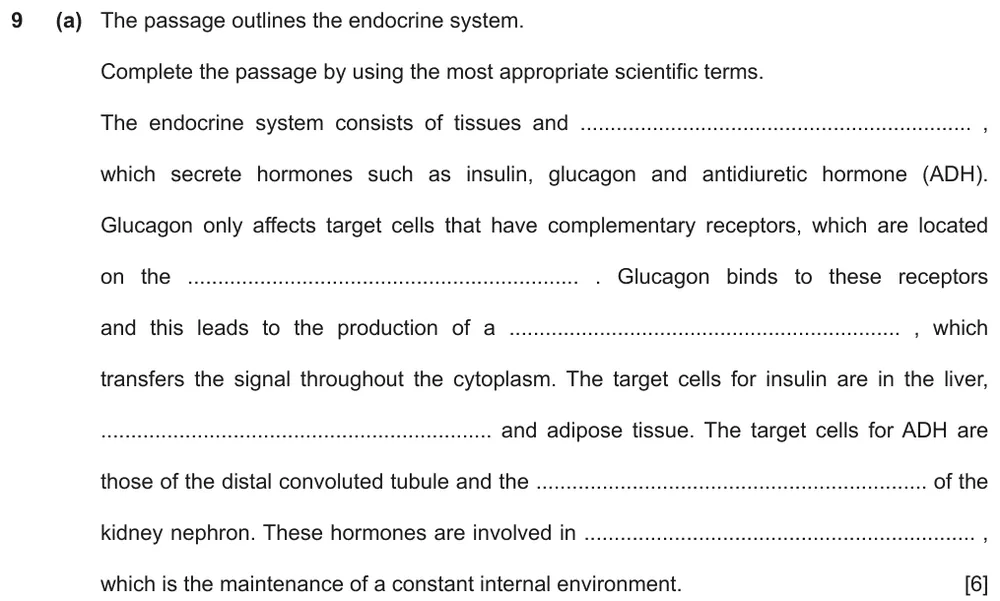
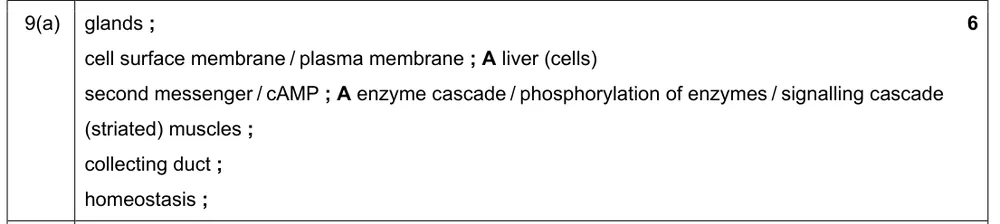
Complete the passage on the endocrine system and the hormones glucagon, insulin and ADH.
Show the mark scheme
Tap an image to open it full size.
From the examiners' report: Well answered. Common errors were leaving out that the receptors are on the cell surface membrane, or saying that glucagon binding produces a G-protein rather than cAMP or a second messenger. Negative feedback was sometimes given where homeostasis was needed.
Comparing the nervous and endocrine systems (15.1.2)
Question 2
Paper 4 · October/November 2023 (42) · Q9(b) · 4 marks
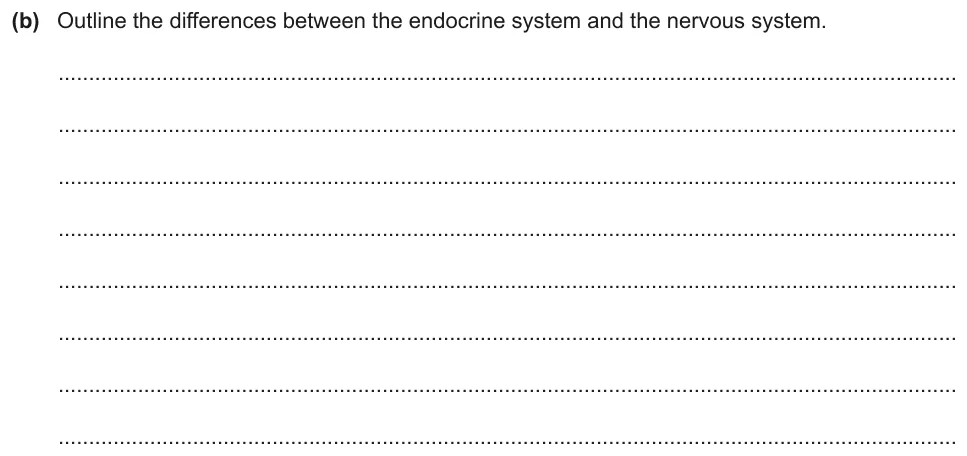
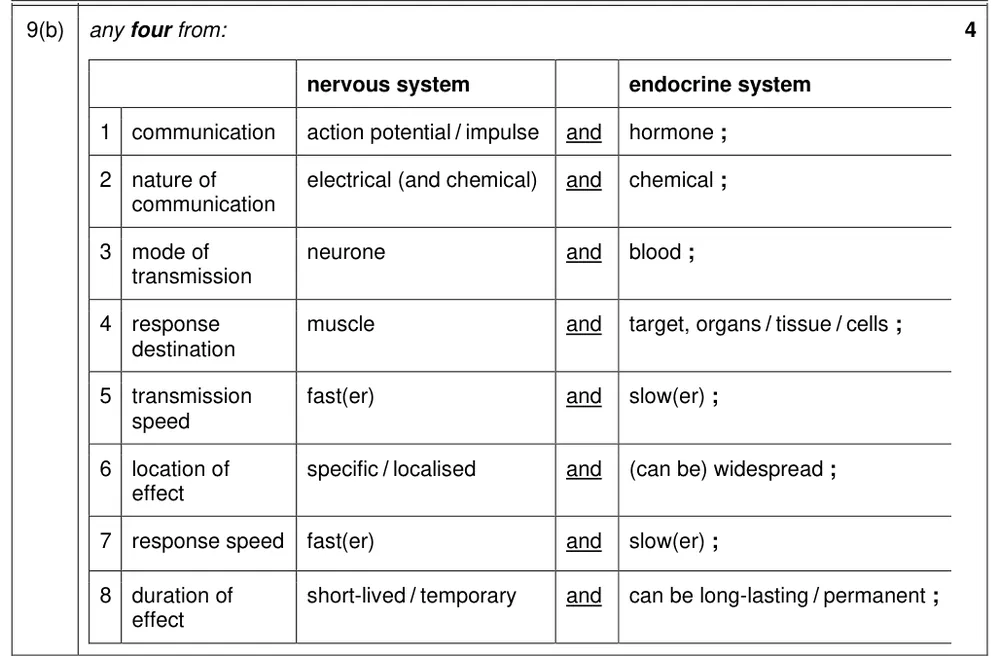
Outline the differences between the endocrine system and the nervous system.
Show the mark scheme
Tap an image to open it full size.
From the examiners' report: Some lost credit for writing nerves instead of neurones. Fewer students mentioned that impulses go to muscles while hormones have target cells or organs, or that hormones are chemical while impulses are electrical.
Neurones and receptor cells (15.1.3 and 15.1.4)
Question 3
Paper 4 · February/March 2023 (42) · Q7(b) · 3 marks
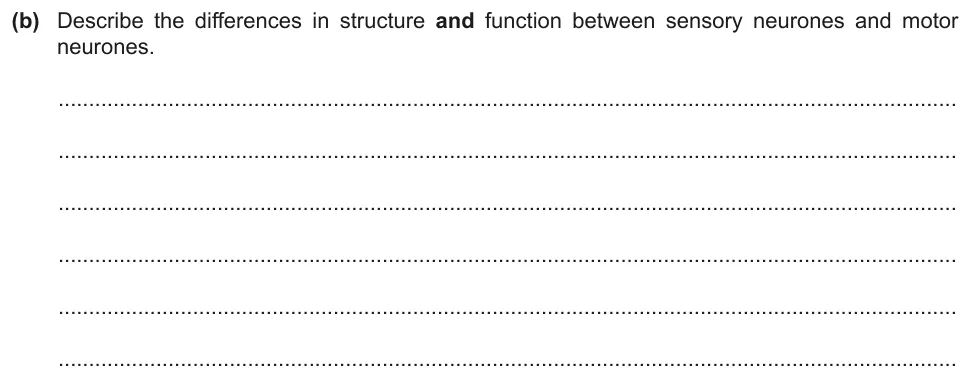
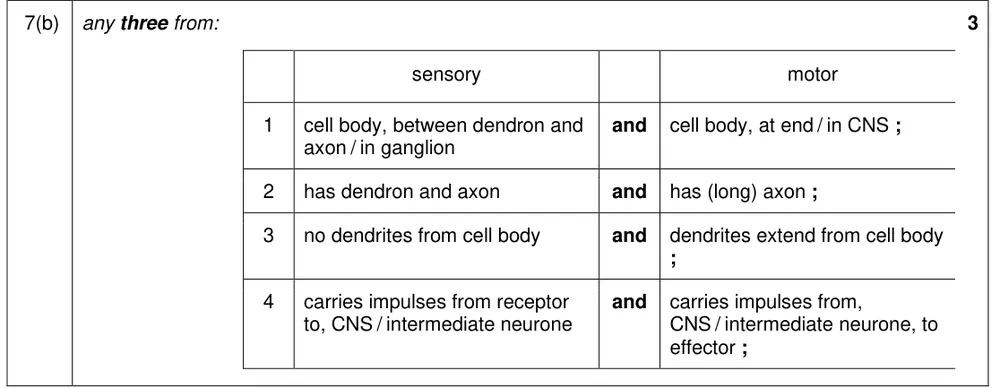
Describe the differences in structure and function between sensory neurones and motor neurones.
Show the mark scheme
Tap an image to open it full size.
From the examiners' report: Most found this hard. Compare the same feature in both neurones: few considered the position of the cell body, the position of the dendrites or the presence of an axon. Write impulses or action potentials, not messages or signals.
Question 4
Paper 4 · May/June 2024 (42) · Q8(a)(i) · 1 mark · Easy
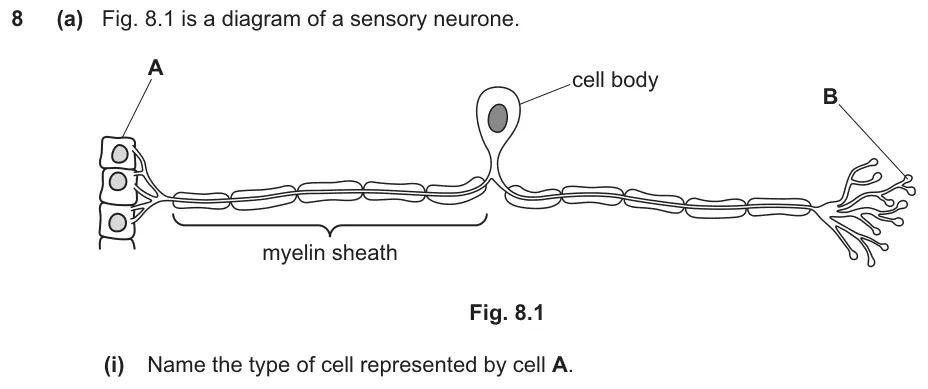
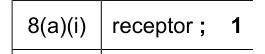
Name the type of cell labelled A on the diagram of a sensory neurone.
Show the mark scheme
Tap an image to open it full size.
Question 5
Paper 4 · May/June 2024 (42) · Q8(a)(ii) · 1 mark · Easy
Name a type of cell that forms a synapse with structure B.

Show the mark scheme

Tap an image to open it full size.
From the examiners' report: Relay or intermediate neurone was expected, and motor neurone was also accepted. Many wrote dendrite or axon because they had not focused on the word 'cell' in the question.
Chemoreceptor cells and the sensory neurone (15.1.5)
Question 6
Paper 4 · May/June 2022 (42) · Q8(b) · 1 mark · Hard
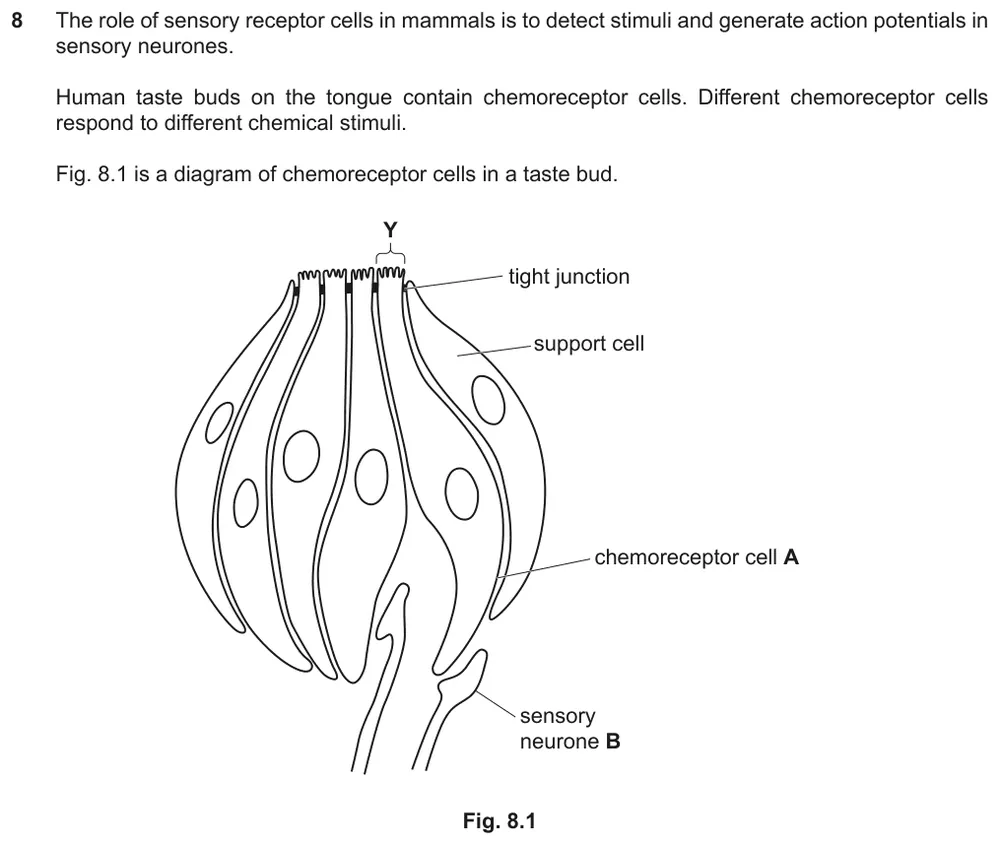
Suggest a reason for the tight junctions between the chemoreceptor cells.
Information from earlier in this question:

Show the mark scheme

Tap an image to open it full size.
From the examiners' report: Very few used the information in the stem of the question. Preventing leakage of substances, stopping the impulse escaping, making sure an impulse is generated and holding the cells together did not gain credit.
Question 7
Paper 4 · May/June 2022 (42) · Q8(c) · 7 marks · Easy
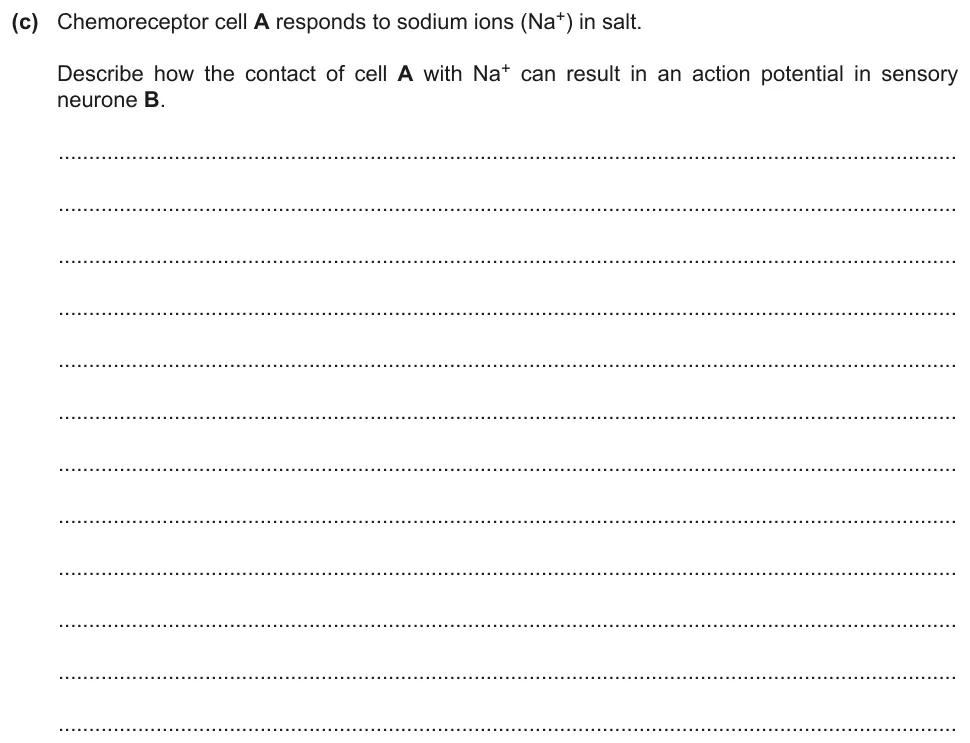
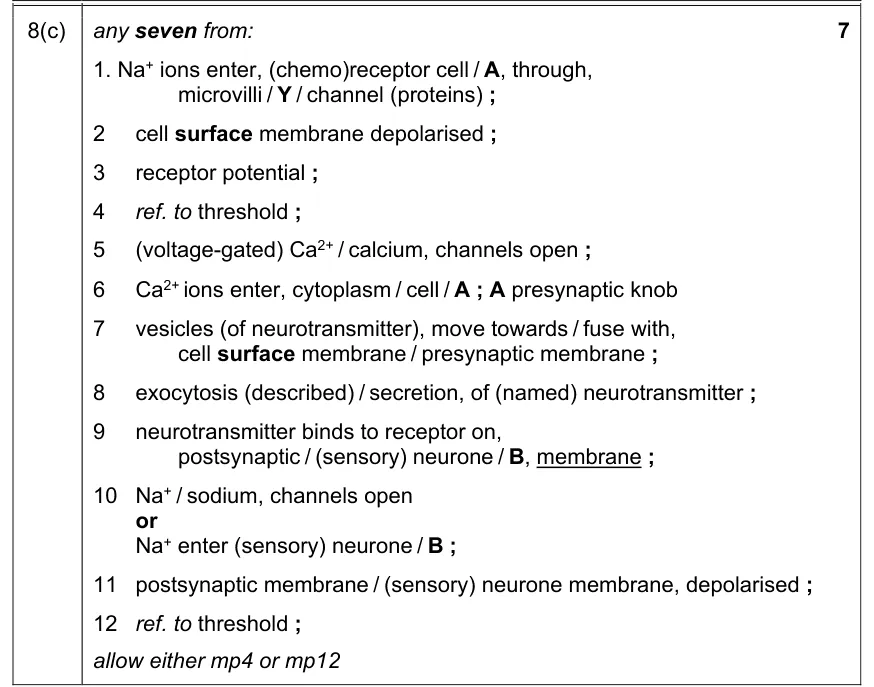
Describe how sodium ions touching chemoreceptor cell A can lead to an action potential in sensory neurone B.
Show the mark scheme
Tap an image to open it full size.
From the examiners' report: Name the membrane: 'depolarisation' needed 'of the cell surface membrane', and the receptor for the neurotransmitter is on the membrane of B. Vesicles fuse with the membrane and the neurotransmitter binds to the receptor, not the other way round. Write Ca2+, not Ca+.
Resting potential and action potential (15.1.6)
Question 8
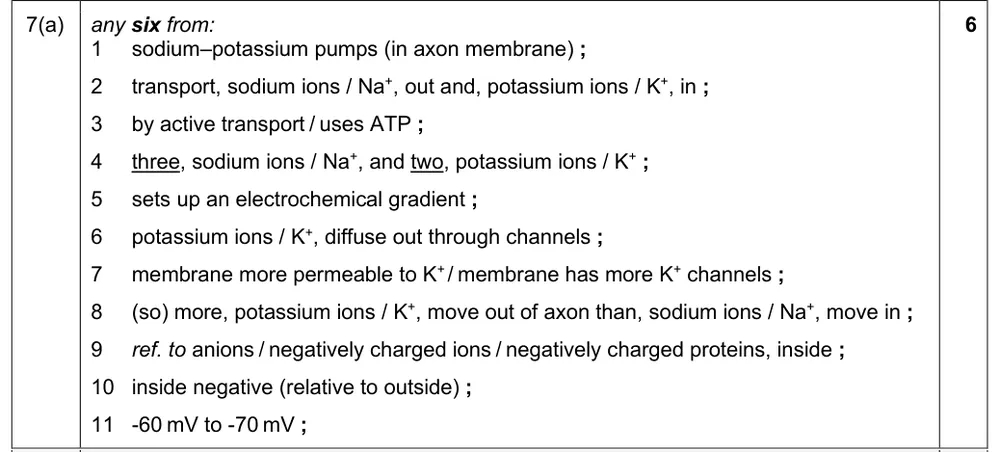
Paper 4 · May/June 2025 (42) · Q7(a) · 6 marks
Describe and explain how the resting potential of an axon membrane is maintained.
Show the mark scheme
Tap an image to open it full size.
Question 9
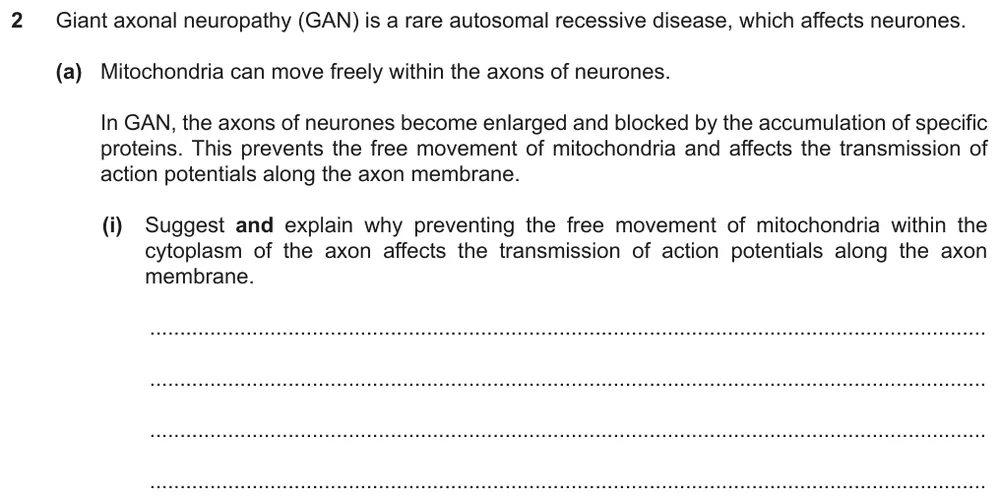
Paper 4 · February/March 2022 (42) · Q2(a)(i) · 2 marks
Suggest and explain why stopping mitochondria moving within the axon affects the transmission of action potentials.
Show the mark scheme

Tap an image to open it full size.
From the examiners' report: Very few linked ATP to the active transport of ions that restores and maintains the resting potential. A frequent error was to give ATP a role in depolarisation and repolarisation, which depend on voltage-gated ion channels. Answers about synapses did not answer the question.
Question 10
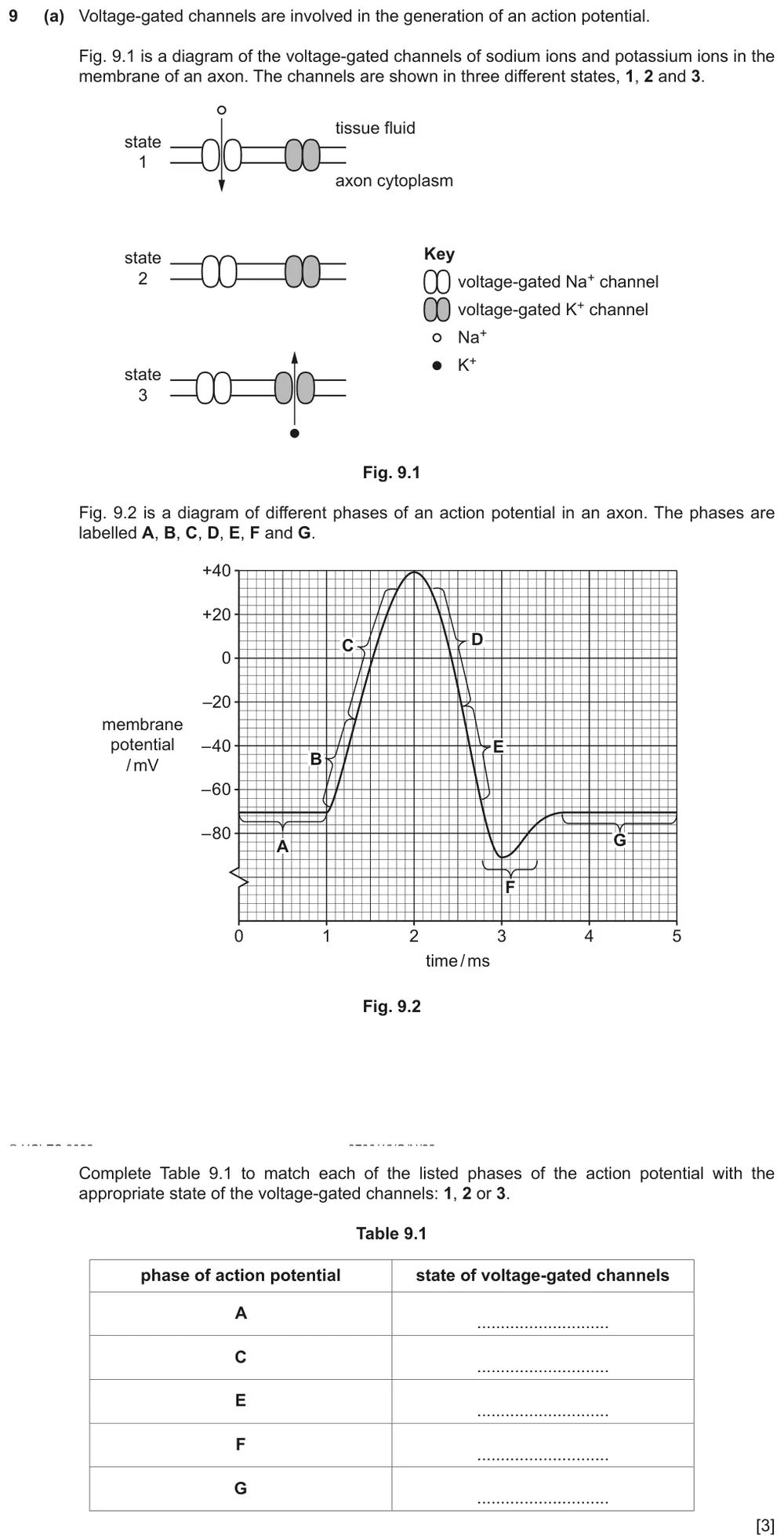
Paper 4 · October/November 2022 (42) · Q9(a) · 3 marks · Easy
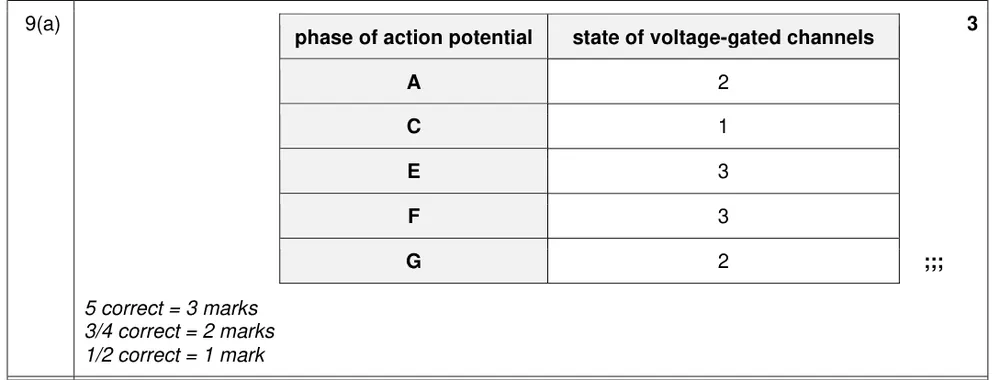
Match each phase of the action potential with the state of the voltage-gated sodium ion and potassium ion channels.
Show the mark scheme
Tap an image to open it full size.
From the examiners' report: The most common error was to give state 2 instead of state 3 for the period of hyperpolarisation. Weaker answers wrote the section of the action potential in the table instead of the number.
Myelinated neurones and saltatory conduction (15.1.7)
Question 11
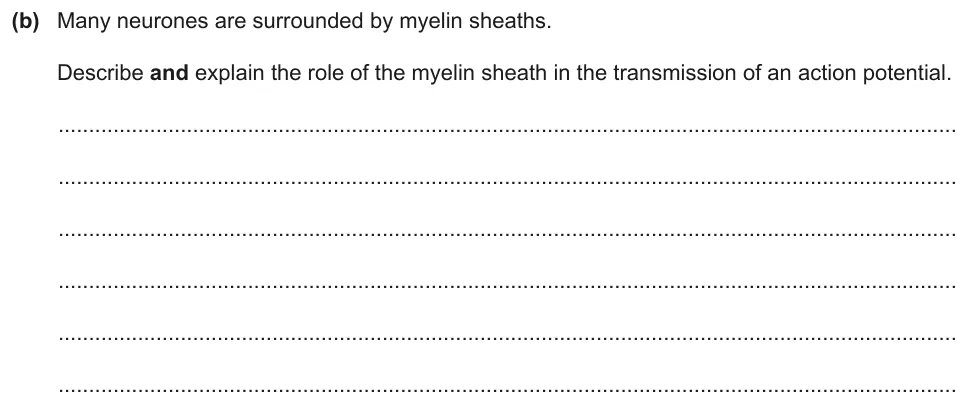
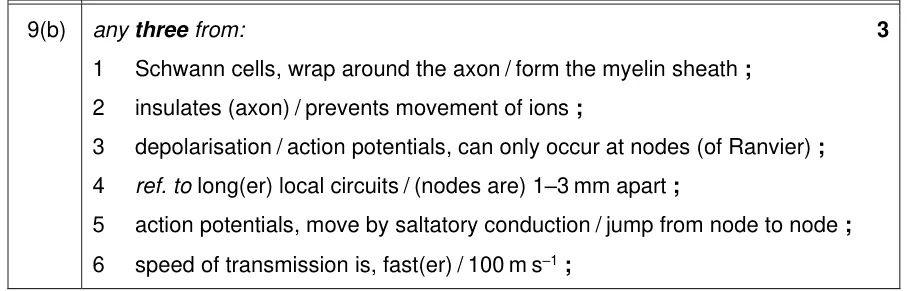
Paper 4 · October/November 2022 (42) · Q9(b) · 3 marks
Describe and explain the role of the myelin sheath in the transmission of an action potential.
Show the mark scheme
Tap an image to open it full size.
From the examiners' report: Write that the speed of transmission is faster; 'a faster action potential' was not credited. Fewer students mentioned that the myelin sheath is made of Schwann cells or that there are longer local circuits between the nodes.
Question 12
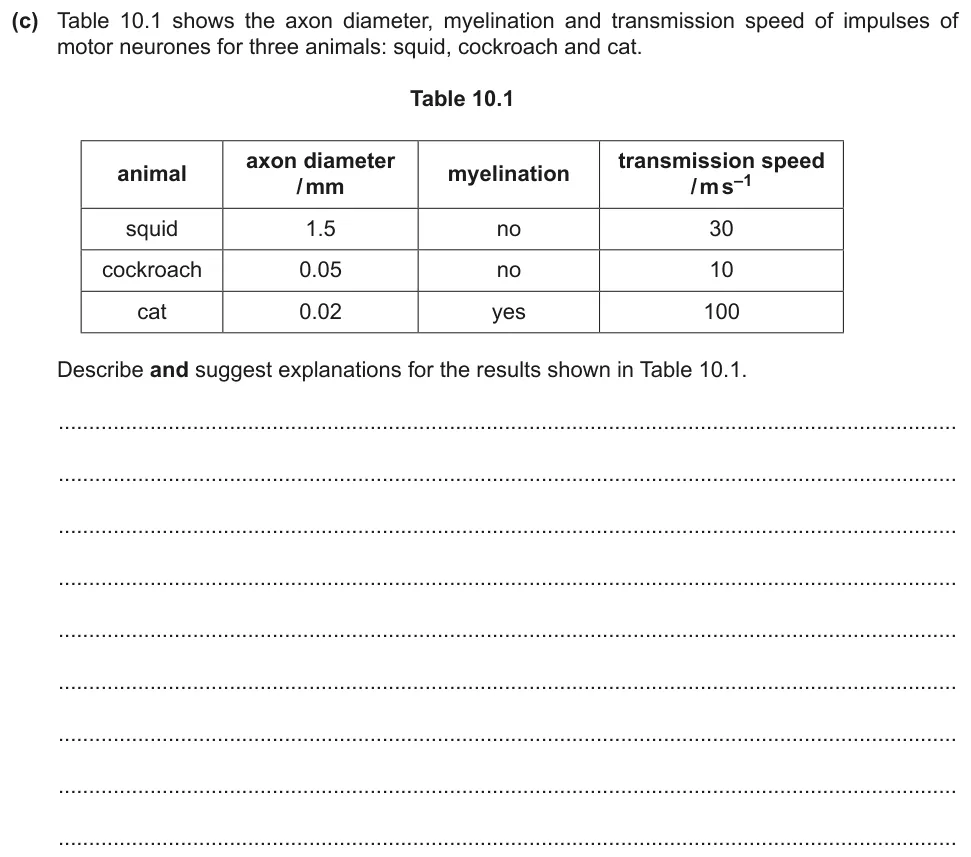
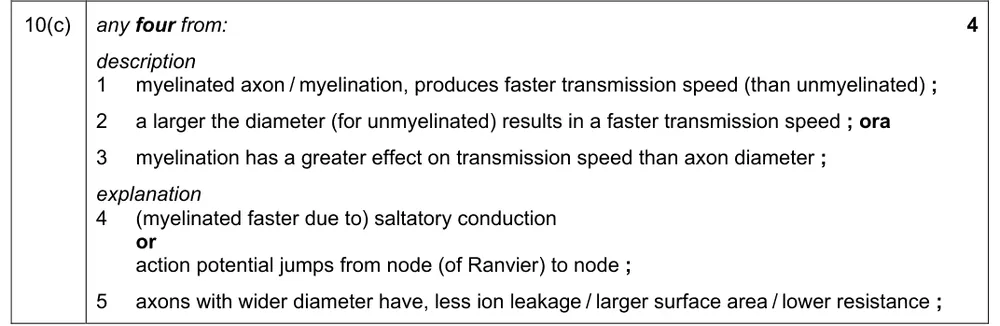
Paper 4 · May/June 2024 (43) · Q10(c) · 4 marks · Hard
Describe and suggest explanations for the transmission speeds in the motor neurones of a squid, a cockroach and a cat.
Show the mark scheme
Tap an image to open it full size.
From the examiners' report: It is the action potential that jumps from node to node, not the impulse, and it is the transmission that is faster, not the action potential. Few explained that a wide axon has a larger surface area or lower resistance. 'Signal' is not credited: write action potential or impulse.
The refractory period (15.1.8)
Question 13
Paper 4 · October/November 2025 (42) · Q7(b) · 3 marks
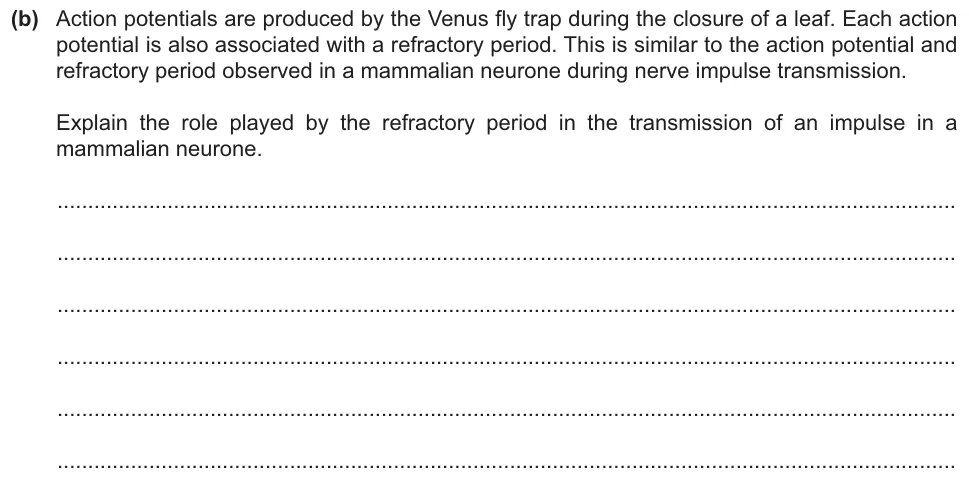
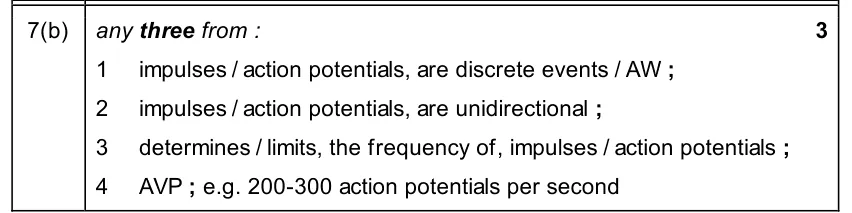
Explain the role of the refractory period in the transmission of an impulse in a mammalian neurone.
Show the mark scheme
Tap an image to open it full size.
Cholinergic synapses (15.1.9)
Question 14
Paper 4 · October/November 2023 (42) · Q7(b) · 3 marks
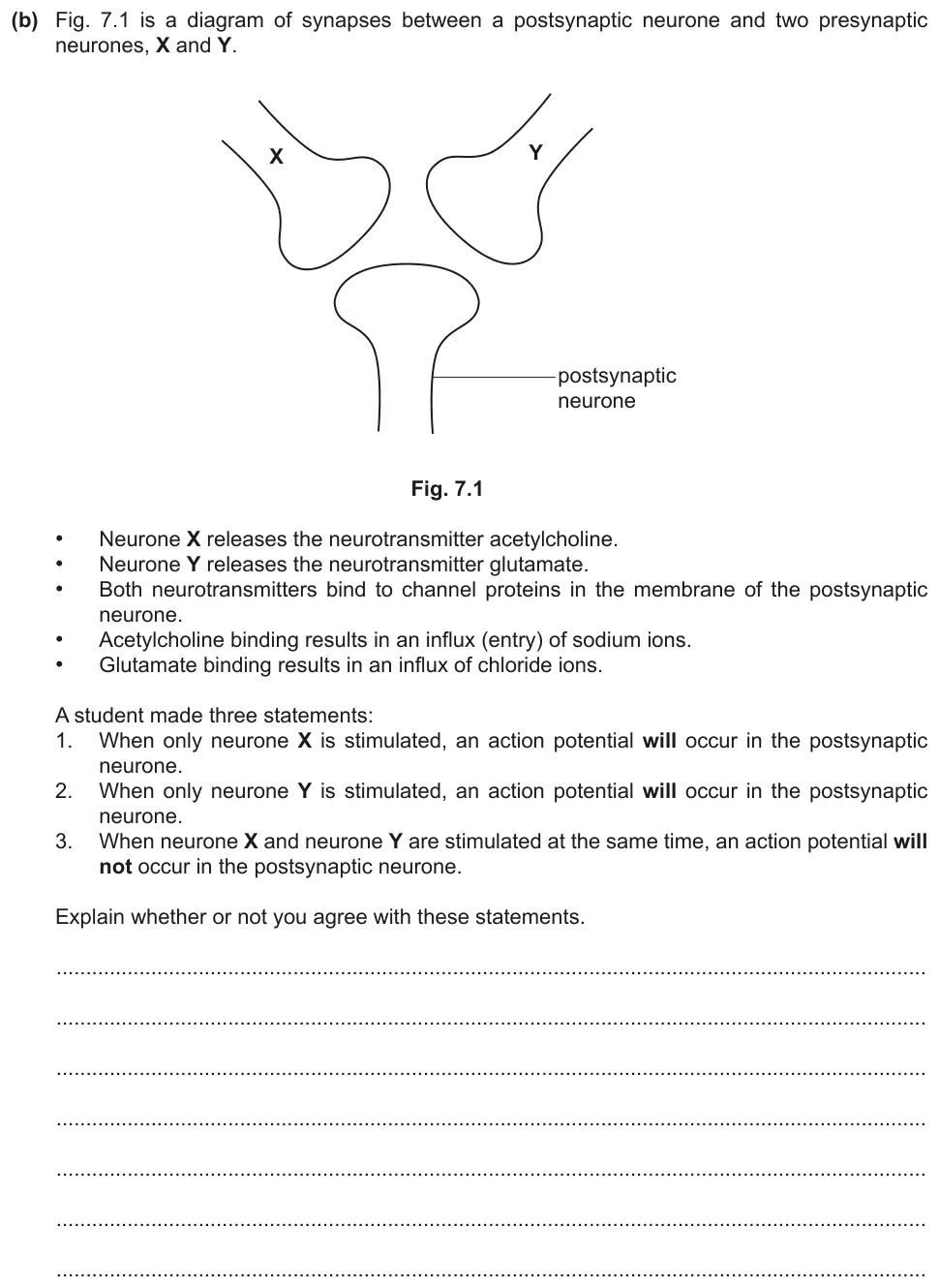
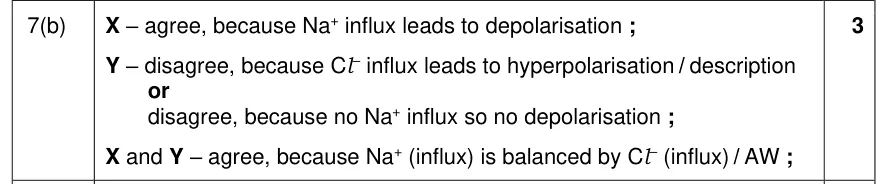
Explain whether you agree with three statements about a postsynaptic neurone and two presynaptic neurones.
Show the mark scheme
Tap an image to open it full size.
From the examiners' report: The best answers dealt with each statement separately. Most found statement 2 difficult and could not link the influx of chloride ions with hyperpolarisation.
Question 15
Paper 4 · May/June 2024 (42) · Q8(c)(i) · 2 marks
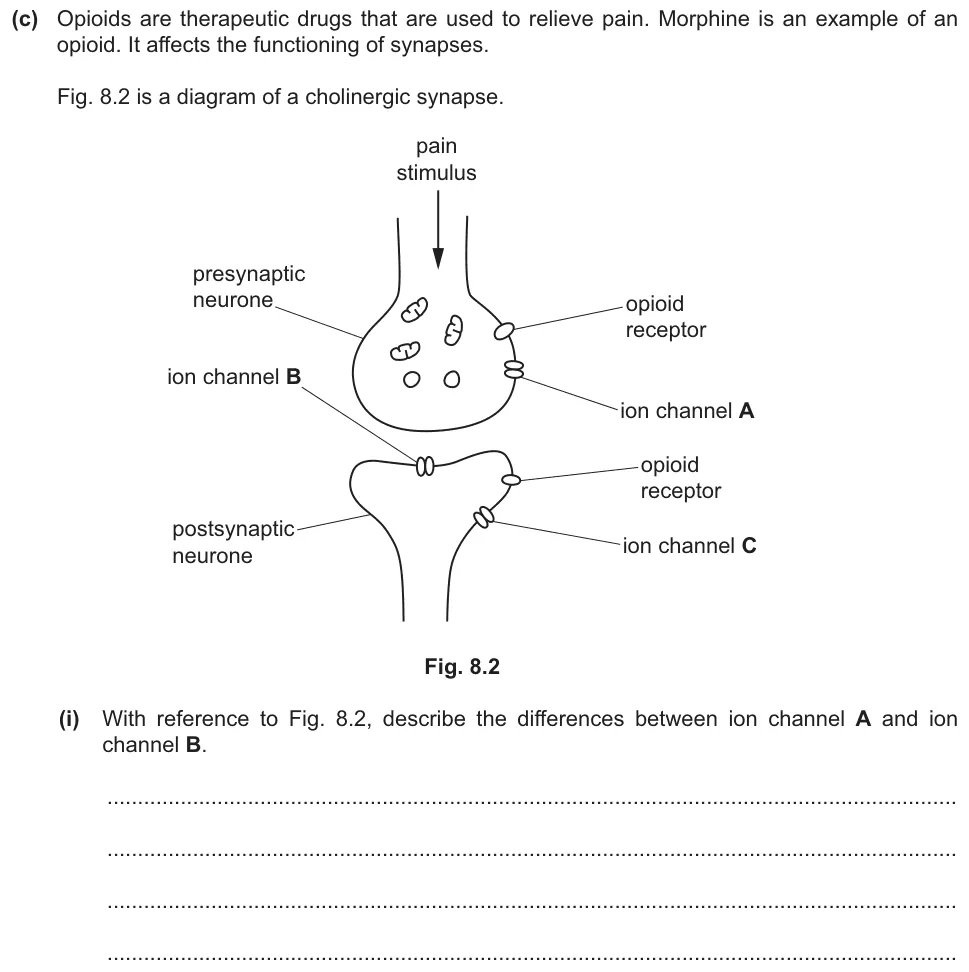
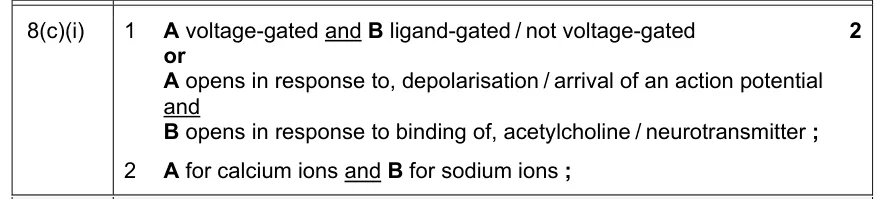
Describe the differences between ion channel A and ion channel B in the diagram of a cholinergic synapse.
Show the mark scheme
Tap an image to open it full size.
From the examiners' report: Many only described where the two channels are. Say which ion passes through each channel and how each one opens: voltage-gated or ligand-gated. Ca+ was not credited for Ca2+.
Question 16
Paper 4 · May/June 2024 (42) · Q8(c)(ii) · 4 marks · Easy
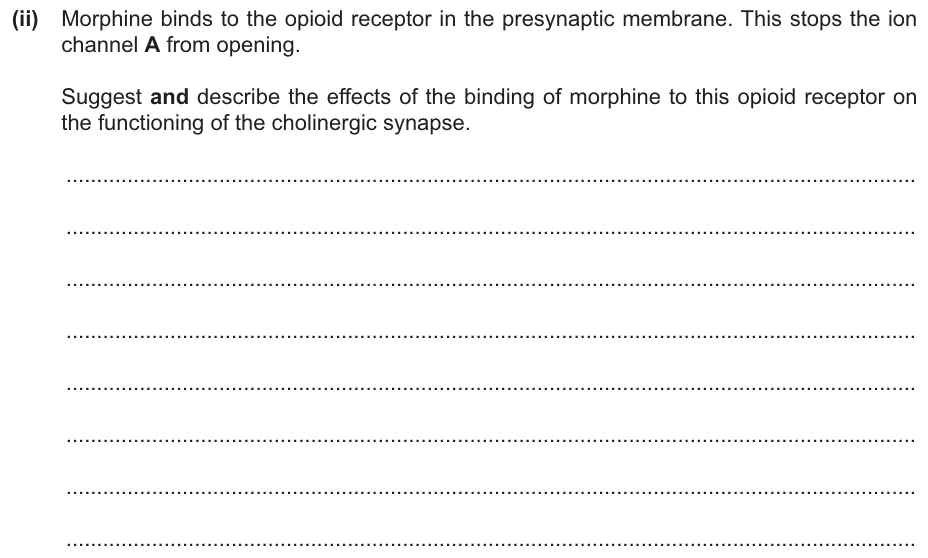
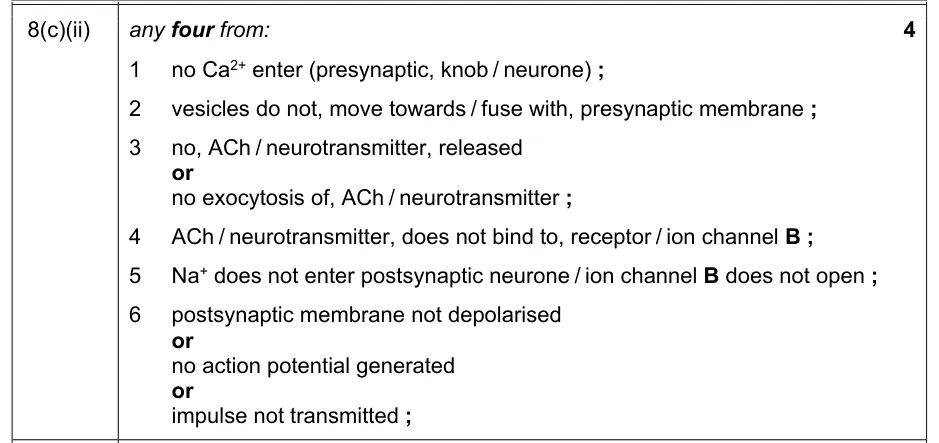
Suggest and describe how morphine binding to the presynaptic opioid receptor affects the cholinergic synapse.
Show the mark scheme
Tap an image to open it full size.
From the examiners' report: Name the membrane: vesicles fuse with the presynaptic membrane, and it is the postsynaptic membrane, not the postsynaptic neurone, that is not depolarised. Calcium ions enter the neurone, not the membrane. Vesicles that 'bind' to the membrane lost the mark.
Question 17
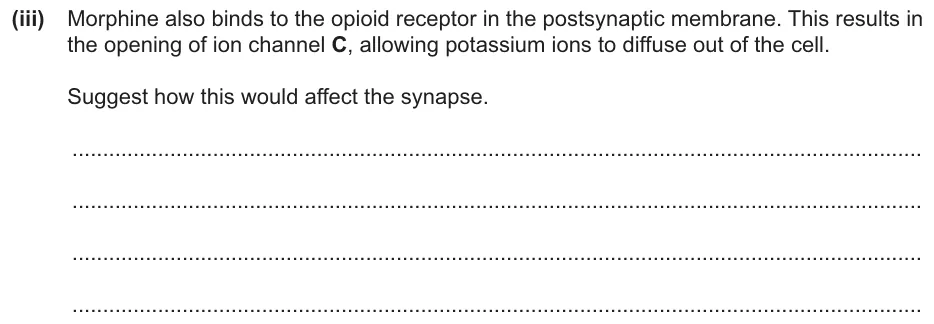
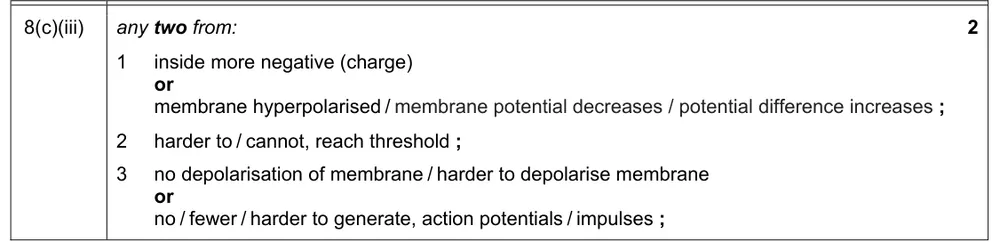
Paper 4 · May/June 2024 (42) · Q8(c)(iii) · 2 marks · Hard
Suggest how opening ion channel C, so that potassium ions diffuse out of the cell, would affect the synapse.
Show the mark scheme
Tap an image to open it full size.
From the examiners' report: A common error was to say the inside of the cell becomes negative; it becomes more negative. Strong answers went on to explain that the threshold is harder to reach, so action potentials may not be generated.
Sarcomere structure and the neuromuscular junction (15.1.10 and 15.1.11)
Question 18
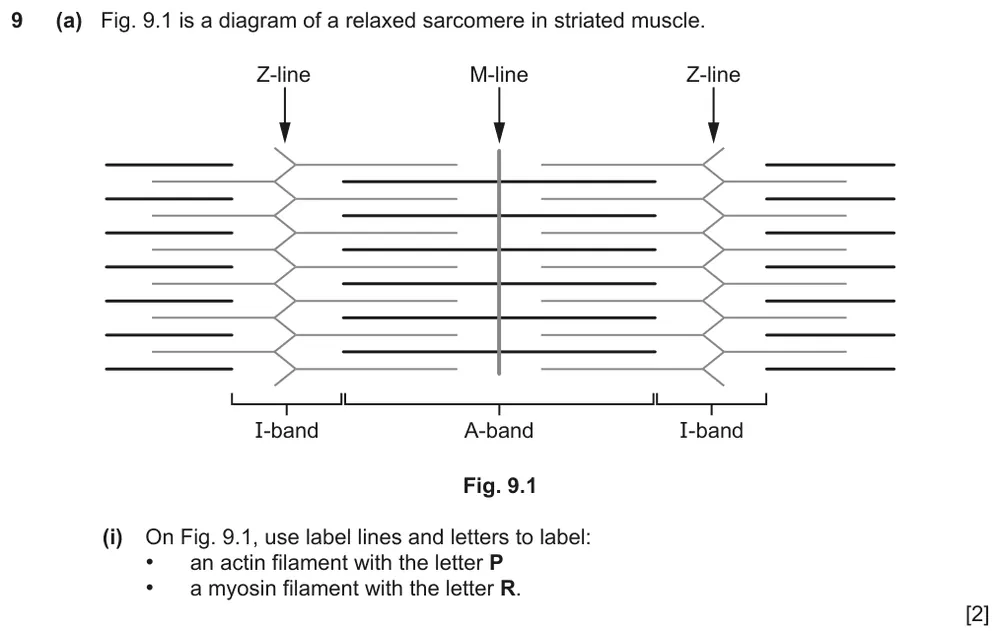
Paper 4 · February/March 2023 (42) · Q9(a)(i) · 2 marks · Easy
Label an actin filament and a myosin filament on the diagram of a relaxed sarcomere.
Show the mark scheme

Tap an image to open it full size.
Question 19
Paper 4 · February/March 2023 (42) · Q9(a)(ii) · 2 marks · Hard
State what happens to the A-band and the I-band when the sarcomere contracts.

Show the mark scheme

Tap an image to open it full size.
From the examiners' report: A common error was to say that the I-band contracted. The A-band stays the same and the I-band gets shorter.
Question 20
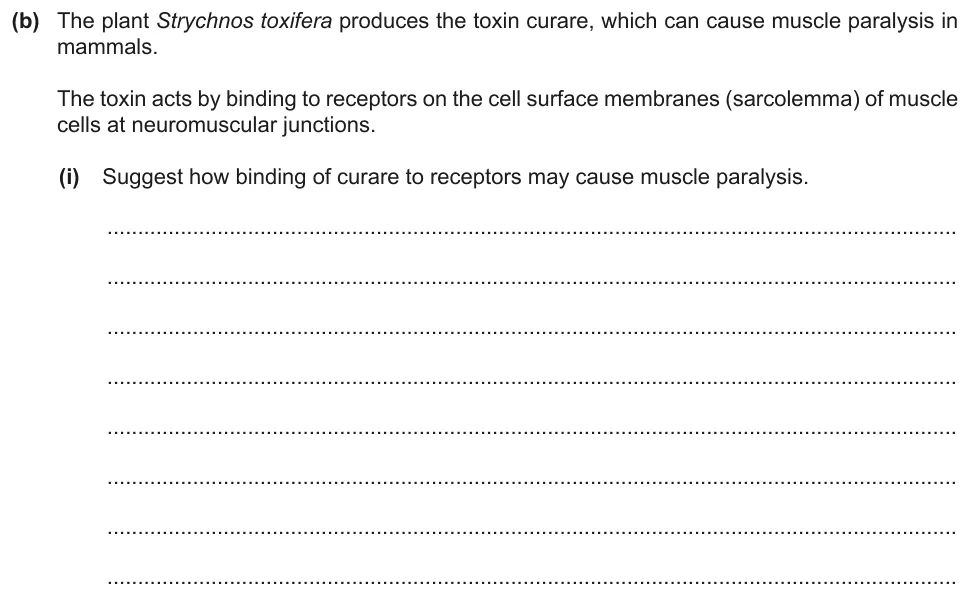
Paper 4 · February/March 2023 (42) · Q9(b)(i) · 4 marks · Easy
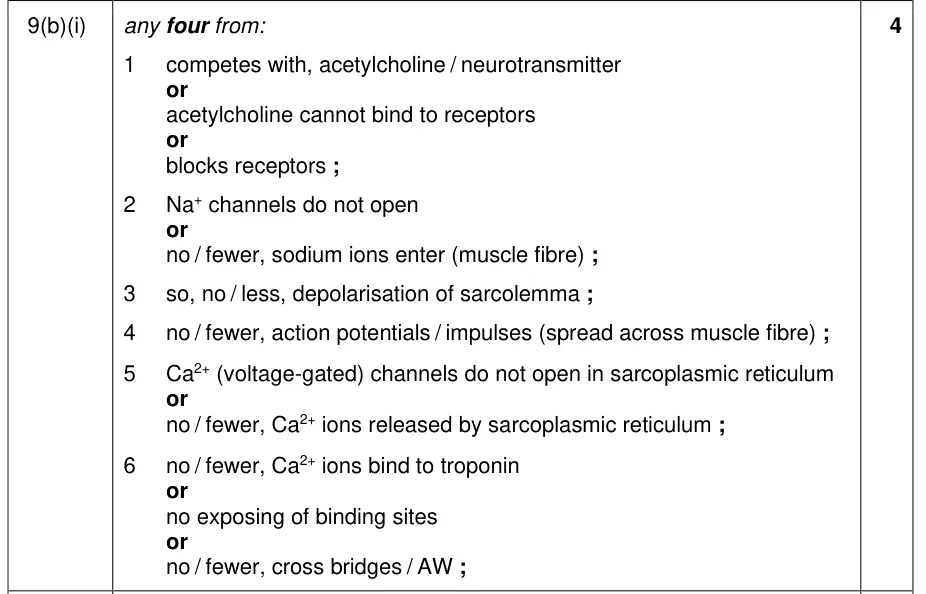
Suggest how curare binding to receptors on the sarcolemma may cause muscle paralysis.
Show the mark scheme
Tap an image to open it full size.
From the examiners' report: Generally well answered. Some students described the action of curare on a cholinergic synapse rather than a neuromuscular junction.
The sliding filament model (15.1.12)
Question 21
Paper 4 · May/June 2023 (42) · Q7(a) · 4 marks · Hard
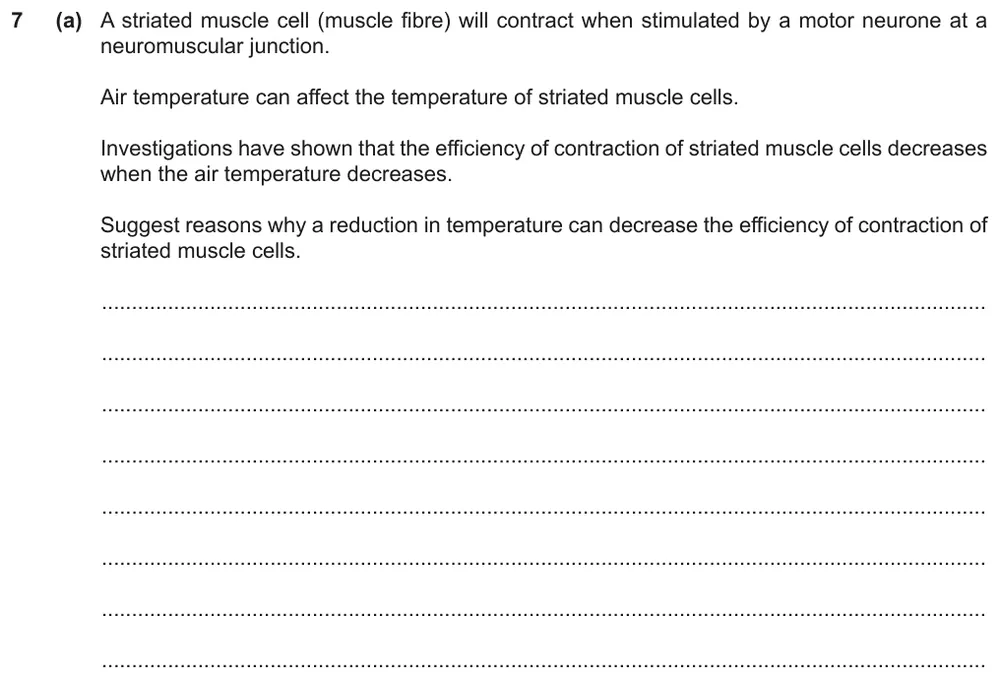
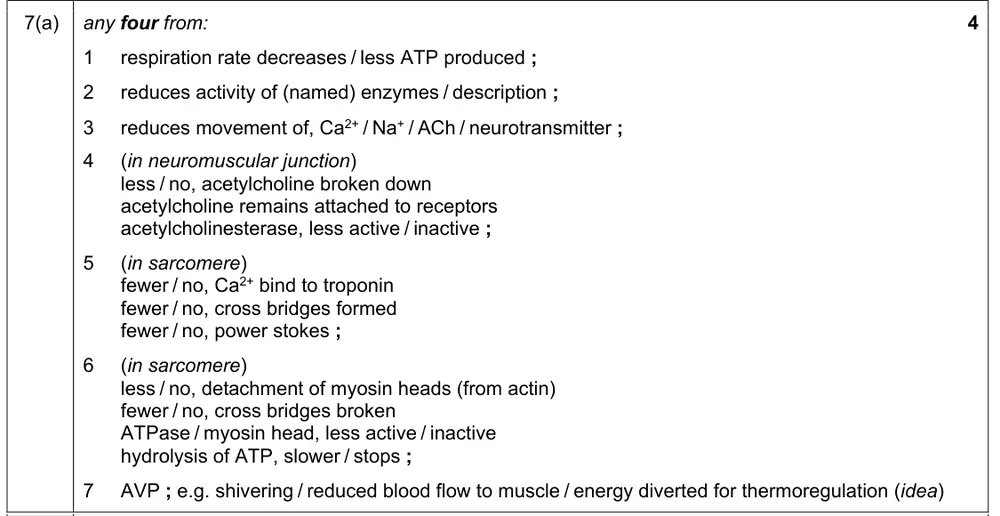
Suggest reasons why a fall in temperature makes the contraction of striated muscle cells less efficient.
Show the mark scheme
Tap an image to open it full size.
From the examiners' report: Accounts of how a muscle contracts gained no credit: the sliding filament model had to be applied to the lower temperature. Most credit came from lower enzyme activity, such as ATPase on the myosin head or acetylcholinesterase, and from less ATP being made in respiration. Some misread the question and described a rise in temperature.
Question 22
Paper 4 · February/March 2024 (42) · Q10(a) · 4 marks
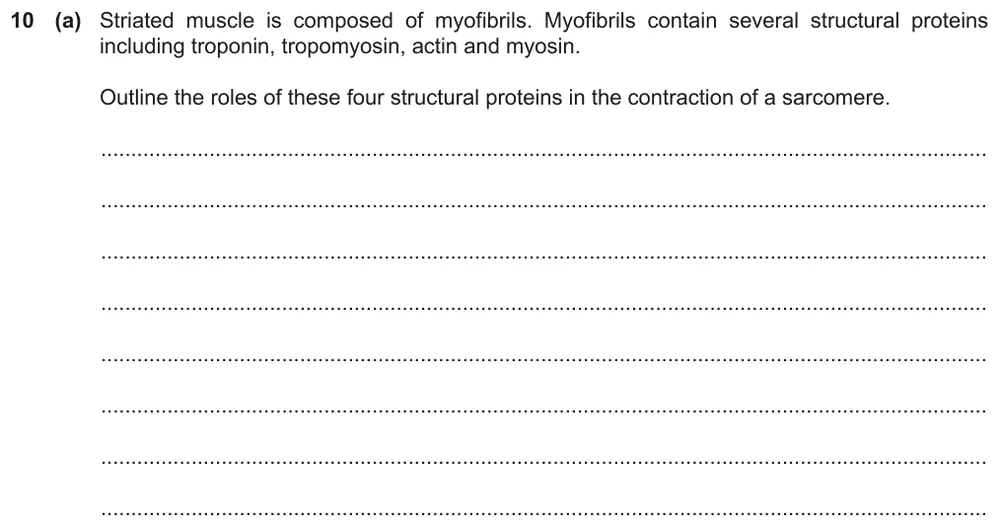
Outline the roles of troponin, tropomyosin, actin and myosin in the contraction of a sarcomere.
Show the mark scheme
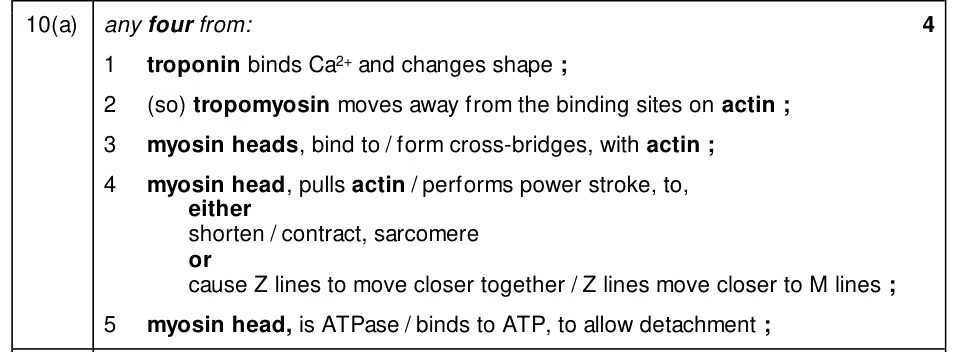
Tap an image to open it full size.
Where students lose marks (from Cambridge examiners' reports and mark schemes)
Each point below comes from the examiners' reports and mark schemes, and is followed by wording that gained marks.
Glucagon receptors and cAMP. Students left out that the receptors are on the cell surface membrane, said that glucagon binding produces a G-protein, or wrote negative feedback instead of homeostasis.
✔ Gains credit: receptors on the 'cell surface membrane', production of a 'second messenger' or 'cAMP', and 'homeostasis' for the maintenance of a constant internal environment.
Neurones, not nerves. Students wrote about nerves, and few said that impulses are electrical while hormones are chemical.
✔ Gains credit: an 'impulse' in a 'neurone' compared with a 'hormone' in the 'blood'; 'electrical' compared with 'chemical'; 'fast(er)' compared with 'slow(er)'.
Compare the same feature in both neurones. Students did not make direct comparisons of equivalent features, and wrote about messages or signals.
✔ Gains credit: sensory: 'cell body, between dendron and axon', 'carries impulses from receptor'; motor: 'cell body, at end / in CNS', carries impulses 'to effector'.
Say which membrane is depolarised. Students wrote 'depolarisation' on its own, or said the postsynaptic neurone was not depolarised.
✔ Gains credit: 'cell surface membrane depolarised' in the receptor cell, then 'postsynaptic membrane' of the sensory neurone 'depolarised'.
Vesicles fuse, neurotransmitters bind. Students wrote that vesicles 'bind' to the cell surface membrane, that the neurotransmitter 'fuses' with the receptor, or that the vesicles themselves leave the cell.
✔ Gains credit: 'vesicles (of neurotransmitter)' 'fuse with' the 'cell surface membrane', 'exocytosis' of neurotransmitter, and 'neurotransmitter binds to receptor'.
ATP is for the sodium-potassium pump. Students gave ATP a role in depolarisation and repolarisation, or answered about synapses.
✔ Gains credit: 'less ATP for the sodium-potassium pump', which 'reduces' the 're-establishment of' the 'resting potential'.
Action potentials jump; transmission is faster. Students wrote that the impulse jumps from node to node, that the action potential is faster, or used the word 'signal'.
✔ Gains credit: 'action potential jumps from node (of Ranvier) to node', 'saltatory conduction', and a 'faster transmission speed'.
More negative, not negative. Students said the inside of the cell becomes negative when potassium ions diffuse out.
✔ Gains credit: 'inside more negative' or 'membrane hyperpolarised', so it is 'harder to' 'reach threshold' and 'harder to generate' 'action potentials'.
Download the questions
Download the PDF pack (22 questions, mark schemes at the end)
Keep practising
- Control and Coordination in Plants (15.2): Cambridge (CIE) exam questions by topic
- Cambridge (CIE) A level Biology 9700 past papers, mark schemes and examiners' reports
- Cambridge (CIE) A level Biology grade thresholds
- Book a one-to-one CIE lesson or a free 15-minute discovery chat with Tom
- Register your interest in a CIE A level Biology group class
Questions, mark schemes and examiners' report extracts © Cambridge University Press & Assessment.