

Replication and Division of Nuclei and Cells (5.1): Cambridge (CIE) A Level Biology 9700 Exam Questions by Topic
Replication and division of nuclei and cells is sub-topic 5.1 of Topic 5, The mitotic cell cycle, in the Cambridge International AS & A Level Biology syllabus (9700). You need to describe the structure of a chromosome, explain why mitosis is important in growth, cell replacement, tissue repair and asexual reproduction, and outline the mitotic cell cycle: interphase, mitosis and cytokinesis. You also need to outline the roles of telomeres and stem cells, and explain how uncontrolled cell division can form a tumour. This is AS content, examined on Papers 1 and 2. A level students meet it again on Paper 4; questions marked A level on this page come from Paper 4.
The examiners' reports return to the same points. Mitosis repairs tissues and replaces cells; it does not repair cells. The daughter cells are 'genetically identical', and 'identical' on its own is not enough. DNA replication takes place in the S phase of interphase and is what forms the two sister chromatids, so write 'replication' and name the phase. The division of the cytoplasm is cytokinesis; 'cell division' does not gain the mark. Telomeres prevent the loss of genes or genetic information, not the 'loss of DNA' or 'loss of genetic material'. Keep centromere and centrosome apart, and use chromosome, chromatid and chromatin correctly.
Studying Cambridge International A level Biology and want more help? Tom teaches CIE students one-to-one online, including students in the UAE, Saudi Arabia, Hong Kong, India and Indonesia, and every lesson is recorded. You can book a one-to-one lesson or a free 15-minute discovery chat, or register your interest in a CIE group class starting in September 2027, using the links at the bottom of this page.
What you need from IGCSE
Each question on this page assumes you're secure on these ideas. If any of them feels shaky, look it up before you start.
- Chromosomes are made of DNA, which carries genetic information in the form of genes.
- Mitosis is nuclear division that gives genetically identical cells. It is used in growth, repair of damaged tissues, replacement of cells and asexual reproduction.
- The chromosomes are copied exactly before mitosis, and during mitosis the copies separate so that each daughter cell has the same number of chromosomes.
- Stem cells are unspecialised cells that divide by mitosis to produce daughter cells that can become specialised for particular functions.
Key terms
These words come up in the questions and mark schemes. Examiners expect you to use them exactly.
- Chromatin: the diffuse form of a chromosome in interphase, made of DNA complexed with histone proteins.
- Histones: the proteins that DNA is associated with in a chromosome.
- Sister chromatids: the two genetically identical chromatids of a chromosome, formed by DNA replication in the S phase; each has one DNA molecule.
- Centromere: the point where two sister chromatids are joined, and where the chromosome attaches to the spindle fibres.
- Telomere: a region of DNA with repeated nucleotide sequences at the end of a chromosome; it prevents the loss of genes during DNA replication.
- Interphase: the part of the cell cycle between divisions, made up of the G1, S and G2 phases; DNA replication occurs in the S phase.
- Cytokinesis: division of the cytoplasm, which follows mitosis.
- Stem cell: an undifferentiated cell that can divide by mitosis continuously, to form more stem cells and cells that can differentiate.
What these questions cover (Cambridge 9700 Topic 5: The mitotic cell cycle)
The questions test these learning outcomes from sub-topic 5.1 of the Cambridge International AS & A Level Biology syllabus (9700) for 2025 to 2027.
- 5.1.1 describe the structure of a chromosome, limited to
- 5.1.2 explain the importance of mitosis in the production of genetically identical daughter cells during
- 5.1.3 outline the mitotic cell cycle, including
- 5.1.4 outline the role of telomeres in preventing the loss of genes from the ends of chromosomes during DNA replication
- 5.1.5 outline the role of stem cells in cell replacement and tissue repair by mitosis
- 5.1.6 explain how uncontrolled cell division can result in the formation of a tumour
How to use this page
Write your answer on paper before you open the mark scheme. Allow about 1.2 minutes per mark: the 22 questions are worth 55 marks, so about 66 minutes in total. Then mark your answer strictly against the mark scheme and read the examiners' tip underneath it. If you'd rather print the questions, download the PDF pack.
Chromosome structure (5.1.1)
Question 1
Paper 2 · February/March 2025 (22) · Q5(a) · 4 marks · Easy
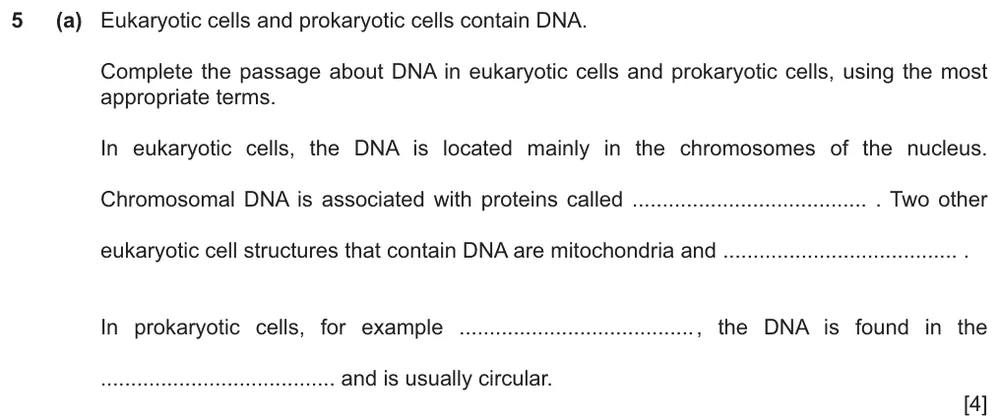
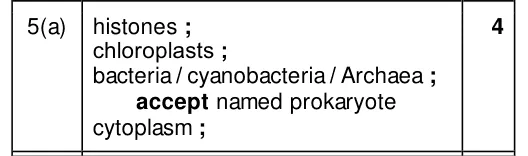
Complete the passage about where DNA is found in eukaryotic cells and prokaryotic cells.
Show the mark scheme
Tap an image to open it full size.
Question 2
Paper 2 · May/June 2024 (22) · Q5(b) · 4 marks
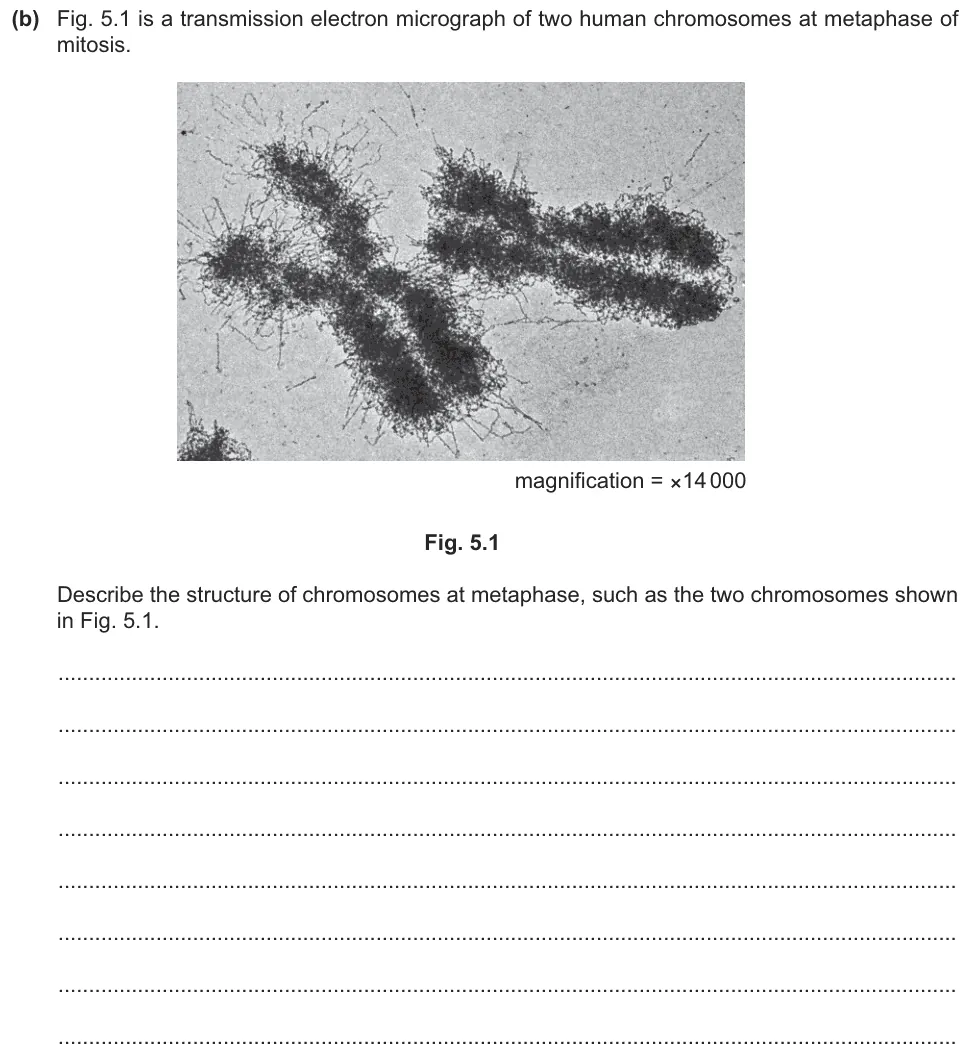
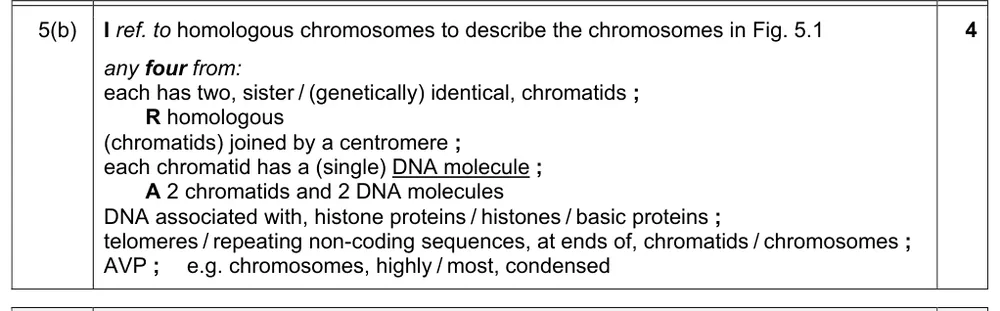
Describe the structure of the two metaphase chromosomes shown in the electron micrograph.
Show the mark scheme
Tap an image to open it full size.
From the examiners' report: The question asks for the structure of the chromosomes, not for a description of metaphase. Say that there are two identical (sister) chromatids joined by a centromere, and that each chromatid has a DNA molecule, not a 'DNA strand'. Some wrote 'centrosome' for centromere, or said that the centromere joins chromosomes together.
Question 3
Paper 2 · October/November 2023 (22) · Q1(a) · 1 mark · Easy
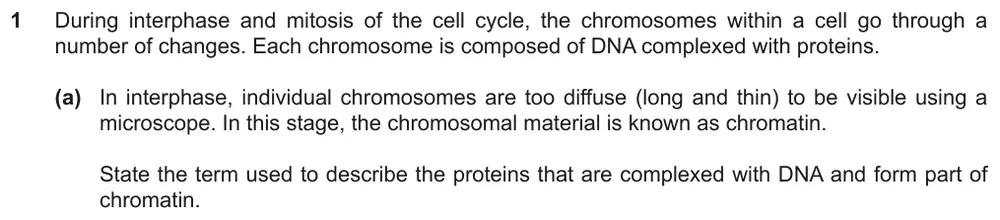
State the name of the proteins that are complexed with DNA in chromatin.
Show the mark scheme

Tap an image to open it full size.
From the examiners' report: Many knew that histone proteins are complexed with DNA. Wrong answers included amino acids, chromatin, chromosome, nucleotides, globular, cytokines and capsids.
Question 4
Paper 4 (A level) · February/March 2021 (42) · Q7(a)(i) · 2 marks · Easy
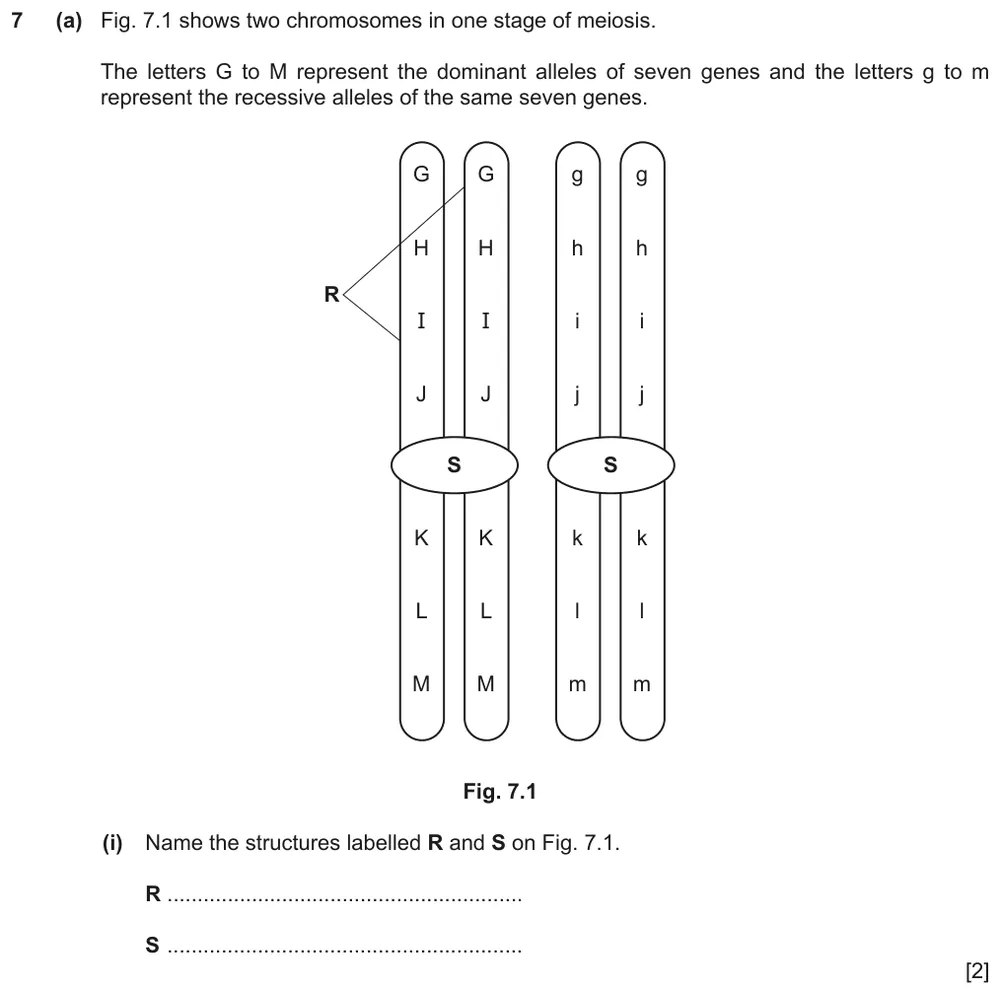
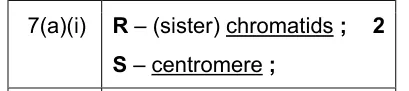
Name the structures labelled R and S on the diagram of two chromosomes.
Show the mark scheme
Tap an image to open it full size.
The importance of mitosis (5.1.2)
Question 5
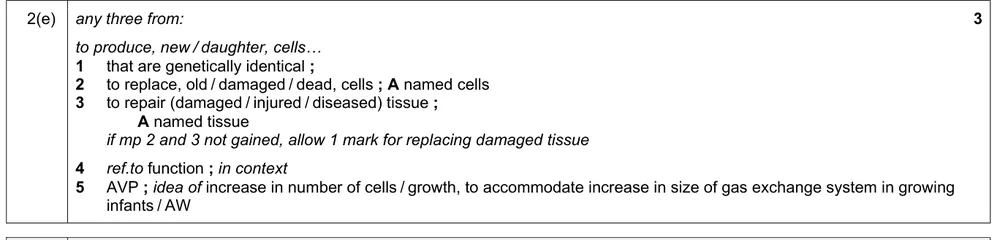
Paper 2 · May/June 2019 (22) · Q2(e) · 3 marks · Easy
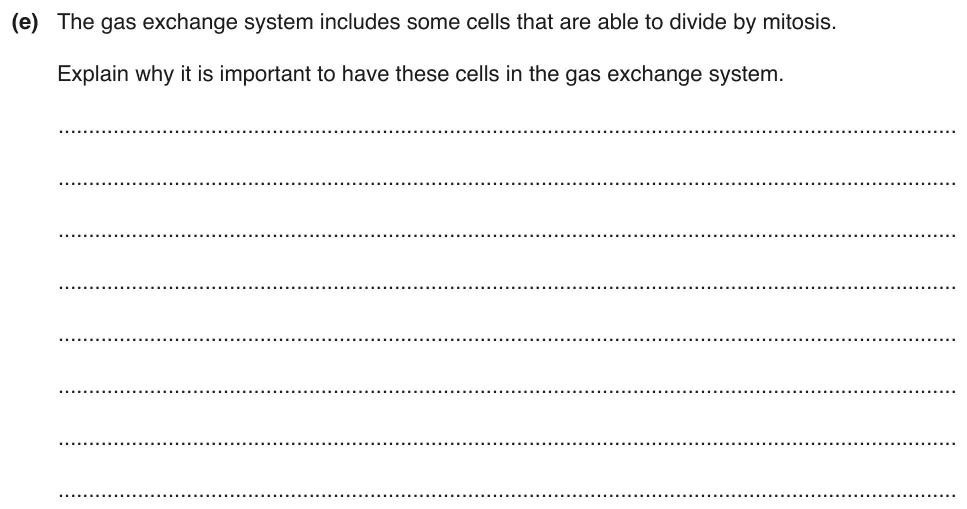
Explain why it is important that some cells in the gas exchange system can divide by mitosis.
Show the mark scheme
Tap an image to open it full size.
From the examiners' report: Saying that cells need replacing was not enough without a reason. Mitosis repairs tissues; many wrongly wrote that it repairs cells. 'Identical cells' was not enough either: the new cells are genetically identical. Asexual reproduction and mitosis in immune system cells had nothing to do with this question.
Question 6
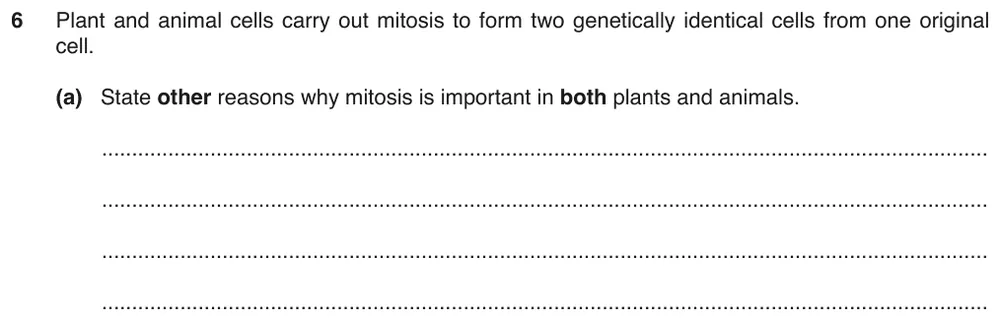
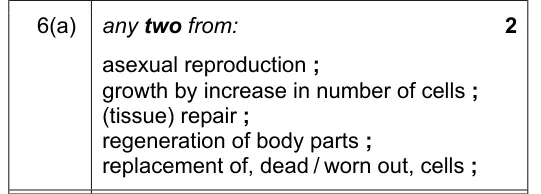
Paper 2 · February/March 2019 (22) · Q6(a) · 2 marks · Hard
State other reasons why mitosis is important in both plants and animals.
Show the mark scheme
Tap an image to open it full size.
From the examiners' report: A common error was to say that mitosis is used to repair damaged cells. Clonal expansion in the immune system was not accepted, because it does not apply to plants.
Question 7
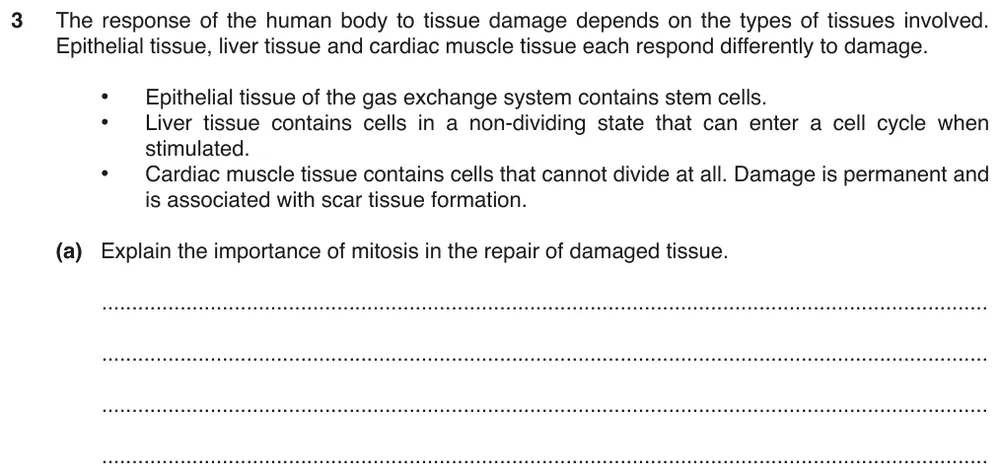
Paper 2 · October/November 2018 (22) · Q3(a) · 2 marks
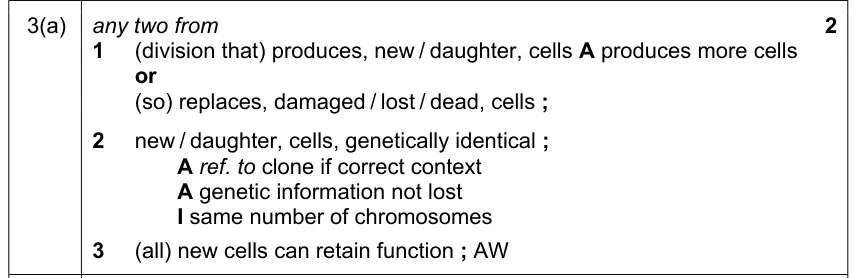
Explain the importance of mitosis in the repair of damaged tissue.
Show the mark scheme
Tap an image to open it full size.
From the examiners' report: Saying that mitosis produces cells was not enough. Stronger answers explained that damaged or dead cells are replaced and that the new cells have the function of the damaged tissue. Do not write 'repair of cells', and say 'genetically identical' rather than 'identical'.
The mitotic cell cycle (5.1.3)
Question 8
Paper 2 · May/June 2023 (22) · Q3(c) · 3 marks · Easy
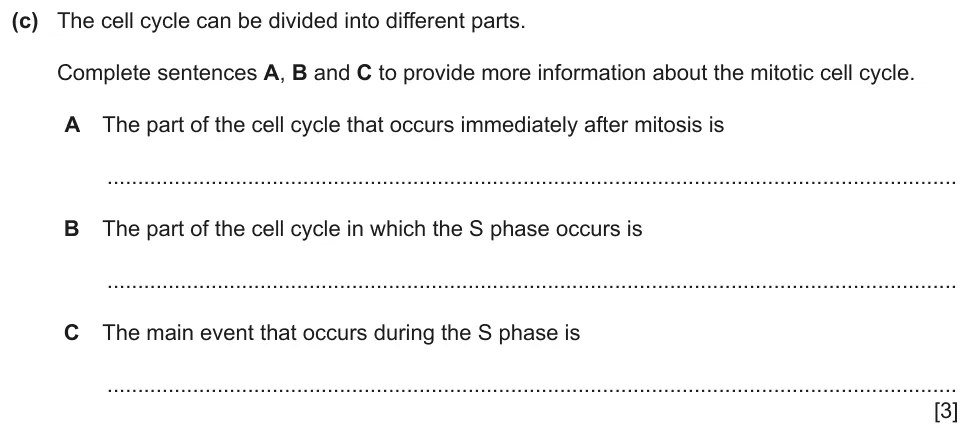
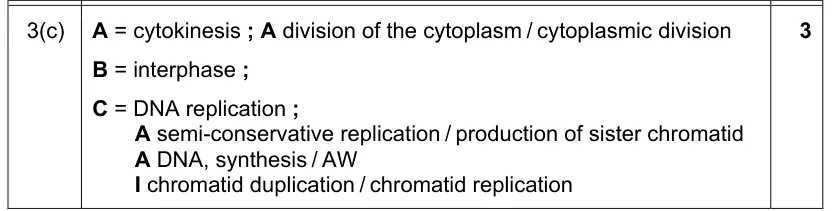
Complete three sentences about the parts of the mitotic cell cycle.
Show the mark scheme
Tap an image to open it full size.
From the examiners' report: Most completed sentences B and C correctly. 'Cell division' was not enough for sentence A, and a number wrongly gave interphase or G1 phase. Sentence C asks for the main event, so give DNA replication and do not add another event.
Question 9
Paper 2 · October/November 2023 (22) · Q1(c) · 3 marks
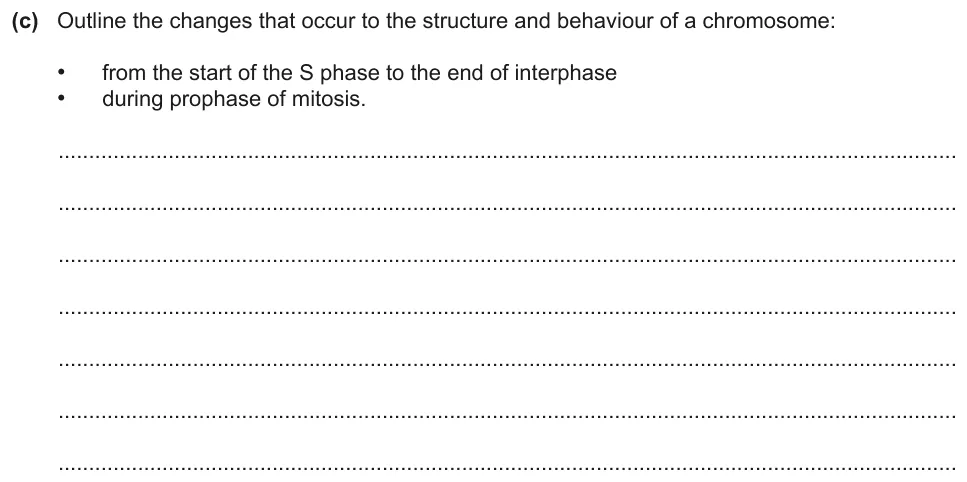
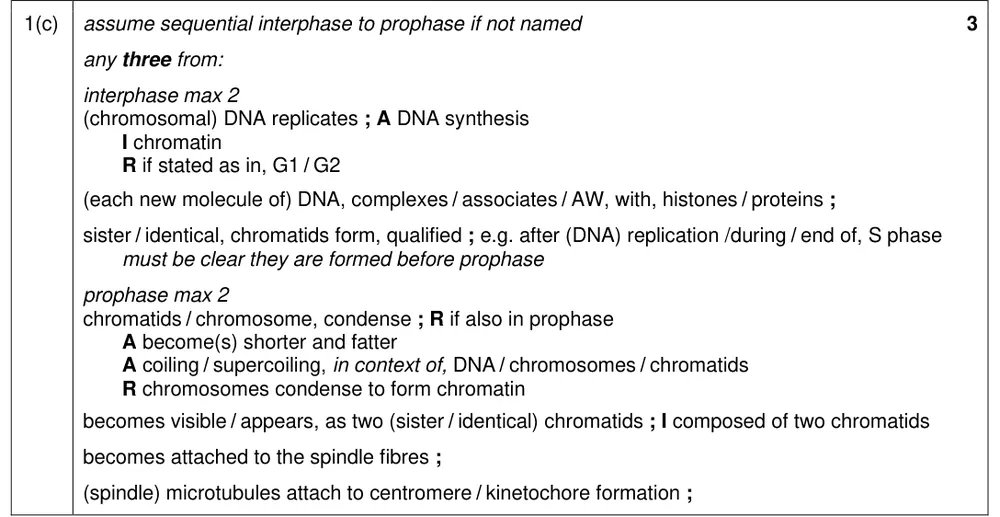
Outline the changes to a chromosome from the start of the S phase to the end of interphase, and during prophase.
Show the mark scheme
Tap an image to open it full size.
From the examiners' report: Many knew that DNA replicates in the S phase; fewer said that this forms two sister chromatids. Some wrongly thought that condensation begins in the G2 phase. Use the terms chromosome, chromatid and chromatin correctly. The rest of mitosis and details of checkpoints were not needed.
Question 10
Paper 2 · October/November 2022 (22) · Q2(f) · 3 marks
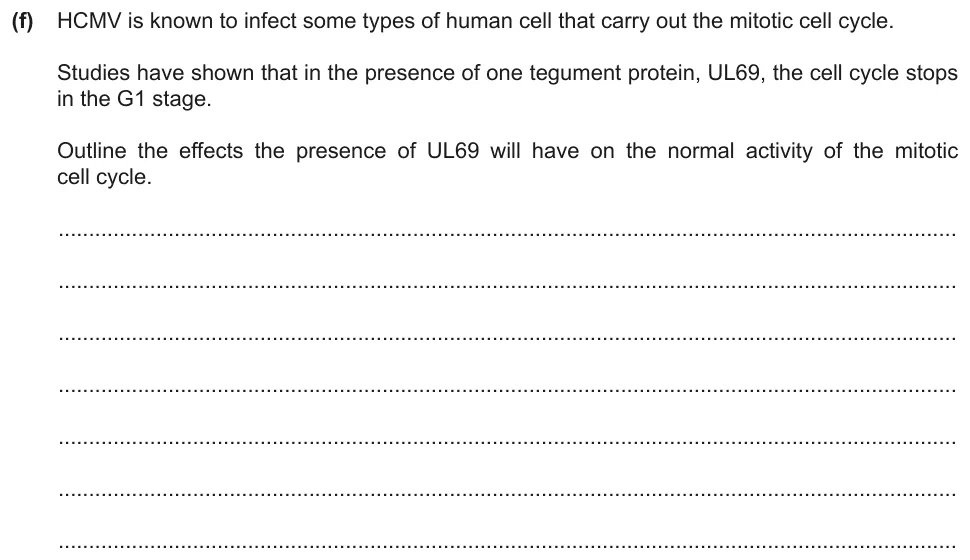
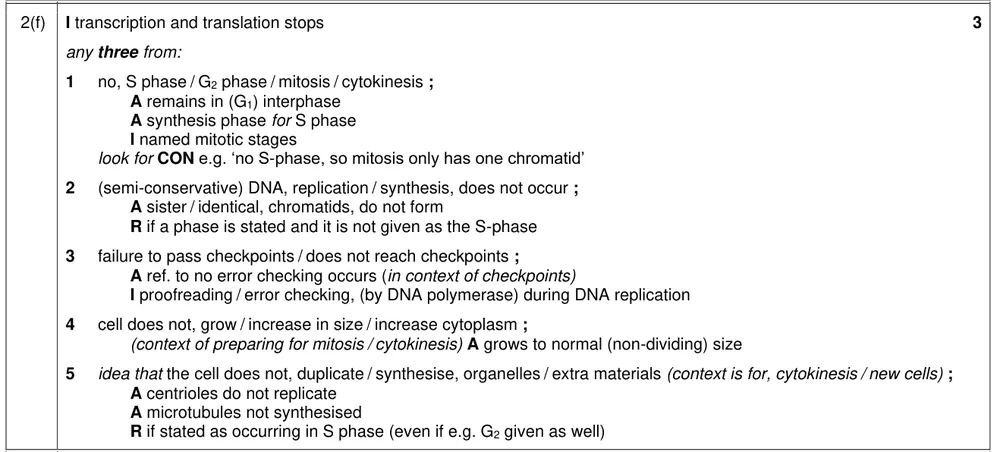
Outline the effects on the mitotic cell cycle of a viral protein that stops the cycle in G1.
Show the mark scheme
Tap an image to open it full size.
From the examiners' report: Many realised that the S and G2 phases, mitosis and cytokinesis would not occur, and linked the missing S phase to no DNA replication. Fewer mentioned growth of the cell or the increase in organelles. Some wrongly suggested that the events of G1 could not occur, or that mutations would lead to uncontrolled mitosis.
Question 11
Paper 2 · February/March 2021 (22) · Q5(a)(i) · 4 marks · Easy
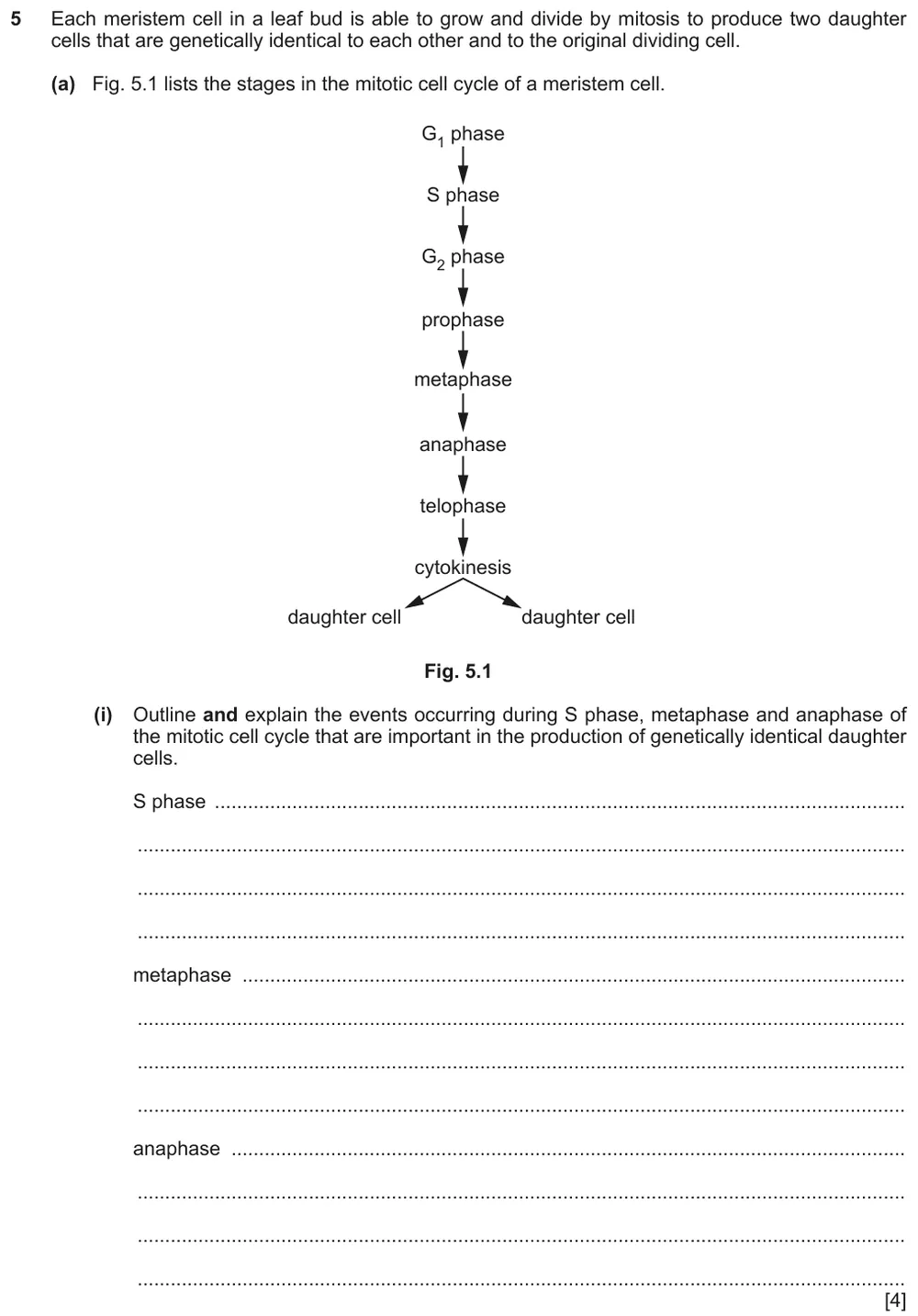
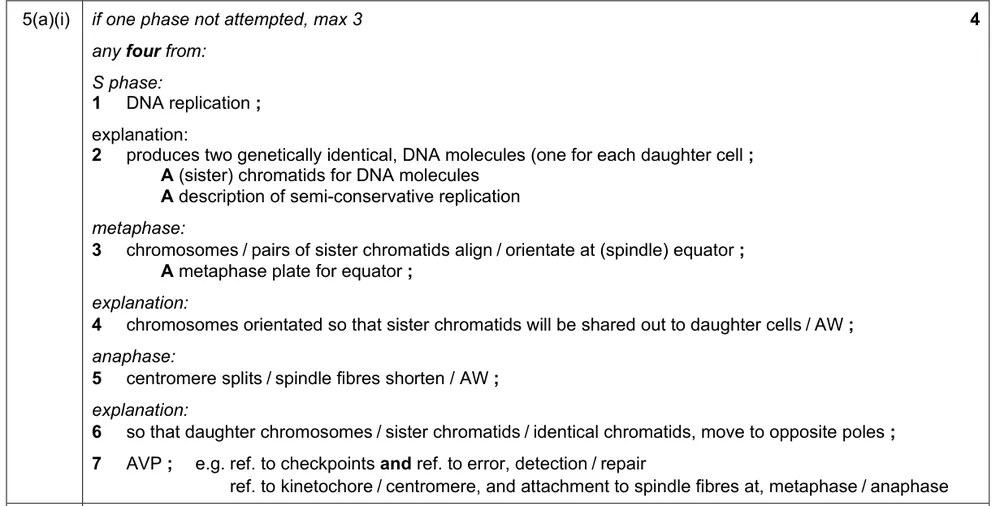
Outline and explain the events in S phase, metaphase and anaphase that are important in producing genetically identical daughter cells.
Show the mark scheme
Tap an image to open it full size.
From the examiners' report: Metaphase and anaphase were usually described in detail. For the S phase, 'synthesis of DNA' did not explain how the daughter cells come to be genetically identical; the term replication does this better. Transcription is not related to the production of genetically identical daughter cells.
Question 12
Paper 2 · February/March 2021 (22) · Q5(a)(ii) · 1 mark
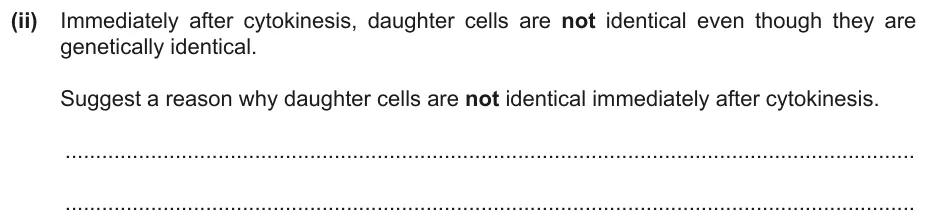
Suggest why daughter cells are not identical immediately after cytokinesis.
Show the mark scheme

Tap an image to open it full size.
From the examiners' report: The comparison needed is between the two daughter cells, not between the daughter cells and the parent cell.
Question 13
Paper 4 (A level) · May/June 2023 (42) · Q2(c) · 1 mark
State the term for the division of the cytoplasm.

Show the mark scheme

Tap an image to open it full size.
From the examiners' report: Most gave the correct term, although spelling mistakes were common. A minority wrote mitosis or reduction division.
Telomeres (5.1.4)
Question 14
Paper 2 · February/March 2022 (22) · Q2(b) · 1 mark · Easy
State the role of telomeres during DNA replication.

Show the mark scheme

Tap an image to open it full size.
Question 15
Paper 2 · May/June 2023 (23) · Q1(b)(ii) · 2 marks
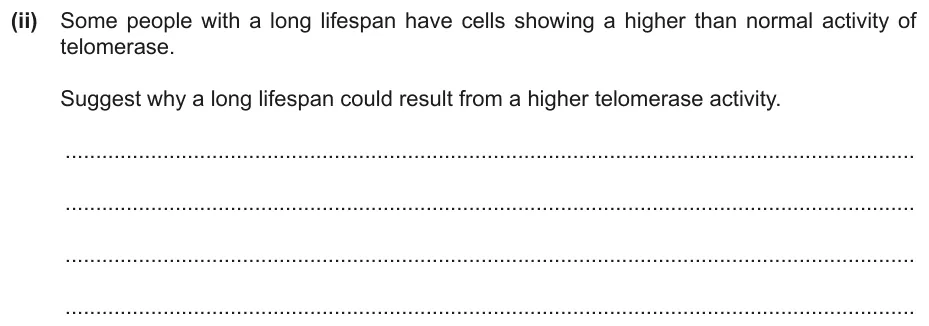
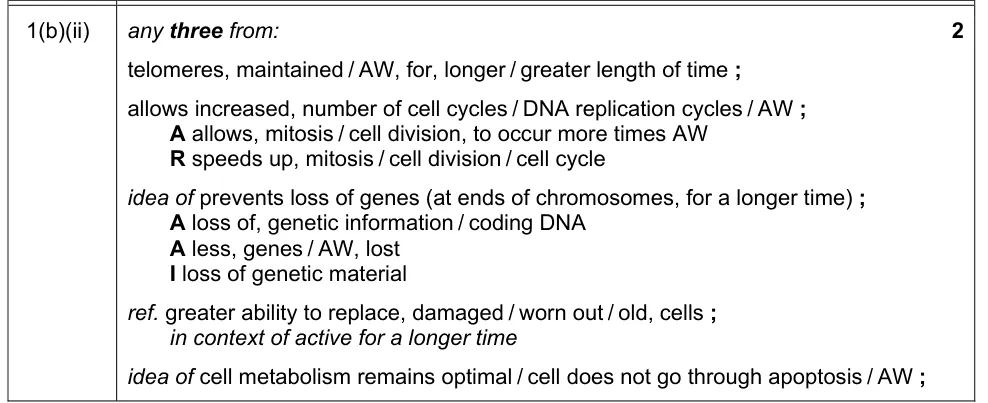
Suggest why a long lifespan could result from a higher telomerase activity.
Information from earlier in this question:

Show the mark scheme
Tap an image to open it full size.
From the examiners' report: Most understood that telomeres help to prevent loss of DNA during replication. 'Loss of genetic material' was not precise enough, because telomeres can themselves be described as genetic material; write genes or genetic information. Some added that more cell division could take place.
Question 16
Paper 2 · October/November 2019 (22) · Q6(a) · 2 marks
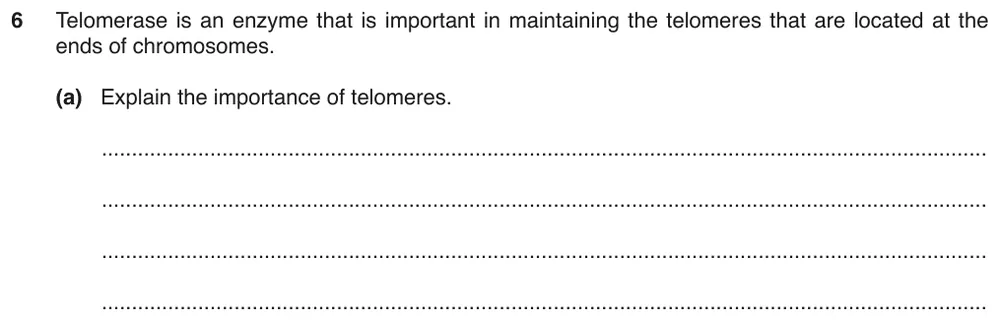
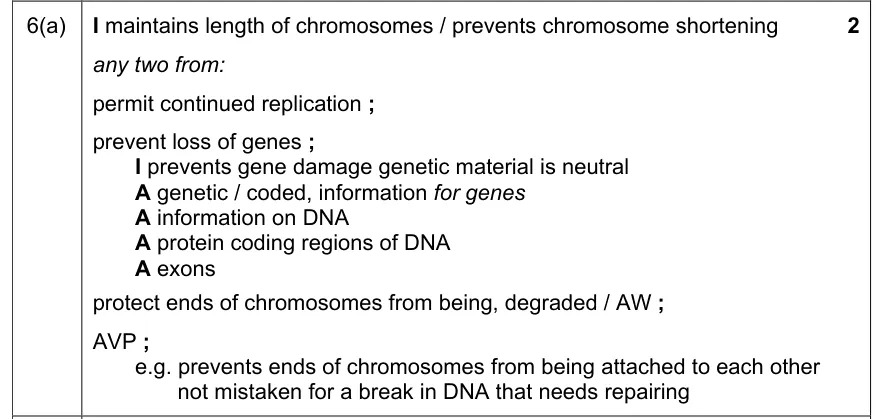
Explain the importance of telomeres.
Show the mark scheme
Tap an image to open it full size.
From the examiners' report: Credit was usually gained for saying that telomeres prevent the loss of genes or genetic information. 'Loss of DNA' or 'loss of genetic material' was not enough, because telomeres are lengths of DNA and they do shorten during replication. Fewer said that telomeres allow DNA replication to continue.
Stem cells (5.1.5)
Question 17
Paper 2 · May/June 2022 (22) · Q1(d) · 4 marks
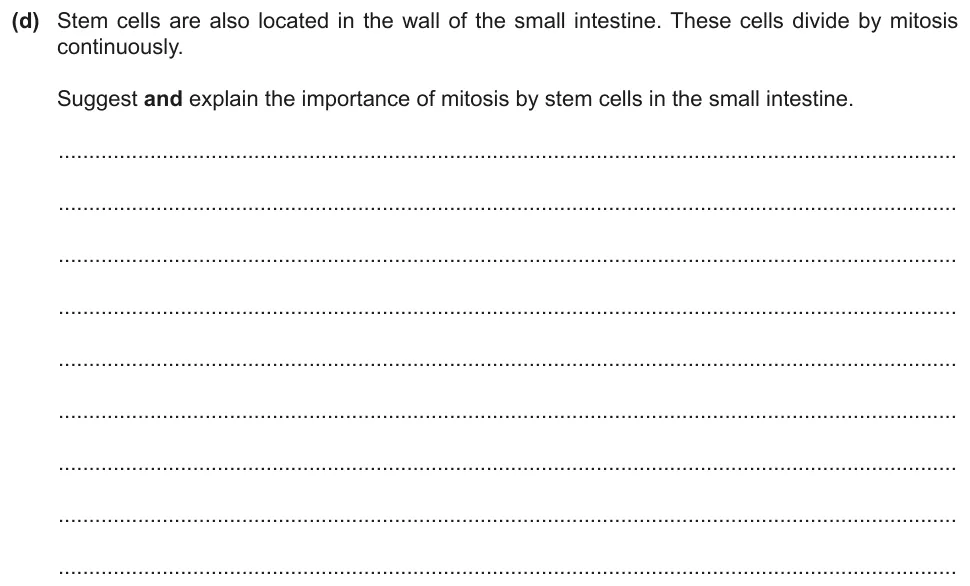
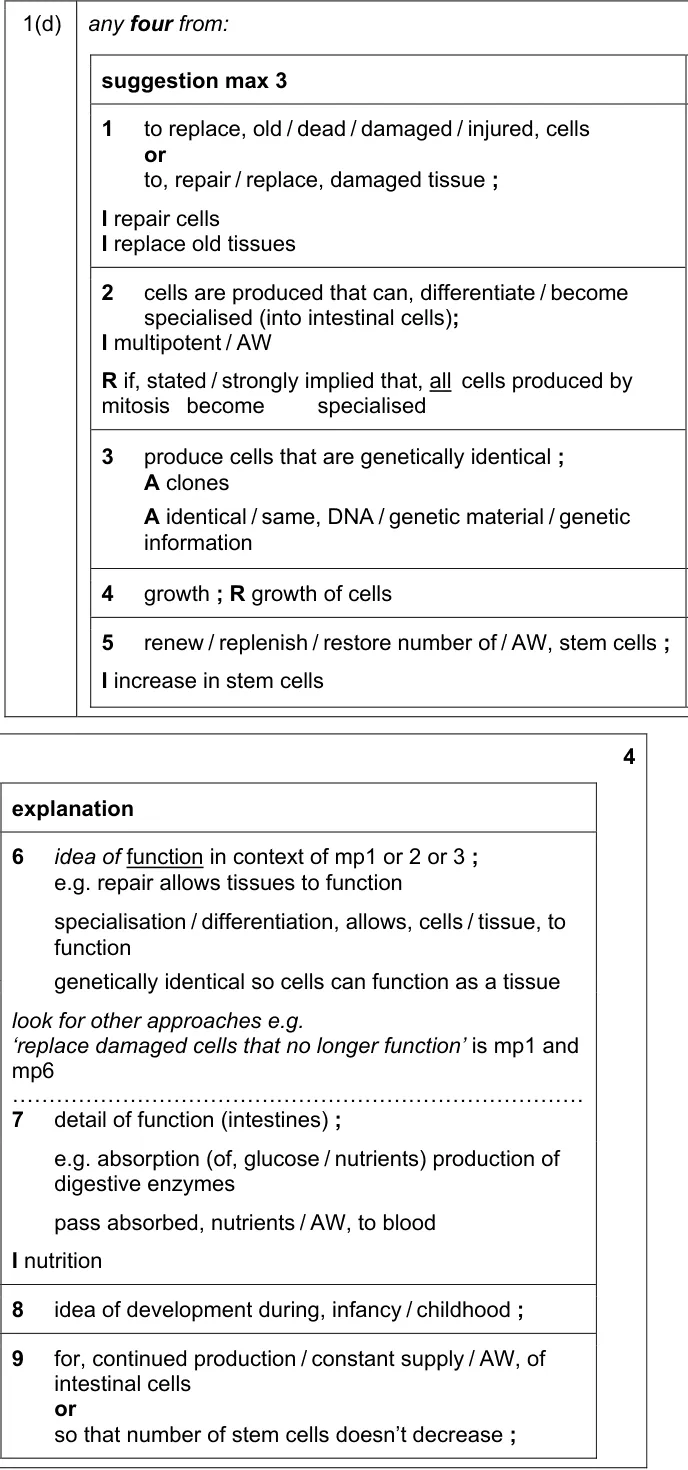
Suggest and explain the importance of mitosis by stem cells in the small intestine.
Show the mark scheme
Tap an image to open it full size.
From the examiners' report: The strongest answers explained that stem cells produce genetically identical daughter cells, which can remain as stem cells or go on to form differentiated cells, and they kept to the cells of the intestine. Weaker answers gave a general list of the uses of mitosis, or wrote about blood cells or ciliated epithelial cells.
Question 18
Paper 2 · February/March 2022 (22) · Q2(c) · 3 marks
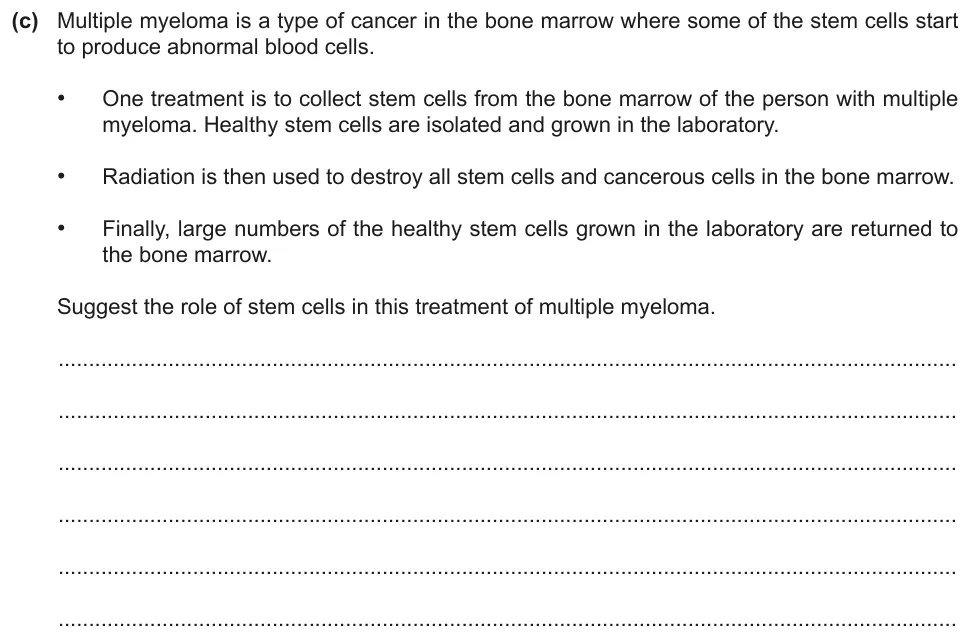
Suggest the role of stem cells in this treatment of multiple myeloma.
Show the mark scheme

Tap an image to open it full size.
From the examiners' report: Keep to the treatment described in the question and do not write about stem cells in general. Make the difference between cell division (mitosis) and cell differentiation clear.
Question 19
Paper 2 · October/November 2018 (22) · Q3(b) · 2 marks
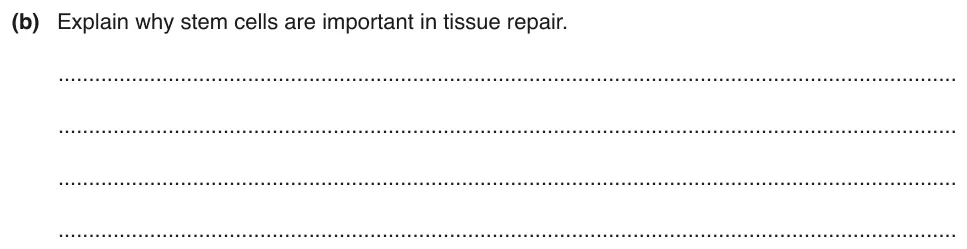
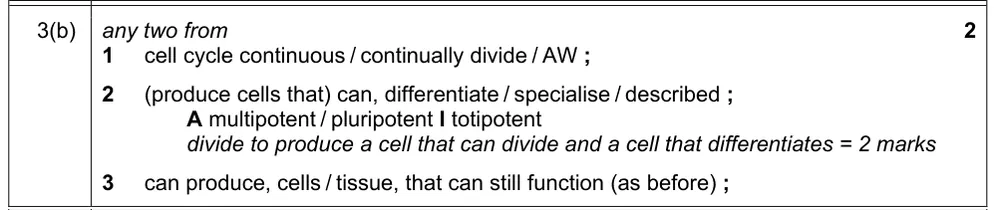
Explain why stem cells are important in tissue repair.
Show the mark scheme
Tap an image to open it full size.
From the examiners' report: The best answers made it clear that stem cells divide to give more stem cells as well as cells that can differentiate, so the stock of stem cells does not run down. Further credit was given for explaining that the tissue containing the new cells can continue to function.
Tumours (5.1.6)
Question 20
Paper 2 · October/November 2024 (22) · Q4(b) · 2 marks
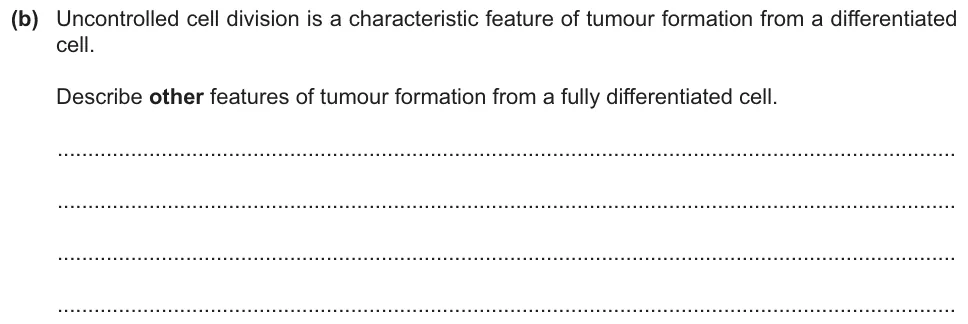
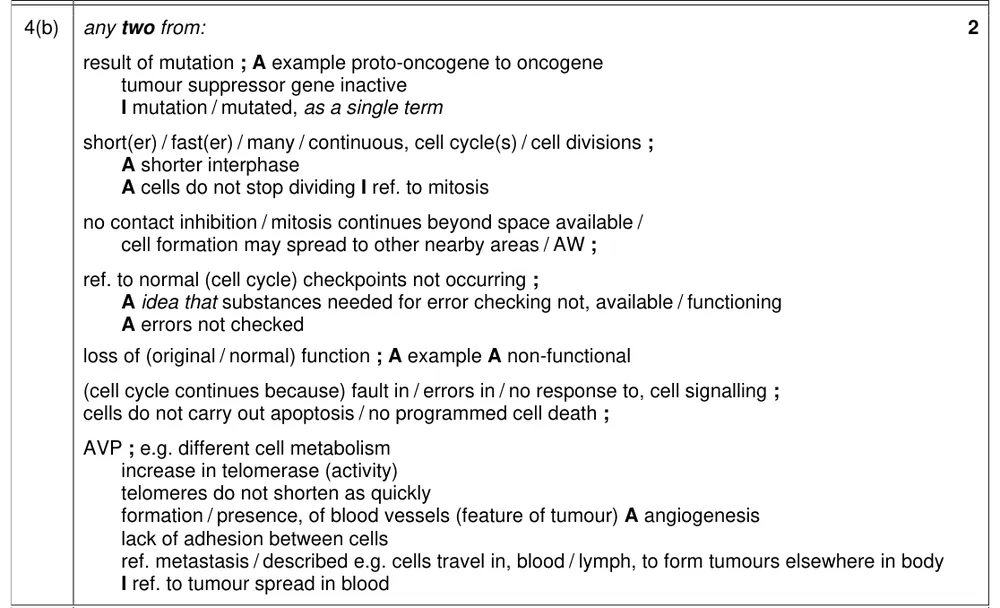
Describe features of tumour formation from a fully differentiated cell, other than uncontrolled cell division.
Show the mark scheme
Tap an image to open it full size.
Question 21
Paper 4 (A level) · May/June 2020 (42) · Q1(b) · 2 marks
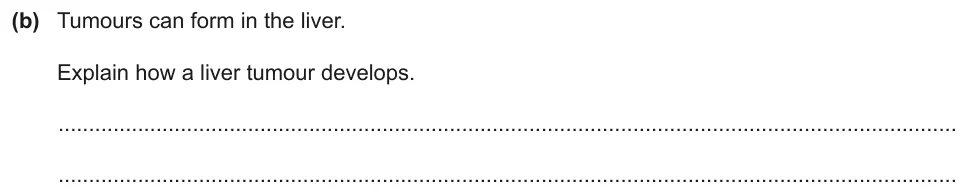
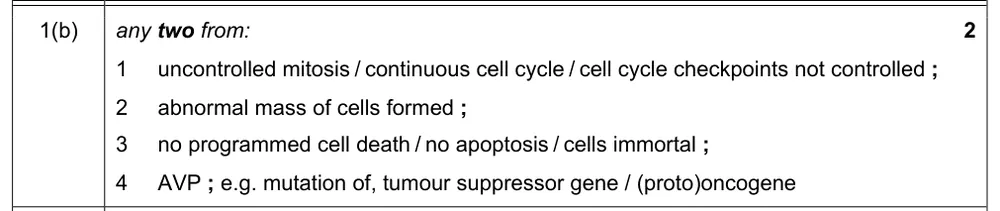
Explain how a liver tumour develops.
Show the mark scheme
Tap an image to open it full size.
Question 22
Paper 2 · October/November 2016 (22) · Q5(a)(ii) · 4 marks
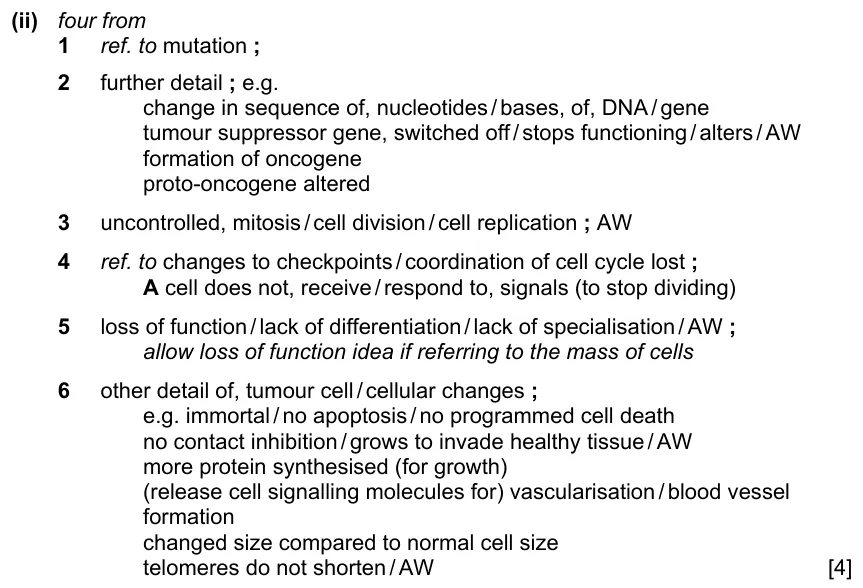
Suggest and explain the cellular changes that occur in the development of lung cancer.
Show the mark scheme
Tap an image to open it full size.
From the examiners' report: Many answers were clear, covering mutation, the types of gene involved and uncontrolled mitosis, often explained in terms of cell signalling or checkpoints. A description of metastasis was not required. Weaker answers wrote about changes in the gas exchange system of a person who smokes.
Where students lose marks (from Cambridge examiners' reports and mark schemes)
Each point below comes from the examiners' reports and mark schemes, and is followed by wording that gained marks.
Describe the chromosome, not metaphase. Students described what happens in metaphase, wrote that each chromatid has a 'DNA strand', or used 'centrosome' for centromere.
✔ Gains credit: each chromosome has 'two sister chromatids' 'joined by a centromere', 'each chromatid has a DNA molecule', the 'DNA associated with histone proteins', with 'telomeres at ends of chromatids'.
Mitosis repairs tissues, not cells. Students wrote that mitosis is used to repair damaged cells.
✔ Gains credit: 'tissue repair', 'replacement of dead or worn out cells' and 'growth by increase in number of cells'.
Genetically identical, not just identical. Students said only that mitosis produces cells, or that the new cells are identical.
✔ Gains credit: mitosis 'replaces damaged cells', the 'daughter cells' are 'genetically identical' and the 'new cells can retain function'.
Sister chromatids form in the S phase. Students thought that condensation begins in the G2 phase, or used chromosome, chromatid and chromatin as if they meant the same thing.
✔ Gains credit: in the S phase 'DNA replicates' and 'sister chromatids form'; in prophase the 'chromosome condenses' and 'becomes visible as two sister chromatids'.
Replication, not just synthesis. Students wrote about synthesis of DNA in the S phase without showing how this gives genetically identical daughter cells, or described transcription.
✔ Gains credit: 'DNA replication' 'produces two genetically identical DNA molecules', one for each daughter cell.
Telomeres prevent the loss of genes. Students wrote that telomeres prevent the loss of DNA or the loss of genetic material.
✔ Gains credit: telomeres 'prevent loss of genes', 'permit continued replication' and 'protect ends of chromosomes from being degraded'.
Division is not differentiation. Students wrote about stem cells in general and did not make clear the difference between mitosis and differentiation.
✔ Gains credit: 'stem cells can undergo mitosis', they 'are undifferentiated', and they 'can differentiate into all blood cell types' to 'replace the person's own blood cell supply'.
Write about the cells, not the lungs. Students described changes in the gas exchange system of a person who smokes when the question asked for the changes in cells.
✔ Gains credit: a 'mutation', such as a 'tumour suppressor gene switched off', leads to 'uncontrolled mitosis', with 'no apoptosis' and 'loss of function'.
Download the questions
Download the PDF pack (22 questions, mark schemes at the end)
Keep practising
- Chromosome Behaviour in Mitosis (5.2): Cambridge (CIE) exam questions by topic
- Cambridge (CIE) A level Biology 9700 past papers, mark schemes and examiners' reports
- Cambridge (CIE) A level Biology grade thresholds
- Book a one-to-one CIE lesson or a free 15-minute discovery chat with Tom
- Register your interest in a CIE A level Biology group class
Questions, mark schemes and examiners' report extracts © Cambridge University Press & Assessment.