

OCR A PAG 10 · 7 questions · mark schemes and examiners’ tips included
PAG 10 is about letting a sensor and a computer do the measuring. You will probably have used a spirometer or a breathing sensor to record your own lung volumes, and an oxygen, carbon dioxide or pH probe with a data logger to follow respiration in yeast or photosynthesis in pondweed.
The exam questions on PAG 10 are rarely about the software itself. They ask you to read a spirometer trace, choose the right probe for the process being measured, say what has to change to control a new variable, and give a genuine advantage of logging data with a computer. The examiners don't give marks for 'more accurate' or 'more precise' on their own, and they want both sides when the command word is evaluate.
Work through the seven questions below in order. They start with spirometers, move on to probes in respiration experiments, and finish with sensors in photosynthesis investigations. If you'd like to go through questions like these with me each week, my OCR A masterclasses run on Wednesdays at 5.15pm for Year 12 and on Tuesdays at 6.30pm or Thursdays at 5.15pm for Year 13.
Want help with this topic? It comes up in my weekly OCR A masterclasses. See the timetable →
What you need from GCSE and Year 12
Each question on this page assumes you're secure on these GCSE and Year 12 ideas. If any of them feels shaky, revise it before you start.
- GCSE: aerobic respiration uses oxygen and releases carbon dioxide; yeast can also respire anaerobically.
- GCSE: the rate of photosynthesis depends on light intensity, carbon dioxide concentration and temperature.
- GCSE: carbon dioxide dissolves in water to make an acid, so the pH falls.
- Year 12 (OCR 3.1.1): how breathing in and out works, and what tidal volume and vital capacity mean.
- Rate = change ÷ time, and reading values from graphs.
Key terms
These words come up in the questions and mark schemes. Examiners expect you to use them exactly.
- Data logger: a device that records readings from a sensor automatically at set time intervals.
- Sensor (probe): an electronic device that measures a variable, such as oxygen concentration, pH or temperature.
- Spirometer: apparatus that measures the volume of air breathed in and out.
- Tidal volume: the volume of air breathed in or out in one normal breath at rest.
- Vital capacity: the largest volume of air you can breathe out after breathing in as deeply as possible.
- Breathing rate and ventilation rate: the number of breaths per minute; and the volume of air breathed per minute (tidal volume × breathing rate).
- Respirometer: apparatus that measures the rate of respiration from the oxygen taken up; soda lime absorbs the carbon dioxide produced.
- Algal beads: algae trapped in alginate jelly; their photosynthesis changes the colour of hydrogencarbonate indicator.
- Valid: the results answer the question being asked, because the other variables are controlled.
What these questions cover (OCR PAG 10: data loggers and computer modelling)
PAG 10 is one of the twelve practical activity groups in the OCR A Level Biology A specification (H420). The questions test these parts of the specification:
- 1.2.2(l) use of ICT such as computer modelling, or a data logger to collect data, or use of software to process data
- 3.1.1(e) the relationship between vital capacity, tidal volume, breathing rate and oxygen uptake (to include data from a data logger or spirometer)
- 5.2.2(l) practical investigations into the effect of factors such as temperature, substrate concentration and different respiratory substrates on the rate of respiration (to include the use of respirometers)
- 5.2.1(g)(ii) practical investigations into factors affecting the rate of photosynthesis
How to use this page
Write your answer on paper before you open the mark scheme. Allow about 1.2 minutes per mark: the 7 questions are worth 13 marks, so about 16 minutes in total. Then mark your answer strictly against the mark scheme and read the examiners' tip underneath it. If you'd rather print the questions, download the PDF pack.
Spirometers and breathing data
Question 1
AS Paper 2 · June 2016 · Q1(b)(ii) · 2 marks · Medium
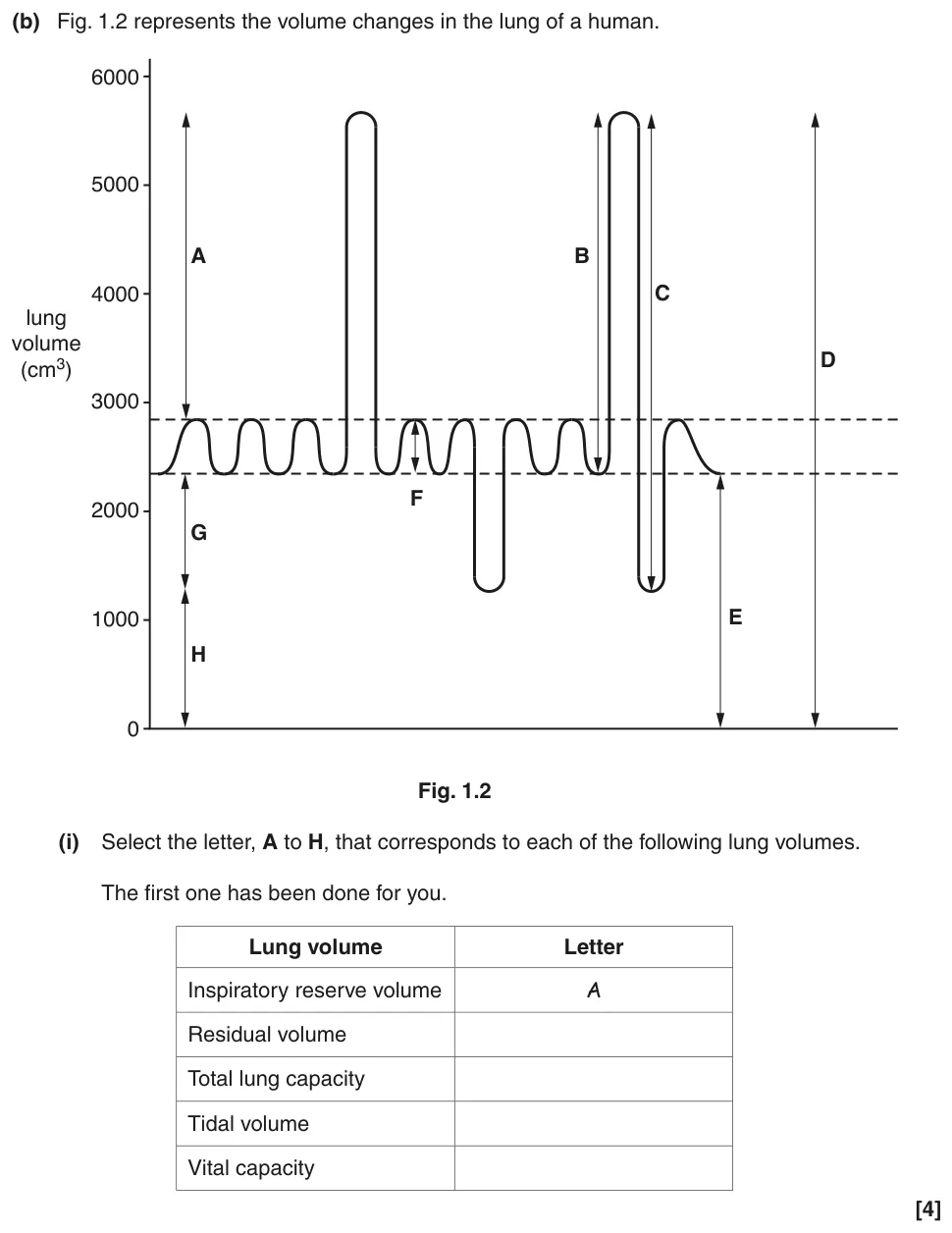
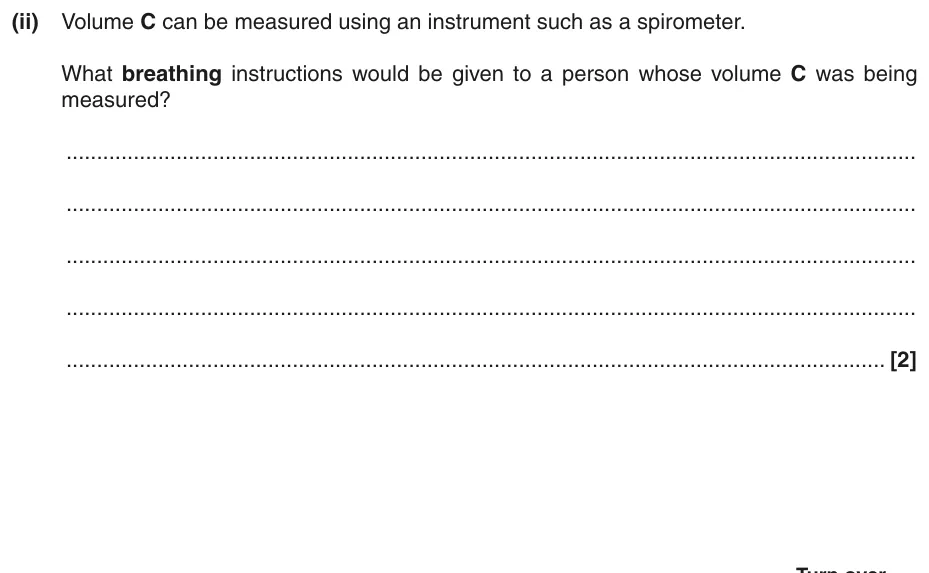
Give the breathing instructions for measuring a person's vital capacity with a spirometer.
Information from earlier in this question:
Show the mark scheme
Tap an image to open it full size.
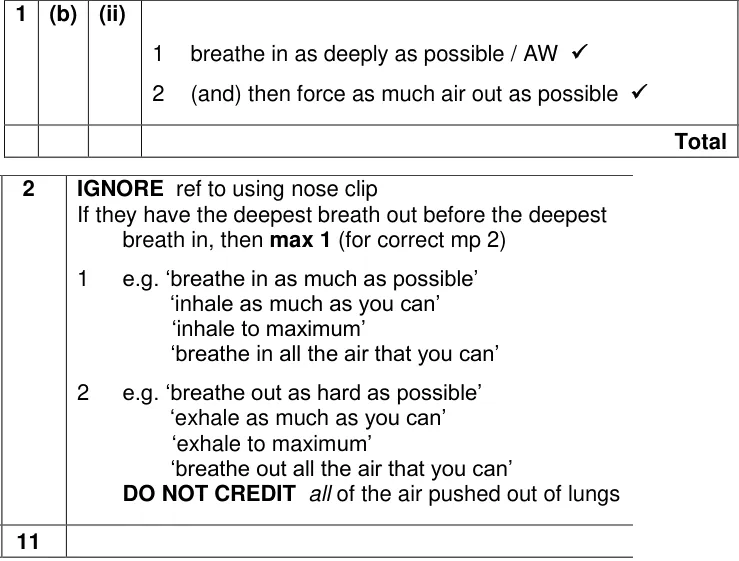
From the examiners' report: There's no examiners' comment for this part. The mark scheme wants the order right: the deepest possible breath in first, then breathe out as hard and as far as you can. Saying 'all the air is pushed out of the lungs' isn't credited, because the residual volume always stays behind.
Question 2
AS Paper 1 · November 2021 · Q23(a)(ii) · 2 marks · Medium
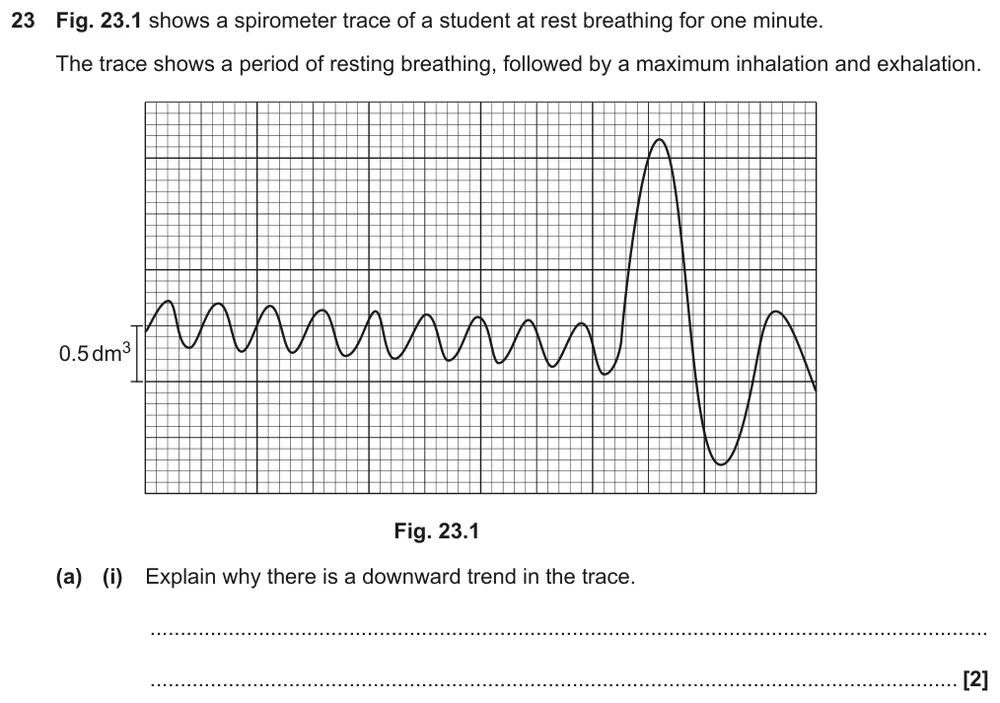
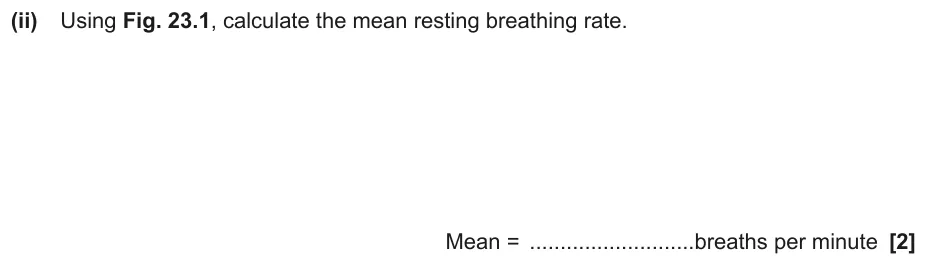
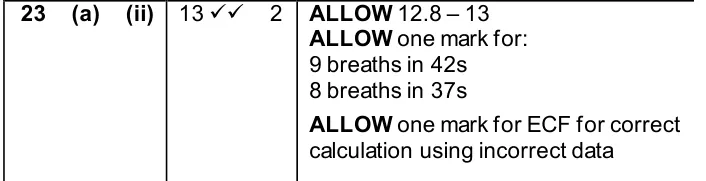
Calculate the mean resting breathing rate from a spirometer trace.
Information from earlier in this question:
Show the mark scheme
Tap an image to open it full size.
From the examiners' report: There's no examiners' comment for this part. Count complete breaths over the resting section only, read the time they take from the trace, then scale up to breaths per minute; one mark is available for the count and time even if the final answer slips.
Probes and data loggers in respiration
Question 3
A level Paper 1 · June 2022 · Q20(a)(i) · 2 marks · Medium
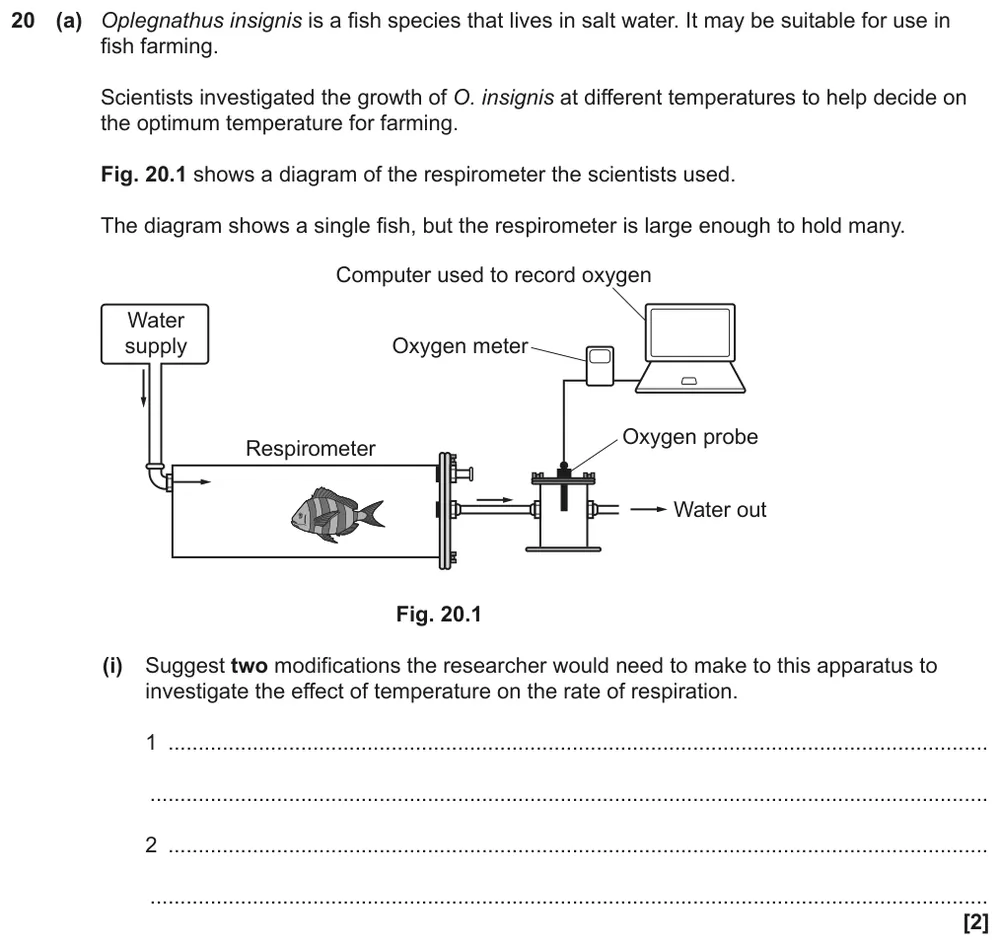
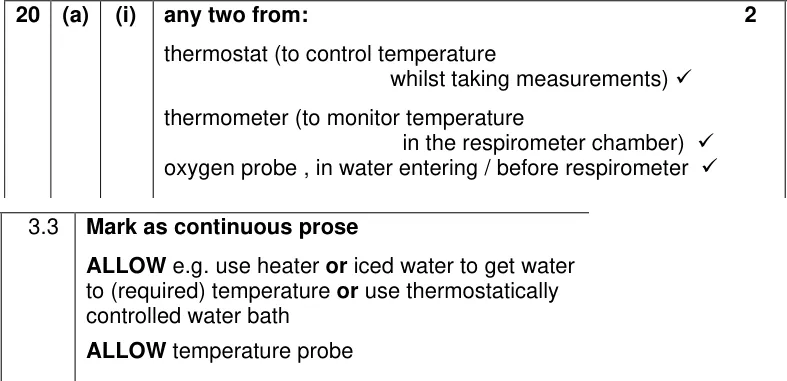
Suggest two modifications to a computer-linked fish respirometer to investigate the effect of temperature.
Show the mark scheme
Tap an image to open it full size.
From the examiners' report: Most students suggested a thermometer, but a water bath on its own isn't enough: say a thermostat controls the temperature while readings are taken, or that a heater brings the water to the required temperature. A stop clock isn't a modification to this apparatus.
Question 4
A level Paper 1 · June 2022 · Q20(a)(ii) · 1 mark · Medium
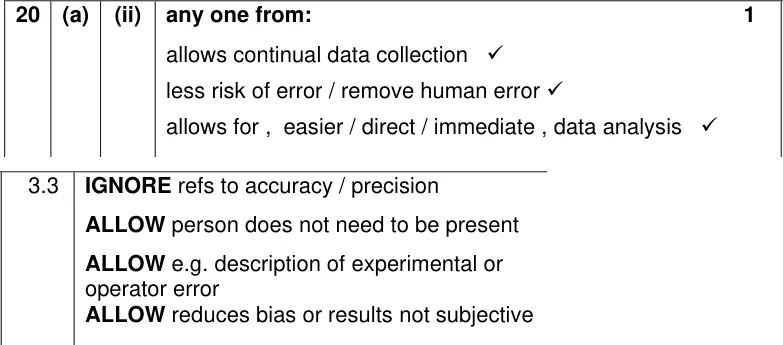
Suggest one advantage of using a computer to collect the data.

Show the mark scheme
Tap an image to open it full size.
From the examiners' report: Removing human error was the most common correct answer. 'More accurate' or 'more precise' got no mark, and neither did saying a computer gives quantitative results. Continuous recording and quicker analysis were good answers that few students gave.
Question 5
A level Paper 3 · June 2017 · Q2(b)(iv) · 3 marks · Medium
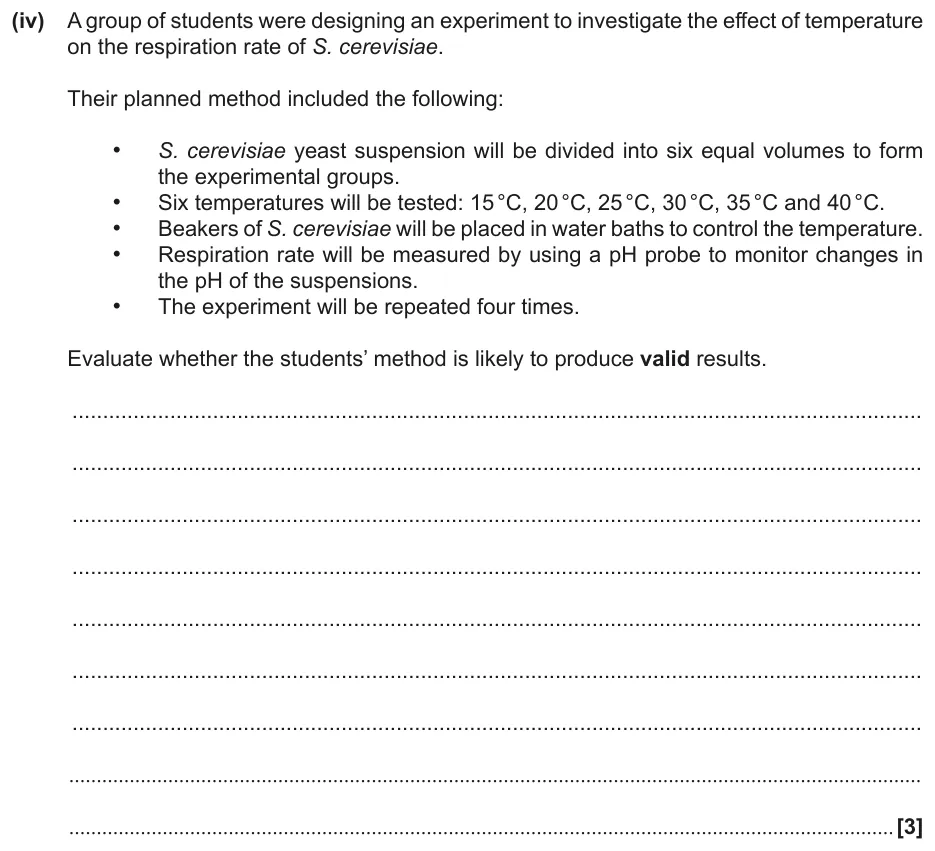
Evaluate whether a plan using a pH probe to measure yeast respiration at six temperatures will give valid results.
Show the mark scheme
Tap an image to open it full size.
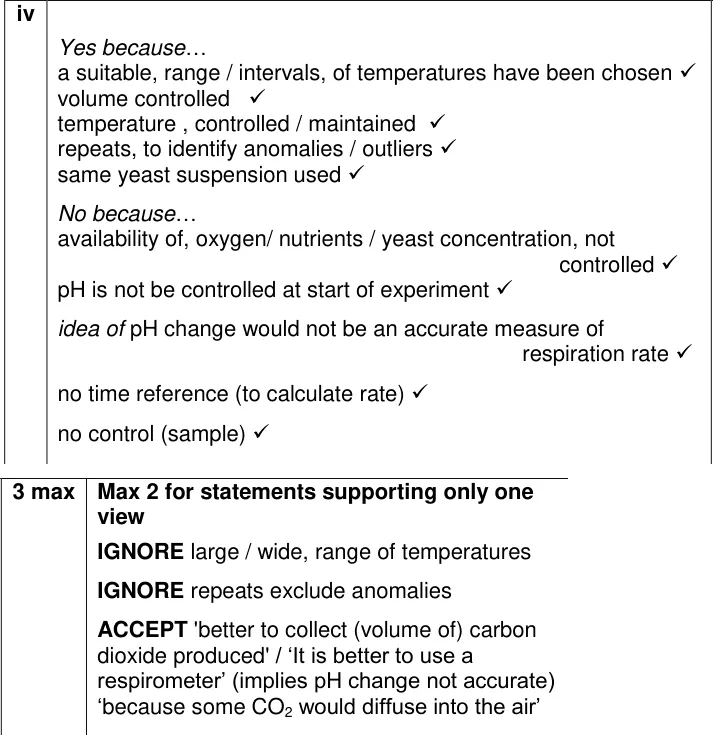
From the examiners' report: Evaluate means arguments for and against: answers that only said yes or only said no were capped at 2 marks. Good answers spotted that a pH change isn't an accurate measure of respiration rate. Repeats help you identify anomalies, which isn't the same as removing them.
Sensors in photosynthesis investigations
Question 6
A level Paper 1 · June 2019 · Q22(b)(ii) · 1 mark · Medium
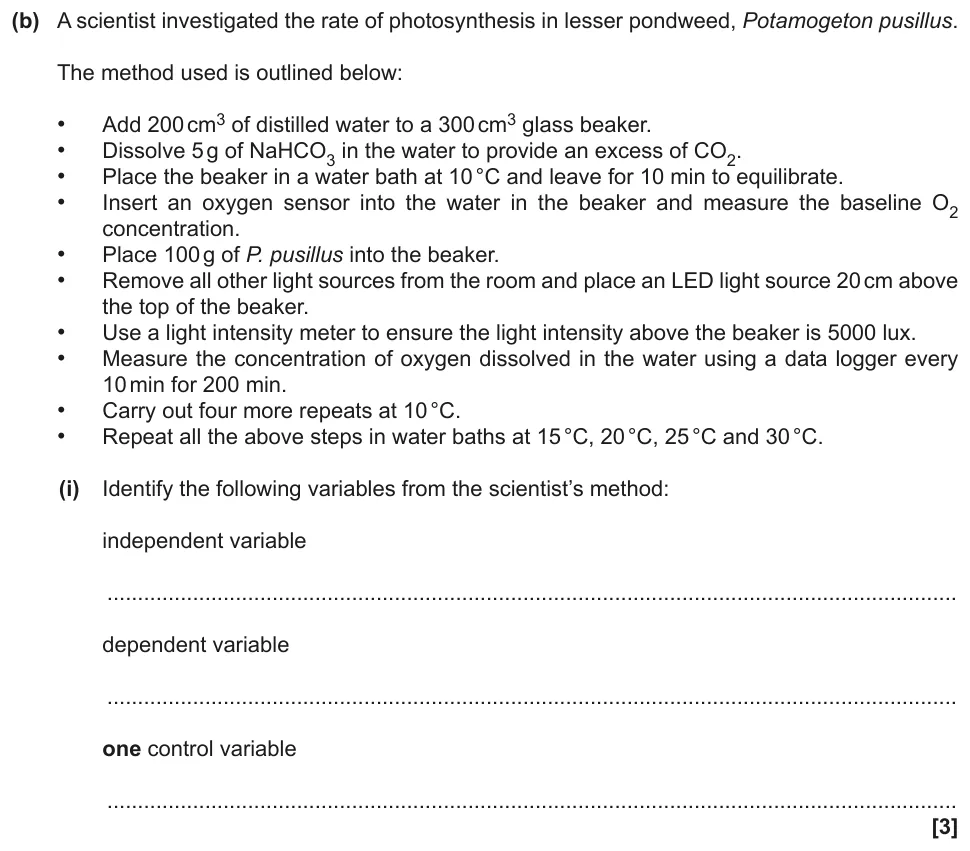
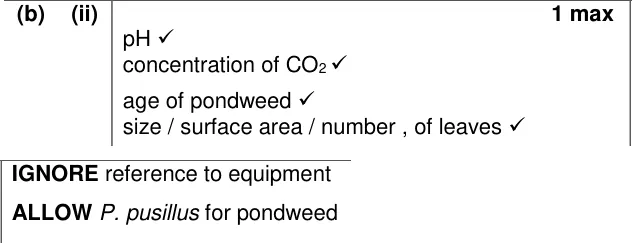
Identify one variable not controlled in a pondweed investigation that uses an oxygen sensor and data logger.
Information from earlier in this question:

Show the mark scheme
Tap an image to open it full size.
From the examiners' report: There's no examiners' comment for this part. Name a condition that affects the rate of photosynthesis, such as pH or the number of leaves; answers about the equipment weren't credited.
Question 7
A level Paper 1 · June 2025 · Q19(b)(ii) · 2 marks · Medium
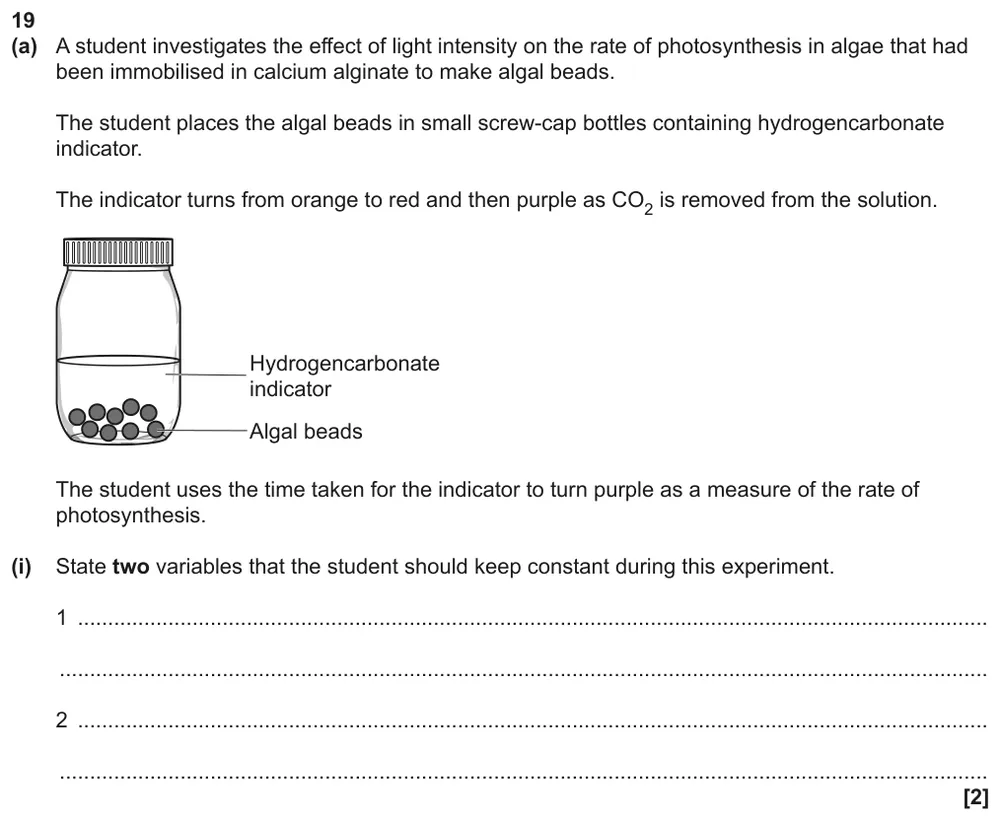
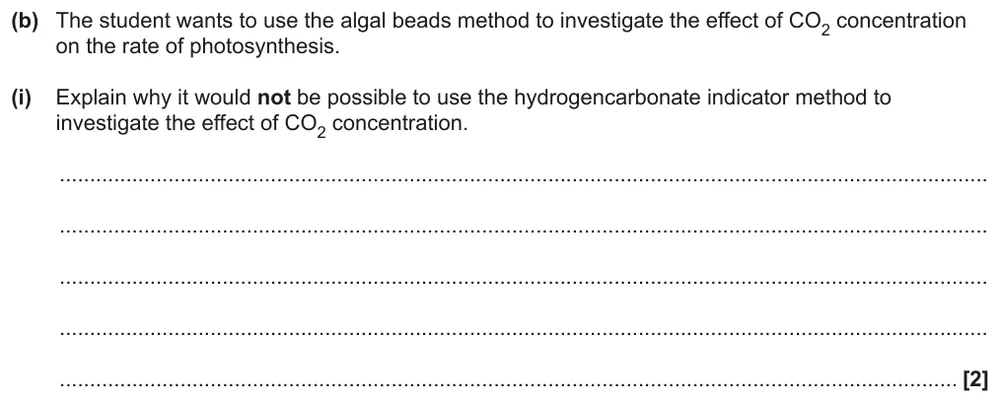
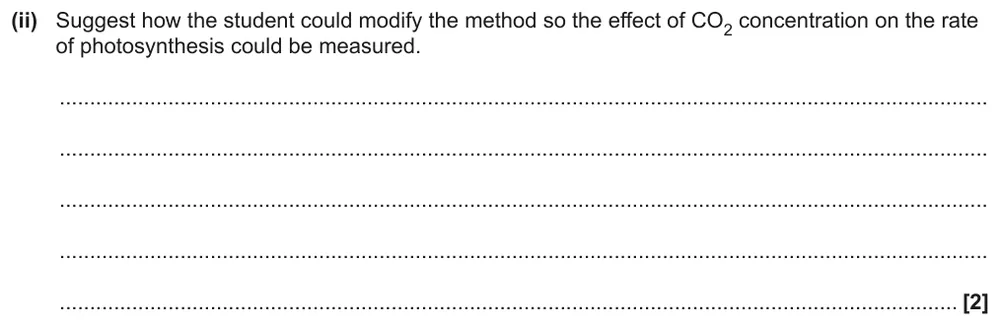
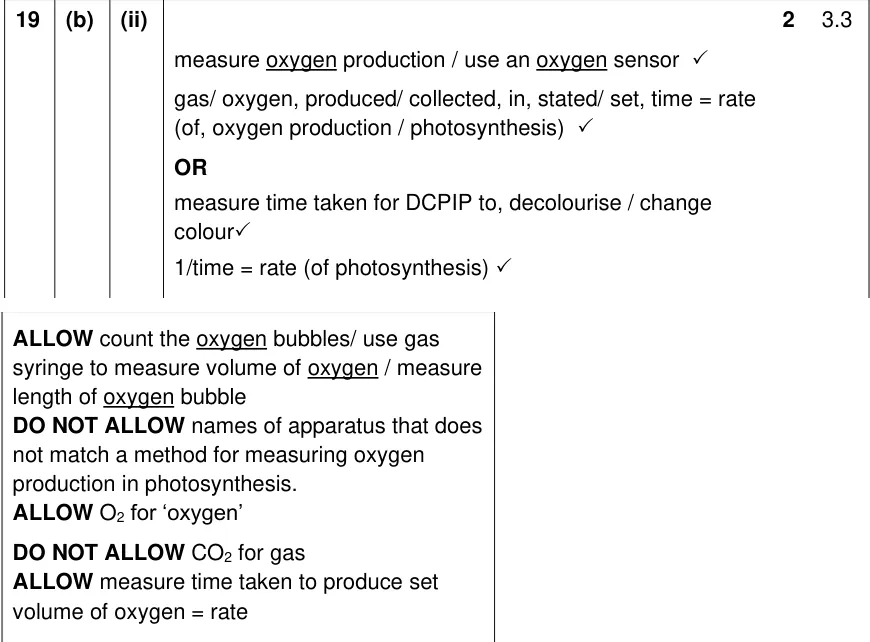
Suggest how to modify an algal beads method to measure the effect of CO2 concentration on photosynthesis.
Information from earlier in this question:
Show the mark scheme
Tap an image to open it full size.
From the examiners' report: Many students rightly said to measure the oxygen produced, but then named apparatus that doesn't measure photosynthesis, such as a potometer or respirometer. Pair the measurement with a time so it becomes a rate.
Where students lose marks (from OCR examiners' reports and mark schemes)
Each point below is followed by wording that gained marks.
Deepest breath in comes first: For vital capacity on a spirometer, giving the deepest breath out before the deepest breath in limited the answer to 1 mark, and 'all of the air pushed out of the lungs' wasn't credited.
✔ Gains credit: "Breathe in as deeply as possible, and then force as much air out as possible".
Control the temperature, don't just set it: Most students added a thermometer, but examiners have stressed that a water bath on its own isn't enough, and a heater needs a reason.
✔ Gains credit: "Thermostat (to control temperature whilst taking measurements)"; "use a heater or iced water to get the water to the required temperature".
Name a real advantage of logging: Students said a computer makes results more accurate or precise, or that it gives quantitative results; none of these gained the mark.
✔ Gains credit: "Allows continual data collection"; "less risk of error / removes human error"; "allows easier, direct or immediate data analysis".
Evaluate means both sides: Many answers gave only 'yes, because…' or only 'no, because…', which capped them at 2 marks.
✔ Gains credit: "Yes because temperature is controlled… No because pH change would not be an accurate measure of respiration rate".
Repeats identify anomalies: Students said repeats are for removing or discarding anomalies before calculating a mean, and missed the mark.
✔ Gains credit: "Repeats, to identify anomalies / outliers".
A condition, not a piece of kit: Asked for a variable that wasn't controlled, answers that named equipment were ignored.
✔ Gains credit: "pH"; "concentration of CO2"; "age of pondweed"; "size / surface area / number of leaves".
Match the apparatus to the process: Students rightly said to measure oxygen, then named a potometer or respirometer, which don't measure photosynthesis.
✔ Gains credit: "Measure oxygen production / use an oxygen sensor; oxygen collected in a set time = rate of photosynthesis".
Download the questions
Download the PDF pack (7 questions, mark schemes at the end)
Keep practising
- PAG 5 Colorimeter and Potometer: OCR A Level Biology exam questions by topic
- Handling Data (M1): OCR A Level Biology exam questions by topic
- OCR A gas exchange quiz
- OCR A Level Biology respiration quiz
- OCR A Level Biology masterclasses
Questions, mark schemes and examiners' report extracts © OCR.