

OCR A M0 · 18 questions · mark schemes and examiners’ tips included
The M0 skills are the everyday arithmetic of A Level Biology: units, standard form, percentages and ratios, estimates, and logs and powers on your calculator. They turn up in almost every topic, from cell counts and energy transfer to cardiac output and PCR, and they carry a big share of the maths marks on your papers.
These are rarely hard sums. Marks are lost on the details: multiplying by 8 when something is 800% greater, dividing by the final value instead of the starting one, forgetting to convert cm³ to dm³, giving too many significant figures in an estimate, or not writing the answer in standard form when the question asks for it. The examiners' reports point out the same slips every year, so careful reading wins most of them back.
Work through the eighteen questions below with your calculator. They are grouped by skill, starting with units, then standard form, percentages and ratios, estimating, and finally logs and powers. If you'd like to go through questions like these with me each week, my OCR A masterclasses run on Wednesdays at 5.15pm for Year 12 and on Tuesdays at 6.30pm or Thursdays at 5.15pm for Year 13.
Want help with this topic? It comes up in my weekly OCR A masterclasses. See the timetable →
What you need from GCSE
Each question on this page assumes you're secure on these GCSE ideas. If any of them feels shaky, look it up before you start.
- Unit prefixes: kilo (×1000), milli (÷1000), micro (÷1 000 000) and nano (÷1 000 000 000). 1 mm = 1000 µm, 1 dm³ = 1000 cm³ and 1 cm³ = 1000 mm³.
- Write very large and very small numbers in standard form, such as 3.2 × 10⁶.
- Round to a given number of significant figures or decimal places.
- Percentage = part ÷ whole × 100, and percentage change = (new value − original value) ÷ original value × 100.
- Simplify a ratio and use it to compare two quantities.
Key terms
These words come up in the questions and mark schemes. Examiners expect you to use them exactly.
- Standard form: a number written as A × 10ⁿ, where A is between 1 and 10 (for example 0.00045 = 4.5 × 10⁻⁴).
- Significant figures: the digits in a number that carry meaning, counted from the first non-zero digit. 0.04072 to 2 significant figures is 0.041.
- Order of magnitude: a power of ten. A value 1000 times bigger is three orders of magnitude bigger.
- Rate: a change divided by the time it took; the unit always includes 'per unit time', such as mm day⁻¹.
- Percentage increase or decrease: the change as a percentage of the starting value. Something 800% greater is 9 times the original, not 8 times.
- Ratio: how much of one quantity there is compared with another, written as a : b or as one number divided by the other.
- Logarithm (log₁₀): the power that 10 is raised to. log₁₀ 1000 = 3, and pH = −log₁₀[H⁺].
- Estimate: a sensible approximate value, for example counting squares under a curve to find its area.
- Mean: the total divided by the number of values.
What these questions cover (OCR maths skills M0: arithmetic and numerical computation)
The questions test these mathematical skills from the OCR A Level Biology A specification (H420):
- M0.1 Recognise and make use of appropriate units in calculations
- M0.2 Recognise and use expressions in decimal and standard form
- M0.3 Use ratios, fractions and percentages
- M0.4 Estimate results
- M0.5 Use calculators to find and use power, exponential and logarithmic functions
How to use this page
Write your answer on paper before you open the mark scheme. Allow about 1.2 minutes per mark: the 18 questions are worth 32 marks, so about 38 minutes in total. Then mark your answer strictly against the mark scheme and read the examiners' tip underneath it. If you'd rather print the questions, download the PDF pack.
Units in calculations (M0.1)
Question 1
A level Paper 3 · June 2022 · Q3(c)(i) · 1 mark · Medium
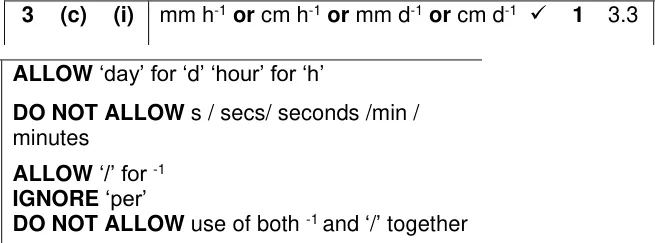
Suggest suitable units for the rate of stem elongation in pea plants.

Show the mark scheme
Tap an image to open it full size.
From the examiners' report: Many students gave a unit of length, such as mm, when the question asked about a rate. Others used seconds or minutes, which don't suit something as slow as plant growth, or wrote the unit with both a slash and a negative index.
Question 2
A level Paper 3 · June 2017 · Q4(c)(i) · 2 marks · Medium
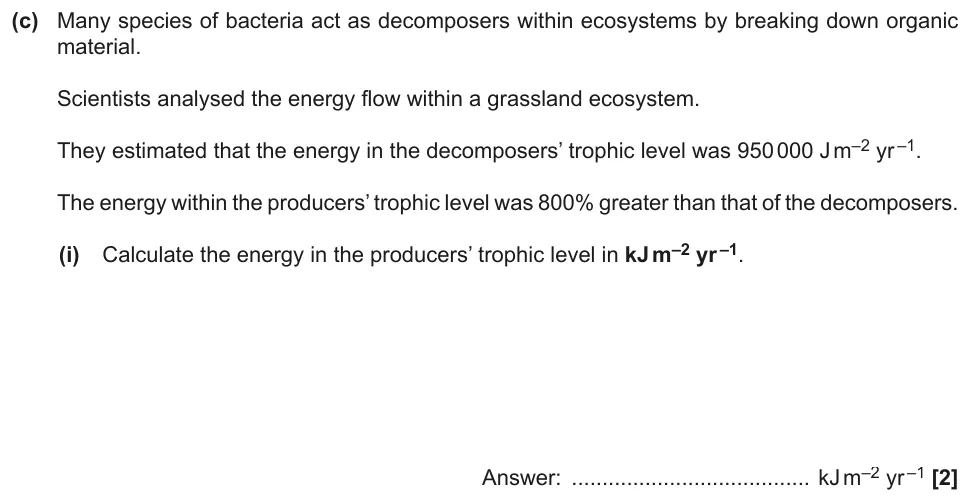
Calculate the energy in the producers when it is 800% greater than in the decomposers, in kJ.
Show the mark scheme

Tap an image to open it full size.
From the examiners' report: Only a few students got both marks. Many multiplied 950 000 by 8 instead of 9 and got 7600, and others forgot to convert J to kJ. 800% greater means the original plus eight times more.
Question 3
A level Paper 1 · November 2021 · Q20(c)(ii) · 2 marks · Medium
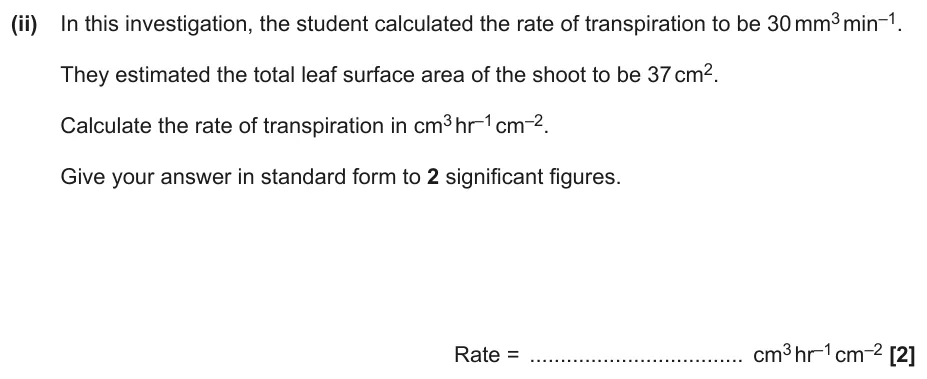
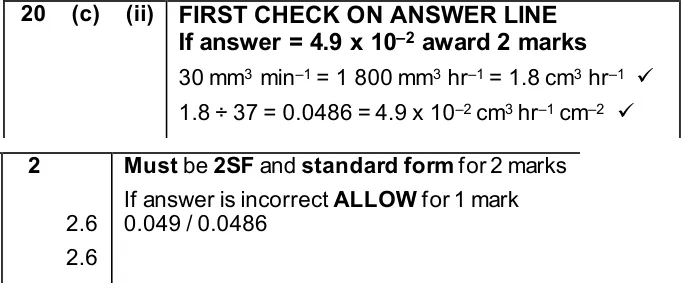
Convert a transpiration rate in mm³ min⁻¹ into cm³ hr⁻¹ cm⁻² of leaf, in standard form.
Show the mark scheme
Tap an image to open it full size.
From the examiners' report: This calculation was not well answered. Do one conversion at a time: minutes to hours, then mm³ to cm³ (divide by 1000), then divide by the leaf area.
Question 4
A level Paper 1 · June 2024 · Q20(a)(ii) · 2 marks · Medium
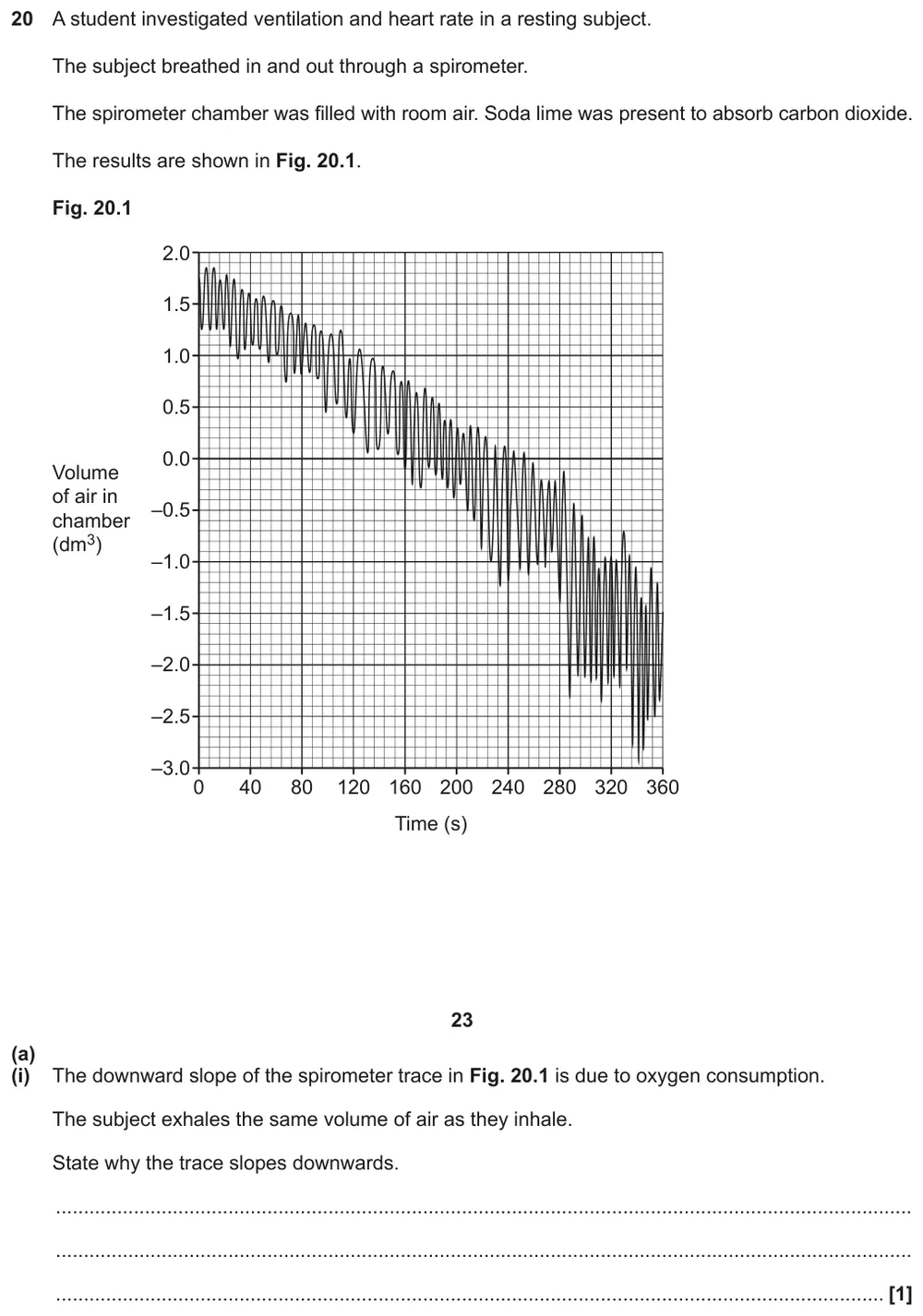
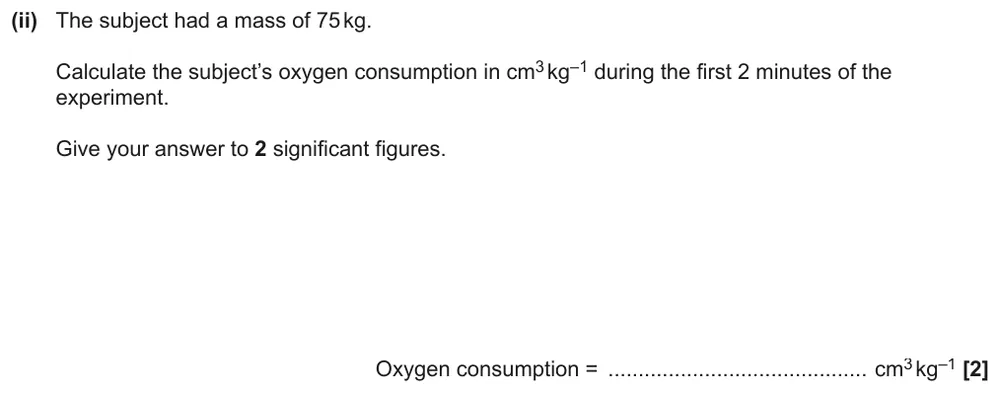
Use a spirometer trace to calculate oxygen consumption per kg of body mass, in cm³ kg⁻¹.
Information from earlier in this question:
Show the mark scheme
Tap an image to open it full size.
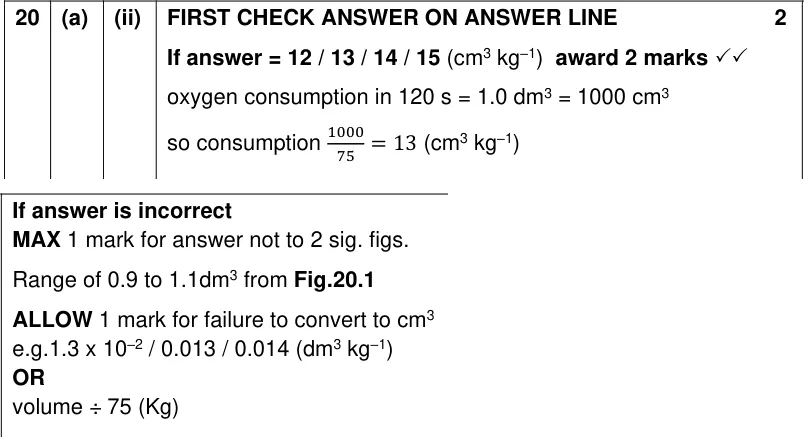
From the examiners' report: This needed three steps: read the oxygen used from the graph, convert dm³ to cm³ by multiplying by 1000, then divide by 75 kg. Many students misread the graph; use a ruler and mark the readings on the trace.
Decimal and standard form (M0.2)
Question 5
A level Paper 1 · November 2020 · Q20(c)(iii) · 2 marks · Easy
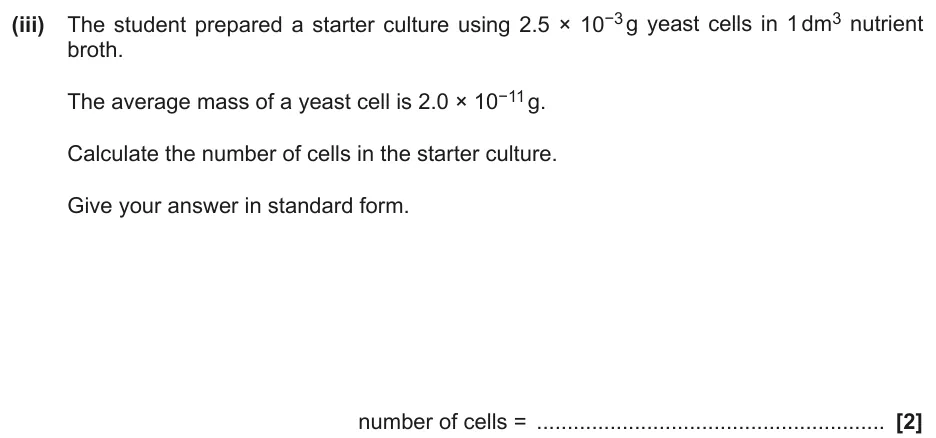
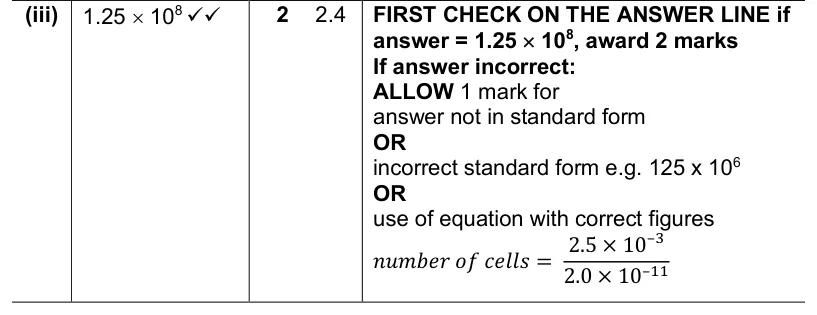
Calculate the number of yeast cells in a starter culture, in standard form.
Show the mark scheme
Tap an image to open it full size.
From the examiners' report: This was generally answered well. When you divide numbers in standard form, subtract one power of 10 from the other, don't divide them.
Question 6
A level Paper 2 · June 2018 · Q21(b) · 2 marks · Medium
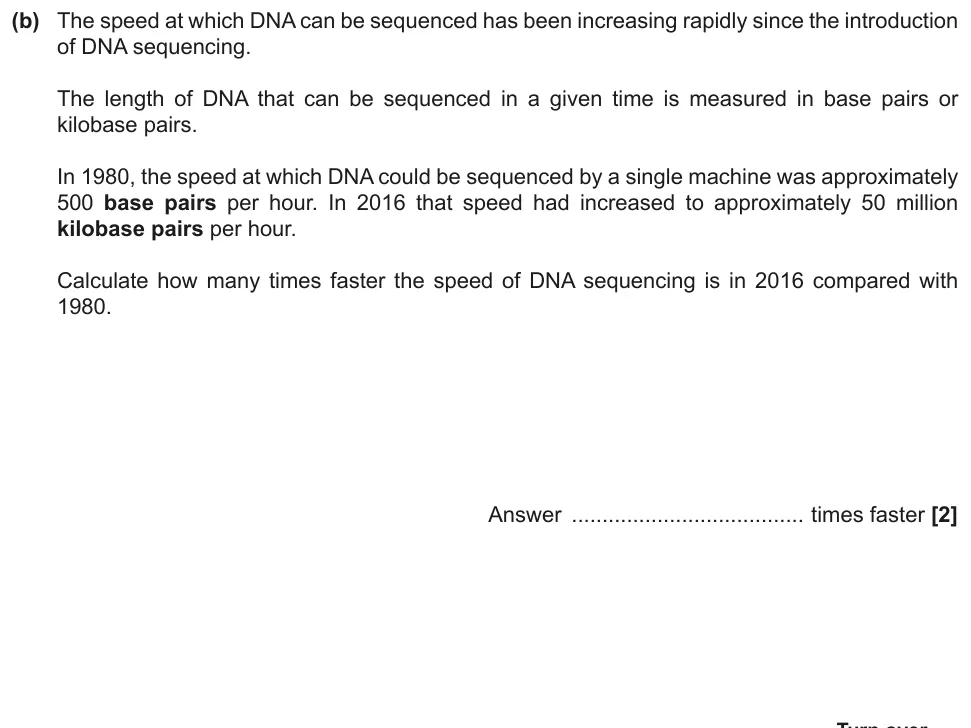
Calculate how many times faster DNA sequencing was in 2016 than in 1980.
Show the mark scheme

Tap an image to open it full size.
From the examiners' report: Students did better on this than on the other calculations. Answers worked in standard form were less likely to be out by a factor of 10, so it is worth using even when the question doesn't ask for it.
Question 7
A level Paper 3 · June 2017 · Q2(b)(iii) · 2 marks · Medium
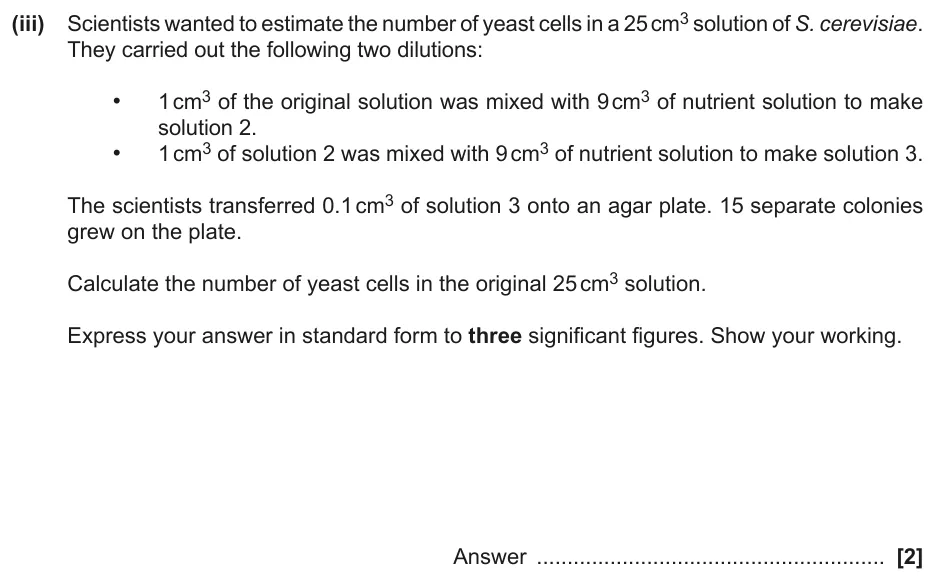
Use a serial dilution and a colony count to estimate the number of yeast cells, in standard form to 3 significant figures.
Show the mark scheme

Tap an image to open it full size.
From the examiners' report: Many students found this hard. Of those who could do the dilution calculation, a large number lost a mark by not giving the answer in standard form to three significant figures.
Question 8
A level Paper 3 · June 2022 · Q2(b)(ii) · 2 marks · Hard
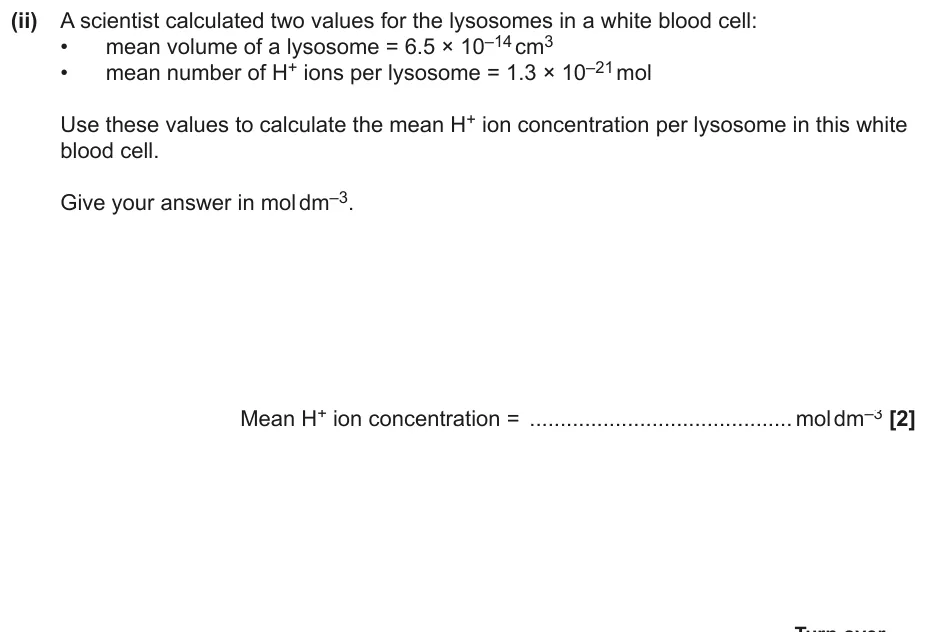
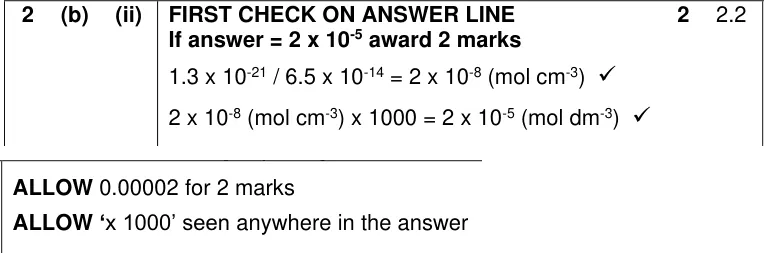
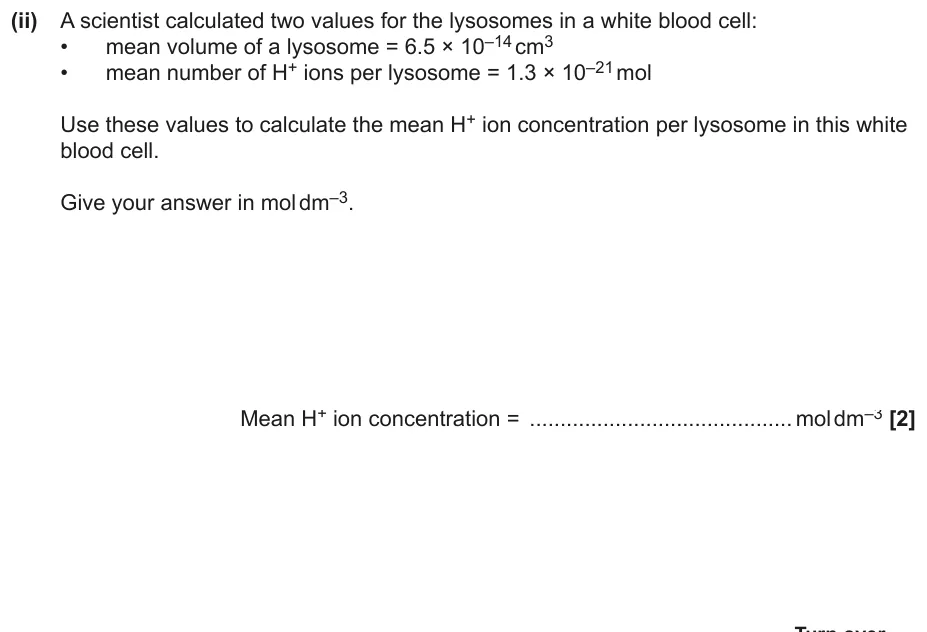
Calculate the H⁺ ion concentration in a lysosome in mol dm⁻³ from values in standard form.
Show the mark scheme
Tap an image to open it full size.
From the examiners' report: Few students got both marks. Many divided the numbers the wrong way round or didn't convert from cm³ to dm³; there are 1000 cm³ in 1 dm³, so the concentration per dm³ is 1000 times bigger.
Ratios, fractions and percentages (M0.3)
Question 9
A level Paper 2 · June 2023 · Q20(b)(i) · 2 marks · Easy
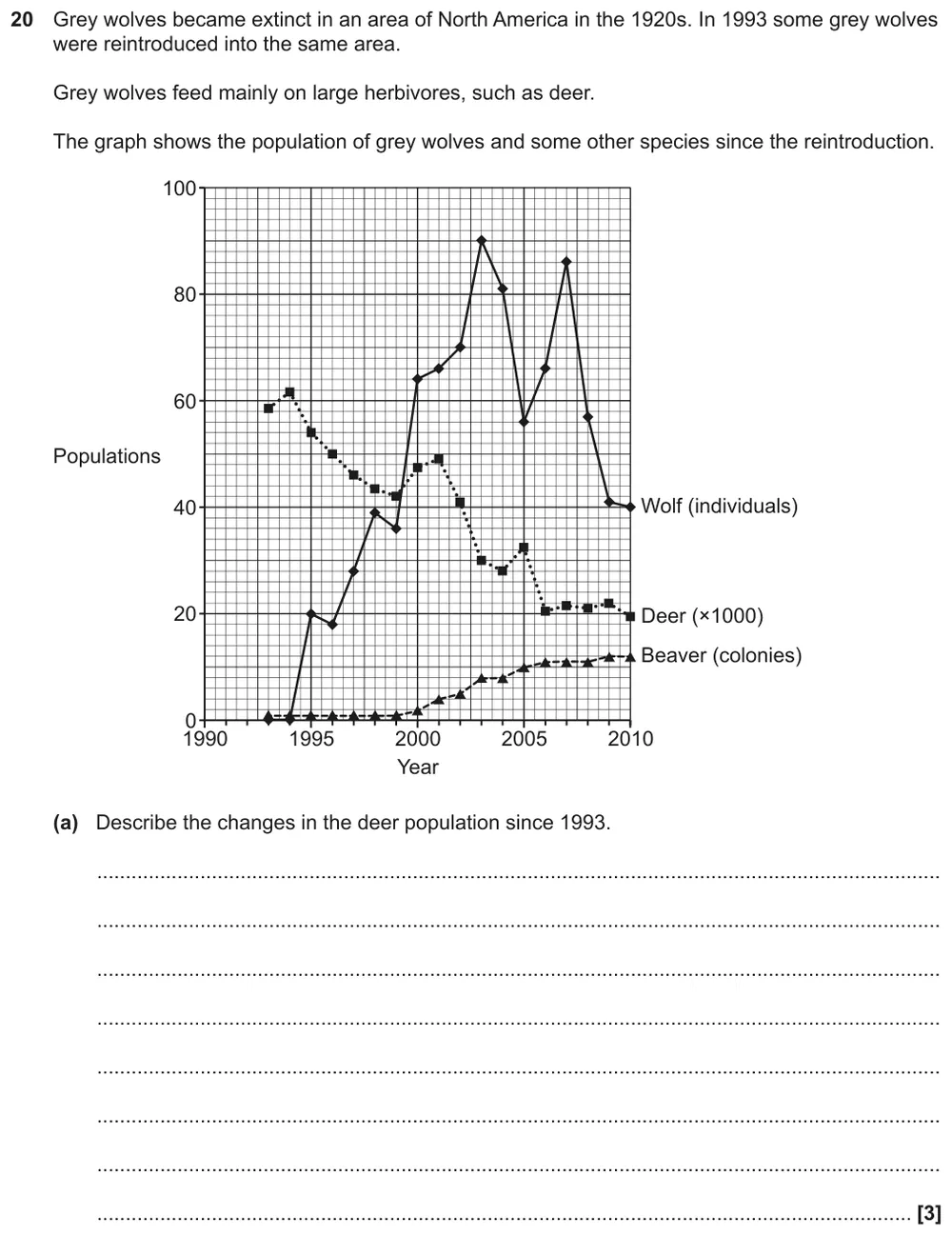
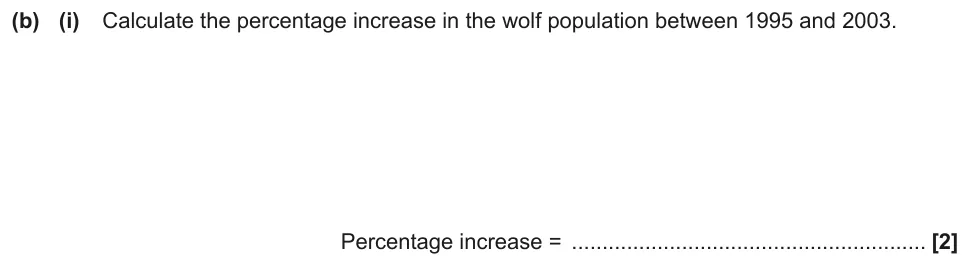
Calculate the percentage increase in a wolf population from a graph.
Information from earlier in this question:
Show the mark scheme
Tap an image to open it full size.
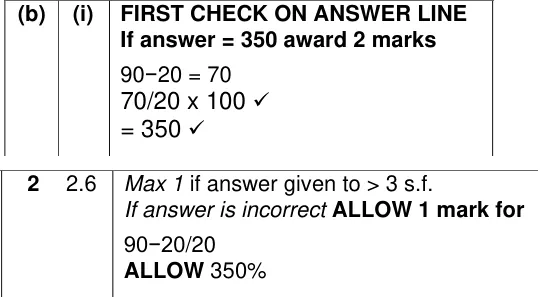
From the examiners' report: Most students got both marks, but some gave 450 by using the 2003 population instead of the increase, or 77.7 by dividing by the 2003 figure. Percentage change is the change divided by the starting value, × 100.
Question 10
AS Paper 2 · June 2024 · Q4(a)(i) · 1 mark · Easy
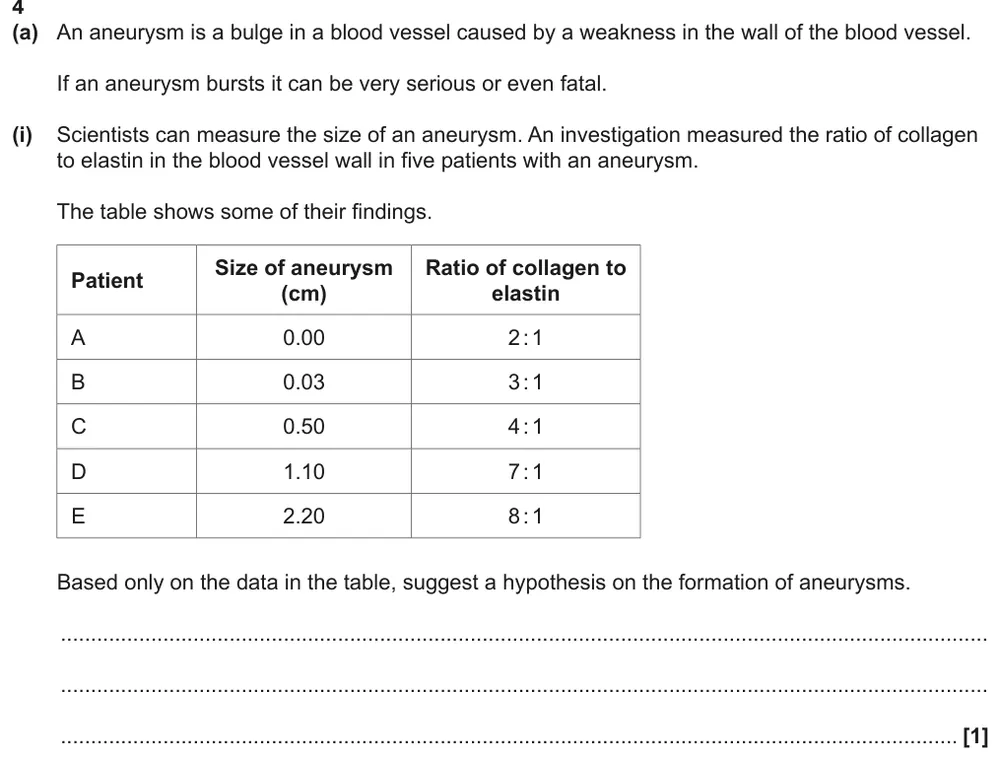
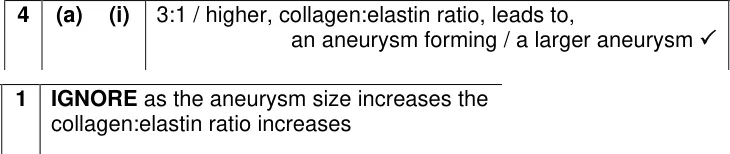
Use collagen to elastin ratios to suggest a hypothesis about how aneurysms form.
Show the mark scheme
Tap an image to open it full size.
From the examiners' report: Most students did well. Good answers saw that patient A, with a 2:1 ratio and no aneurysm, was the baseline. A ratio is relative, so don't just say 'more collagen' causes the aneurysm.
Question 11
A level Paper 3 · June 2018 · Q2(c)(i) · 1 mark · Medium
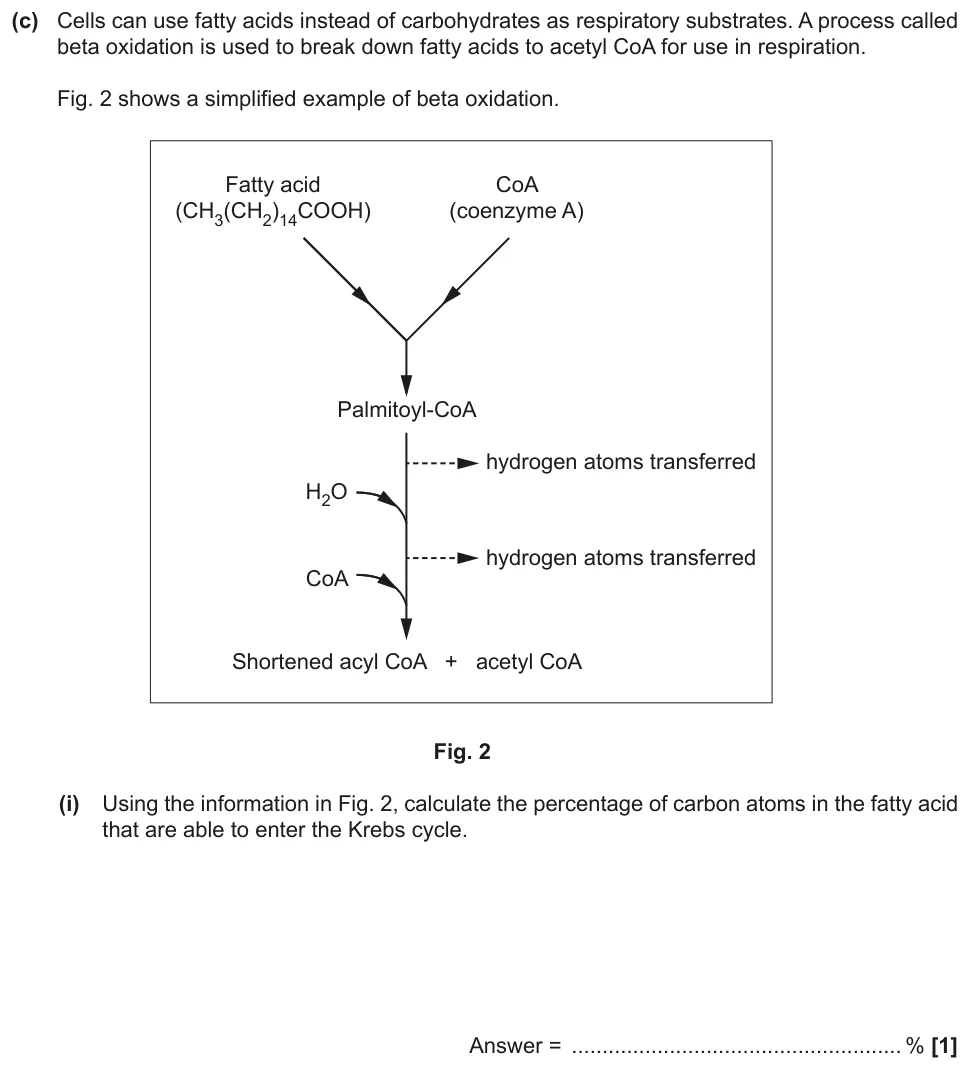
Calculate the percentage of carbon atoms in a fatty acid that enter the Krebs cycle.
Show the mark scheme

Tap an image to open it full size.
From the examiners' report: Many students didn't read the question and gave 100%. Count the carbons from the formula first: 16 in the fatty acid and 2 in acetyl CoA, so 2 ÷ 16 × 100.
Question 12
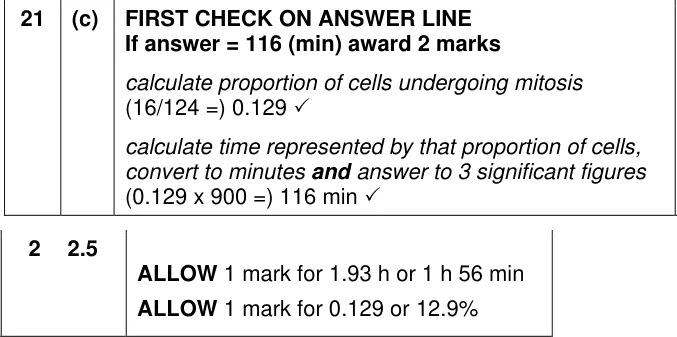
A level Paper 2 · June 2024 · Q21(c) · 2 marks · Medium
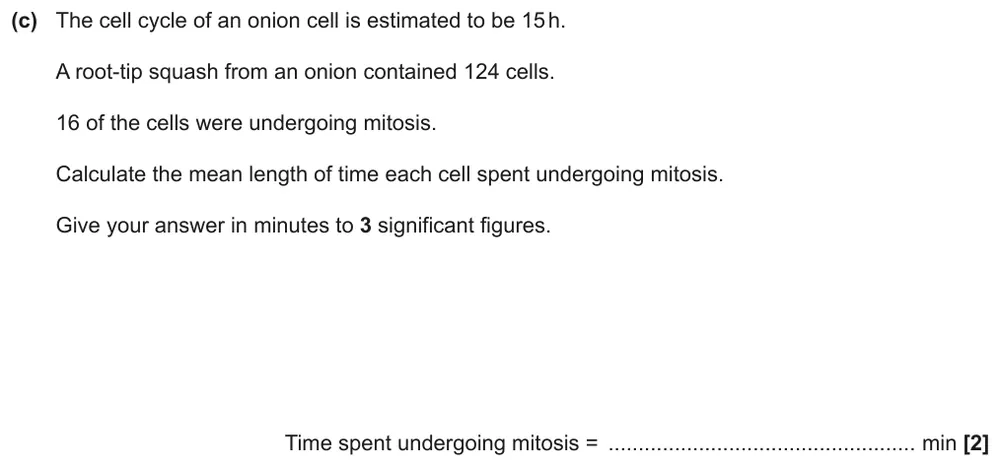
Use the proportion of cells in mitosis to calculate how long mitosis lasts, in minutes.
Show the mark scheme
Tap an image to open it full size.
From the examiners' report: Around half of students scored here. Many struggled with the idea that the proportion of cells in a stage equals the proportion of time spent in it. Changing 15 hours into 900 minutes was usually done well.
Question 13
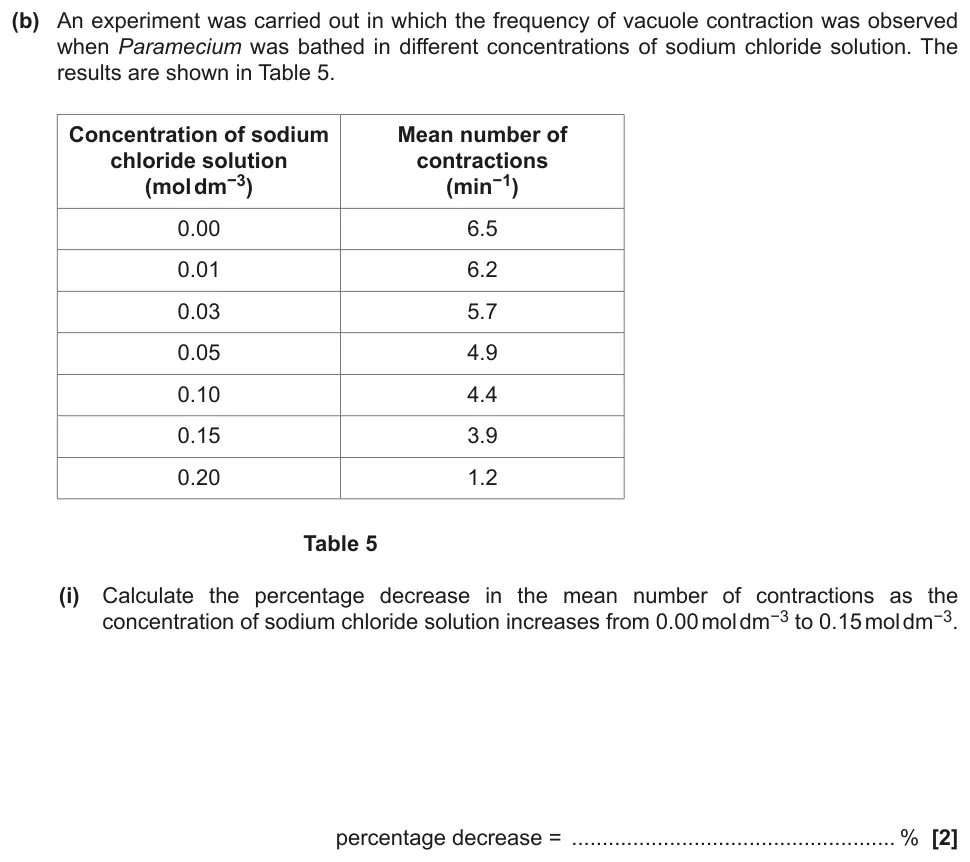
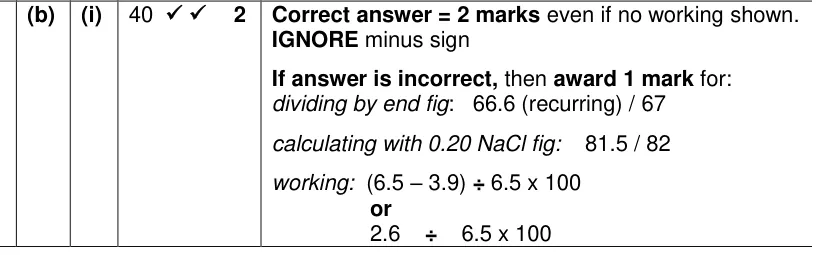
AS Paper 2 · June 2019 · Q5(b)(i) · 2 marks · Hard
Calculate a percentage decrease in contractile vacuole contractions from a table.
Show the mark scheme
Tap an image to open it full size.
From the examiners' report: Many students got 40%. Some used the 0.20 mol dm⁻³ value instead of 0.15, and others divided the difference by the final figure, 3.9, instead of the starting figure, 6.5.
Estimating results (M0.4)
Question 14
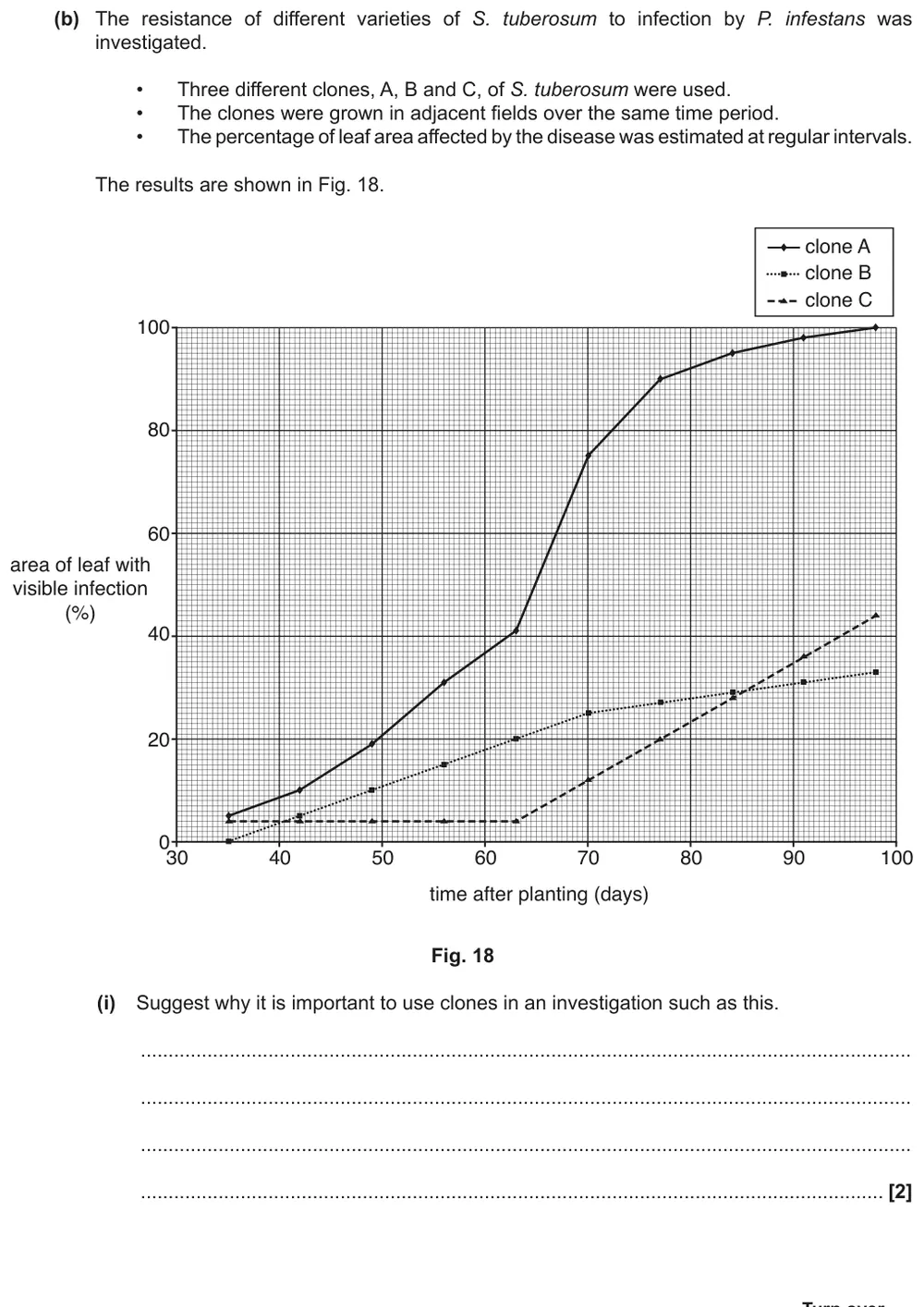
A level Paper 2 · June 2017 · Q18(b)(iii) · 3 marks · Medium
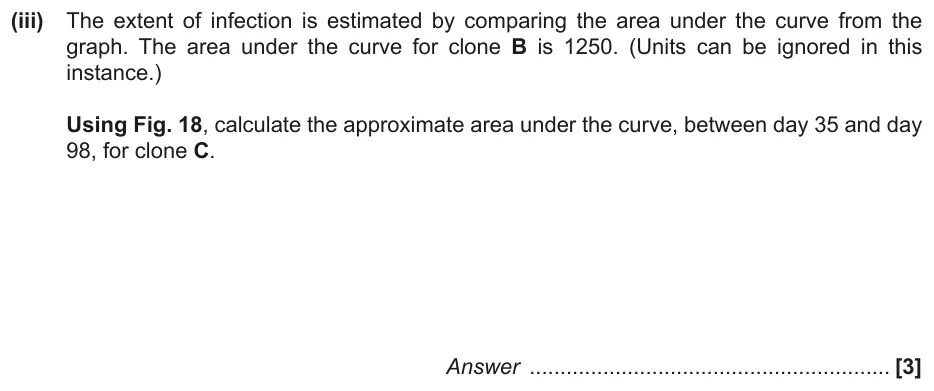
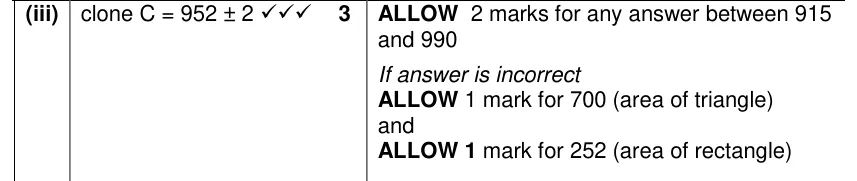
Estimate the area under a curve of leaf infection for one potato clone.
Information from earlier in this question:
Show the mark scheme
Tap an image to open it full size.
From the examiners' report: There is no examiners' comment for this part. The mark scheme splits the area into a triangle (700) and a rectangle (252), so break an awkward shape into simple ones and add them up.
Question 15
A level Paper 2 · June 2019 · Q18(b)(i) · 1 mark · Hard
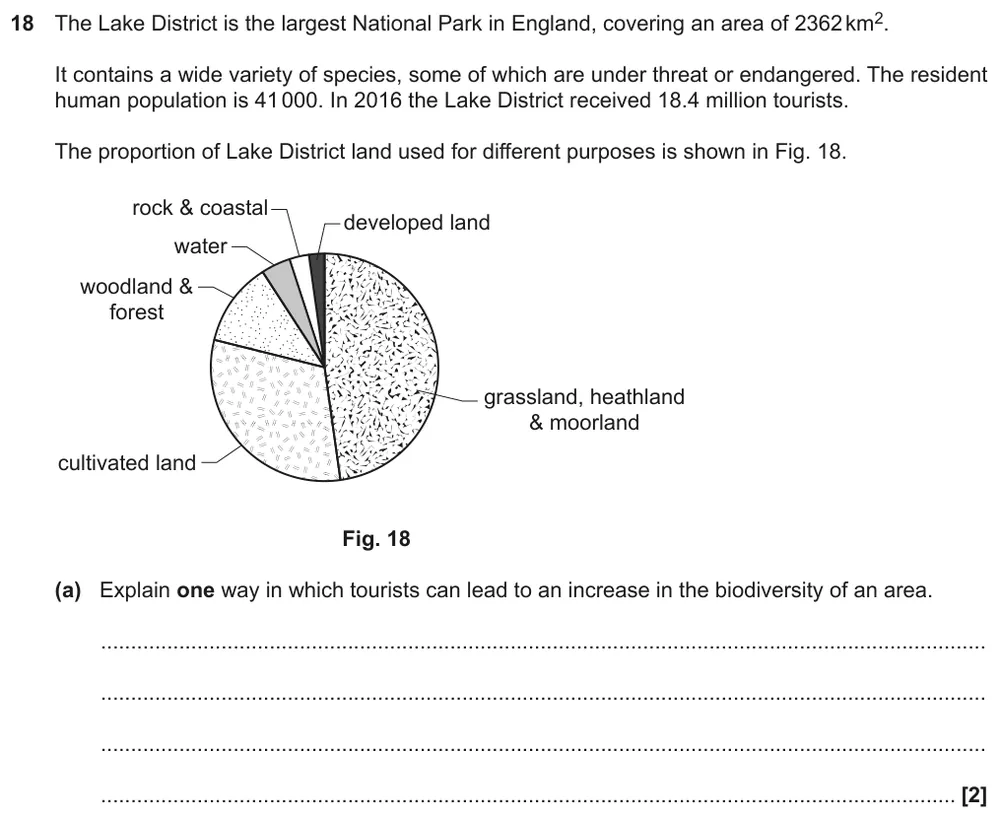
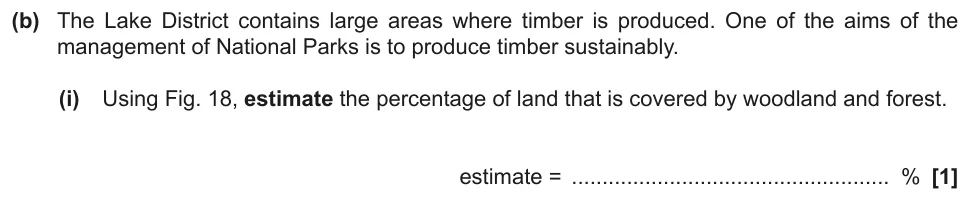
Estimate the percentage of the Lake District covered by woodland and forest from a pie chart.
Information from earlier in this question:
Show the mark scheme

Tap an image to open it full size.
From the examiners' report: Only a few students got this. Most who missed it had a value in the right range but gave it to 3 significant figures. The word 'estimate' tells you a rough whole number is enough.
Powers and logarithms (M0.5)
Question 16
A level Paper 3 · June 2022 · Q2(b)(iii) · 1 mark · Medium
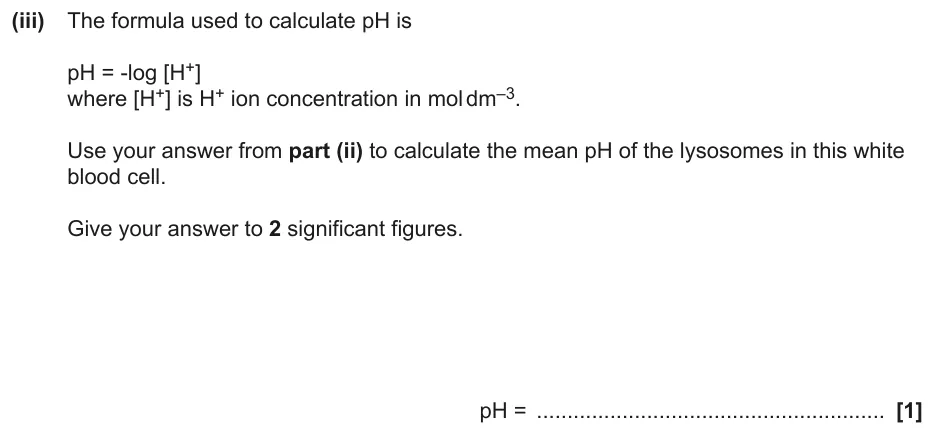
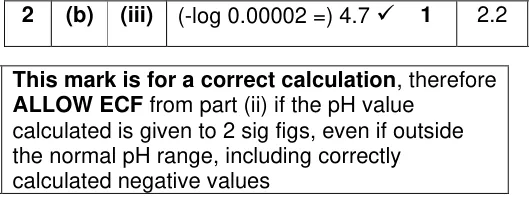
Use pH = −log[H⁺] to calculate the pH of a lysosome, to 2 significant figures.
Information from earlier in this question:
Show the mark scheme
Tap an image to open it full size.
From the examiners' report: Many students didn't notice when their pH came out below 0 or above 14, which should have sent them back to check part (ii). A few gave 2 decimal places instead of 2 significant figures.
Question 17
A level Paper 2 · June 2023 · Q16(d) · 2 marks · Medium
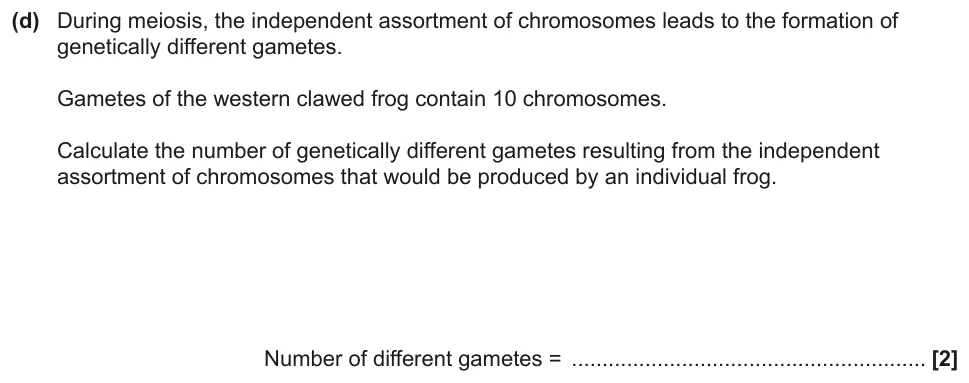
Calculate the number of genetically different gametes from independent assortment.
Show the mark scheme

Tap an image to open it full size.
From the examiners' report: Fewer than 1 in 5 students got this, but nearly all of those got both marks. The most common wrong answer was 40. The number of combinations is 2ⁿ, where n is the haploid number.
Question 18
A level Paper 3 · June 2018 · Q4(c)(ii) · 2 marks · Hard
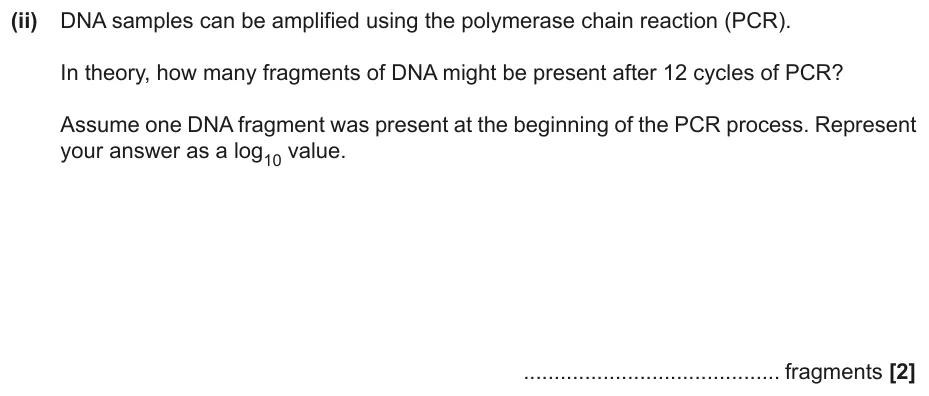
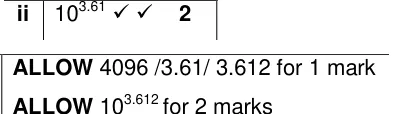
Calculate the number of DNA fragments after 12 cycles of PCR, as a log₁₀ value.
Show the mark scheme
Tap an image to open it full size.
From the examiners' report: Few students got this fully right. Some got one mark for 4096 or 3.61 but couldn't put the answer in the form asked for. The number doubles each cycle, so it is 2¹² = 4096, which is 10³·⁶¹.
Where students lose marks (from OCR examiners' reports and mark schemes)
Each point below is followed by wording that gained marks.
800% greater means times nine: Many students multiplied by 8 instead of 9 for an increase of 800%, and others left the answer in J when kJ was asked for.
✔ Gains credit: "9 × 950 000 = 8 550 000 J m⁻² yr⁻¹ = 8550 kJ m⁻² yr⁻¹".
Divide by the starting value: For percentage change, students divided by the final value (giving 67% or 77.7%) or used the final population instead of the change (450%).
✔ Gains credit: "(6.5 − 3.9) ÷ 6.5 × 100 = 40%" and "(90 − 20) ÷ 20 × 100 = 350%".
Pick a sensible time unit: For the rate of stem growth, many students gave a length unit with no time, used seconds or minutes, or wrote both '/' and ⁻¹ in the same unit.
✔ Gains credit: "mm h⁻¹ or cm h⁻¹ or mm d⁻¹ or cm d⁻¹".
There are 1000 cm³ in a dm³: Students often missed the conversion between cm³ and dm³, so a concentration or a volume was out by a factor of 1000.
✔ Gains credit: "2 × 10⁻⁸ (mol cm⁻³) × 1000 = 2 × 10⁻⁵ (mol dm⁻³)" and "1.0 dm³ = 1000 cm³, 1000 ÷ 75 = 13 cm³ kg⁻¹".
Standard form to the figures asked for: A correct calculation lost a mark when it wasn't in standard form or had the wrong number of significant figures, such as 375 000 or 3.8 × 10⁵.
✔ Gains credit: "3.75 × 10⁵" to three significant figures and "4.9 × 10⁻² cm³ hr⁻¹ cm⁻²" to two.
An estimate is a rough number: Many students had a value in the right range for the pie chart but gave it to 3 significant figures, which the mark scheme did not credit.
✔ Gains credit: "10 / 11 / 12 / 13 / 14 (%)".
Doubling each time means a power of 2: For independent assortment the most common wrong answer was 40, and for PCR many students stopped at 4096 when a log₁₀ value was asked for.
✔ Gains credit: "number of combinations = 2ⁿ, 2¹⁰ = 1024" and "10³·⁶¹" fragments after 12 cycles.
Is the answer possible?: Students didn't notice that a pH below 0 or above 14 is impossible, which would have told them to recheck the earlier part.
✔ Gains credit: "(−log 0.00002 =) 4.7".
Download the questions
Download the PDF pack (18 questions, mark schemes at the end)
Keep practising
- Graph Skills (M3): OCR A Level Biology exam questions by topic
- Geometry and Surface Area to Volume (M4): OCR A Level Biology exam questions by topic
- PAG 5 Colorimeter and Potometer: OCR A Level Biology exam questions by topic
- OCR A Level Biology practical skills quiz
- OCR A Level Biology masterclasses
Questions, mark schemes and examiners' report extracts © OCR.