

The Big Sleep asks whether the early ancestors of mammals, including our own, could hibernate, and what that could mean for human health. It explains torpor, a state in which an animal reduces its physiological activity, body temperature and metabolism, describes how scientists compare the tissues and genomes of hibernating and non-hibernating mammals to find the genes involved, and looks at how hibernation research could help astronauts and at the role of adenosine in the brain. This was the scientific article for the June 2025 A level Paper 3 (9BN0/03), and Question 8, worth 30 marks, was set on it. Its eleven parts test biology from across the specification, including evolution, respiration and thermoregulation, gene expression, enzymes and synapses. Read the article (linked just below) before you try the questions.
The examiners' reports kept returning to precise wording and to answering the question asked. Nerve messages are impulses, not 'signals', and the thermoregulatory centre is in the hypothalamus, not the hippocampus. Some candidates answered from a general thermoregulation approach, or explained why blood pressure is low during hibernation, when the questions asked something else. Inherited traits needed genes or alleles, gene activity needed tissue from both hibernating and non-hibernating mammals, and heat needed to be called heat energy, not just 'energy'. A lower temperature slows enzymes; it does not denature them.
Studying Edexcel SNAB and want more help? If you'd like to arrange one-to-one Edexcel tutoring, or to register your interest in an Edexcel group class, message Tom on WhatsApp using the link at the bottom of this page.
Read the article first: The Big Sleep (June 2025). It is the June 2025 Paper 3 question paper (PDF); the article is printed at the back.
What you need first
Each question on this page assumes you're secure on these ideas. If any of them feels shaky, look it up before you start.
- Respiration releases energy as ATP, and some energy is released as heat.
- Enzymes catalyse metabolic reactions, and their rate depends on temperature.
- Genes are transcribed into mRNA, which is translated into proteins.
- Nerve impulses cross synapses when neurotransmitters are released and bind to receptors.
Key terms
These words come up in the article, the questions and the mark schemes. Examiners expect you to use them exactly.
- Hibernation: a long period of reduced metabolism and body temperature that helps an animal survive cold or food shortage.
- Torpor: the state at the centre of hibernation, in which physiological activity, body temperature and metabolism are reduced.
- Metabolic rate: the rate of the chemical reactions in the body; a lower metabolic rate needs less ATP and so less respiration.
- Set point: the value, such as core temperature, that negative feedback keeps the body close to.
- Thermoregulatory centre: the part of the hypothalamus that receives impulses from thermoreceptors and sends impulses to effectors.
- Comparative genomics: comparing the complete genomes of different species to identify important genes.
- Adenosine: a molecule that can act as an inhibitory neurotransmitter, binding to receptors and reducing neural activity.
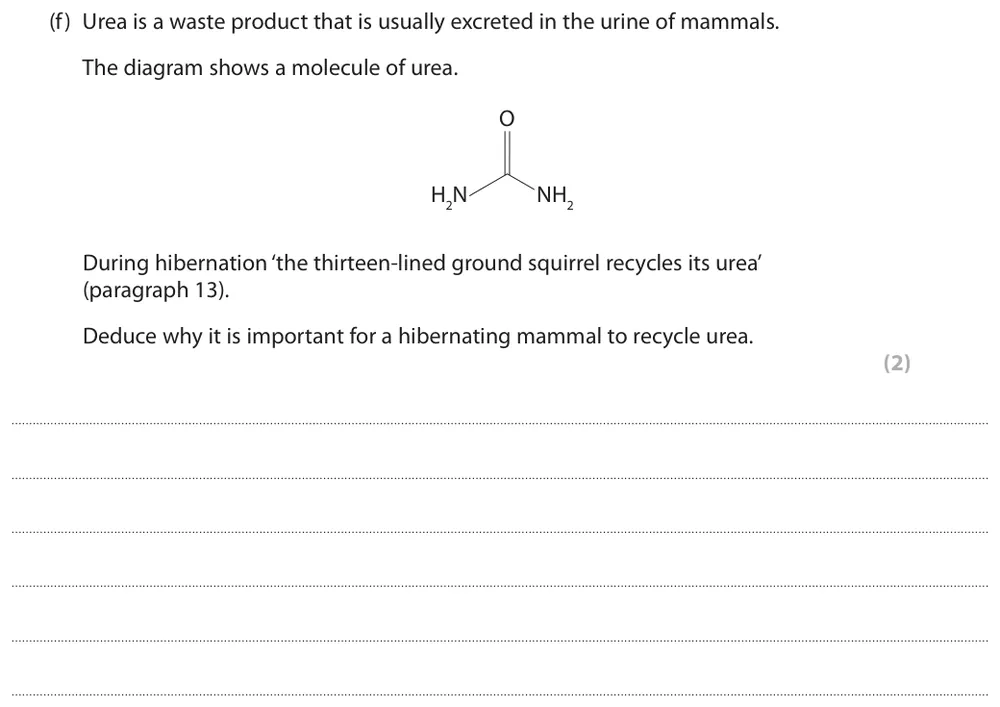
- Urea: a nitrogen-containing waste product; its amine groups can be recycled to make amino acids and nucleotides.
What these questions cover
The article questions draw on biology from across the specification. These are the statements of the Pearson Edexcel A level Biology A (Salters-Nuffield) specification (9BN0) that they test.
- 2.9i Know the basic structure of an amino acid (structures of specific amino acids are not required).
- 3.12 Understand how cells become specialised through differential gene expression, producing active mRNA leading to synthesis of proteins, which in turn control cell processes
- 4.6i Understand that classification is a means of organising the variety of life based on relationships between organisms using differences and similarities in phenotypes and
- 5.16 Understand the effect of temperature on the rate of enzyme activity and its impact on plants, animals and microorganisms.
- 7.1 Know the way in which muscles, tendons, the skeleton and ligaments interact to enable movement, including antagonistic muscle pairs, extensors and flexors.
- 7.3i Understand the overall reaction of aerobic respiration as splitting of the respiratory substrate, to release carbon dioxide as a waste product and reuniting of hydrogen w
- 7.9ii Understand how variations in ventilation and cardiac output enable rapid delivery of oxygen to tissues and the removal of carbon dioxide from them, including how the hear
- 7.12 Understand homeostasis and its importance in maintaining the body in a state of dynamic equilibrium during exercise, including the role of the hypothalamus and the mechan
- 8.4 Know the structure and function of synapses in nerve impulse transmission, including the role of neurotransmitters, including acetylcholine.
How to use this page
Write your answer on paper before you open the mark scheme. Allow about 1.2 minutes per mark: the 11 questions are worth 30 marks, so about 36 minutes in total. Then mark your answer strictly against the mark scheme and read the examiners' tip underneath it. If you'd rather print the questions, download the PDF pack.
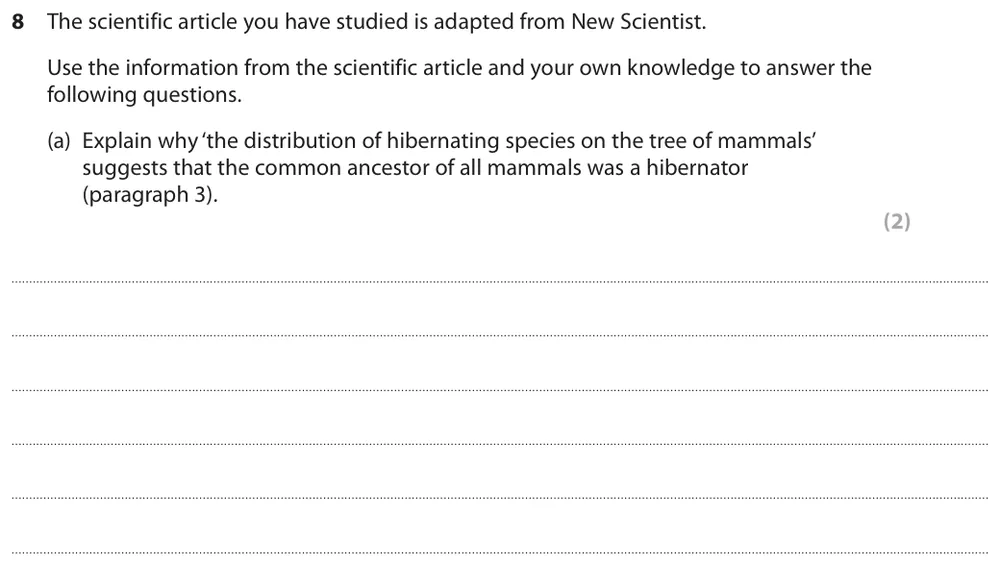
Were all mammals once hibernators? (paragraph 3)
Question 1
A level Paper 3 · June 2025 · Q8(a) · 2 marks
Explain why the spread of hibernating species across the mammals suggests their common ancestor hibernated.
Show the mark scheme
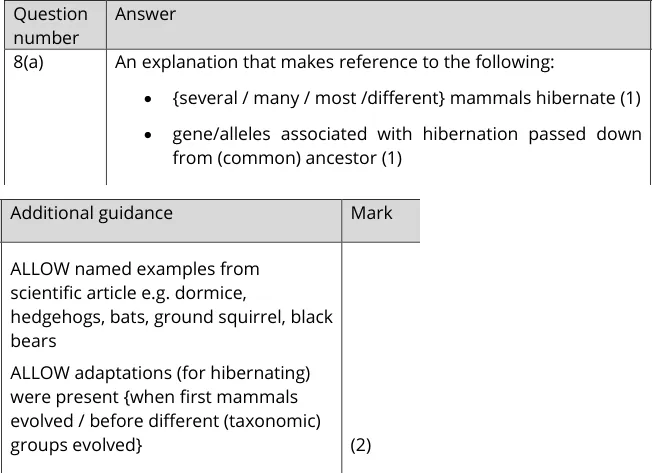
Tap an image to open it full size.
From the examiners' report: Say that many different mammals hibernate. Most attempts at the second mark just said hibernation was inherited from a common ancestor; refer to genes or alleles associated with hibernation being passed down.
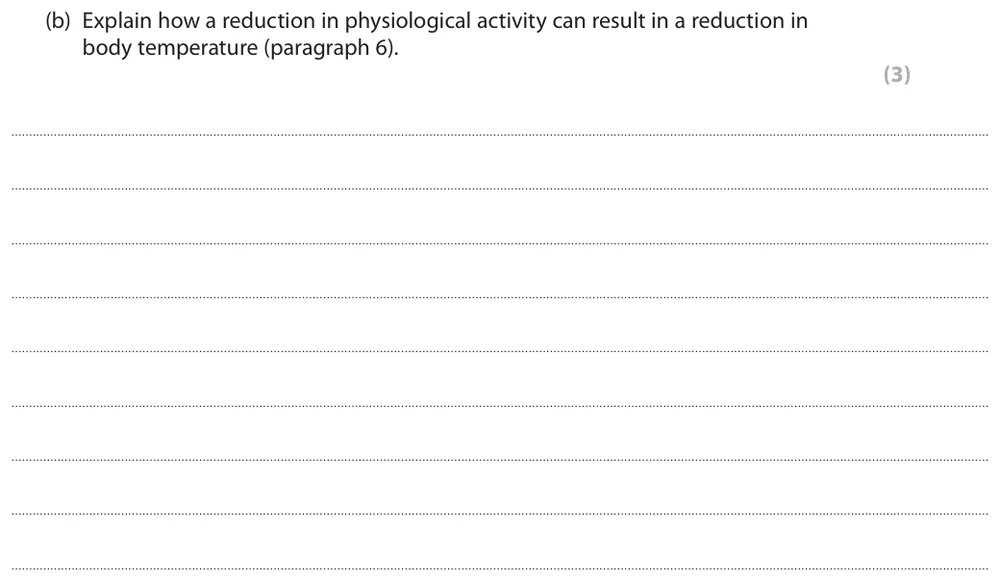
Torpor and core temperature (paragraphs 6–8)
Question 2
A level Paper 3 · June 2025 · Q8(b) · 3 marks
Explain how a reduction in physiological activity can lower body temperature.
Show the mark scheme
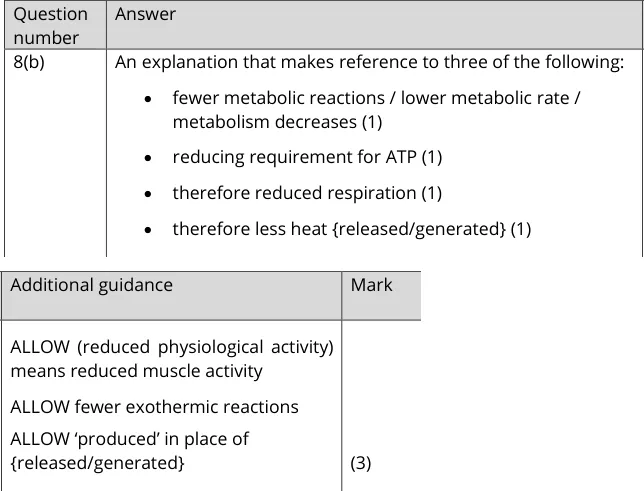
Tap an image to open it full size.
From the examiners' report: Some answered with thermoregulation, which was not what was asked. Link reduced activity to a lower metabolic rate, less need for ATP, less respiration and less heat released; 'energy' on its own was not enough.
Question 3
A level Paper 3 · June 2025 · Q8(c) · 5 marks · Hard
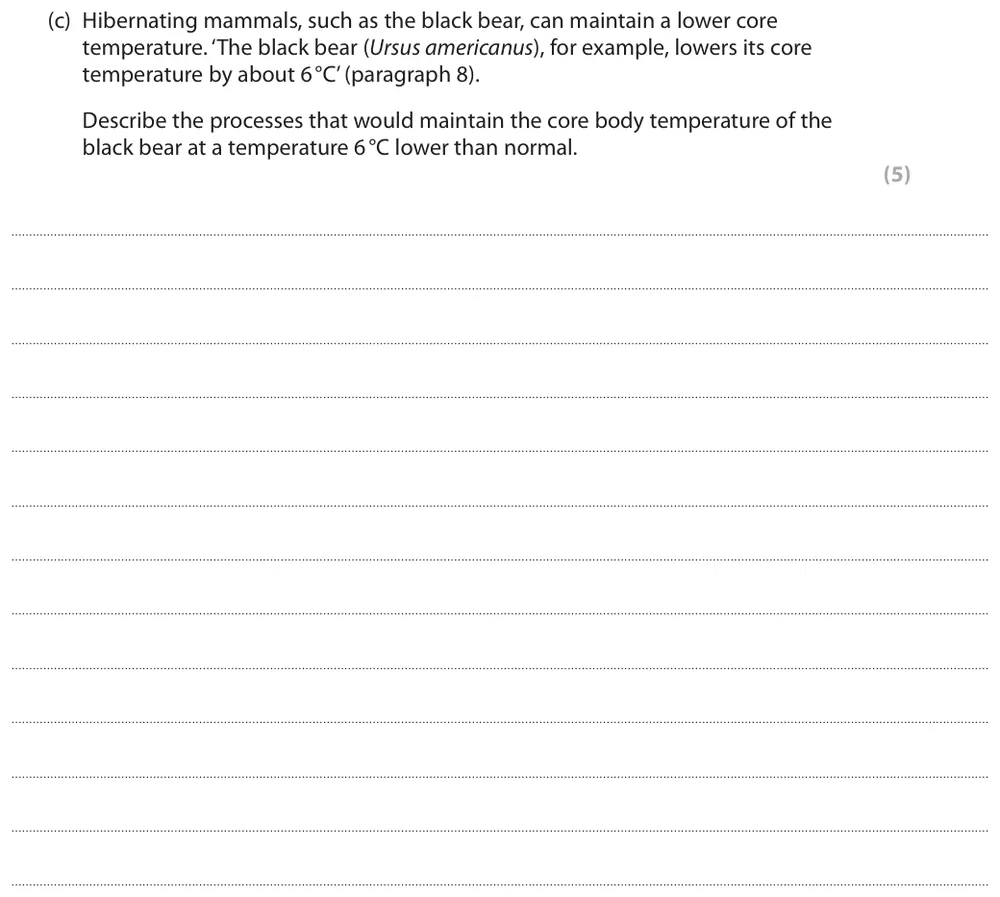
Describe the processes that would keep a black bear's core temperature 6 °C below normal.
Show the mark scheme
Tap an image to open it full size.
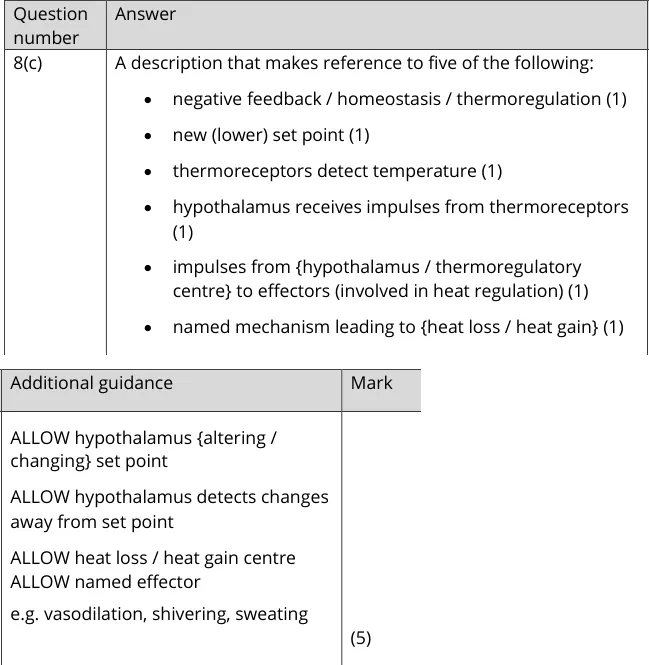
From the examiners' report: Most candidates found this challenging. Naming a heat loss or heat gain mechanism was commonly credited, but many lost the marks for the nerve pathway by writing 'signals' instead of impulses from the thermoreceptors to the hypothalamus and from the hypothalamus to effectors.
Finding the genes for hibernation (paragraphs 10–11)
Question 4
A level Paper 3 · June 2025 · Q8(d) · 3 marks · Hard
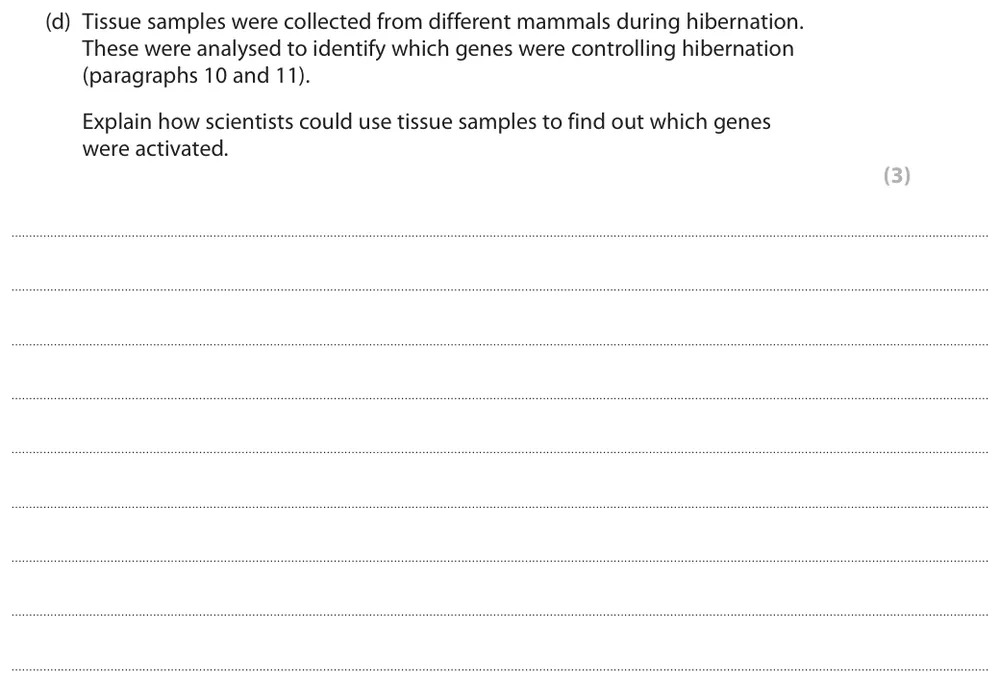
Explain how scientists could use tissue samples to find out which genes were activated.
Show the mark scheme
Tap an image to open it full size.
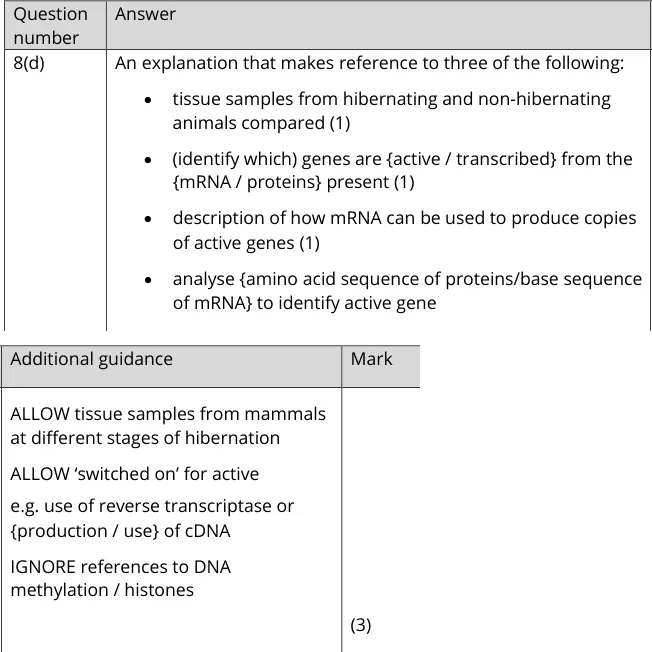
From the examiners' report: Few said the samples must come from both hibernating and non-hibernating mammals. Few explained how the base sequence of mRNA, or the amino acid sequence of proteins, identifies the active gene.
Coming out of hibernation (paragraph 13)
Question 5
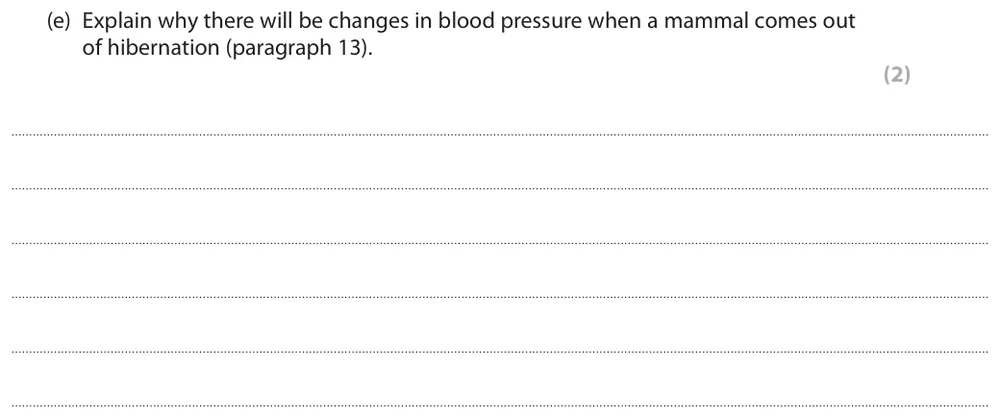
A level Paper 3 · June 2025 · Q8(e) · 2 marks
Explain why blood pressure changes when a mammal comes out of hibernation.
Show the mark scheme
Tap an image to open it full size.
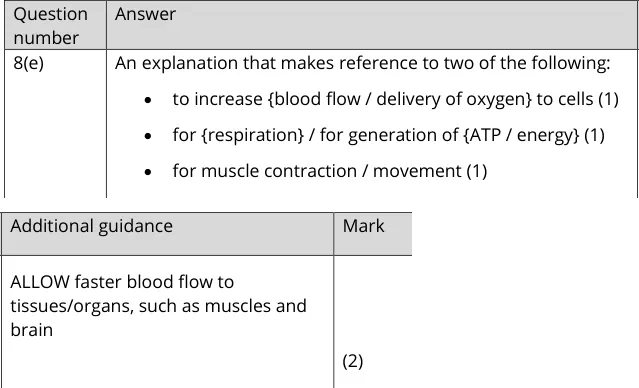
From the examiners' report: Many explained why blood pressure is low during hibernation, which was not asked. Refer to increased blood flow and oxygen delivery to cells for respiration; 'nutrients' and 'reactions' gained nothing.
Question 6
A level Paper 3 · June 2025 · Q8(f) · 2 marks
Deduce why it is important for a hibernating mammal to recycle urea.
Show the mark scheme
Tap an image to open it full size.
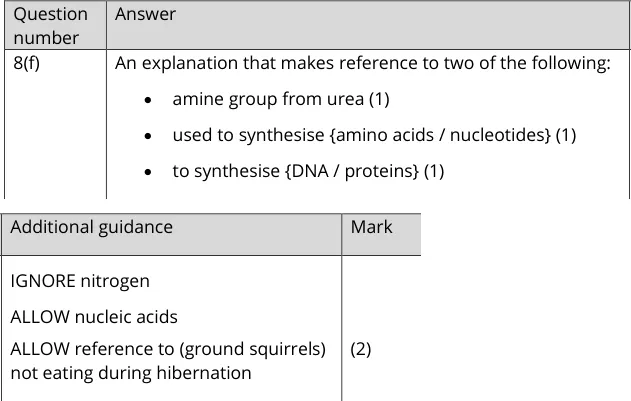
From the examiners' report: Recognise the amine groups in the urea diagram. Many scored only one mark by naming amino acids and nucleotides, which are the same marking point; go on to the DNA or proteins they make.
Hibernation and space travel (box 'To blearily go')
Question 7
A level Paper 3 · June 2025 · Q8(g) · 2 marks
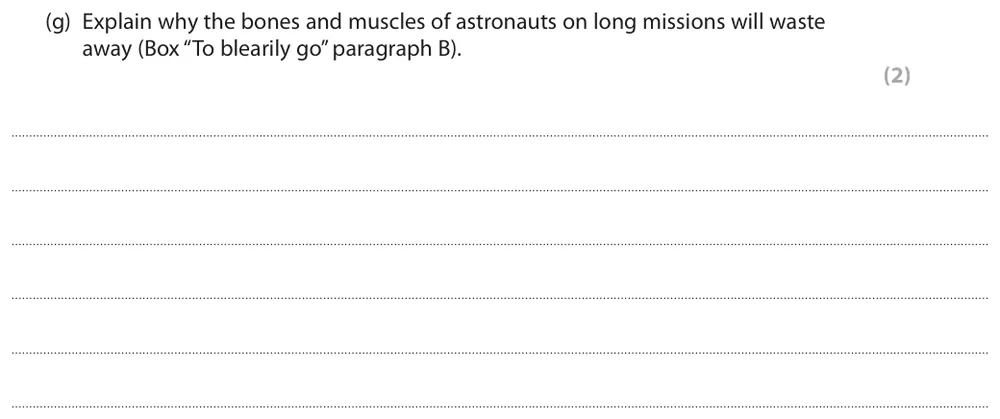
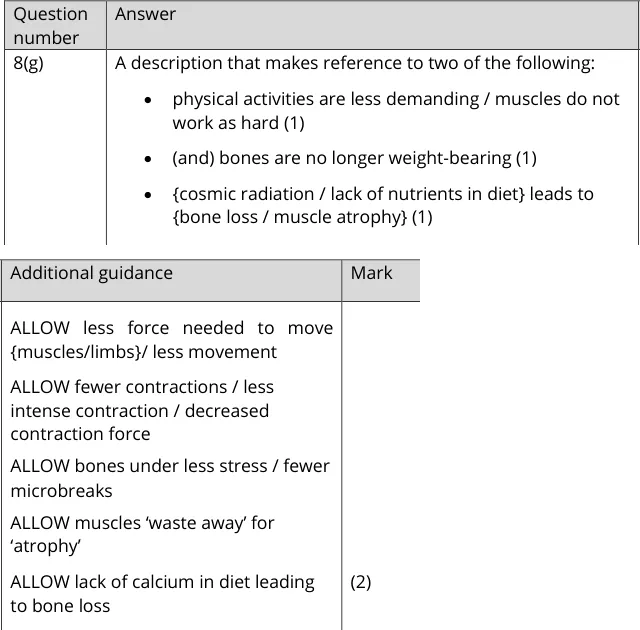
Explain why the bones and muscles of astronauts on long missions waste away.
Show the mark scheme
Tap an image to open it full size.
From the examiners' report: Most scored no more than one mark. Muscles still work in space, just not as hard; saying they are not used at all was not credited. Few said the bones are no longer weight-bearing.
Question 8
A level Paper 3 · June 2025 · Q8(h) · 3 marks · Easy
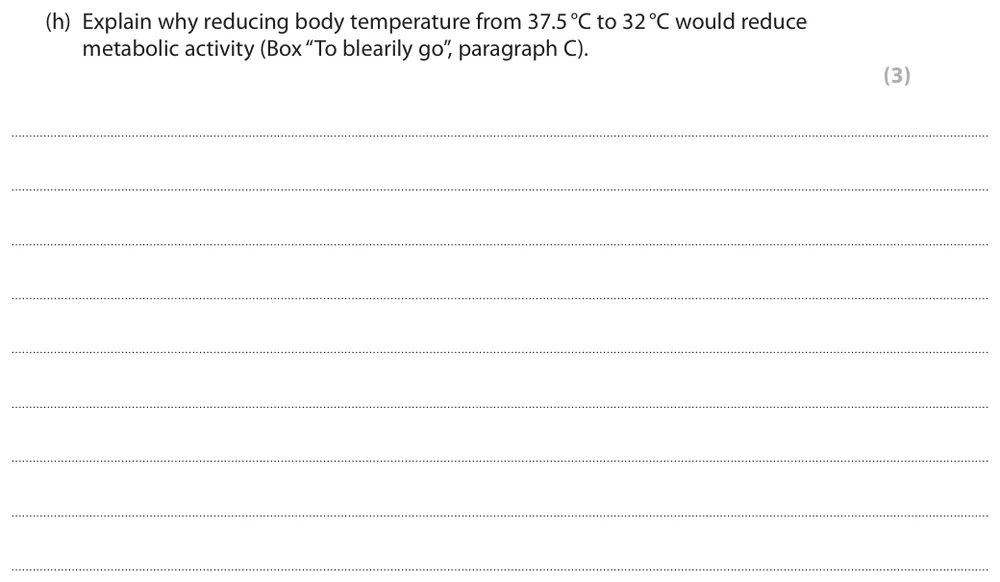
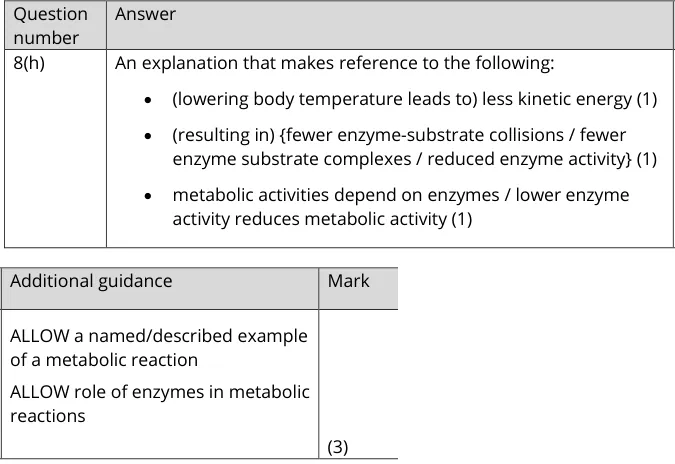
Explain why lowering body temperature from 37.5 °C to 32 °C would reduce metabolic activity.
Show the mark scheme
Tap an image to open it full size.
From the examiners' report: Most gained full marks. Do not mention denaturing, mention kinetic energy, and say fewer collisions between enzymes and substrates rather than just 'collisions'.
Adenosine and the brain (paragraphs 15–16)
Question 9
A level Paper 3 · June 2025 · Q8(i) · 2 marks
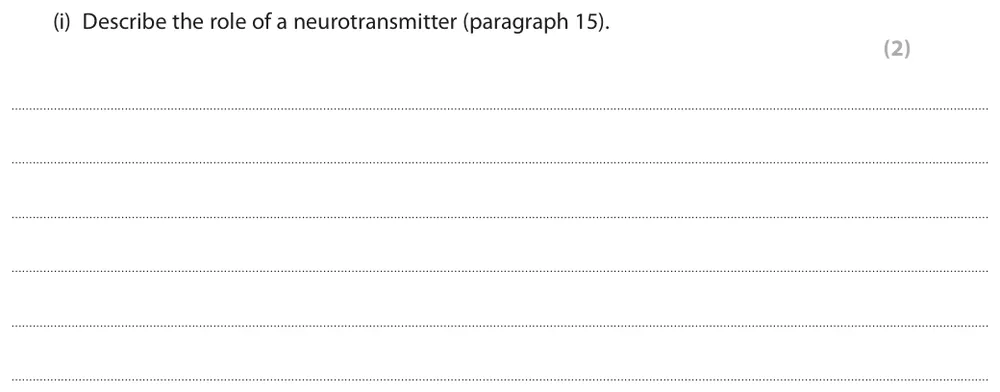
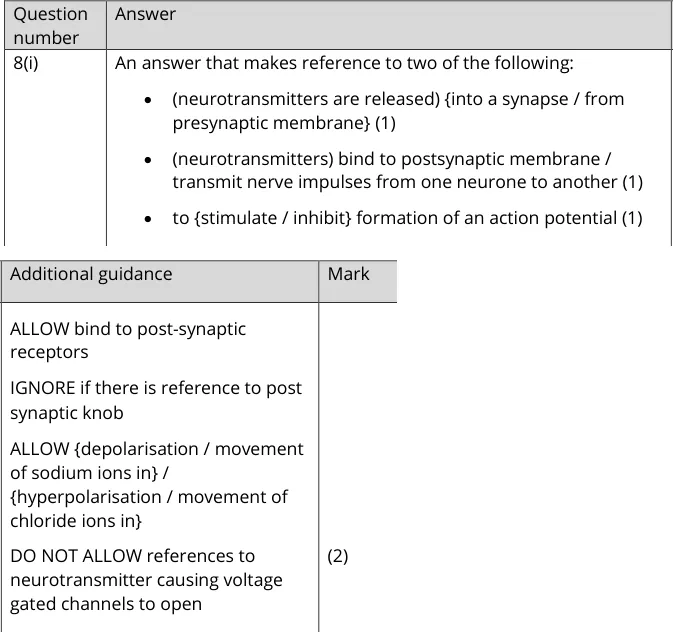
Describe the role of a neurotransmitter.
Show the mark scheme
Tap an image to open it full size.
From the examiners' report: Say neurotransmitters are released from the presynaptic membrane and bind to the postsynaptic membrane. A 'signal' passing between neurones was not credited, and some wrote about specific neurotransmitters instead of the general role.
Question 10
A level Paper 3 · June 2025 · Q8(j) · 3 marks
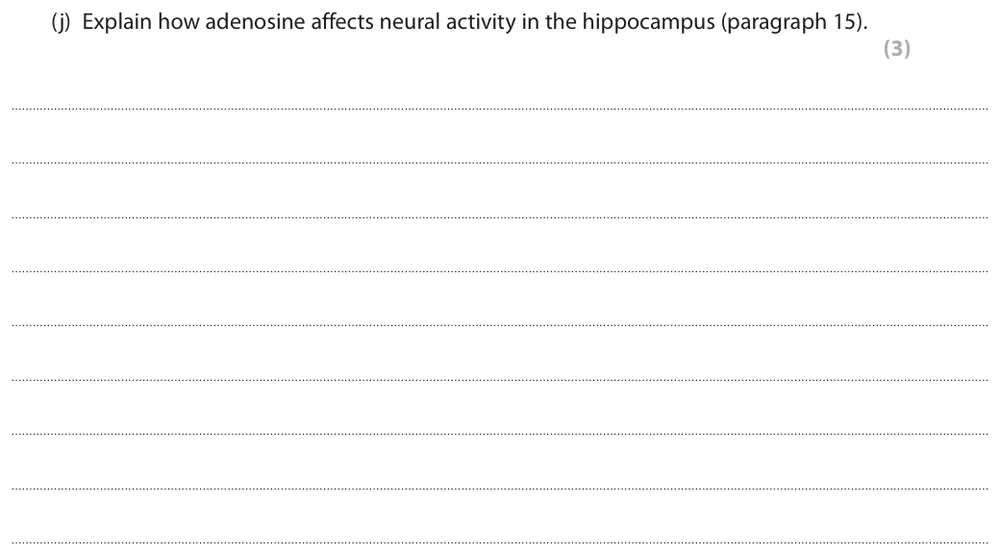
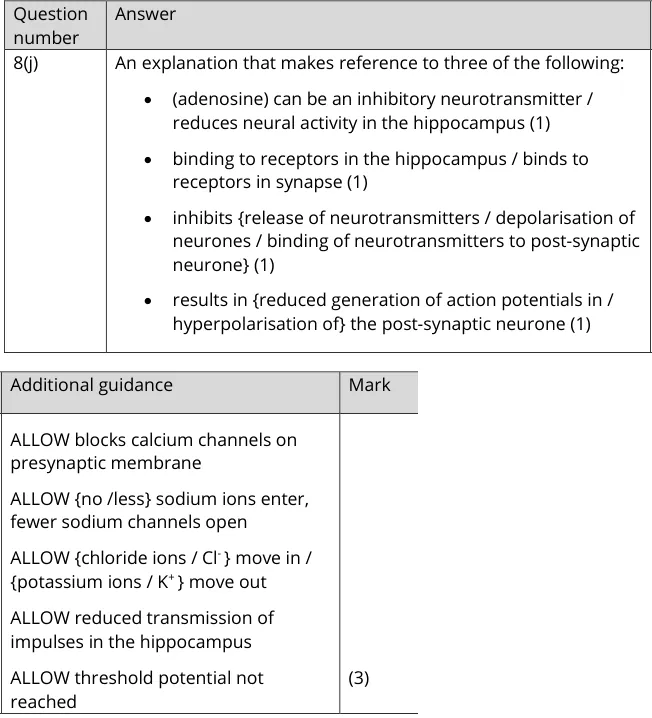
Explain how adenosine affects neural activity in the hippocampus.
Show the mark scheme
Tap an image to open it full size.
From the examiners' report: Some missed the first marks by not mentioning the hippocampus. Many said adenosine stops neurotransmitter binding on the postsynaptic membrane; it can also inhibit neurotransmitter release from the presynaptic neurone.
Question 11
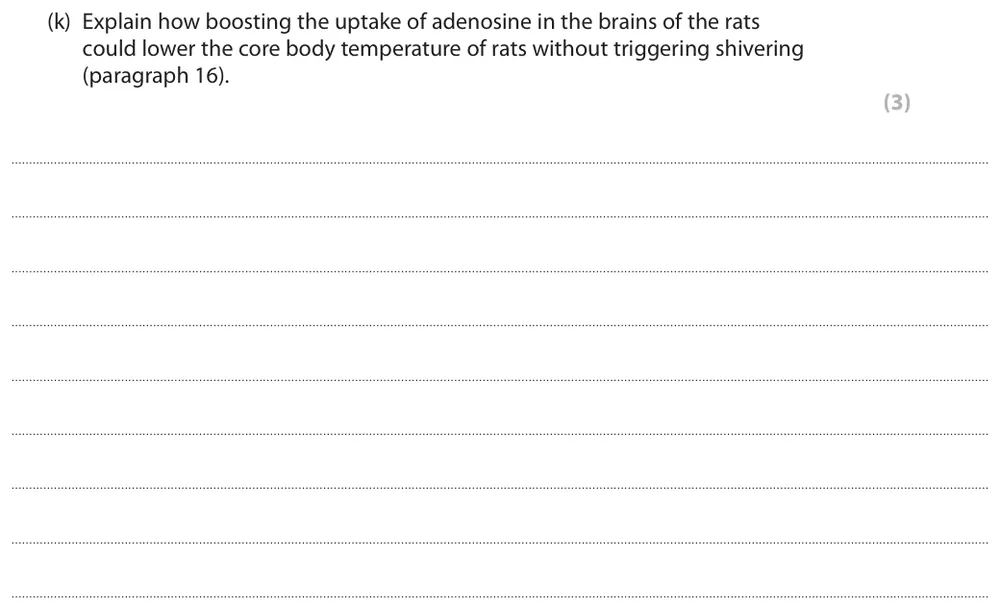
A level Paper 3 · June 2025 · Q8(k) · 3 marks
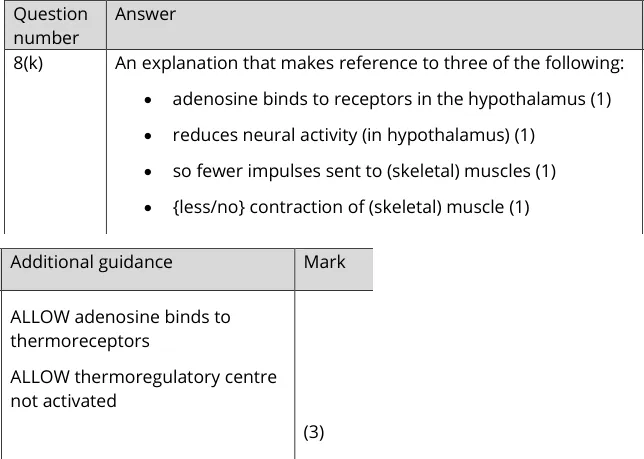
Explain how boosting adenosine uptake could lower a rat's core temperature without shivering.
Show the mark scheme
Tap an image to open it full size.
From the examiners' report: Many put the receptors in the hippocampus rather than the hypothalamus, which contains the thermoregulatory centre, or wrote 'signals' instead of impulses. Finish with less or no contraction of the skeletal muscles that cause shivering.
Where students lose marks (from Pearson examiners' reports and mark schemes)
Each point below comes from the examiners' report and mark scheme, and is followed by wording that gained marks.
Hibernation genes, not just hibernation. Most attempts at the second mark said hibernation was inherited from a common ancestor without mentioning genes or alleles.
✔ Gains credit: 'Several different mammals hibernate, so genes associated with hibernation were passed down from a common ancestor.'
Less respiration means less heat. Some answered with thermoregulation, or wrote 'energy' without saying heat energy.
✔ Gains credit: 'A lower metabolic rate reduces the requirement for ATP, therefore reduced respiration, therefore less heat released.'
Thermoreceptors send impulses. Many wrote 'signals' instead of impulses, losing the marks for the nerve pathway.
✔ Gains credit: 'Thermoreceptors detect temperature; the hypothalamus receives impulses from thermoreceptors, and impulses go from the hypothalamus to effectors.'
Sample both hibernators and non-hibernators. Few said the tissue samples had to come from both hibernating and non-hibernating mammals.
✔ Gains credit: 'Tissue samples from hibernating and non-hibernating animals compared, to identify which genes are transcribed from the mRNA present.'
Explain the rise, not the low. Many explained why blood pressure is low during hibernation, or never mentioned blood flow, oxygen or respiration.
✔ Gains credit: 'To increase delivery of oxygen to cells for respiration, for muscle contraction.'
From amine group to protein. Many named amino acids and nucleotides, which count as one marking point, and stopped there.
✔ Gains credit: 'The amine group from urea is used to synthesise amino acids, to synthesise proteins.'
Collisions between enzyme and substrate. Some said enzymes denature, left out kinetic energy, or wrote 'more collisions' without naming enzymes and substrates.
✔ Gains credit: 'Less kinetic energy, resulting in fewer enzyme-substrate collisions; metabolic activities depend on enzymes.'
Adenosine acts on the hypothalamus here. Many said adenosine binds to receptors in the hippocampus, not the hypothalamus with its thermoregulatory centre.
✔ Gains credit: 'Adenosine binds to receptors in the hypothalamus, reducing neural activity, so fewer impulses are sent to skeletal muscles and there is less contraction.'
Download the questions
Download the PDF pack (11 questions, mark schemes at the end)
Keep practising
- Read the June 2025 scientific article: The Big Sleep
- How the Edexcel SNAB Paper 3 scientific article works, and what examiners want
- Edexcel SNAB A level Biology revision resources by topic
- Life in the Sloth Lane (June 2024 Paper 3 Scientific Article): Edexcel SNAB A Level Biology Exam Questions
- All Edexcel SNAB exam questions by topic
- Edexcel SNAB A level Biology past papers, mark schemes and examiners' reports
- Edexcel SNAB A level Biology grade boundaries
- Message Tom on WhatsApp about one-to-one Edexcel SNAB tutoring or an Edexcel group class
Questions, mark schemes and examiners' report extracts © Pearson Education Ltd.