

Photosynthesis as an Energy Transfer Process (13.1): Cambridge (CIE) A Level Biology 9700 Exam Questions by Topic
Photosynthesis as an energy transfer process is sub-topic 13.1 of Topic 13, Photosynthesis, in the Cambridge International AS & A Level Biology syllabus (9700). You need to relate the structure of a chloroplast to its function, describe the role of chloroplast pigments, interpret absorption spectra and action spectra, and use chromatography and Rf values to identify pigments. You also need to explain cyclic and non-cyclic photophosphorylation, outline the three stages of the Calvin cycle and state how Calvin cycle intermediates are used to make other molecules. This is A level content, examined on Paper 4.
The examiners' reports repeat the same warnings. Link each feature of a chloroplast to what it does: naming the electron transport chain or ATP synthase is not enough on its own. Pigments 'absorb' light; they do not 'trap' or 'capture' it, and accessory pigments pass energy, not light, to the reaction centre. Keep the thylakoid space and the thylakoid membrane apart: protons are pumped into the thylakoid space and diffuse back to the stroma through ATP synthase, which is not ATPase. Photolysis of water gives hydrogen ions, electrons and O2. When you use a spectrum, quote the wavelengths accurately, with units, and compare two curves at the same wavelength.
Studying Cambridge International A level Biology and want more help? Tom teaches CIE students one-to-one online, including students in the UAE, Saudi Arabia, Hong Kong, India and Indonesia, and every lesson is recorded. You can book a one-to-one lesson or a free 15-minute discovery chat, or register your interest in a CIE group class starting in September 2027, using the links at the bottom of this page.
What you need from AS Level
Each question on this page assumes you're secure on these ideas. If any of them feels shaky, look it up before you start.
- A chloroplast is surrounded by an envelope of two membranes and contains 70S ribosomes and circular DNA.
- ATP is the molecule that transfers energy within cells, and it is made in chloroplasts and mitochondria.
- Enzymes are specific: the substrate binds to the active site to form an enzyme-substrate complex.
- Facilitated diffusion moves ions down a concentration gradient through a membrane protein; active transport moves them against a gradient.
Key terms
These words come up in the questions and mark schemes. Examiners expect you to use them exactly.
- Thylakoid: a flattened membrane sac inside a chloroplast. The thylakoid membrane holds the pigments, electron transport chain and ATP synthase; the thylakoid space builds up a high concentration of protons.
- Granum: a stack of thylakoids (plural: grana), which gives a large surface area for absorbing light.
- Stroma: the fluid around the thylakoids; the site of the light-independent stage (Calvin cycle).
- Accessory pigment: a pigment such as chlorophyll b, carotene or xanthophyll that absorbs wavelengths of light not absorbed by chlorophyll a and passes the energy to the primary pigment in the reaction centre.
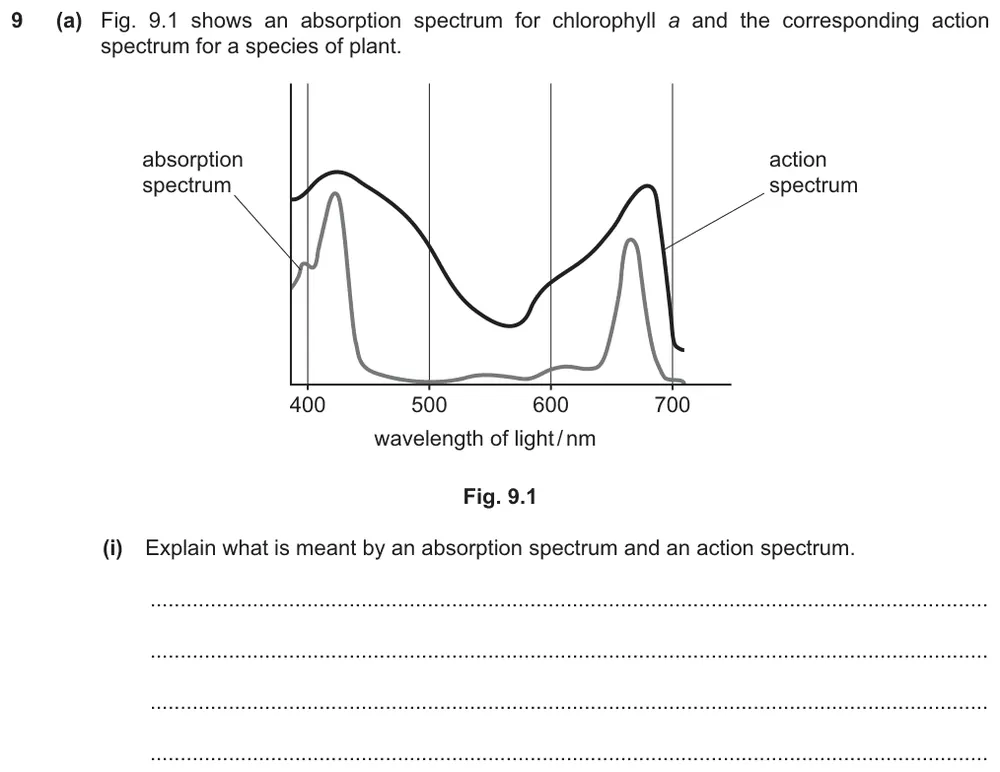
- Absorption spectrum: a graph of the absorption of different wavelengths of light by a pigment.
- Action spectrum: a graph of the rate of photosynthesis at different wavelengths of light.
- Rf value: distance moved by the pigment from the baseline divided by the distance moved by the solvent from the baseline; it is compared with known values to identify a pigment.
- Photolysis: the splitting of water into protons, electrons and oxygen, catalysed by the oxygen-evolving complex.
What these questions cover (Cambridge 9700 Topic 13: Photosynthesis)
The questions test these learning outcomes from sub-topic 13.1 of the Cambridge International AS & A Level Biology syllabus (9700) for 2025 to 2027.
- 13.1.1 describe the relationship between the structure of chloroplasts, as shown in diagrams and electron micrographs, and their function
- 13.1.2 explain that energy transferred as ATP and reduced NADP from the light-dependent stage is used during the light-independent stage (Calvin cycle) of photosynthesis to produce complex organic molecules
- 13.1.3 state that within a chloroplast, the thylakoids (thylakoid membranes and thylakoid spaces), which occur in stacks called grana, are the site of the light-dependent stage and the stroma is the site of the light-independent stage
- 13.1.4 describe the role of chloroplast pigments (chlorophyll a, chlorophyll b, carotene and xanthophyll) in light absorption in thylakoids
- 13.1.5 interpret absorption spectra of chloroplast pigments and action spectra for photosynthesis
- 13.1.6 describe and use chromatography to separate and identify chloroplast pigments
- 13.1.8 only photosystem I (PSI) is involved
- 13.1.9 photosystem I (PSI) and photosystem II (PSII) are both involved
- 13.1.10 energetic electrons release energy as they pass through the electron transport chain
- 13.1.11 outline the three main stages of the Calvin cycle
- 13.1.12 state that Calvin cycle intermediates are used to produce other molecules, limited to GP to produce some amino acids and TP to produce carbohydrates, lipids and amino acids
How to use this page
Write your answer on paper before you open the mark scheme. Allow about 1.2 minutes per mark: the 22 questions are worth 68 marks, so about 82 minutes in total. Then mark your answer strictly against the mark scheme and read the examiners' tip underneath it. If you'd rather print the questions, download the PDF pack.
Chloroplast structure and function (13.1.1 and 13.1.3)
Question 1
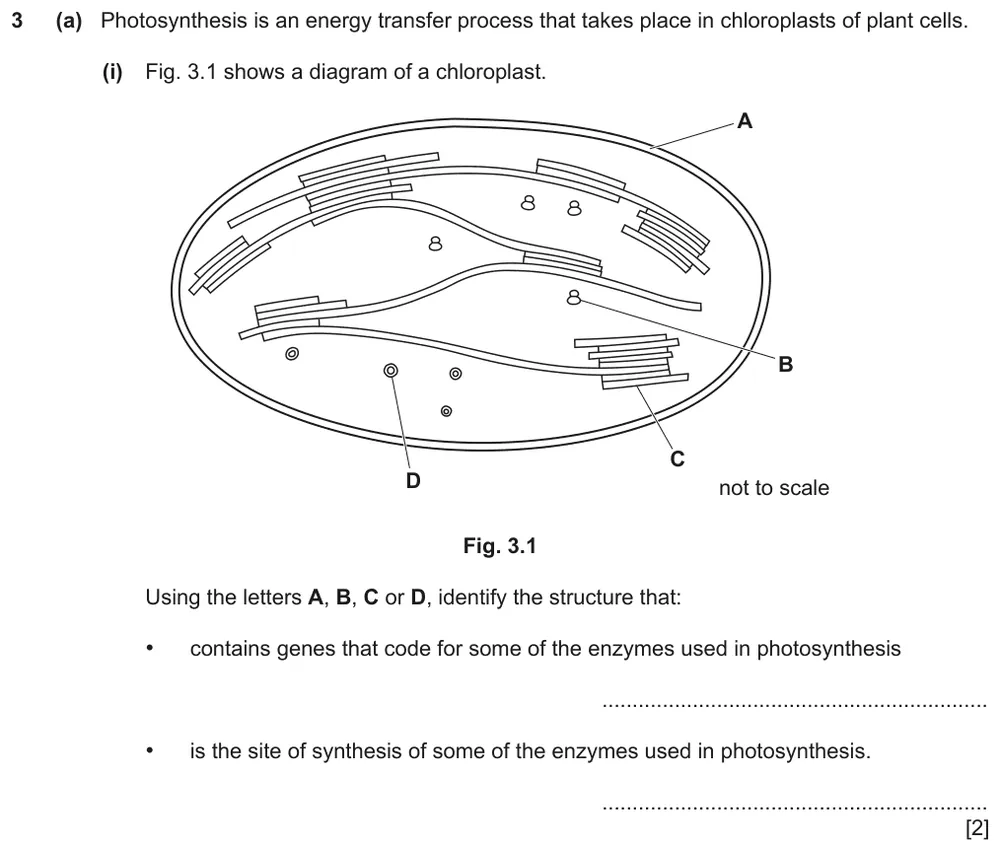
Paper 4 · October/November 2022 (42) · Q3(a)(i) · 2 marks · Easy
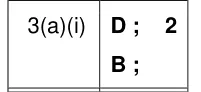
Use the letters on a diagram of a chloroplast to identify where genes for photosynthesis enzymes are found and where the enzymes are made.
Show the mark scheme
Tap an image to open it full size.
Question 2
Paper 4 · October/November 2022 (42) · Q3(a)(ii) · 4 marks · Easy
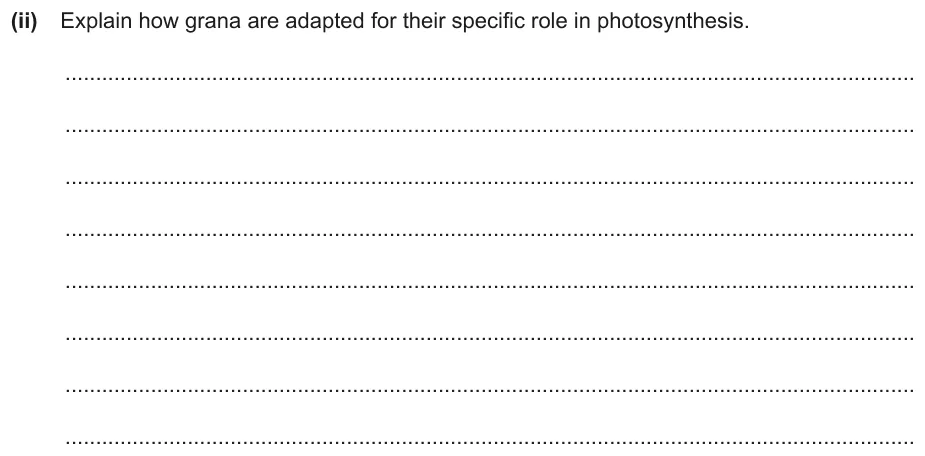
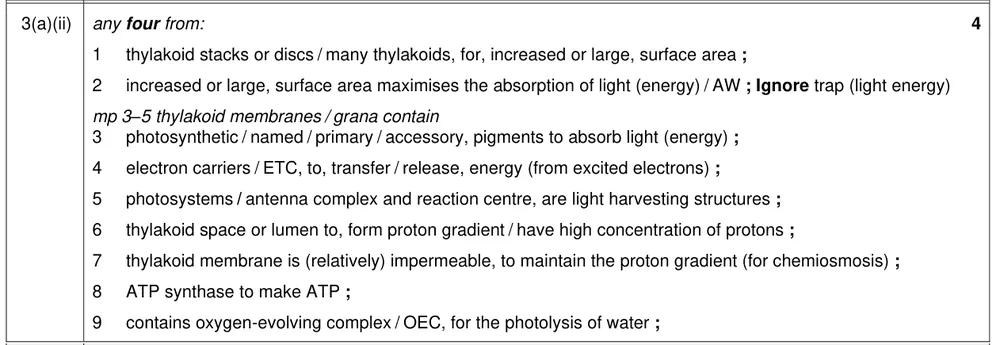
Explain how grana are adapted for their role in photosynthesis.
Show the mark scheme
Tap an image to open it full size.
From the examiners' report: Set out each feature briefly and link it straight to its role. Naming the electron transport chain or ATP synthase gained nothing without saying what it does. Write that pigments 'absorb' light, not 'trap' or 'capture' it, and write ATP synthase, not ATPase.
Question 3
Paper 4 · May/June 2023 (41) · Q1(a) · 4 marks
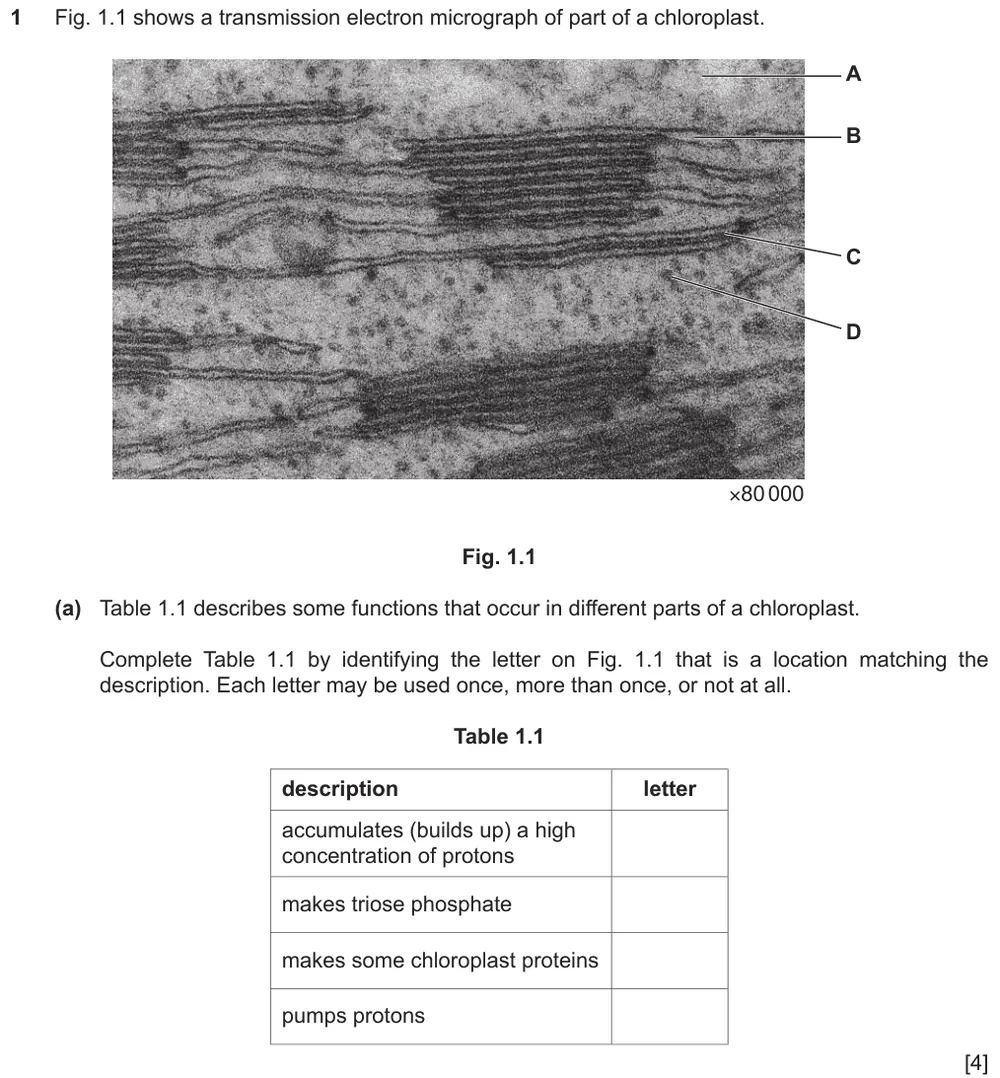
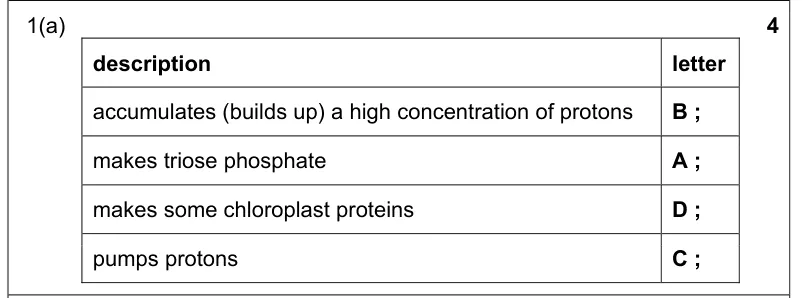
Match four functions to the labelled parts of a chloroplast in an electron micrograph.
Show the mark scheme
Tap an image to open it full size.
From the examiners' report: This was done well. Some students confused the thylakoid space with the thylakoid membrane when deciding which pumps protons and where the protons build up.
Chloroplast pigments, ATP and reduced NADP (13.1.2 and 13.1.4)
Question 4
Paper 4 · February/March 2025 (42) · Q9(a) · 2 marks
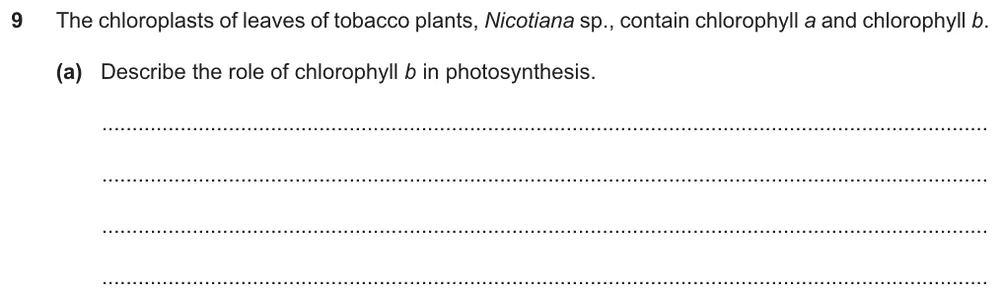
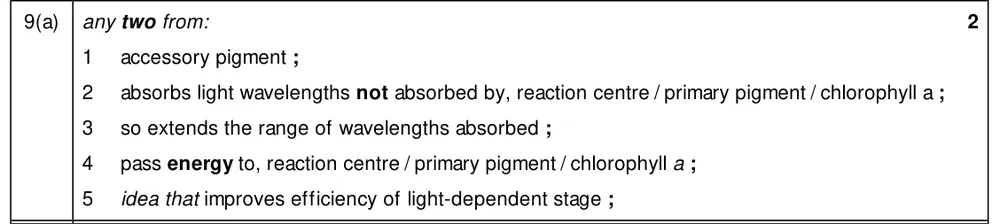
Describe the role of chlorophyll b in photosynthesis.
Show the mark scheme
Tap an image to open it full size.
From the examiners' report: Many said that chlorophyll b is an accessory pigment that absorbs light, but did not explain that it absorbs wavelengths the primary pigment does not, which extends the range of wavelengths used. Accessory pigments pass energy, not light, to the reaction centre.
Question 5
Paper 4 · February/March 2025 (42) · Q9(b)(ii) · 4 marks · Easy
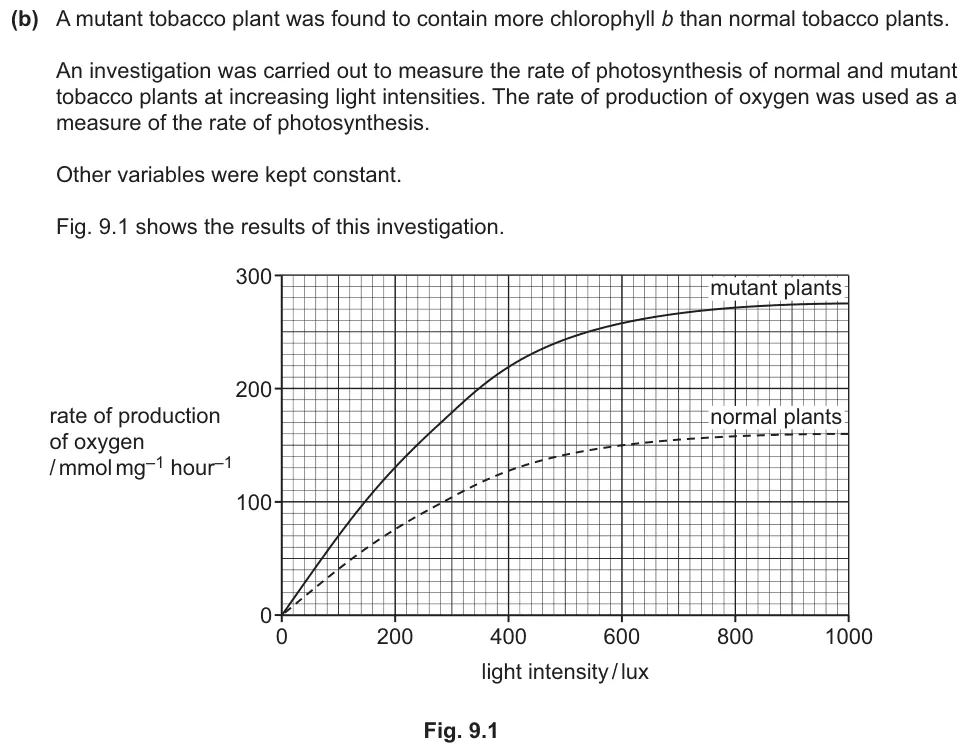
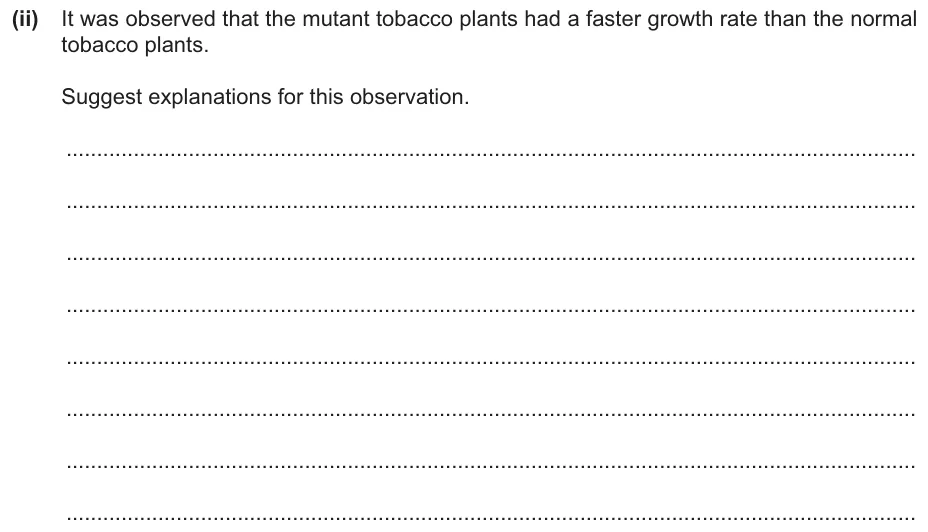
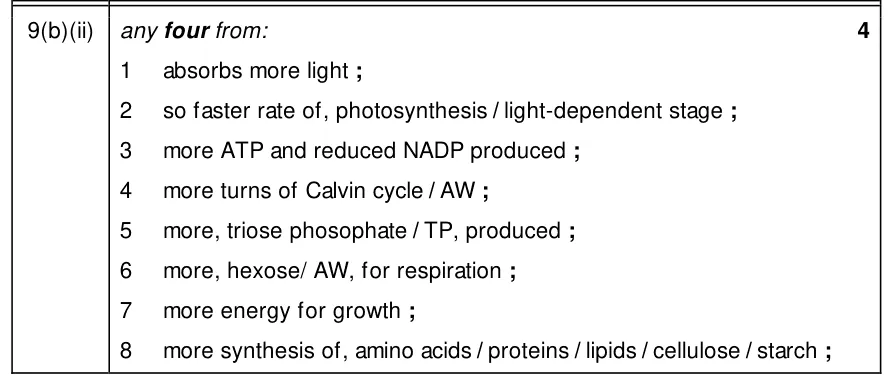
Suggest why mutant tobacco plants that absorb more light grow faster than normal plants.
Information from earlier in this question:
Show the mark scheme
Tap an image to open it full size.
From the examiners' report: Most linked more light absorbed to a higher rate of photosynthesis and more ATP. Fewer mentioned more reduced NADP. Only stronger answers went on to more triose phosphate for making biological molecules and for transferring energy for growth.
Absorption spectra and action spectra (13.1.4 and 13.1.5)
Question 6
Paper 4 · October/November 2025 (42) · Q9(a)(i) · 2 marks
Explain what is meant by an absorption spectrum and an action spectrum.
Show the mark scheme

Tap an image to open it full size.
Question 7
Paper 4 · October/November 2025 (42) · Q9(a)(ii) · 3 marks
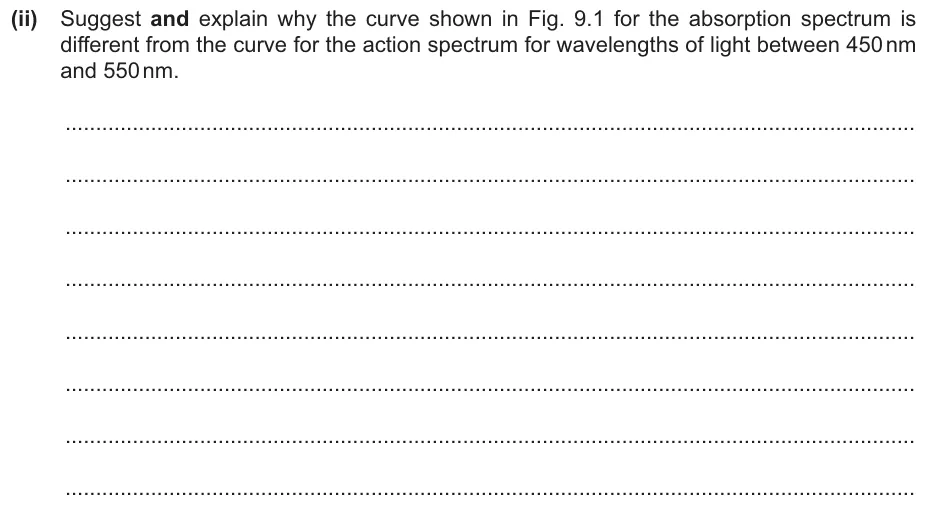
Suggest and explain why the absorption spectrum of chlorophyll a differs from the action spectrum between 450 nm and 550 nm.
Show the mark scheme

Tap an image to open it full size.
Question 8
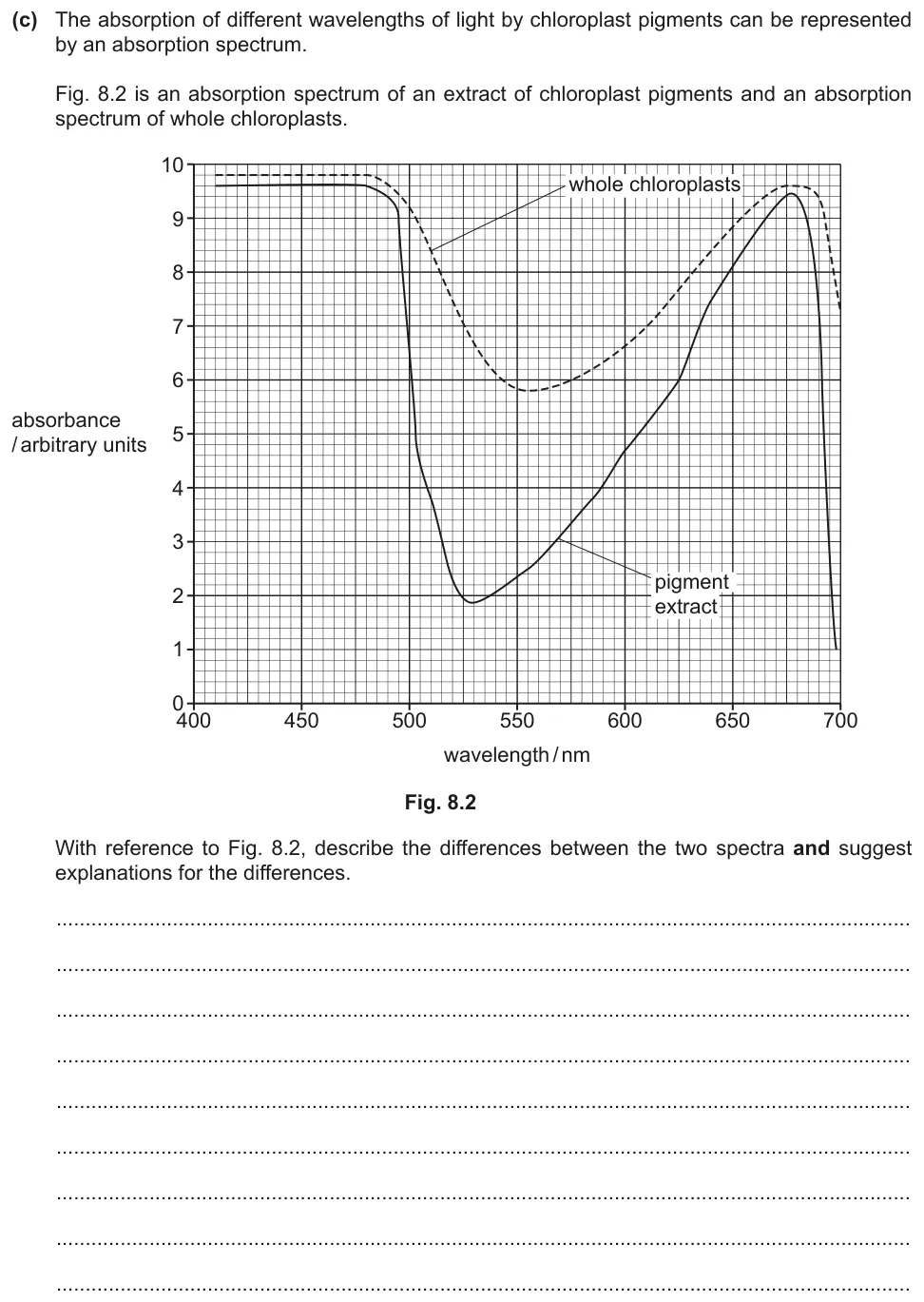
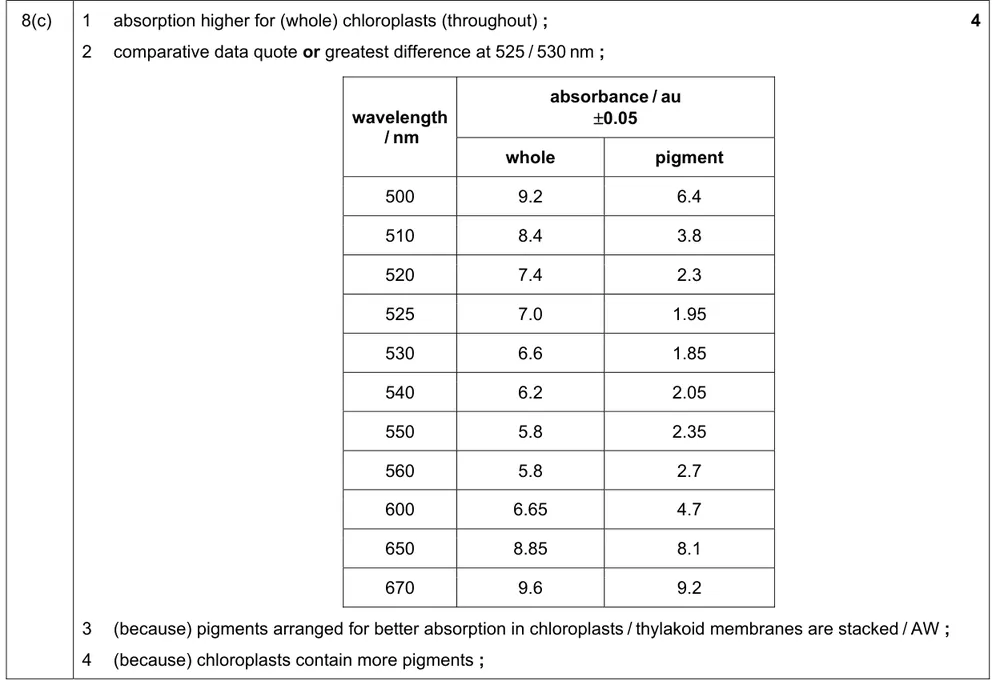
Paper 4 · May/June 2023 (43) · Q8(c) · 4 marks
Describe and explain the differences between the absorption spectra of a pigment extract and of whole chloroplasts.
Show the mark scheme
Tap an image to open it full size.
From the examiners' report: Many figures were inaccurate, or did not compare the two spectra at the same wavelength of light. Only a minority suggested that whole chloroplasts have more pigments, or that the pigments are arranged better for absorption.
Question 9
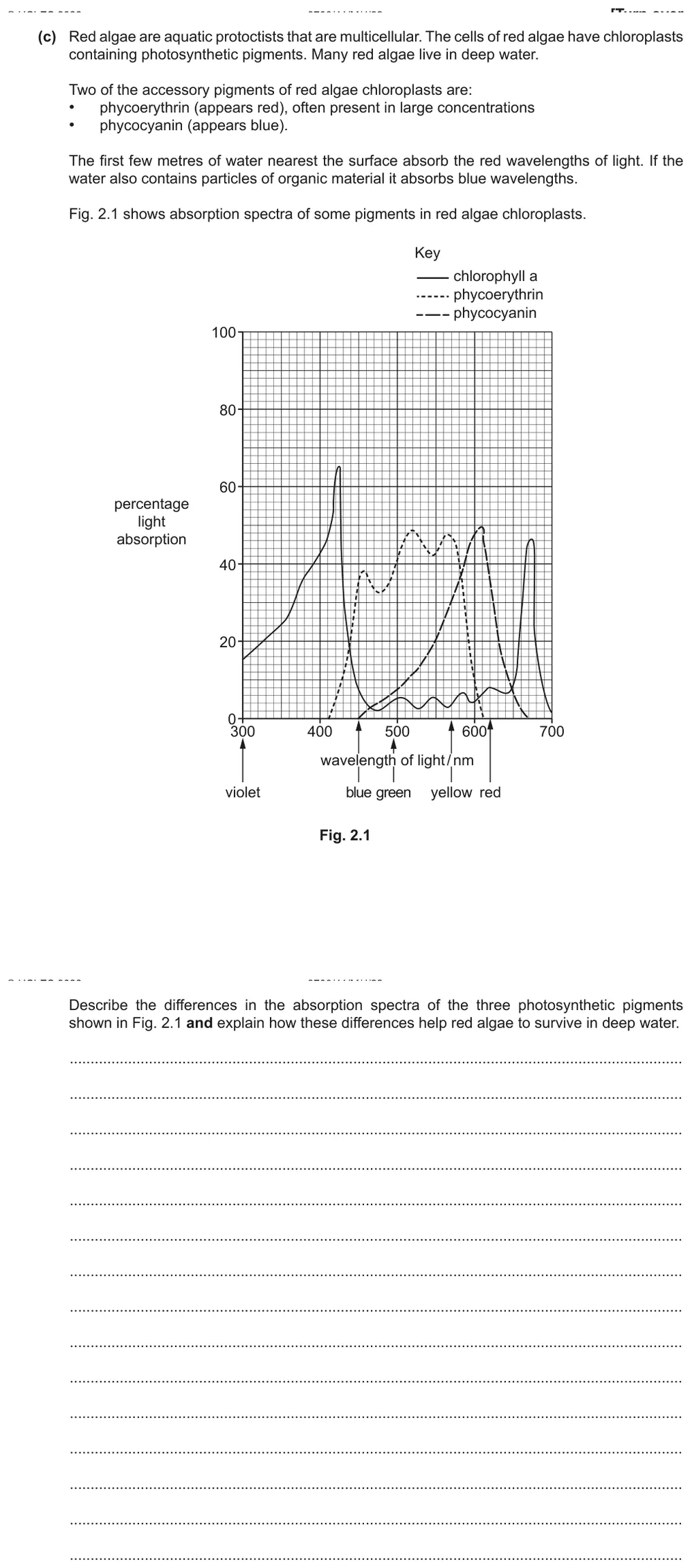
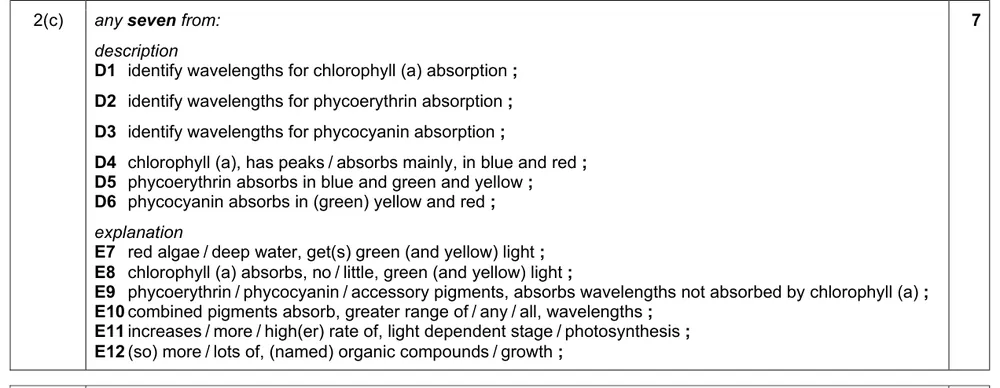
Paper 4 · May/June 2022 (41) · Q2(c) · 7 marks · Hard
Use absorption spectra to describe and explain how the pigments of red algae allow them to live in deep water.
Show the mark scheme
Tap an image to open it full size.
From the examiners' report: Quote wavelengths precisely and give the units. Many did not use the information in the question that deep water lacks red and blue light. The strongest answers said that the green and yellow light that chlorophyll a cannot absorb is absorbed by the accessory pigments, giving a higher rate of the light-dependent stage.
Chromatography of chloroplast pigments (13.1.6)
Question 10
Paper 4 · February/March 2021 (42) · Q4(b)(i) · 1 mark
Name a technique used to separate and identify photosynthetic pigments.
Information from earlier in this question:


Show the mark scheme

Tap an image to open it full size.
From the examiners' report: Most named the technique. The most common wrong answer was electrophoresis.
Question 11
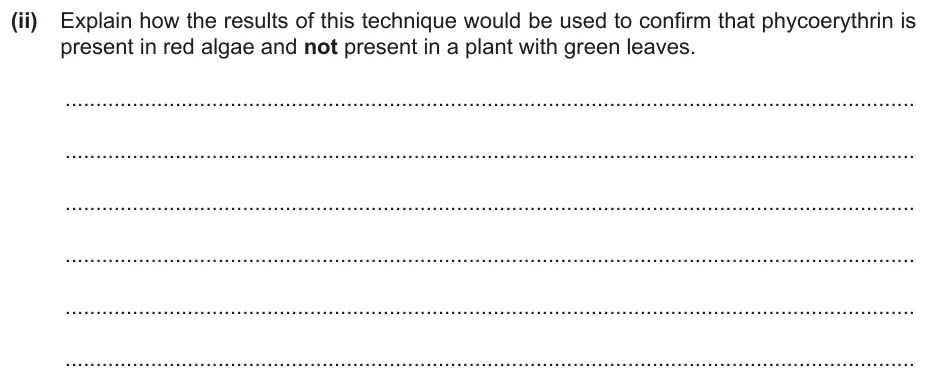
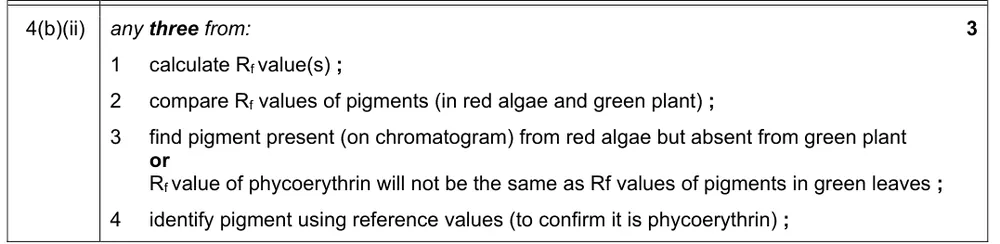
Paper 4 · February/March 2021 (42) · Q4(b)(ii) · 3 marks
Explain how the results would confirm that a pigment is present in red algae but not in a green plant.
Show the mark scheme
Tap an image to open it full size.
From the examiners' report: Many compared green plants with red algae without saying how the presence of the pigment could be confirmed. Those who did usually explained how to calculate Rf values and how to use them. Long descriptions of how to carry out the technique were not needed.
Cyclic and non-cyclic photophosphorylation (13.1.8 and 13.1.9)
Question 12
Paper 4 · February/March 2019 (42) · Q1(c) · 5 marks · Hard
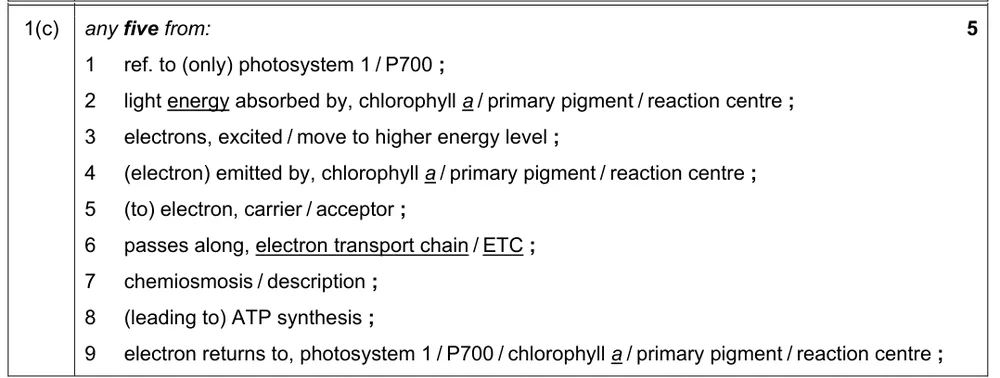
Outline the process of cyclic photophosphorylation.
Show the mark scheme
Tap an image to open it full size.
From the examiners' report: There were many good descriptions. Few mentioned the role of the primary pigment in absorbing light energy, or the role of chemiosmosis in making ATP.
Question 13
Paper 4 · May/June 2024 (42) · Q7(b) · 3 marks · Easy
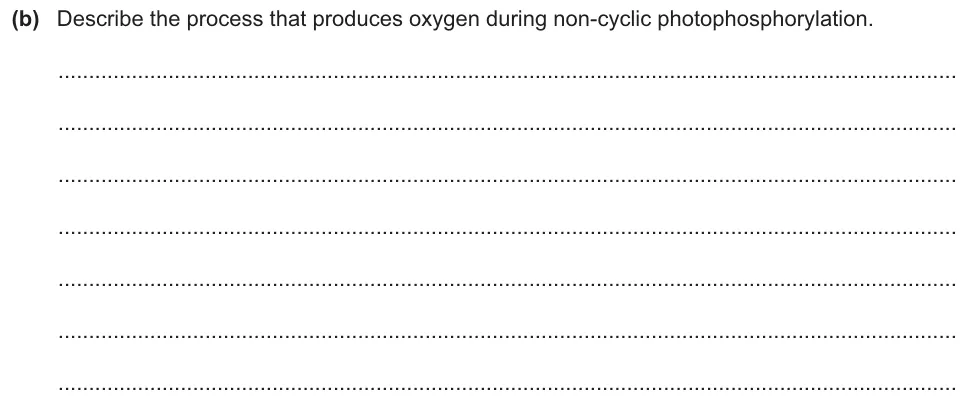
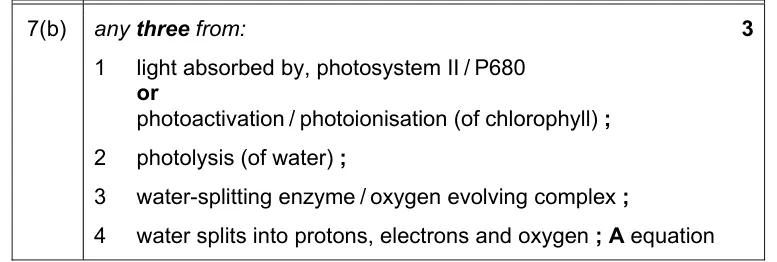
Describe the process that produces oxygen during non-cyclic photophosphorylation.
Show the mark scheme
Tap an image to open it full size.
From the examiners' report: Photolysis and its products were well known, but photosystems and the oxygen-evolving complex much less so. Many were unsure where light is absorbed. Write hydrogen ions, not hydrogen, and O2, not O.
Question 14
Paper 4 · October/November 2023 (42) · Q8(a) · 4 marks · Easy
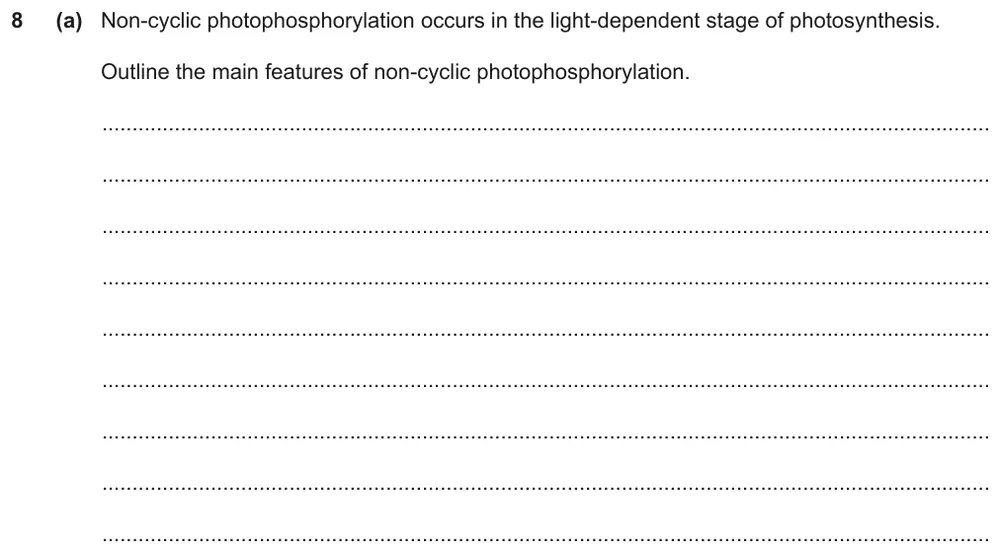
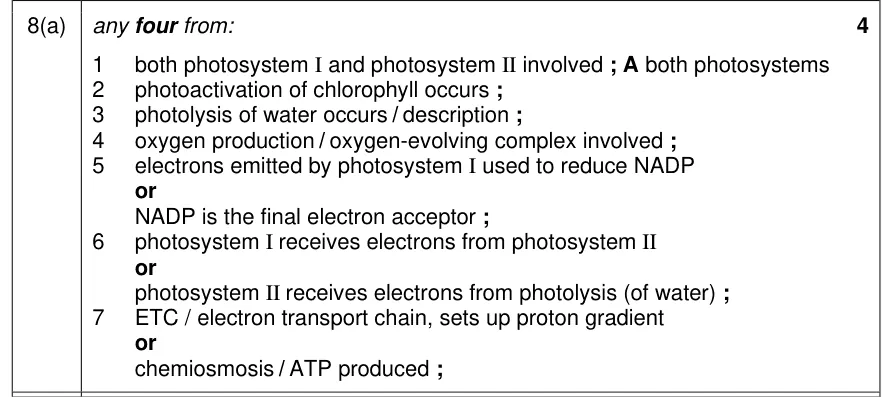
Outline the main features of non-cyclic photophosphorylation.
Show the mark scheme
Tap an image to open it full size.
From the examiners' report: Most said that both photosystems are involved and described the photolysis of water. Only some knew that the electrons used to reduce NADP come from photosystem I. Very few mentioned the photoactivation of chlorophyll.
Electron transport, protons and ATP synthase (13.1.10)
Question 15
Paper 4 · May/June 2024 (43) · Q7(b) · 4 marks
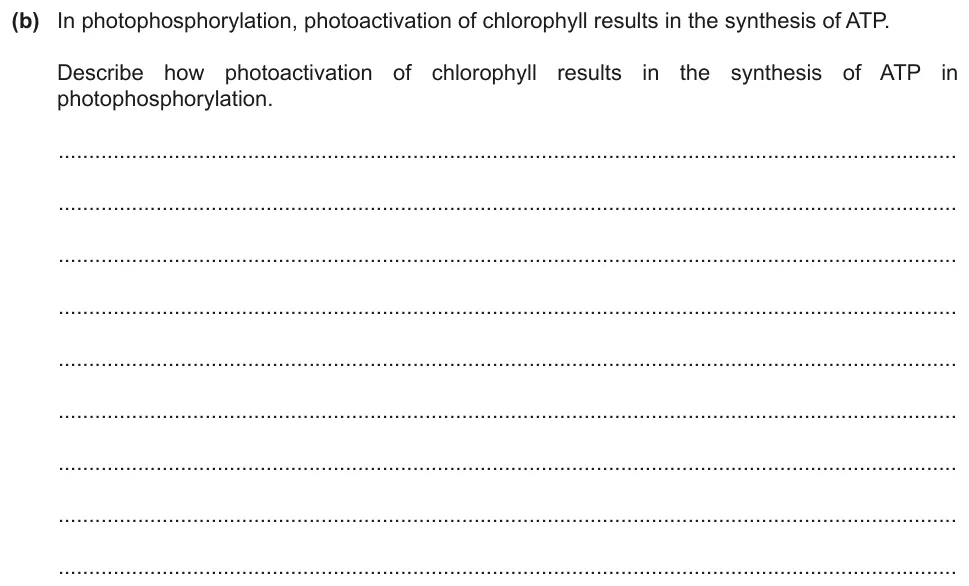
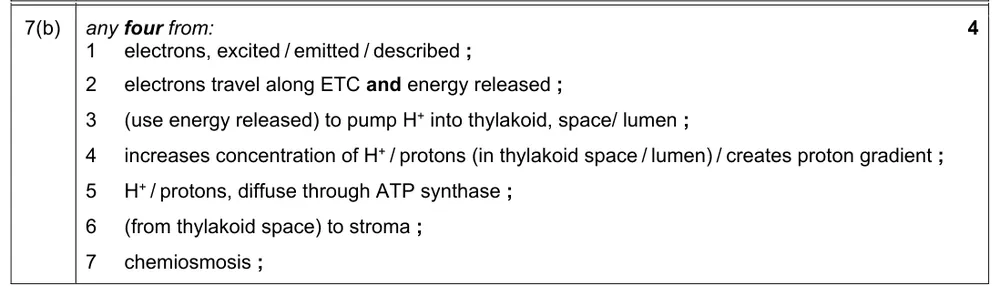
Describe how photoactivation of chlorophyll results in the synthesis of ATP.
Show the mark scheme
Tap an image to open it full size.
From the examiners' report: Protons are pumped into the thylakoid space, not into the thylakoid membrane, and the enzyme is ATP synthase, not ATPase. Energy is released as the electrons move along the chain; do not write that energy is 'produced' or 'generated'.
The Calvin cycle (13.1.11)
Question 16
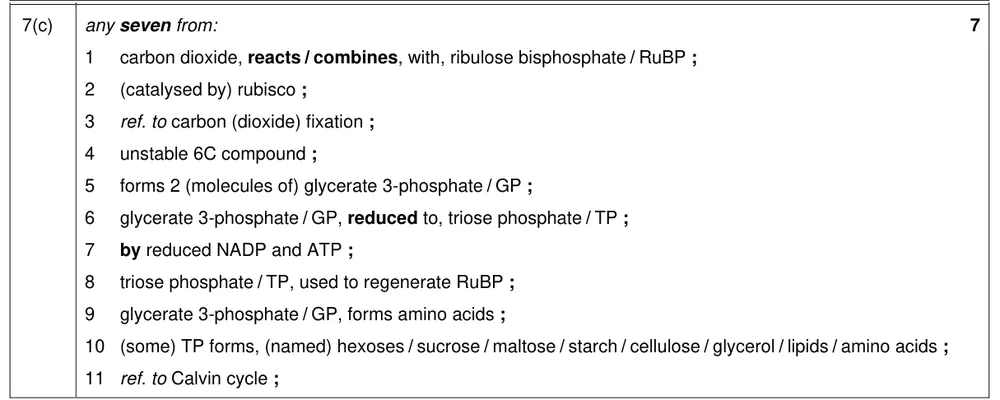
Paper 4 · October/November 2024 (42) · Q7(c) · 7 marks
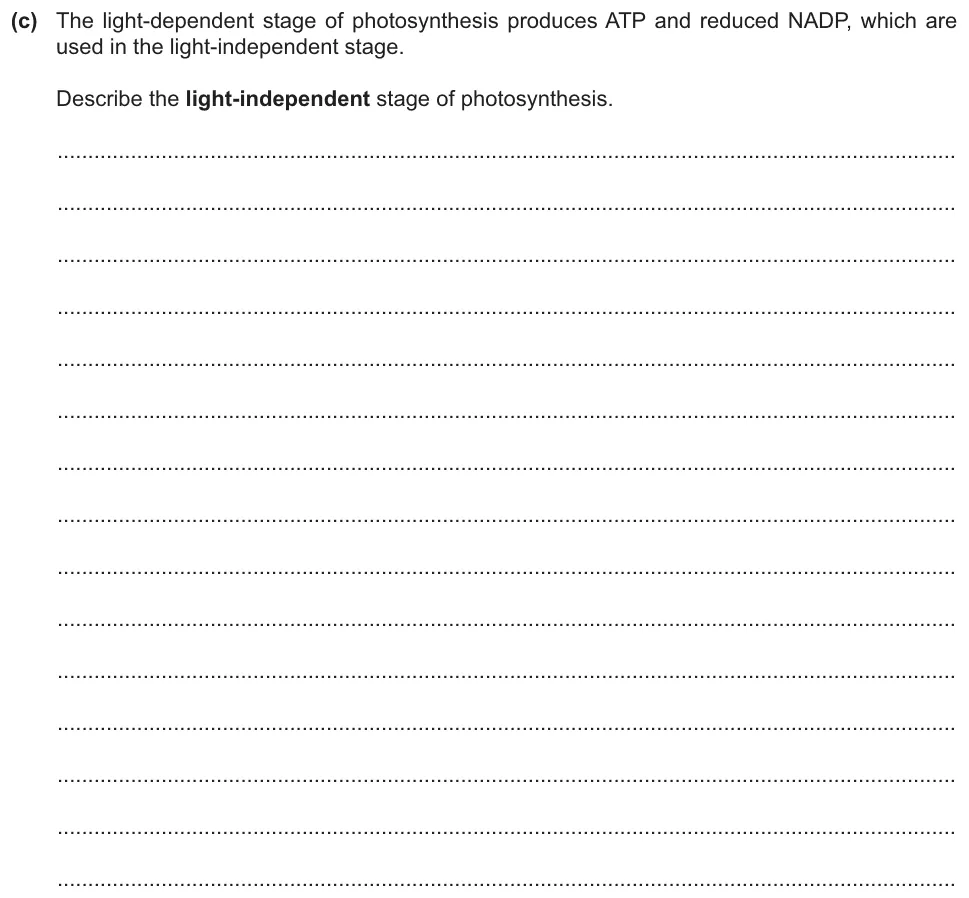
Describe the light-independent stage of photosynthesis.
Show the mark scheme
Tap an image to open it full size.
Question 17
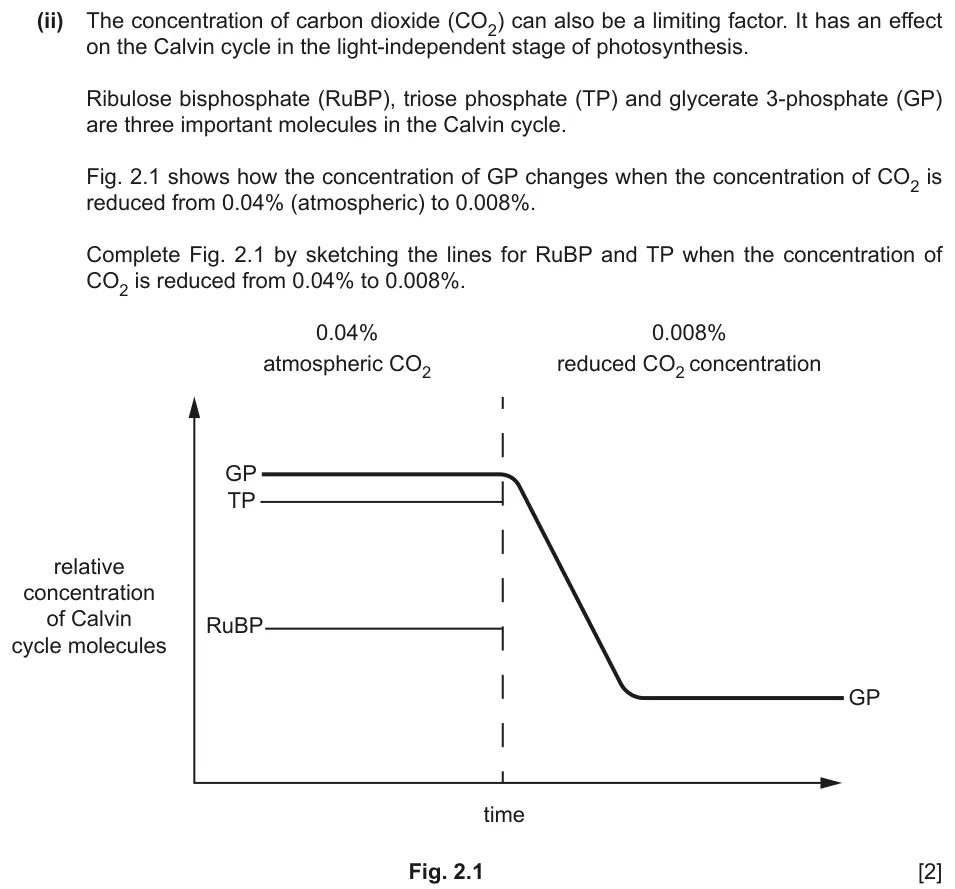
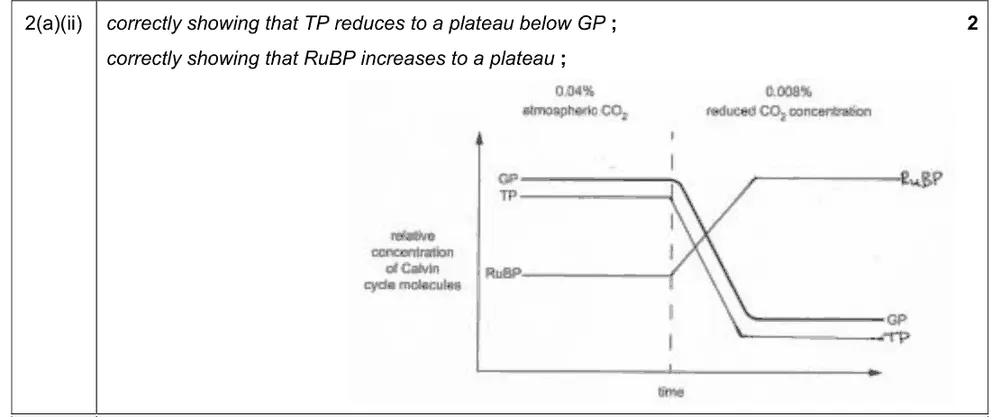
Paper 4 · May/June 2022 (42) · Q2(a)(ii) · 2 marks · Easy
Sketch how the concentrations of RuBP and TP change when the carbon dioxide concentration is reduced.
Information from earlier in this question:

Show the mark scheme
Tap an image to open it full size.
From the examiners' report: This was usually answered well. A minority drew RuBP as a horizontal line, or falling like the other two lines. A significant number left the graph blank, so read the question carefully.
Question 18
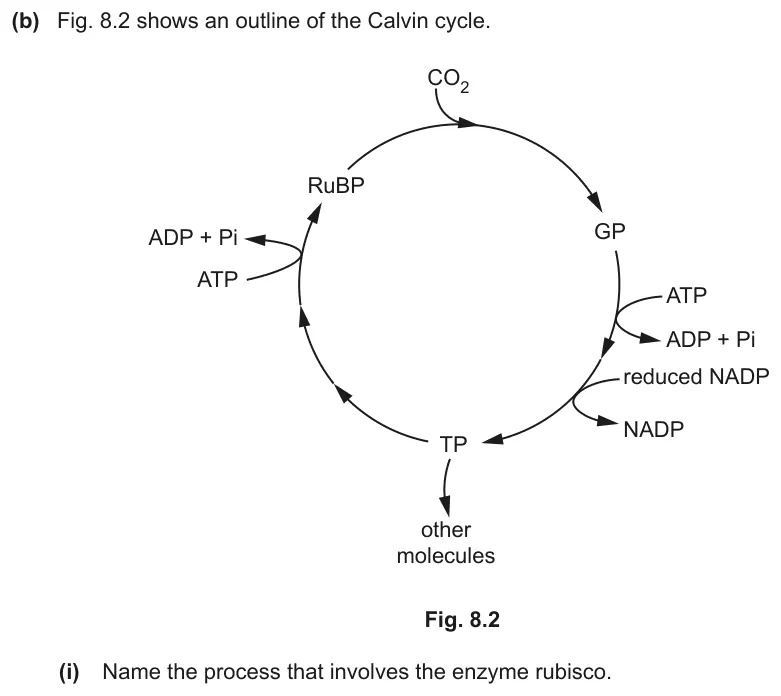
Paper 4 · May/June 2023 (42) · Q8(b)(i) · 1 mark · Easy
Name the process in the Calvin cycle that involves rubisco.
Show the mark scheme

Tap an image to open it full size.
Question 19
Paper 4 · May/June 2023 (42) · Q8(b)(ii) · 1 mark
State the type of reaction that converts GP to TP.

Show the mark scheme

Tap an image to open it full size.
From the examiners' report: Most answered correctly. Wrong answers included phosphorylation, oxidation, dehydrogenation and redox.
Question 20
Paper 4 · May/June 2023 (42) · Q8(b)(iii) · 1 mark · Hard
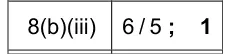
State how many molecules of RuBP are produced from 10 molecules of TP.

Show the mark scheme
Tap an image to open it full size.
From the examiners' report: Some students found this hard. Eight was the most common wrong answer.
Uses of Calvin cycle intermediates (13.1.12)
Question 21
Paper 4 · May/June 2023 (42) · Q8(b)(iv) · 2 marks
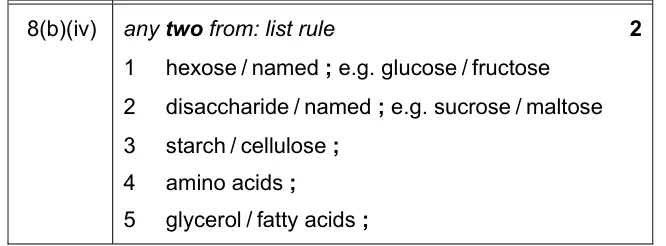
State two molecules that can be made from TP that is not used to regenerate RuBP.

Show the mark scheme
Tap an image to open it full size.
Question 22
Paper 4 · February/March 2022 (42) · Q6(b)(ii) · 2 marks · Hard
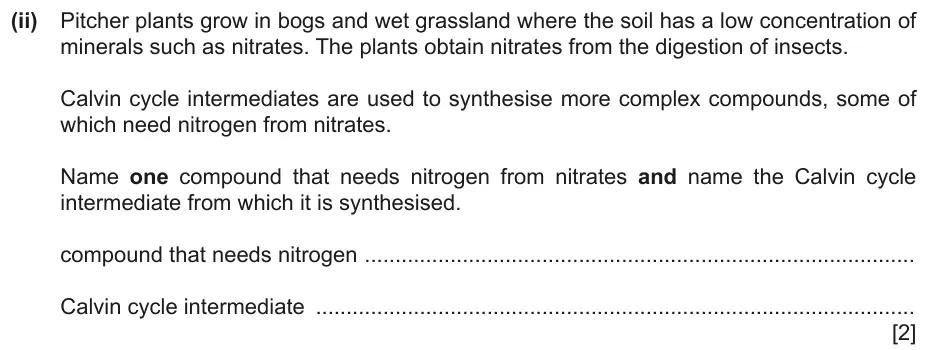
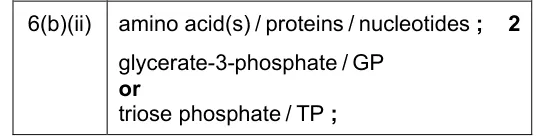
Name a compound that needs nitrogen from nitrates and the Calvin cycle intermediate it is made from.
Show the mark scheme
Tap an image to open it full size.
From the examiners' report: A large minority could not suggest a compound that contains nitrogen, so they could not name the Calvin cycle intermediate it is made from.
Where students lose marks (from Cambridge examiners' reports and mark schemes)
Each point below comes from the examiners' reports and mark schemes, and is followed by wording that gained marks.
Link each feature to its role. Students listed features of grana, such as the electron transport chain or ATP synthase, without saying what each one does, and some wrote ATPase.
✔ Gains credit: 'thylakoid stacks' for 'large surface area', 'pigments to absorb light', 'ATP synthase to make ATP' and the 'oxygen-evolving complex' 'for the photolysis of water'.
Thylakoid space is not thylakoid membrane. Students mixed up the thylakoid space and the thylakoid membrane when deciding which pumps protons and where protons build up.
✔ Gains credit: the thylakoid space 'accumulates (builds up) a high concentration of protons'; the thylakoid membrane 'pumps protons'.
Energy is passed on, not light. Students wrote that accessory pigments pass light to the reaction centre, and did not say that they absorb different wavelengths from the primary pigment.
✔ Gains credit: an 'accessory pigment' that 'absorbs light wavelengths not absorbed by' 'chlorophyll a', 'so extends the range of wavelengths absorbed', and will 'pass energy to' the 'reaction centre'.
Compare spectra at the same wavelength. Students quoted inaccurate figures, or gave a figure for each spectrum at a different wavelength.
✔ Gains credit: 'absorption higher for (whole) chloroplasts', with the 'greatest difference at 525 / 530 nm', because 'chloroplasts contain more pigments' or 'thylakoid membranes are stacked'.
Use what the question says about deep water. Students did not use the information that deep water lacks red and blue light, and some suggested the algae feed on the organic material in the water.
✔ Gains credit: 'deep water' gets 'green (and yellow) light'; 'chlorophyll (a) absorbs' 'little' of it; 'accessory pigments' absorb 'wavelengths not absorbed by chlorophyll (a)', so there is a higher 'rate of' the 'light dependent stage'.
Rf values identify the pigment. Students wrote long descriptions of how to carry out chromatography, or compared the two organisms without saying how the pigment would be confirmed.
✔ Gains credit: 'calculate Rf value(s)', 'compare Rf values of pigments' and 'identify pigment using reference values'.
Hydrogen ions and O2, not hydrogen and O. Students were unsure where light is absorbed, and gave the products of photolysis as hydrogen instead of hydrogen ions, or O instead of O2.
✔ Gains credit: 'light absorbed by' 'photosystem II', 'photolysis (of water)' by the 'oxygen evolving complex', and 'water splits into protons, electrons and oxygen'.
Protons are pumped into the thylakoid space. Students wrote that protons are pumped into the thylakoid membrane, called the enzyme ATPase, or said that energy is produced.
✔ Gains credit: 'electrons travel along ETC and energy released' 'to pump H+ into thylakoid' 'space', which 'creates proton gradient'; 'protons' 'diffuse through ATP synthase' 'to stroma'.
Download the questions
Download the PDF pack (22 questions, mark schemes at the end)
Keep practising
- Investigation of Limiting Factors (13.2): Cambridge (CIE) exam questions by topic
- Cambridge (CIE) A level Biology 9700 past papers, mark schemes and examiners' reports
- Cambridge (CIE) A level Biology grade thresholds
- Book a one-to-one CIE lesson or a free 15-minute discovery chat with Tom
- Register your interest in a CIE A level Biology group class
Questions, mark schemes and examiners' report extracts © Cambridge University Press & Assessment.