AQA, Exam questions Jenny Shipway AQA, Exam questions Jenny Shipway

Another "Suggest" AQA exam question walk through

Example 2: Q3 Paper 2 2023

This next question is more complex, and there are two ‘suggest’ questions.

But first - I always recommend you don’t read the actual questions until you’ve looked at the background information, graph etc. Doing this will help you avoid getting overwhelmed and jumping to mistaken conclusions (which is very common in exam situations!).

So let’s keep the questions for later. First make sense of this:
Here is another example of a “Suggest” question from a past paper.

Find the main “Suggest” article and first example question here

Example 2: Q3 Paper 2 2023

This next question is more complex, and there are two ‘suggest’ questions.

But first - I always recommend you don’t read the actual questions until you’ve looked at the background information, graph etc. Doing this will help you avoid getting overwhelmed and jumping to mistaken conclusions (which is very common in exam situations!).

So let’s keep the questions for later. First make sense of this:

1. Don’t panic!

This question is going to challenge your working memory by throwing lots of information at you all at once. Tackle it bit by bit to make sense of what’s going on.

2. Use your knowledge to make sense of the background information:

There are tomatoes, a “mycorrhizal species’, and different water conditions.

  • You know that mycorrhizae are fungi (3.5.4)

  • You know that plants need the correct amount of water in order to grow (GCSE)

  • You can understand the experiment – including identifying the independent, dependent, and controlled variables. (8.3)

  • You can understand the data – what is the graph is showing? (6.4)

Top tip: Write “IV” and “DV” on the paper to identify the Independent and Dependent variables.

Water availability = IV
Whether mycorrhizae were added to the soil = IV
The mean mass of tomatoes = DV

…. What is the graph showing? 

·       The pair of bars on the left of the graph compare the yield of tomatoes from plants grown in conditions of water shortage.

o   The bar on the far left is for plants grown in soil that did not have mycorrhize added. The other is for plants in soil that did have mycorrhizae added.

o   The results show a significant difference between the yield of tomatoes for these two groups of plants. The plants with mycorrhizae yielded more tomatos.

·       The pair of bars on the right compare plants that did not experience water shortage.

o   Again, the bar on the left is without mycorrhizae, and that on the right is with mycorrhizae.

o   The results show no significant difference between the yield of tomatoes from these two groups of plants.

Got that? Ok now you’re ready to look at the questions. How would you approach these?


3. Answer questions in order:

The first part of the question (not shown) is about phosphorous cycles, so you will already be thinking about content from 3.5.4 (Nutrient Cycles).

4. Check the Command Word:

‘Suggest’.

5. Understand the question:

These questions are quite straightforward.

6. Think about relevant information from the spec

  • You know that mycorrhizae facilitate the uptake of water and inorganic ions by plants. (3.5.4)

  • You know that there are a variety of living organisms in soil, and that these are in competition (3.7.4)

  • ou have identified the fertiliser concentration as a controlled variable (8.3)

7. How many marks are there available?

Each question has two reasons for two marks; one mark per reason. Make them good ones!

8. So, what are your answers?

There are a variety of different ways to get the marks, allowing you to play to your strengths. Give it a go before looking at the makr scheme below.

..

..

..

..

..

..

..

..

..


Q3 Paper 2 2023 Q3.3 – mark scheme

Did you get the marks?

Paper 2 2023 Q3.3 – example answers

Good answer examples, which would win marks:

✅ to ensure that there are no other fungi growing in the soil

✅ to remove any seeds in the soil so that other plants don’t grow and consume the nutrients and water

✅ to ensure that there are no pathogens in the soil that can infect the tomato plants

Poor answers that would not get the mark – can you identify where they’ve gone wrong?

❌ To remove harmful bacteria

❌ To kill everything living in the soil so it doesn’t interfere with the experiment

❌ to make sure that conditions are ideal for growing tomato plants


Q3 Paper 2 2023 Q3.4 - markscheme

Paper 2 2023 Q3.4 – example answers

Good answer examples, which would win marks:

✅ The investigation is on the effect of water shortage so the concentration of fertiliser should be a control variable

✅  The concentration of fertiliser will affect the growth of the plant so the recommended amount should be used to get the best crop

✅  Fertilisers can affect the water potential of the soil which may impact how water is absorbed by the roots


Poor answers that would not get the mark – can you identify where they’ve gone wrong?

❌ Without fertiliser the tomatoes won’t grow

❌ So that the soil doesn’t affect the size of the tomatoes

❌ So that the tomatoes can be compare

Article by Natalie Vlachakis (an ex-teacher who also worked for AQA) & Jenny Shipway

Read More
AQA, Exam questions, Exam Tips Jenny Shipway AQA, Exam questions, Exam Tips Jenny Shipway

How to answer "Suggest" questions in AQA A level Biology

Command words are important! Step by step guide to how to approach and answer “Suggest” questions for top marks in AQA A level Biology.

Article by Natalie Vlachakis (an ex-teacher who also worked for AQA) & Jenny Shipway

Command Words: What do you Suggest?

There are many ways that examiners can ask an A-level Biology question. They might ask you to describe the structure of DNA. Or to explain the importance of the xylem being kept open as a continuous tube.

In exam questions, words like ‘describe’, ‘explain (and ‘suggest’) are known as command words. Always pay attention to command words because they tell you what type of knowledge or skill is being tested, and how you should approach the question.

So - when you get a question that asks you to ‘suggest’ something, what exactly does it want from you?

‘Suggest’ Questions

Suggest’ questions are usually asking you to use your biology knowledge and understanding to make sense of, and build upon, information about an unfamiliar organism and/or experiment.

Using unfamiliar contexts is a way for examiners to check that you really understand the content; rather than just having memorised set phrases and information.

You aren’t expected to already know the answer, or even be absolutely 100% certain that you’re correct. You just need to come up with something that would make sense biologically, and is likely to be true.

Example Exam Question

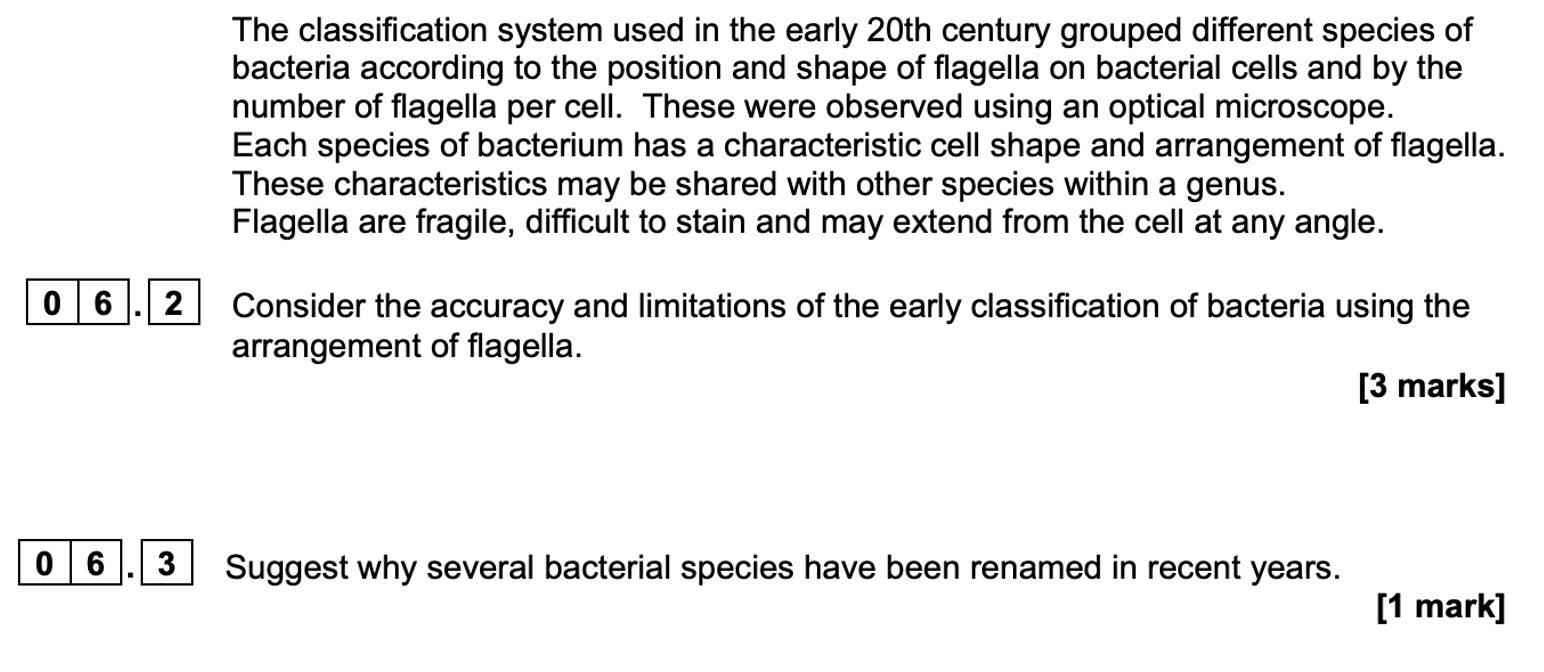
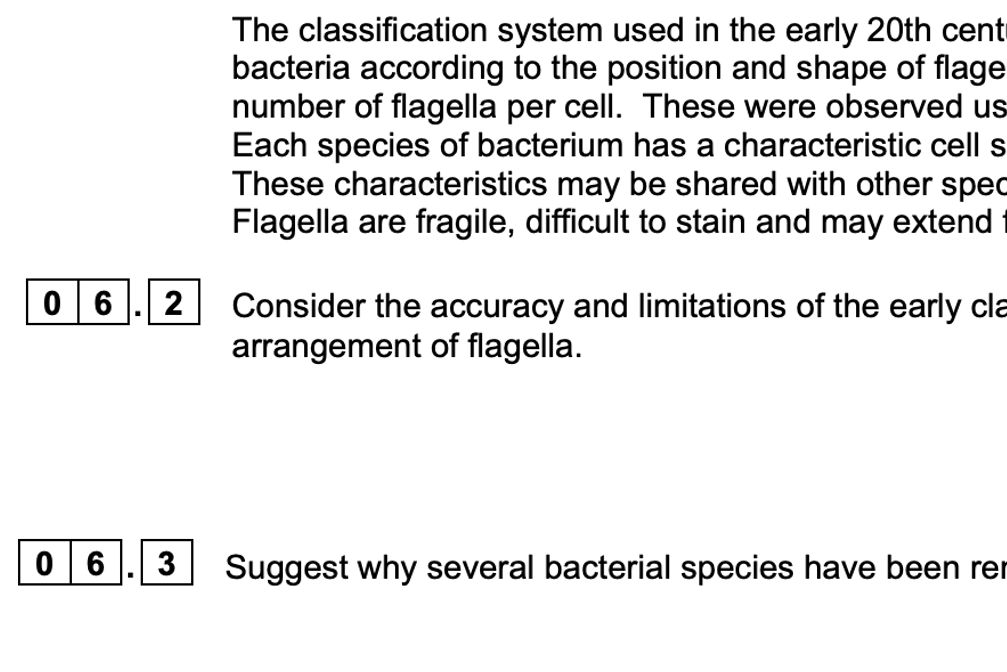
Q6 Paper 1 2023

The question:

How to approach this question:

1.       Don’t panic!

A question about historical classification of bacteria?! That topic is not in the spec!! Don’t panic – all the information you need about any off-spec topic will be provided in the question.

This example question is going to test your knowledge of classification, bacteria and microscopy (all from the spec), and – most crucially - your ability to apply that knowledge in an unfamiliar context.

2. Use your knowledge to make sense of the background information:

  • You know that bacteria are uni-cellular organisms. Your knowledge of bacterial structure will allow you to understand the description of how bacteria appear under the microscope. You know what a flagellum is. (3.2.1.2)

  • You know how ‘species’ and ‘genus’ are used in classification (3.4.5)

  • Your knowledge and experience of microscopy will allow you to understand the description of the limitations of optical microscopes. (3.2.1.3)

3. Answer questions in order

Answering question 6.2 (‘consider’ = ‘review and respond’) first will help you. This question gets you thinking in more detail about things that will help you answer 06.3.

4. Check the Command Word:

Question 6.3 asks you to ‘suggest’. So you know that you should use your existing knowledge/skills to make sense of, and build upon, the information given. You don’t need to know the exact answer for sure, but you need to give a biologically reasonable answer.

5. Understand the question:

The question asks “why” the species have been renamed.

  • Why might someone rename a species? – because they were misclassified before

  • Why might they have been misclassified before? – because of the limitations as in your answer to 6.2

Something has changed in recent years that has made it possible to classify these bacteria more accurately than before. What might this be?

6. Think about relevant information from the spec

What have you learned that is related to this question?

  • Phylogenetic classification (3.4.5)

  • Methods of studying cells (3.2.1.3)

7. How many marks are there available?

There is only one mark available – you can do this! But if possible, try to include more than one thing that might get a mark, so if one fails you are still ok.

8. So, what’s your answer?

Give it a go before looking at the markscheme below. Remember you need to use specific, technical language to win marks.


Q6 Paper 1 2023 6.3 - mark scheme

A range of answers are acceptable for this 1 mark. How did you do?

Q6 Paper 1 2023 6.3 – example answers

Successful answer that would win marks:

✅ “Different species will have different DNA sequences so by using genome sequencing they  can identify different species”

✅ “Comparing the base sequences of mRNA from the different bacteria will show how similar they are to one another so whether or not they are the same species”

✅ “Electron microscopes have better resolution that optical microscopes so scientists can see the arrangement of the flagella in more detail”

Poor answers that would not get the mark – can you identify where they’ve gone wrong?

❌ “They can identify phylogeny better now, by looking at the DNA”

❌ “They can see more detail with microscopes now so there are fewer mistakes”

❌ “Advanced techniques allow more accurate determination of phylogeny“

A final thought:

The word ‘Suggest’ can be used in different types of questions (e.g. “Suggest two reasons why … ”, “Suggest how … ”) . But the word ‘Suggest’ always invites you to think about the problem in your own way - to use the information in the question with your biology knowledge to come up with your best possible answer.

Want more? Find another “Suggest” exam question walk-through here

Read More