

The short answer: far less than you have been told, and in a different way.
Ask around and you will hear that you need a fortnight of hospital shadowing, or eighty hours, or a GP placement plus a care home. For the standard five-year medicine course, none of that is a requirement anywhere in the UK.
I went through what every UK medical school currently publishes. Of the 40 standard-entry schools that state a position:
28 do not require work experience
8 expect it in some form
2 require you to complete a form about it
Not one sets an hours target
What follows is each school's own wording, with sources, plus the national guidance that sits behind it.
1. What the Medical Schools Council actually says
The Medical Schools Council represents every UK medical school. Its published guidance is unambiguous:
"There's no set number of hours or specific type of experience required. What matters most is how well you reflect on what you've learned."
— Medical Schools Council, Guidance on relevant work experience
Its fuller guidance document repeats the point:
"Medical schools do not set a minimum number of hours of work experience that applicants need to undertake."
— Medical Schools Council, Guidance on relevant experience for applying to medical school
What counts
The Council defines work experience as any activity that helps you understand what it is like to work in a caring profession, develop values like empathy, communication and teamwork, and gain insight into the realities of a medical career.
It identifies two broad types:
Working in a caring or service role — interacting with people who need support, with a focus where possible on people who are ill, disabled or disadvantaged
Direct observation of healthcare — watching healthcare professionals at work
And it lists as valuable:
Volunteering or working in care homes, hospices, schools or community groups
Customer service or team-based jobs involving people
Shadowing doctors or other healthcare professionals
Caring for a friend or family member, if reflected on appropriately
Two rules that are easy to miss
Recency. Experience should normally have happened within two years of applying.
Variety over volume. "There is little benefit in repeating the same type of work experience." Three different settings beat three weeks in one.
What they are actually assessing
"You have a realistic understanding of medicine and in particular the physical, organisational and emotional demands of a medical career."
Note what that sentence does not mention: hours, hospitals, or doctors.
2. The hours myth, and the one real exception
No standard five-year course publishes an hours requirement. Where you see a figure — eighty hours is the one most often quoted — it does not come from the Council or from any A100 course. I have found a commercial preparation site quoting an "80-hour target" in the same article that cites the Council's guidance saying the opposite.
But two graduate-entry courses genuinely do, and they are strict about it. If you are a graduate applying to A101, this applies to you:
University of Chester (A101) requires at least 70 hours of relevant work experience, completed within the three years before applying — for 2027 entry, between 15 October 2023 and 15 October 2026. Evidence is required if you are invited to a selection centre. Shadowing counts for a maximum of 20 hours of the 70, and an online course for a maximum of 10. Applicants who have not completed the 70 hours may still apply if working towards it, and it becomes a condition of any offer.
Warwick Medical School (A101) likewise requires at least 70 hours of health or social care experience within the same window, across at least two experiences in different roles.
By contrast, Pears Cumbria states that clinical experience is not required at all.
If you are a school leaver applying to a five-year course, these do not apply to you — but they explain where the "70 hours" figure in circulation originates.
3. Virtual work experience now counts
This is the development most students and teachers have missed.
Observe GP, a free video platform run by the Royal College of General Practitioners and open to UK students aged 16 and over, is in the RCGP's own words "supported by the Medical Schools Council as a suitable element of relevant experience". You observe GPs, practice managers, receptionists, advanced nurse practitioners and GP trainees.
BSMS Virtual Work Experience, run free by Brighton and Sussex Medical School, is the other widely accepted option — accepted even by Chester, within its 10-hour online cap.
Imperial's own guidance states the position plainly:
"Providing that the online work experience gives you a useful insight into what a future career as a healthcare professional can involve, it can be just as useful as in-person work experience."
One practical constraint: the RCGP notes that under-16s cannot undertake GP work experience because of insurance and safeguarding, though Observe GP is open from 16.
The RCGP also runs a widening-participation placement programme, partnering with medical schools since 2016 to offer general practice placements to pupils from widening-participation backgrounds.
4. Every school's position
Stance is my summary; What the school says is theirs. Evidence records whether the claim was read on the university's own publication (Primary), obtained through a Freedom of Information disclosure (FOI), or taken from compilations citing the school (Reported).
Manchester – Form required. Requires a NON-ACADEMIC INFORMATION FORM covering hands-on caring experience, which may or may not be medically related. Manchester states that shadowing doctors is NOT essential and is not a substitute for hands-on caring… (bmh.manchester.ac.uk; Primary)
Norwich Medical School (UEA) – Form required. Any experience giving insight into your suitability is valuable — healthcare settings, care volunteering or paid work as a healthcare assistant. If invited to interview you must COMPLETE A WORK EXPERIENCE FORM and bring it with… (uea.ac.uk; Reported)
Aberdeen – Expected. Hospital or GP experience is 'very useful' and you must show understanding of what a medical career entails. If you struggled to obtain experience, Aberdeen asks you to say so in your statement and describe how else you… (abdn.ac.uk; Reported)
Cardiff – Expected. Requires insight into a medical career and evidence of experience and reflection in a caring environment, while explicitly recognising that opportunities vary by socioeconomic, cultural and geographical background. (cardiff.ac.uk; Reported)
Edinburgh – Expected. Expects understanding of the realities of a medical career, which may come from shadowing, health promotion, talking to doctors and medical students, open days, conferences, or reading and listening. Quality is valued over… (ed.ac.uk; Primary)
King's College London (GKT) – Expected. Normally expects experience in a caring environment or observation in a clinical setting. If that was not possible, King's looks for evidence of a setting where you interacted with the public, such as a pharmacy or restaurant. (kcl.ac.uk; Primary)
Queen's University Belfast – Expected. Your statement should evidence what you did to find out about medicine — observational experience in a clinical setting, medical careers conferences, or voluntary work in a care setting. (qub.ac.uk; Reported)
Sheffield – Expected. Normally expects work experience showing realistic insight into the profession, while recognising a medical setting is not always possible. Suggests residential care homes, hospices, youth centres, working with children and… (sheffield.ac.uk; Primary)
St Andrews (BSc Medicine) – Expected. Expects work or shadowing experience in a caring or health environment — hospitals, GP surgeries, nursing homes, hospices, or working with people who have ill health or a disability. One of the more specific expectations. (st-andrews.ac.uk; Reported)
University of Lancashire (formerly UCLan) – Expected. Practical experience in a caring role is 'extremely valuable'. Paid employment counts, as does active involvement helping underprivileged, unwell, disabled or distressed people, or going beyond basic duties at work. (uclan.ac.uk / lancashire.ac.uk; Reported)
Anglia Ruskin University – Not required. Healthcare-sector experience is desirable but explicitly not required to be clinical — a nursing home, charity, voluntary organisation or pharmacy all count, as does other work demonstrating communication and problem-solving. (aru.ac.uk; FOI)
Aston Medical School – Not required. NOT REQUIRED. Aston states applicants need not evidence healthcare work experience in the statement or at interview, recognising not everyone can secure it, and that valuable experience can come from non-medical environments. (aston.ac.uk; Reported)
Birmingham – Not required. No specific clinical experience required. At interview Birmingham focuses on your understanding of caring roles and the values of medicine. Clinical, non-clinical, caring roles, wider life experience and virtual opportunities all… (birmingham.ac.uk; Primary)
Brighton and Sussex Medical School (BSMS) – Not required. No requirements on amount or type. BSMS expects a realistic understanding of medicine and some experience of engaging with a wide range of people, and runs its own virtual work experience course. (bsms.ac.uk; Reported)
Bristol – Not required. Not a formal requirement, though strongly encouraged and discussed at interview. Clinical experience is not essential — customer-facing roles, care volunteering, youth work and supporting family or community members are all named… (bristol.ac.uk; Primary)
Cambridge – Not required. Strongly advised but NOT required. Cambridge suggests relevant paid or voluntary experience in a health or social care organisation to develop your understanding of the career. (undergraduate.study.cam.ac.uk; Primary)
City St George's, University of London – Not required. Relaxed its requirements after the pandemic. Still requires understanding of the realities of working as a healthcare professional; online resources are accepted as offering valuable insight. (citystgeorges.ac.uk; Reported)
Dundee – Not required. Highly valued but CLINICAL EXPERIENCE IS NOT REQUIRED. Dundee states it values transferable skills over specific work experience. (dundee.ac.uk; Primary)
Edge Hill University – Not required. No work experience requirements specified. (edgehill.ac.uk; Reported)
Exeter – Not required. NOT part of standard entry requirements. Exeter states plainly that whether you have work experience or not, you are welcome to apply. (exeter.ac.uk; Reported)
Glasgow – Not required. Experience in a medical setting is NOT necessary. Glasgow expects you to have at least spoken to a doctor or researched the career, to be aware of current issues facing the profession, and to show an interest in caring for others. (gla.ac.uk; Primary)
Hull York Medical School (HYMS) – Not required. Requires demonstrated experience of providing people-focused care, across a range of paid or voluntary settings. Clinical work experience is explicitly NOT an essential criterion. (hyms.ac.uk; Primary)
Imperial College London – Not required. Does not have to be medically related. Imperial wants insight into caring or responsible roles and reflection showing teamwork, leadership, communication, resilience and empathy. ONLINE experience is considered as valuable as… (imperial.ac.uk; Primary)
Keele – Not required. Keele goes further than any other school in DESIGNING OUT advantage. In its own words: 'We do not expect applicants to have experience in medical settings, and we do not give any credit for shadowing or observation of doctors or… (keele.ac.uk; Primary)
Kent and Medway Medical School (KMMS) – Not required. No requirements specified and KMMS DOES NOT SCORE work experience. All experience must still be listed in the UCAS experience section — incomplete or untrue applications are disqualified. Applicants must be 18 by the first… (kmms.ac.uk; Reported)
Lancaster Medical School – Not required. Important but need NOT involve shadowing a doctor or a healthcare setting. Lancaster recognises paid work, volunteering, virtual experience and other life experience, provided you can reflect and relate the skills to medicine. (lancaster.ac.uk; Reported)
Leeds – Not required. Clinical work experience is NOT mandatory. Leeds expects insight into the profession and reflection on experiences that helped you understand a medical career. (leeds.ac.uk; Reported)
Leicester – Not required. Medical work experience is NOT essential. Leicester asks that you demonstrate some kind of work involving communication with the public. (le.ac.uk; Primary)
Liverpool – Not required. Directs applicants to the Medical Schools Council statement on core values and its guidance on gaining relevant experience, rather than setting its own requirement. (liverpool.ac.uk; Reported)
Newcastle – Not required. No specific requirements. At interview Newcastle looks for examples of commitment to caring, acknowledging that primary or secondary care placements are hard to find and that volunteering can show the same thing. (ncl.ac.uk; Primary)
Nottingham – Not required. NOT a formal requirement. Nottingham expects insight into the doctor's role and experience of working with and supporting others, including volunteering, working with disadvantaged groups, or paid employment involving… (nottingham.ac.uk; Reported)
Oxford – Not required. NO specific requirement — Oxford acknowledges hospital experience is very difficult to arrange. Any form of voluntary work is beneficial. What matters is a realistic understanding of the career and potential to become a caring… (medsci.ox.ac.uk; Primary)
Plymouth (Peninsula Medical School) – Not required. NONE SPECIFIED, and Plymouth does not consider personal statements OR work experience when selecting for interview. The most accommodating position of any UK medical school. (plymouth.ac.uk; Reported)
Queen Mary University of London (QMUL) – Not required. No type or amount specified. Barts says experience can be voluntary or paid, acknowledges that shadowing a doctor is not attainable for everyone, and states volunteering in a care home or with a charity is just as valuable. (qmul.ac.uk; Reported)
Southampton – Not required. ANY form of work experience is valuable — Southampton names retail, restaurant and bar work as opportunities to discuss customer service, handling problems at pace and showing initiative. Medical experience gives greater insight… (southampton.ac.uk; Reported)
UCL – Not required. NO specific requirement for clinical experience and NO minimum duration. UCL states the main factor is your ability to demonstrate and reflect on what you learned, and directs applicants to the Medical Schools Council guide. (ucl.ac.uk; Reported)
University of Lincoln Medical School – Not required. NOT mandatory. Lincoln expects insight into the profession and understanding of caring roles, which may come from volunteering, paid employment or other responsibilities. Anything you mention may be explored at interview. (lincoln.ac.uk; Primary)
University of Sunderland – Not required. No requirements on amount or type. Sunderland expects a realistic understanding of medicine, some experience of engaging with a wide range of people, and understanding of the realities of a caring profession. (sunderland.ac.uk; FOI)
Bangor / North Wales Medical School – Unclear. All applicants must be 18 years old at the start of the course. Bangor does not accept A-level resits at all, though GCSE resits are allowed within 12 months of the original sitting — with English or Welsh First Language exempt… (bangor.ac.uk; Reported)
Brunel Medical School – Unclear. Applicants must have reached the age of 18 by registration. One distinctive route: up to ten high-performing Brunel Biomedical Science students are reported to receive an automatic interview, bypassing the score ranking entirely. (brunel.ac.uk; FOI)
St Mary's Twickenham is omitted: no completed admissions cycle and nothing published. Chester and Warwick appear in section 2 as graduate-entry courses.
5. The schools worth knowing by name
Keele has gone furthest in designing out advantage. In its own words:
"We do not expect applicants to have experience in medical settings, and we do not give any credit for shadowing or observation of doctors or other healthcare professionals."
And, more pointedly:
"We deliberately exclude experiences that may depend on personal connections (workplace shadowing) or wealth (overseas travel) from gaining credit in the personal statement."
Keele weights commitments within community or faith groups equally with formal caring settings, and scales its expectations to your age and opportunities.
Plymouth is the most accommodating. It requires no work experience, and does not consider the personal statement when selecting for interview. Shortlisting is on academic qualifications and UCAT.
Manchester is the most specific about type. It requires a Non-Academic Information Form covering hands-on caring experience, and states that shadowing doctors is not a substitute for it.
UEA requires a form at interview — two examples of relevant experience that informed your decision to study medicine.
St Andrews has the most traditional expectation: work or shadowing in a caring or health environment — hospitals, GP surgeries, nursing homes, hospices, or working with people who have ill health or a disability.
UCL may ask you to prove it. It requires no clinical experience and sets no minimum duration, but states it may ask a small selection of candidates to evidence what they have claimed.
6. The age rule that catches people out
Several schools require you to be 18 before clinical placements begin, sometimes within weeks of term starting:
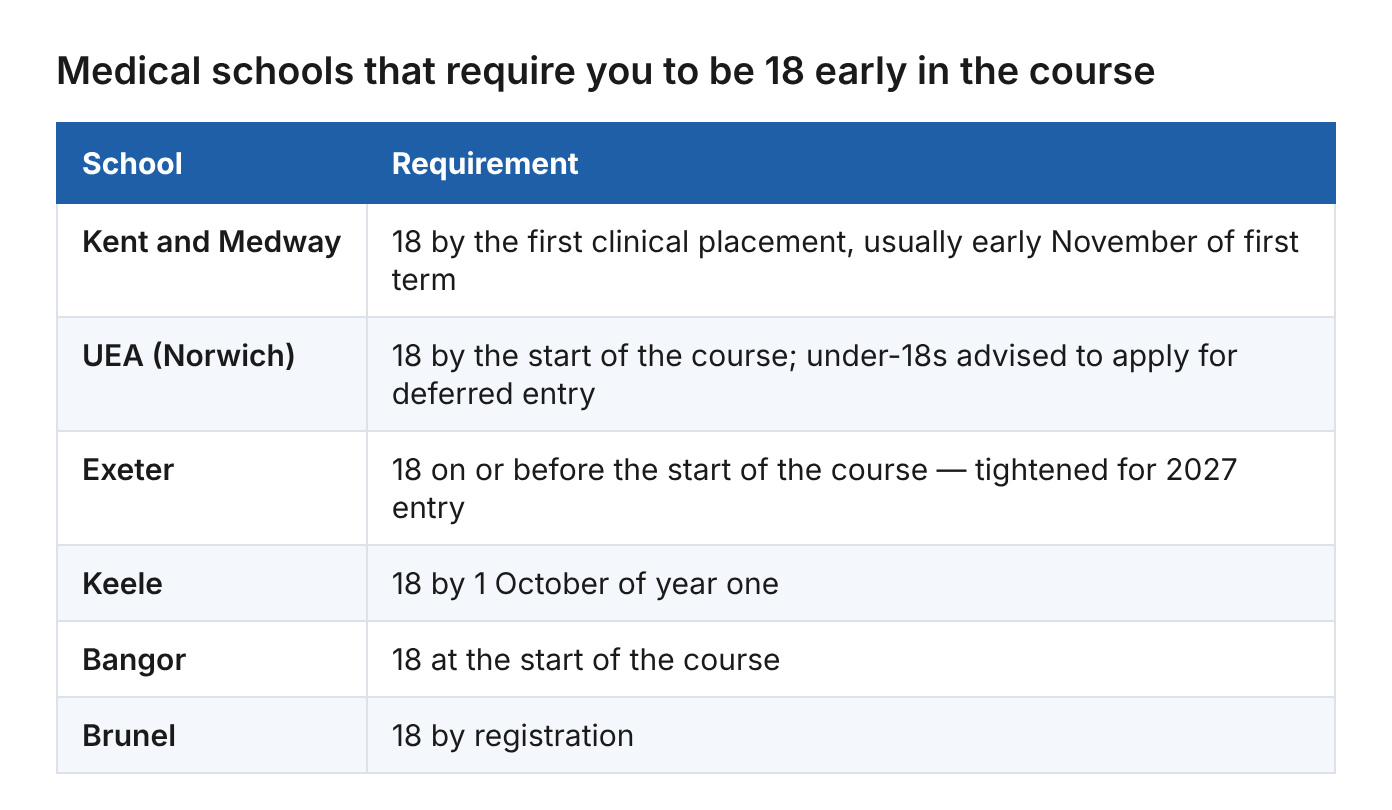
This affects students who started school early, and Scottish applicants with summer birthdays.
7. So does it matter?
Less than you fear at shortlisting. More than you expect at interview.
Almost no school scores work experience when deciding whom to interview. That decision is dominated by UCAT and academic attainment. But once you are in the room, what you did and — far more — what you made of it is standard territory, because interviewers are testing whether you understand what the job involves.
That tells you exactly where the effort belongs. Not accumulating hours. Not chasing a placement you cannot get. Being able to say something specific and honest about what an experience taught you — about communication, about the limits of what medicine can fix, about how care actually works.
As one admissions guide puts it, interviewers can usually tell within minutes whether an applicant has enough experience: the ones who fall short cannot describe what doctors actually spend their time doing, speak only in ideals, and avoid discussing anything difficult.
8. What to do
If you cannot get clinical experience, stop worrying about it. Care work, retail, hospitality, tutoring, coaching, volunteering, caring for a relative — all count at the great majority of schools, and several name them explicitly.
Use Observe GP. Free, needs no personal connections, endorsed by the body representing every UK medical school.
Keep a reflective diary as you go. Not what happened, but what surprised you, what you found difficult, what it changed in your thinking. The Medical Schools Council publishes a free reflective diary template with the RCGP. This is nearly impossible to reconstruct a year later and is exactly what interviews probe.
Vary it. The Council is explicit that repeating the same type of experience adds little.
Do not pad or invent. Kent and Medway warns that applications containing untrue or omitted information will be disqualified.
Check your own four schools. If St Andrews or Manchester is on your list, the expectations are real and specific. If Plymouth or Exeter is, they genuinely are not.
Sources
Medical Schools Council — Guidance on relevant work experience; Guidance on relevant experience for applying to medical school; course entry requirements database
Royal College of General Practitioners — Observe GP; GP work experience and widening-participation programme
University of Chester — Graduate Entry Medicine MBChB entry requirements
Warwick Medical School — A101 entry requirements
Individual medical school admissions pages, cited per row in the table
Freedom of Information disclosures where marked
A note on reliability. Rows marked Reported rest on compilations citing the school rather than a page I read directly. Admissions policies change every cycle. Before making a decision that matters, confirm it on the school's own site.
Compiled by Tom Whitburn, alevelbiologytutor.com. Information checked October 2026 against 2027-entry requirements.